SOCIOCULTURAL FACTORS E DRUG CONSUMPTION AMONG
COSTARRICAN UNIVERSITY STUDENTS
Jaime Alonso Caravaca Morera1, Samuel Noh2, Hayley Hamilton3, Bruna Brands4, Denise Gastaldo5, Maria da Gloria MiottoWright6
1 Doctoral Student, Programa de Post Graduación en Enfermería de la Universidade Federal Santa Catarina. Florianópolis, Santa
Catarina, Brasil. E-mail: [email protected]
2 Ph.D. Investigator, Centre for Addiction and Mental Health, CAMH, University of Toronto. Toronto, Canada. E-mail: samuel.
3 Ph.D. Investigator, CAMH, University of Toronto. Toronto, Canada. E-mail: [email protected]
4 Ph.D. Senior Scientist. Ofice of Research and Surveillance, Drug Strategy and Controlled Substances Programme, Health Canada and Public Health and Regulatory Policies, CAMH, University of Toronto. Toronto, Canada. E-mail: [email protected] 5 Ph.D. Professor, Lawrence S. Bloomberg Faculty of Nursing de la University of Toronto. Toronto, Canada. E-mail: denise.
6 Ph.D. Former Coordinator Educational Development Program Inter-American Drug Abuse Control Commission, Secretariat
for Multidimensional Security. Washington, USA. E-mail: [email protected]
ABSTRACT: A quantitative, descriptive and exploratory research, with a cross-sectional design aimed at examining the moderating effect of certain sociocultural factors related to drug use among university students in San José, Costa Rica. The sample was composed of 126 women and 124 men from a public university. A questionnaire was developed with 5 validated scales that interrogated about the inluence of the peer group, the family relationships, the entertainment, the spirituality, and drug consumption. The SPSS ver 18 software was used for the statistical analysis. It was found that 98.4% of students had at least one friend who is drug consumer, most of them use alcohol, tobacco and marijuana. A signiicant association between some academic and sociocultural factors and the consumption of licit and illicit drugs was established. We concluded that some preventive strategies should be elaborated considering the inluence of sociocultural factors among college students.
DESCRIPTORS: Street drugs. University. Family. Spirituality.
FATORES SOCIOCULTURAIS E O CONSUMO DE DROGAS ENTRE
ESTUDANTES UNIVERSITARIOS COSTARRIQUENHOS
RESUMO: Pesquisa quantitativa, descritiva e exploratória, com desenho transversal, que examinou o efeito moderador de certos fatores socioculturais no consumo de drogas entre estudantes universitários em San José, Costa Rica. A amostra foi composta por 126 mulheres e 124 homens de uma universidade pública de forma não probabilística. Foi elaborado um questionário com cinco escalas validadas que questionavam sobre a inluência do grupo de pares, as relações familiares, o entretenimento, a espiritualidade e o consumo de drogas. Utilizou-se o programa SPSS, versão 18, para a análise estatística. Veriicou-se que 98.4% dos estudantes tinham pelo menos um amigo consumidor de drogas, as drogas mais consumidas foram álcool, tabaco e maconha. Estabeleceu-se associação signiicativa entre alguns fatores acadêmicos e culturais com o consumo de drogas lícitas e ilícitas. Concluiu-se que devem ser implementadas estratégias preventivas considerando a inluência dos fatores culturais entre os estudantes universitários.
DESCRITORES: Drogas ilícitas. Universidade. Família. Espiritualidade.
FACTORES SOCIOCULTURALES Y CONSUMO DE DROGAS ENTRE
ESTUDIANTES UNIVERSITARIOS COSTARRICENSES
RESUMEN: Investigación cuantitativa de tipo descriptiva-exploratoria, con diseño transversal que examinó el efecto moderador de ciertos factores socio-culturales en el consumo de drogas entre estudiantes universitarios en San José, Costa Rica. La muestra fue conformada por 126 mujeres y 124 hombres de una universidad pública de forma no probabilística. Fue elaborado un cuestionario con cinco escalas ya validadas, que interrogaba sobre la inluencia del grupo de pares, las relaciones familiares, el entretenimiento, la espiritualidad y el consumo de drogas. Se utilizó el programa SPSS versión 18 para el análisis estadístico. Se estableció que el 98,4% de los estudiantes reportaron tener por lo menos un amigo que consumía drogas, las drogas más consumidas fueron alcohol, tabaco y marihuana. Se estableció asociación signiicativa entre algunos factores académicos y culturales con el consumo de drogas legales e ilegales. Se concluye que deben ser implementadas estrategias preventivas considerando la inluencia de los factores culturales entre los estudiantes universitarios.
INTRODUCTION
Many causes explain why youngsters are vulnerable to legal or illegal drug consumption. That vulnerability results from a set of factors that can moderate consumption, either positively or negatively, and may be associated with social, cultural, political, and economic changes percei-ved at the global level, leading to the adoption of different risk behaviors and attitudes.
Drugs in general are substances that chan -ge physical and chemical responses in the body, acting directly on the central nervous system, and that change several normal physiological structures.1 When the central nervous system is
subjected to such excitement, it triggers processes that have direct effects on awareness, orientation, and other psychical functions of the individual that directly affect individual and collective behavior. Consumption is deined as the conduct of exposing oneself to a substance through different routes of administration, such as oral, nasal, sub-lingual, intravenous, among others.
Today there is great concern about the substantial increase in legal and illegal drug con -sumption, not only at a global level but also in our reality as a Latin American country. Data from the Global Report on Drugs prepared by the United Nations Ofice on Drug and Crime (UNODC) in 2012 showed that there were 230 million illegal drug users worldwide. The report is a reference document that provides guidance for policies on drugs. According to the same report, in 2010 there were slightly more than 200 million users, eviden-cing a signiicant increase in the consumption of psychoactive substances. In that year, the global situation among the adolescent/adult population in the age group of 15 to 64 years old showed that 6.6% of that population had consumed at least one illegal drug at least once in the last year, where marijuana was the most-widely consumed drug, followed by amphetamines, other opiates, cocaine, and crack.2
Several investigations in Costa Rica show a signiicant and constant increase and greater inci -dence of drug consumption as youngsters advance their professional training, deserving even more attention as consumption starts at earlier ages. The latest scientiic indings of those investigations identify alcohol, tobacco, and marijuana as the most-widely consumed drugs.3-4
Drug consumption among university youth can be manifested in several ways, mainly the
initial consumption associated with experimental, social, regular, continuous, intermittent, intensive, and compulsive use; however, the most interesting is that standards are subject to changes in this po -pulation group, and are characterized by a lack of evident linear order. The fact is that such drugs re-sult in addiction that, in turn, is directly dependent on the strength, type, doses, and frequency of use. These variables, like other sociocultural factors, can produce important physical-biochemical chan -ges in the brain, causing signiicant modiications in some psychical and neural functions.
Drug consumption has been the object of national and international investigations. Likewise in the last few years there has been an increase in the interest in understanding which are the sociocultural protection (or risk) factors that may be involved in the increase (or reduction) of the drug consumption standard and which could be affected by macro-variables such as neo-globa -lization and the recent changes in international health. Among these factors, we should mention: the inluence of the group of peers; changes in the understanding and application of cultural values; entertainment; spirituality; and family relations.
Based on these assumptions this survey tried to describe the inluence of some sociocultural factors (entertainment, spirituality, and family relations) that moderate the correlation between the group of peers and legal and illegal consump-tion among young university students in the city of San José.
METHODS
This study is part of a multicenter investi-gation performed simultaneously in three uni-versities in the Caribbean and ive uniuni-versities in Latin America. This is a quantitative, analytical, descriptive, and cross-sectoral survey. It comprises students from a public university in San José, Costa Rica attended by students from all socioeconomic backgrounds and from the seven provinces of the country. The survey comprises male and female students 18 to 24 years of age. The sample size was non-probabilistic and classiied by quotas. We decided to work with 250 students from the social sciences, human sciences and health sciences colle-ges, as these colleges were found in all university centers in the eight countries.
-cohol, marijuana, cocaine, and amphetamines sold without a medical prescription. The level of in-luence of the group of peers was the independent variable of this study. The sociocultural variables that moderate the correlation between dependent and independent variables were family relations, participation in interactive and non-interactive entertainment based on exposure to technology, entertainment based on social activities, and level of spirituality. The socio-demographic variables surveyed were age, sex, marital status, course load, years of study, and employment status.
To correlate data, a self-administered ques-tionnaire was elaborated comprising the scales and validities of the inluence of the group of peers5; the Index of Family Relations (IFR)6; the Spiritual Involvement and Belief Scale (SIBS)7; an open-ended question about how many parties the subject has attended in the last three months where alcohol, tobacco, or other substances such as marijuana, cocaine, and amphetamines might be present; and the Interactive and Non-Interactive Entertainment Scale.8 Finally, it employed the test of participation in the consumption of alcohol, tobacco, and other substances, designed by the World Health Organization.9 Content validity was obtained through the CAMH commission of experts, while internal consistency was calculated using Cronbach’s alpha (0.95; p<0.05). The Engli -sh version of the questionnaire was translated into Spanish and Portuguese, considering the cultural meaning of words and the grammatical structure of the phrases. The Spanish version of the questionnaire was validated by a group of 50 Costa Rican university students at the university studied, aged 18 to 25 years old, to adjust termi -nologies, concepts, and semantic understanding. The questionnaire consisted of six sections with 81 questions. The areas included questions about socio-demographic information, participants’ perceptions of the inluence of the group of peers, family relations, entertainment, spirituality, and consumption of legal and illegal drugs.
The study was approved by the Committee for Ethics in Research of the Centre for Addictions and Mental Health of Canada (CAMH) (report N 136/2011) and by the Ethics Committee of the University of Costa Rica (report VI-6600-2011 of November 2, 2011). The database provides an identiication code for each subject, which was kept anonymous during the investigation. Be-fore receiving the questionnaire, subjects were informed about the conidential nature of their
responses. Data were collected from November to December 2011, and from January to February 2012, in groups and individually. The researchers declared to have no conlict of interest.
A bi-variate analysis was performed through categorical data (Chi-square test) obtaining an odds ratio (OR) and a conidence interval (CI) for each variable surveyed and for the independent samplings, according to their nature. Moreover, a logistic regression analysis included the model of all variables with a statistically signiicant asso -ciation in the bi-variate analysis. For all cases, the level of signiicance established was lower than or equal to 0.05. The Statistical Package for Social Sciences (SPSS) software, version 18 for Windows, was used to perform data analysis
vestigadas y las muestras independientes según la naturaleza de estas. Además se realizó un análisis de regresión logística, incluyendo en el modelo todas las variables que presentaron aso -ciación estadísticamente signiicativa en el análisis bivariado. En todos los casos se estableció un nivel de signiicación menor o igual a 0,05 y se utilizó el programa estadístico Statistical Package for Social Sciences (SPSS) versión 18 para Windows, con el
in de realizar el análisis de datos.
RESULTS
Socio-demographic characteristics of drug
consumption among university students
-- 148 -- Morera JAC, Noh S, Hamilton H, Brands B, Gastaldo D, Wright MGM, et al. trition, physical therapy, and education); 36.4%
stated that they were enrolled in some course of the college of social sciences (sociology, psycho-logy, anthropopsycho-logy, social work, library science, and mass communication). In terms of academic status, most of the sample (91.2%) were full-time students, as opposed to 8.8% that afirmed to be part-time students. Regarding the year of the course participants were taking, 65.6% were in the irst or second year; the lowest percentage (1.2%) were taking the sixth year, 19.8% were taking the ifth year, 5.4% the fourth, and 8% the third year.
In relation to employment status, only 14.8% of the participants afirmed that they worked in places such as call centers, stores, restaurants, and libraries. Regarding the inluence of friends, 85% said that they were inluenced by friends in their everyday decisions. Only 1.6% of the sample stated that they had no friends who used tobacco, alcohol, or other drugs, as opposed to the remaining 98.4% who said that they had at least one friend who is a drug user. Sixty-ive point six percent of students believed that their friends engaged in unprotected sex, against 34.4% who said their friends engaged protected sex. Sixty-one point two percent of the students stated that their friends did not smoke or use tobacco, while 54.4% stated that most of their friends have ive or more cigarettes during an event.
Regarding family relations, only 55% of the respondents had positive family relations, while 45% considered their relations to be “regular” or negative. This situation was conirmed by the low index of responses to the statements “I believe my family is excellent”, “I really enjoy my family,” and “my family members are really good with each other.” It is surprising that 59.3% consider that other families seem to be better than theirs, while 38.6% afirm that families argue too frequently.
Most of the students have attended at least one party in the last three months where legal and illegal drugs were present. On average, the popu-lation sample had participated in 6.88 parties, and the highest number of parties attended by students in the last three months was 31.
In general, entertainment is part of the ac-tivities developed by young university students. Sixty-two percent of them had high exposure to interactive and non-interactive playful/recrea-tional activities. Regarding technology-based interactive entertainment, social networks clear-ly represent a strong indicator of membership to them, as 84% of participants stated that they
used it very frequently or frequently; 42.4% said they access e-mail frequently; and, regarding technology-based non-interactive entertainment, the main activities were associated with watching the news and pornography, either frequently or very frequently.
For the level of spirituality, 24.6% of the respondents alleged to have a high level of spiri-tuality, against 75.4% stating to have a medium/ low level of spirituality. The statements “prayers do not really change what happens” and “spiritual activities have not affected the development of my identity” were the lowest ranked, and 43.6% of the respondents reported that they had not participated in any religious activities in the last six months. It was evidenced that 49.2% never or almost never pray or meditate.
The analysis of the distribution of drug consumption in the last 12 months showed the fo-llowing results: alcohol 78.4% and tobacco 31.2%. Regarding the most widely-used illegal drugs, we found marijuana (27.2%) and amphetamines (15.2%), closely followed by cocaine (6%).
Association between sociocultural factors
and drug consumption
Tables 1 and 2 describe the correlation be -tween demographic and sociocultural factors re-lated to drug consumption among youth and their relation to peers in the last 12 months. Moreover, it included the resulting signiicance levels for each variable with legal and illegal drugs.
There is a signiicant correlation between the sociocultural factors evaluated and the con-sumption of legal and illegal substances; those sociocultural factors sometimes serve as signiicant risk factors for the consumption of drugs.
year.
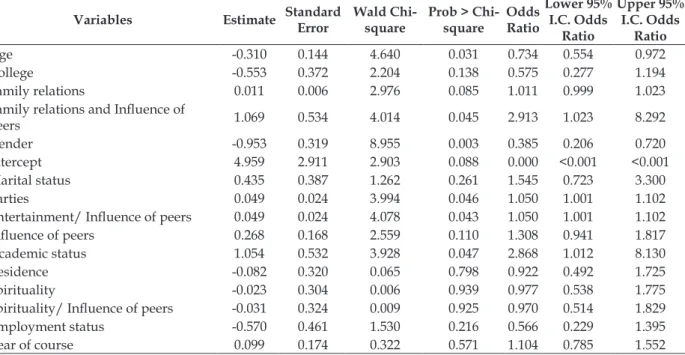
We found a different behavior when we analyzed the phenomenon of illegal drug con-sumption in the last year. Some variables have served as protective factors, such as age (OR of 0.734 [IC95%: 0.554–0.972]) and gender (OR of 0.385 [IC95%: 0.206–0.720]). Students older than 20 were less likely to consume illegal drugs; in terms of gender, women were less likely to consume marijuana, cocaine, and amphetamines.
On the other hand, students taking fewer classes (part-time students) (OR of 2.868 [IC95%: 1.012–8.130]) and those who attended more par
-ties (OR of 1.050 [IC95%: 1.001–1.102]) were more likely to consume illegal substances. According to these results, family relations had a signiicant in -luence on the correlation between group of peers and consumption of drugs such as marijuana, cocaine, and amphetamines. Moreover, students with negative family relations presented almost three times more probability of consuming illegal drugs (OR of 2.913 [IC95%: 1.023–1.023]) and stu -dents who attended parties and actively partici-pated in interactive/non-interactive entertainment were more likely to consume illegal drugs (OR of 1.050 [IC95%: 1.001–1.102]).
Table 1 - Correlation Among the Inluence of Peers, Spirituality, Family Relations, Entertainment
and Legal Drug Consumption in the Last Year (Including Interactions Between Each Cultural Agent and Relation With Group of Peers’ Consumption of Alcohol/Tobacco)la relación con el grupo de pares-consumo de alcohol/tabaco)
Variables Estimate Standard Error
Wald Chi-square
Prob > Chi-square
Odds Ratio
Lower 95% I.C. Odds
Ratio
Upper 95% I.C. Odds
Ratio
Age -0.188 0.212 0.786 0.375 0.829 0.547 1.255
College -0.682 0.634 1.157 0.282 0.506 0.146 1.752
Family relations -0.005 0.010 0.237 0.626 0.995 0.977 1.014
Family relations and Inluence of peers 0.013 0.009 2.003 0.157 1.013 0.995 1.032
Gender -0.491 0.494 0.988 0.320 0.612 0.233 1.611
Intercept 5.614 4.262 1.735 0.188 0.000 <0.001 <0.001
Marital status -1.318 0.827 2.537 0.111 0.268 0.053 1.355
Entertainment 0.102 0.053 3.731 0.053 1.107 0.999 1.228
Entertainment and Inluence of peers -0.056 0.056 1.022 0.312 0.945 0.847 1.054
Inluence of peers 0.093 0.263 0.124 0.724 1.097 0.655 1.838
Academic status 1.686 0.703 5.743 0.017 5.398 1.359 21.429
Residence 0.447 0.498 0.804 0.370 1.563 0.589 4.152
Spirituality -0.297 0.486 0.373 0.541 0.743 0.287 1.927
Spirituality and Inluence of peers 0.108 0.054 3.988 0.046 1.114 1.002 1.239
Employment status -0.095 0.741 0.016 0.898 0.909 0.213 3.885
Table 2 - Correlation among inluence of peers, spirituality, family relations, entertainment, and
illegal drug consumption in the last year (including interactions between each cultural agent and
relation with group of peers’ consumption of marijuana, cocaine, and amphetamines)
Variables Estimate Standard Error
Wald Chi-square
Prob > Chi-square
Odds Ratio
Lower 95% I.C. Odds
Ratio
Upper 95% I.C. Odds
Ratio
Age -0.310 0.144 4.640 0.031 0.734 0.554 0.972
College -0.553 0.372 2.204 0.138 0.575 0.277 1.194
Family relations 0.011 0.006 2.976 0.085 1.011 0.999 1.023
Family relations and Inluence of
peers 1.069 0.534 4.014 0.045 2.913 1.023 8.292
Gender -0.953 0.319 8.955 0.003 0.385 0.206 0.720
Intercept 4.959 2.911 2.903 0.088 0.000 <0.001 <0.001
Marital status 0.435 0.387 1.262 0.261 1.545 0.723 3.300
Parties 0.049 0.024 3.994 0.046 1.050 1.001 1.102
Entertainment/ Inluence of peers 0.049 0.024 4.078 0.043 1.050 1.001 1.102
Inluence of peers 0.268 0.168 2.559 0.110 1.308 0.941 1.817
Academic status 1.054 0.532 3.928 0.047 2.868 1.012 8.130
Residence -0.082 0.320 0.065 0.798 0.922 0.492 1.725
Spirituality -0.023 0.304 0.006 0.939 0.977 0.538 1.775
Spirituality/ Inluence of peers -0.031 0.324 0.009 0.925 0.970 0.514 1.829
Employment status -0.570 0.461 1.530 0.216 0.566 0.229 1.395
Year of course 0.099 0.174 0.322 0.571 1.104 0.785 1.552
DISCUSSION
CTo become acquainted with and unders -tand the international policies dealing with the phenomenon of drugs among young university students, education professionals in health and in other areas must have a broader view on the topic, contributing to build links between their work and the neo-global reality. This neo-globalization process brought about new questions about the inluence of given social agents among youth who have access to the higher education system, thus redeining the roles played by political authorities.
The consumption of legal and illegal psy-choactive substances emerges in this context as a problem that is not exclusive to the ield of heal -th, belonging also to the geo-political and social areas. Drugs in general are an axiomatic issue in the news, and most of cases are associated with violence and other illegal activities. Nonetheless, there are few recent data in Costa Rica explicitly referring to the consumption of those substances among university youth, and the correlation between consumption and some sociocultural factors.10-12
The sample investigated clearly showed a signiicant association between most sociocultural factors on drug consumption and, in some spe-ciic cases, that correlation was more signiicant. The factors negative family relations; low level
of spirituality; parties; interactive and non-inte-ractive entertainment could all be considered as risk factors, because they are more closely related to the dynamic consumption of legal and illegal psychoactive substances.
This investigation also found that alcohol is the most widespread legal drug used by university students, as nearly 78.4% of them consume alcohol one or two times a week, in line with other surveys performed by the Ministry of the Presidency, the Instituto Costarricense sobre Drogas (ICD–Costa Rican Institute on Drugs), and the Instituto sobre Alcohol y Farmacodependencia (IAFA–Institute on Alcohol and Drug Dependence) of Costa Rica, in addition to other surveys developed in Latin America.10-13
which tobacco is the second most widely consu -med drug in the world.9 Regarding the consump
-tion of legal drugs, variables such as gender have not affected the use of alcohol and tobacco, as both male and female students have reported propor-tional use when compared to one another. These data are in opposition to those found by several investigations about smoking, alcoholism, habits, and attitudes, where the consumption standard is higher among men than women.2,13
The inluence of groups of friends on drug consumption was evident, supporting the indings of some global studies and reports proving that the social inluence of sociability with the group of peers is very signiicant, and social attitudes play a very important role regarding the availability of drugs and social anomia.12-14
In-depth studies about the pressure exerci -sed by the group of peers recognize the existence of similarities between youngsters and the group of peers to which they belong.15 There are seve -ral arguments to explain this fact, but the most consistent one is that a friendship relationship exists when one socializes, shares, and has mu-tual understanding, which are expressed in si-milar everyday behaviors. In general, the sisi-milar conducts of adolescents are attributable to two well-identified processes: social selection and social inluence. This means that, on one hand, youngsters are similar because they get involved with other similar youngsters (social selection) and, on the other hand, they become similar due to their close relation with peers (social inluence).
Regarding the family, it plays a key role in the integral development of individuals, strongly affecting education, primary socialization, provi-sion of care, and transmisprovi-sion of beliefs and values in general, as well as the health and well-being of the family components. Many times the relation of youngsters and their families is not visible or is disregarded. However, this is a clear determinant for integral well-being, and inluences the general behaviors of the young population, because nei -ther the group of peers nor any o-ther sociocultural factor can replace the role played by parents in the transmission of social mores at home.
This investigation found and corroborated the indings that other surveys identiied, that is, youngsters from well-structured families with closer communication ties, trust, and love, are less likely to consume drugs than those living in fami-lies featuring a lack of communication, violence, and neglect.7,15
Undeniably family is very important as the main educational factor and, in this sense, has been positively considered as an element to foster crea-tivity and fulill academic tasks; however, when relations are less than positive, these could be a factor for risk and vulnerability regarding drug consumption. The conclusions found suggest that negative family relations effectively moderate in a negative way and lead to drug consumption. Fa-mily supervision, communications, management of rules, and parents’ awareness of what their children do, are factors that contribute to resist when someone offers drugs to them. That is why positive family relations become a locus of care, fostering the promotion of healthy attitudes and capabilities and, as such, this role should be more intensively fostered.
On the other hand, party-based entertain -ment is strongly associated with the availability of time not only on weekends, but during the week as well. The level of satisfaction produced by university students is also associated with drug consumption. The fact is that exposure to drugs is proportional to attendance at these social activities, and thus the possibility of consuming some kind of substance is higher, corroborates the indings of our investigation.
Regarding interactive and non-interactive technological entertainment, activities such as checking e-mail and using social networks like Fa-cebook, Twitter, and Instagram, among others, are associated with signiicant changes in users, while exchange of information many times is associated with leisure and recreation activities. The level of inluence depends on the speciic setup of the so -cial network at the level of integration/participa-tion of the person, messages posted during chats, and the links/meanings between the person and other members of the network. Nonetheless this is clearly a means to publicize several advertisement messages that may even entice consumption of some drug or encourage the youth’s participation in social activities that might facilitate access to some psychoactive substance. That is why interac -tive and non-interac-tive entertainment in general is many times deined as a negative moderator of drug consumption.
it is considered to be a factor of risk/vulnerability. From the analysis of existing data from strictly quantitative epidemiological surveys in the scientiic literature, there is a clear inverse relation between spirituality and use of psychotropic subs -tances, although one cannot disregard the several issues entailed in the eventual measurement of religiosity levels, in addition to some sample bia -ses in those studies. The positive effect of religion on the recovery of drug addicts is pointed out, highlighting the key role played by church in the prevention and treatment of drug addiction.16 In
this survey, spirituality was at least a protective factor against the consumption of legal drugs among young university students.
Therefore, we conclude that different socio-cultural factors strongly inluence the consump -tion of either legal or illegal psychoactive substan -ces among the Costa Rican university population
CONCLUSIONS
EThe phenomenon of drugs and the invol-vement of youth in consumption is a typologically complex movement involving different aspects related to factors such as social exclusion, vulne-rability, stigmatization, family disaffection, and absence of life assignments, among others.
Universities are privileged places to develop programs on drug use prevention, as it enjoins legitimacy and validity in the community, family, and youngsters of Costa Rica. It is widely known that the drug phenomenon is not restricted to youngsters attending university centers; however, focusing on youth and developing their critical/ analytical capacities jointly with a thoughtful stand towards drugs would help build alternative me -chanisms of resistance to these substances.
This investigation surveyed some aspects regarding the relation of sociocultural variables as moderating agents to drug consumption and relation with peers. It found that consumption in this population locus is increasing, a concerning fact that should warn all professionals working in higher education institutions and in national policy-making institutions.
Universities cannot disregard the current issues that affect the society to which they belong; neither should situations that affect the quality of life of their young students go unnoticed. The ight against poverty and the social development of nations largely depends on their capacity to generate knowledge, and universities are one of
the main institutional agents that generate and apply knowledge, jointly with other public re -search authorities. That is why higher education centers cannot let drug consumption interfere in the teaching-learning process of students.
All professionals working in universities should strive to meet the needs of the popula-tion they serve, in line with the global initiatives around the phenomenon of drugs. The challenges of taking care of health in general and dealing with issues related to the phenomenon of drugs demand collaboration and new approaches to other professionals in education, the social scien-ces, and health.
ACKNOWLEDGMENTS
This investigation was possible thanks to the support, advice, and sponsorship of the Go-vernment of Canada/DFAIT; the Organization of American States (OAS); the Inter-American Drug Abuse Control Commission (CICAD); and the Centre for Addictions and Mental Health (CAMH), Canada. I would like to express my gratitude for the support of the University of Costa Rica, the Costa Rica Institute on Drugs, the students in the sample, and other professionals who have directly or indirectly participated in the study
REFERENCES
1. Domenech D, Mann R, Strike C, Brands B, Khenti AU. Estudio de la prevalencia de la comorbilidad entre el distrés psicológico y el abuso de drogas en usuarios del Portal Amarillo, Montevideo - Uruguay. Texto Contexto Enferm [online]. 2012 [citado 2014 Set 05]; 21(spe):174-84. Available at: http://www.scielo.br/scielo.php?pid=S0104-07072012000500022&script=sci_arttext
2. Nunes ED. United Nations Ofice on Drugs and Crime (UNODC). Global Study on homicide: trends, context, data. Vienna: UNODC; 2011. Ciênc Saúde Coletiva [online]. 2012 Dec [cited 2013 May 12]; 17(12):3447-9. Available at: http://www.scielo.br/ pdf/csc/v17n12/29.pdf
3. Rojas Valenciano L. Opinión y factores que motivan el consumo de drogas lícitas e ilícitas en algunos estudiantes de la licenciatura en enfermería. RevEnfermería Actual en Costa Rica [online]. 2008 [citted 2012 Jul 14]; 15. Available at: http://www. revistas.ucr.ac.cr/index.php/enfermeria/article/ viewFile/3609/3517
2012 Jul 24]; 18(spe):565-72. Available at: http:// www.scielo.br/scielo.php?script=sci_arttext&pid= S010411692010000700012&lng=en&nrm=iso 5. Mayberry ML, Espelage DL, Koenig B. Multilevel
modeling of direct effects and interactions of peers, parents, school, and community influences on adolescent substance use. J Youth Adolesc. 2009 Sep;38(8):1038-49
6. Hudson WW. The WALMYR Assessment Scales Scoring Manual. Tempe, AZ: WALMYR Publishing Co; 1992.
7. Hatch RL, Burg MA, Naberhaus DS, Hellmich LK. The Spiritual Involvement and Beliefs Scale: development and testing of a new instrument. J Fam Pract. 1998 Jun;46(6):476-86.
8. Padilla-Walker LM, Nelson LJ, Carroll JS, Jensen AC. More than a just a game: video game and internet use during emerging adulthood. J Youth Adolesc. 2010 Feb;39(2):103-13.
9. World Health Organization. World health report: working together for health. Geneva (CH): World Health Organization; 2006.
10. Instituto Costarricense sobre Drogas. Plan nacional sobre drogas 2013-2017. Costa Rica; 2012.
11. Mecanismo de evaluación multilateral. Costa Rica: evaluación del progreso de control de drogas 2005-2006. Organización de los Estados Americanos –OEA & Comisión Interamericana para el Control del Abuso de Drogas-CICAD; 2009.
12. Cáceres D, Salazar I, Varela M, Tovar J. Consumo de drogas en jóvenes universitarios y su relación de riesgo y protección con los factores psicosociales. Rev Univ Psycol Bogotá (Colombia). 2006; 5(3):521-34. 13. Sena ELS, Boery RNO, Carvalho PAL, Reis HFT,
Marques AMN. Alcoolismo no contexto familiar: um olhar fenomenológico. Texto Contexto Enferm [online]. 2011 Jun [cited 2013 Nov 14]; 20(2):310-8. Disponível em: http://www.scielo.br/scielo. php?script=sci_arttext&pid=S01040707201100020 0013&lnpt
14. Herrera Rodríguez A, Prieto Silva R, Veloza Gomez M, Riquelme Hernández G, Nóbrega MPSS, Mitchell C, et al. Policonsumo simultáneo de drogas en estudiantes de facultades de ciencias de la salud/ ciencias médicas en siete universidades de cinco países de América Latina y un país del Caribe: implicaciones de género, legales y sociales. Texto
Contexto Enferm [online]. 2012 [cited 2014 Sep 05]; 21(spe):17-24. Disponible en: http://www.scielo. br/scielo.php?script=sci_arttext&pid=S010407072 012000500002&lng=es
15. Delbert SE, Beatrix A. Hamburg KR. Williams. Violence in American schools; Cambridge: Cambridge University Press, 1998.
16. Cline A. Religion V.S. Spirituality, distinguishing between religion and spirituality. Ann Intern Med. 2010 Jun [cited 2012 Out 20]; 1;124(11):980-3. Available at: http://atheism.about.com/od/ religionnonreligion/a/spirituality.htm.
Correspondence: Jaime Alonso Caravaca Morera Universidade Federal de Santa Catarina Departamento de Enfermagem