DRUG CONSUPTION AMONG UNIVERSITY STUDENTS: FAMILY,
SPIRITUALITY AND ENTERTAINMENT MODERATING INFLUENCE OF
PAIRS
Maria Terezinha Zeferino1, Halley Hamilton2, Bruna Brands3, Maria da Glória Miotto Wright4, Francisco Cumsille5, Akwatu Khenti6
1 Ph.D. in Nursing. Docente do Departamento de Enfermagem da Universidade Federal de Santa Catarina (UFSC). Florianópolis, Santa Catarina, Brasil. E-mail: [email protected]
2 Ph.D. Investigator, CAMH, University of Toronto. Toronto, Canada. E-mail: [email protected]
3 Ph.D. Senior Scientist. Ofice of Research and Surveillance, Drug Strategy and Controlled Substances Programme, Health Canada and Public Health and Regulatory Policies, CAMH, University of Toronto. Toronto, Canada. E-mail: [email protected] 4 Ph.D. Former Coordinator Educational Development Program Inter-American Drug Abuse Control Commission (CICAD),
Secretariat for Multidimensional Security. Washington, USA. E-mail: [email protected]
5 Ph.D. Director Interamerican Drug Observatory, CICAD, Secretariat for Multidimensional Security at Organization of American States. Washington, USA. E-mail: [email protected]
6 Doctoral Student, Director, Ofice of Transformative Global Health, CAMH. Toronto, Canada. E-mail: [email protected]
ABSTRACT: A quantitative, descriptive and exploratory study, with a cross-sectional design aimed at investigatedthe role of the
family, spirituality and entertainment in moderate relationship of inluence of pairs and drug consuption among university students
of one university. The sample was composed of 250 students from a public university in Brazil. A questionnaire was developed with
5 validated scales that interrogated about the inluence of the peer group, the family relationships, the entertainment, the spirituality,
and drug consumption. It was used SPSS version 18 for the statistical analysis. The data indicated that 90.8% of students had at least
one friend who is drug consumer, most of them use alcohol, tobacco and marijuana. There was signiicant association between some
academic and sociocultural factors and the consumption of licit and illicit drugs. We recommended that some preventive strategies
should be elaborated considering the inluence of sociocultural factors about drug consuption among university students. DESCRIPTORS: Drug abuse. University. Family. Cultural factors. Peer group.
CONSUMO DE DROGAS ENTRE ESTUDIANTES UNIVERSITARIOS:
FAMILIA, ESPIRITUALIDAD Y ENTRETENIMIENTO MODERADOR LA
INFLUENCIA DE PARES
RESUMEN: Investigación cuantitativa de tipo descriptiva-exploratoria, con diseño transversal que investigado el papel de la familia,
la espiritualidad y entretenimiento en la moderá a la relación entre inluencia de la pares y el consumo de drogas entre estudiantes
universitarios. La muestra fue conformada por 250 estudiantes de una universidad pública brasileira de forma no probabilística. Fue
elaborado un cuestionario con 5 escalas ya validadas, que interrogaba sobre la inluencia del grupo de pares, las relaciones familiares,
el entretenimiento, la espiritualidad y el consumo de drogas. Se utilizó el programa SPSS versión 18 para el análisis estadística. Los datos indicaran que el 90,8% de los estudiantes de la muestran reportaron tener por lo menos un amigo que consumía drogas, las
drogas mas consumidas fueron alcohol, tabaco y marihuana. Se estableció asociación signiicativa entre algunos factores académicos
y culturales con el consumo de drogas legales e ilegales Se recomienda que deben ser elaboradas estrategias preventivas considerando
la inluencia de los factores culturales sobre el consumo de drogas entre los estudiantes universitarios. DESCRIPTORES: Consumo de drogas. Universidad. Familia. Factores culturales. Grupo paritario.
CONSUMO DE DROGAS ENTRE ESTUDANTES UNIVERSITÁRIOS:
FAMÍLIA, ESPIRITUALIDADE E ENTRETENIMENTO MODERANDO A
INFLUÊNCIA DOS PARES
RESUMO: pesquisa quantitativa, descritiva e exploratória, com desenho transversal que investigou o papel da família, da espiritualidade
e do entretenimento em moderar a relação da inluência dos pares sobre o consumo de drogas entre estudantes universitários. A amostra
foi composta por 250 estudantes de uma universidade pública brasileira de forma não probabilística. Foi elaborado um questionário com
cinco escalas validadas que indagaram sobre a inluência do grupo de pares, as relações familiares, o entretenimento, a espiritualidade e o consumo de drogas. Utilizou-se o programa SPSS versão 18 para a análise estatística. Veriicou-se que 90,8% dos estudantes da
amostra tinham pelo menos um amigo consumidor de drogas, e as mais consumidas foram álcool, tabaco e maconha. Estabeleceu-se
associação signiicativa entre alguns fatores acadêmicos e culturais com o consumo de drogas lícitas e ilícitas. Recomenda-se a elaboração de estratégias preventivas, considerando a inluência dos fatores culturais sobre o consumo de drogas entre os estudantes universitários. DESCRITORES: Abuso de drogas. Universidade. Família. Fatores culturais. Grupo de pares.
INTRODUCTION
ODrug consumption is increasing and is considered to be a public health problem because of its fatal effects, which are worrying to the global community. Today the use of illegal drugs has increased all over the world, affecting 230 million
individuals aged 15 to 65 years old. Regarding the
consumption of legal drugs, it is estimated that there are more than 200 million alcohol consu-mers and 700 million individuals who use tobacco worldwide, and one in every 10 adults older than 30 years of age dies from the chronic use of these substances.1
In Brazil, drug use/abuse is directly and indirectly correlated with several health hazards such as road accidents, aggression, behavioral
disorders, risky behavior in the sexual sphere,
and HIV virus transmission through the use of injected drugs. Additionally there are other health conditions resulting from the components of the substances used and the route of administration, such as alcohol’s association with cirrhosis, and cigarettes’ (nicotine) association with lung cancer.2
Therefore, strategies aimed at institutional strengthening, demand reduction, supply reduc-tion, control measures, and international coopera-tion have been adopted. Policies on drugs should include as core elements: prevention; early inter-vention; treatment; rehabilitation; and recovery-re-lated support services. Moreover, policies should be guided by the principle of promoting health and social well-being among individuals, families, and communities as mechanisms to reduce the adverse consequences of drug consumption.3
For our purposes, “drug” is deined as any
substance that is not produced by the body and which has the property of acting on one or more bodily systems to produce changes in their functio-ning.4 Thus, drugs are not necessarily hazardous,
as these can even entail signiicant beneits when
used with care and on medical prescription. Some drugs, however, can change the functioning of the central nervous system (CNS): these are the so-called psychotropic drugs.
Drugs can be natural or synthetic, and act on the brain, affecting the mental, motor, and emotional processes, changing psychic activities and behavior (exciting, depressing, and/or dis-turbing). These substances can cause dependence and, thus, must be used with care. When used in this study, the term “drug” refers particularly to this group.
Identifying the risk factors for consumption
and the protection factors is crucial to understand the phenomenon of drugs. Drug addiction is a complex phenomenon with multiple determinants
and demands considerable scientiic knowledge
to understand it.
Today there is an unprecedented increase in the use of drugs by different groups and social
classes. University students make up one of the
social segments that deserves more attention from
the scientiic community. They face situations that
build up a special process since many of them are in a phase of life full of cognitive and emotional
conlicts that can escape control if disregarded.
Brazil has 2,377 higher education institu-tions, of which 278 are public, and 2,099 are pri-vate, spread over the 26 Brazilian states and the Federal District.5 In 2010, the First National Survey on the Use of Alcohol, Tobacco and other Drugs among University Students in 27 Brazilian Capitals was published. Data were collected in 2009, and the sample was made up of 12,856 university stu-dents at 51 public education institutions (EIs) and 49 private EIs from all regions of Brazil. Alcohol was the most widely consumed drug regarding use throughout life (86.2%), in the last 12 months (72%), and in the last 30 days (60.5%). The study also found that nearly half of university students had consumed some illegal drug at a point in their lives (48.7%), of which a little more than one-third had used them in the last 12 months (35.8%).4
Regarding the reasons for the multiple use of drugs, university students afirmed that they used either because they liked it or to forget their every -day problems. They used alcohol to manipulate the effect of another substance to maximize pleasant effects and minimize unpleasant effects; the sites that allowed access to alcohol also allowed access
to other drugs, making this a mandatory associa
-tion (environmental inluence). Or they stated that
they used drugs to imitate the behavior of friends
(social inluence).5
It can be observed that the reasons for drug consumption vary from one country to another, emphasizing that cultural, social, and economic
In this study, peers were deined as members of a group or sub-group that inluence one another
in their social activities, study habits, clothing, sexual behavior, and use or non-use of drugs; typically these are friends who share similar atti-tudes and values.6 Therefore, the inluence of peers occurs as individuals respond to social pressure or motivation by their peers towards behaving in a way acceptable to them.
Family relations were deined as the inter -connection of family members in their relations with other family members, and how they affect the thoughts and actions of the participants within the family unit.7 In the inal analysis, the terms were approached in the sense of belonging, coexis-tence, cohesion, and intra-family communication.
Entertainment (based on technological inte-raction, non-interactive technology, and parties
and social activities) was deined as any activity
or experience envisaged to delight and to satisfy
as a result of exposure to information, knowledge, and actions by others or oneself. The deinition considers all kinds of activities wherein the person
is a witness, participant, or sole performer.8
Spirituality was deined as the perception of
individuals about themselves as a spiritual and/or religious person with moments of silence, prayer, or meditation.9
In this context, this study investigated the role played by the family, spirituality, and
enter-tainment in moderating the inluence of peers on
drug consumption among Brazilian university students.
METHOD
This study is part of a multicenter research carried out simultaneously at three universities
in the Caribbean and ive universities from Latin
America, coordinated by the Centre for Addic-tions and Mental Health (CAMH) of Canada, in partnership with the Inter-American Drug Abuse Control Commission (CICAD/OAS). It is a cross--sectoral, quantitative, analytical and descriptive survey. In Brazil, the study was performed with university students from a public university in Santa Catarina.
The non-probabilistic sample by quotas was made up of 250 undergraduate students of both sexes. The criterion for inclusion in these
quotas was to be a student enrolled in the ields
of either health sciences, social sciences, or human
sciences—courses common to the universities that were part of the study—thus completing the total sampling according to the availability of the areas and courses of the university hosting the survey. The exclusion criterion was to be younger than 18 years or older than 24 years. The sample provided potency higher than 0.8 to bi-varied analyses, with
potency suficient to detect the average and small effects in terms of coeficients of correlation and
regression.
Data were collected through a self-admi-nistered questionnaire prepared by a team of researchers, and adopted some existing scales
such as the Peer Inluence scale;10 the Index of
Family Relations;11 the Spirituality Involvement and Beliefs Scale,12 Screen-based entertainment;13
and the Alcohol, Smoking, and Substance Involve -ment Screen Test.14 Content validity was obtained through a CAMH experts panel, while internal consistency was calculated using Cronbach’s alpha (0.95; p<0.05). The English version of the questionnaire was translated into Portuguese and tested with 20 university students from the same
areas as the study sample to check understanding and make the required adjustments. The inal ver -sion comprised six sections with 81 close-ended questions.
Following were the variables of this study: dependent variable (drug consumption); mode-rator variables (family relations, participation in entertainment based on interactive and non-inte-ractive technology at parties/social activities, and degree of spirituality); and demographic variables (age, sex, marital status, year of study/semester, and labor status).
Data were collected from March to May 2012 through the application of the questionnaire in classrooms and at university facilities, and were
illed in by students who have voluntarily agreed
to participate in the study by signing the free and informed consent form.
Data analysis used the Statistical Package
for Social Sciences (SPSS) software, version 18 for Windows. Data were analyzed in a descriptive way to establish the percentage of frequency and
average and logistic regression, thus inding the
correlation between variables. The estimates pro-vided by the bivariate analysis were expressed in
odds ratio, and statistical signiicance was veriied
signiicance level lower than or equal to 0.15. The
model retained the variables associated with
out-come at a signiicance level lower than or equal to 0.05, veriied through the Wald test.
The research project was submitted to the
evaluation of the Committee of Ethics and Re -search of the Federal University of Santa Catarina
(CEP-UFSC) and approved through certiicate #
2432. It is also worth mentioning that the research project was previously approved by the CAMH Ethics Committee. The database assigns an
iden-tiication code to each subject, thus preserving
anonymity.
RESULTS
The total sample of this study was made up of 250 students from a university in Florianópolis, Santa Catarina, Brazil. Of the total sample, 187 (74.8%) students were women, and 63 (25.2%) were men. As regards age: seven were 18 years old (2.8%); 59 were 19 years old (23.6%); 50 were 20 years old (20%); 59 were 21 years old (23.6%); 39 were 22 years old (15.6%); nine were 23 years old (3.6%); and 27 were 24 years old (10.8%). It is important to mention that most of the sample belonged to the age group of 19 to 21 years old. Among the participants, 202 (80.8%) students stated that they were single; three (1.2%) were married; two (0.8%) were in a stable union; 42 (16.8%) were in a relationship; and one (0.4%) was divorced. Of these, 113 (45.2%) lived with their families; 90 (36%) lived with friends outside of the university campus; 37 (14.8%) lived alone outside
of the university campus; ive (2%) lived in a uni
-versity residence; and ive (2%) lived with other
relatives. Only one (0.4%) participant had a child.
Regarding academic data, 150 students (60%)
were from health sciences and 100 (40%) from social/human sciences. Of the total, 238 (95.2%)
studied full-time; 62 (24.8%) were taking the irst year of the course; 75 (30%) were taking the second year; 112 (44.8%) were taking the third year, and one (0.4%) was taking the fourth year of the course. Regarding labor status, 223 students (89.2%) did not work and, of the 27 (10.8%) who worked,
six (2.4%) performed formal professional activities
and 21 (8.4%) were fellows and worked in the university or partner institutions. Their weekly workload ranged from 12 to 40 hours a week, and most of the workers (20; 8%) worked 20 hours a week.
The results displayed that 227 (90.8%) of the
students afirmed to have friends who used drugs
and only 23 (9.2%) had no drug-user friends. Most
of the friends, 164 (72.4%), were reported to drink ive or more alcoholic beverages at a time but,
on the other hand, 168 (74.4%) of the friends did not use tobacco. According to the data, a strong
inluence of peers on decisions about drug use
can be inferred.
As regards family relationship traits, and according to the gross data in the table below, it seems that family relations, in general, were good, for example: “I believe my family is wonderful” occurred with 189 (75.6%) of the responses “all the time” and “most of the time.” However, when
using the Index of Family Relations and making a
reversion of the control of positive and negative questions in the set of responses, the family rela-tions in the sample displayed a slight tendency towards being good.
When it comes to entertainment based on social meetings, the average participation in par-ties for the students in the sample was 8.16, with a maximum of 50 participations in the last three months. Alcohol, tobacco, or other substances that change mood were present at these parties. Technology-based interactive entertainment, in turn, was one of the activities with the largest participation by the students in the sample. It is worth mentioning that 216 (86.4%) of students had frequent or very frequent access to e-mail, and 203 (81.2%) of the students in the sample frequently or
very frequently used social networks. Participation
for non-interactive entertainment was lower, with 156 (62.4%) frequently or very frequently watching pornography on television or the Internet; 145 (58%) frequently or very frequently watching mu-sic videos on the Internet; in addition to 96 (38.4%) frequently or very frequently watching the news on media such as the Internet and television.
Regarding spirituality, results show that the
level of spirituality of the students in the sample, in general, ranged from good to neutral. For example, 182 (72.9%) of the sample agreed with the
state-ment: “I can ind spiritual comfort in hard times”
and 207 (82.8%) agreed with the statement: “there is a purpose in my life.” However, it was found that 188 (75.2%) rarely meditate or pray, and 216 (83.6%) were not engaged in religious activities with other persons.
Regarding drug consumption in the last 12
with 86 (34.4%). For illegal drugs, the most widely consumed was marijuana with 76 (30.4%), and ecstasy among seven (2.8%) of the students of the sample.
To allow logistic regression, the
socio-demo-graphic and moderator variables were aggregated and linearly compared to the independent
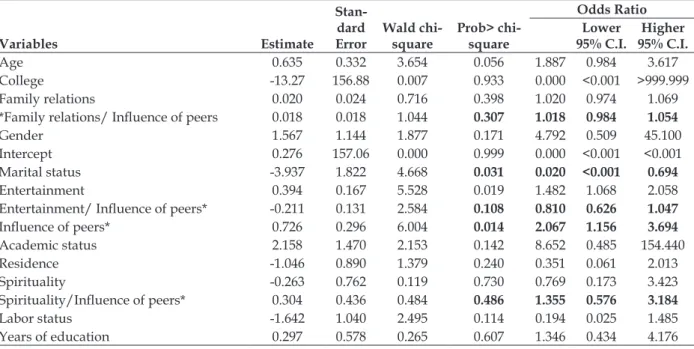
(in-luence of peers) and dependent (drug consump -tion) variables, as depicted in Tables 1 and 2 below.
Table 1 - Correlation among peer inluence, spirituality, family relations, entertainment, and con
-sumption of legal drugs (alcohol and tobacco) in the last 12 months. Florianópolis-SC, 2012
Variables Estimate
Stan-dard
Error
Wald
chi-square Prob> chi-square
Odds Ratio
Lower
95% C.I. 95% C.I.Higher
Age 0.635 0.332 3.654 0.056 1.887 0.984 3.617
College -13.27 156.88 0.007 0.933 0.000 <0.001 >999.999
Family relations 0.020 0.024 0.716 0.398 1.020 0.974 1.069
*Family relations/ Inluence of peers 0.018 0.018 1.044 0.307 1.018 0.984 1.054
Gender 1.567 1.144 1.877 0.171 4.792 0.509 45.100
Intercept 0.276 157.06 0.000 0.999 0.000 <0.001 <0.001
Marital status -3.937 1.822 4.668 0.031 0.020 <0.001 0.694
Entertainment 0.394 0.167 5.528 0.019 1.482 1.068 2.058
Entertainment/ Inluence of peers* -0.211 0.131 2.584 0.108 0.810 0.626 1.047
Inluence of peers* 0.726 0.296 6.004 0.014 2.067 1.156 3.694
Academic status 2.158 1.470 2.153 0.142 8.652 0.485 154.440
Residence -1.046 0.890 1.379 0.240 0.351 0.061 2.013
Spirituality -0.263 0.762 0.119 0.730 0.769 0.173 3.423
Spirituality/Inluence of peers* 0.304 0.436 0.484 0.486 1.355 0.576 3.184
Labor status -1.642 1.040 2.495 0.114 0.194 0.025 1.485
Years of education 0.297 0.578 0.265 0.607 1.346 0.434 4.176
* Variables with statistical signiicance
The logistic regression data displayed in Table 1 show that legal drug consumption was
associated with the inluence of peers who used some kind of drug, and students with no personal
relationship were more vulnerable.
Results show that the inluence of peer group is signiicantly associated with the consumption
of legal substances, because all of the students with friends who consumed drugs were more
likely to use legal drugs when compared to those whose friends did not consume drugs: OR of 2.067
(IC95%: 1.156–3.394). For the variable of marital
status, students in some kind of union were less
likely to consume legal drugs than those who were single: OR of 0.020 (IC95%: 0.001–0.694).
Results show that entertainment, family rela
-tions, and spirituality had no signiicant inluence
on the correlation between peer group and legal drug consumption (alcohol and tobacco) in the last 12 months.
In terms of illegal drugs, the highest con-sumption standards were associated with students younger than 21 years old who had friends that consumed drugs and were studying social/human sciences, as displayed in the table below:
Table 2 - RCorrelation among peer inluence, spirituality, family relations, entertainment, and consumption of illegal drugs (marijuana, cocaine, and ecstasy) in the last 12 months Florianópolis-SC, 2012
Variables Estimate Standard Error Wald chi-square Prob> chi-square Odds Ratio Lower 95% C.I. Odds
Ratio
Higher 95% C.I. Odds
Ratio
College -0.768 0.374 4.205 0.040 0.464 0.223 0.967
Family relations 0.003 0.008 0.190 0.663 1.003 0.989 1.018
Family relations/ Inluence of peers* -0.017 0.009 3.060 0.080 0.984 0.965 1.002
Gender -0.608 0.364 2.781 0.095 0.545 0.267 1.112
Intercept -11.40 343.25 0.001 0.973 0.000 <0.001 <0.001
Marital status 0.448 0.415 1.164 0.281 1.565 0.694 3.529
Entertainment 0.038 0.019 3.990 0.046 1.039 1.001 1.079
Entertainment/ 0.008 0.029 0.080 0.778 1.008 0.953 1.067
Inluence of peers* 0.008 0.029 0.080 0.778 1.008 0.953 1.067
Inluence of peers 0.564 0.187 9.090 0.003 1.757 1.218 2.535
Academic status 13.493 343.24 0.002 0.969 724577 <0.001 >999.999
Residence 0.237 0.332 0.509 0.476 1.267 0.661 2.427
Spirituality -0.106 0.324 0.106 0.744 0.900 0.477 1.699
Spirituality/ 0.901 0.585 2.369 0.124 2.461 0.782 7.747
Inluence of peers* 0.198 0.384 0.264 0.607 1.218 0.574 2.587
Labor status 0.901 0.585 2.369 0.124 2.461 0.782 7.747
Years of education 0.151 0.241 0.394 0.530 1.163 0.725 1.866
* Variables with statistical signiicance
The results of Table 1 show that the inluence of the peer group is signiicantly associated with
the consumption of illegal drugs, because students with friends who consumed drugs were more
likely to consume illegal drugs when compared
against those whose friends did not consume
illegal drugs: OR of 1.757 (IC95%: 1.218–2.535).
Age was a protective factor; students older than
21 years were less likely to consume drugs: OR of 0.795 (IC95%: 0.645–0.980). Likewise, students studying health sciences were less likely to consu -me illegal drugs when compared against students
studying social/human sciences: OR of 0.464
(IC95%: 0.223–0.967).
Results show that entertainment, family relations, and spirituality have no signiicant in
-luence on the correlation between the peer group
and illegal drug consumption (marijuana, cocaine, ecstasy) in the last 12 months
DISCUSSION
Many youngsters who enter the university, an environment favorable to personal and profes-sional growth, undergo a wide range of changes in their everyday lives, such as separation from family, new friendships, more independence, new forms of leisure and interaction, and more res-ponsibility in the face of academic demands. This
new reality may inluence the individual’s health
mainly regarding the use of drugs, as these factors
can play the role of either protection from or risk
toward the use of these substances.
Data for Brazil show that nearly half of university students (48.7%) reported to have
con-sumed some psychoactive substance at least once in their lives.4 Moreover, most of the students had tried drugs before entering the university, during adolescence, at more or less 12 years of age,15 for curiosity, fun, or pleasure, and the use was sustained in order to enjoy the effects and reduce anxiety/distress,16 or relieve pain, anguish, hope-lessness, and depression.17 When an individual en-ters the university he is involved in several changes
that may act as risk factors for the use of drugs.2
This survey identiied that, in the previous
12 months, alcohol was the most widely consumed drug among university students, followed by to-bacco and marijuana. This reality was also found in other institutions in Brazil and in other countries. Similar results were found in a survey carried out in another public university with academics in
the ield of human, exact, and biological sciences
regarding the prevalence of drug use. The survey
identiied that, in the previous 12 months, alcohol
was the most widely used drug (80%), followed by tobacco (23.6%), and marijuana (18.5%).18 Corrobo-rating these data, another study with 275 university students in a private institution in Brazil found that alcohol was the most widely used substance, followed by tobacco, prescribed psychoactive dru-gs, marijuana, and inhalants.19
worldwide and, thus, use of drugs is a global public health issue.
In addition to identifying the prevalence of drug use in higher education institutions, there is also the urgent need analyze the factors that interfere in consumption by university students.
Therefore, this survey tried to identify the inluence
of peers on drug consumption, and whether the family, entertainment, and spirituality played the
role of moderator in such inluence.
The logistic regression data show that legal drug consumption was associated with the
in-luence of friends who used some kind of drug,
and students with no intimate relationship were more vulnerable.
In terms of illegal drugs, the highest con-sumption standards were associated with students younger than 21 years old who had friends that consumed drugs and belonged to the social/hu-man sciences departments.
The use of legal and illegal drugs proved to
be strongly inluenced by peers, as students who
had friends that consume drugs have more fre-quently consumed these substances. This reality
is explained by other studies that have identiied
the interaction of university students and drug users with permissive relations, and shared views favorable to the use of drugs have a negative
in-luence on consumption.21 Furthermore, friends and colleagues serve as companions to use drugs at pubs and parties and in moments of interaction
at home. A survey of 275 nursing students in Rio
de Janeiro showed that only 7.3% consume alcoho-lic beverages alone.22 The perception of drug use among peers with higher estimates than actual
use has also inluenced, in a negative way, the
consumption of drugs among university students.23 It is perceived that youngsters belonging to a group where most of their peers use drugs
are more likely to consume drugs as well. Group
pressure may be the reason for drug consumption, and social cognitive theory suggests that the model is the critical point of that behavior, as youngsters observe and comply with the rules described by the actual behavior perceived by the others.
This model introduces an explanation for the use of drugs and deviation considering the notion of pressure on individuals, even those protected by
good social links with conventional agents. Thus, despite the exposure to the positive inluences of conventional institutions and strong links with these inluences, youngsters duly socialized also engage in deviating behaviors, speciically the use
of drugs. Why, then, does this deviation occur if
strong links have been built earlier in the life of an
individual?
One study showed that youngsters with
friends who engage in risky behaviors are more likely to get involved with some of those behaviors,
such as consuming drugs, for example. It also indi-cated that if youngsters are associated with groups of peers that consume drugs, that is a factor that increases vulnerability to involvement with illegal
drugs. Results were clearly evident—all those who
consumed at least one drug had many friends who used it, too.24
Therefore, the consumption of drugs among individuals can be explained by the fact that groups
of peers play an important role in the identiication
of causes for the use of drugs in adolescence. Peer
groups strongly inluence the decision-making of
youngsters in general, as the authors have
men-tioned. This work identiied peers as the factor of strongest inluence in the consumption of legal and
illegal drugs.24
For the consumption of legal drugs, this sample showed that not being in an intimate relationship is a factor of vulnerability. A study performed among academics in the course of
me-dicine at a public university also identiied that
single students adhere more to the consumption of drugs.25 The study observed that single students spent more time at social events and with friends and, just as in this study, it was shown that most of them had friends who use drugs, thus increa-sing the possibility that students with no intimate relationship would consume drugs.
In relation to the consumption of illegal
dru-gs, being younger than 21 years old was identiied as a factor of vulnerability in this sample. Research
has also found that nearly 92% of the population that stated they had used drugs did so before en-tering the university; these data include alcohol and tobacco. This information is very relevant, as it shows that the university is not the starting point
for using drugs. Of the 92%, 14% afirmed to have
tried drugs before the age of 12; 45% from 13 to 15 years old; 33% from 16 to 18 years of age; and only 8% after the age of 18.26
In relation to students in this sample, those
taking social/human sciences courses were more
The consumption of drugs among youth is also recognized as a behavior culturally mediated by learning processes.27 Cultural agents of sociali-zation such as family, colleagues, religion, and the entertainment industry are among the social insti-tutions from which young adults and adolescents
cognitively assimilate information and inluence and which, by extension, inluences others’ beha -viors.28 Hence, these cultural agents can potentially
inluence the use of drugs, similarly to the social rules or practices that govern the use of speciic
substances in a given culture.29
In this study the factors of family relations,
spirituality, and entertainment did not signii -cantly moderate the influence of peers on the consumption of legal and illegal drugs. It is worth considering that spirituality and family relations are neutral among students, thus justifying their
non-interference in the moderation of the inluence of peers. However, these factors can be worked
on in the move away from neutrality and become
inluencing factors, in the sense of positive mode
-ration, so that students make conscious decisions
and do not consume drugs.
Nonetheless, some students displayed a
signiicant inluence of family relations. A study
among university students showed that the stan-dard of family organization among marijuana users had at its core the controlling authority, where
youngsters kept a superficial and submissive
relation with family members despite displays of affection. The families of non-users, in turn, held
links with less authority that favored interpersonal connections marked by relations of exchange and
fellowship.30 Regarding the use of alcohol and other drugs, a study among undergraduate students of
courses in the ields of biological, exact, and human
sciences evidenced an association of family aspects with regular use of drugs.31
When it comes to spirituality, other studies
have found no signiicance between spirituality
and drug consumption. A study performed in a public university with a sample of 278 academics did not associate the use of drugs with having or not having a religion.32 These different realities highlight the importance of performing studies in different institutions and courses, as the factors
that inluence the use of drugs vary depending on
the population being studied.
In this study, the results showed that
enter-tainment did not signiicantly inluence the relation
between peer group and drug consumption in the last 12 months, although the students in the sample
participate in parties where alcohol, tobacco, or other substances that change mood could be found. Technology-based interactive entertainment, in turn, is one of the activities with a higher partici-pation of students in this sample, mainly through
access to e-mail and social networks. Non-interac -tive entertainment was also strong among these students, such as watching videos and news on the television or the Internet.
It is known that entertainment can inluence
the use of drugs among university students. Te-levision and the Internet are very popular enter-tainment media, and display many advertisements that increase the consumption of alcohol mainly among youth, as shown by some surveys.33 From a different perspective, these communications and entertainment means bear the power of dissemina-ting information about the negative consequences of drugs and could become a protective factor.34 However, in this study entertainment did not play the role of moderator in relation to the use of drugs among university students.
Nonetheless, it is accepted that, in a
universi-ty environment, the media inluences the consump -tion of alcoholic beverages. This fact is evidenced by a survey that evaluated the posters displayed on the campus of a university. Most of the posters publicizing university parties showed contents referring to the use of alcohol, encouraging the use of this drug and, more than advertising the party, they served as an incitement to the use of alcohol.33 However, entertainment could be used to assist in the prevention of drug consumption by bringing accurate information to students and, thus,
provi-ding them with autonomy to make decisions.
CONCLUSIONS
Os estudantes universitários participantes deste The university students participating in this study used legal drugs, alcohol and tobacco, followed by illegal drugs, where marijuana was the most common. However, what is worth men-tioning is the differences between the rates of drug
consumption, risk factors, and protective factors identiied herein, and others found at different
universities and in different courses.
Data divergence suggests that other univer-sities should carry out epidemiological and quali-tative surveys in their campuses, considering the different courses, to identify the drugs used and
existing risk factors and, thus, implement actions
students.
The inluence of peers on drug consumption
among the university students in this sample was
highly signiicant, and the single students were
the largest consumers of legal drugs, while those younger than 21 years old prefer illegal drugs and were found predominantly in the social/human science courses.
Family relations and spirituality were neu-tral socio-cultural factors and did not exercise any
signiicant moderation on the inluence of peers
and drug consumption, although other studies
have found such signiicance. For this sample, entertainment had no moderating inluence on
drug consumption.
Several studies have pointed out that family relations and spirituality are important protective factors against drug use, but in this study those factors were neutral among this student sample. The university should implement strategies to
strengthen family links and spirituality to maxi -mize these factors, and further investigate whether the rates of drug use among students are affected. Moreover, as most of the participants indicated the use of technology-based entertainment, the university should start using this resource to
disse-minate knowledge about drugs, thus contributing
to preventing the use of these substances. It is worth mentioning that the facts investi-gated play no preponderant role as moderators of
the inluence on drug consumption in this sample.
Alternatively, the size of the sample may not have
been suficient to evidence such moderation.
Therefore, the Brazilian and university au-thorities should carry out new surveys in the same line of investigation to provide subsidies to poli-cies to promote health among university students, engaging them in this transformation process.
Limitations
The use of an intentional sample restricted potential generalizations of the results to other population groups, as well as to the set of uni-versity youngsters from other localities/regions of Brazil. However, these methods are typically used in psychosocial and epidemiological studies, in addition to other health-related surveys. The results of this study should be considered in the context of the sample surveyed
ACKNOWLEDGMENTS
To the Government of Canada (DFAIT), to
the Organization of the American States (OAS), to the Inter-American Drug Abuse Control Com-mission (CICAD), to the Centre for Addictions and Mental Health (CAMH) of the University of Toronto–Canada, to our fellow researchers, direc-tors, advisers, and the professors of the program for the opportunity, as well as to the authorities, professors and, above all, the students who parti-cipated in this survey.
REFERENCE
1. United Nations Ofice on Drugs and Crime (UNO
-DC). Global study on homicide: trends, context,
data. Vienna (AT): UNODC; 2011 [acesso 2011 Jul 15]. Disponível em: http://www.unodc.org/do-cuments/data-and-analysis/statistics/Homicide/
Globa_study_on_homicide_2011_web.pdf
2. Zeferino MT, Fermo VC. Prevenção ao uso/abuso
de drogas. In: PROENF. Saúde do Adulto v.2. Porto Alegre (RS): Artmed/Panamericana; 2012. p. 9-42.
3. Organization of American States, Inter-American Drug Abuse Control. Multilateral Evaluation
Mechanism. Governmental Expert Group: Brazil.
Assessment of Progress in Drug Control 2007-2009. Washington (DC): CICAD/OAS; 2010.
4. Brasil. Presidência da República. Secretaria Nacional de Políticas sobre Drogas. I Levantamento Nacional sobre o uso de álcool, tabaco e outras drogas entre universitários das 27 capitais brasileiras. Brasília (DF): SENAD; 2010.
5. Brasil. Ministério da Educação. Instituto Nacional de Estudos e Pesquisas Educacionais Anísio Teixeira. Censo da Educação Superior 2010: Divulgação dos principais resultados do Censo de Educação Superior 2010. Brasília (DF): INEP; 2011.
6. Andrews JA, Tildesley E, Hops H, Li F. The inluence of peers on young adult substance use. Health Psychol. 2002 Jul; 21(4):349-57.
7. Avenevoli S, Merikangas KR. Familial inluences on
adolescent smoking. Addiction. 2003 May; 98(Suppl
1):1-20.
8. Bates S, Ferri AJ. What’s entertainment? Notes toward
a deinition. Stud Popular Culture. 2010; 33(1):1-20.
9. Cline A. Religion v.s. spirituality: distinguishing between religion and spirituality [online]. [access 2011 Jul 15] Disponível em: http://atheism.about.
com/od/religionnonreligion/a/spirituality_2.htm
10. Mayberry ML, Espelage DL, Koening B. Multilevel
adolescent substance use. J Youth Adolesc. 2009 Sep; 38(8):1038-49.
11. Hudson WW. The Walmyr Assessment Scales scoring manual. Tempe (US): Walmyr Publishing Co.; 1992.
12. Hatch RL, Burg MA, Naberhaus DS, Hellmich
LK. The spiritual involvement and beliefs scale:
development and testing of a new instrument. J Fam Pract. 1998 Jun; 46(6):476-86.
13. Padilla-Walker LM, Nelson LJ, Carroll JS, Jensen AC. More than a just a game: video game and internet use during emerging adulthood. J Youth Adolesc. 2010 Feb;39(2):103-13.
14. World Health Organization. The Alcohol, Smoking
and Substance Involvement Screening Test (ASSIST):
manual for use in primary care. Geneva (CH):WHO;
2010.
15. Botti NCL, Lima AFD, Simões WMB. Uso de
substâncias psicoativas entre acadêmicos de
enfermagem da Universidade Católica de Minas
Gerais. 2010; 6(1): 1-13.
16. Chiapetti N, Serbena CA. Uso de álcool, tabaco e drogas por estudantes da área de saúde de uma
universidade de Curitiba. Psicologia: Relexão e
Crítica. 2007; 303-313.
17. Zalaf MRR, Fonseca RMGS. Uso problemático de ál
-cool e outras drogas em moradia estudantil: conhecer para enfrentar. Rev Esc Enferm USP. 2009; 43(1):132-8. 18. Wagner GA. Álcool e drogas: terceira pesquisa sobre atitudes e uso entre alunos na Universidade de São Paulo - Campus São Paulo [tese na internet]. São Paulo: Universidade de São Paulo, Faculdade de Medicina; 2011 [acesso 2012 Jun 27]. Disponível em: http://www.teses.usp.br/teses/ disponiveis/5/5142/tde-27062011-123240/ 19. Nóbrega MPSS, Simich L, Strike C, Brands B,
Giesbrecht N, Khenti A. Policonsumo simultâneo
de drogas entre estudantes de graduação da área de
ciências da saúde de uma universidade: implicações de gênero, sociais e legais, Santo André – Brasil.
Texto Contexto Enferm. 2012; 21(Esp): 25-33. 20. Johnston, LD et al. Monitoring the future national
survey results drug use, 1975-2006. Volume II: College students and adults ages 19-45. Bethesda (US): National Institute on Drug Abuse, 2009. 21. Floripes, TMF. Beber se embriagando (binge
drinking):estudo de umapopulaçãodeestudantes universitários que fazem uso de álcool de risco [dissertação]. Botucatu (SP): Universidade Estadual Paulista, Faculdade de Medicina de Botucatu; 2008. 22. Oliveira EB, Cunningham J, Strike C, Brands B,
Wright MGM. Normas percebidas por estudantes
universitários sobre o uso de álcool pelos pares.
Rev Latino-am Enfermagem, 2009; 17(Esp.):878-85.
23. Carvalho AMP, Cunningham J, Strike C, Brands B,
Wright MGM. Normas percebidas por estudantes
universitários de três carreiras, da área da saúde,
sobre o uso de drogas entre seus pares. Rev
Latino-am Enfermagem. 2009; 17(Esp):900-6.
24. Elliott DS, Menard S, Rankin B, Elliott A, Wilson WJ,
Huizinga D. Good kids from bad neighborhoods:
successful development in social context. Cambridge,
UK: Cambridge University Press, 2006.
25. Petroianu A, Reis DCF, Cunha BDS, Souza DM
Prevalência de consumo de álcool, tabaco e
entorpecentes por estudantes de medicina da
Universidade Federal de Minas Gerais. Rev Assoc
Med Bras 2010; 56(5):568-71.
26. Fiorini JE, Alves AL, Ferreira LR, Fiorine MC, Durães
SW, Santos RLD, et al. Use of licit and illicit drugs
at the University of Alfenas. Rev Hosp Clin. 2003:
58(4):199-206.
27. Hallan C, Bewley-Taylor D. Brieing Paper 21:
drug use: knowledge, culture and context. Oxford (UK): The Beckley Foundation Drug Policy
Programme; 2010.
28. European Regeneration Areas Network. Quartiers in
crise. gender stereotypes: the impact of socialization and education [online] , 2005 [acesso 2011 Jul 18]. Disponível em: http://qeceran.cluster003.ovh.net/
network/genderstereotypes.pdf
29. Organización de los Estados Americanos, Comisión Interamericana para el Control del Abuso de Drogas. El Salvador: evaluación del progreso de control de drogas, 2007-2009. Washington (US): CIA. World
Factbook; 2010.
30. Ferreira VM, Filho EAS. Maconha e contexto familiar: um estudo psicossocial entre universitários
do Rio de Janeiro. Psicol Sociedade. 2007; 19(1):52-60.
31. Stempliuk VA, Barroso LP, Andrade AG, Nicastri
S, Malbergier A. Estudo comparativo entre 1996 e 2001 do uso de drogas por alunos da graduação da
Universidade de São Paulo: Campus São Paulo. Rev
Bras Psiquiatr. 2005; 27(3):185-93.
32. Sanchez ZVDM, Oliveira LG, Nappo SA. Fatores
protetores de adolescentes contra o uso de drogas
com ênfase na religiosidade. Ciênc Saúde Coletiva.
2004; 9(1):43-55.
33. Snyder LB, Milici FF, Slater M, Sun H, Strizhakova Y.
Effects of alcohol advertising exposure on drinking
among youth. Arch Pediatr Adolesc Med. 2006 Jan;160(1):18-24.
Correspondence: Maria Terezinha Zeferino Universidade Federal de Santa Catarina
Centro de Ciências da Saúde
Departamento de Enfermagem
88040-070 − Florianópolis, SC, Brasil