ABSTRACT
ORIGINAL AR
Cristianne Akie Kavamoto
José Augusto Fernandes Lopes
Jeane Cintra Peixoto de Vasconcelos
without ankle bracing and taping
Department of Physical Therapy, Speech and Occupational Therapy, School
of Medicine, Universidade de São Paulo, and Medical Rehabilitation Division,
Hospital das Clínicas, Universidade de São Paulo, São Paulo, Brazil
INTRODUCTION Sport injuries are one of the most com-mon types of injury in modern Western societies. Their treatment is not only diffi cult, but also costly and lengthy. Therefore, the use of preventive measures is justifi ed, from both an economic and a medical standpoint.1 For such prevention to be effective, the etiology, risk factors and main injury mechanisms need to be understood.
For basketball players, the ankle is the segment most frequently injured, and in-version sprains present the highest injury incidence rate. The ankle injury rate is 3.85 per 100 participations, with approximately half (45.9%) of the players kept away from competition for a week or more.2 It is com-mon to observe players using prophylactic measures, such as taping, wrapping, orthoses and other measures, either as sprain preven-tion or as rehabilitapreven-tion.
A large number of studies have in-vestigated the use of taping and orthoses as a prophylactic measure, usually with results defending the stance that bracing usage reduces injuries. However, its exact mechanism of action is still not well under-stood. Several studies in the literature have described external devices and taping, but with contradictory results. A few studies have investigated the role of proprioception and awareness of foot position in taping and orthoses for sprain prevention. A variety of methods were used by these authors, rang-ing from kinematics and electromyographic analyses to postural oscillation and stimula-tion of anesthetized cutaneous receptors of the lateral ligament complex.3
Some studies have analyzed the effects of orthoses and taping on athletic performance. Some of these found that external devices or taping impair activities such as jumping and running.4,5 One other study found that
performance was improved among individu-als with ankle instability by using semi-rigid orthoses,6 while in a study by Verbrugge7 these neither impaired nor improved athletic performance.
Electromyographic studies on the use of external devices and taping also describe dif-ferent results. Some observed higher response latency or lower electromyographic (EMG) activity in fi bular muscles while using orthoses and taping.8,9 Others found an improvement in reaction time or higher EMG activity in fi bular muscles while using bracing.10,11
According to Canavan,12 taping and orthosis use by healthy athletes is unjusti-fi ed. However, an external device or taping is recommended for competition-level athletes with a history of ankle injuries. This provides comfort and helps to control edema during the acute stage of a sprain.
Reductions in the injury rate may result from decreased muscle reaction time for the fi bularis brevis in unstable ankles10 and also for ankle mechanoreceptor stimulations.6 The proprioceptive role of taping and orthoses seems to be greater than their restriction of total movement amplitude in ankles.6,10
There are few studies relating to ground reaction force (GRF) and external ankle de-vices or taping. Most of them studied move-ments that were less dynamic and functional, and did not fi nd any differences in temporal or magnitude characteristics of GRF.9,13,14 One study found that the time to reach vertical GRF under orthosis and taping conditions was shorter than under control conditions during landing.15
Caulfield and Garrett16 examined the changes in timing and magnitudes of forces sustained by unstable ankles during jump landing, compared with healthy controls. They suggested that the changes in lateral and anterior peak forces observed are likely to
CONTEXT AND OBJECTIVE: In basketball, the most common injuries are ankle sprains. For this reason, players frequently use external ankle devices or taping as prophylactic and rehabilita-tion measures. The purpose of this study was to evaluate ground reaction force (GRF) responses in basketball players while performing typical cutting maneuvers with and without ankle bracing and ankle taping.
DESIGN AND SETTING: Comparative study with experimental design of single-group repeated measurements, at Medical Rehabilitation Divi-sion, Hospital das Clínicas, Faculdade de Medicina, Universidade de São Paulo.
METHODS: Vertical (Fy) and medial-lateral (Fz) GRF measurements were made under three condi-tions (taping, Aircast-type orthosis and basketball shoes alone), with analysis of peak forces at foot contact (Fymax1, Fzmax1, Fymax2 and Fzmax2), growth gradient (peak/time) (GG Fymax1, GG Fzmax1, GG Fymax2 and GG Fzmax2) and impulse after foot contact.
RESULTS: Bracing signifi cantly reduced Fymax2 and GG Fymax2. GG Fzmax1 was signifi cantly higher for the sport shoe condition than for the taping condition. Taping increased Fy in relation to the sport shoe at foot contact, but over a longer time interval, without increasing excessive ankle loading. Fz reached a peak in less time, which might generate greater inversion/eversion loading on a player’s foot. The Aircast exerted better shock-absorbing ef-fect than did the other two conditions, since it generated less vertical force over longer time intervals and smaller medial-lateral forces in relation to taping.
CONCLUSIONS: Ankle bracing and ankle taping action mechanisms are still unclear and therefore should be carefully prescribed. More studies are needed to clarify taping and bracing effects on sporting activities.
result in repeated injury due to signifi cant in-creases in stress on ankle joint structures, since the peak forces occurred signifi cantly earlier in subjects with functional ankle instability.
In basketball, cutting maneuvers (quick eluding movements) are the mechanism res-ponsible for approximately 30% of sprains.2 It has been suggested that when subjects perform cutting tasks during walking and running, the braking forces (anterior/posterior ground reaction force) increase during early stance. The higher braking forces are explained by the need to decelerate in preparation to cut toward the new plane of progression. These greater braking forces have been associated with a rela-tive increase in quadriceps activation during the early stance of cutting tasks.17 However, the GRF patterns during cutting activities in subjects wearing ankle braces or taping have not been described to date.
OBJECTIVE AND HYPOTHESIS The purpose of this study was to evaluate the dynamic GRF responses among professio-nal basketball players while performing cutting maneuvers under controlled conditions: only using the sport shoes normally used for playing basketball and under two conditions of ankle support (taping and Aircast-type orthoses).
If ankle bracing or taping alters ankle sta-bility, it would be expected that changes would occur in the timing and magnitudes of the forces sustained by the braced or taped ankle.
Our hypothesis was that the use of braces or taping would alter the vertical and medial-lateral components of GRF during the impact and propulsion phases of basketball cutting maneuvers, and the temporal components of GRF, expressed as growth gradient (peak/time) for these forces and the impulses at 50 ms and 75 ms after foot contact on the platform.
methods The sample was made up of a group of eight men who had played basketball for at least fi ve years. At the time of the evaluation, they were between the ages of 17 and 25, healthy and without musculoskeletal or joint injuries or any functional or mechanical ankle instabilities. By means of an informed consent agreement, the subjects were made aware of the stages of the experimental protocol, which they read and through which they agreed to participate in the research. The protocol was assessed and approved by the Ethics Commit-tee of the Physical Therapy, Speech and Oc-cupational Therapy Department of the School of Medicine of Universidade de São Paulo.
The experimental protocol was developed at the Gait Laboratory of the Vergueiro Medi-cal Rehabilitation Division and it consisted of two stages.
Players’ characteristics Players’ characteristics
The players were evaluated by a physical therapist by means of clinical and functional tests on their ankles to verify the absence of
mechanical or functional instability.18-23 In-dividuals with well-characterized complaints, either from the interview or functional test-ing, were considered to present functional instability. The functional test consisted of going down a staircase of 44 stairs; each stair was 18 cm long and 22 cm deep. The subject was asked to go down the staircase once, one step at a time with full contact of the foot shoe sole on the stairs. The time taken to go down the staircase was recorded using a chronometer. The results were classifi ed as less than 18 seconds for the best results, from 18 to 20 seconds for the middle range, and over 20 seconds for the group with the worst results.24 Players going downstairs in over 20 s were not included in the study.
Bracing and taping Bracing and taping
The ankle bracing used in this study was the Aircast Stirrup-type orthosis (Aircast Inc.). This bracing device was chosen because basketball players frequently use it.5 The
Aircast orthosis consists of two semi-rigid thermoplastic structures with a pre-infl ated air cell of adjustable position and air volume. The orthosis surrounds the medial and lateral malleoli, reaching up to approximately six inches above the ankle joint and is fastened by Velcro® straps.
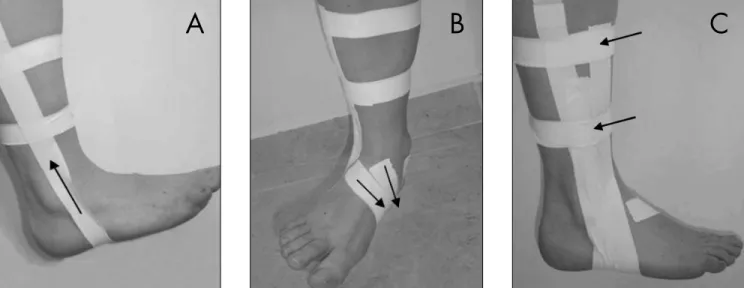
The taping technique consisted of ap-plying non-elastic adhesive tape over the individual’s skin. This technique has been considered to be the most effi cient for joint
Figure 1. Schematic representation of taping technique. (A) Two strips of adhesive tape around the ankle about 5 and 10 centimeters
above the lateral and medial malleoli were attached, and another tape strip was placed, passing over the medial malleolus, heel and lateral malleolus and attaching the tips of this tape to the support base, while maintaining the ankle in dorsifl exion and eversion. (B) Another two tape strips were applied to the instep, passing diagonally around the mid-foot, while also maintaining the ankle in dorsifl exion and eversion. A further strip was also placed across the instep, passing around the mid-foot, and over the lateral malleolus, and attaching it to the support base. (C) Another two tape strips were applied over the two support bases.
stabilization.25 There are many ways of apply-ing the tape. The technique used in the present study is illustrated in Figure 1. It consisted of, fi rstly, using two strips of adhesive tape around the ankle about 5 to 10 centimeters above the lateral and medial malleoli, and this was used as a support base. Then another tape strip was placed, passing over the medial malleolus, heel and lateral malleolus and attaching the tips of this tape to the support base, while maintaining the ankle in dorsifl exion and eversion. Another two tape strips were applied to the instep, passing diagonally around the mid-foot, while also maintaining the ankle in dorsifl exion and eversion. A further strip was also placed across the instep, passing around the mid-foot, and over the lateral malleolus, and attaching it to the support base. Finally, another two tape strips were applied over the two support bases.
During these trials, the sport shoes used by the subjects were those usually worn for playing basketball. The use of these sport shoes alone formed the control group (one individual was his own control).
Dynamics Dynamics
During the second stage of the experimen-tal protocol, the basketball cutting maneuver was dynamically evaluated. Cutting was chosen because it is the mechanism respon-sible for approximately 30% of sprains.2 This maneuver was performed by the players with and without the use of bracing or taping and under the control conditions of only using the normal sport shoes. The study design was as follows. The subjects were evaluated while performing cutting maneuvers on the force platform, and the change in direction was carried out using each player’s dominant lower limb. The cutting movement was tested under each of these three conditions: Aircast-type bracing, taping and sport shoes alone. Each of these three conditions was repeated fi ve times (fi ve attempts), and the mean was calculated from these results.
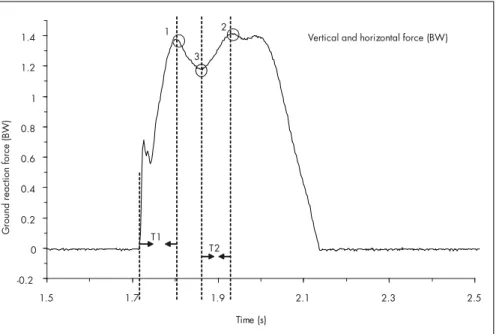
This study used a force platform made by Applied Marine Technology, Inc., for acquisition and analysis of the vertical and anteroposterior and medial-lateral horizontal components of the ground reaction force. This platform was placed at ground level in a room with approximately 20 linear meters for the locomotion movements. Data were collected during the fi ve attempts, each one with a sampling frequency of 500 Hz for a period of six seconds, which was compatible with these types of movements.26 Table 1 and Figure 2 describe the vertical and medial-late ral
ground reaction force variables analyzed during this movement.
The vertical and medial-lateral ground re-action force variables for each study condition were normalized for the body weight of each subject and then fi ltered using a low-pass But-terworth fi lter with a 200 Hz cutoff frequency, as suggested by Roesler et al.26
Statistical analysis Statistical analysis
The biomechanical variables studied were initially analyzed to verify the statistical
data distribution through the Shapiro-Wilks W test, to identify non-parametric data. The variables were described for each trial condition in terms of their central trend measurement and error: meanand standard deviation. For variables originating from the questionnaire, the data for each trial condi-tion were shown as percentages.
The ground reaction force and temporal variables did not show normal distribution, and therefore the three trial conditions were compared by means of the Kruskal-Wallis
Table 1.Description of the vertical and horizontal ground reaction force variables in
cutting movements in basketball players
Movement Symbol Description
Cutting maneuver
Fymax1 and Fzmax1 Maximum vertical and medial-lateral forces
at foot contact on the ground
Fymax2 and Fzmax2 Maximum vertical and medial-lateral forces at the moment of propulsion
Fymin and Fzmin Minimum vertical and medial-lateral forces
GG Fymax1 and Fzmax1 GG for maximum vertical and medial-lateral
forces at ground contact
GG Fymax2 and Fzmax2 GG for maximum vertical and medial-lateral
forces at the moment of propulsion
Impulse after 50 ms Impulse at 50 ms after ground contact
Impulse after 75 ms Impulse at 75 ms after ground contact
GG = growth gradient.
Vertical and horizontal force (BW)
-0.2 0 0.2 0.4 0.6 0.8 1 1.2 1.4
1.5 1.7 1.9 2.1 2.3 2.5
Time (s)
Ground reaction force (BW)
1 2
3
T1
T2
Figure 2. Graphic representation of vertical and horizontal forces during cutting
non-parametric inferential test, using the Mann-Whitney test as a post-hoc test, in which the latter was strong enough to prove individual differences. Differences with a signifi cance level (p) lower than 0.05 were considered signifi cant.
The Excel (Microsoft) and Statistica v.5.1 (Statsoft Inc.) software were used for handling the statistical treatment, while Origin v.5.0
(MicrocalSoftware) software was used for the mathematical treatment of ground reaction force variables.
RESULTS Table 2 shows the means, standard de-viations and percentage distributions of the demographic and basketball-related variables for the subjects evaluated in this study.
In this study all subjects were male, with a mean age of 22.4 ± 1.7 years. The subjects had a mean body mass index of 21.8 ± 2.7 kg/m2. The length of time for which they had par-ticipated in basketball was 10.8 ± 2.8 years. The mean frequency of training sessions was 3 ± 1 times per week, with a mean duration of two hours. With regard to the position they played, only two players were guards, four played as centers and seven as forwards, and of the eight subjects, fi ve played in more than one position. A large majority of these subjects (87.5%, or 7/8) played basketball within the adult ranking while only one (12.5%) played within the 17-year-old ranking. Concerning their basketball skill levels, one player (12.5%) played professionally, one player (12.5%) played at the amateur level and the other 75% (6/8) played college basketball.
Fifty percent of the players use regularly external devices or taping during games and training sessions, yet 75% of the players had already suffered ankle sprains and, of these, 66% had injured both ankles.
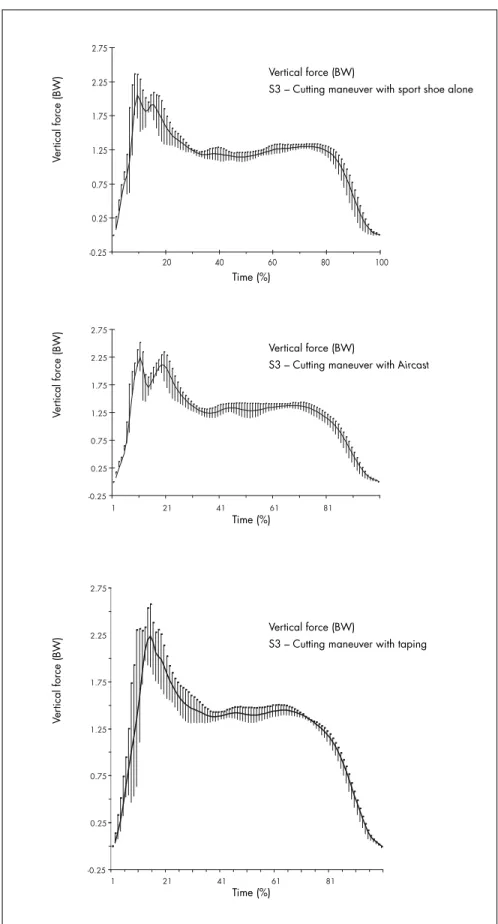
Figure 3 and Table 3 show the mean and standard deviations for vertical ground reaction force variables during cutting maneu-vers under the three trial conditions. For the sport shoe condition, the second peak force (Fymax2) was signifi cantly higher than for the taping and Aircast conditions (p = 0.0000), but there was no difference in cutting maneu-vers between the taping and Aircast conditions (p > 0.05). With regard to the Fymax2 growth gradient, there were signifi cant differences between the three conditions (p = 0.0490), in which the value found for the sport shoe con-dition was higher than the values for Aircast (p = 0.0020) and taping (0.0121). The gra-dient values for the taping and Aircast condi-tions did not show any statistical differen ce between them (p = 0.8778).
Figure 4 and Table 4 show the mean and standard deviation of medial-lateral ground reaction force variables during cutting ma-neuvers while using bracing, taping and sport shoes alone. There were no signifi cant differences with respect to force magnitudes between these three conditions. However, the Fzmax1 growth gradient was signifi cantly lower for the sport shoe condition than for the taping condition (p = 0.0433).
DISCUSSION The mean age in this study (22 years) shows that the subjects were all young individ-uals, which lowered the likelihood of chronic diseases related to decreased mobility. A large majority of the subjects (87.5%) played
Table 2. Means, standard deviations and percentage distributions of demographic
variables, and description of basketball skill levels of subjects evaluated
Variables Test group (n = 8)
Age (years) 22.4 ± 1.7
Weight (kg) 78.8 ± 9.1
Height (m) 1.9 ± 0.1
Body mass index (kg/m2) 21.8 ± 1.7
Time playing basketball (years) 10.8 ± 2.8
Training session time (hours) 2 ± 0
Weekly training frequency (times/week) (median) 3
Bracing and taping usage (%) 50
Table 3.Mean and standard deviation for vertical ground reaction force during cutting
maneuver in basketball, with sport shoe alone, taping and Aircast ankle bracing (n = 8)
Variables Sport shoe alone Aircast Taping p
Fymax1 (BW) 2.04 ± 0.37 2.03 ± 0.43 2.11 ± 0.43 > 0.05
Fymax2 (BW) 2.02 ± 0.26 1.44 ± 0.13 1.50 ± 0.17 0.0000
Fymin (BW) 1.20 ± 0.19 1.16 ± 0.20 1.14 ± 0.25 > 0.05
GG Fymax1 (BW/s) 45.64 ± 22.06 41.01 ± 16.92 44.91 ± 21.54 > 0.05 GG Fymax2 (BW/s) 29.20 ± 27.05 15.85 ± 10.65 18.64 ± 15.59 0.0490 Impulse after 50 ms (N.s) 0.05 ± 0.01 0.05 ± 0.01 0.05 ± 0.02 > 0.05 Impulse after 75 ms (N.s) 0.09 ± 0.02 0.08 ± 0.02 0.09 ± 0.02 > 0.05
GG = growth gradient; BW = body weight; N.s = Newton.seconds; Fymax1 = maximum vertical and medial-lateral forces at foot contact on the ground; Fymax2 = Maximum vertical and medial-lateral forces at the moment of propulsion; Fymin = Minimum vertical and medial-lateral forces; GG Fymax1 = GG for maximum vertical and medial-lateral forces at ground contact; GG Fymax2 = GG for maximum vertical and medial-lateral forces at the moment of propulsion.
Table 4.Mean and standard deviation of horizontal ground reaction force during cutting in basketball with and without ankle bracing: sport shoe, taping and Aircast (n = 8)
Variables Sport shoe alone Aircast Taping p
Fzmax1 (BW) 1.53 ± 0.35 1.54 ± 0.39 1.54 ± 0.42 > 0.05
Fzmax2 (BW) 0.85 ± 0.40 0.95 ± 0.26 1.00 ± 0.31 > 0.05
Fzmin (BW) 0.79 ± 0.12 0.82 ± 0.21 0.81 ± 0.19 > 0.05
GG Fzmax1 (BW/s) 27.36 ± 11.19 30.73 ± 11.01 35.38 ± 16.78 0.0433
GG Fzmax2 (BW/s) 10.75 ± 10.61 11.44 ± 11.56 14.43 ± 16.19 > 0.05
Impulse 50 ms (N.s) 0.03 ± 0.01 0.03 ± 0.01 0.03 ± 0.01 > 0.05
Impulse 75 ms (N.s) 0.07 ± 0.02 0.02 ± 0.02 0.07 ± 0.02 > 0.05
basketball within an adult ranking, at college level. Moreover, all the subjects had negative results from clinical tests for functional and mechanical instability, thus demonstrating that none of them had any kind of ankle joint instability that could alter the results.
The mean body mass index (BMI) was 21.8 kg/m2, which is within normal limits (i.e. between 20 and 25),27 thereby eliminating the possibility that there might have been excessive loading on the joints, or other abnormalities resulting from states of excessive weight.
A considerable percentage of the subjects (50%) were regularly using external devices or taping during games and training sessions as a way of preventing ankle sprains. Yet we observed in this study that most of the players (75%) had already suffered ankle sprains and, of these, 66% had injured both ankles. This demonstrates that these are very common basketball injuries, and that there is therefore a need to improve the knowledge of how to prevent this kind of injury, and how such injuries are related to the types of maneuvers made by players.
A study by McKay et al.28 did not fi nd any correlations for gender, age, mass, height and training frequency versus the incidence of ankle injuries. However, it is important to note that the sport of basketball typically presents training overload and this was the case for the players evaluated in that study. Such training overload would increase the musculoskeletal loading and, consequently, place stress on ankles and favor the incidence of injuries.
One study analyzed ground reaction force in lateral displacement and found no differences between control conditions and conditions using orthoses and taping.9 However, in the present study there were sta-tistically signifi cant differences in the vertical and medial-lateral components of the ground reaction force.
In considering the cutting maneuver, it was observed that under the taping condi-tions, the vertical force magnitude (Fymax1) at the moment of foot contact with the ground tended to be higher than under the conditions of sport shoes alone and Aircast, and that the growth gradient (GG) for this force (GG Fymax1) tended to be higher solely in relation to Aircast. Although taping produced higher vertical force in relation to the sport shoe alone, the GG values for both conditions remained similar. That is, taping increased the vertical peak force, but over a proportionally longer time interval. The consequent interpretation for this is that the
-0.25 0.25 0.75 1.25 1.75 2.25 2.75
100 80
60 40
20
-0.25 0.25 0.75 1.25 1.75 2.25 2.75
1 21 41 61 81
-0.25 0.25 0.75 1.25 1.75 2.25 2.75
1 21 41 61 81
Ver
tical force (BW)
Ver
tical force (BW)
Ver
tical force (BW)
Figure 3.Graphic representation of mean and standard deviation for vertical ground
reaction force during cutting maneuver in basketball with sport shoe alone, Aircast and taping for subject 3. BW = body weight.
Vertical force (BW)
S3 – Cutting maneuver with sport shoe alone
Vertical force (BW)
S3 – Cutting maneuver with Aircast
Vertical force (BW)
S3 – Cutting maneuver with taping Time (%)
Time (%)
excessive loading under this condition did not change. In relation to Aircast, taping tended to produce a higher vertical force value over a shorter time interval during ground impact. The growth gradient for vertical force under the taping condition had higher inclination than for Aircast, thus indicating that this bracing was exerting a better shock-absor bing effect than were the sport shoe alone and taping, and consequently, less loading on the more distal joints.
From analysis of the medial-lateral com-ponent of the cutting maneuver, it was found that, for taping, the growth gradient for this force at ground contact (GG Fzmax1) was also signifi cantly higher than for the sport shoe alone (p = 0.0433) and tended to be higher than for Aircast, although the medial-lateral force values were similar. This result is in agree-ment with the earlier study by Cordova et al.,9 which did not fi nd any differences in impact peak force magnitude (foot contact with the ground) for the medial-lateral component during lateral displacements that were similar to cutting maneuvers. However, these authors did not analyze the time needed to reach this peak force at the moment of ground contact. The increased GG Fzmax1 under the taping condition that was observed in the present study means that the use of this stabilizing technique decreased the time to reach the medial-lateral peak force. This higher growth gradient for medial-lateral force may result from a more rigid ankle, which would have smaller inversion and eversion movement amplitudes as a result of taping.
On the other hand, a high GG Fzmax1 value may signify more excessive loading on the ankle and lower limb joints over a medium and long-term basis. Bracing usage would limit the time for external forces to act on the small movement amplitude available for the joint, thus making the other foot and ankle structures absorb greater forces.9 Furthermore, higher compressive forces might be gener-ated, thereby resulting in greater injury risk. Although the Aircast and taping conditions did not show any statistical difference, these conditions showed a tendency towards higher medial-lateral peak force on the impact and propulsion moments (Fzmax1 and Fzmax2) and greater growth rates for these forces. As previous stated by Riemann et al.,15 these alterations indicate that during dynamic ac-tivities the musculoskeletal structures of the body may be subjected to loads within shorter time periods.
At the propulsion phase of the cutting maneuver, the sport shoe condition showed
Figure 4.Graphic representation of mean and standard deviation for horizontal ground
reaction force during cutting maneuver in basketball with sport shoe alone, Aircast and taping for subject 3. BW = body weight.
Medial-lateral force (BW)
S3 – Cutting maneuver with sport shoe alone
-0.25 0.25 0.75 1.25 1.75 2.25
1 21 41 61 81
Medio-lateral force (BW)
Time (%)
Medial-lateral force (BW) S3 – Cutting maneuver with Aircast
-0.25 0.25 0.75 1.25 1.75 2.25 2.75
1 21 41 61 81
Medial-lateral force (BW)
Time (%)
Medial-lateral force (BW) S3–Cutting maneuver with taping
-0.25 0.25 0.75 1.25 1.75 2.25
1 21 41 61 81
Medio-lateral force (BW)
signifi cantly higher vertical force values (Fy-max2) than did the taping (p = 0.0000) and
Aircast (0.0000) conditions. The force growth gradient (GG Fymax2) was also signifi cantly higher than for taping (p = 0.0121) and Aircast
(p = 0.0020). Bracing produced smaller verti-cal forces over longer time intervals, i.e. after the minimum vertical force moment (Fymin) the vertical GRF peaks for impulsion were reached in less time for taping and Aircast, in comparison with the sport shoe. But the tap-ing and Aircast conditions were shown to be signifi cantly similar. As mentioned earlier, it can be interpreted that bracing might be reducing the excessive loading on the vertical joint at the moment of impulsion during the cutting maneuver, a situation that the sport shoe alone was unable to implement. This fi nding is in agreement with the study by Anderson et al.,29 which suggested that the use of non-rigid ortho-ses slows the inversion movement. Therefore, the musculoskeletal system might have more time to respond to the demands from external forces, thereby generating less excessive loading on the foot and ankle structures.
Concerning the medial-lateral force at the propulsion phase, the taping condition tended to show a higher peak force value in comparison to the Aircast condition, and the latter was higher than for the sport shoe condition. The growth gradient for taping also tended to be higher than for the other two conditions. It can be considered that, when taping is used, at the moment of propulsion there are more foot movement instabilities, which is unexpected, since this bracing should serve to stabilize medial-lateral maneuvers.
In summary, at the moment the ground receives the load, taping increased the vertical force in relation to the sport shoe alone, but over a longer time interval, without
increas-ing excessive ankle loadincreas-ing. On the other hand, in relation to medial-lateral force, the taping condition reached a peak in less time, which might generate greater inver-sion/eversion loading on the player’s foot. In this same maneuver, the Aircast exerted better shock-absorbing effect than did the other two conditions, since it generated less vertical force over a longer time interval and smaller medial-lateral forces than did taping. With regard to propulsion during the cutting maneuver, bracing reduced the magnitude and increased the time needed to reach vertical peak force, thereby allowing more time for adjustments and adaptations of the muscle control system. But for medial-lateral force, taping produced higher peak forces in less time than did the other two conditions, thereby generating more excessive loading during inversion/eversion.
The search for decreasing the medial-lateral forces is leading towards an increase in other GRF components, i.e., increases in the vertical components of this force, for example. According to Cordova et al.,9 this would cause increased compressive forces on the skeletal system. These alterations indicate that during dynamic activity the musculoskeletal structures of the body may be subjected to loads within shorter time periods. Whether these effects are detrimental over time remains speculative at this point and requires further research.
FINAL CONSIDERATIONS The effects of prophylaxis on sprain pre-vention and the use of such measures for sprain treatment have already been comprehensively described in the literature. However, few studies have analyzed ground reaction forces during dynamic activities with ankle bracing or tap-ing, and most of these did not fi nd differences
between control and study conditions. One alternative to using ankle bracing or taping for preventing injuries would be muscle and proprioception training to improve neuro-muscular response during ankle mobilization. Increasing fl exibility would allow the ankle to reach a certain movement amplitude without reaching the limit at which injury occurs; in-creasing muscle strength would allow muscles to resist the maneuver that might result in ankle sprains; decreasing neuromuscular time response would allow an individual to react more quickly to a possible injury.30
Several studies in the literature have given ambiguous evidence concerning the effects of bracing and taping on GRF, performance, bal-ance and muscle activity.30 The mechanisms by which external ankle devices and taping act are still unclear and more studies are needed in order to understand their effects on sporting activities. It is therefore suggested that coaches and physical therapists should be careful in prescribing brac-ing devices or tapbrac-ing for healthy athletes.
CONCLUSIONS In the present study, it was observed that bracing and taping generated altera-tions in vertical and medial-lateral ground reaction forces between taping, Aircast and control conditions. As expected, bracing and taping attenuated vertical or medial-lateral ground reaction force components in some instances, while on the other hand increasing others, which would lead to in-creased compressive and inversion/eversion forces on the skeletal system by restricting joint mobility. Therefore, although players frequently use bracing devices or taping, whether these effects are detrimental over time also remains speculative at this point and requires further research.
REFERENCES
1. Parkkari J, Kujala UM, Kannus P. Is it possible to prevent sports injuries? Review of controlled clinical trials and recommenda-tions for future work. Sports Med. 2001;31(14):985-95. 2. McKay GD, Goldie PA, Payne WR, Oakes BW. Ankle injuries
in basketball: injury rate and risk factors. Br J Sports Med. 2001;35(2):103-8.
3. Callaghan MJ. Role of ankle taping and bracing in the athlete. Br J Sports Med. 1997;31(2):102-8.
4. Burks RT, Bean BG, Marcus R, Barker HB. Analysis of athletic performance with prophylactic ankle devices. Am J Sports Med. 1991;19(2):104-6.
5. MacKean LC, Bell G, Burnham RS. Prophylactic ankle bracing vs. taping: effects on functional performance in female basketball players. J Orthop Sports Phys Ther. 1995;22(2):77-81. 6. Hals TM, Sitler MR, Mattacola CG. Effect of a semi-rigid
ankle stabilizer on performance in persons with functional ankle instability. J Orthop Sports Phys Ther. 2000;30(9):552-6. 7. Verbrugge JD. The effects of semirigid Air-Stirrup bracing vs.
adhesive ankle taping on motor performance. J Orthop Sports Phys Ther. 1996;23(5):320-5.
8. Perrin PP, Bene MC, Perrin CA, Durupt D. Ankle trauma signifi cantly impairs posture control--a study in basketball players and controls. Int J Sports Med. 1997;18(5):387-92. 9. Cordova ML, Armstrong CW, Rankin JM, Yeasting RA.
Ground reaction forces and EMG activity with ankle brac-ing durbrac-ing inversion stress. Med Sci Sports Exerc. 1998; 30(9):1363-70.
10. Karlsson J, Andreasson GO. The effect of external ankle support in the chronic lateral ankle joint instability. An eletromyographic study. Am J Sports Med. 1992;20(3):257-61.
11. Geyer M, Siebert WE. Komplexe Bewegungsanalyse: dyna-mische Untersuchung zum Effekt des Tapeverbandes auf die Pronation beim Hochsprung mit dreidimensionaler Bewe-gungsanalyse und Elektromyographie. [Complex movement analysis: dynamic study of the effect of a tape bandage on pronation in high-jumping with three-dimensional movement analysis and electromyography]. Sportverletz Sportschaden. 1991;5(2):103-7.
12. Canavan PK. Rehabilitation in Sports Medicine. New York: McGraw-Hill Medical; 1998.
13. Hamill J, Knutzen KM, Bates BT, Kirkpatrick G. Evaluation of two ankle appliances using ground reaction force data. J Orthop Sports Phys Ther. 1986;7(5):244-9.
14. McIntyre DR, Smith MA, Denniston NL. The effectiveness of strapping techniques during prolonged dynamic exercises. J Athl Train. 1983;18:52-5.
15. Riemann BL, Schmitz RJ, Gale M, McCaw ST. Effect of ankle taping and bracing on vertical ground reaction forces during drop landings before and after treadmill jogging. J Orthop Sports Phys Ther. 2002;32(12):628-35.
16. Caulfi eld B, Garrett M. Changes in ground reaction force during jump landing in subjects with functional instability of the ankle joint. Clin Biomec (Bristol, Avon). 2004; 19(6):617-21.
17. Houck J. Muscle activation patterns of selected lower extrem-ity muscles during stepping and cutting tasks. J Electromyogr Kinesiol. 2003;13(6):545-54.
AUTHOR INFORMATION
Isabel de Camargo Neves Sacco, PhD. Department
of Physical Therapy, Speech and Occupational Therapy, School of Medicine, Universidade de São Paulo, São Paulo, Brazil.
Henrique Yuji Takahashi, PT. Department of Physical
Therapy, Speech and Occupational Therapy, School of Medicine, Universidade de São Paulo, São Paulo, Brazil.
Eneida Yuri Suda, PT. Postgraduate student in the
De-partment of Physical Therapy, Speech and Occupational Therapy, School of Medicine, Universidade de São Paulo, São Paulo, Brazil.
Linamara Rizzo Battistella, PhD. Gait Laboratory,
Medical Rehabilitation Division, Hospital das Clínicas, School of Medicine, Universidade de São Paulo, São Paulo, Brazil.
Cristianne Akie Kavamoto, MD. Gait Laboratory,
Medi-cal Rehabilitation Division, Hospital das Clínicas, School of Medicine, Universidade de São Paulo, São Paulo, Brazil.
José Augusto Fernandes Lopes, MSc. Gait Laboratory,
Medical Rehabilitation Division, Hospital das Clínicas, School of Medicine, Universidade de São Paulo , São Paulo, Brazil.
Jeane Cintra Peixoto de Vasconcelos, PT. Gait
Laboratory, Medical Rehabilitation Division, Hospital das Clínicas, School of Medicine, Universidade de São Paulo, São Paulo, Brazil.
Address for correspondence:
Isabel de Camargo Neves Sacco
Departamento de Fisioterapia, Fonoaudiologia e Terapia Ocupacional da Faculdade de Medicina da Universidade de São Paulo (FMUSP)
Rua Cipotânia, 51 — Cidade Universitária São Paulo (SP) — Brasil — CEP 05360-000 Tel. (+55 11) 3091-7464 — Fax (+55 11) 3091-7462 E-mail: [email protected]
Copyright © 2006, Associação Paulista de Medicina
RESUMO Análise da força de reação do solo durante o cutting no basquetebol com e sem o uso de implementos no tornozelo
CONTEXTO E OBJETIVO:A lesão mais comum no basquetebol é a entorse de tornozelo. Assim, os atletas freqüentemente utilizam suportes externos como medidas profi láticas. O objetivo deste estudo é avaliar as respostas da força de reação do solo (FRS) durante a execução do movimento de cutting do basquetebol com e sem acessórios de tornozelo.
TIPO DE ESTUDO E LOCAL: Estudo comparativo. Delineamento experimental de grupo único com medidas repetidas; Divisão de Medicina de Reabilitação, Hospital das Clínicas, Faculdade de Medicina da Uni-versidade de São Paulo, Brasil.
MÉTODOS:Foram colhidas as forças vertical (Fy) e médio-lateral (Fz) em três condições (bandagem, Air-cast e calçado esportivo) e analisados os picos de força e de propulsão no contato com o solo (Fymax1, Fzmax1, Fymax2 e Fzmax2), o gradiente de crescimento (pico/tempo) (GC Fymax1, GC Fzmax1, GC Fymax2 e GC Fzmax2) e o impulso após o contato.
RESULTADOS:Os acessórios reduziram signifi cativamente Fymax2 e GC Fymax2. GC FZmax1 foi maior na situação com tênis quando comparado com bandagem. No momento do impacto, a bandagem aumentou a Fy em relação ao calçado, mas em um intervalo de tempo maior, não aumentando a carga articular. Fz atingiu um pico em menor tempo, podendo gerar maior carga eversora/inversora. O Aircast exerceu um melhor efeito de absorção de impacto, pois gera menor Fy em um maior intervalo de tempo.
CONCLUSÕES: Apesar do uso freqüente deste tipo de recurso pelos atletas, seu mecanismo de ação ainda é confuso. Mais estudos são necessários para esclarecer seus efeitos nas atividades esportivas a longo prazo.
PALAVRAS-CHAVE:Biomecânica. Tornozelo. Cinética. Atividade motora. Movimento. Basquetebol.
19. Ribeiro CZP, Akashi PMH, Sacco ICN, Pedrinelli A. Relation-ship between postural changes and injuries of the locomotor system in indoor soccer athletes. Rev Bras Med Esporte. 2003;9(2):98-103.
20. Fu FH, Stone DA. Sports injuries: mechanisms, prevention, treatment. Baltimore: Williams & Wilkins; 1994. 21. Konradsen L, Olesen S, Hansen HM. Ankle sensorimotor
control and eversion strength after acute ankle inversion injuries. Am J Sports Med. 1998;26(1):72-7.
22. Safran MR, Benedetti RS, Bartolozzi AR 3rd, Mandelbaum BR.
Lateral ankle sprains: a comprehensive review. part 1: etiology, pathoanatomy, histopathogenesis, and diagnosis. Med Sci Sports Exerc. 1999;31(7Suppl):S429-37.
23. Hockenbury RT, Sammarco GJ. Evaluation and treatment of ankle sprains. Clinical recommendations for a positive outcome. Phys Sportsmed. 2001;29(2):569-81.
24. Kaikkonen A, Kannus P, Järvinen M. A performance test protocol and scoring scale for the evaluation of ankle injuries. Am J Sports Med. 1994;22(4):462-9.
25. Ferreira PH. A efi cácia de tornozeleiras e bandagens funcionais no controle do equilíbrio dinâmico. In: Anais. VII Congresso Brasileiro de Biomecânica; 1997, Mai 23-26, Campinas; 1997. p. 407-12.
26. Roesler CRM, Iturrioz I. Identificação do conteúdo de freqüências presente na força de reação do solo medida com plataforma de forças. [Frequency present in reaction force of the fl oor measure with force platform]. Rev Bras Biomec. 2002;3(4):51-6.
27. McArdle WD, Katch FI, Katch VL. Fisiologia do exercício: energia, nutrição e desempenho humano. 4a ed. Rio de Janeiro:
Guanabara Koogan; 1998.
28. McKay GD, Goldie PA, Payne WR, Oakes BW, Watson LF. A prospective study of injuries in basketball: a total profi le and comparison by gender and standard of competition. J Sci Med Sports. 2001;4(2):196-211.
29. Anderson DL, Sanderson DJ, Hennig EM. The role of external nonrigid ankle bracing in limiting ankle inversion. Clin J Sports Med. 1995;5(1):18-24.
30. Hume PA, Gerrard DF. Effectiveness of external ankle support. Bracing and taping in rugby union. Sports Med. 1998;25(5):285-312.
Sources of funding: None Confl ict of interest: None