Dipetalogaster maximus embryo extracts were used to evaluate their ef fects and s p e c i f i c i t y o n h u m a n p e r i p h e r a l b l o o d mononuclear cells (PBMC) of chronic chagasic patients. It was previously observed that these extracts were able to promote and exacerbate the growth of the parasites when added to Trypanosoma cruzi culture medium1.
A suspension of D. maximus four day old embryos was obtained from ground eggs in PBS (pH 7.2) and the extract filtered with 0.45µm millipore filter and stored at -20oC. The protein concentration was measured2and adjusted to 160µg/ml in the culture (final concentration).
The blood was collected from six non infected donors and from four patients with Chagas’ disease, layed over a ficoll-diatrizoated mixture (LSM) (Litton Biometrics, Inc, Kensiton, Maryland) and centrifuged (40min/400 x g/20oC). The PBMC layer was collected, washed three times with Minimum Essential Medium (MEM) ( G i b c o , G r a n d I s l a n d , N e w Yo r k ) a n d resuspended to a final concentration of 6 x 10⁶ cells/ml of RPMI 1640 cell culture medium (Gibco). The PBMC was cultured in flat bottom tissue culture plate at a concentration of
150.000 cells per well in complete medium (91% RPMI; 1% L-glutamine stock of 2mM), 3% antibiotic-antimycotic (100x stock of 10.000U penicillin, 10.000µg streptomycin, 25µg fungizone per ml) and 5% heat inactivated, normal human, AB, Rh+ serum.
Cultures were also stimulated with 2.5µg/ml of PHA either in the presence or absence of triatomine’s embryo extract and maintained at 37o
C in 5% CO2 in air for three days, after which each culture received 0.5uCi of tritiated thymidine (specific activity: 2.0Ci/mM). Cultured cells were collected 6 hr later on glass fiber paper using an automatic cell harvester and the retained radioactivity was determined b y s c i n t i l l a t i o n s p e c t r o s c o p y . D a t a a r e presented as mean CPM of triplicate cultures (CPM = E - C).
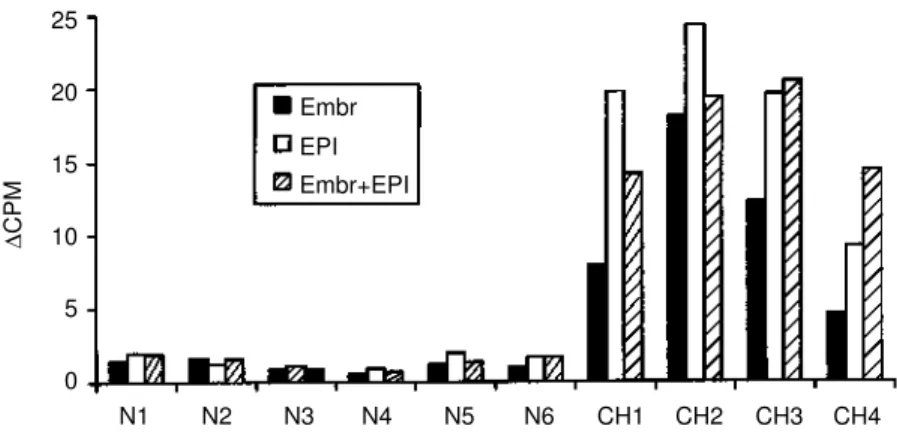
Surprisingly the results indicated that D. maximus embryo’s extract is able to increase the proliferative response of peripheral blood mononuclear cells from patients with Chagas’ disease and not of PBMC from non infected donors (Figure 1).
The data in these experiments lead us to conclude that triatomine’s embryo extract is able to stimulate human PBMC when these cells are from patients with Chagas’ disease, suggesting that there are antigenic epitopes in t r i a t o m i n e e m b r y o c e l l s t h a t c o u l d b e analogous to some of those found on the parasite, which are recognized by the immune system of infected human patients.
To further investigate the immune reactivity to D. maximusembryo extracts, sera from five chagasic patients and six non-infected donors
73
HUMAN IMMUNE RESPONSE TO TRIATOMINE
EMBRYO EXTRACT
Nelson J. Alvarenga, Elisabeth Bronfen, Alessandra L.A. Botelho, Lilian M.G. Bahia-Oliveira, Juliana A.S. Gomes,
Rodrigo Correa-Oliveira and Maria José F. Morato
Dipetalogaster maximus embryo extracts were used to stimulate peripheral blood mononuclear cells (PBMC) and in ELISA with sera either from Trypanosoma cruzi infected or non-infected individuals. The results showed that there was significant proliferative response and high antibody titers in sera of chagasic patients.
Key-words: Dipetalogaster maximus. Trypanosoma cruzi. Triatomine embryo extract. Chagasic immune response.
Laboratório de Biologia de Triatomíneos e Laboratório de Imunologia, Centro de Pesquisas René Rachou/FIOCRUZ, Belo Horizonte, MG.
Supported by PAPES/FIOCRUZ (038).
Address to: Dr. Nelson J. Alvarenga. Centro de Pesquisas René Rachou/FIOCRUZ. Caixa Postal 1743, 30161-970 Belo Horizonte, MG, Brasil. Fax: (031) 295-3115.
Recebido para publicação em 14/06/96.
Revista da Sociedade Brasileira de Medicina Tropical 30(1):73-74, jan-fev, 1997.
were used in ELISA at dilutions starting at 1:40 to 1:160 with the T. cruzi antigen at the concentration of 40µg/ml.
Figure 1 shows increasing of proliferative response of PBMC as previously indicated.
The results have confirmed our previous observations in the proliferation assays showing that antibodies present in sera from chagasic patients react against triatomine’s embryo extract with higher titers than those observed with sera from normal donors, confirming our previous suggestion that chagasic patients develop an immune response that cross-react with D. maximusembryo extract (Table 1).
Table 1- Sera titers of chagasic patients (CH) and non-infected donors (N) against antigens of D. maximusembryo extracts and T. cruzi.
Sera T. cruzi Embr.1:40 Embr. 1:80 Embr. 1:160 CH1 0,411 0,705 0,430 0,211 CH2 1,143 0,384 0,322 0,158 CH3 0,973 0,418 0,238 0,114 CH4 0,841 0,522 0,315 0,151 CH5 1,286 0,397 0,249 0,151 N1 0,139 0,156 0,043 0,024 N2 0,182 0,141 0,088 0,062 N3 0,194 0,198 0,070 0,041 N4 0,132 0,177 0,147 0,083 N5 0,052 0,241 0,108 0,045 N6 0,109 0,159 0,106 0,054
RESUMO
Extratos de embrião de Dipetalogaster maximus foram usados para estimular a proliferação das células mononucleares do sangue periférico humano (PBMC) bem como em ELISA com soro de indivíduos infectados ou não pelo Trypanosoma cruzi. Os resultados mostraram significante proliferação das PBMC e títulos mais elevados nos soros de pacientes chagásicos.
Palavras-chaves: Dipetalogaster maximus. Trypanosoma cruzi. Extrato embrionário de triatomíneo. Resposta imune de chagásicos.
REFERENCES
1. Alvarenga NJ, Morato MJF, Bahia-Oliveira LMG, Gomes JAS, Botelho ALA, Correa-Oliveira R, Bronfen E.Triatomine’s embryo extracts promote growth of culture forms of Trypanosoma cruzi. Revista da Sociedade Brasileira de Medicina Tropical 29:53-54, 1996.
2. Lowry OH, Rosebrough NJ, Farr AL, Randall RJ. Protein measurement with the Folin Phenol Rea gent. Jour nal of Biolog ical Chemistr y 193:265, 1951.
Comunicação. Alvarenga NJ, Bronfen E, Botelho ALA, Bahia-Oliveira LMG, Gomes JAS, Correa-Oliveira R, Morato MJF. Human immune response to triatomine embryo extract. Revista da Sociedade Brasileira de Medicina Tropical 30:73-74, jan-fev, 1997.
74
25
20
15
10
5
0
∆
CPM
N1 N2 N3 N4 N5 N6 CH1 CH2 CH3 CH4
Embr
EPI
Embr+EPI