Maria Noel Marzano Rodrigues PetruzziI
Karen CherubiniII
Fernanda Gonçalves SalumII Maria Antonia Zancanaro de FigueiredoII
I Programa de Pós-Graduação em Odontologia. Faculdade de Odontologia. Pontifícia Universidade Católica do Rio Grande do Sul. Porto Alegre, RS, Brasil II Serviço de Estomatologia e Prevenção do
Câncer Bucomaxilofacial. Hospital São Lucas. Pontifícia Universidade Católica do Rio Grande do Sul. Porto Alegre, RS, Brasil Correspondence:
Maria Antonia Zancanaro de Figueiredo Serviço de Estomatologia e Prevenção do Câncer Bucomaxilofacial
Hospital São Lucas da PUC-RS Av. Ipiranga, 6690 Conjunto 231 Jardim Botânico
90610-000 Porto Alegre, RS, Brasil E-mail: antonia.fi [email protected] Received: 4/18/2012
Approved: 7/23/2012
Article available from: www.scielo.br/rsp
Risk factors of HIV-related oral
lesions in adults
Fatores de risco de lesões bucais
associadas ao HIV em adultos
ABSTRACT
OBJECTIVE: To assess the risk factors in the occurrence of oral lesions in
HIV-positive adults.
METHODS:A retrospective analytical-descriptive survey was conducted using
the medical/dental records of 534 patients with oral lesions associated with HIV. The data were collected from fi ve referral centers for managing HIV and associated comorbidities in the city of Porto Alegre, Southern Brazil, between 1996 and 2011. Using a standardized form, socio-demographic and clinical data were recorded. Exclusively and defi nitively diagnosed oral pathologies were included and classifi ed according to ECC criteria on Oral Problems Related to HIV Infection. For data analysis cross-tabulations, Chi-squared tests and logistic regression models were used where appropriate.
RESULTS: CD4+ counts lower than 350 cells/mm³ (p < 0.001), alcohol
consumption (p = 0.011) and female gender (p = 0.031) were predisposing factors for oral candidiasis. The occurrence of hairy leukoplakia was independently associated with CD4+ counts below 500 cells/mm³, (p = 0.029) a viral load above 5,000 copies/mm³ (p = 0.003) and smoking (p = 0.005).
CONCLUSIONS: Moderate and severe degrees of immunodefi ciency and
detectable viral loads were risk factors for the onset of oral lesions. Smoking and alcohol consumption also increased susceptibility to the development of opportunistic infections in HIV-positive adults from Porto Alegre, irrespective of the use of antiretroviral therapy.
DESCRIPTORS: AIDS-Related Opportunistic Infections, epidemiology.
Porto Alegre, in Southern Brazil, is the city which has the highest incidence of AIDS in Brazil (99.8:100,000 inhabitants) since 2006.a Around 21,000 cases of
this syndrome had been reported reported by 2010 and occurred mostly in adults (98.5%) with a 38.7% mortality rate. HIV/AIDS remains a major public health problem in this city, attributed principally to diagnosis in late stages of the disease, delayed commencement of highly active antiretroviral therapy (HAART) and poor treatment compliment.b
HIV causes the infected host to become susceptible to a wide spectrum of life-threatening secondary infections, malignant neoplasms and other disorders.1 The
devel-opment of oral tissue lesions associated with HIV is a frequent clinical fi nding in Brazil.21 Despite the use of
HAART, more than 50% of HIV/AIDS carriers present opportunistic infections in the oral cavity.10 Especially
oral candidiasis (OC) and hairy leukoplakia (HL) which are considered to be of the utmost importance
RESUMO
OBJETIVO: Analisar fatores de risco para a ocorrência de lesões bucais em
adultos soropositivos para o HIV.
MÉTODOS: Estudo transversal, descritivo analítico de prontuários médicos/
odontológicos de 534 pacientes com lesões bucais associadas ao HIV em Porto Alegre, RS, no período de 1996 a 2011. Os dados foram coletados em cinco centros de referência em saúde para o atendimento de portadores do HIV e comorbidades associadas. Os dados sociodemográfi cos e clínico-laboratoriais foram coletados em formulários padronizados. Foram incluídos dados exclusivamente de lesões com diagnóstico defi nitivo e classifi cadas de acordo com os critérios da ECC on Oral Problems Related to HIV Infection. A análise dos dados foi realizada mediante a aplicação de tabulações cruzadas, teste do Qui-quadrado e modelos de regressão logística.
RESULTADOS: Níveis de CD4+ < 350 células/mm³ (p < 0,001), consumo
de álcool (p = 0,011) e sexo feminino (p = 0,031) foram predisponentes para candidíase bucal. A ocorrência de leucoplasia pilosa foi associada com contagens de CD4+ < 500 células/mm³ (p = 0,029), cargas virais > 5.000 cópias/mm³ (p = 0,003) e tabagismo (p = 0,005).
CONCLUSÕES: Graus de imunodefi ciência moderados e severos e cargas virais detectáveis foram fatores de risco para o desenvolvimento de lesões bucais. O consumo de tabaco e álcool aumentou a suscetibilidade de desenvolver infecções oportunistas em adultos HIV positivos, independentemente do uso de terapia antirretroviral.
DESCRITORES: Infecções Oportunistas Relacionadas com a AIDS,
epidemiologia. Manifestações Bucais. Fatores de Risco. Infecções por HIV. Síndrome de Imunodefi ciência Adquirida. Estudos Transversais.
INTRODUCTION
a Ministério da Saúde. Programa Nacional de Doenças Sexualmente Transmissíveis/AIDS. Bol Epidemiol DST/AIDS. 2011;8(1):3-21. b Secretaria Municipal de Saúde de Porto Alegre, Coordenadoria Geral de Vigilância em Saúde, Equipe de Vigilância de DST. AIDS em Porto Alegre. Bol Epidemiol. 2011;13(45):2-3.
in the diagnosis and prognosis of HIV infection as well as in predicting therapy failure.11,14 An increased risk
of developing HIV-associated oral manifestations in Brazilian samples has been associated with low CD4 counts, high viral load (VL) levels, low income and schooling and addiction to tobacco and alcohol.6,15
However, variations may be expected due to the hetero-geneity of studied populations and the dynamic spread of HIV infection.
It is pertinent to determine the risk factors that lead to the onset of oral pathologies. This knowledge will allow a better understanding of the course of HIV infection and consequently, allow identifi cation of subjects that are at risk of developing oral affections and contributing to prevention and patient management.
adults, especially with regard to VL.21 This study aimed
to assess the risk factors for the occurrence of oral lesions in HIV-positive adults.
METHODS
The survey methodology was based on guidelines for the epidemiological study of oral lesions associated with HIV infection provided by the World Health Organization (WHO).9 We retrospectively reviewed
the records of 534 HIV-positive adults who received medical or dental treatment at fi ve referral health centers in Porto Alegre city, Southern Brazil, between 1996 and 2011. Only the records of subjects that matched prede-termined inclusion criteria were sampled: aged 15 or over, an HIV-positive exam independently confi rmed by two enzyme-linked immunosorbent assay or western blot tests and the occurrence of any oral lesions at the time of the HIV diagnosis or during the course of the disease progression. The obtainability of sociode-mographical, laboratory and clinical data were also considered for inclusion.
The included patients had been previously examined as a part of their routine medical management of HIV or other related illnesses. The oral evaluation of these patients was performed under non standardized physical assets by a non-calibrated infectologists or dentist specialized in oral medicine. The profes-sionals were experienced in the management of HIV seropositive patients and in diagnosing related comor-bidities, including oral manifestations of HIV/AIDS. Only the affections that were defi nitively diagnosed by their clinical features alone or those which were absolutely diagnosed through the completion of addi-tional clinical and laboratory tests, according to the parameters of the WHO9 were included in the current
survey. The data collection was classifi ed according to the criteria of EC-Clearinghouse on Oral Problems Related to HIV Infection.5
Sociodemographic (age, gender, race, marital status, occupation and tobacco, alcohol and illegal drug consumption), clinical (HIV-related oral lesions, anti-retroviral therapy use) and laboratory (quantitative CD4+ cell count and VL) data were recorded using a standardized form. The considered information was that which was determined closest to the date of the oral lesion appearance with a maximum range of six months before and after.3,16
With regard to the risk factors related to an unhealthy lifestyle (use of tobacco, alcohol and illicit drugs), the subjects were classifi ed as users (who reported using legal or illegal substances in a period within six months before the onset of these affections) or non-users (who stopped the consumption of the noxious substances six months before the occurrence of oral lesions), according to data available on medical records.16
Categorical variables were described by counts and percentages with a 95% confi dence interval (95%CI) and binomial distribution. Quantitative variables with symmetrical distribution were described using mean and standard deviation (sd), and the variables with asymmetrical distributions were described using median and percentiles. Comparisons were analyzed using cross-tabulation, the Chi-square test and a multi-variate logistic regression model that was adjusted for confounding factors. P ≤ 0.05 was determined to be statistically signifi cant.
Subject age was treated as a quantitative continuous variable and non-parametrically included in the logistic regression models. The sociodemographic character-istics: gender (reference: masculine), race (reference: Caucasian), alcohol, tobacco and illicit drugs use (refer-ence: non user) were equally considered as nominal and dichotomous. The categorical variables: CD4+ count (≥ 500 cells/mm³, 350 to 500 cells/mm³, < 350 cells/mm³), VL level (> 20,000 copies/mm³, 5,001 to 20,000 copies/ mm³, 51 to 5,000 copies/mm³, ≤ 50 copies/mm³) and HAART use (compliant, noncompliant, not prescribed) were parametrically included in the regression models. The data analyses were performed using the Statistical Package for the Social Sciences (SPSS®, Chicago, IL, USA) version 18.0 software program for Windows. The study was conducted in compliance with the princi-ples of the Helsinski Declaration and in agreement with the Brazilian-specifi c normative for research involving human subjects nº 196/96. It was also approved by the institutional review board of each participating institution Serviço de Estomatologia e Prevenção do Câncer Bucomaxilofacial e Serviço de Infectologia do Hospital São Lucas, Process nº 0092/2010, approved on November 17th, 2010; Centro de Especialidades Odontológicas do Hopital Nossa Senhora da Conceição, Process nº 11/011, approved on March 16th, 2011, Centro de Saúde Vila dos Comerciários,
Process nº 0010003281116, approved on February 8th,
2011 and Centro de Testagem e Aconselhamento do Hospital Sanatório Partenon, approved on April 8th,
2011; CAAE- 0392.0.002.164-11).
RESULTS
Most of the oral lesions were diagnosed at a routine consultation, while 31.5% were observed during hospi-talization. The median of CD4+ counts and VL of the patients sample was 242 cells/mm³ and 4,191 copies/ mm³, respectively (Table 1).
The use of HAART was mentioned in the medical records of 61.0% of patients; of those, 69.3% were in compliance with the treatment at the time of oral lesion occurrence. Poor adherence to the HAART was described in 30.7% of the patients’ records. However, 38.6% had not previously used antiretroviral drugs. A combination of two nucleoside reverse transcriptase inhibitor plus a non-nucleoside reverse transcrip-tase inhibitor (NNRTI) (Lamivudine/Zidovudine plus Efavirenz) were used for 50.0% of the treated individuals. Women were more susceptible to OC
than men (OR 0.66, 95%CI 0.45;0.96, p = 0.031), and OC was also associated with chronic alcohol consumption (OR 2.38, 95%CI 1.22;4.67, p = 0.011). HL (OR 2.85, 95%CI 1.38;5.88, p = 0.005) was strongly associated with tobacco use. No correlations were observed between the different oral lesions and the proposed risk factors in the logistic regression analysis (Tables 2 and 3).
DISCUSSION
Moderate and severe degrees of immunodefi ciency and detectable viral loads were risk factors for the onset of oral lesions, irrespective of the use of HAART in Southern Brazil. Smoking and alcohol consumption contributed to a high susceptibility to the development of these affections in the evaluated subjects.
Table 1. The most prevalent oral lesions with respect to CD4+and VL ranges. Porto Alegre, Southern Brazil, 2012.
Lesion
CD4+(cells/mm³) (n = 534) Viral load (copies/mm³) (n = 534)
< 350 (n = 351)
350-500 (n = 82)
> 500
(n = 101)
50 (n = 158)
51-5,000 (n = 118)
5,001-20,000 (n = 92)
> 20,000 (n = 166)
f % f % f % f % f % f % f %
OC 207 59.0 37 45.1 23 22.8 48 30.4 62 52.5 57 62.0 100 60.2
HL 42 12.0 10 12.2 1 1.0 5 3.2 8 6.8 22 23.9 18 10.8
KS 10 2.8 2 2.4 0 0.0 3 1.9 2 1.7 1 1.1 6 3.6
HSI 24 6.8 3 3.7 18 17.8 15 9.5 12 10.2 6 6.5 12 7.2
AOU 21 6.0 9 11.0 7 6.9 13 8.2 10 8.5 6 6.5 8 4.8
MP 10 2.8 4 4.9 12 11.9 14 8.9 7 5.9 2 2.2 3 1.8
LYM 45 12.8 14 17.1 9 8.9 22 13.9 12 10.2 10 10.9 24 14.5
OC: oral candidiasis (all types); HL: hairy leukoplakia; KS: Kaposi's sarcoma; HSI: herpes simplex infection; AOU: atypical oral ulceration; MP: melanocytic pigmentation; LYM: lymphadenitis
Table 2. Logistic regression models for oral candidiasis. Porto Alegre, Southern Brazil, 2012.
Variable Univariate analysis Multivariate analysis
n OR 95%CI p OR 95%CI p
CD4+ (cells/mm3)
> 500 (reference) 23 1 1
350 to 500 37 2.79 1.47;5.27 0.002 2.47 1.26;4.84 0.009
< 350 207 4.88 2.92;8.13 < 0.001 3.82 2.16;6.77 < 0.001
VL (copies/mm³)
50 (reference) 48 1 1
51-5,000 62 2.54 1.55;4.16 < 0.001 1.63 0.88;3.03 0.124
5,001-20,000 57 3.73 2.17;6.41 < 0.001 1.99 0.90;4.37 0.089
> 20,000 100 3.47 2.19;5.50 < 0.001 1.53 0.70;3.36 0.290
HAART
Compliant (reference) 66 1 1
Noncompliant 120 3.11 1.91;5.07 < 0.001 1.74 0.86;3.50 0.124
Not prescribed 81 2.70 1.83;3.99 < 0.001 1.70 0.90;3.20 0.103
OR: odds ratio obtained in a logistic regression model including the following terms: age, gender (male), race (Caucasian),
No previous studies which evaluated a sample with similar characteristics or with the same scope had been conducted previously in this city, which has the greatest incidence of AIDS in Brazil.a One report evaluated the
associations among HIV-associated oral lesions and CD4+ counts in 42 adults, inpatients, carriers of HIV and tuberculosis from Porto Alegre.21 The literature on
this subject is scarce in the state.6,10
OC and HL have been associated with HIV since the beginning of the epidemic, but their prevalence has decreased after HAART began to be used.This fact is attributed to immune reconstitution accomplish-ment after viral replication cessation due to the use of HAART.14 Our data indicate that OC and HL were the
most common opportunistic infections, even among treated patients. These results confi rm previous esti-mates obtained in surveys from Porto Alegre21 and other
Brazilian reports.14,15
The univariate analyses showed that the subjects with moderate (OR 2.79, 95%CI 1.47;5.27, p = 0.002) and severe (OR 4.88, 95%CI 2.92;8.13, p < 0.001) degrees of immunosuppression were more susceptible to devel-oping OC than those with mild or no immunologic impairment. These associations were also found in the multivariate analyses adjusted for several confounding factors, which demonstrated that patients with CD4+ counts between 350 and 500 cells/mm³ (OR 2.47, 95%CI 1.26;4.84, p = 0.009) and under 350 cells/mm³ (OR 3.83, 95%CI 2.16;6.77, p < 0.001) had a statisti-cally signifi cantly increased risk of developing OC than those with CD4+ counts higher than 500 cells/mm³. Our data did not support the results of Volkweis et al in relation to the association between OC occurrence and
immunosuppression.21 Similar fi ndings were reported
by Aleixo et al2 and Lourenço & Figueiredo.8
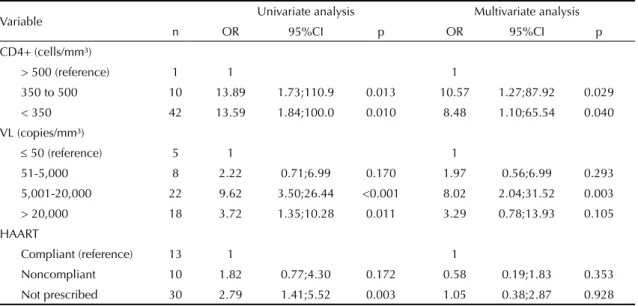
A mild immunologic impairment (CD4+350 to 500 cells/mm³) was suffi cient to increase the risk of devel-oping HL nearly 11-fold (OR 10.57, 95%CI 1.27;87.92, p = 0.029). The multivariate logistic regression model showed that immunologic defi ciency could be consid-ered to be an independently associated risk factor for the onset of these lesions, and similar statistics from Brazil confi rm this hypothesis.11,18 Moura et al12 which
assessed the risk factors for HL in HIV-positive adults from Brazil, did not fi nd a relationship between CD4+ counts and this opportunistic infection. Among the 53 carriers of HL observed, one presented CD4+ counts above 500 cells/mm³. The heterogeneous distribution of the sample may be responsible for the high OR values (Table 3).
The univariate model (Table 2) suggested that detect-able VL (> 50 copies/mm³) was a risk factor for OC compared with undetectable circulating HIV-RNA. When this association is investigated together with CD4+ counts and use of HAART in a multivariate analysis, detectable VL did not augment the suscep-tibility of developing this fungal infection. Of the 267 patients who developed OC, 100 presented circu-lating HIV-RNA levels that were higher than 20,000 copies/mm.³ Despite the absence of signifi cance, the VL range of 5,001 to 20,000 copies/mm³ increased the risk of developing OC nearly 2-fold. Yielded the p (p = 0.089) and the extensive confi dence interval (0.90;4.37), the correlation between elevated VL and OC could not be conclusively excluded, despite the sample size and elevated number of adjustment factors.
Table 3. Logistic regression models for hairy leukoplakia. Porto Alegre, Southern Brazil, 2012.
Variable Univariate analysis Multivariate analysis
n OR 95%CI p OR 95%CI p
CD4+ (cells/mm³)
> 500 (reference) 1 1 1
350 to 500 10 13.89 1.73;110.9 0.013 10.57 1.27;87.92 0.029
< 350 42 13.59 1.84;100.0 0.010 8.48 1.10;65.54 0.040
VL (copies/mm³)
50 (reference) 5 1 1
51-5,000 8 2.22 0.71;6.99 0.170 1.97 0.56;6.99 0.293
5,001-20,000 22 9.62 3.50;26.44 <0.001 8.02 2.04;31.52 0.003
> 20,000 18 3.72 1.35;10.28 0.011 3.29 0.78;13.93 0.105
HAART
Compliant (reference) 13 1 1
Noncompliant 10 1.82 0.77;4.30 0.172 0.58 0.19;1.83 0.353
Not prescribed 30 2.79 1.41;5.52 0.003 1.05 0.38;2.87 0.928
OR: odds ratio obtained in a logistic regression model including the following terms: age, gender (male), race (Caucasian),
HL was directly infl uenced by the progression of the infection. A VL level between 5,001 to 20,000 copies/ mm³ was independently associated with an augmented risk of developing HL (OR 8.02, 95%CI 2.04;31.52, p = 0.003) in the multivariate analysis. A longitudinal prospective study from Mexico, which provided the
fi rst follow-up evaluation of the association of OC and HL with CD4+ counts and VL levels, showed that the occurrence of these pathologies is preceded by a sustained reduction of lymphocyte counts and an abrupt viral burden.16
Individuals with high VL levels may present a complete depletion of mucosal Langerhans cells, and this localized cytopathic effect causes the impairment of mucosal immunologic protection. This cellular event is associated with fungal and viral colonisation events (especially Epstein-Barr) in HIV-positive patients.5 The
salivary levels of HIV-RNA may be higher than the plasma levels if they are enhanced by local infl amma-tory conditions, which leads to the increased prevalence of oral manifestations.17
We acquired data from medical charts and the labora-tory index considered included six-month intervals before and after the appearance of oral lesions. It is possible that elevations in VL levels and decreases in CD4+ cell count were not temporally coincident.3
The present study did not fi nd that OC and HL were inversely and signifi cantly associated with HAART use. This result is in contrast with other studies, which effectively considered these therapeutic agents as protection factors against oral lesions.14,16 Most patients
who received HAART were treated with a drug combi-nation that contained an NNRTI (Efavirenz). Ortega et al14 and da Silva et al18 observed a lower prevalence
of oral lesions in patients undergoing HAART with NNRTI than patients who were treated with protease inhibitors. Therapy failure due to ineffectiveness or inadequate compliance, which was elevated among the observed patients,may explain our results.
The chronic consumption of alcoholic drinks was considered to be a risk factor for OC occurrence (OR = 2.38; CI = 1.22 to 4.67; p = 0.011), and the patients who smoked had the highest risk of developing HL (OR = 2.85; CI = 1.38 to 5.88; p = 0.005), which was independent of their CD4+counts and VL levels.
Candida albicans oxidizes salivary ethanol, which leads to a high level of acetaldehyde production. This product affects the oral mucosa by augmenting its permeability, causing atrophic areas on the surface of the epithelia that became poor in extracellular lipids due to alcohol use. Glucose concentrations of 18 g/dL easily obtained from drinks increase biofi lm formation and
C.albicans adhesion, which facilitates OC occurrence.20
The components of cigarette smoke may induce chronic infl ammation on the oral mucosae, cause damage to the innate immunity mechanisms against pathogens and inhibit cell growth by apoptosis mechanisms. These effects of smoking reduce the production of salivary enzymes and immunoglobulins and affect the production of lymphocytes, resulting in an imbalance of the oral microfl ora. These modifi cations probably encourage EBV infectivity, promoting the occurrence of HL.7
Female gender was associated with OC occurrence. Lourenço & Figueiredo8 described the same fi nding in
Brazilian patients. The relationship between feminine sexual hormones and oral fl ora remains unclear. Down-regulated levels of oestrogen would predispose the oral mucosae to C.albicans colonization. This hormone acted as a protection factor for vaginal candidiasis,13 possibly
in lower levels of oestrogen both tissues, oral and vaginal remain more susceptible to fungal infections.
A wide spectrum of oral diseases have been associated with HIV/AIDS since the beginning of the epidemic.5
The onset of certain affections can provide valuable clinical information on HIV progression.8 Several
of these manifestations can be accurately diagnosed based exclusively on their clinical features.5,9 Oral
examination is an inexpensive and simple procedure and should be mandatory for HIV carriers, especially in low-income settings.19
The limitations of our study are inherent to data collec-tion from medical records not explicitly designed to explore HIV-associated oral lesions. Oral lesions may be under-reported, leading to a sub-estimation of prevalence. Both HIV carriers and AIDS patients were included. This fact would have also infl uenced the prevalence of some oral affections. Some condi-tions have a stronger association with HIV-infection and a few are defi nitively AIDS defi ning, possibly due to local and systemic immune variations.4,17
Symptomatic individuals are most at risk of being affected by other systemic opportunistic diseases, which possibly enhanced the risk of developing certain oral affections.18 Furthermore, we reported data from
a single evaluation.
use of oral opportunistic infections as early clinical markers of disease progression and HAART failure. This validation is of great importance in countries with limited resources, and there are limited data available from the developing world.
The results suggest that elevated VL levels and low CD4+ counts are risk factors for HL. Moderate to severe degrees of immunologic impairment increased the susceptibility of developing OC and HL in adult carriers of HIV. It is necessary to improve prevention, early diagnosis and the management of these patholo-gies in symptomatic patients, who are more susceptible
1. Adurogbangba MI, Aderinokun GA, Odaibo GN, Olaleye OD, Lawoyin TO. Oro-facial lesions and CD4 counts associated with HIV/ AIDS in an adult population in Oyo State,
Nigeria. Oral Dis. 2004;10(6):319-26.
DOI:10.1111/j.1601-0825.2004.01036.x
2. Aleixo RQ, Scherma AP, Guimarães G, Cortelli JR, Cortelli SC. DMFT index and oral mucosal lesions associated with HIV infection: cross-sectional study in Porto Velho, Amazonian region
- Brazil. Braz J Infect Dis. 2010;14( 5):449-56.
DOI:10.1590/S1413-86702010000500005
3. Carpio E, López V, Fardales V, Benítez I. Oral manifestations of HIV infection in adult patients from the province of Sancti Spiritus,
Cuba. J Oral Pathol Med. 2009;38(1):126-31.
DOI:10.1111/j.1600-0714.2008.00716.x
4. Chou LL, Epstein J, Cassol SA, West DM, He W, Firth JD. Oral mucosal Langerhans’ cells as target, effector and vector in HIV infection.
J Oral Pathol Med. 2000;29(8):394-402. DOI:10.1034/j.1600-0714.2000.290805.x
5. Classifi cation and diagnostic criteria for oral lesions in HIV infection. EC-Clearinghouse on Oral Problems Related to HIV Infection and WHO Collaborating Centre on Oral Manifestations of the Immunodefi ciency
Virus. J Oral Pathol Med. 1993;22(7):289-91.
DOI:10.1111/j.1600-0714.1993.tb01074
6. Gasparin AB, Ferreira FV, Danesi CC, Mendoza-Sassi RA, Silveira J, Martinez AM, et al. Prevalência e fatores associados às manifestações bucais em pacientes HIV positivos atendidos em cidade
sul-brasileira. Cad Saude Publica. 2009;25(6):1307-15.
DOI:10.1590/S0102-311X2009000600013
7. Lee J, Taneja V, Vassallo R. Cigarette smoking and infl ammation: cellular and molecular
mechanisms. J Dent Res. 2012;91(2):142-9.
DOI:10.1177/0022034511421200
8. Lourenço AG, Figueiredo LTM. Oral lesions in HIV
infected individuals from Ribeirão Preto, Brazil. Med
Oral Patol Oral Cir Bucal. 2008;13(5):E281-6.
9. Melnick SL, Nowjack-Raymer R, Kleinman DV, Swango PA. A guide for epidemiological studies of oral manifestations of HIV infection. Geneva: World Health Organization; 1993.
10. Michelim L, Atti JL, Panarotto D, Lovatto L, Boniatti MM. Dermatoses em pacientes infectados pelo HIV com a contagem de linfócitos
CD4. Rev Saude Publica. 2004;38(6):758-63.
DOI:10.1590/S0034-89102004000600002
11. Miziara ID, Weber R. Oral candidosis and oral hairy leukoplakia as predictors of HAART failure in Brazilian
HIV-infected patients. Oral Dis. 2006;12(4):402-7.
DOI:10.1111/j.1601-0825.2005.01214.x
12. Moura MDG, Grossmann SMC, Fonseca LMS, Senna MIB, Mesquita RA. Risk factors for oral hairy leukoplakia in HIV-infected adults of
Brazil. J Oral Pathol Med. 2006;35(6):321-6.
DOI: 10.1111/j.1600-0714.2006.00428.x
13. Nwokolo NC, Boag FC. Chronic vaginal candidiasis:
management in the postmenopausal patient. Drugs
Aging. 2000;16(5):335-9.
14. Ortega KL, Vale DA, Magalhães MH. Impact of PI and NNRTI HAART-based therapy on oral lesions of Brazilian HIV-infected patients.
J Oral Pathol Med. 2009;38(6):489-94. DOI:10.1111/j.1600-0714.2009.00783.x
15. Pinheiro A, Marcenes W, Zakrzewska JM, Robinson PG. Dental and oral lesions in HIV infected patients: a
study in Brazil. Int Dent J. 2004;54(3):131-7.
16. Ramírez-Amador V, Anaya-Saavedra G, Calva JJ, Clemades-Pérez-de-Corcho T, López-Martínez C, González-Ramírez I, et al. HIV-related oral lesions, demographic factors, clinical staging and
anti-retroviral use. Arch Med Res. 2006;37(5):646-54.
DOI:10.1016/j.arcmed.2006.01.002
17. Shugars DC, Sweet SP, Malamud D, Kazmi SH, Page-Shafer K, Challacombe SJ. Saliva and inhibition of
HIV-1 infection: molecular mechanisms. Oral Dis.
2002;8(Suppl 2):169-75.
18. Silva CA, Dourado I, Dahia SR, Harzheim E, Rutherford GW. Oral manifestations of HIV infection in patients receiving highly active antiretroviral therapy (HAART)
in Bahia, Brazil. J Public Health Dent.
2008;68(3):178-81. DOI:10.1111/j.1752-7325.2007.00071.x
19. Taiwo OO, Okeke EN, Jalo PH, Danfi llo IS. Oral manifestations of HIV/AIDS in Plateau state indigenes,
Nigeria. West Afr J Med. 2006;25(1):32-7.
20. Uittamo J, Siikala E, Kaihovaara P, Salaspuro M, Rautemaa R. Chronic candidosis and oral cancer in APECED-patients: production of carcinogenic acetaldehyde from glucose and ethanol by
Candida albicans. Int J Cancer. 2009;124(3):754-6.
DOI:10.1002/ijc.23976
21. Volkweis MR, Rocha RS, Leonardo LN, Wagner JCB. Lesões bucais manifestadas em pacientes aidéticos e tuberculosos, relacionados com a contagem celular CD4+/CD8+. PGR: Pos graduaçao em revista
Pos-Grad Rev Fac Odontol São José dos Campos. 2001;4(3):74-82.
REFERENCES
Master degree's thesis presented on March 9th, 2012 at Progr ama de Pós-Graduação em Odontologia – Pontifícia Universidade Católica do Rio Grande do Sul.