Revista Gaúcha
de Enfermagem
How to cite this article:
Salvador PTCO, Costa TD, Gomes ATL, Assis YMS. Patient safety: characterization of YouTube videos. Rev Gaúcha Enferm. 2017 mar;38(1):e61713. doi: http://dx.doi. org/10.1590/1983-1447.2017.01.61713.
doi: http://dx.doi.org/10.1590/1983-1447.2017.01.61713
Patient safety:
characterization of YouTube videos
Segurança do paciente: caracterização de vídeos do YouTube
Seguridad del paciente: caracterización de los vídeos de YouTube
a Universidade Federal do Rio Grande do Norte (UFRN), Escola de Saúde. Natal, Rio Grande do Norte, Brasil.
b Universidade Federal do Rio Grande do Norte (UFRN), Programa de Pós-Graduação em Enferma-gem. Natal, Rio Grande do Norte, Brasil.
Pétala Tuani Candido de Oliveira Salvadora
Theo Duarte da Costaa
Andréa Tayse de Lima Gomesb
Yole Matias Silveira de Assisb
Viviane Euzébia Pereira Santosb
ABSTRACT
Objective: To describe how patient safety is addressed in YouTube videos
Methods: descriptive study with a quantitative approach. Data was collected in May 2015, at YouTube’s search field, with descriptor “patient safety”. The sample included 92 videos, which were analyzed using descriptive statistics.
Results: The videos showed a positive concept of patient safety, based on a systemic vision that attempts to eliminate the traditional punitive culture by promoting a culture of safety.
Conclusions: The use of videos containing high quality information may improve the training process of health students and profes-sionals, as well as raise the individuals’ awareness of the importance of their participation in safety issues.
Keywords: Patient safety. Nursing research. Webcasts. RESUMO
Objetivo: Descrever como a segurança do paciente é abordada nos vídeos compartilhados pelo sítio YouTube.
Métodos: Pesquisa descritiva, de abordagem quantitativa. A coleta de dados foi realizada em maio de 2015, no campo de busca do YouTube com o descritor “segurança do paciente”. A amostra foi de 92 vídeos analisados com auxílio de instrumento construído pelos pesquisadores a partir de estatística descritiva simples.
Resultados: Os vídeos denotaram um conceito positivo acerca da segurança do paciente, pautado em uma visão sistêmica, que busca superar a cultura de punição em prol da promoção da cultura de segurança.
Conclusões: Compreende-se que a seleção e a reprodução adequada de vídeos pode qualificar o processo formativo de estudantes e profissionais de saúde, além de otimizar o envolvimento do cidadão em sua segurança a partir da distribuição de materiais infor-macionais de qualidade.
Palavras-chave: Segurança do paciente. Pesquisa em enfermagem. Webcasts. RESUMEN
Objetivo: describir cómo se aborda la seguridad del paciente en los vídeos compartidos por el sitio YouTube.
Métodos: investigación descriptiva, enfoque cuantitativo. Los datos se recolectaron en mayo de 2015, en el campo de búsqueda de YouTube con el descriptor “seguridad del paciente”. La muestra fue de 92 videos y fueron analizados con la ayuda del instrumento construido por los investigadores por estadística descriptiva simple.
Resultados: los videos presentan un concepto positivo sobre la seguridad del paciente, basado en una visión sistémica, que pretende superar la cultura del castigo para la promoción de la cultura de la seguridad.
Conclusiones: la selección y la reproducción correctas de vídeos pueden calificar el proceso formativo de los estudiantes y profe-sionales de la salud, así como optimizar la participación de los ciudadanos en su seguridad a partir de la distribución de material informativo de calidad.
INTRODUCTION
Concern for patient safety has become a priority in the health area in the past decades. Although health care brings benefits to the subjects involved, adverse events may occur causing severe consequences and even death(1).
Human errors and patient safety in the health system have been discussed in several situations, e.g. in the re-port entitled “To Err is Human” released by the Institute of Medicine (IOM), of the United States, showing that adverse events in health result in more deaths in that country than road traffic accidents, breast cancer and Acquired Immune Deficiency Syndrome (AIDS)(2).
The release of this report has generated worldwide repercussions, resulting in the project World Alliance for Patient Safety, launched by the WHO in October 2004. It is believed that this important initiative will act as a major force for patient safety improvement across the world(3).
For this purpose, in 2010, the WHO defined patient safety as the reduction of risk or unnecessary harm asso-ciated with healthcare to an acceptable minimum(3). Thus, understanding the concept of patient safety is indispens-able for determining the size of the problem and gaining greater insight into the various factors involved.
To ensure the delivery of safe care it is of paramount importance that a patient safety culture is developed in universities and technical high school courses. There-fore, several technological resources are widely used to facilitate the teaching-learning process about patient safety in educational institutions, particularly the use of audiovisual materials, such as videos available via the internet.
Thus, the increasing use of Information and Communi-cation Technologies (ICT) in the teaching-learning process can promote the development of new educational meth-ods. Computing resources are a valuable tool for support-ing teachsupport-ing and learnsupport-ing, both in traditional face-to-face classes or in virtual classroom environment(4).
However, users must be able to select the best quality content. Among the sources of information available on the network, there is YouTube, the largest free video-shar-ing website (www.youtube.com).
YouTube is a very popular free video sharing site and a virtual space where people can share and download any videos made available to the public.
Since YouTube has not only educational purposes, it may offer materials unsuitable for teaching and learning,
since most content is delivered by non-expert individu-als. However, videos that offer outstanding contributions to teaching, research and care practice can be accessed through a careful search(5).
Therefore, despite the limitations of this tool, some vid-eos may stimulate debate and the development of critical thinking(5). Moreover, with YouTube, users can integrate in-ternet available content offered by data networks to the traditional education model.
Given the wide range of applications of technological resources to assist the teaching-learning process in edu-cational institutions, with emphasis to videos available on the internet, the justification for this study is the need to assess the accuracy and reliability of YouTube videos on patient safety.
Also, it is important to note that YouTube videos are con-stantly accessed by healthcare workers or students. Thus, the distribution of quality materials may contribute to the sec-ond axis of Brazil’s National Patient Safety Program (PNSP), which promotes individual’s awareness of personal safety(6).
Therefore, the following research question was formu-lated: how is patient safety addressed in YouTube videos? In an attempt to answer this question, the present study aimed to describe how patient safety is addressed in You-Tube videos.
METHODS
This is a descriptive study with quantitative approach, carried out on YouTube video sharing website: www.you-tube.com. This site was selected because it is the most popular site for sharing and viewing videos.
For the study, a research protocol adapted from instru-ments validated by similar studies(7-11) was used. It consisted of the following elements: Research topic; Guiding questions; Objective; Research strategy; Selection of studies; Critical assessment of the studies and presentation of the results.
The search for videos on YouTube website was con-ducted in May 2015, through controlled descriptor “Pa-tient Safety” – extracted from Health Sciences Descriptors (DeCS). Filters offered by the site “type of result” – only “vid-eos”; and “duration time” – with short duration (less than 4 minutes) were used.
Most videos accessed by YouTube users are short. Thus, because they are more likely to be watched, short videos on patient safety were selected(8-9) in this sample.
After this step, the selected links were visited and the pre-selected videos were carefully analyzed in an undetermined site, since there is no restriction of ac-cess to videos from different sites, like in some other search portals.
Use of Patient Safety controlled descriptor on the YouTube search field resulted in a total of 12,400 videos. Figure 1 shows the steps taken to elucidate the final re-search sample: 92 videos, which corresponds to 0.7% of the initial figure.
The videos were individually analyzed, and the
fol-lowing inclusion criteria were established:videos
spe-cifically targeted at patient safety and in Portuguese language. Videos that did not contemplate the topic of the study/ or did not answer the guiding questions, duplicate videos, as well as long and medium videos were excluded.
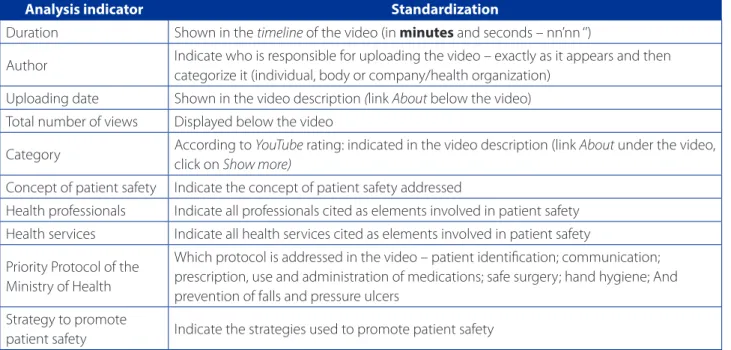
A Microsoft Excel 2010 spreadsheet was elaborated for data tabulation. The analyzed indicators are detailed in Chart 1.
Figure 1 – Flowchart of video collection and analysis, in absolute values. Natal, RN, 2015
Source: Research data, 2015
12,400 videos
• YouTube’s search field, with descriptor “Patient Safety”
92 videos
• Final sample after analysis of inclusion and
exclusion criteria
500 videos
• Links provided by the website 9,540 videos
• Use of website filters: short videos
445 videos
• Exclusion of duplicated videos 154 videos
• Pre-selection through the titles
Analysis indicator Standardization
Duration Shown in the timeline of the video (in minutes and seconds – nn’nn ‘’)
Author Indicate who is responsible for uploading the video – exactly as it appears and then
categorize it (individual, body or company/health organization)
Uploading date Shown in the video description (link About below the video)
Total number of views Displayed below the video
Category According to YouTube rating: indicated in the video description (link About under the video,
click on Show more)
Concept of patient safety Indicate the concept of patient safety addressed
Health professionals Indicate all professionals cited as elements involved in patient safety
Health services Indicate all health services cited as elements involved in patient safety
Priority Protocol of the Ministry of Health
Which protocol is addressed in the video – patient identification; communication; prescription, use and administration of medications; safe surgery; hand hygiene; And prevention of falls and pressure ulcers
Strategy to promote
patient safety Indicate the strategies used to promote patient safety
Chart 1 – Analysis indicators of analysis and respective standardization. Natal, RN, 2015
Data was analyzed with the use of descriptive statis-tics, according to absolute and relative frequencies. Ethics committee approval was not required because the study did not directly involve human participants and used public information.
RESULTS
The videos that composed the final sample of the sur-vey totaled 03h04m55s of analyzed content, with an aver-age of 02m01s of duration.
Most videos were uploaded by companies/health or-ganizations (52, 56.5%) and in the category People and Blogs (24; 25.9%) The period ranged from 2009 to 2015, and most videos on the topic were downloaded from 2013 on: 78% (82) of the videos were released in the last three years (2013 to 2015).
The 92 videos analyzed were viewed 171,084 times, with an average of 1,860 views per video, revealing a signif-icant dissemination of the content portrayed.
Concerning the concept of patient safety elucidated in the videos, emphasis was given to prevention of adverse events in the health environment (10, 10.9%), the search for contin-uous improvement (8; 8.8%), the delivery of high quality care (2; 2.2%) and the implementation of protocols (2; 2.2%). Other related elements were improvement of health processes and actions; logistic control; consolidation of patient protection actions and implementation of evidence-based assistance.
Regarding the health professionals involved in the de-livery of patient safety, the following professionals were cited as follows: nursing team (20; 21.8%); physician (11; 12.0%); pharmacist (7; 7.7%); manager (4; 4.4%); dentist (2; 2.2%) and physiotherapist (1; 1.1%). Thirteen videos (14.1%) demonstrated that the multidisciplinary team is responsi-ble for promoting patient safety.
The hospital environment was predominantly por-trayed in the videos as the primary space to promote pa-tient safety (51, 55.4%). The Basic Health Unit was cited in only two videos (2.2%) and the dental office in only one video (1.1%).
Analysis of the priority protocol of the Ministry of Health referred to in the videos showed the predomi-nance of protocol 3, “Improving safety in the prescrip-tion, use and administration of drugs” (29; 31.5%), and protocol 6, “Reduce the risk of falls and pressure ulcers “(21; 22.8%) (Figure 2).
In addition to the use of priority protocols of the Ministry of Health, the following strategies to promote patient safety were stressed: use of checklists and oth-er standardization tools (14; 15.2%); incorporation of health technologies (8; 8.8%); Professional qualification (8; 8.8%); reporting and traceability of adverse events (6; 6.6%); adequate records of health professionals (6; 6.6%); quality management (4; 4.4%); implementation of Patient Safety Centers (4; 4.4%); teamwork (3; 3.3%); patient participation (3; 3.3%); establishment of a
cul-Figure 2 – Protocols of the Ministry of Health mentioned in the videos, in absolute values. Natal, RN, 2015
Source: Research data, 2015.
0 5 10
21
11
13
11
29
18
15 20 25 30 35
Prevention of falls and pressure ulcers
Hand hygiene
Safe surgery
Prescription, use and administration of drugs
Effective communication
ture of safety (2; 2.2%) and safe training of future health professionals (2; 2.2%).
DISCUSSION
The internet is a wide source of information that signifi-cantly integrates people’s daily lives(7), revealing the wide range of web-published materials. Also, there is a new way to interact and generate content from the so-called web 3.0 interface(7).
It is of utmost importance, therefore, to pay attention to the fact that anyone can use websites like YouTube to get access to various types of information(7), particularly regard-ing healthcare aspects.
Classified as a distribution platform for content, You-Tube allows countless users to view and share home or professional videos(8). This website is a sort of database of audiovisual products, and is considered the most popular video-sharing website and hence is a valuable tool for the contemporary society(9).
Obviously, YouTube videos can be a tool that contrib-utes to the population teaching-learning process, as long its use is carefully planned to meet specific goals, since there is no strict control over the content uploaded on the referred website.
When patient safety is addressed, it is important to ana-lyze the videos run on YouTube on this topic to gain insight on the media repercussions, which is often addressed in an attractive but not very enlightening way regarding the potential prevention strategies.
It should also be noted that the distribution of high quality materials can be a unique strategy that contrib-utes to the second axis of Brazil’s Patient Safety National Program (PNSP), which promotes individual’s awareness of personal safety(6).
The fact that only 0.7% of the total videos initial-ly obtained were related to the topic patient safety, as well as the existence of several videos classified in categories unrelated to the desired content, reveals limitations of the site used. Therefore, users must be attentive to the quality of the content conveyed, since a strict analytical process is required to filter all the in-appropriate material resulting from the search with the descriptor “patient safety”.
This limitation of the YouTube website was also de-scribed by other studies that attempted to analyze health-care topics (10-11), demonstrating the importance of building useful filters for website searches, as well as the quality con-trol of videos, in order to optimize their use.
On the other hand, the existence of 92 videos on the desired topic, which totaled more than three hours of shared content, and 171,084 views, indicates a growing concern with the production of audiovisual material on patient safety, aimed to improve the educational process related to safe care.
Some studies demonstrate the importance of the educational process to promote a culture of safety. It was concluded that the students who were introduced to this theme recognized its importance for their educa-tion, and identified its major impact on patient care(12). In this process, educational videos may represent an addi-tional and motivating element for the learning of all the individuals involved – students, professionals and users of health services.
Thus, in line with the idea that patient safety should be addressed according to a systemic vision that integrates teaching, care practice and research, there is a concern with the production and dissemination of videos by com-panies and health organizations, particularly videos shared by universities and reference hospitals.
It was also observed that 78% of the analyzed videos were released in the last three years (2013 – 2015), which can be related to the launching of the National Patient Safety Program, in Brazil, in 2013, which encourages the insertion of the topic in health settings and defines the following priority actions: patient identification; effective communication; prescription, use and administration of medications; safe surgery; hand hygiene and prevention of falls and pressure ulcers(6).
Encouragingly, the concept of patient safety por-trayed in the analyzed YouTube videos corroborates the concern with replacing a traditional punitive culture, ac-cording to which health professionals are held entirely re-sponsible for adverse events with a non-punitive culture of patient safety.
It is understandable, therefore, that the establishment of regulatory standards and mechanisms not accomnied by institutional and structural changes regarding pa-tient safety is insufficient(13).
Thus, the analyzed videos contribute to the dissem-ination of a broader vision of patient safety, focusing on aspects such as continuous improvement, promotion of quality care and enforcement of protective actions.
In contrast, the literature has already proven the harmful effect of a poor understanding of patient safety. A study conducted in China aimed to describe percep-tions of the patient safety climate in public hospitals in Shanghai, concluded that the “fear of shame” and “fear of guilt” could be significant obstacles to the improvement of patient safety(15).
Moreover, a study carried out in Spain to assess the ef-fect of adverse events on health workers concluded that these professionals were the second victims after adverse patient events, and their most common emotional re-sponses were feelings of guilt (521 – 58, 8%), anxiety (426 – 49.6%), reliving the event (360 – 42.2%) and feeling of disorientation, confusion and difficulty concentrating at work (260 – 29.9%). The referred study concluded that this situation could be related to the fact that Spanish health professionals rarely receive any formal training on strate-gies to cope with this phenomenon(16).
Regarding the professionals cited as involved in the pro-motion of patient safety, it is noteworthy that only 14.1% of the videos mentioned the multidisciplinary team and only 4.4% emphasized the participation of the managers.
Teamwork should be understood as a guiding ele-ment in patient safety actions, so that the actions tak-en by all those involved in the healthcare process are based on a culture of safety, understood as the product of individual and group values, attitudes, skills and be-havioral patterns, which determine the commitment, style and proficiency in management of a healthy and safe organization(14).
The nursing team, however, was the most cited in the videos – 21.8%. In this regard, the literature emphasizes the significant participation of nursing professionals in patient safety, because of its major role in the delivery of safe care, due to their prolonged contact with the same patients and the characteristics of their interventions, making them more susceptible to commit errors and fail to promote pa-tient safety(17).
Thus, the participation of the nursing staff in all care processes, as well as their involvement with the multidis-ciplinary healthcare team requires formal training aimed to provide these workers with the necessary skills to promote high quality and care and patient safety(17).
Regarding the healthcare services cited as elements involved in patient safety, 55.4% of the videos highlighted
the hospital environment. The researchers emphasized that hospitals account for a significant and complex share of the healthcare provided to patients and that studies in hospitals in several countries have shown the associ-ation between the occurrence of adverse events and hospitalization, so that adverse events that cause harm to patients increase the length of hospital stay, mortality and hospital costs(3).
However, it should be stressed, that concern for pa-tient safety should not be restricted to high complexity services, since most healthcare is provided outside hospi-tal environments and many safety incidents identified in hospitals actually originate in primary care and in medi-um complexity services.
Regarding the priority protocol of the Ministry of Health to which the videos referred, 31.5% of the sample cited protocol 3 – “Improve safety in prescription, use and administration of medications”. The errors associated to medication systems are portrayed as the most common types of adverse events related to hospitalization, affect-ing a large number of people and significantly increasaffect-ing health system costs(3).
They are also the adverse events most disseminated in the media, mostly related to nursing professionals, since these workers are directly or indirectly involved in all stages of the medication process.
The strategies for promotion of patient safety portrayed by YouTube videos are in line with the literature’s systemic view of the subject, which suggests that the Safety Com-petencies model proposed by the Canadian Patient Safety Institute, in 2008, can support the training of health profes-sionals in the culture of safety, based on six basic domains: contribute to the patient safety culture; work in teams; communicate effectively; manage security risks; optimize human and environmental factors and recognize, respond to and reveal adverse events(12).
The use of protocols is considered an essential strategy, and planning is a priority step. Thus, identification of safety incidents is a challenge to be faced, which is critical to the improvement of patient safety.
Moreover, the administration of checklists and other standardization tools are stressed as effective strategies for safe care. A study carried out in India showed that the im-plementation of a modified checklist on surgical safety was associated with decrease in mortality and in the number of complications. Mortality was significantly lower when this checklist was implemented(18).
pro-tocols and lack of knowledge of health professionals were the main causes of adverse events, and an intervention consisting in the implementation of protocols significantly reduced medication errors(19).
Finally, the importance of the participation of pa-tients in self-care is emphasized. A study on the active participation of hospitalized patients in their therapy obtained a positive association between hospitalized patients’ participation in their own care and a favorable judgment about the quality of care received, and reduc-tion in the risks of these patients experiencing an ad-verse event during hospitalization(20).
Therefore, the release of high quality informative and educational videos can contribute to the empowerment of users, who become aware of the need to get involved with their own safety, since these videos support the promotion of educational campaigns, through the dissemination of relevant information.
CONCLUSIONS
A total of 92 videos on patient safety were identified and more than three hours of content were analyzed. Most videos were shared by companies or health organizations, and were uploaded in the past three years (2013-2015), in the People and Blogs category.
The analyzed videos expressed a positive concept about patient safety, based on a systemic vision that seeks toeliminate the traditional punitive culture by promoting a culture of safetyamong health professionals.
Thus, in addition to the use of priority protocols of the Ministry of Health, the following key strategies for the promotion of patient safety were highlighted: the use of checklists and other standardization tools; the incorpora-tion of health technologies and professional training.
Some limitations of the study were the difficulties re-lated to the search of the website, such as the unavailabil-ity of all the links initially shown as search results and the large number of videos unrelated to the topic. The impor-tance of building useful search filters for the website, as well as the quality control of the videos, was identified, in order to optimize their use.
Since YouTube is the most popular video-sharing web-site on the internet and many people use it as a source of information, we stress the importance of investigating the accuracy and reliability of the information uploaded by the referred site.
Moreover, appropriately selected videos can be used in training and teaching environments, optimizing the train-ing process of the participants.
Thus, the use of educational videos may contribute to the implementation of the priority axes of the National Pa-tient Safety Program, because careful production and re-lease of high quality videos can qualify the training process of health students and professionals, as well as favor the participation of users in their own safety.
REFERENCES
1. Rigobello MCG, Carvalho REFL, Cassiani SHB, Galon T, Capucho HC, Deus NN. Clima de segurança do paciente: percepção dos profissionais de enfermagem. Acta Paul Enferm. 2012;25(5):728-35.
2. World Health Organization (CH). World Alliance for Patient Safety. Geneva: WHO; 2011.
3. World Health Organization (CH). World Alliance for Patient Safety: forward pro-gramme 2008-2009. Geneva: WHO; 2010.
4. Frota NM, Barros LM, Araújo TM, Caldini LN, Nascimento JC, Caetano JA. Con-struction of an educational technology for teaching about nursing on peripheral venipuncture. Rev Gaúcha Enferm. 2013;34(2):29-36.
5. Dulcan I, Yarwood-Ross L, Haigh C. YouTube as a source of clinical skills educa-tion. Nurse Educ Today. 2013;33(12):1576-80.
6. Ministério da Saúde (BR). Documento de referência para o Programa Nacional de Segurança do Paciente. Brasília: Ministério da Saúde; 2014.
7. Carvalho JA, Gurgel PKF, Lima KLN, Dantas CN, Martins CCF. Análise de vídeos do YouTube sobre aleitamento materno: importância e benefício. Rev Enferm UFPE. 2013;7(esp):1016-22.
8. Schneider CK, Caetano L, Ribeiro LOM. Análise de vídeos educacionais no You-Tube: caracteres e legibilidade. Porto Alegre: CINTED-UFRGS; 2012.
9. Pellegrini DP, Reis DD, Monção PC, Oliveira R. YouTube: uma nova fonte de discur-sos. Rio de Janeiro; 2013.
10. Tourinho FSV, Medeiros KS, Salvador PTCO, Castro GLT, Santos VEP. Análise de vídeos do YouTube sobre suporte básico de vida e reanimação cardiopulmonar. Rev Col Bras Cir. 2012;39(4):335-9.
11. Salvador PTCO, Martins CCF, Alves KYA, Costa TD, Santos VEP. Analy-sis of YouTube videos about adverse health events. Rev Min Enferm. 2014;18(4):830-44.
12. Leung GK, Patil NG. Patient safety in the undergraduate curriculum: medical students’ perception. Hong Kong Med J. 2010;16(2):101-5.
13. Inoue KC, Matsuda LM. Segurança do paciente: abordando um antigo problema. Cienc Cuid Saude. 2013;12(2):208-9.
14. Reis CT, Martins M, Laguardia J. A segurança do paciente como dimensão da qualidade do cuidado de saúde – um olhar sobre a literatura. Ciênc Saúde Cole-tiva. 2013;18(7):2029-36.
15. Zhou P, Bundorf MK, Gu J, He X, Xue D. Survey on patient safety climate in public hospitals in China. BMC Health Serv Res. 2015;15:53.
16. Mira JJ, Carrillo I, Lorenzo S, Ferrús L, Silvestre C, Pérez-Pérez P, et al. The after-math of adverse events in Spanish primary care and hospital health profession-als. BMC Health Services Research. 2015;15:151.
17. Monsivais MGM. Calidad y seguridad de la atención. Cienc Enferm. 2013;XIX(1):7-9.
19. Huang YY, Liao MC, Chen YH, Deng CH. Promoting the accuracy of chemother-apy medication administration for nurses: an application of root cause analysis. Hu Li Za Zhi. 2009;56(3):57-65
20. Weingart SN, Zhu J, Chiappetta L, Stuver SO, Scheneider EC, Epstein AM, et al. Hospitalized patient’s participation and its impact on quality of care and patient safety. Int J Qual Health Care. 2011;23(3):269-77.
Corresponding author:
Pétala Tuani Candido de Oliveira Salvador E-mail: [email protected]