SUMMARY
Despite the implementation of various intervention measures, the number of obese individuals remain high; thus, it is important to consider what is contributing to this scenario. Authors have been striving to understand the role healthcare providers, es-pecially in primary healthcare, seem to play in this context. he present review aims to synthesize the main investigation results regarding beliefs, attitudes, and practices of healthcare providers, as they seem to negatively inluence the practitioner’s actions. he words “obesity”, “beliefs”, “healthcare professionals”, “general practitioners”, “attitudes”, “practices”, “health physicians”, and “family practitioners” were entered into databases, such as EBSCOHost, ScienceDirect, PsychInfo, PubMed, and SciELO. hirteen studies from 1991 to 2011 were reviewed. he data indicate a lack of appropriate understanding and adequate competence regarding obesity, which likely contributes to ambivalent be-lief development and negative attitudes toward obese individuals, who are described as unmotivated, lazy, and lacking self-control. hese professionals consider it hard to deal with obesity, manifesting low expectations of success regarding weight loss, thus con-sidering themselves unsuccessful. heir practices are inconsistent, mirroring a certain skepticism towards the eicacy of available interventions. Either during graduation or as active practitioners, it is imperative to make healthcare providers aware of the impact their beliefs regarding obesity can exert on their practices, as these may impair appropri-ate and efective treatment delivery to obese individuals.
Keywords: Knowledge; attitudes and practices in healthcare; obesity; general practitioners.
©2012 Elsevier Editora Ltda. All rights reserved.
Study conducted at the Psychology and Education Science School, Universidade do Porto, Portugal
Submitted on: 07/20/2011
Approved on: 12/19/2011
Correspondence to: Filipa Valente Teixeira Rua Alfredo Allen, 4200-135 Porto, Portugal [email protected]
Conflicts of interest: None.
Beliefs and practices of healthcare providers regarding obesity:
a systematic review
FILIPA VALENTE TEIXEIRA1, JOSÉ LUIS PAIS-RIBEIRO2, ÂNGELA ROSA PINHODA COSTA MAIA3
1 PhD Program Student in Psychology, Psychology and Education Science School, Universidade do Porto, Portugal
INTRODUCTION
Obesity, considered one of the 21st century epidemics by the World Health Organization (WHO)1, is a chronic disease whose prevalence has been dramatically increas-ing. From the projections reported in 2008 by the WHO2, around 200 million men and 300 million women are obese, who belong to the 1,5 billion overweight adults over 20 years old. According to the same source, these numbers are expected to rise to 2.3 billion overweight adults and 700 million obese adults by 2015. Looking deeply into this scenario in the USA, obesity prevalence has signiicantly increased over the last 30 years, ranging from 15% in 1980 to 33% in 2004 for adults aged 20 to 74 years, with higher obesity rates being reported in females than in males3. he WHO report regarding the year 2008 demonstrates a marked increase in the overweight and obesity rates in that country, estimating that 70% of the American population will have a weight problem, placing the USA at the top of the rank of countries with the high-est overweight and obesity rates4.
Data concerning the Brazilian scenario are poor and inconsistent. However, according to a national inquiry performed in 1989, about 27 million adults, represent-ing 32% of the population, were overweight; 11 million were male and 16 million were female, corresponding to 27% and 38% of the male and female populations, re-spectively. According to the same study, approximately 6.8 million adults were obese, corresponding to 8% of the total population5. More recent data shown by the WHO indicate that 52.8% of Brazilian population aged 20 and older is overweight, with the prevalence being higher among males than females within an age range between 48 and 56 years4.
In Europe, a signiicant rise in the number of obese individuals is found in almost every country of the “Old Continent”. According to the WHO report in 2008, over-weight prevalence in Europe was around 54.8%, and was higher in males than in females in the age group from 53 to 56 years. Concerning obesity, the same source indi-cates that approximately 21.9% of European individuals aged 20 to 23 years are obese, and women are more af-fected by the disorder than men4. Portugal is no excep-tion in the obesity epidemiological picture: in 2003/2005, according to Carmo et al.6, 53.6% of the Portuguese population between 18 and 64 years of age had a weight problem. From 8,116 subjects, 39.46% were overweight and 14.2% were obese, with a higher prevalence reported in males (60.2%) than in females (47.8%), and the age groups more afected were 50-59 years and 60-64 years.
In response to the high number of obese individuals reported, a recent development of primary, secondary, and tertiary prevention measures aiming to stop this epi-demic has been observed1,7. Among other aspects, these
measures have been especially emphasizing the role that healthcare providers - mainly those practicing primary healthcare - play as promoters of behavior change in risk areas, such as obesity. However, the few studies evaluat-ing the efectiveness of healthcare providers’ work in this scenario have revealed very negative outcomes, arousing a deep interest in investigators to ind out what could be contributing to the failures observed8,9. Although many justiications can be found, such as nonadherence to treatment by obese individuals, duration of consulta-tions, policies directed toward other diseases, etc.7, some investigators7,9-11 have indicated that general and family practitioners are likely responsible for poor results, since they do not seem to take the problem as seriously as they should, manifest negative attitudes toward this group, feel unmotivated to approach the obesity issue, and are skeptical about the efectiveness of some treatments; as a result, they neither make the appropriate diagnosis nor refer patients to specialized practitioners, thus contribut-ing to the perpetuation and exacerbation of obesity cas-es10,11. According to Budd et al.12, this scenario might be improved by eliminating the bias of healthcare providers’ beliefs, suggesting that the irst step would be character-izing and understanding beliefs, attitudes, and practices of healthcare providers regarding obesity.
his review aims to summarize the main results of studies on beliefs, attitudes, and practices of healthcare providers regarding obesity in order to better understand this issue. Fishbein and Ajzen’s13 deinition of beliefs was adopted, which considers that beliefs relate to subjective judgments the individual makes regarding either an idea or a speciic object, establishing a relationship between understanding him/herself and understanding the world around him/her. herefore, they are propositions that the individual supports about something he/she believes it is true, with the veracity being relative (distinct from the concept of knowledge, which has an objective quality), as they result from psychological processes liable to bias from the cognitive function. hey are diferent from the concept of attitudes, which pertain to a more afective domain14.
Lastly, this article also aims to draw healthcare pro-viders’ attention to such an important issue as obesity, and to make them aware of how their own beliefs and attitudes could inluence their practices during the man-aging of obesity.
METHODS
and 2011; b) regarding obesity in adults only; c) straight-forwardly approaching the beliefs, knowledge, attitudes, and practices of healthcare providers; d) showing empiri-cal evidence; e) sample including only general and family practitioners. he references indicated in the articles also led to new searches, and the option “related articles/cita-tions” was used when available. hus, out of 40 studies ini-tially retrieved, only 13 met the deined criteria and were reviewed. Studies regarding healthcare providers other than general and family practitioners, systematic review articles or literature reviews, studies focusing on beliefs and feelings of obese individuals toward their physicians’ practices, and studies approaching childhood obesity were excluded.
RESULTS
No studies written in Portuguese were found and only one study was written in Spanish. Nevertheless, the latter did not meet the criteria, so the search methods had to be lim-ited to studies published in English.
Empirical studies on beliefs, attitudes, and practices of general and family practitioners were identiied, in which the physicians were contacted through medical associa-tions/boards(4), primary healthcare centers(4), university centers of family medicine(2), and hospitals (2). Another study was considered for review, but it did not provide in-formation regarding access to the sample. In three stud-ies, in addition to general and family practitioners, the authors also included interns in their sample. However, as this group always had a reduced size, these articles were considered in the review. Eight studies were conducted in the USA, four in the United Kingdom, and one in Israel. he majority of studies were published between 2001 and 2010, with only one study being published in the 1990’s. Two studies chose the qualitative method, conducting in-dividual interviews or focus group, with data being ana-lyzed using a phenomenological approach10 and grounded analysis15, respectively. Eleven studies opted for the quan-titative method, prioritizing the use of questionnaires. However, three of these studies irst conducted focus group interviews as a basis to construct and validate the questionnaire used11,16,17; three other studies introduced, along with the questionnaire, diferent clinical cases used to guide the responses provided to the subjects18-20. Only four studies mention a pilot study conducted to validate the questionnaire, and only the study by Ogden and Fla-nagan9 provides information about psychometric char-acteristics of the items in the questionnaire used. Most questionnaires were sent by e-mail; a few of them were personally administered or sent by mail, with the response rate ranging between 24.4% and 82%. he responses could be given either by ive- or nine-point Lickert scales or by choosing one among a set of possible answers.
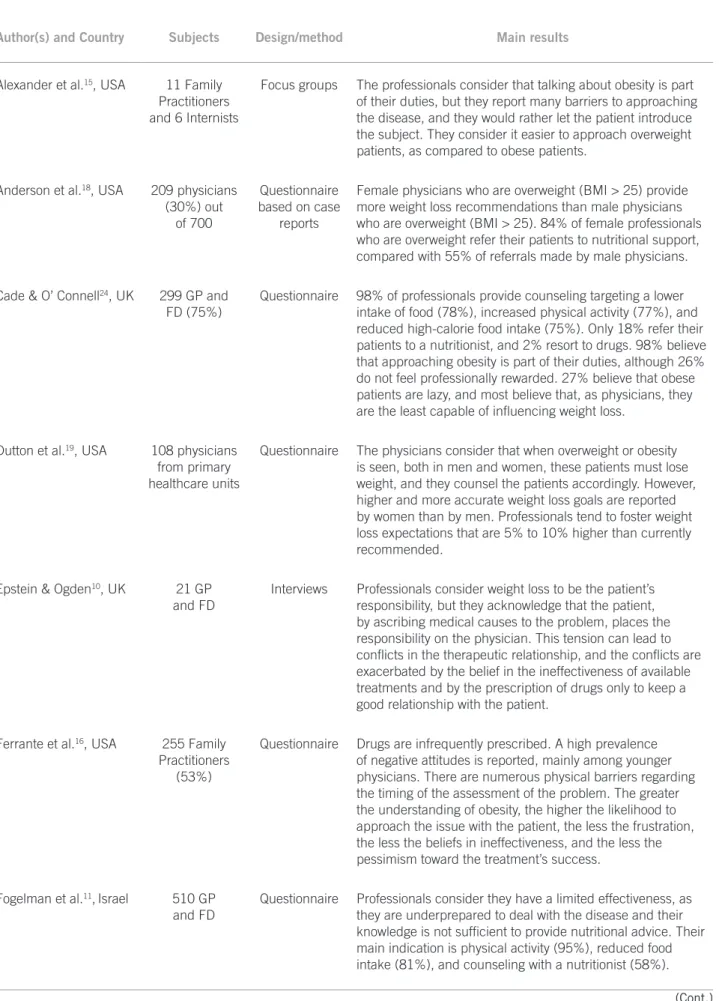
Some characteristics and the main results in diferent studies are summarized in Table 1. hese results suggest that there are common domains, which will be discussed further.
KNOWLEDGEANDBACKGROUND
A large number of studies tried to evaluate the health-care providers’ knowledge about overweight and obesity in terms of causes, outcomes, and solutions by investigat-ing the contribution of their educational background and whether they felt competent to deal with the problem. he study by Forman-Hofman17 indicates that 85.5% of respondents consider obesity a disease, which raises the probability that they ofer some counseling in this area. he same data were found in the study by Foster et al.21, which indicates that most subjects consider obesity a chronic disease associated with severe comorbidities. Regarding causes, behavior factors, such as physical inactivity, poor eating habits, excessive eating, consumption of high-cal-orie food, and psychological factors - as in inappropriate coping strategies, such as turning to food in order to solve problems -, are the factors most strongly indicated by phy-sicians as causes of obesity 21-23. Diabetes; high blood pres-sure; musculoskeletal pain; diiculty making new friends, inding a job, or even receiving medical care are some of the more oten reported consequences22.
Generally, professionals feel underprepared to deal with obesity and consider their knowledge insuicient, making it diicult to approach patients. A few studies found that physicians consider their educational background to be poor, which created gaps between knowledge related to nutritional aspects and knowledge about treatment and in-tervention requirements10,11,17. In contrast, in the study by Ferrante et al.16, the subjects consider that their knowledge of nutritional indications and physical exercise practices is adequate; in the study by Foster et al.21, 49% of the respon-dents feel capable of providing some counseling on weight loss. However, there is a lack of understanding about the use of drugs for weight loss, surgical procedures, speciic techniques to assess morbid obesity, and the availabil-ity and operating mode of group therapies. In this sense, the study by Cade and O’Connel24 shows that healthcare providers attribute greater importance to experience and information from articles as sources of knowledge rather than their educational background.
BELIEFSABOUTOBESITYMANAGEMENTANDTREATMENT
Author(s) and Country Subjects Design/method Main results
Alexander et al.15, USA 11 Family
Practitioners and 6 Internists
Focus groups The professionals consider that talking about obesity is part
of their duties, but they report many barriers to approaching the disease, and they would rather let the patient introduce the subject. They consider it easier to approach overweight patients, as compared to obese patients.
Anderson et al.18, USA 209 physicians
(30%) out of 700
Questionnaire based on case
reports
Female physicians who are overweight (BMI > 25) provide more weight loss recommendations than male physicians who are overweight (BMI > 25). 84% of female professionals who are overweight refer their patients to nutritional support, compared with 55% of referrals made by male physicians.
Cade & O’ Connell24, UK 299 GP and
FD (75%)
Questionnaire 98% of professionals provide counseling targeting a lower
intake of food (78%), increased physical activity (77%), and reduced high-calorie food intake (75%). Only 18% refer their patients to a nutritionist, and 2% resort to drugs. 98% believe that approaching obesity is part of their duties, although 26% do not feel professionally rewarded. 27% believe that obese patients are lazy, and most believe that, as physicians, they are the least capable of influencing weight loss.
Dutton et al.19, USA 108 physicians
from primary healthcare units
Questionnaire The physicians consider that when overweight or obesity
is seen, both in men and women, these patients must lose weight, and they counsel the patients accordingly. However, higher and more accurate weight loss goals are reported by women than by men. Professionals tend to foster weight loss expectations that are 5% to 10% higher than currently recommended.
Epstein & Ogden10, UK 21 GP
and FD
Interviews Professionals consider weight loss to be the patient’s
responsibility, but they acknowledge that the patient, by ascribing medical causes to the problem, places the responsibility on the physician. This tension can lead to conflicts in the therapeutic relationship, and the conflicts are exacerbated by the belief in the ineffectiveness of available treatments and by the prescription of drugs only to keep a good relationship with the patient.
Ferrante et al.16, USA 255 Family
Practitioners (53%)
Questionnaire Drugs are infrequently prescribed. A high prevalence
of negative attitudes is reported, mainly among younger physicians. There are numerous physical barriers regarding the timing of the assessment of the problem. The greater the understanding of obesity, the higher the likelihood to approach the issue with the patient, the less the frustration, the less the beliefs in ineffectiveness, and the less the pessimism toward the treatment’s success.
Fogelman et al.11,Israel 510 GP
and FD
Questionnaire Professionals consider they have a limited effectiveness, as
they are underprepared to deal with the disease and their knowledge is not sufficient to provide nutritional advice. Their main indication is physical activity (95%), reduced food intake (81%), and counseling with a nutritionist (58%).
Table 1 – Summary of main studies on beliefs, attitudes, and practices of healthcare providers regarding obesity
Author(s) and Country Subjects Design/method Main results
Forman-Hoffman et al.17, USA
55 physicians from primary healthcare in veteran centers
Questionnaire The lack of preparation is associated with less approach of
the obesity issue. Those concerned about their own weight tend to be more concerned about the patients’ obesity. 31% believe overweight people are lazy, 25% that they are unwilling. 58% report a referral to a nutritionist, 38% to behavioral therapy, and 4% prescribe drugs.
Foster et al.21, USA 620 GP
and FD
Questionnaire 34.5% always recommend the obese patients to lose weight;
56.4% sometimes refer to a nutritionist; 66% never refer to surgery; and 32.7% rarely indicate surgery. 23.6% consider their background is good regarding obesity management, but 30.9% had learning in practice. 85.1% believe that obesity is a disease.
Helb & Xu19, USA 122 physicians
in a hospital setting
Questionnaire based on case
reports
Negative attitudes tend to parallel the patient’s degree of obesity, and practices lose quality as the patient’s weight increases, with some stereotypes being observed against this population. However, most consider obesity to be a severe health problem which deserves careful attention.
Ogden et al.22, UK 89 GP and FD
and 599 obese subjects
Questionnaire Professionals and patients have different models and
perceptions regarding obesity causes, control, and management, leading to difficulty in intervention, as both groups have different conceptions regarding the responsibility for treatment.
Ogden & Flanagan9, UK 73 GP and
FD and 311 subjects from
the general population
Questionnaires Professionals believe that obesity is not a part of their scope,
as it has many psychological and behavioral causes. They are ambivalent regarding the efficacy of most available treatments and show a high consistency about causes and solutions for obesity, in contrast with the findings in the general population.
Sansone et al.23, USA 99 GP and
FD (40%)
Questionnaire A certain ambivalence regarding bariatric surgery is reported,
with 78% considering that there are more effective ways of managing obesity. However, most (84%) report that they would indicate surgery to patients if they met the appropriate criteria. Female professionals seem to be more reticent than males about resorting to this procedure.
Table 1 – Summary of main studies on beliefs, attitudes, and practices of healthcare providers regarding obesity (Cont.)
the disease development, as well as its treatment, on the obese patients, as found by Ogden and Flanagan9. Like-wise, the subjects in the qualitative study conducted by Epstein e Ogden10 consider obesity to be the obese pa-tients’ responsibility, identifying them as the cause of the problem and, as such, they advocate that the obese indi-vidual should assume its management. However, the prac-titioners recognize that these patients are prone to place this responsibility on the physicians, and are reluctant to assume the control of the condition either because they believe their problem results from a medical disorder they
cannot control, or because they do not recognize the prob-lem’s severity and oten deny it. However, diferent data can be found in other studies, showing that 85% to 98% of respondents consider obesity as a part of their scope and feel that, as physicians, they must warn their patients about the risks and outcomes of obesity11,21,24.
that the patients are not capable of losing weight; in 45% to 74% of the subjects, those feelings are enhanced by a lack of professional gratiication and satisfaction as they pro-vide care to this group10,11,16,17,21,24. Between 85% and 90% of health technicians also mention the weight loss desire irst occurs from esthetic reasons, with health being a second-ary reason. 40% to 54% consider family assumes a more powerful position than physicians concerning motivation and support for a lifestyle change11,24. Efectively, data show that 34% to 40% of general and family practitioners do not believe patients will succeed in losing weight, and in the study by Foster et al.21, one third of the 620 respondents do not believe that this group of patients could reach a normal weight, with only 14% of them feeling successful in pro-viding support. However, physicians recognize a weight reduction as low as 5% or 10% to be beneicial for an obese patient21. Likewise, the results of the vast majority of stud-ies analyzed indicate that these healthcare professionals usually consider current obesity treatments to be inefec-tive10,16,21. Only in the study by Horman-Hofman et al.17 did the subjects believe their action could be successful, and that there are efective measures in the management of this chronic disease.
ATTITUDES REGARDINGOBESEPATIENTS
Results reveal accordance in this domain, showing that most general and family practitioners characterize obese individuals as lazy people who are highly unwilling and unmotivated to lose weight, demonstrate no self-con-trol, and oten do not take the blame for their condi-tion11,16,17,21,24. hese professionals consider that the pa-tients look for an easy solution for their problem, deny their poor eating habits, and are unavailable for physical activities16. In the study by Fogelman et al.11, over 50% of the subjects describe obese patients as awkward, unat-tractive, ugly, sloppy, unpleasant, dishonest people with diiculties in adhering to treatments. he investigation conducted by Helb and Xu20, consisting of 122 gen-eral and family practitioners, showed that the patients’ weight/size inluenced the way professionals viewed and treated them, concluding that the heavier the patient, the more tests were prescribed, and the shorter the time spent in the visit. he data still revealed that professionals state that the heavier the individual, the poorer his/her health and the lower his/her self-discipline, thus requir-ing stricter counselrequir-ing. his and other studies16,23 also in-dicate that these patients are seen as unhappy and emo-tionally unstable, and that they are believed to have severe psychological problems. A further inding was that the more experienced the physician, the less negative were the attitudes he/she exhibited11. Also, larger understand-ing about obesity led to less negative attitudes towards this group, less diiculty in approaching the problem, less
frustration in dealing with the issue, greater belief in the efectiveness of the treatments, and higher expectation of successful weight loss16.
PRACTICESANDREFERRALSTOOTHERPROFESSIONALS
Despite the varied percentages found among studies, indi-cating diferent importance physicians assign to practices initiated, a high concurrence regarding physical activity, reduced food intake, decreased calorie ingestion, and ap-propriate development of informational material about obesity and weight loss is reported11,15-17,24. Between 35% and 98% of professionals report themselves as ofering this type of counseling,20,24, with patient referral to other pro-fessionals, such as nutritionists, being not only seldomly mentioned in some studies, but also referenced by only 30% to 58% of subjects15,17,20. In the investigation by Fogel-man et al.11, 38% and 25% of respondents reported that they advise behavioral therapy and group intervention, re-spectively, whereas in the study by Cade and O’Connel24, only 17% of the professionals indicated group interven-tion. In contrast with these low frequencies of referral to the various treatment options, the healthcare practitio-ners in the study by Ogden and Flanagan9 consider group therapies to be the only means that are deinitely beneicial for obese patients, and they are apprehensive regarding the beneits from other measures, such as surgery, drug treatment, and direct counseling based on the few avail-able guidelines at this time. In at least two studies, family engagement arises as a key support, being sometimes more relevant than the general and family practitioners’ role11,24, as previously mentioned.
Regarding bariatric surgery for weight loss, data are somewhat controversial. In the study conducted by San-sone et al.23, in which general and family practitioners are speciically asked about this procedure, the conclusion was that 78% of the subjects believe that there are more efec-tive methods than bariatric surgery for weight loss, but 84% report a high probability of referring obese patients to this kind of treatment. However, in the study by Foster et al.21, only 23% of the respondents reported this practice as an option, and in the study by Epstein and Ogden10, the subjects consider the surgery a high-risk procedure.
PERCEIVEDBARRIERSTOOBESITYTREATMENT
In some studies, general and family practitioners were asked about occasional barriers to a greater engagement and success of obesity management and treatment. Poor educational background, associated with a diiculty in approaching the weight loss issue with obese patients, ap-peared as the most frequent reasons mentioned among diferent studies6,15,20. Next, limitations of the consultation time and low expectations about the patients’ ability to suc-ceed in losing weight were found. he absence of appro-priate and well-founded counseling guidelines were also indicated by Alexander et al.24 and Forman-Hofman17; the latter pointed out the necessity of the healthcare system itself to regard obesity as a priority.
DISCUSSION
Data from the 13 studies reviewing beliefs, attitudes, and practices of general and family practitioners regarding obesity are quite revealing about these professionals’ dif-iculties and the way they view obese individuals, as well as how their relationships can be described.
Despite the fact that a general concern about the osity problem seems to be present, a set of ambivalent be-liefs and negative attitudes toward these patients is found. Regarding knowledge and educational background in this area, the majority of professionals do not feel properly prepared to deal with the obesity issue, although not all studies demonstrate this, and this inappropriate prepara-tion seems to be the source of many observed beliefs and practices. he lack of appropriate knowledge may result in viewing counseling as something diicult to concret-ize, associated with diiculty in approaching weight loss, low expectations of success, and beliefs of inefectiveness regarding some available treatments. Likewise, the fact that medical training largely occurs under a biomedical inluence can contribute to the diiculty healthcare pro-viders present as they deal with a mostly behavioral dis-ease whose main treatment mode lies precisely in behavior changes21. However, it is controversial that, despite the low competence perceived, the results indicate a tendency for physicians themselves to counsel obese patients, which could be the cause of the failures found. Nevertheless, this behavior could also be due to the lack of resources oten found in healthcare facilities, thus limiting actions in pri-mary care and referral to more specialized centers.
Obesity has also been described in terms of responsi-bility, namely, who should assume control of the disease. Some professionals think the issue is within their scope; others disagree, considering that the disease does not have a medical cause, but results from individual behavior, and that the obese patient should be held accountable (blaming the victim model)22. However, physicians acknowledge that the obese patient usually puts the control of the situation
into the hands of healthcare providers. hese diferent atti-tudes and point of views regarding treatment may contrib-ute to damage the therapeutic relationship, as mentioned by Epstein and Ogden10. In an efort to maintain balance in the relationship, professionals choose to administer drugs with whose use they do not agree to and whose eicacy they dispute only to meet the patient’s expectations. his conlict and its resolution then elicit feelings of frustration and professional dissatisfaction, maybe one of the aspects leading physicians to consider it diicult to deal with the problem. he same reasons may also contribute to the neg-ative attitudes observed during data analysis.
Efectively, stigmas and social stereotypes were found in the attitudes of professionals regarding obese patients, such as the idea that obese people are unwilling, unmoti-vated, lazy, have no self-control, and have many psycho-logical problems; this seems to inluence both the way professionals view the group and their practices, with a decreased quality in the services provided being reported as the patient’s weight increases16. However, these aspects seem to be mediated by the number of years of profes-sional experience and by the knowledge about the obesity problem, meaning the more years of professional expe-rience with obesity and the more knowledge the practi-tioner has accumulated, the less negative attitudes will be expressed11,16. hese factors may contribute to a better understanding of the problem, allowing the adoption of a more impartial and less judgmental posture regarding obese people. It is important to point out that negative attitudes, if noticed by obese patients, might likewise contribute to a negative response, leading, in turn, to per-petuation and exacerbation of negative attitudes by the professionals, repeating a cycle that is detrimental to the obese patient and which might inhibit his/her behavior of searching for help to lose weight, since he/she would try to self-protect from stigmas and social stereotypes also present in healthcare facilities20.
he practices elicited are in accordance with the data from the study by Ogden and Flanagan9, which reveal a high congruence between causal beliefs and beliefs re-garding solutions for obesity; that is, the options for coun-seling and treatment carried out by healthcare providers lean on their beliefs about the problem’s causes. herefore, since physicians consider that the main cause for obesi-ty derives from the subject’s behavior, the indication of physical activity and reduced food and high-calorie food intake to lose weight is in alignment, fundamentally holding to behavior and lifestyle changes.
both a shortage of resources or unavailability of certain services, and reasonable and appropriate guidelines for obesity treatment, may contribute to inconsistencies in the support provided. hese factors may also explain the inding of low frequencies of referral to specialized ser-vices, such as nutritional support, group interventions, or evaluation for bariatric surgery, even when there are stud-ies demonstrating, for example, that obese patients will beneit greatly in the long term if they are monitored in a group24,25, and that bariatric surgery, namely gastric band-ing, is currently one of the most efective procedures in morbid obesity management26,27. A negative attitude to-wards the administration of drugs is observed, with their use being rare, which conirms the fact that physicians would rather resort irst to behavioral interventions when causes are thought to be behavioral. Interestingly, negative attitudes shown along with low expectations of success-ful results might likewise contribute to a very low referral rate, since the professionals tend to think this would be a waste of time considering the unwillingness, low motiva-tion, and failure in losing weight found in obese patients.
LIMITATIONS
One of the limitations found in the 13 reviewed articles concerns the fact that many studies had very low response rates, contributing to a lack of representativeness of the sample and creating problems concerning generalization and comparisons among indings of diferent researches. Likewise, few studies had random samples, most used con-venience samples, and no investigation used comparative groups. Regarding statistical data, few studies described the validation process of the questionnaire that was used, and only one shows the psychometric characteristics of the tool. he great diversity of statistical tests used makes it diicult to do comparisons among studies. hese com-parisons become even more diicult to concretize when the various settings (primary healthcare centers, hospitals etc.) where data were collected are considered, but it would be interesting to investigate, in future studies, whether this aspect exerts any inluence on beliefs, attitudes, and prac-tices of healthcare providers. Another limitation particu-larly highlighted concerns the priority given to quantita-tive studies over studies based on a qualitaquantita-tive method. Efectively, for a few authors10,12, this limitation translates into somewhat reduced outcomes as they explore only be-liefs regarding causes, consequences, and eicacy of avail-able treatments, thus missing important aspects related, for example, to the signiicance attributed to the obesity treatment process, to the commitment to obesity manage-ment, and to physician-patient interaction.
Concerning this review, its main limitation is associ-ated with the fact that it has focused only on beliefs, at-titudes, and practices of general and family practitioners;
it is suggested that future investigations explore those variables focusing in other healthcare providers more con-nected to the obesity issue such as nutritionists, surgeons, psychologists, … and compare these results with the ones obtained from general practitioners.
CONCLUSION
As found in the present review, there is a lack of investiga-tion in this ield, which is conirmed by a reduced number of reports found and considered for analysis, highlighting the need for studying and deepening the understanding of beliefs, attitudes, and practices of healthcare provid-ers regarding obesity. Although only studies published in English have been reviewed, with the risk of inding re-sults depicting a reality that does not match other nations’ scenarios, this review is expected to make a contribution in order to enlighten healthcare providers about the way their beliefs can inluence their attitudes and practices re-garding obese patients, as well as their relationship and the patients’ adherence to treatment, ultimately aiming to improve healthcare provided to individuals with this disorder.
REFERENCES
1. World Health Organization. What are overweight and obesity? 2006. [cited 2008 sept 25]. Available from: http://www.who.int/mediacentre/factsheets/ fs311/en/index.html.
2. World Health Organization. Obesity and overweight. 2011. [cited 2011 mar 3]. Available from: http://www.who.int/mediacentre/factsheets/fs311/en/index. html.
3. Ogden C, Yanovski S, Carroll M, Flegal K. he epidemiology of obesity. Gas-troenterology. 2007;132: 2087-102.
4. World Health Organization. Global Health Observatory Data Repository. 2011 [cited 2011 sept 29]. Available from: http://apps.who.int/ghodata/?vid=2469. 5. Ferreira V, Magalhães R. Obesidade no Brasil: tendências actuais. Rev Port
Saúde Pública. 2006;24:71-81.
6. Carmos I, Santos O, Camolas J, Vieira J, Carreira M, Medina L, et al. Over-weight and obesity in Portugal: national prevalence in 2003-2005. Obes Rev. 2007;9:11-9.
7. Ogden J. Obesity treatment. In: Ogden J, editor. he psychology of eating: from healthy to disordered behaviour. New York: Blackwell; 2009. p.180-210. 8. Kristeller J, Hoerr R. Physicians attitudes toward managing obesity: diferences
among six specialty groups. Prev Med. 1997;26:542-9.
9. Ogden J, Flanagan Z. Beliefs about the causes and solutions to obesity: a com-parison of GPs and lay people. Patient Educ Cousel. 2008;71:72-8.
10. Epstein L, Ogden J. A qualitative study of GP’ views of treating obesity. Br J Gen Pract. 2005;55:750-4.
11. Fogelman Y, Vinker S, Lachter J, Biderman A, Itzhak B, Kitai E. Managing obe-sity: a survey of attitudes and practices among Israeli primary care physicians. Int J Obes. 2002;26:1393-97.
12. Budd G, Marioti M, Graf, D, Falkenstein K. Healthcare professionals’ attitudes about obesity: an integrative review. Appl Nurs Res. 2009;24:127-37. 13. Fishbein M, Ajzen I. Belief formation. In: Fishbein M, Ajzen, I, editors.
Be-lief, attitude, intention, and behavior: an introduction to theory and research. Reading: Addison-Wesley; 1975. p.130-215.
14. Vala J. Representações sociais e psicologia social do conhecimento quotidiano. In: Vala J, Monteiro M, editores. Psicologia social. Lisboa: Fundação Calouste Gulbenkien; 2000. p.457-501.
15. Alexander S, Ostbye T, Pollak K, Gradison M, Bastian L, Brouwe R. Physicians’ beliefs about discussing obesity: results from focus groups. Am J Health Pro-mot. 2007;21:498-500.
16. Ferrante J, Piasecki A, Ohman-Strickland P, Crabtree B. Family physicians’ practices and attitudes regarding care of extremely obese patients. Obesity. 2009;17:1710-6.
18. Anderson C, Peterson C, Fletcher L, Mitchell J, huras P, Crow S. Weight loss and gender: an examination of physicians attitudes. Obes Res. 2001;9:257-63. 19. Dutton G, Perri M, Stine C, Goble M, Vessem N. Comparison of physician
weight loss goals for obese male and female patients. Prev Med. 2010;50:186-8. 20. Hebl M, Xu J. Weighing the care: physicians’ reactions to the size of a patient.
Int J Obes. 2001;25:1246-52.
21. Foster G, Wadden T, Makris A, Davidson D, Sanderson R, Allison D, et al. Primary care physicians’ attitudes about obesity and its treatment. Obes Res. 2003;11:1168-77.
22. Ogden J, Bandara I, Cohen H, Farmer D, Hardie J, Minas H, et al. General practitioners’ and patients’ models of obesity: whose problem is it? Patient Educ Couns. 2001;44:227-33.
23. Sansone R, Mc Donald S, Wiederman M, Ferreira K. Gastric bypass surgery: a survey of primary care physicians. Eat Dis. 2007;15:145-52.
24. Cade J, O’connell S. Management of weight problems and obesity: knowl-edge, attitudes and current practice of general practitioners. Br J Gen Pract. 1991;41:147-50.
25. Renjilian D, Perri M, Nezu A, Mckelvey W, Shermer R, Anton S. Individual versus group therapy for obesity: efects of matching participants to their treat-ment preferences. J Consult Clin Psychol. 2000;69:717-21.
26. Mrad B, Stoklossa C, Birch D. Does preoperative weight loss predict success following surgery for morbid obesity? Am J Surg. 2008;195:569-74. 27. Sarwer D, Wadden T, Fabricatore A. Psychosocial and behavioral aspects of