SCLEREDEMAOF BUSCHKEASSOCIATEDWITHDIFFICULT-TO-CONTROLTYPE 2 DIABETESMELLITUS
REV ASSOC MED BRAS 2016; 62(3):199-201 199
IMAGE IN MEDICINE
Scleredema of Buschke associated with difficult-to-control type 2
diabetes mellitus
LUCIANA RODINO LEMES1*, GABRIELE MEDINA VILELA1, SANDRA MARIA BARBOSA DURÃES2, ENOI APARECIDA GUEDES VILAR3
1Graduate degree in Dermatology from Universidade Federal Fluminense (UFF), Niterói, RJ, Brazil
2PhD in Dermatology from Universidade Federal do Rio de Janeiro (UFRJ). Adjunct Professor IV, Dermatology, UFF, Niterói, RJ, Brazil 3MSc in Anatomical Pathology from UFF. Adjunct Professor, Pathology, UFF, Niterói, RJ, Brazil
S
UMMARYStudy conducted at Hospital Universitário Antonio Pedro (HUAP), Universidade Federal Fluminense (UFF), Niterói, RJ, Brazil
Article received: 4/21/2015 Accepted for publication: 5/4/2015
*Correspondence: Address: Rua Marquês de Paraná, 303, Centro Niterói, RJ – Brazil Postal code: 24033-900 [email protected]
http://dx.doi.org/10.1590/1806-9282.62.03.199
Scleredema of Buschke (SB) is a rare disorder of connective tissue characterized by diffuse non-pitting induration of the skin, mainly on the cervical, deltoid and dorsal regions. It is a cutaneous mucinosis of unknown etiology and is associ-ated with bacterial or viral infections, hematological disorders and diabetes mel-litus. Histopathological examination shows thickened dermis with wide
colla-gen bundles separated by gaps that correspond to mucopolysaccharide deposits, visualized using special staining. Several treatments are reported in the litera-ture without well-established results. We report a case of SB in a patient with type 2 diabetes mellitus.
Keywords: scleredema adultorum, diabetes mellitus, dorsum.
I
NTRODUCTIONScleredema of Buschke (SB) is a rare disorder of connective tissue, perhaps more prevalent than reported in the litera-ture, characterized by diffuse induration of the skin, espe-cially in the cervical, deltoid and dorsal regions. Systemic manifestations are also described.1 It is a cutaneous muci-nosis divided into three types according to its associations. Pathogenesis is unknown but triggering factors are described, such as hyperinsulinemia, vascular damage, lymphatic ob-struction, and streptococcal hypersensitivity. We report a case of SB in a patient with type 2 diabetes mellitus.
C
ASEMale, 63-year old obese patient, with long-standing difi-cult-to-control diabetes mellitus, high blood pressure and
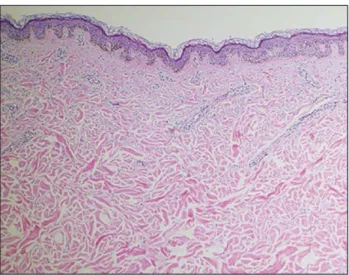
dyslipidemia; he presented erythema and induration of the neck and upper back starting 1 month earlier (Figure 1). The patient had no clinical history or laboratory indings compatible with any infections or blood disorders. Histo-pathological examination of the affected area on the back showed: thickened collagen ibers in the reticular dermis with gaps between them and mucin deposit conirmed by staining with Alcian Blue at pH 2.5 (Figures 2 and 3).
D
ISCUSSIONSB is a generally benign dermatosis, part of the group of
cutaneous mucinoses, with easy clinical and histopatho- FIGURE 1 Erythema and induration of the neck and upper back.
logic diagnosis. SB was described by Buschke in 1902, and classiied into 3 subtypes by Graff, in 1968: Type 1, asso-ciated with bacterial or viral infections; type 2, associat-ed with paraproteinemias; and type 3, associatassociat-ed with di-abetes mellitus.1,2
LEMES LR ETAL.
200 REV ASSOC MED BRAS 2016; 62(3):199-201
Pathogenesis is unknown, but the main mechanism of accumulation of matrix components appears to be re-lated to abnormal gene expression of extracellular pro-tein (collagen types I and III and ibronectin) in the skin.6 Other possible pathogenic factors would be: hyperinsu-linemia, vascular damage, lymphatic obstruction, and streptococcal hypersensitivity.
Systemic manifestations are rare and include: cardi-ac, ocular, hepatosplenic, musculoskeletal and joint im-pairment; serositis, myositis and parotiditis; as well as
in-volvement of the tongue, esophagus and pharynx.6
On histopathological examination, the epidermis has normal appearance and the dermis is thickened with broad collagen bundles and mucopolysaccharide depos-its, visualized using special staining (Alcian blue at pH 2.5 to 4.0, toluidine blue and colloidal iron). There is no increase in the number of ibroblasts.2 Mucin deposits can also be evidenced in other organs such as bone mar-row, nerves, salivary glands, and heart.
Differential diagnosis includes scleroderma and sclero-myxedema. Scleroderma is distinguished by acral skin
in-volvement, Raynaud’s phenomenon and typical fascies.
Histopathological examination may reveal rectiied epi-dermis, dermal sclerosis, and loss of appendages. Sclero-myxedema, in turn, is characterized by conluent papules which gives a hardened appearance to the skin, with wide-spread deposition of mucin in the dermis, and ibrosis with irregular proliferation of ibroblasts.5,7
Several treatments have been proposed, such as topical, systemic and intralesional corticosteroids, immunosuppres-sives, and PUVA therapy.1,4 Nevertheless, in most cases, the disease is self-limiting with spontaneous resolution.8 Its im-portance lies in the possibility of being a systemic marker of disease, such as dificult-to-control diabetes or paraprotein-emias. The possibility of systemic involvement makes early diagnosis critical for proper treatment and better prognosis.
R
ESUMOEscleredema de Buschke associado a diabetes mellitus tipo
2 de difícil controle
Escleredema de Buschke (EB) é doença rara do tecido con-juntivo caracterizada por endurecimento difuso e não de-pressível da pele, principalmente nas regiões cervical, deltoi-deanas e dorso. Enquadrado no grupo das mucinoses cutâneas, tem etiologia desconhecida e associação com: infecções bac-terianas ou virais, alterações hematológicas e diabetes mellitus.
O exame histopatológico evidencia derme espessada com i-bras colágenas calibrosas separadas por fendas que
corre-FIGURE 3 Material between thickened collagen bundles stained
with Alcian blue at pH 2.5, evidencing mucin deposits.
FIGURE 2 Thickened dermis, forming gaps between collagen
bundles.
inluenza, measles, parotiditis, CMV and HIV. It has bet-ter prognosis and is more prevalent in children and young adults.3,4
Type 2 is classically associated with paraproteinemi-as (monoclonal gammopathy), but there are also reports of an association with primary hyperparathyroidism, rheu-matoid arthritis, amyloidosis and Sjogren’s syndrome. It has a higher probability of chronic progression.1
Type 3 SB is associated with diabetes mellitus (DM),
both as type 1 DM and type 2 DM. Patients most com-monly reported in the literature are adult men with long-standing diabetes mellitus with glycemic control that is
SCLEREDEMAOF BUSCHKEASSOCIATEDWITHDIFFICULT-TO-CONTROLTYPE 2 DIABETESMELLITUS
REV ASSOC MED BRAS 2016; 62(3):199-201 201
spondem a depósito de mucopolissacárides, observados por colorações especiais. Diversos tratamentos são relatados na literatura sem resultados bem deinidos. Descrevemos caso de EB em paciente com diabetes mellitus tipo 2.
Palavras-chave: escleredema do adulto, diabetes mellitus,
dorso.
R
EFERENCES1. Gervini RL, Lecompte SM, Pineda RCB, Ruthner FG, Magnabosco EM, Silva LMC. Escleredema de Buschke: relato de dois casos. An bras Dermatol. 2002; 77(4):465-72.
2. Graff R. Discussion of scleredema adultorum. Arch Derm. 1968; 98:319-20. 3. Cron RQ, Swetter SM. Scleredema revisited. A poststreptococcal complication.
Clin Pediatr (Phila). 1994; 33(10):606- 701.
4. Dinato SL, Costa GL, Dinato MC, Sementilli A, Romiti N. Escleredema de Buschke associado diabetes melito tipo 2: relato de caso e revisão da literatura. Arq Bras Endocrinol Metabol. 2010; 54(9):852-5.
5. Pitarch G, Torrijos A, Martínez-Aparicio A, Vilata JJ, Fortea JM. Escleredema de Buschke associado a diabetes mellitus. Estudio de cuatro casos. Actas Dermosiiliogr. 2005; 96(1):46-9.
6. Meguerditchian C, Jacquet P, Béliard S, Benderitter T, Valéro R, Carsuzza F, et al. Scleredema adultorum of Buschke: an under recognized skin complication of diabetes. Diabetes Metab. 2006; 32(5 Pt 1):481-4. 7. Sampaio SAP, Rivitti EA. Mucinose e mucopolissacaridoses. Dermatologia.
3.ed. São Paulo: Artes Médicas, 2008. P.933-44