HEARING AIDS USERS’ SATISFACTION
ATTENDING A PRIVATE SERVICE
Satisfação de usuários de aparelho de amplificação
sonora individual atendidos em um centro auditivo
Débora Conceição de Oliveira da Silva (1), Renata Coelho Scharlach (2)
(1) Instituto de Estudos Avançados da Audição (IEAA), São Paulo, SP, Brasil.
(2) Universidade Federal de Santa Catarina (UFSC), Florianó-polis, SC, Brasil.
Conlict of interest: non-existent
of selection and adaptation of the same is carried
out in appropriate order 2.
The hearing aid is an electronic device whose main function sound ampliication gives the individual the use of their residual hearing. For this objective to be achieved is crucial that the electroacoustic settings are in accordance with the
individual needs3. This is a challenge because the
professional will have to translate those needs that are often expressed through the patient’s reports and indings of audiological evaluations and turn into electroacoustic adjustments in hearing aids. With the development of digital technology devices, the speech therapist has at its disposal a number of features that allows programs as the audiological evaluation indings and patient reports of more precise way 4.
However, it needs to know the patient’s perception regarding their limitations in communication. A
INTRODUCTION
The hearing is set as a key factor for the overall development of the individual. It is the way that the human being enters in the world of sound, allowing the acquisition and development of language occur 1.
Thus, hearing loss entails several negative consequences for the life of an individual, decisively interfering with their quality of life, because it produces social and family isolation. The negative efects of hearing loss can be minimized with the use of individual hearing aid (HA) since the process
ABSTRACT
Purpose: to ascertain the degree of satisfaction of individual hearing aid users through the
questionnaire Satisfaction with Ampliication in Daily Life. Methods: an observational, descriptive and
analytical cross-sectional study with the participation of individuals aged between 52 and 96 years old with bilateral sensorineural hearing loss from mild to severe, hearing aid users. All participants answered a questionnaire at the beginning of the process of adaptation of the hearing aids and after three months of use of it. Results: there were signiicant diferences in questionnaire scores
comparing the results of users with unilateral and bilateral adaptation both for the irst time and for the second assessment. Showed a statistically signiicant diference between the two moments for the subscale negative factors and the average overall score, greater satisfaction was observed on the second time. There are statistically signiicant positive correlations between the results of subscale rates, and has global average and among negative factors and overall average. Among the negative factors and personal image correlation was negative. Conclusion: the survey results showed that
users evaluated hearing aid were satisied with ampliication after three months of efective use. There was no diference in satisfaction between unilateral and bilateral adaptation. There was no statistically signiicant correlation between the overall average and the results of subscale costs and services. Acclimatization has helped meet the negative factor subscale and the overall survey average.
problems related to activities of daily living, though these diferences between the groups disappear after using the ampliication Furthermore, expecta
-tions regarding the use of hearing aids were higher in patients coming from public service. Therefore, they concluded that it is risky to generalize results of surveys of hearing aid users of public health in relation to private service patients, and vice versa13.
Based on the above considerations, the present study aimed to determine the degree of satisfaction of hearing aid users through the questionnaire
Satisfaction with Ampliication in Daily Life – SADL and evaluate the efect of acclimatization in user satisfaction.
METHODS
This study was approved by the Ethics Committee of the Santa Casa de Misericordia de Belo Horizonte (SCMBH) under the research protocol Number: 300,611. The hearing aid users who have agreed to participate in the study signed a free and informed consent form and only then data collection began.
This is an observational, descriptive, analytical cross-sectional study conducted with patients of a particular hearing center located in Muriaé in the state of Minas Gerais. The survey sample consisted of individuals aged between 52 and 96 years old with bilateral sensorineural14 hearing loss from
mild to severe15, new ampliication users itted with
hearing aids of digital technology. All participants had graphical code domain.
In order to assess the satisfaction of these patients with the use of ampliication, we used the questionnaire Satisfaction with Ampliication in Daily Life - SADL, developed at the University of Memphis in the United States by Cox and Alexander, in 199916,
which was translated and validated for Brazilian Portuguese 20117.
The SADL questionnaire consists of 15 questions divided into four subscales: Positive Efects (six items associated with acoustic and psychological beneit); Services and Costs (three items associated with professional competence, product price and number of repairs); Negative factors (three related items with the ampliication of background noise, the presence of noise and the use of telephone) and Personal Image (three items related to esthetical factors and stigma of use of hearing aid)17.
The subscales are composed of the following questions: 1-positive efects, questions 1, 3, 5, 6, 9 and 10; 2-negative factors, questions 2, 7 and 11; 3-personal image, questions 4, 8, 13 and well-designed self assessment questionnaire may
identify the actual hearing diiculties, and will serve as a beacon along the time5. Therefore it became
necessary to subjective methods of self-assessment which also initially measure the psychosocial efects of hearing loss. In recent years several self-assessment questionnaires are available to the professional to draw a proile of the main needs of the hearing aid user6. The use of questionnaires is
a simple, fast and efective procedure that promotes the evaluation of the individual throughout the process of adapting a HA7.
In Brazil there are several self-assessment questionnaires, among them are: APHAB (Abbreviated Proile of Hearing Aid Beneit), the HHIE (Hearing Inventory for the Elderly) and HHIA (Hearing Handicap Inventory for the Adults), which were translated and adapted to the Brazilian reality in order to verify the beneit as well, reducing partici
-pation restrictions resulting from the use of HA8.
The use of self-assessment questionnaires are vital and complement the other assessment methods, providing the decline in dissatisfaction of the hearing aid user. Therefore, evaluate and document the satisfaction and the beneit that the use of sound ampliication system ofers the user becomes indis
-pensable9. Among the various questionnaires to
assess the satisfaction of the hearing aid user is the Satisfaction with Ampliication in Daily Life (SADL). This material is intended to measure the degree of satisfaction in daily life with the use of hearing aids and presents itself as an excellent tool quality10.
Moreover, it is easy to apply, very useful in clinical use because it allows the independent and objective measurement of constituents of satisfaction11.
Knowledge of satisfaction with the use of hearing aids should be a priority in attendance, as will ofer guidance to the audiologist ensuring the possibility of success in the process of adaptation12. Study at a
public hearing health in Brazil showed that patients itted with hearing aids were satisied with the use of ampliication. The authors observed that the satisfaction ratings were generally higher than those observed by the authors of the questionnaire in the previous survey. They also reported that satisfaction was not related to the variables gender, age, degree of hearing loss and proile electroacustic11.
In Brazilian literature there are several studies on the satisfaction of hearing aid users who are accompanied in public services, but little is read on patients treated in private services, such as the auditives centers 5,11,12.
how good a correlation, we used the grading scale below18.
RESULTS
This study consisted of 14 individuals, 10 (71.4%) were female and four (28.6%) were male. The age range was 52-96 years old with a mean age of 75.4 years old (7.3).
Of all study three (21.42%) had mild hearing loss, seven (50%) moderate, two (14.29%) of moderately severe degree and two (14.29%) of severe degree.
The next itted with hearing aids, eight subjects (57.1%) were unilateral and six use bilateral use (42.9%). The unilateral ampliication of individual users claimed that for inancial reasons it was not possible to bilateral adaptation, but were aware of the importance and beneits of the bilateral use.
As for the distribution of the type of hearing aid, only one individual (7.1%) was adapted with intra-aural type the microcanal, and 13 individuals (92.9%) were itted with BTE, two with conven
-tional ear mold, two with thin tube (RITA) and nine individuals with the receiver in the ear (RITE).
Initially comparisons were made between perfor
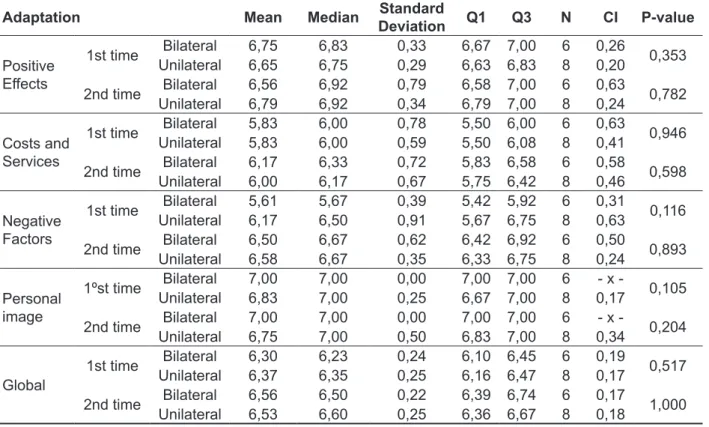
-mance on SADL questionnaire considering the individuals who were itted with one or two hearing aids for both time points. The results are shown in Table 1.
The statistical test of Mann Whitney showed that there were no diferences between the results for any of the subscales, ie the score achieved on each subscale was similar between subjects who were itted with one or two individual hearing aids. Since there was no diference in satisfaction between users of one or two hearing aids, it was decided to unify the sample.
In Table 2, we observed the scores obtained in the diferent subscales of the SADL questionnaire, considering the two time points.
aid, a seven-point scale as follows: A-No; B-low; Shortly C-; D- East; And sometimes; Often F- and G- Always7.
The medium used to record the results of the SADL considering the 15 items were: For the issues 1, 3, 5, 6, 8, 9, 10, 11, 12, 14 and 15 the score coincides with the score scale. That is, if the patient answered the letter A, received a score of one, if answered the letter G, received seven points. As for the items 2, 4, 7 and 13, there is an inverse relationship between scores and scale, ie, the letter A receives and expresses seven points greater satisfaction, while the letter G, a point receives and expresses dissatisfaction. As larger numerical results obtained by averaging each subscale, the greater the degree of satisfaction7.
In order to evaluate the efect of acclimatization in meeting the use of sound ampliication, the questionnaire was administered at two diferent times, namely: 1st time: the questionnaire was applied at the end of the selection and adaptation of the hearing process and 2nd moment: the question
-naire after 12 weeks (three months) efective use of hearing aids. The average daily use time was 7 hours. The establishment of this time was obtained through analysis of the data stored in the memory of hearing aids of research participants.
In this research were conducted the following analysis with data obtained in the collection: analysis of the results of the questionnaire on the 1st time of research, analyzing the results of the questionnaire on the 2nd moment and, inally, a comparison of results obtained in two stages.
The participant was asked to read the question
-naire and answer it without any interference in the responses by the researcher.
and the overall survey average (p = 0.007) and between the subscale of negative factors and the average overall (p = 0.013). In both cases the corre
-lation found was good. Among the negative factors and personal image was no statistically signiicant correlation (p = 0.037), but regular and negative (r = -56.1%).
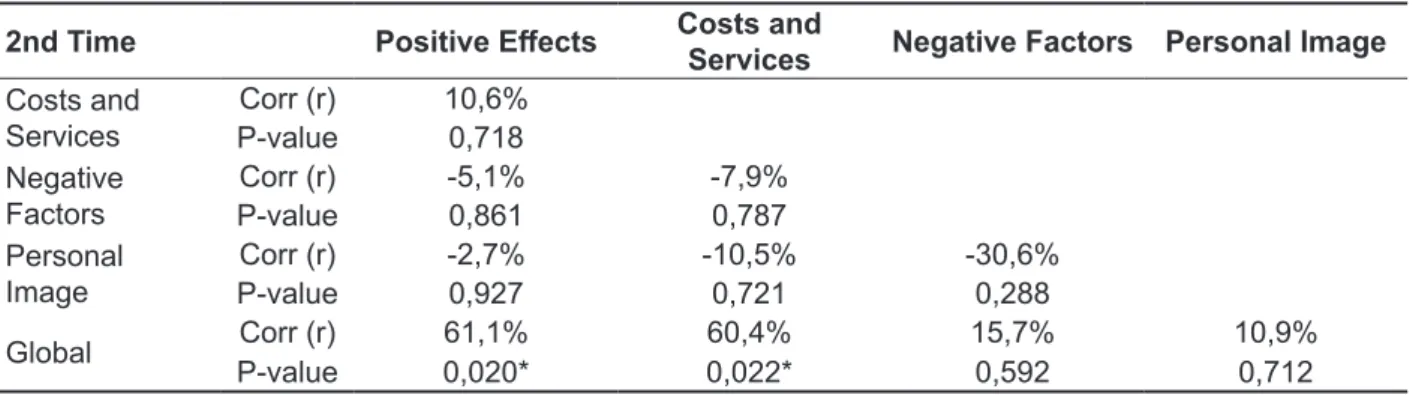
The 2nd time statistically signiicant positive correlations were found between the subscales positive and global average (p = 0.020) and costs and services with global average (p = 0.022). In both cases a positive correlation was seen and good. Comparing the results of the questionnaire, the
Wilcoxon test revealed a statistically signiicant diference between the two moments for the negative factor subscale (p = 0.012) and the mean global score (p = 0.010).
Finally, we chose to make a correlation analysis between the subscales. Tables 3 and 4 can be seen the results considering the 1st time to review and assessment point 2, respectively.
The Spearman correlation analysis showed that there are statistically signiicant positive correla
-tions in the 1st moment of application of the SADL questionnaire between subscale costs and services
Table 1 – Comparison of performance of questionnaire Satisfaction with Ampliication in Daily Life
considering the adaptation of the ampliication sound on individual hearing aid to each moment of
the evalution
Adaptation Mean Median Standard
Deviation Q1 Q3 N CI P-value
Positive
Efects
1st time Bilateral 6,75 6,83 0,33 6,67 7,00 6 0,26 0,353
Unilateral 6,65 6,75 0,29 6,63 6,83 8 0,20
2nd time Bilateral 6,56 6,92 0,79 6,58 7,00 6 0,63 0,782
Unilateral 6,79 6,92 0,34 6,79 7,00 8 0,24
Costs and
Services
1st time Bilateral 5,83 6,00 0,78 5,50 6,00 6 0,63 0,946
Unilateral 5,83 6,00 0,59 5,50 6,08 8 0,41
2nd time Bilateral 6,17 6,33 0,72 5,83 6,58 6 0,58 0,598
Unilateral 6,00 6,17 0,67 5,75 6,42 8 0,46
Negative Factors
1st time Bilateral 5,61 5,67 0,39 5,42 5,92 6 0,31 0,116
Unilateral 6,17 6,50 0,91 5,67 6,75 8 0,63
2nd time Bilateral 6,50 6,67 0,62 6,42 6,92 6 0,50 0,893
Unilateral 6,58 6,67 0,35 6,33 6,75 8 0,24
Personal
image
1ºst time Bilateral 7,00 7,00 0,00 7,00 7,00 6 - x - 0,105
Unilateral 6,83 7,00 0,25 6,67 7,00 8 0,17
2nd time Bilateral 7,00 7,00 0,00 7,00 7,00 6 - x - 0,204
Unilateral 6,75 7,00 0,50 6,83 7,00 8 0,34
Global 1st time
Bilateral 6,30 6,23 0,24 6,10 6,45 6 0,19
0,517
Unilateral 6,37 6,35 0,25 6,16 6,47 8 0,17
2nd time Bilateral 6,56 6,50 0,22 6,39 6,74 6 0,17 1,000
Unilateral 6,53 6,60 0,25 6,36 6,67 8 0,18
Table 2 – Comparison of scores on the subscales of questionnaire Satisfaction with Ampliication in
Daily Life, according to variable in the moment of application
SADL Mean Median Standard
Deviation Q1 Q3 N CI P-value
Positive Efects 1st time 6,69 6,75 0,30 6,67 6,83 14 0,16 0,472
2nd time 6,69 6,92 0,56 6,71 7,00 14 0,29
Costs and
Services 2nd time1st time 5,836,07 6,006,33 0,650,67 5,425,75 6,586,00 1414 0,350,34 0,311
Negative
Factors 2nd time1st time 5,936,55 5,836,67 0,760,46 5,676,33 6,926,58 1414 0,240,40 0,012* Personal
image 2nd time1st time 6,906,86 7,007,00 0,200,39 7,007,00 7,007,00 1414 0,200,11 0,593
Global 2nd time1st time 6,34 6,31 0,24 6,14 6,49 14 0,13 0,010*
6,54 6,58 0,23 6,39 6,67 14 0,12
Legend: SADL: Satisfaction with Ampliication in Daily Life, Q1°quartile, Q3°quartile; N= size of sample, CI conidence interval Statistical test: Wilcoxon Test. Signiicance level 0,05*.
Table 3 – Correlation of scores of questionnaire Satisfaction with Ampliication in Daily Life obtained
in the subscales, considering the irst time of evaluation
1st Time Positive Efects Costs and
Services Negative Factors Personal Image
Costs and
Services P-valueCorr (r) 16,0%0,585
Negative
Factors P-valueCorr (r) -24,7%0,394 0,9033,6%
Personal
Image P-valueCorr (r) 20,3%0,486 0,9701,1% -56,1%0,037*
Global Corr (r) 13,9% 68,2% 64,6% -35,7%
P-value 0,634 0,007* 0,013* 0,210
Legend: Satisfaction with Ampliication in Daily Life
P-value, Corr- correlation of Spearman. Signiicance level 0,05*
Table 4 – Correlation of scores of questionnaire Satisfaction with Ampliication in Daily Life obtained in the subscales considering the second time of evaluation
2nd Time Positive Efects Costs and
Services Negative Factors Personal Image
Costs and
Services P-valueCorr (r) 10,6%0,718
Negative
Factors P-valueCorr (r) -5,1%0,861 -7,9%0,787
Personal
Image P-valueCorr (r) -2,7%0,927 -10,5%0,721 -30,6%0,288
Global Corr (r) 61,1% 60,4% 15,7% 10,9%
P-value 0,020* 0,022* 0,592 0,712
5.61 to negative factors; 5.83 to costs and services at irst and 6.17 to costs and services in the second time.
Since the unilateral hearing aid users in this study showed greater satisfaction for the following subscales: Personal image (6.83 points) and positive efects (6.65 points) at irst; and positive efects (6.79 points) and personal image (6.75 points) in the second time. The lowest satisfaction was found for the following subscales: 5.83 to costs and services at irst and 6.00 for costs and services in the second time.
Studies showed that the binaural adaptation brings many beneits to individuals, such as: better sound localization, binaural summation, better speech understanding in noise, eliminating the shadow efect and prevents the deprivation
sensorial24. Some individuals involved in this study,
even being counseled about the importance of binaural hearing, opted for monaural use, explaining that the inancial situation was not favorable for the purchase of two hearing aids. In this study there was no statistically signiicant diference between the scores for individuals with binaural and monaural itting, agreeing with the indings of previous surveys, in which no diference in satis
-faction of independent hearing aid users adaptation be unilateral or bilateral25, and even though the
loss was bilateral, but with adaptation unilateral26.
In addition, it is noteworthy that for both groups observed satisfaction was high.
In Table 2 the results are described in each subscale and the average global satisfaction for both the 1st time 2nd time as for the evaluation. Initially it was observed that, regardless of time, survey participants were satisied with the use of ampliication considering each subscale and the global average. Whereas the maximum average value that could be obtained was 7.0, the average value obtained in the irst time was not less than 5.83 and the 2nd time was not less than 6.07.
Separately analyzing the results of the 1st moment, it was found that the personal image subscale was obtained the greatest mean score (6.90), followed by positive efects subscale (6.69). As for the subscales rates, and has negative factors had the lowest average scores, with values of 5.83 and 5.93 respectively. Considering the 2nd time, it observed similar behavior for each subscale, and the best results were obtained on the subscales Personal Image (6.86) and positive efects (6.69) and the lowest scores for costs and services (6, 07) and negatives (6.55).
DISCUSSION
Hearing loss causes many impacts on an individ
-ual’s life. Besides not hear well, there are several psychosocial changes for this and their families, among which are: inability to understand the conver
-sation, removal of the situations involving communi
-cation. In the case of the elderly, these are taxed by the family as distracted, confused, disoriented, not employee, angry, old and unjustly senile19.
Thus, it is believed that the use of ampliication appears as a means for minimizing the devas
-tating efects of hearing loss. The whole process of adapting a hearing aid should not be based only objective reviews and tests. One should value the judgment of the patient, their acceptance, the beneits provided and the satisfaction with them20.
Not enough to use a hearing aid, it is necessary that the individual is satisied with the results of all the features ofered by it, such as improved speech recognition in quiet and in noise, auditory comfort, physical aspects, among others.
It emphasizes the importance of using question
-naires as the SADL, because it presents itself as a tool that evaluates the satisfaction of hearing aid users, as well as their front performance in a challenging environment, provides information about the disadvantages of hearing impairment, predicts successful adaptation. Moreover, it provides routing data for the entire process of adaptation21.
Although all participants of this research reveal bilateral hearing loss, only six (42.9%) subjects of the study population were itted with two hearing aids. In Table 1 it can be seen that there was no statistically signiicant diference in what concerns the satisfaction obtained with the use of amplii
-cation among individuals who used hearing aids unilaterally or bilaterally in two evaluated periods, conirming survey conducted earlier in which he obtained 98% satisfaction with the use of hearing aids, regardless of whether the use was bilateral or
unilateral22. Although studies indicate that the greater
the hearing loss, the more beneits the individual will have with the use of bilateral ampliication and better the individual’s ability to localize sound and have a better satisfaction with the use of hearing aids, professionals emphasize that one should take into consideration the consent of the individual in the use of adaptation bilateral23.
-For the personal image subscale, which is related to aesthetic factors and the stigma associated with the use of hearing aids, yielded the highest values both at irst (6.90) and the second (6.86) Other researchers have found that this subscale was kept in the questionnaire due to overvaluation that some individuals make with respect to the appearance of the appliances as well as the impression that they cause to others, although not all care about the aspects mentioned above30. A study conducted in
Brazil with SADL conirmed by global score and its relationship with the subscales that survey partici
-pants found themselves satisied with the use of hearing aids, and on the subscale personal image, it had the highest number of people demonstrating much satisfaction31.
In contrast, the previous two surveys showed diferent results. A study conducted in 2007 in the state of Tocantins revealed a high satisfaction rate in the various ields of SADL, except for the subscale personal image in which we observed a higher rate of insatisied individuals32. Another study conducted
in southern Brazil revealed that although individuals were satisied with the use of hearing aids the highest percentage of dissatisfaction also occurred with personal image domain33. An important aspect
to be considered refers to the fact that in this study 85.71% of the sample was itted with hearing aids the microcanal type or RITE and RITA. Already in the two studies mentioned above most of the users were itted with hearing aid BTE type.
It is assumed that the acclimatization has great inluence in the process of satisfaction, contributing to improve functional capacity, physical, emotional, vitality, mental health and social aspects, ensuring quality of life to HA34 user. In this study there was
clearly the inluence of acclimatization in satis
-faction. Analyzing global average between the two time points, there was a statistically signiicant diference (p = 0.010) between the results. At irst obtained the mean score was 6.34 and 6.54 in the second stage.
The results presented in Table 2 indicate that the acclimatization positively inluences user satis
-faction. Hence the importance of patient follow-up and given guidelines. He should be aware that the beneits obtained with the use of ampliication are not achieved immediately and that the acclimati
-zation period assists in satisfaction.
Table 3 one sees the correlation analyzes with the results obtained in the irst moment. Through the Spearman correlation test it was found that there were positive correlations statistically signiicant between the overall average and the results of the SADL subscale and service costs (p = 0.007) and with the irst subscale negative factors (p = 0.013). positive efects averaging 6.50 and services and
costs with an average of 6.26 and less satisfaction for the subscale negative factors averaging 4,737.
The literature27 reports that the use of hearing aids
increases the satisfaction related to the subscale items positive factors, however, this study found no improvement with continued use of ampliication, for the two times the score obtained in this regard was 6.69 points .
International study with SADL in 2002, empha
-sized that the results obtained in the subscale Positive Efects have strong inluence on the construction of satisfaction. Furthermore, they reported that an increase in this range is an improvement in commu
-nication and sound quality even at the beginning of adaptation28. The authors of this questionnaire
reported that a high level of satisfaction with this subscale, indicates that users feel satisied with the acoustic issues and competence of the audiologist responsible for adapting professional as well as the quality of the HA16.
As for the subscale costs and services with respect to professional competence issues, price and quality of the hearing aid, there was a score change from the irst moment (5.83) for the second time (6.07), but no statistically signiicant diference.
As for the subscale negative factors, which are discussed items related to environmental noise, feedback and telephone use, we observed a statis
-tically signiicant diference (p = 0.012) between the two time points, and at irst was obtained as a result of 5.93 points and 6.55 points in the second time. It was found that at irst the individual was less than satisied after the acclimatization period. The aspects covered in this subscale are usually loaded with expectations at irst time of ampliication use. In the second time after several hours of experience and also by the positive efect caused by accli
-matization period, especially in aspects related to communication noisy environment, the individual was able to realize more clearly the beneits obtained with the use of ampliication. The authors of this survey reported that, as studies mentioned the dissatisfaction listening in challenging environ
-ments, talking on the phone and presence of noise, this area was used by the author as a parameter to the adaptation problems16. It was reported by the
national study authors 2010 that the items addressed in the subscale negative factors take longer to be incorporated by the user and thus improve their satisfaction11.
the overall satisfaction of the subject with their hearing aid after the acclimatization period.
This study veriied the importance of self-assessment measures to measure the satisfaction of the subject with the use of sound ampliication system. Also showed the importance of the individual monitoring, because it found that the aspects related to the subscale negative factors the efective use of ampliication during the acclimatization period further increased the satisfaction. It is worth mentioning the importance of regular monitoring of the hearing aid user, even after it has been adapted and also the counseling sessions to work issues to the expecta
-tions of patients and families, as well as the dii
-culties presented in challenging situations 36 In the
national literature can be found studies17,37 that link
high level of satisfaction in patients who received their hearing aids through the dispensation of the Uniied Health System. This study also showed high satisfaction in individuals who acquired their devices in a private service.
This study used a small number of individuals participating, being justiied due to the established inclusion criteria. In the auditory center in which the survey was conducted, the number of new adjustments has been reduced, because during the collection period there were more indications of hearing aids for older users than for new, this being one of the study inclusion criteria.
CONCLUSION
From the analysis and discussion of the results, it became possible to establish the following conclu
-sions: the results of the SADL questionnaire showed that the hearing aid users attending a private service were satisied, both for the diferent evaluated subsescales as in overall satisfaction . The acclima
-tization period resulted in an increase in satisfaction for the subscale negative factors and the overall survey average. There was no statistically signiicant diference between the hearing aid user satisfaction with bilateral and unilateral adaptation. There was a statistically signiicant positive correlation between the total score of the questionnaire and the results of subscale costs and services.
These results show that the higher the satisfaction on the items involved in the subscales costs, services and negative factors, the greater the overall satisfaction, showing that these two subscales had greater strength in the inal satisfaction of the subject.
The subscale costs and services that represent three items associated with: professional compe
-tence, product price, and number of repairs, showed a high degree of satisfaction, thus conirming the indings of the authors of questionnaire 20. Research in Brazilian utilities also stress a high degree of satisfaction for the subscale costs and services31,35. However, the question whether this
high level of satisfaction is especially true because of the individuals receiving the individual hearing aids through the Uniied Health System35. Based
on the data observed in this study it was found that individuals were satisied, even getting their hearing aids in a private service.
It is noteworthy that the satisfaction subscale score related to costs and beneits although it was the lowest among all subscales analyzed in both time points, was a high score when compared to other studies31,33.
The positive and good correlation (64.6%) found among the global average of SADL and subscale scores of negative factors is due, according to Cox and Alexander, the improvement in hearing aid technology, and the modiications that the signal processing passed, ceasing to be a straight line passing to a nonlinear system, improving perfor
-mance of the subject in noisy environments, thus providing better sound quality and, therefore, better satisfaction21.
REFERENCES
1. Santos MFC. Processamento auditivo na escola. In: Bevilaqua MC, Martinez MAN, Balen AS, Pupo AC, Reis ACMB, Frota S. Tratado de Audiologia.
São Paulo: Santos; 2011. p.570-2.
2. Teixeira AR, Garces VRC. Aparelho de ampliicação sonora individual: componentes e características eletroacústicas In: Bevilacqua, MC, Martinez MAN, Balen AS, Pupo AC, Reis ACMB, Frota S. Tratado de Audiologia. São Paulo: Santos; 2011. p. 349-60.
3. Bosso JR. Ajustes das características eletroacústicas do aparelho de ampliicação sonora individual com base em limiares auditivos tonais e
resposta auditiva de estado estável. [dissertação].
São Paulo (SP): Universidade de São Paulo; 2009. 4. Helou LF, Novaes BC. Utilização da matriz de confusão na indicação de aparelho de ampliicação sonora individual. Distúrbios Comum.
2005;17(2):203-13.
5. Silva DPCB, Silva VB. Auditory satisfaction of patients itted with hearing aids in the Brazilian Public Health Service and beneits ofered by the hearing aids. Braz J Otorhinolaryngol. 2013;79(5):538-45. 6. Mueller HG, Ricketts TA, Bentler R. Self-assessment scales for pre-itting testing. In: ______________. Modern hearing aids: pre-itting
testing and selection considerations. San Diego: Plural Publishing; 2014. p.195-229.
7. Mondelli MFCG, Magalhaes FF, José RP. Cultural adaptation of the SADL (satisfaction with ampliication in daily life) questionnaire for Brazilian portuguese. Braz J Otorhinolaryngol.
2011;77(5):563-72.
8. Almeida K. Avaliação dos resultados da intervenção. In: Almeida K, Iorio MCM. Próteses Auditivas: fundamentos teóricos & aplicações clínicas. 2ª ed. São Paulo: Editora Lovise; 2003. p.
335-52.
9. Lessa KM, Ferreira MIDC. Aplicabilidade das medidas de satisfação em usuários de aparelho de ampliicação sonora individual: revisão sistemática. Distúrbios Comun. 2014;26(4):809-14.
10. Magalhães FF, Mondelli MFCG. Avaliação da satisfação dos usuários de aparelho de ampliicação sonora individual: revisão sistemática. Rev CEFAC.
2011;13(3):552-8.
11. Farias RB, Russo ICP. Saúde auditiva: estudo do grau de satisfação de usuários de aparelho de ampliicação sonora individual. Rev Soc Bras
Fonoaudiol. 2010;15(1):26-31.
12. Schuster LC, Costa MJ, Menegotto IH. Expectation as a factor of inluence on the success of use of hearing aids in elderly individuals. Int Arch Otorhinolaryngol. 2012;16(2):201-8.
RESUMO
Objetivo: veriicar o grau de satisfação de usuários de aparelho de ampliicação sonora individual
por meio do questionário Satisfaction with Ampliication in Daily Life. Métodos: estudo observacional,
descritivo e analítico de delineamento transversal do qual participaram indivíduos com idade entre 52 e 96 anos portadores de perda auditiva neurossensorial bilateral de grau leve a severo, usuários de aparelho auditivo. Todos os participantes responderam o questionário no inicio do processo de adaptação do aparelho de ampliicação sonora e após três meses de uso do mesmo. Resultados:
não houve diferença signiicante nos escores do questionário comparando os resultados dos usuários com adaptação unilateral e bilateral tanto para o primeiro momento quanto para o segundo momento de avaliação. Evidenciou-se diferença estatisticamente signiicante entre os dois momentos para a subescala fatores negativos e para a média da pontuação global, sendo observada maior satisfação no segundo momento. Existem correlações positivas estatisticamente signiicantes entre os resulta
-dos da subescala custos e serviços e média global e entre fatores negativos e média global. Já entre os fatores negativos e a imagem pessoal a correlação observada foi negativa. Conclusão: os
resul-tados da pesquisa evidenciaram que os usuários de aparelho auditivo avaliados mostraram-se satis
-feitos com a ampliicação após três meses de utilização efetiva. Não houve diferença de satisfação entre adaptação unilateral e bilateral. Existiu correlação estatisticamente signiicante entre a média global e os resultados da subescala custos e serviços. A aclimatização contribuiu para a satisfação na subescala fatores negativos e para a média global do questionário.
25. Magni C, Freiberger F, Tonn K. Avaliação do grau de satisfação entre os usuários de ampliicação de tecnologia analógica e digital. Rev Bras Otorrinolaringol. 2005;71(5):650-7.
26. Jose MR, Campos PD, Mondelli MFCG. Unilateral hearing loss: beneits and satisfaction from the use of hearing aids.Braz J Otorhinolaryngol.
2011;77(2):221-8.
27. Laperuta EB, Fiorini AC. Satisfaction of elderly individuals with hearing aids in the irst six months of use. J Soc Bras Fonoaudiol. 2012;24(4):316-21. 28. Humes LE, Wilson DL, Barlow NN, Garner C. Changes in hearing-aid beneit following 1or 2 years of hearing-aids use by older adults. J Speech Lang
Hear. 2002;45(4):772-82.
29. Santos SN, Petry T, Costa MJ. Efeito da aclimatização no reconhecimento de fala: avaliação sem as próteses auditivas. Pró-Fono R Atual Cient.
2010;22(4):543-8.
30. Hosford-Dunn H. Halpern J. Clinical application of the satisfaction with ampliication in daily life scale in private practice I: statistical, content and factorial validity. J Am Acad Audiol. 2000;11(10):523-39. 31. Danieli F, Castiquini EAT, Zambonatto TCF, Bevilacqua MC. Avaliação do nível de satisfação de usuários de aparelhos de ampliicação sonora individuais dispensados pelo Sistema Único de Saúde. Rev Soc Bras Fonoaudiol. 2011;16(2):152-9. 32. Carvalho JSA. Satisfação de idosos com aparelhos auditivos concedidos no estado do Tocantins. Arq. Int. Otorrinolaringol, 2007;11(4):
416-26.
33. Dell’Antônia SF, Ikino CMY, Carreirão Filho W. Degree of satisfaction of patients itted with hearing aids at a high complexity service. Braz J Otorhinolaryngol. 2013;79(5):555-63.
34. Magalhaes R, Iorio MCM. Avaliação da restrição de participação e de processos cognitivos em idosos antes e após intervenção fonoaudiológica. J Soc Bras Fonoaudiol. 2011;23(1):51-6.
35. Aurélio FS, Silva SP, Rodrigues LB, Kuniyoshi IC, Silva M, Botelho N. Satisfaction of patients it with a hearing aid in a high complexity clinic. Braz. J. Otorhinolaryngol. 2012;78(5):69-77.
36. Grossi LMR, Scharlach,RC. Análise da satisfação e das restrições de participação em usuários de próteses auditivas: um estudo em idosos. Revista Equilíbrio Corporal e saúde. 2011;3(1):03-15. 37. Hundertmarck LA, Julio CM, Thais BK, Almeida 13. Cox RM, Alexander GC, Gray GA . Hearing
aid patients in private practice and public health (Veterans Afairs) clinics: Are they diferent? Ear
Hear. 2005;26(6):513-28.
14. Silmam S, Silvermam CA. Basic audiologic testing. In: Silmam S, Silvermam CA. Auditory diagnosis: principies and applicacation. San Diego: Singular Publishing Group; 1997. p.44-52.
15. Lloyd LL, Kaplan H. Audiometric interpretation: manual o basic audiometry. Baltimore: Univesity Park Press; 1978. p.16-7.
16. Cox RM, Alexander, GC. Measuring satisfaction with ampliication in daily life: The SADL Scale. Ear Hear. 1999;20(4):306-20.
17. Silva DPCB, Silva VB. Aurelio FS. S Auditory satisfaction of patients itted with hearing aids in the Brazilian Public Health Service and beneits ofered by the hearing aid. Braz J Otorhinolaryngol. 2013;79(5):538-45.
18. Murray RS, Estatística Coleção Schaum, 3ª Edição, Editora Ailiada, São Paulo 1993.
19. Russo ICP. Reabilitação auditiva de idosos. In: Bevilaqua MC, Martinez MAN, Balen AS, Pupo AC, Reis ACMB, Frota S. Tratado de Audiologia. São
Paulo: Santos; 2011. p.773-85
20. Rodrigues CCC, Aurélio FS, Silva VB, Lopes TA. Benefício fornecido pelo uso de aparelhos de ampliicação sonora individual em idosos de um programa de saúde auditiva de Porto Velho – RO.
Rev CEFAC. 2013;15(5):1170-80.
21. Cox RM, Alexander GC. Validation of the SADL questionnaire. Ear Hear. 2001; 22(2):151-60. 22. Iwahashi JH, Jardim IS, Bento RF. Results of hearing aids use dispensed by a publicly-funded health service. Braz J Otorhinolaryngol. 2013;79(6):681-7.
23. Mencher GT, Davis M. Bilateral or unilateral ampliication: Is there a diference? A brief tutorial.
Int J Audiol. 2006;45(Suppl 1):S3-11.
24. Mueller HG, Ricketts TA, Bentler R. Hearing aid styles and itting applications. In: ______. Modern hearing aids: pre-itting testing and selection considerations. San Diego: Plural Publishing; 2014.
p.230-86.
http://dx.doi.org/10.1590/1982-021620151766115 Received on: May 05, 2015
Accepted on: August 06, 2015
Mailing address: