EARLY SPEECH THERAPY INTERVENTION IN A PATIENT
WITH FACIAL PARALYSIS AFTER OTOMASTOIDITIS
Intervenção fonoaudiológica precoce num paciente
com paralisia facial após otomastoidite
Adriana Maria Romão (1), Celina Cabral (1), Cristiana Magni(2)
(1) Universidade Estadual do Centro Oeste- Unicentro, Irati, PR, Brasil.
(2) Departamento de Fonoaudiologia da Universidade Esta-dual do Centro Oeste- Unicentro, Irati, PR, Brasil.
Conlict of interest: non-existent
inlammation of these structures to reach the nerve, bringing on neurological complications, for the nerve walls are slim around the Middle ear area, and this allows the inlammation to persist. Otomastoiditis is not frequent, occuring 2-4 Mastoiditis in every 100.000 cases of Otitis. Facial paralysis as a conse
-quence of it has a frequency of 0,02% 3.
Complications may occur in 35 % of the cases being extra cranial, which consist of: subperiosteo abcess, Bezold abcess, facial paralysis, osteo
-mielitis, hypoacusis, labyrinthitis and petrositis. The
intra-cranial ones include meningitis, epidural and
subdural Empyema, temporal abcess or cerebellar abcess and Thrombosis of the Venous Sinuses 4.
Many are the harms suffered by an individual affected by facial paralysis, which can be temporary (laccid phase) or deinite (sequel phase). Facial paralysis limits the normal motor function, impair the individual in accomplish facial expression and daily
activities like eating, drinking and speaking. Besides,
it can cause a defensive behavior, in a ierce or bashful way and also a trend toward isolation and loss of self-esteem 5.
In view of the foregoing paragraphs, the present paper aims to describe the rehabilitation of a patient affected by facial paralysis as consequence of
INTRODUCTION
Facial paralysis is a consequence of a lesion on the facial nerve (VII cranial pair), responsible for innervating seventeen pairs of facial muscles1.
A lesion may trigger several degrees of impairment of the nerve, from a partial interruption of the ibers which compose it to its complete inter
-ruption, generating a partial immobility or paralysis which can be unilateral or bilateral, depending on the lesion location. When a disease like facial paralysis attacks facial expression, the ability for non verbal communication is affected, which directly inluences
socialization and communication 2.
A not very common etiology is otomastoiditis, deined as an inlammation of the pneumatic processes of the Temporal bone, being a worsening of accute Otitis Media. In some cases facial paralysis happens because the route of the Facial nerve next to the Middle ear and the Mastoid allows the
ABSTRACT
Facial palsy is a condition of frequent occurrence that affects the face and the facial expression. Amongst the possible etiologies it will be highlighted one uncommon occurrence, Otomastoiditis. Speech therapy starting early collaborates for the return of mobility and function of the muscles thus preventing muscle atrophy and minimizing synkinesis and contracture. The study objective was to rehabilitate a patient affected by facial paralysis after otomastoiditis with early intervention and describe the implementation and effectiveness of a proposal for differentiated and unusual therapeutic intervention. In the methodology we chose speciic miofunctional exercises, audiological assessment and monitoring. The results, after nine weeks of follow-up, showed a signiicant improvement in the symmetry of the smile, adequacy of stomatognathic functions and presence of acoustic stapedial relexes.
a otomastoiditis with the help of an early speech-language therapy intervention as well as describe the application of a differential proposal for the therapeutic intervention.
CASE PRESENTATION
The present paper was approved by the Research Ethics Committee of Universidade Estadual do Centro Oeste – Unicentro, with the issue number 345.558
Patient at 11 years old, male, came to the Speech-language Therapy Clinic-School – CEFONO, of
Universidade Estadual do Centro Oeste complaining
about hypoacusis, lack of facial movements on right hemiface, a dificulty in completely close the right eye, dificulty in chewing and in the intake of liquid. The computerized tomography report showed: signs of otomastoiditis on the right.
At anamnesis, the responsible adult reported a strong ear infection which led the boy to a 7-day hospital stay, being treated with antibiotics. Facial paralysis occurred even before the hospitalization, suddenly, and when they realized the boy’s face had no movement. Referred by the ENT doctor the patient looked for speech therapy help on the same week after leaving the hospital.
At the speech-language therapy evaluation a sequence of photos were taken at irst, using a Sony Cyber-shot camera, 16.1 mp and a 5.0 zoom. A pattern was adopted for the photos: patient and therapist sitting face to face, on similar chairs, 1 meter of distance from each other. The following facial expressions were requested: rest position, weak smile, strong smile, closed eyes, raise eyebrows and sip movement. (Pictures 1, 2 and 3).
Some facial movements were also requested: sip movement, weak smile, hard smile, angry face, frowning, inlation of the cheeks, sucking of the cheeks. Later the Orofacial Myology Assessment Protocol adapted from Marchesan 6 and
Bigenzahn 7, used in the Clinic-School where we
work was used. This allows a more detailed obser
-vation of phonoarticulatory organs and functions of the stomatognathic system. In addition, facial measures were extracted using a digital caliper
rule 8, which can be found in table 1
Picture 1 – Rest position
Picture 2 – Weak/close smile
Based on these data the speech therapy was started. In all sessions the patient was advised as follows:
• Always do the exercises in front of a mirror; • Should not feel pain or discomfort;
• All the exercises should be done in a symmetric
and balanced way, every exercise should be strictly controlled in order to keep the movement harmonic and symmetric;
• Do the exercises every day, three times a day,
morning, afternoon and night.
• Take breaks between the periods for resting and
not to fatigue the muscles.
• Special care with the eyes, wearing sun-glasses,
using microporetm at night to help a complete
close.
We emphasize the fact that, with the treatment evolution and the resuming of movements, the advices focused on symmetry.
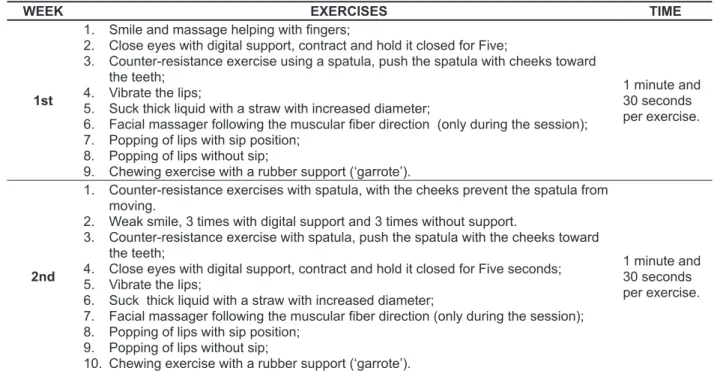
Speech-language therapy was led using isotonic and isometric myofunctional exercises, which were done along the sessions (Table 2).
At the end of the assessment were found: statically and dynamically asymmetry of smile, hypotonia of phonoarticulatory organs (cheeks, lips and tongue) on the right hemiface and hypotonia of the right frontal muscle; hypertonia of the cheeks, lips and tongue muscles on the opposite side (left); unilateral chewing (left), incomplete closing of the right eye and loss of luid. The audiological evalu
-ation was also carried out, in which normal hearing thresholds were found for the left ear and a decrease in hearing for low frequencies, with an air/bone gap at 500 Hz for the right ear. Speech perception tests were preserved. Bilateral tympanometric curves A type and bilateral absent acoustic relexes, except for the ipsilateral of the left ear.
After two weeks, the second audiological evaluation showed an absent air/bone gap. Tympanometric curves were still normal with some contralateral acoustic relexes present bilaterally, as well as the ipsilateral ones on the right ear.
Table 1 – Facial Measures
Lips Commissure – Tragus Right Left
Rest Position Weak smile
Strong smile
105.31 mm 105.12mm 110.05mm
103.37mm
96.40mm 84.99mm
Table 2 - Expressing exercises and time of performance per session
WEEK EXERCISES TIME
1st
1. Smile and massage helping with ingers;
2. Close eyes with digital support, contract and hold it closed for Five;
3. Counter-resistance exercise using a spatula, push the spatula with cheeks toward the teeth;
4. Vibrate the lips;
5. Suck thick liquid with a straw with increased diameter;
6. Facial massager following the muscular iber direction (only during the session); 7. Popping of lips with sip position;
8. Popping of lips without sip;
9. Chewing exercise with a rubber support (‘garrote’).
1 minute and 30 seconds
per exercise.
2nd
1. Counter-resistance exercises with spatula, with the cheeks prevent the spatula from
moving.
2. Weak smile, 3 times with digital support and 3 times without support.
3. Counter-resistance exercise with spatula, push the spatula with the cheeks toward the teeth;
4. Close eyes with digital support, contract and hold it closed for Five seconds; 5. Vibrate the lips;
6. Suck thick liquid with a straw with increased diameter;
7. Facial massager following the muscular iber direction (only during the session); 8. Popping of lips with sip position;
9. Popping of lips without sip;
10. Chewing exercise with a rubber support (‘garrote’).
1 minute and 30 seconds
case. Facial muscles movements got back in a
symmetric way, as well as there was a re-itting of the tonus and of the previously unsettled functions.
Facial measures also suffered modiications after the therapy. In table 3 it’s possible to see the measures taken in the irst and last sessions.
The early started intervention made possible the patient to recover. This is shown in the images below (4, 5 and 6).
A total of 9 sessions were carried out at the end of the treatment at CEFONO clinic, counting the daily exercises, a total of 63 days of treatment, without interruption, including Saturdays, Sundays and holidays.
RESULTS
After the speech-language therapy intervention it was possible to observe a great evolution of the
WEEK EXERCISES TIME
3rd •1. Sipping position keeping a straw between the lips and the nose. Adding one more exercise to the list. 1 minute and
30 seconds
4th
1. Counter-resistance exercise with spatula, with the cheeks prevent the spatula from
moving.
2. Weak smile, 3 times with digital support and 3 times without.
3. Counter-resistance exercise with spatula, push the spatula with the cheeks toward the teeth;
4. Close eyes with digital support, contract and hold it closed for Five seconds; 5. Vibrate the lips;
6. Suck thick liquid with a straw with increased diameter;
7. Facial massager following the muscular iber direction (only during the session); 8. Popping of lips with sip position;
9. Popping of lips without sip 10. Blow a candle and extinguish it
1 minute and 30 seconds
per exercise.
5th
1. Symmetric open smile without digital support; 2. Symmetric open smile with digital support;
3. Facial massager following the muscular iber direction (only during the session for 5 minutes)
4. Vibrate the lips;
5. Close eyes with digital support contract and hold it closed for Five seconds; 6. Suck a thick liquid using a straw with increased diameter;
2 minutes and 30 seconds
per exercise.
6th
1. Smile without Grace without digital support; keep for 5 seconds; 2. Open smile without digital support and keep it for 3 seconds. 3. ‘Rinse the mouth’ with water.
4. Fill a rubber balloon without help.
5. Suck a thick liquid with a straw with increased diameter;
6. Close eyes with digital support, contract and hold it closed for 5 seconds; 7. Facial massager following the muscular iber direction (only during the session
for 5 minutes).
2 minutes and 10 seconds
per exercise.
7th
1. Open smile without digital support and without depressing the lips; keep it for 5
seconds.
2. Facial massager following the muscular iber direction (only during the session for 5 minutes).
3. Suck a thick liquid with a straw with increased diameter;
4. Close eyes with digital support, contract and hold it for ive seconds; 5. Fill a rubber balloon without help and hold it for 10 seconds. 6. To frown and help with ingers following de movement direction. 7. Frowning without support.
2 minutes and 10 seconds
per exercise.
8th
1. Close eyes without support and keep it for 5 seconds, without contracting the corner of the lips
2. ‘Mouth rinsing’ without water. 3. Fill a balloon without help.
4. Suck a thick liquid with a straw with increased diameter; 5. To frown helping with ingers following the movement direction. 6. Frowning without support.
7. Make na ‘angry’ face.
2 minutes and 10 seconds
per exercise.
9th 1. In this session, due the excellent results, the patient was exempted from further
Table 3 – Facial measures obtained in the First and the Last Sessions.
Lips Commissure –Tragus Right Left
Before After Before After
Rest Position Weak smile
Strong smile
105.31mm 105.12mm 110.05mm
105.12 mm 99.06mm
98.02mm
103.37mm
96.40mm 84. 99mm
103.84mm 95.47mm 95.04mm
Picture 4 – Rest Position
Picture 5 – Weak/ Close smile
Picture 6 – Strong/open smile
DISCUSSION
Speech-language therapy in facial paralysis aims the rehabilitation of oral functions such as speaking, chewing, swallowing, suction and facial expressiveness. Intervention must start in the early stages, for the recovery of the functions depends on the kind of impairment of the nerve, degree and time duration for the reinnervation, as well as the motor and sensory connections. To achieve this, myotherapic exercises are used in addition to conventional exercises, in order to work with the facial muscles9. Myofunctional exercises have
as objective to accelerate the nerve regenerative process and also the resumption of movements and functions of the muscles in the facial mimicry, preventing muscle atrophy, which would damage the recovery process10.
The practice of speech-language therapy in individuals with facial paralysis provides them with the ability to realize and feel facial movements, while the nerve regeneration occurs. For this, it is necessary a detailed follow up of movements in order to rebalance facial movements, providing symmetry and facial harmony to the individual. Thus, the patient rehabilitation started with isotonic exercises irstly aiming to re-it facial symmetry, always in a controlled way, that is, even the more restricted movement on the paralysed side should have a similar movement on the opposite side, providing a symmetric movement. In this process, self-control is of high importance and the mirror plays a fundamental role since, associated to neuro
-muscular treatment, it facilitates visual feedback for the control of movements during the exercises111.
This triggers cerebral plasticity, that is, the central system is ‘plastic’ and this characteristic remains active along people’s lives. Motor cortex is able to reorganize itself in response to tasks training. Voluntary control of movements allows, therefore,
a neural reprogramming12 providing, this way,
harmonic and symmetric movements. For this reason a mirror was used in every sessions and the patient was instructed to use the same procedure at home.
and also as a parameter for the therapist about the effectiveness of the exercises. It should be noted that the case had a good prognosis. Not for the fact that the patient was an 11-year-old child, for the age is not a factor to predict the prognosis. The aspect which points out if the prognosis is good or bad is the degree and duration of the injury in addition to the time of reinnervation15. This set of factors can’t
be neglected when the prognosis is analyzed for they immensely contribute to the recovery.
CONCLUSION
A satisfactory result was achieved with the proposed treatment, for there was a re-it of the orofacial musculature and the recovery of facial symmetry in 9 sessions of speech-language treatment, which allows us to infer that the adopted and previously described methodology for the case was adequate.
The early intervention, still in the laccid phase was of great importance for the patient’s recovery. In addition, the time suggested for the implementation of the exercises was effective for this case.
The choice for isotonic exercises during the laccid phase of the facial paralysis was effective and adequate.
The concurrent interdisciplinary work of speech-language therapists and Otorhinolaryngologist doctors was crucial. It should be noted that the cooperation of the patient played a fundamental role for the success of the treatment.
It is suggested that further research in this area should be done, with signiicant samples and varied ages aiming to prove the indings in this and in other similar studies already carried out (1, 3, 5, 7-9). For sure there are still many aspects about the action of speech-language therapy in facial paralysis, which need to be studied and proved enriching, this way, the Brazilian collection of studies about the subject. From research and production of scientiic knowledge the area will obtain recognition, allowing the speech-language therapy action in facial paralysis, which is still not clear to the understanding in many places, to get known and respected.
was observed. Facial tonus must be treated as
well, but it is believed that the priority must be the resumption of facial symmetry and not its tonus. It is known that it is useless to perform the exercises only once a week, during the therapy session. The paralysed muscles can be reactivated only with the everyday practice. There is no agreement among authors about how much time the exercises should be performed. Every therapist advises the patient according to the conditions of the case and the therapist’s experience. In the described case the time was approximately 15 minutes for every period, which was good enough for the recovery.
Anthropometric measurements taken before and after the therapy period contributed to proove objectively the effectiveness of the treatment, for it was observed a great difference between the irst measures and those observed in the last session. The measure which the best expresses facial asymmetry was that of the open smile, whose measure was 110.05mm on the paralysed side (right), whilst on the healthy side (left) it was 84.99mm. It is due to the fact that the mouth pulls on the healthy side because of the paralysis, increasing the measure on the impaired side. The measures of the same point after the treatment provide important data, indicating that there was a re-it of the smile symmetry: 98.02mm on the right side and 95.04 on the left side, showing balance of the two sides. Other articles in the literature also indicate positive results at the end of the therapy period like Salvador et al. 2013, in which the rehabilitation of a group of patients with facial paralysis was described, using the caliper rule for measurements that indicate an improvement of movements at the end of the study13. Tessitore et al. (2009)14 describe the appli
6. Marchesan I Q. Alterã̧es de fala de origem musculoesqueĺtica. In.: Ferreira L P, Bei-Lopes D M, Limongi S C O. Tratado de fonoaudiologia. S̃o Paulo: Roca, 2004. P. 292-303.
7. Bigenzahn W. Disfuņ̃es orofaciais na inf̂ncia. 2. ed. S̃o Paulo: Santos , 2008.
8. Quintal M, Tessitore A, Paschoal JR, Pfeilsticker LN. Quantiicã̧o da paralisia facial com paquímetro digital. Rev CEFAC. [periódico na internet]. 2004 abr-jun [acesso em 03 de setembro de 2014]; 6 (2): (7p.). Disponível em: http://www.cefac.br/revista/ revista62/Artigo%208.pdf
9. Rom̃o AM, Viterbo F. Reabilitã̧o em paralisia facial. In: F́lix GB. (Re) habilitã̧o fonoaudiológica, avaliã̧o e eicácia. S̃o Paulo: Parma; 2009. P. 150-8.
10. Fouquet ML. Atuã̧o fonoaudiológica nas paralisias faciais. In: Barros APB, Arakawa L, Tonini MD, Carvalho VA. Fonoaudiologia em Cancerologia [livro na internet]. S̃o Paulo: Imprensa oicial; 2000 [acesso em 23 de setembro de 2013] P.99-104. Disponível em: http://bvsms.saude.gov.br/bvs/ publicacoes/cd06_03.pdf
11. Cury RWI, Fouquet ML, Lazarini PR. Reabilitã̧o da paralisia facial perif́rica por biofeedbackeletroneuromiográico. In: Lazarini PR, Fouquet ML. Paralisia facial: avaliã̧o, tratamento e reabilitã̧o. S̃o Paulo: Lovise; 2006. P. 177-80. 12. Fouquet ML, Serrano DMS, Abbud IA. Reabilitã̧o fonoaudiológica na paralisia facial perif́rica: fase lácida e de recuperã̧o do movimento. In:Lazarini PR, Fouquet ML. Paralisia facial: Avaliã̧o, tratamento e reabilitã̧o. S̃o Paulo: Lovise;2006. P. 149-59.
13. Salvador CHM, Tessitore A, Pfeilsticker LN, Paschoal JR, Nemr K. Mensurã̧o da evolũ̧o terapêutica com paquímetro digital na paralisia
REFERENCES
1. Toledo PN. Efeito da terapia miofuncional em pacientes com paralisia facial de longa durã̧o associada a aplicã̧o de toxina botulínica [dissertã̧o na internet]. S̃o Paulo (SP): Universidade de S̃o Paulo; 2007 Jul [acesso em 10 de setembro de 2013]; Disponível em: http:// www.teses.usp.br/teses/disponiveis/5/5158/.../ Paulanunestoledo.pdf
2. Calais LL, Gomez MVSG, Bento RF, Comarlatti LR. Avaliã̧o funcional da mimica na paralisia facial
central por acidente cerebrovascular. Pró-Fono R Atual Cient. [periódico na internet]. 2005 Mai-ago
[acesso em 20 de setembro de 2013]; 34 (2): (10 p.). Disponível em: http://www.scielo.br/pdf/pfono/ v17n2/v17n2a09.pdf
3. Lin J, Peruchi MM, Pacheco VF, Knihs V, Leal RDG, Silva RJM et al. Paralisia de nervos cranianos secundária a otomastoidite: relato de caso. ACM. arq. catarin. med. [periódico na internet]. 2005 Jun [acesso em 24 de setembro de 2013]; 34(2):(2 p.). Disponível em: http://www.acm.org.br/revista/pdf/ artigos/341.pdf
4. Salgueiro AB, Brito MJ, Luís C, Machado MC. Mastoidites na Idade Pediátrica. Rev. port.
pediatr. [periódico na internet]. 2007 Jan [acesso
em 24 de setembro de 2013]; 38(6):(5 p.). Disponível em: http://repositorio.hff.min-saude.pt/ bitstream/10400.10/73/1/Salgueiro.pdf
5. Januário PO. Estudo Clínico randomizado no tratamento da paralisia facial perif́rica [dissertã̧o na internet]. S̃o Joś do Rio Preto (SP): Universidade do Vale do Paraíba; 2011 Jun [acesso em 24 de setembro de 2013]. Disponível em: http:// biblioteca.univap.br/dados/000003/0000034F.pdf
RESUMO
De ocorrência frequente, a paralisia facial ́ uma patologia que acomete a face ea express̃o facial. Dentre as etiologias possíveis será destacada uma de ocorrência pouco comum, a Otomastoidite. A interveņ̃o fonoaudiológica iniciada precocemente colabora para o retorno da mobilidade e fuņ̃es da musculatura reduzindo assim a atroia muscular e surgimento de sincinesias e contraturas. O objetivo do estudo foi reabilitar um paciente acometido pela paralisia facial após otomastoidite com a interveņ̃o fonoaudiológica precoce e descrever a aplicã̧o de uma proposta de interveņ̃o tera
-pêutica diferenciada. Na metodologia optou-se por exercícios miofuncionais especíicos, avaliã̧o e acompanhamento audiológico. Nos resultados, após nove semanas de acompanhamento, observou
--se melhora expressiva na simetria do sorriso, adequã̧o das fuņ̃es estomatognáticas e preseņa dos relexos acústicos estapedianos.
na paralisia facial perif́rica. Rev CEFAC. [periódico na internet]. 2009 [acesso em 08 de setembro de 2014]; 11(3): (9p.). Disponível em: http://www.scielo. br/pdf/rcefac/v11s3/a19v11s3.pdf
15. Viterbo F. Paralisia Facial. In: Carreir̃o S, Cardim V, Goldenberg D. Cirurgia Plástica. S̃o Paulo: Atheneu; 2005.P.325-35.
facial perif́rica de Bell. Rev CEFAC. [periódico na internet]. 2013 mai-jun [acesso em 03 de setembro de 2014]; 15 (3): (6 p.). Disponível em: http://www. scielo.br/scielo.php?script=sci_pdf&pid=S1516184 62013000300011&lng=en&nrm=iso&tlng=pt
14. Tessitore A, Paschoal JR, Pfeilsticker LN. Avaliã̧o de um protocolo da reabilitã̧o orofacial
Received on: April 20, 2014 Accepted on: December 03, 2014
Mailing address: Adriana Maria Romão
Rua Ezequiel Ramos, nº 11-69 Bauru – SP – Brasil
CEP: 17013-111