Pharmaceutical Sciences
http://dx.doi.org/10.1590/s2175-97902017000115239
A
r
ti
*Correspondence: A. A. Radwan. Kayyali Chair. Department of Pharmaceu-tics. College of Pharmacy. King Saud University. Riyadh 11451, Saudi Arabia. E-mail: [email protected]; [email protected]
1,3,4-Thiadiazole and 1,2,4-triazole-3(4
H
)-thione bearing salicylate
moiety: synthesis and evaluation as anti-
Candida albicans
Awwad Abdoh Radwan
1,2,*, Fares Kaed Alanazi
1,3, Mohammed Hamed Al-Agamy
3,41Kayyali Chair, College of Pharmacy, King Saud University, Riyadh, Saudi Arabia, 2Department of Pharmaceutical Organic
Chemistry, Faculty of Pharmacy, Assiut University, Assiut, Egypt, 3Department of Pharmaceutics, College of Pharmacy,
King Saud University, Riyadh, Saudi Arabia, 4Department of Microbiology and Immunology, Faculty of Pharmacy, Al-Azhar
University, Cairo, Egypt
Dramatically increased occurrence of both superficial and invasive fungal infections has been observed. Candida albicans appear to be the main etiological agent of invasive fungal infections. The anti-C. albicans activity of thiosemicarbazide, 1,3,4-Thiadiazole,and 1,2,4-triazole-3(4H)-thione compounds (compounds 3-23) were investigated. The MIC values of thiadiazole and triazole derivatives 10-23 were in the range of 0.08-0.17 µmol mL-1, while that of luconazole was 0.052 µmol mL-1. Compound 11 (5-(2-(4-chlorobenzyloxy)phenyl)-N-allyl-1,3,4-thiadiazol-2-amine) and compound 18 (5-(2-(4-chlorobenzyloxy)phenyl)-4-allyl-2H-1,2,4-triazole-3(4H)-thione) were found to be the most active compounds, with MIC values of 0.08 µmol mL-1. The newly synthesized thiadiazole and triazole compounds (compounds 10-23) showed promising anti-Candida activity. The allyl substituent-bearing compounds 11 and 18 exhibited signiicant anti-Candida albicans activity and showed a binding mode
as well as the luconazole x-ray structure.
Uniterms: Anti-Candida/docking studies. Thiadiazole. Triazole.
INTRODUCTION
Over the last two decades, dramatically increased occurrence of both superficial and invasive fungal infections has been observed. In organ transplant cases and in immune compromised individuals, including patients with cancer or AIDS, fungal infections are the major cause of morbidity and mortality (Romani, 2008). The invasive Candida infections are mainly caused by Candida albicans and account for 30-40% of fungal infection-related mortality (Pfaller, Diekema, 2010).
A major obstacle in the treatment of Candida
infections is the spread of anti-Candida drug resistance following long-term regular administration of antimycotic therapy in severely immunocompromised subjects, such as cancer patients, transplant recipients, and patients undergoing surgery. In spite of the development of new drugs, such as new azole or echinocandin derivatives,
there has been a dramatic increase in both anti-Candida
resistance and the frequency of invasive Candida
infections (Pfaller, 2012). Among enormous classes of heterocyclic compounds, the synthesis of new derivatives of 1,2,4-triazole-3-thiones and 2-amino-1,3,4-thiadiazoles has been attracting considerable attention because of their broad biological activity, including antibacterial and antifungal (Güzeldemirci, Küçükbasmaci, 2010; Plec et al., 2011; Camoutsis et al., 2010; Küçükgüzel et al., 2007; Kadi et al., 2007), anti-tubercular (Küçükgüzel et al., 2001; Küçükgüzel et al., 2008), antiviral (Abdel-Aal et al., 2003; Küçükgüzel et al., 2008), antioxidant (Ayhan-Kilcigil et al., 2004; Khan et al., 2010), antitumoral (Duran, Dogan, Rollas, 2002; Rzeski, Matysiak, Kandefer-Szerszen, 2007; Mavrova et al., 2009), anti-inlammatory (Amir, Shikha,
proile (Wang et al., 2009). Azoles were broadly used as first-line treatment of invasive fungal infections, which led to the emergence of high resistance (Hofman, Ernst, Klepser, 2000; Casalinuovo, Di Francesco, Garaci, 2004) that largely decreased their efficacy. Azoles exert their antifungal activity by inhibiting the synthesis of sterols in fungal cells. This may be achieved through its inhibitory effect on cytochrome P450-dependent 14a-lanosterol demethylase, exerted through binding to the heme cofactor of the cytochrome CYP51”. (Odds, Brown, Gow, 2003; Hamdan, Hahn, 2006). As a result, ergosterol is depleted, and subsequent accumulation of lanosterol inside the fungal cells occurs, leading to inhibition of their growth. Because of the vital role of the CYP51 enzyme in the biosynthetic processes of fungal cells, CYP51 is considered the main target of antifungal azole agents (Lamb et al., 1999). In view of the potential biological activity of derivatives of 1,2,4-triazole and 1,3,4-thiadiazole and in continuation of our ongoing research on the synthesis of heterocycles with potential antimicrobial activity (Radwan, Hussein, 2006; Mostafa et al., 2008; Aboul-Fadl et al., 2012; Attia et al., 2013; Radwan, 2013; Ghorab et al., 2013a, b; Radwan et al., 2014; Radwan, Abdel-Mageed, 2014), we synthesized a new series from 1,2,4-triazole and 1,3,4-thiadiazole in order to examine their antifungal activity. Hydrocarbon substituents with variable size were included at position 2 of the thiadiazole ring and at position 1 of the triazole ring in order to enhance the lipophilicity and subsequently the biological activity of the compounds and to study the steric and electronic effect of these substituents on biological activity.
MATERIAL AND METHODS
Methyl salicylate (1), chlorobenzyl chloride (2), and isothiocyanate derivatives were purchased from Sigma-Aldrich Company (St. Louis, MO, USA). Measurements of melting points were done on a Barnstead 9001 Electrothermal apparatus using open capillary tubes; these measurements were uncorrected. FTIR spectra were obtained using KBr discs on a Perkin-Elmer (USA) spectrophotometer at the research center of the College of Pharmacy, King Saud University, Saudi Arabia. 1H and 13C
NMR spectra were recorded in DMSO-d6 on a Bruker NMR spectrophotometer operating at either 500 MHz or 125.76 MHz. Elemental analysis was performed on a Perkin-Elmer CHNSO analyzer, model no. 2400. Reaction monitoring and purity testing of the inal products were carried out by thin layer chromatography (TLC) using silica gel-precoated aluminum sheets (60 F254, Merck) and visualization with ultraviolet light (UV) at 365 and 254 nm.
Synthesis of methyl 2-(4-chlorobenzyloxy) benzoate (1)
Methyl 2-hydroxybenzoate (1.3 g, 0.01 mol) was dissolved in dry acetone (120 mL). Dry potassium carbonate (4.14 g, 0.03 mol) was added and the mixture was stirred at room temperature for 10 min. Chlorobenzyl chloride (3.86 mL, 0.03 mol) was added to the mixture and the solution was heated under relux for 18 h under a nitrogen atmosphere. The cooled reaction mixture was iltered, the solvent was removed under reduced pressure, and the residue was dissolved in dichloromethane (25 mL). The organic layer was washed consecutively with 5% aqueous NaOH (25 mL), brine (20 mL), and distilled water (20 mL). The organic layer was dried over magnesium sulfate and the solvent was removed under reduced pressure. The residue was purified by column chromatography with 5%-20% ethyl acetate/hexane as eluent to aford the product. Yield 2.5 g, 90%.
Synthesis of 2-(4-chlorobenzyloxy) benzohydrazide (2)
Methyl 2-(4-chlorobenzyloxy)benzoate (1)(2.76 g, 0.01 mol), ethanol (20 mL), and 64% hydrazine hydrate (4 mL) were mixed together and heated under reflux at 80°C for 8 h. TLC eluted with 1:4 ethanol/benzene showed the development of a new spot at Rf = 0.65. Ethanol was evaporated under reduced pressure and a white solid product was recrystallized from H2O/MeOH to yield compound 2 (2.6 g, 95% yield), melting point 111-112°C, IR (KBr, cm-1) 3246 (NH), 1583 (CO-N). 1H NMR (DMSOd
6, δ ppm): 4.53 (s, 2H, NH2), 5.24 (s,
2H, Ar–CH2–O), 7.02–7.65 (8H, m, Ar-Hs), 9.24 (s, 1H, -CONH). 13C NMR (DMSO-d
6, δ ppm): 69.4 (Ar–CH2–O),
113.82, 121.27, 123.38, 128.97, 129.81, 130.18, 132.12, 132.94, 136.3, 156.97 (C-Ar), 165.54 (C=O). Anal. calcd. for C14H13ClN2O2: C, 60.77; H, 4.74; N, 10.12. Found: C, 60.63; H, 4.85; N, 10.01.
Synthesis of 1-(2-(4-chlorobenzyloxy)benzoyl)-4-substituted-thiosemicarbazide (3-9)
and recrystallized from appropriate solvent to yield compounds 3-9.
1-(2-(4-chlorobenzyloxy)benzoyl)-4-phenylthiosemicarbazide (3)
Yield 4.02 g, 98%, melting point 176–178 °C; IR (KBr) 3320, 1664, 1618, 833, 750, 691 cm-1; 1H NMR
(DMSOd6, δ ppm): 5.32 (2H, s, (Ar–CH2–O), 7.08–7.87 (13H, m, Ar-Hs), 9.42, 9.93, 10.15 (3s, 3H, 3NH). 13C
NMR (DMSO-d6, δ ppm): 69.69 (Ar–CH2–O), 114.05, 121.4, 122.1, 123.4, 125.2, 126.4, 128.63, 128.09, 130.1, 131.22, 133.07, 133.25, 135.93, 139.48, 156.38 (C-Ar), 165.15 (C=O), 182.23 (C=S). Anal. calcd. for C21H18ClN3O2S: C, 61.23; H, 4.40; N, 10.20; S, 7.78. Found: C, 61.01; H, 4.58; N, 10.03; S, 7.63.
1-(2-(4-chlorobenzyloxy)benzoyl)-4-allylthiosemicarbazide (4)
Yield 3.2 g, 85%, melting point 157–158 °C; IR (KBr) 3314, 1648, 1622, 852, 772, 672 cm-1; 1H
NMR (DMSOd6, δ ppm): 4.04 (s, 2H, CH2=CH-CH2-),
5.07 (d, 1H, J=10, transCH2=CH-), 5.11 (d, 1H, J=17,
cisCH2=CH-), 5.28 (s, 2H, Ar–CH2–O), 5.79 (m, 1H,
CH2=CH-CH2-), 7.06–7.97 (8H, m, Ar-Hs), 9.37, 9.71, 10.09 (3s, 3H, 3NH). 13C NMR (DMSO-d
6, δ ppm): 46.19
(allyl-CH2), 69.57 (Ar–CH2–O), 113.93, 119.71, 121.32, 128.95, 130.05, 131.03, 133.03, 133.05, 135.01, 136.05, 156.26 (C-Ar), 165.02 (C=O), 181.95 (C=S). Anal. calcd. for C18H18ClN3O2S: C, 57.52; H, 4.83; N, 11.18; S, 8.53.
Found: C, 57.43; H, 4.91; N, 11.03; S, 8.61.
1-(2-(4-chlorobenzyloxy)benzoyl)-4-(m-tolyl) thiosemicarbazide (5)
Yield 4.08 g, 96%, melting point 170–171 °C; IR (KBr) 3294, 1640, 1608, 816, 746, 694 cm-1; 1H NMR
(DMSOd6, δ ppm): 2.28 (s, 3H, CH3), 5.31 (s, 2H, Ar– CH2–O), 6.96–7.86 (m, 12H, Ar-Hs), 9.36, 9.82, 10.18
(3s, 3H, 3NH). 13C NMR (DMSO-d
6, δ ppm): 21.44 (CH3),
69.7 (Ar–CH2–O), 114.04, 121.42, 125.05, 128.45, 128.89,
130.08, 131.18, 133.07, 133.23, 135.91, 139.32, 156.37 (C-Ar), 165.23 (C=O), 180.76 (C=S). Anal. calcd. for C22H20ClN3O2S: C, 62.04; H, 4.73; N, 9.87; S, 7.53. Found: C, 61.92; H, 4.80; N, 9.76; S, 7.38.
1-(2-(4-chlorobenzyloxy)benzoyl)-4-(p-tolyl) thiosemicarbazide (6)
Yield 4.16 g, 98%, melting point 162–163 °C; IR (KBr) 3294, 1640, 1608, 816, 746, 694 cm-1; 1H NMR
(DMSOd6, δ ppm): 2.29 (s, 3H, CH3), 5.31 (s, 2H, Ar–
CH2–O), 7.07–7.86 (m, 12H, Ar-Hs), 9.42, 9.88, 10.12 (3s, 3H, 3NH). 13C NMR (DMSO-d
6, δ ppm): 21.01
(CH3), 69.69 (Ar–CH2–O), 114.03, 121.4, 128.89, 129.14,
130.09, 131.19, 133.08, 133.21, 135.91, 136.85, 156.37 (C-Ar), 165.78 (C=O), 180.93 (C=S). Anal. calcd. for C22H20ClN3O2S: C, 62.04; H, 4.73; N, 9.87; S, 7.53. Found: C, 61.88; H, 4.79; N, 9.93; S, 7.61.
1-(2-(4-chlorobenzyloxy)benzoyl)-4-(o-tolyl) thiosemicarbazide (7)
Yield 4.0 g, 95%, melting point 148–149 °C; IR (KBr) 3323, 1662, 1628, 869, 772, 732 cm-1; 1H NMR
(DMSOd6, δ ppm): 2.14 (s, 3H, CH3), 5.24 (s, 2H, Ar–
CH2–O), 7.07–7.85 (m, 12H, Ar-Hs), 9.15, 9.72, 10.16 (3s, 3H, 3NH). 13C NMR (DMSO-d
6, δ ppm): 18.06 (CH3),
69.69 (Ar–CH2–O), 113.93, 121.32, 126.26, 126.97, 128.87, 130.04, 130.53, 131.13, 133.06, 135.87, 156.35 (C-Ar), 165.62 (C=O), 181.06 (C=S). Anal. calcd. for C22H20ClN3O2S: C, 62.04; H, 4.73; N, 9.87; S, 7.53. Found:
C, 62.14; H, 4.8; N, 9.75; S, 7.46.
1-(2-(4-chlorobenzyloxy)benzoyl)-4-(3-chlorophenyl) thiosemicarbazide (8)
Yield 4.35 g, 98%, melting point 151–152 °C; IR (KBr) 3314, 1683, 1612, 876, 778, 674 cm-1; 1H NMR
(DMSOd6, δ ppm): 5.24 (s, 2H, Ar–CH2–O), 7.08–7.87 (m, 12H, Ar-Hs), 9.52, 10.04, 10.14 (3s, 3H, 3NH). 13C
NMR (DMSO-d6, δ ppm): 69.67 (Ar–CH2–O), 114.06, 121.4, 124.98, 128.88, 129.81, 130.05, 131.27, 132.62, 133.07, 133.32, 135.92, 141.06, 156.43 (C-Ar), 165.3 (C=O), 181.58 (C=S). Anal. calcd. for C21H17Cl2N3O2S:
C, 56.51; H, 3.84; N, 9.41; S, 7.18. Found: C, 56.43; H, 3.71; N, 9.52; S, 7.25.
1-(2-(4-chlorobenzyloxy)benzoyl)-4-isopropylthiosemicarbazide (9)
Yield 3.54 g, 94%, melting point 163–164 °C; IR (KBr) 3335, 1672, 1628, 853, 764, 679 cm-1; 1H NMR
(DMSOd6, δ ppm): 1.06 (d, 6H, J=6, 2CH3), 4.35 (m, 1H,
CH), 5.31 (s, 2H, Ar–CH2–O), 7.06–7.75 (m, 8H, Ar-Hs), 9.25, 9.48, 10.12 (3s, 3H, 3NH). 13C NMR (DMSO-d
6,
δ ppm): 22.34 (CH3), 46.01 (>CH), 69.61 (Ar–CH2–O),
113.97, 118.32, 121.4, 127.81, 128.97, 129.82, 129.25, 133.04, 133.08, 156.06 (C-Ar), 165.1 (C=O), 180.52 (C=S). Anal. calcd. for C18H20ClN3O2S: C, 57.21; H, 5.33;
N, 11.12; S, 8.49. Found: C, 57.08; H, 5.41; N, 11.19; S, 8.56.
Synthesis of 5-(2-(4-chlorobenzyloxy)phenyl)-N -substituted-1,3,4-thiadiazol-2-amine (10-16)
with stirring at 0 °C. The reaction mixture was stirred for 3 h at room temperature, allowed to stand overnight, and neutralized with diluted sodium hydroxide. The precipitated crude solid was filtered and washed with water. The crude product was then recrystallized from a mixture of acetic acid and water (1:1 or 1:2) to yield disubstituted 1,3,4-thiadiazole (10-16).
5-(2-(4-chlorobenzyloxy)phenyl)-N-phenyl-1,3,4-thiadiazol-2-amine (10)
Yield 3.35 g, 85%, melting point 154–156 °C; IR (KBr) 3278, 838, 751, 695 cm-1; 1H NMR (DMSOd
6, δ
ppm): 4.6 (s, 2H, Ar–CH2–O), 4.8–5.52 (bs, 1H, NH),
6.94-7.69 (m, 13H, Ar-Hs). 13C NMR (DMSO-d
6, δ ppm):
70.42 (Ar–CH2–O), 117.69, 118.12, 122.1, 123.4, 125.2,
126.4, 128.63, 128.85, 129.56, 130.18, 133.07, 133.25, 135.93, 139.97, 154.05, 150.1, 169.04. Anal. calcd. for C21H16ClN3OS: C, 64.03; H, 4.09; N, 10.67; S, 8.14. Found: C, 63.88; H, 4.15; N, 10.51; S, 8.06.
5-(2-(4-chlorobenzyloxy)phenyl)-N-allyl-1,3,4-thiadiazol-2-amine (11)
Yield 2.67 g, 75%, melting point 142–144 °C; IR (KBr) 3305, 883, 752, 672 cm-1; 1H NMR (DMSOd
6,
δ ppm): 4.36 (s, 2H, CH2=CH-CH2-), 4.92 (s, 2H, Ar–
CH2–O), 5.11 (d, 1H, J=10, transCH2=CH-), 5.16 (d, 1H, J=17, cisCH2=CH-), 5.67 (m, 1H, CH2=CH-CH2-),
5.8–6.34 (bs, 1H, NH), 7.13–7.72 (8H, m, Ar-Hs). 13C NMR
(DMSO-d6, δ ppm): 45.86 (allyl-CH2), 69.17 (Ar–CH2–O),
114.23, 116.04, 121.25, 122.4, 128.05, 128.6, 129.1, 129.42, 133.62, 134.83, 139.65, 157.02, 164.3, 168.06. Anal. calcd. for C18H16ClN3OS: C, 60.41; H, 4.51; N, 11.74; S, 8.96. Found: C, 60.28; H, 4.64; N, 11.61; S, 8.82.
5-(2-(4-chlorobenzyloxy)phenyl)-N-m-tolyl-1,3,4-thiadiazol-2-amine (12)
Yield 3.33 g, 82%, melting point 143–145 °C; IR (KBr) 3319, 884, 791, 697 cm-1; 1H NMR (DMSOd
6,
δ ppm): 2.31 (s, 3H, CH3), 4.95 (s, 2H, Ar–CH2–O),
5.61–6.37 (bs, 1H, NH), 7.15–7.68 (m, 12H, Ar-Hs).
13C NMR (DMSO-d
6, δ ppm): 23.02 (CH3), 70.16 (Ar–
CH2–O), 112.61, 114.52, 118.3, 119.22, 120.81, 121.65, 126.41, 127.91, 128.86, 129.32, 130.66, 131.54, 138.62, 139.35, 141.55, 150.11, 155.54, 167.31. Anal. calcd. for C22H18ClN3OS: C, 64.78; H, 4.45; N, 10.30; S, 7.86.
Found: C, 64.62; H, 4.42; N, 10.38; S, 7.78.
5-(2-(4-chlorobenzyloxy)phenyl)-N-p-tolyl-1,3,4-thiadiazol-2-amine (13)
Yield 3.25 g, 80%, melting point 154–156 °C; IR (KBr) 3318, 819, 762, 684 cm-1; 1H NMR (DMSOd
6, δ
ppm): 2.38 (s, 3H, CH3), 5.13 (s, 2H, Ar–CH2–O), 5.74–
6.51 (bs, 1H, NH), 7.26–7.81 (m, 12H, Ar-Hs). 13C NMR
(DMSO-d6, δ ppm): 21.32 (CH3), 69.75 (Ar–CH2–O),
113.06, 114.32, 116.01, 118.98, 120.01, 120.89, 123.98, 125.88, 128.31, 131.01, 133.05, 134.87, 135.92, 138.33, 146.01, 151.04, 168.03. Anal. calcd. for C22H18ClN3OS: C, 64.78; H, 4.45; N, 10.30; S, 7.86. Found: C, 64.71; H, 4.48; N, 10.26; S, 7.95.
5-(2-(4-chlorobenzyloxy)phenyl)-N-o-tolyl-1,3,4-thiadiazol-2-amine (14)
Yield 3.0 g, 75%, melting point 146–148 °C; IR (KBr) 3299, 846, 749, 669 cm-1; 1H NMR (DMSOd
6, δ
ppm): 2.26 (s, 3H, CH3), 5.08 (s, 2H, Ar–CH2–O), 5.82– 6.38 (bs, 1H, NH), 7.02–7.73 (m, 12H, Ar-Hs). 13C NMR
(DMSO-d6, δ ppm): 18.58 (CH3), 70.04 (Ar–CH2–O), 113.46, 114.52, 114.89, 116.04, 116.53, 121.08, 124.05, 125.12, 127.81, 130.76, 132.65, 133.65, 137.53, 138.09, 149.31, 152.3, 166.14. Anal. calcd. for C22H18ClN3OS:
C, 64.78; H, 4.45; N, 10.30; S, 7.86. Found: C, 64.76; H, 4.51; N, 10.38; S, 7.72.
5-(2-(4-chlorobenzyloxy)phenyl)-N-(3-chlorophenyl)-1,3,4-thiadiazol-2-amine (15)
Yield 3.33 g, 78%, melting point 150–152 °C; IR (KBr) 3296, 861, 788, 681 cm-1; 1H NMR (DMSOd
6, δ
ppm): 5.16 (s, 2H, Ar–CH2–O), 5.48–6.28 (bs, 1H, NH),
7.23–7.84 (m, 12H, Ar-Hs). 13C NMR (DMSO-d
6, δ ppm):
70.33 (Ar–CH2–O), 112.35, 114.58, 116.25, 116.63,
120.02, 122.87, 126.25, 126.91, 128.36, 130.57, 130.22, 136.35, 138.39, 146.24, 151.05, 166.08. Anal. calcd. for C21H15Cl2N3OS: C, 58.89; H, 3.53; N, 9.81; S, 7.49. Found: C, 58.81; H, 3.42; N, 9.93; S, 7.59.
5-(2-(4-chlorobenzyloxy)phenyl)-N-isopropyl-1,3,4-thiadiazol-2-amine (16)
Yield 2.65 g, 74%, melting point 156–158 °C; IR (KBr) 3295, 873, 775, 693 cm-1; 1H NMR (DMSOd
6, δ
ppm): 1.13 (d, 6H, J=6, 2CH3), 4.48 (m, 1H, CH), 5.08 (s,
2H, Ar–CH2–O), 5.62–6.51 (bs, 1H, NH), 7.11–7.69 (m, 8H, Ar-Hs). 13C NMR (DMSO-d
6, δ ppm): 21.66 (CH3),
46.8 (>CH), 69.04 (Ar–CH2–O), 113.31, 114.12, 114.01, 118.42, 119.09, 120.96, 124.14, 124.54, 127.33, 128.97, 133.12, 133.88, 137.63, 148.01, 151.11, 167.13. Anal. calcd. for C18H18ClN3OS: C, 60.07; H, 5.04; N, 11.68; S,
8.91. Found: C, 60.11; H, 5.17; N, 11.61; S, 8.82.
Synthesis of 5-(2-(4-chlorobenzyloxy)phenyl)-4-substituted-2H-1,2,4-triazole-3(4H)-thione (17-23)
was dissolved in ethanol (200 mL). Then, 20 mL of an ethanolic solution of KOH (0.85 g, KOH, 0.015 mol) was added and the mixture was heated under relux at 80 °C for 4 h. Excess ethanol was evaporated to dryness and the bulk of the solid was washed with 2 M hydrochloric acid, iltered, dried, and recrystallized from ethanol to yield the corresponding compounds (17-23).
5-(2-(4-chlorobenzyloxy)phenyl)-4-phenyl-2H-1,2,4-triazole-3(4H)-thione (17)
Yield 3.25 g, 83%, melting point 223–225 °C; IR (KBr) 3315, 871, 752, 699 cm-1; 1H NMR (DMSOd
6,
δ ppm): 3.38 (bs, 1H, SH), 4.89 (s, 2H, Ar–CH2–O),
6.91–7.51 (m, 13H, Ar-Hs). 13C NMR (DMSO-d
6, δ ppm):
69.04 (Ar–CH2–O), 113.1, 115.74, 122.24, 128.2, 128.28,
129.02, 129.32, 129.51, 132.33, 132.9, 132.96, 134.57, 135.92, 149.76, 156.35 (C5), 168.04 (C3). Anal. calcd. for C21H16ClN3OS: C, 64.03; H, 4.09; N, 10.67; S, 8.14. Found: C, 63.92; H, 4.13; N, 10.52; S, 8.23.
5-(2-(4-chlorobenzyloxy)phenyl)-4-allyl-2H-1,2,4-triazole-3(4H)-thione (18)
Yield 2.65 g, 74%, melting point 231–233 °C; IR (KBr) 3308, 873, 756, 663 cm-1; 1H NMR (DMSOd
6,
δ ppm): 3.25 (bs, 1H, SH), 4.47 (d, 2H, J=5, CH2
=CH-CH2-), 4.7 (d, 1H, J=17, transCH2=CH-), 4.95 (d, 1H, J=10 cisCH2=CH-), 5.19 (s, 2H, Ar–CH2–O), 5.62 (m,
1H, CH2=CH-CH2-), 7.08–7.57 (m, 8H, Ar-Hs). 13C
NMR (DMSO-d6, δ ppm): 69.04 (Ar–CH2–O), 46.06
(Allyl-CH2), 69.14 (Ar–CH2–O), 113.59, 115.83, 117.31, 124.13, 128.97, 129.78, 132.02, 132.18, 133.08, 133.1, 135.94, 149.73, 156.62 (C5), 167.18 (C3). Anal. calcd. for C18H16ClN3OS: C, 60.41; H, 4.51; N, 11.74; S, 8.96.
Found: C, 60.32; H, 4.59; N, 11.66; S, 9.08.
5-(2-(4-chlorobenzyloxy)phenyl)-4-(m-tolyl)-2H-1,2,4-triazole-3(4H)-thione (19)
Yield 3.0 g, 73%, melting point 185–187 °C; IR (KBr) 3293, 871, 787, 693 cm-1; 1H NMR (DMSOd
6,
δ ppm): 2.14 (s, 3H, CH3), 4.15 (bs, 1H, SH), 4.87 (s,
2H, Ar–CH2–O), 6.83–7.45 (m, 12H, Ar-Hs). 13C NMR
(DMSO-d6, δ ppm): 21.17 (CH3), 69.12 (Ar–CH2–O), 113.06, 116.98, 121.15, 125.03, 128.55, 128.75, 128.82, 129.24, 132.37, 132.41, 134.76, 135.34, 136.16, 138.04, 149.51, 156.29 (C5), 166.38 (C3). Anal. calcd. for C22H18ClN3OS: C, 64.78; H, 4.45; N, 10.30; S, 7.86. Found: C, 64.61; H, 4.52; N, 10.23; S, 7.94.
5-(2-(4-chlorobenzyloxy)phenyl)-4-(p-tolyl)-2H-1,2,4-triazole-3(4H)-thione (20)
Yield 3.1 g, 76%, melting point 177–179 °C; IR
(KBr) 3308, 872, 809, 754 cm-1; 1H NMR (DMSOd 6,
δ ppm): 2.26 (s, 3H, CH3), 3.7 (bs, 1H, SH), 4.84 (s,
2H, Ar–CH2–O), 6.84–7.38 (m, 12H, Ar-Hs). 13C NMR
(DMSO-d6, δ ppm): 21.14 (CH3), 69.83 (Ar–CH2–O), 113.04, 119.15, 121.01, 127.12, 128.7, 128.79, 129.38, 131.31, 132.29, 132.62, 134.53, 135.39, 136.7, 149.31, 156.01 (C5), 167.81 (C3). Anal. calcd. for C22H18ClN3OS:
C, 64.78; H, 4.45; N, 10.30; S, 7.86. Found: C, 64.72; H, 4.58; N, 10.41; S, 7.73.
5-(2-(4-chlorobenzyloxy)phenyl)-4-(o-tolyl)-2H-1,2,4-triazole-3(4H)-thione (21)
Yield 2.9 g, 70%, melting point 200–202 °C; IR (KBr) 3311, 810, 754, 719 cm-1; 1H NMR (DMSOd
6, δ
ppm): 1.99 (s, 3H, CH3), 3.49 (bs, 1H, SH), 5.0 (s, 2H, Ar–
CH2–O), 6.89–7.42 (m, 12H, Ar-Hs). 13C NMR (DMSO-d 6,
δ ppm): 18.17 (CH3), 69.51 (Ar–CH2–O), 113.17, 120.91,
126.4, 128.36, 129.12, 129.38, 129.43, 130.36, 132.01, 132.37, 132.79, 134.98, 136.2, 136.64, 149.33, 156.47 (C5), 166.86 (C3). Anal. calcd. for C22H18ClN3OS: C, 64.78; H, 4.45; N, 10.30; S, 7.86. Found: C, 64.71; H, 4.36; N, 10.39; S, 7.72.
5-(2-(4-chlorobenzyloxy)phenyl)-4-(m-chlorophenyl)-2H-1,2,4-triazole-3(4H)-thione (22)
Yield 3.5 g, 84%, melting point 225–226 °C; IR (KBr) 3327, 858, 776, 684 cm-1; 1H NMR (DMSOd
6, δ
ppm): 4.26 (bs, 1H, SH), 5.01 (s, 2H, Ar–CH2–O), 7.08– 7.61 (m, 12H, Ar-Hs). 13C NMR (DMSO-d
6, δ ppm): 70.29
(Ar–CH2–O), 112.22, 118.64, 124.31, 125.01, 127.54, 128.12, 129.26, 131.47, 131.16, 132.22, 133.06, 135.18, 138.01, 148.31, 158.32 (C5), 169.11 (C3). Anal. calcd. for C21H15Cl2N3OS: C, 58.89; H, 3.53; N, 9.81; S, 7.49. Found:
C, 58.72; H, 3.58; N, 9.73; S, 7.58.
5-(2-(4-chlorobenzyloxy)phenyl)-4-(isopropyl)-2H-1,2,4-triazole-3(4H)-thione (23)
Yield 2.7 g, 75%, melting point 212–213 °C; IR (KBr) 3328, 871, 809, 755 cm-1; 1H NMR (DMSOd
6, δ
ppm): 1.17 (d, 6H, J=6, 2CH3), 4.25 (m, 1H, CH), 4.06 (bs, 1H, SH), 5.28 (s, 2H, Ar–CH2–O), 6.72–7.65 (m,
8H, Ar-Hs). 13C NMR (DMSO-d
6, δ ppm): 23.18 (CH3),
42.86 (>CH), 69.84 (Ar–CH2–O), 113.34, 116.81, 121.05,
125.35, 127.67, 128.33, 129.14, 130.45, 136.16, 132.68, 133.06, 136.18, 139.01, 141.52, 152.08 (C5), 166.63 (C3). Anal. calcd. for C18H18ClN3OS: C, 60.07; H, 5.04; N, 11.68; S, 8.91. Found: C, 59.91; H, 5.11; N, 11.62; S, 8.88.
Anti-Candida albicans screening
determination of minimum inhibitory concentration (MIC) for diferent synthetic compounds were performed using the cup plate difusion method and macro-broth dilution method, respectively (Bauer et al., 1966; Arendrup et al., 2012).
Cup plate experiment
Three to five pure colonies of Candida albicans
ATCC 2091 were taken from overnight culture of Sabauraud’s 2% dextrose agar medium (Merck®, Darmstadt, Germany) and suspended in 5 mL of Sabauraud’s 2% dextrose broth medium. The inoculum was evenly suspended by vigorous shaking on a vortex mixer for 15 s. The yeast strain was measured using a spectrophotometer (LKB® Ultrospec) at 530 nm to give absorbance of 0.2-0.15 (1-5x10⁶ CFU/mL). The
suspension was diluted 1:10 in Sabauraud’s 2% dextrose broth medium to obtain 1x10⁵ CFU/mL. The suspension
was swabbed onto a Sabauraud’s 2% dextrose agar plate and allowed to dry completely. Three ditches per agar plate were made using a cork borer. Then, 100 µL (512 µg) of stock solution (5120 µg mL-1) was transferred into the
cup using a sterile pipette. The plates were refrigerated at 4°C for 30 min for difusion, and then incubated at 37°C for 24 h. After the incubation period, the diameter of the inhibition zone (including the diameter cup) was measured and recorded in mm. Fluconazole (50 µg mL-1) was used as
a positive control. The assay was carried out in duplicate.
Determination of MIC
MIC was determined with the broth dilution method. The test solution and all standard drugs were prepared at a concentration of 2048 μg mL-1 in distilled
dimethylsulfoxide and treated as stock solutions. Briely, 1 mL of RPMI 1640 medium was dispensed into a sterile 7 mL bijou tube (Sterilin Limited, UK). Ten tubes were required for each experiment and each experiment was done in duplicate. Tubes #9 and #10 were used as the positive growth control (no tested compound) and the negative control for the medium sterility (no microorganism), respectively. A 1-mL (2048 μg mL-1)
aliquot of the tested compound was pipetted into tube #1 and mixed well for a concentration of 1024 μg mL-1. Then,
1 mL was transferred from tube #1 to tube #2 for a twofold dilution (512 μg mL-1). This procedure was repeated down
to tube #8, for a concentration of 8 μg mL-1 in tube #8.
One milliliter was discarded from tube #8. Then, 1 mL of inoculum (1-5x10⁵ CFU/mL) was added to each of the
eight tubes to give a inal concentration of 0.5-2.5x10⁵
CFU/mL and to make a two-fold dilution of the tested compound. In addition, tube #9 (growth control tube), containing 1 mL of sterile drug-free distilled water, was inoculated with 1 mL of the same inoculum suspension. One milliliter of drug-free medium was added to tube #10 as a sterility control for medium. The inoculated tubes were incubated at 35°C for 20 h. The tubes were inoculated with prepared yeast suspension within 30 min in order to maintain the viable cell concentration. After the incubation period, the results of MIC were recorded manually and interpreted according to the guidelines of the European Committee for Antimicrobial Susceptibility Testing (EUCAST).
Docking procedure
The docking studies were performed on a PC with Windows Vista Home Premium Intel(R) Core(TM)2 Duo, 1.83GHz using Autodock vina program (Trott, Olson, 2010). The chemical structures of the compounds under study were prepared with a protonation state similar to that found under physiological conditions. The X-ray crystal structure of the 14-α-sterol demethylase (CYP51) enzyme complexed with luconazole (1EA1) was obtained from the Protein Data Bank (Podust, Poulos, Waterman,2001). The cocrystallized luconazole structure was docked in its target macromolecule structure using Autodock vina program with its default settings.
RESULTS AND DISCUSSION
Chemistry
M e t h y l 2 - ( 4 - c h l o r o b e n z y l o x y ) b e n z o a t e (1) was synthesized through the reaction of methyl 2-hydroxybenzoate with p-chlorobenzyl chloride. Reaction of 1 and hydrazine hydrate yielded the corresponding hydrazide (2). Reaction of 2 with the corresponding isothiocyanate yielded the isothiocyanate derivatives (3-9), which were cyclized in concentrated sulfuric acid resulting in 1,3,4-thiadiazoles (10-16) (Daoud, Al-Obaydi, 2008). The reflux of 2 in 2 M NaOH yielded the corresponding 1,3,4-triazole-2-thione derivatives (17-23) (Daoud, Al-Obaydi, 2008). The synthetic route of these compounds is given in the scheme. The chemical structures of the synthesized compounds were in accordance with their 1H and 13C NMR spectra. The
spectral data are summarized in the material and methods section. 1H NMR and 13C NMR spectra were measured
a characteristic signal at δ 5.24 ppm corresponding to the methylene protons of the p-chlorobenzyloxy moiety. The disappearance of the methyl ester signal and appearance of two signals at δ 4.53 and 9.24 exchangeable with deuterium oxide are consistent with the chemical structure of the hydrazide derivative 2. 1H NMR and 13C NMR
spectra of the thiosemicarbazide compounds 3–9 showed a similar trend in the chemical shift of the common part of the molecular backbone. In the 1H NMR spectra, the
presence of a singlet at δ 5.24-5.32 ppm was assigned to the methylene protons of the p-chlorobenzyloxy moiety, and the three singlets exchangeable with deuterium oxide at δ 9.15-9.52, 9.48-10.04, and 10.09-10.18 ppm were assigned to the thiosemicarbazide NH protons. The 13C-NMR spectra showed characteristic signals at
δ 69.37–69.7, 165.02-165.78, and 180.76-182.23 ppm due to the methylene carbon of the p-chlorobenzyloxy substituent, C=O, and C=S, respectively. The 1H NMR and 13C NMR spectra of the triazole compounds 10-16 were
characterized by the absence of the amide and thioamide signals. In the 1H NMR spectra, the methylene protons of
the p-chlorobenzyloxy moiety resonated at δ 4.6-5.16 ppm. In compound 11, the allyl substituent showed a singlet at δ 4.36 due to an allylic methylene, a doublet at δ 5.11, a doublet at δ 5.16 due to trans and cis protons of vinylic methylene, and a multiplet at 5.67 due to vinylic methine. In compounds 12-14, the methyl protons of tolyl groups resonated at δ 2.31, 2.38, and 2.26 ppm, respectively. In compound 16, two characteristic signals of the isopropyl group appeared as a doublet at δ 1.13 and a multiplet at δ 4.48. In the 13C NMR spectra, the methylene carbon of the p-chlorobenzyloxy substituent resonated at δ 69.04-70.42
ppm while the C-2 and C-5 of the thiadiazole ring resonated at δ 150.1-157.02 and 164.3-169.04 ppm, respectively. The
1H NMR and 13C NMR spectra of the triazole compounds 17-23 showed two singlets at δ 3.25-4.26 and 4.47-5.28
ppm due to the SH and methylene protons, respectively, of the p-chlorobenzyloxy substituent. In addition, the methyl protons of the tolyl moiety in compounds 19-21 resonated at δ 2.14, 2.26, and 1.99 ppm, respectively. Compound
23 showed two additional characteristic signals of the isopropyl group as a doublet at δ 1.17 and a multiplet
at δ 4.25 ppm. In the 13C NMR spectra, the methylene
carbon of the p-chlorobenzyloxy substituent resonated at δ 69.04-70.29 ppm, while the C-2 and C-5 of the triazole ring resonated at δ 166.38-169.11 and 152.08-158.32 ppm, respectively.
Anti-Candida albicans screening
Fluconazole has been widely used for treatment of fungal infections, but its extensive clinical use has led to the development of drug resistance (Pfaller et al., 2010). The
in vitro anti-candida activity of the synthesized compounds
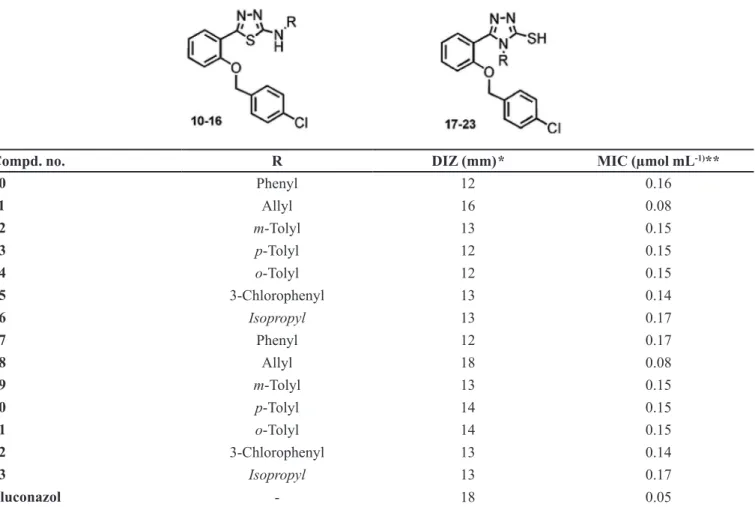
3-23 was evaluated against C. albicans. The obtained data, expressed as the diameter of the inhibition zone (DIZ) and minimum inhibition concentration (MIC) for the test compounds and for the reference drug luconazole are presented in Table I. Compounds 3-9 were found to be inactive against C. albicans, while compounds 10-23
showed promising antifungal activity with DIZ = 13–18 mm towards C. This suggests that the cyclization of the biologically inactive thiosemicarbazides 3-9 into thiadiazole or triazole rings developed biologically active compounds against C.albicans at a concentration of 100 µg mL-1. In
other words, the heterocyclic ring in these compounds is crucial for their antifungal activity. Compounds 10-23
showed MIC values in the range of 0.08-0.17 µmol mL-1,
while the MIC value of luconazole was 0.052 µmol mL-1.
Compounds 11 and 18 were found to be the most active, with MIC values of 0.08 µmol mL-1. The allyl substituent
at position 4 of the heterocyclic ring showed higher activity than the phenyl, tolyl, or isopropyl substituents. Basically, the small bulk size of the allyl group is proposed to be related to the high activity of the compound. For optimization of antifungal activity and in view of these results, further studies will be suggested to be undertaken starting with the two lead compounds 11 and 18.
TABLE I - AntiCandida albicans activity of compounds 10-23 (100 μg mL-1)
Compd. no. R DIZ (mm)* MIC (µmol mL-1)**
10 Phenyl 12 0.16
11 Allyl 16 0.08
12 m-Tolyl 13 0.15
13 p-Tolyl 12 0.15
14 o-Tolyl 12 0.15
15 3-Chlorophenyl 13 0.14
16 Isopropyl 13 0.17
17 Phenyl 12 0.17
18 Allyl 18 0.08
19 m-Tolyl 13 0.15
20 p-Tolyl 14 0.15
21 o-Tolyl 14 0.15
22 3-Chlorophenyl 13 0.14
23 Isopropyl 13 0.17
Fluconazol - 18 0.05
* The arithmetic mean of the inhibition zone diameters in mean ± standard deviation. **The lowest concentration of the compound
that produced 50-80% microbial growth inhibition (μmol mL-1). Count=14, Mean=0.3, Standard Devation= 0.029, Standard
Docking Procedure
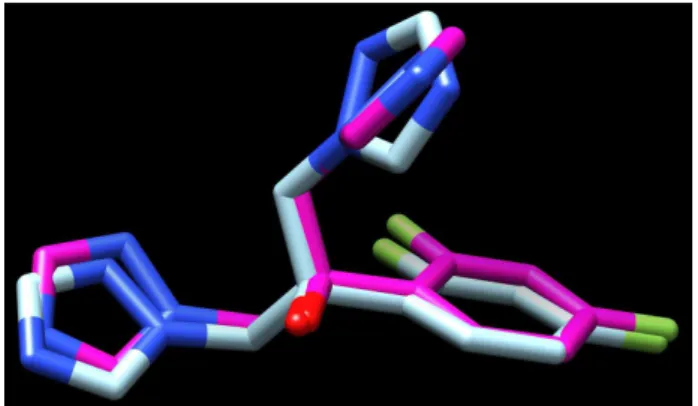
The comparative study of the binding mode of the synthesized compounds and the drug luconazole with the binding site of the CYP51 protein was done using Autodock vina (Trott, Olson,2010). From the protein data bank, the X-ray structure of the enzyme bound with fluconazole (FCZ) was obtained; PDB code: 1EA1 (Podust, Poulos, Waterman,2001). The docking procedure was conirmed based on the RMSD value diference of 0.432 Å of the pose of the nonrestricted redocked FCZ into the binding site of the CYP51 from the co-crystallized FCZ (Figure 1). The binding domain shows a hydrophobic pocket surrounded by the side chains of Tyr 76, Phe 78, Met 79, Phe 83, Arg 96, Met 99, Leu 100, Ser 252, Met 253, Phe 255, Ala 256, His 259, Thr 260, Leu 321, Ile 323, Met 433, and Val 434 (Figure 2). The docking results of compound 18 revealed that its triazole ringoccupied the same position inside the binding site and showed the same orientation as the triazole moiety of the co-crystallized FCZ with 1EA1 (Figure 2). The triazole ringis oriented near the heme molecule inside the binding domain and is surrounded by the side chains of Phe 255, Ala 256, His 259, and Thr 260. The p-chlorophenyl moiety overlaid the second triazole ring FCZ, showing hydrophobic interaction with the side chains of Leu 321, Ile 323, Met 433, and Val 434. In addition, the allyl substituent
is oriented in the same binding pocket of the diluorophenyl moiety of FCZ, showing hydrophobic interaction with the side chains of Phe 83, Arg 96, Met 99, Leu 100, Ser 252, and Met 253.
CONCLUSION
A novel series of thiosemicarbazide derivatives of methyl o-chlorobenzylysalicylate and its cyclized forms, 1,3,4-thiadiazol-2-amine and 2H -1,2,4-triazole-3(4H)-thione, has been synthesized and screened for
FIGURE 1 - The co-crystallized luconazol FCZ (from 1EA1.
pdb, colored cyan) overlaid onto the redocked fluconazol (colored magenta).
anti-Candida albicans activity. Variable and promising anti-Candida albicans activity was observed in the synthesized compounds 10-23; these compounds had MIC values in the range of 0.08-0.17 µmol mL-1, while the MIC
value of luconazole was 0.05 µmol mL-1. Compounds 11 and 18 were found to be the most active, with MIC values of 0.08 µmol mL-1. In addition, an in silico docking
study of compound 18 with X-ray structure of 14-α-sterol
demethylase (CYP51) active site domain (1EA1) postulated that the designed compound may act on the same enzyme target as the luconazole x-ray structure. A good correlation was found between the in silico generated model and the reported X-ray structure, with similar hydrogen bonding and orientation inside the binding site.
ACKNOWLEDGEMENTS
The authors would like to extend their sincere appreciation to the deanship of Scientiic Research at King Saud University for its funding of this research through the research Group Project no. RG-1435-080. The author (F. K. A.) appreciate the Kayyali Chair for Pharmaceutical Industries to his support 2016.
REFERENCES
ABDEL-AAL, M.T.; EL-SAYED, W.A.; ABDEL ALEEM, A.H.; EL ASHRY, E.S.H. Synthesis of some functionalized a r y l a m i n o m e t h y l - 1 , 2 , 4 - t r i a z o l e s , 1 , 3 , 4 - o x a - a n d
thiadiazoles. Pharmazie, v.58, p.788-792, 2003.
ABOUL-FADL, T.; RADWAN, A.A.; ABDEL-AZIZ, H.A.; BASEERUDDIN, M.; ATTIA, M.I.; KADI, A. Novel Schiff bases of indoline-2,3-dione and nalidixic acid hydrazide: synthesis, in vitro antimycobacterial and in silico mycobacterium tuberculosis (mtb) DNA gyrase inhibitory activity. Dig. J. Nanomater. Biostruct., v.7, p.327-336, 2012.
AMIR, M.; SHIKHA, K. Synthesis and anti-inflammatory, analgesic, ulcerogenic and lipid peroxidation activities of some new 2-[(2,6-dichloroanilino) phenyl]acetic acid
derivatives. Eur. J. Med. Chem., v.39, p.535-545, 2004.
ARENDRUP, M.C.; CUENCA-ESTRELLA, M.; LASS-FLORL, C.; HOPE, W.; EUCAST-AFAST. EUCAST technical note on the EUCAST definitive document E. Def 7.2: method for the determination of broth dilution minimum inhibitory concentrations of antifungal agents
for yeasts E. Def 7.2 (EUCAST-AFAST). Clin. Microbiol.
Infect., v.18, p.E246-E247, 2012.
ATTIA, M.I.; RADWAN, A.A.; ZAKARIA, A.S.; ALMUTAIRI, M.S.; GHONEIM, S.W. 1-Aryl-3-(1H-imidazol-1-yl) propan-1-ol esters: synthesis, anti-Candida potential and
molecular modeling studies. Chem. Cent. J., v.7, p.168,
2013.
AYHAN-KILCIGIL, G.; KUS, C.; ÇOBAN, T.; CAN-EKE, B.; ISCAN, M. Synthesis, antioxidant and radical scavenging
activities of novel benzimidazoles. J. Enz. Inhib. Med.
Chem., v.19, p.129-135, 2004.
BAUER, R.W.; KIRBY, M.D.K.; SHERRIS, J.C.; TURCK, M. Antibiotic susceptibility testing by standard single disc
difusion method. Am. J. Clin. Pathol., v.45, p.493–496,
1966.
CAMOUTSIS, C.; GERONIKAKI, A.; CIRIC, A.; SOKOVIC, M.; ZOUMPOULAKIS, P.; ZERVOU, M. Sulfonamide-1, 2, 4-thiadiazole derivatives as antifungal and antibacterial agents: Synthesis, biological evaluation, lipophilicity and
conformational studies. Chem. Pharm. Bull., v.58,
p.160-167, 2010.
CASALINUOVO, I.A.; DI FRANCESCO, P.; GARACI, E.
Fluconazol resistance in Candida albicans: a review of
mechanisms. Eur. Rev. Med. Pharmacol. Sci., v.8, p.69-77,
2004.
DAOUD, K.M.; AL-OBAYDI, A.W. Synthesis and antibacterial activity of some hdrazides, substituted thiosemicarbazide,
1,3,4-oxadiazoles, thiadiazoles and 1,2,4-triazoles. Nat. J.
Chem., v.31, p.531-542, 2008.
DOGAN, H.N.; DURAN, A.; ROLLAS, S.; SENER, G.; UYSAL, M.K.; GÜLEN, D. Synthesis of new 2,5-disubstituted-1,3,4-thiadiazoles and preliminary evaluation of anticonvulsant and antimicrobial activities.
Bioorg. Med. Chem., v.10, p.2893-2898, 2002.
DURAN, A.; DOGAN, H.N.; ROLLAS, S. Synthesis and preliminary anticancer activity of new
1,4-dihydro-3-(3-hydroxy-2-naphthyl)-4-substituted-5H
-1,2,4-triazoline-5-thiones. Farmaco, v.57, p.559-564, 2002.
GHORAB, M.M.; ISMAIL, Z.H.; ABDALLA, M.; RADWAN, A.A. Synthesis, antimicrobial evaluation and molecular modelling of novel sulfonamides carrying a biologically
active quinazoline nucleus. Arch Pharm Res., v.36,
GHORAB, M.M.; ISMAIL, Z.H.; RADWAN, A.A.; ABDALLA, M. Synthesis and pharmacophore modeling of novel quinazolines bearing a biologically active sulfonamide
moiety. Acta Pharm., v.63, p.1-18, 2013b.
GÜZELDEMIRCI, N.U.; KÜÇÜKBASMACI, Ö. Synthesis and antimicrobial activity evaluation of new 1,2,4-triazoles and
1,3,4-thiadiazoles bearing imidazo[2,1-b]thiazole moiety.
Eur J Med Chem., v.45, p.63-68, 2010.
HAMDAN, J.S.; HAHN, R.C. Antifungal drugs for systemic mycosis: an overview of mechanism of action and
resistance. Anti-Infect Agents Med. Chem., v.5, p.403-412,
2006.
HOFFMAN, H.L.; ERNST, E.J.; KLEPSER, M.E. Novel
triazole antifungal agents. Expert Opin. Investig. Drugs,
v.9, p.593-605, 2000.
KADI, A.A.; EL-BROLLOSY, N.R.; AL-DEEB, O.A.; HABIB, E.E.; IBRAHIM, T.M.; EL-EMAM, A.A. Synthesis, antimicrobial, and anti-inlammatory activities of novel 2-(1-adamantyl)-5-substituted-1,3,4-oxadiazoles and 2-(1-adamantylamino)-5-substituted-1,3,4-thiadiazoles.
Eur. J. Med. Chem., v.42, p.235-242, 2007.
KANE, J.M.; STAEGER, M.A.; DALTON, C.R.; MILLER, F.P.; DUDLEY, M.W.; OGDEN, A.M.L. 5-Aryl-3-(alkylthio)-4H-1,2,4-triazoles as selective antagonists of
strychnine-induced convulsions and potential antispastic agents. J.
Med. Chem., v.37, p.125-132, 1994.
KHAN, I.; ALI, S.; HAMEED, S.; RAMA, N.H.; HUSSAIN, MT.;WADOOD, A. Synthesis, antioxidant activities and urease inhibition of some new 1,2,4-triazole and
1,3,4-thiadiazole derivatives. Eur. J. Med. Chem., v.45,
p.5200-5207, 2010.
KÜÇÜKGÜZEL, I.; KÜÇÜKGÜZEL, S.G.; ROLLAS, S.; KIRAZ, M. Some 3-thioxo/alkylthio-1,2,4-triazoles with a substituted thiourea moiety as possible antimycobacterials.
Bioorg. Med. Chem. Lett., v.11, p.1703-1707, 2001.
KÜÇÜKGÜZEL, I.; TATAR, E.; KÜÇÜKGÜZEL, S.G.; ROLLAS, S.; DE CLERCQ, E. Synthesis of some novel thiourea derivatives obtained from 5-[(4-aminophenoxy) methyl]-4-alkyl/aryl-2,4-dihydro-3H-1,2,4-triazole-3-thiones and evaluation as antiviral/HIV and
anti-tuberculosis agents. Eur. J. Med. Chem., v.43, p.381-392,
2008.
KÜÇÜKGÜZEL, S.G.; KÜÇÜKGÜZEL, I.; TATAR, E.; ROLLAS, S.; AHIN, F.S.; GÜLLÜCE, M. Synthesis of some novel heterocyclic compounds derived from dilunisal hydrazide as potential anti-infective and anti-inlammatory
agents. Eur. J. Med. Chem., v.42, p.893-901, 2007.
KUMAR, H.; JAVED, S.A.; KHAN, S.A.; AMIR, M. 1,3,4-Oxadiazole/thiadiazole and 1,2,4-triazole derivatives of biphenyl-4-yloxy acetic acid: synthesis and preliminary
evaluation of biological properties. Eur. J. Med. Chem.,
v.43, p.2688-2698, 2008.
LAMB, D.C.; KELLY, D.E.; VENKATESWARLU, K.; MANNING, N.J.; BLIGH, H.F.; SCHUNCK, W.H.; KELLY, S.L. Generation of a complete, soluble, and catalytically active sterol 14 alpha-demethylase-reductase
complex. Biochemistry, v.38, n.27, p.8733-8738, 1999.
MAVROVA, A.T.; WESSELINOVA, D.; TSENOV, Y.A.; DENKOVA, P. Synthesis, cytotoxicity and effects of some 1,2,4-triazole and 1,3,4-thiadiazole derivatives on
immunocompetent cells. Eur J Med Chem., v.44, p.63-69,
2009.
MOSTAFA, Y.A.-H.; HUSSEIN, M.A.; RADWAN, A.A.; KFAFY, A.E.N. Synthesis and antimicrobial activity of certain new 1,2,4-triazolo[1,5-a]pyrimidine derivatives.
Arch. Pharm. Res., v.31, n.3, p.279-293, 2008.
ODDS, F.; BROWN, A.J.P.; GOW, N.A.R. Antifungal agents:
mechanisms of action. Trends Microbiol., v.11, p.272-279,
2003.
PFALLER, M.A. Antifungal drug resistance: mechanisms,
epidemiology, and consequences for treatment. Am. J. Med.,
v.125, p.S3-S13, 2012.
PFALLER, M.A.; ANDES, D.; DIEKEMAN, D.J.; ESPINEL-INGROFF, A.; SHEEHAN, D. Wild-type MIC distributions, epidemiological cutoff values and species-specific clinical breakpoints for luconazol and Candida: time for harmonization of CLSI and EUCAST broth microdilution
methods. Drug Resist. Updates, v.13, p.6180–6195, 2010.
PFALLER, M.A.; DIEKEMA, D.J. Epidemiology of invasive
mycoses in North America. Crit. Rev. Microbiol., v.36,
PLEC, T.; WUJEC, M.; SIWEK, A.; KOSIKOWSKA, U.; MALM, A. Synthesis and antimicrobial activity of thiosemicarbazides, s-triazoles and their Mannich bases
bearing 3-chlorophenyl moiety. Eur. J. Med. Chem., v.46,
p.241-248, 2011.
PODUST, L.M.; POULOS, T.L.; WATERMAN, M.R. Crystal structure of cytochrome P450 14-α-sterol demethylase (CYP51) from mycobacterium tuberculosis in complex with azole inhibitors. Proc. Natl. Acad. Sci. U. S. A., v.98, p.3068, 2001.
RADWAN, A.A. Design, synthesis, and molecular modelling of novel 4-thiazolidinones of potential activity against
Gram-positive bacteria. Med. Chem. Res., v.22,
p.1131-1141, 2013.
RADWAN, A.A.; ABDEL-MAGEED, W. In silico studies of
quinoxaline-2-carboxamide 1,4-di-N-oxide derivatives as
antimycobacterial agents. Molecules, v.19, p.2247-2260,
2014.
RADWAN, A.A.; GHORAB, M.M.; ALSAID, M.S.;
ALANAZI, F.K. Novel ethyl 1,5-disubstituted-1H
-pyrazole-3-carboxylates as a new class of antimicrobial
agents. Acta Pharm., v.64, p.335-344, 2014.
RADWAN, A.A.; HUSSEIN, N.A. Synthesis and antimicrobial activity of some
3-(1-phenylethyl)-5-substituted-2H-tetrahydro-1,3,5-thiadiazine-2-thione derivatives. Bull.
Pharm. Sci.Assiut.University., v.28, p.255-260, 2006.
ROMANI, L. Cell-mediated immunity to fungi: a reassessment.
Med. Mycol., v.46, n.6, p.515-529, 2008.
RZESKI, W.; MATYSIAK, J.; KANDEFER-SZERSZEN, M. Anticancer, neuroprotective activities and computational studies of 2-amino-1,3,4-thiadiazole based compound.
Bioorg. Med. Chem., v.15, p.3201-3207, 2007.
SHARMA, R.; MISRA, G.P.; SAINY, J.; CHATURVEDI, S.C. Synthesis and biological evaluation of 2-amino-5-sulfanyl-1,3,4-thiadiazole derivatives as antidepressant, anxiolytics
and anticonvulsants agents. Med. Chem. Res., v.20,
p.245-253, 2011.
TROTT, O.; OLSON, A.J. AutoDock Vina: improving the speed and accuracy of docking with a new scoring function,
efficient optimization and multithreading. J. Comput.
Chem., v.31, p.455-461, 2010.
WANG, W.; SHENG, C.; CHE, X.; JI, H.; MIAO, Z.; YAO, J.; ZHANG, W. Design, synthesis, and antifungal activity of
novel conformationaly restricted triazole derivatives. Arch.
Pharm. Chem. Life Sci. v.342, p.732–739, 2009.
Received for publication on 02nd December 2015