REGULAR ARTICLE
CAN BE BLUEBERRIES THE RISK FOOD AND RAW MATERIAL?
Lívia Krížová1*, Alena Vollmannová1, Eva Margitanová1, Ján Daniel2, Michal Medvecký2
Address*:1Slovak University of Agriculture in Nitra, Faculty of Biotechnology and Food Science, Department of Chemistry, Tr. A . Hlinku 2, 949 76 Nitra, Slovak Republic 2Regional Research Station in Krivá on Orava, 027 55 Krivá na Orave, Slovakia, Slovak
Republic
*Corresponding author: [email protected]
ABSTRACT
0.45 %. It is important to carry out monitoring of heavy metals to consumption of safe food raw materials and foodstuffs.
Keywords: blueberries, antioxidant capacity, DPPH, anthocyanins, heavy metals, AAS
INTRODUCTION
Blueberry is the fruit of the genus Vaccinium, which belongs to the Ericaceae family. It is recognized for its anthocyanin and flavonoid content, antioxidant activity (Prior et al., 1998), and for its potential health benefits (Smith et al., 2000). Antocyanins are flavonoids (Rui et al., 2011), and colorant candidates (Maier et al., 2009), because they are representative pigments widely distributed in nature, and are responsible for the attractive red, purple and blue color in many fruits and flowers (Xiong et al., 2006). Anthocyanins also exhibit antioxidant activity (Malien-Aubert et al., 2001) and they possess characteristics known to be effective against cancer, heart and inflammatory diseases (Estupiᵰan et al., 2011). Heavy metals are among the contaminants, which are characterized by different sources of origin, properties and action on living organisms (Tóth et al., 2005). Heavy metals are irreplaceable biological micronutrients (Cu, Zn, Fe) as well as numerous non-essential chemical elements (Cd, Pb, Cr, etc.). Toxic can be also biological irreplaceable microelements, if they exceed a certain concentration (Tomáš et al., 2001; Tóth et al., 2000). In terms of content of risk elements is especially high demands on the productive parts of plants that are used in human nutrition.
The aim of this study was on risk assessment of selected elements in relation to the content of bioactive compounds in wild and cultivated of highbush blueberries (Vaccinium corymbosum L.).
We were performed analysis of lyophilized samples to determinate the concentrations of risk elements after "wet" mineralization by microwave digestion on MARS X-press equipment . Analytical extension was atomic absorption spectrometry on the VARIAN AA 240 FS equipment.
Antioxidant capacity was determined by the Brand - Williams method (1995), using a compound DPPH (2.2-diphenyl-1-pikrylhydrazyl) (Merck). 2.2-diphenyl-1-pikrylhydrazyl (DPPH) was pipetted to cuvettes (3.9 m3), then was wrote the value of absorbance, which corresponded to the initial concentration of DPPH solution in time A0. Then 0.1 cm3 of the followed solution was added and then was immediately started to measure the dependence A = f(t). The solution in the cuvette was mixed and measured the absorbance of 1, 5 and 10 minutes at 515.6 nm in the spectrophotometer Shimadzu UV/VIS -1240. The percentage of inhibition reflects how is the followed compound able to remove DPPH radical at the given time.
Inhibition (%) = A0 – A10 x 100 A0
The content of anthocyanins was determined in fresh samples by the modified method of Lapornik (2005). From blueberries samples 25 g were homogenised and extracted by 50 cm3 80 % ethanol during 16 hours. Into two tubes 1 cm3 of extract was pipetted and 1 cm3 0,01 % HCl in 80 % ethanol was added. Then 10 cm3 14 % HCl into the first tube and 10 cm3 McIIvain agens (pH 3,5) into another tube were added. Absorbance was measured at 520 nm against blank sample in the spectrophotometer Shimadzu UV/VIS -1240.
RESULTS AND DISCUSSION
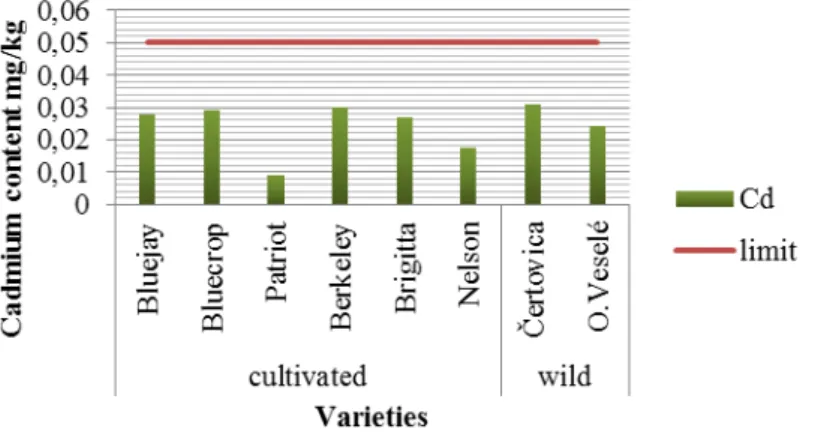
Figure 1 Cd content (mg.kg-1) in selected samples of cultivated and wild blueberries in relation to the hygienic limit
The measured values for the content Cd in observed blueberry fruits did not exceed in either variety the maximum amount of Cd which is defined in the Codex Alimentarius SR (PK SR: Cd 0.05 mg.kg-1). The average content of Cd in observed varieties of blueberries was 0.0244 mg.kg-1. Reimann et al. (2001) in their results indicate even lower values for the content Cd in the fruits of blueberries (0.009 mg.kg-1).
Figure 2 Pb content (mg.kg-1) in selected samples of cultivated and wild blueberries in
relation to the hygienic limit
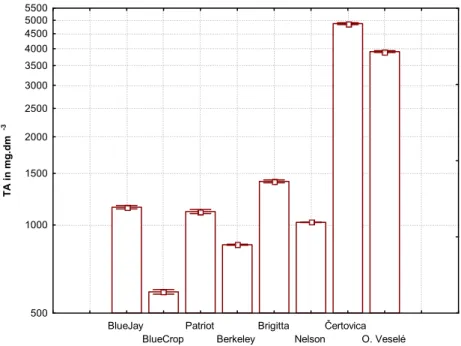
Figures 3 and 4 present the average contents of anthocyanins and antioxidant capacity in six cultivated varieties of highbush blueberries (Vaccinium corymbosum L.) and in two wild blueberries from different areas of Slovakia (Čertovica, Oravské Veselé).
BlueJay BlueCrop Patriot Berkeley Brigitta Nelson Čertovica O. Veselé 500 1000 1500 2000 2500 3000 3500 4000 4500 5000 5500 TA in m g. dm -3
Figure 3 The content of anthocyanins (TA - total anthocyanins) in selected samples
of cultivated and wild blueberries (mg.dm-3)
BlueJay
BlueCropPatriotBerkeleyBrigittaNelsonČertovicaO. Veselé 55
60 65 70 75 80 85 90
TA
C
in
%
Figure 4 Antioxidant capacity (TAC – total antioxidant capacity) in selected samples
of cultivated and wild blueberries, reported as % inhibition
Figure 4 shows the antioxidant capacity in 6 cultivated varieties, and 2 samples of wild blueberries from different areas of Slovakia. The highest antioxidant capacity was measured in the sample of the medium late variety Bluejay 87.175 ± 0.45 %. The lowest antioxidant capacity was measured in the sample of wild blueberries from the area Čertovica 61.15 ± 1.002 %. Su and Chien (2007) in his work determined the antioxidant capacity (60.6%), which corresponds to our findings that blueberries have high antioxidant capacity. Confirming the arguments the authors Smith et al. (2000), the bioactive extracts of wild blueberries, rich in anthocyanins and proanthocyanidins, exhibit antioxidant activity.
CONCLUSION
sources, because wet and dry atmosphere deposition of Pb is one of the most important sources of Pb input into the plant raw materials. The summ of Pb in the plant is significantly influenced by the remote transport.
So, it is necessary to monitor heavy metal content in blueberry fruits to ensure the food safety and to support the significant benefit of this fruit to the human health.
Acknowledgments: This contribution is the result of the project implementation: Centre of
excellence for white-green biotechnology, ITMS 26220120054, supported by the Research & Development Operational Programme funded by the ERDF.
REFERENCES
BRAND – WILLIAMS, W. – CUVELIER, M. E. – BERSET, C. 1995. Use of a free radical method to evaluate antioxidant activity. In Lebensmittel-Wissenschaft und Technologie, vol. 28, (1), 1995, p. 25 – 30.
ESTUPINAN, D. C. - SCHWARTZ, S. J. - GARZÓN, G. A. 2011. Antioxidant activity, total phenolics content, anthocyanin, and color stability of isotonic model beverages colored with andes berry (Rubus glaucus Benth) anthocyanin powder. In Journal of Food Science, vol. 76, 2011, p. 26 – 34.
LAPORNIK, B. - PROŠEK, M. - WONDRA, A. G. 2005. Comparison of extracts prepared from plant by-products using different solvents and extraction time. In Journal of Food Engineering, vol. 71, 2005, p. 214 - 222.
MAIER, T. - FROMM, M. - SCHIEBER, A. - KAMMERER, D. R. - CARLE, R. 2009. Process and storage stability of anthocyanins and non-anthocyanin phenolics in pectin and gelatin gels enriched with grape pomace extracts. In European Food Research and Technology, vol. 229, 2009, p. 949 – 960.
MALIEN - AUBERT, C. - DANGLES, O. - AMIOT, M. J. 2001. Color stability of commercial anthocyanin-based extracts in relation to the phenolic composition. Protective effects by intra and intermolecular copigmentation. In Journal of Agricultural and Food Chemistry, vol. 49, 2001, p.170 – 176.
and variety of Vaccinium species. In Journal of Agricultural and Food Chemistry, vol. 46, 1998, p. 2686 – 2693.
REIMANN, C. - KOLLER, F. - KASHULINA, G. - NISKAVAARA, H. - ENGLMAIER, P. 2001. Influence of extreme pollution on the inorganic chemical composition of some plants. In Environmental Pollution, vol. 115, 2001, p. 239 - 252.
RUI, L. - PING, W. - QING-QI, G. - ZHEN-YU, W. 2011. Anthocyanin composition and content of the Vaccinium uliginosum berry. In Food Chemistry, vol. 125, 2011, p. 116 - 120. ŚCIBISZ, I. - MITEK, M. 2007. Antioxidant properties of highbush blueberry fruit cultivars. In Food Science and Technology, vol. 10, (4), 2007.
SMITH, M. A. L. - MARLEY, K. A. - SEIGLER, D. - SINGLETARY, K. W. - MELINE, B. 2000. Bioactive properties of wild blueberry fruits. In Journal of Food Science, vol. 65, 2000, p. 352 – 356.
SU, M. S. - CHIEN, P. J. 2007. Antioxidant activity, anthocyanins, and phenolics of rabbiteye blueberry (Vaccinium ashei) fluid products as affected by fermentation. In Food Chemistry, vol. 104, 2007, p. 182 - 187.
TOMÁŠ, J. - TÓTH, J. - LAZOR, P. 2001. Heavy metals content and distribution in soils in relation to soil hygiene. In Poľnohospodárstvo, vol. 47, (1), 2001, p. 11 – 26.
TÓTH, J. - TOMÁŠ, J. - LAZOR, P. 2000. Hodnotenie bioprístupnosti kadmia, olova, medi, zinku a chrómu v silne kontaminovanej fluvizemi. In Acta Fytotechnica et Zootechnica, vol. 3, (1), 2000, p. 25 – 28.
TÓTH, T. - POSPÍŠIL, R. - PARILÁKOVÁ, K. - MUSILOVÁ, J. - BYSTRICKÁ, J. 2005. Distribúcia ťažkých kovov v pôdach aplikáciou substrátu po výrobe biokalu. In ChemZi, vol. 1, (1), 2005, p. 108 – 109.