Precambrian Research, 65 (1994) 25- 54
Elsevier Science B.V., Amsterdam
25
The tectonic evolution of the Quadrilfitero Ferrifero, Minas
Gerais, Brazil
Farid Chemale Jr.a, Carlos A. RosiCreb and Issamu Endo”
aDepartamento de Geologia, Universidade do Vale do Rio dos Sines, 93023- 000 Sa’o Leopoldo, RS, Brazil
bCentro de Pesquisas M. T. da Costa/IGC, Universidade Federal de M inas Gerais. Pampulha, 31270- 000 Belo Horizonte, M C, Brazil
‘Departamento de Geologia, Universidade Federal de Ouro Preto. M orro do Cruzeiro, 35400- 000 Ouro Preto, M G, Brazil
Received February 3, 1992; revised version accepted March 24, 1993
ABSTRACT
The structural framework of the Quadrilatero Ferrifero is the result of two main deformational events. The first is an extensional event of Palaeoproterozoic age (between 2100 and 1700 Ma, the Transamazonian Event), which resulted in the formation of Archaean granite-gneiss domes and the nucleation of regional synclines in the overlying Rio das Velbas and Minas supergroups strata. Such regional synclines are continuous with each other and are bordered by structural granite-gneiss highs. At the contact between these units, ductile-brittle to ductile extensional shear zones are developed, representing the dislocation surfaces of Archaean blocks. This tectonism is probably related to the evolution of a meta- morphic core complex, formed in the hinterland to the west of a Transamazonian collision zone, which structured the Paramirim Craton. The second event is compressive and associated with the closure of the Pan-African/Brasiliano proto- ocean (650-500 Ma), situated to the east of Quadrilltero Ferrffero (QF). During this event, a west-verging foldand- thrust belt (FTB) developed, causing inversion, amplification, translation and rotation of the basinal synclines. The FTB affected mainly the eastern portion of QF and obliterated many of the tectonic features of the extensional event.
Int ruduct ion
The Quadrilatero Ferrffero/Iron Quadran-
gle is one of the most intensively investigated geological areas in Brazil. Many studies on its stratigraphy, structural geology, metallogeny,
geochemistry and geochronology have been
published as individual contributions. Only a few authors such as Dorr ( 1969 ) , Ladeira and Viveiros ( 1984), and Marshak and Alkmim
( 1989)) however, published interpretative pa- pers on the geological/tectonic evolution of this complex and enigmatic area. Most of the pub- lished papers regarded the quadrangular shape of the area as the result of a multiple deforma-
Correspondence to: Farid Chemale Jr., Departamento de Geologia, Universidade do Vale do Rio dos Sinos, 93022- 000 Sgo Leopoldo, RS, Brazil.
tional evolution, with acute variations of the stress field during distinct periods of time.
The purpose of this work is to present a tec- tonic evolutionary model of the QF and sur- rounding terrains (Fig. 1 ), based on detailed structural analysis. Our model incorporated two main episodes: the first is one of exten- sional tectonics, affecting the supracrustal and granite-gneissic units of QF during the Tran- samazonian (Eburnean) Cycle of Palaeopro- terozoic age; and the second involves colli- sional tectonics, affecting all earlier units and also the supracrustal rocks of the Espinhaco Meridional and S5o Francisco Basin during the Brasiliano (Pan-African) Cycle of Neoproter- ozoic age.
The data presented are the culmination of several structural-geologic studies carried out at different scales (1:25,000 to l:l,OOO) dur-
~.CHEMALEJR. E7 4L.
’
??
x
X 2-- sl? ? ? ?
3 _I7
??
---9
0
4
??
0 50 100
I
Km
5
0
IO /
6
THE TECTONIC EVOLUTION OF THE QUADRILATERO FERRIFERO, MINAS GERAIS 27
ing the 80’s by the authors, integrated with a compilation of other relevant publications. Over 40,000 linear and planar data have been used to construct the structural-geologic maps.
Geologic setting
The QF, which quadrangular shape is de- fined by the distribution of Palaeoproterozoic
metasedimentary rocks (Minas Supergroup),
is exposed in the southeastern part of the SBo Francisco Craton (SFC) (Almeida 1977, Fig.
I ). This region is composed of ( 1) Archaean to Palaeoproterozoic granite-gneiss terrains, (2) Archaean greenstone belts, (3) Palaeo- proterozoic supracrustal sequences, (4 ) Me- soproterozoic supracrustal sequences, and ( 5 ) Neoproterozoic sequences.
The supracrustal units of the QF surround and are surrounded by commonly dome-like granite-gneiss terrains (GGTs; Fig. 2a). The QF and adjacent regions consist mainly of GGTs, the Rio das Velhas greenstone belt (or Supergroup, RVSG ) , the Palaeoproterozoic Minas Supergroup (MSG), and Mesoprotero- zoic Espinhaco Supergroup (ESG) (Fig. 3 ) . The GGTs are composed of polydeformed gneisses, metatonalites to metagranites, am- phibolites, meta-ultramafic rocks and pegma- tites formed during the Archaean and Palaeo-
proterozoic (Transamazonian) Eras (Cordani
et al., 1980, 1989; Machado et al., 1989; Ro- mano, 1990; Machado and Cameiro, 1992). The RVSG represents an Archaean greenstone belt in the QF region (Schorscher et al., 1982)) and is divided into the Nova Lima and Ma- quine Groups. A lower ultramafic unit, an in- termediate felsic-matic unit, and an upper chemical-elastic unit comprise the Nova Lima Group (Ladeira, 1980, 1985). These rocks are overlain by quartzites of the MaquinC Group
(Dorr, 1969). Both GGTs and the RVSG con- stitute the basement of the QF (Cordani et al.,
1980, 1989; Ladeira and Viveiros, 1984). The overlying MSG comprises a basal clas- tic unit (Caraca Group), a middle clastic-
chemical unit (Itabira Group), and an upper chemical-elastic unit (Piracicaba Group). The Itabira Group contains extensive banded iron formations of the Lake Superior type. In the Serra das Cambotas, NE of the QF (Fig. 2a), quartzites, metaconglomerates, and metabasic rocks of the Mesoproterozoic Espinhaco Su- pergroup (ESG) are exposed (Schorscher et al., 1982; Marshak and Alkmim, 1989). Pa- laeo- to Neoproterozoic deformed and non-de- formed basic dykes occur in the GGT west of the QF (Teixeira, 1985).
Both Archaean and Palaeoproterozoic units display a complex metamorphic and deforma- tional history (Dorr, 1969; Ladeira and Vi- veiros, 1984; Marshak and Alkmim, 1989). The GGTs show prograde metamorphic para- geneses of amphibolite to granulite facies (Herz, 1978; Cordani et al., 1980; Jordt-Evan- gelista, 1984)) and also of retrograde greensch- ist facies. The supracrustal rocks of the RVSG
and MSG have been metamorphosed in the
greenschist to lower amphibolite facies (Herz, 1978; Hoefs et al., 1982; Ladeira and Viveiros, 1984; Marshak and Alkmim, 1989), but lo- cally they display only anchimetamorphism. Near the contact to intrusive granitic bodies, typical progressive contact metamorphic par- ageneses in the schists of the RVSG and of the MSG are developed (Herz, 1978; Jordt-Evan- gelista et al., 1992).
Structural framework of the Quadrilaitero Ferrifero
The Quadrilatero Ferrffero is a tectonic fea- ture which is the result of the superposition of structures developed during two main tectonic events, the first represented by a regional ex- tensional event, and the second by a west-ver- gent compressional event.
Structures related to a regional extensional event
F CHEMALE JR. t I- hl
Fig.? - (4
N
T
0 15 KM
-I
SCHEMATIC CROSS SECTION
(b)
+ c o nta c t
/
P thrust
# strike - slip fa ult P
/ ’ e xte nslo na l she a r zo ne
/ fa ulting 1
J$ a ntic line
,$q sync line ko r<
,XJ o ve rturne d sync line @ I(0
Arc he a n g ne issic b a nd ing
Arc he a n m ine ra l line a tlo n
Se e xte ntio na l fo lia tio n
Le e xte nsio na l m ine ra l line a tio n
Sm l c o m p re ssio na l line a tio n
Lm l c o m p re ssio na l m ine ra l line a tio n
fa ult displa c e m e nt
THE TECTONIC EVOLUTION OF THE QUADRILATERO FERRIFERO, MINAS GERAIS 29
Curral (NW-SE), Moeda (N-S), Dom Bosco (E-W), and Santa Rita (N-S), all bordered by structural basement highs (see Fig. 1) . The synclines of Gandarela, Jogo Monlevade and Itabira, all trending NE-SW, are presently iso- lated from the other megastructures, but were probably generated during the same event
(Rosiere et al., 1990).
The synclines contain relicts of a widespread platformal basin with a basal rift sequence overlain by shallow to deep water marine sed- iments deposited in an intracratonic environ- ment. This basin was segmented during a re- gional extensional event. This extension is recorded by discontinuous, ductile-brittle to ductile extensional shear zones, affecting both supracrustal and infracmstal rocks. Kinematic shear sense criteria, such as asymmetric, sigma- type porphyroclasts and S-C structures attest to the eastward (at the western margin of the Moeda Syncline) and southeastward (at mar- gins of segment I of the Serra do Curral) exten- sional movement of the shear zones. Associ- ated uplift of the underlying crystalline basement and subsidence of the supracrustal strata, resulted in the formation of wide sync- lines and anticlines (Fig. 3, Table 1). The ef- fects of the extensional tectonics are well pre- served in the western portion of the QF, where the structures are autochthonous to para-au- tochthonous, and were less deformed during the younger collisional event than in the east- em portion. The regional vectorial field during the extensional event, that is registered by geo- metric and kinematic data from extensional
shear zones and the shape of megastructures, is oriented WNW-ESE.
In ductile extensional shear zones, parage-
nesis of low greenschist facies (chlo-
rite + quartz + sericite + opaques) occurs, sug- gesting that at least 10 to 12 km of the section have been eroded. In addition, there are con- tact aureoles in the pelitics units of the MSG and the RVSG around the Bonfim and Bacao Complexes, from greenschist to amphibolite
facies metamorphic conditions (Herz, 1978;
Jordt-Evangelista et al., 1992)) associated with the metamorphic complex uplift.
Structures related to a west-vergent compressional event
The second group of structures is related to a west-vergent thrusting event of Brasiliano age. Three phases of deformation have been recognized ( D 1 -D3 ) .
III. This phase displays the most pervasive effects. Rocks were deformed under ductile conditions in the greenschist to amphibolite facies, with the development of shear zones re- lated to thrusts, tear faults and conjugate tran- scurrent zones. In the shear zones, the most consistent features are a penetrative mylonitic foliation, Sm 1, associated with variable plung- ing mineral stretching and mineral lineations, Lm 1, trending east or, locally, southeast with variable plunges (Table 2 ) .
02. This phase developed under low
greenschist facies conditions. It is associated with the nucleation of mesoscopic F2-folds and
Fig. 2. (a) Structural map of the Quadrilatero Ferrtfero showing its main structures (modified after Dorr, 1969). I = metabasic rocks, 2= Espinhaco Supergroup, 3=Itacolomi Group, 4= Minas Supergroup, 5 = Rio das Velhas Super- group, 6 = granite-gneiss terrain. Cities and localities: BH= Belo Horizonte, BR = Brumadinho, CC= Congonhas do Campo,
FG= Fazenda Gandarela, IB= Ibirite, IT= Itabira, MR = Mina Raposos, MV= Morro Velho, OP= Ouro Preto. Megas- tructures and geographic features: 1 = Itabira Synclinorium, 2= Jo50 Monlevade Synclinorium, 3 = Serra das Cambotas, 4= Gandarela Syncline, 5= Ouro Fino Syncline, 6= Mariana Anticline, 7= Conta His&a Syncline, 8=Alegria Syncline, 9=Serra do Caraca, IO=FazendZo Thrust Front, II= Serra de Ouro Branco, IZ=Serra de Itatiaia, 13=Dom Bosco Syncline, 14= Ba@o Complex, 15=Rio das Velhas Uplift, 16=Vargem do Lima Syncline, I7=Piedade Syncline,
30 F. CHEMALE JR. ET ,4L.
SUPERGROW
MINAS
PIRACICABA
BASEMENT
WCOUF.
WDNF.
THE TECTONIC EVOLUTION OF THE QUADRILATERO FERRIFERO, MINAS GERAIS 31
TABLE I
Structural elements and styles related to the post-Minas deposi- tional extensional tectonics
Megascopic structures:
Synclines Basement highs Faulting
Dom Bosco Syncline Ba@o Complex and Dextral transcurrent (E-W?/horiz.) Santa Rita Complex SZ (Engenho
Fault) and normal faulting (?)
Moeda Syncline (N-S/horiz.)
Serra do Curral Homocline
Bonlim and Bacao Normal faulting (?) complexes
Caete, Belo Ho- Normal faulting (?) rizonte and
Bontim complexes
Itabira Synclinorium Belo Horizonte Inverted normal (NE-SW/horiz.) Complex faulting (?)
Gandarela Syncline Rio das Velhas Inverted normal (NE-SW/horiz.) Uplift and CaetC faulting (?)
Complex
Ouro Fino Syncline (NE-SW/syncline)
see above see above
Santa Rita Syncline Serra do Caraca Inverted normal (N-S/horiz.) faulting (?)
Mesoscopic structures:
Domain Extensional SZ” Lineation
Bonfim Complex 080-12O/SO-75 Down dip (eastern border)
Bontim Complex (western border)
Bontim Complex (northern border)
275-292174
ooo-030/70
Down-dip and 335135
40-60/40-60
Bontim Complex (interior) Belo Horizonte Complex Moeda Syncline
“SZ = shear zone.
90175-86 Down-dip
120/50-75 Down-dip
080-120/50-75 Down-dip
crenulations with E-W-trending axes, and the development of a spaced, subvertical axial planar cleavage, S2, and strike-slip faults (Ta- ble 3).
03. This phase developed under metamor- phic conditions similar to Phase 2, with the de-
velopment of N-S-trending, mesoscopic F3-
folds and crenulations, together with a sub-
vertical spaced cleavage, S3, and N-S-trend- ing, steep, reverse faults (Table 3 ) .
Structural analysis
In order to simplify the understanding of the tectonics of the QF, the area has been subdi- vided in domains according to the trend of the main megascopic structures (Fig. 2a). These domains are: ( 1) the Dom Bosco Syncline and Engenho Fault System; (2 ) the Moeda Sync- line; ( 3 ) the Bonfim and BaGgo complexes; ( 4 ) the Serra do Curral; (5 ) the Itabira Synclinor-
ium; (6) the Fundio-Cambotas Thrust
System.
The structural analysis is based on geomet- ric and kinematic criteria, and considers the influence of two factors as critical in the devel- opment of the complex present day geometry, viz. ( 1) the basement relief, with several struc- tural highs acting as rigid buttresses, obstruct- ing and “channelling” the overthrust supra- crustal sheets, and (2) the current erosional level, allowing the observation of such “low level” structures.
The structural data for each of the domains are summarized in Tables 1, 2 and 3 and graphically represented in Figs. 2a and 4 for constant reference to 10. The structural legend which is common to all figures is given in Fig. 2b
Each domain is described below, in terms of its broad geometry, structural imprint and ki- nematic history. In order to simplify descrip- tions, planar and linear tectonic features asso- ciated with compressional events are separated
intoD1 (Sml,Sl,Lm1,Fl,bl),D2 (S2,Lm2,
F2, b2), and D3 (S3, Lm3, F3, b3).
The Dom Bosco Syncline and the Engenho Fault System
TABLE 2
Structural elements and styles related to the compressional event (after extensional tectonics)-Phase 1
Domain Dl Phase
faults folds Bl SMl LMl metamorphism
-
Dom Bosco Arcuate thrusts (N-S), B and A-folds 066145 to 120125 90/l O-40 Syncline and strike-slip SZ (E-W, tight, isoclinal rotation towards (frontal Engenho Fault ( I ) 60-240 to 120-300) sheath folds EinSZ thrusts)
Down-dip”
Moeda Thrust (N-S), S-S Syncline ( 2 ) S-Z, bedding shears
same as above 045/20 to 092160 87-90/ 60-90
Down-dip
Bacao Reverse and Complex S-S faults
Upwarping of metasediments. Steep beds and some overturned
Variable Around the complex
Serra do Cur- Reverse N-S/60-80 Open cylindric ral seg. I S-S faults high amplitude (trend 070) NE-SW/SO folds
NE-SW In some shear zones
N,SandE= 90-l 30/ 15-50 w=220-2701 70-90
90/subhz
Serra do Cur- ral seg. II (trend045) (3)
Thrusts 130130 Inverse folds Rotation of axis Axial and S-S SZ tight to iso- toward E in high planar (E-W, 60-240, clinal strain regions position to 120-310) sheath folds 045 to 080/10-30 120130
90/lOb
Itabira Thrusts with Open to
Synclinorium (4) eastward rotation isoclinal
zyxwvutsrqponmlkjihgfedcbaZYXWVUTSRQPONMLKJIHGFEDCBA
(4 w m of megafold axes sheath folds
045-110/l-53 I14-132/ 40-90/ 29-33 5-52
Caete Complex ( 5 )
Thrusts (N-S, NE-SW ) with quartzite
slivers and S-S SZ
Tight to Variable 90/l&30 and
120150
78-102/ 15-48
Low greenschist (W) to low
amphibolite ( E )
zyxwvutsrqponmlkjihgfedcbaZYXWVUTSRQPONMLKJIHGFEDCBA
Mostly low greenschist
Retrograde meta- morphism of old assemblage (am- phib. to greens. )
Regional low grade
Very low to low greenschist
Low greenschist
Serra
das Cambotas ( 5 )
Frontal (N-S ) and B- and A-folds oblique (NE-SW ) open to thrusts isoclinal
Variable 90-1441 18-30
87-90/9-27 rotated = 120-30/50
Greenschist
Variable axis 90-1081 75-119/ Greenschist with 18-93/12-51 40-60 lo-52 kyanite
90-l 17136-54 50-961 66-93/ Greenschist with 50-53 45-49 kyanite
1 17/27b SMl//Sl 99/lgb Greenschist with
20142 kyanite
Rotation towards E of mesofolds 045125 to 099130
12/75 93/42b Greenschist with kyanite
84/45b 94/52 84/4gb Greenschist with kyanite
Gandarela Syncline (6)
Lateral to frontal ramps of NE-SW- trending thrusts and S-S SZ
Open to tight isoclinal over- turned
Ouro Fino (7 ) Frontal to lateral Open to isoclinal
Conta Histo- ria Syncline (8 )
Oblique ramps
Alegria Folded and rotated Syncline (9 ) thrust surface
Tight to isoclinal,
Megascopic horse- shoe-shaped syn- cline ( 160/30-50)
Frontal thrust, A-folds, open S-S faults (E-W, to isoclinal 60-240, 120-300) sheath folds Fazendao
Thrust (IO)
“ Average value corresponds to 107120.
bAverage value of populations over 100 measurements.
Average value for all Ll mineral lineation (mostly parallel to the kinematic vector) is around 90. SZ = shear zone, S-S SZ = strike-slip SZ, HZ= horizontal, VT = vertical.
( 1) Structural data after Gloeckner ( 1981), Alkmim ( 1985) and this work. (2) Structural data after Rosiere ( 1981 ), Evangelista ( 1984) and this work. (3 ) Structural data after Hackspacher ( 1979 ). (4) Structural data after Chemale et al. ( 1987). ( 5 ) Structural data after Croco-Rodrigues et al. (1989). (6) Structural data after Endo and Chemale (1991b). (7) Structural data after Fonseca (1990). (8) Structural data after Endo (1988). (9) Structural data after Januzzi and Alkmim ( 1989) and Chemale and Endo ( 1990). ( 10) Structural data after Silva and Gibotti ( 1989) and Castro Alves
34 F CHEMALE JR. ET 4L. TABLE 3
Structural elements and styles related to the compressional event (after extensional tectonics)-Phases 2 and 3
Domain
D2 Phase”
faults folds B2//LCR2 S2
D3 Phase”
I-_ faults folds B3/ fLCR3 S3 Dom Bosco Transcurrents,
Syncline and sinistral Engenho Fault reactivation
(1) of Engenho F.
Open to 121/ tight, 11 crenul. 180/ 75 Moeda Syncline (2)
Transcurrents Open to tight, crenul.
E-W
Serra do Cur- ral seg. I
No main structure is recognized
Serra do Curral seg. II (3)
Open to tight, crenul. E-W Itabira Synclinorium (4)
Transcurrents Open to 35-l lOI
tight, l-53 crenul.
1701 50-85
Serra das Cambotas (5)
Open to 117/ tight 10-17 crenul. 1351 45 Gandarela Syncline (6) Transcurrents E-W, NE-SW NW-SE
same as above Open crenul.
E-W and 80-1601 20-40
180/ 80190
Ouro Fino Reactivation Open to 096154 3571
Syncline of thrusts and tight VT to
(7) strike-slip crenul. subvt
Conta Historia Syncline ( 8 ) Alegria Syncline (9)
Assym. open Open crenul. 108/ 36 120130 18184 174154 120136
Fazendao Transcurrents Open to E-W 15175
Thrust E-W, NE-SW tight and
(10) NW-SE crenul. 357187
Reverse Open brittle kink faults crenul.
Reverse faults
Open kink crenul.
Reverse Open brittle kink faults crenul. Reverse Open brittle kink faults crenul. Reverse Open brittle kink faults
Reverse Open brittle kink faults crenul. Reverse Rink faults crenul.
Rink 3511 2841
crenul. 56 48
Reverse Open faults kink Reverse Open faults kink
crenul.
1741 811
42 75
NSI 15-17 90 or 2701 subvt NS/ subhz 901 or 2701 subvt
NSI
subhz
901 vt to subvt
N-S/ 901
O-30 subvt
W 2911
subhz 70
NSI 1621
subhz 78
NSI 80-901
05 75-90
0031 2731
06 73-84
aMetamorphic assemblage is represented by f. chlorite & sericite + quartz + opaques For(l)to(lO)seeTable2.
continuous with the Moeda Syncline at its obliterated by a mylonitic foliation in shear western extremity. The southern limb of the zones (Fig. 4).
THE TECTONIC EVOLUTION OF THE QUADRILATERO FERRIFERO, MINAS GERAIS
C'
t a\@
x x
x x
O- 6km
SCHEMc;TIC C 30;s SECTIONY
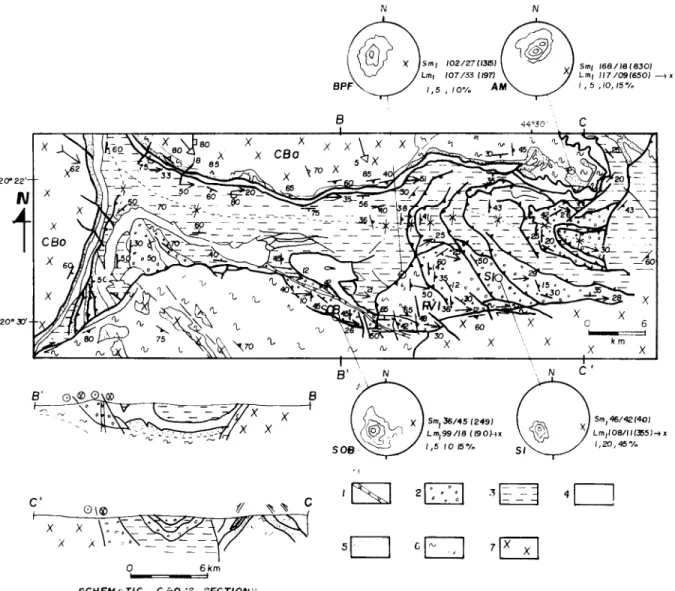
Fig. 4. Geologic-structural map of the Dom Bosco Syncline (modified after Dorr, 1969) with schematic cross-section. I= basic dyke, 2 = Itacolomi Group, 3 = Piracicaba Group, 4 = Itabira Group, 5 = Caraca Group, 6 = RVSG, 7= GGT.
CBu= Ba@o Complex, CBo = Bonfim Complex, SZ= Serra de Itatiaia, SOB= Serra de Ouro Branco. Stereograms with
Sm 1 foliation (contour lines) and Lm 1 mineral lineation. Structural data of BPF (Bico de Pedra Fault) and MA (Mar- iana Anticline), this work; SOB after Alkmim ( 1985); SZ after Gloeckner ( 198 1).
Serra do Itacolomi to the Serra do Mascate (Fig. 4). All thrusts have characteristic flat and ramp geometry. Tear faults connect individual fault planes. The deformational event associ- ated with the thrusts produced three structural assemblages: one under ductile conditions (Table 2)) and the other two respectively un- der brittle-ductile and ductile-brittle condi- tions (Table 3 ) .
N
SCHEMATIC CROSS-SECTION
urn
Sm, lO5/45 1144) Lm, 87/28/l601+ x 1,5, 20,30x
THE TECTONIC EVOLUTION OF THE QUADRILATERO FERRIFERO, MINAS GERAIS 37
stretching lineation remain consistently shal- low plunging (between sections lines A-A’ and B-B’, Fig. 4). In the intensely deformed parts of the shear zones, sheath folds and intrafolial Fl structures with axes parallel to the stretch- ing lineation (a-type folds) are common. With decreasing strain, the folds are west-vergent and display a tight to isoclinal profile with their axes oblique to the tectonic transport direction
(oblique folds).
F2 buckle-folds both in micro- and megas- topic scale superpose these structures. They are most commonly preserved in the pelitic com- positional bands where they deform the earlier S 1 and Sm 1 foliations.
D3 comprises mesoscopic F3-folds and
crenulations that refold S2.
The Engenho Fault was defined by Guild ( 1957) as a strike-slip fault. It strikes essen- tially E-W (Fig. 2a) along an extension of ap- proximately 70 km from the Serra do Itaco- lomi at the east to the town of Born Sucesso at the west, where the fault deviates to the south- west (Fig. 4). The Engenho Fault has a tran- scurrent, right-lateral displacement, resulting from the translative dislocation of tectonic slices of the RVSG, the gneissic Basement Complex, and the quartzites of the Itacolomi Group, that constitute the Serra do Ouro Branco (Fig. 4). The displacement along the strike can be estimated to be at least 25 km, and probably occurred during the extensional event. A superimposed left-lateral movement and the tightening and amplification of the Dom Bosco Syncline, resulting of the younger west-verging belt, indicate that this fault might be at least of Palaeoproterozoic age, and that significant reactivation occurred during the Brasiliano Event.
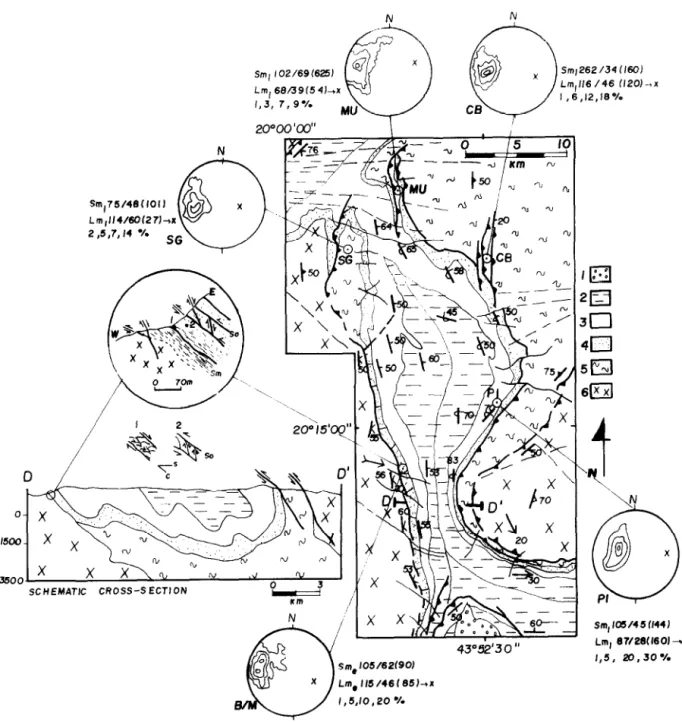
The M oeda Syncline
Similarly to the Dom Bosco Syncline, this megastructure was nucleated very early during the tectonic history of the QF (Table 1). It is a N-S-trending syncline (Fig. 5 ), tightened and
deformed around the Bacao Dome, continu- ous to the south with the Dom Bosco Syncline and truncated by the Engenho Fault. To the north, the syncline is continuous with the structure of the Serra do Curral where it is at- tenuated by younger thrusts (Fig. 5 ) .
Bedding and other sedimentary structures are well preserved in the syncline. Late ductile shear zones, best-developed on the eastern limb of the Moeda Syncline, truncate all lithologies of the supracrustal sequences and the underly- ing talc-schists and serpentinites of the Cor-
rego dos Boiadeiros Ultramafic-Malic Com-
plex, or alternatively being parallel to sub- ljparallel to the bedding of the MSG strata, as in the Serra do Itabirito.
Several strike-slip faults cut both limbs of the Moeda Syncline. N-S-trending D3 structures similar to those described in the Dom Bosco Syncline described above, are superimposed over all pre-existing structures.
Bonfim and Baqiio complexes
The Bonfim Complex comprises multiply deformed gneisses, amphibolites, meta-ultra-
mafic rocks, pegmatites, migmatites, Ar-
chaean foliated granites (Machado and Car- neiro, 1993 ), and N-S- and NW-SE-trending mafic dykes. The gneissic layering is sub-ver- tical and trends N-S, displaying a very low pitch mineral lineation. These fabrics are trun- cated by a 2703Zzt Ma granitic intrusion which itself is affected by all later deformation events of the QF (Machado and Cameiro, 1992 ) .
38 F. CHEM ALE JR. ET \I
affect all rocks of the QF. They are very dis- crete and east-dipping, with the development of a foliation associated with greenschist facies metamorphism and a stretching lineation de- fined by oriented feldspar porphyroclasts. Ex- tensional and compressional shear zones alter- nate and the older extensional structures are locally entirely obliterated by later compres- sive features (Fig. 5, inset ) .
The Bac5o Complex is a domal structure with similar characteristics as the Bonfim Complex. This complex displays a bordering mylonitic foliation which dips away from its centre, with a compressional character. Intern to the complex, compressive shear zones, the most common ones, are also described. We as- sume that the bordering foliation as well as in- ternal faulting formed in the extensional event and then inverted by the younger compres- sional event.
In the rocks of the RVSG biotite, plagio- clase, epidote, garnet, hornblende and tremo- lite occur in assemblages as a contact aureole around the Ba@o Complex (Herz, 1978 ).
The Serra do Curral
The Serra do Curral is an overturned south- eastern limb of a truncated syncline (Fig. 2a) (Pomerene, 1964). In this structure, the Car- aca, Itabira and Piracicaba groups of the MSG crop out along most of its extension as an in- verted sequence without repetition. The syn- clinal closure is mapped at the northeastern end of the range, where it has been named the Pie- dade Syncline, and also at its southwestern ex- tremity (Romano, 1990). Elsewhere, megas- topic parasitic synclines occur at several outcrops along the range.
The Serra do Curral can be divided into two segments (Fig. 2a): I, between its western end and the western limb of the Moeda Syncline; II, between the Moeda Syncline and its eastern end.
Segment I
is not significantly deformed by the thrust tectonics whileSegment II
is highly strained and sinistrally rotated approximately25 ’
from its original position (Fig. 2a). Segment I is defined by a homoclinal struc- ture which contains the MSG in normal posi- tion. As the oldest tectonic register in the range, early, extensional ductile to brittle-ductile shear zones are present both in the surround- ing basement gneiss (Bonfim and Belo Hori- zonte complexes), and in the supracrustal rocks of the Itabira and Piracicaba groups near Ibir- ite and Brumadinho (Table 1).
Kinematic in- dicators record down-dip and oblique exten-sional movement ( Alkmim, pers. commun.,
199 1; Endo and Chemale, 199 1 a) (Table 1) . Such features are related to regional exten- sional tectonics that induced the uplift of gran- ite-gneissic blocks and the downwarping of the sediments of the MSG resulting in open sync- lines surrounded by basement blocks. The oc- currence of undeformed Mesoproterozoic ba- sic dykes and bodies cutting units of the GGT’s and of the MSG near the localities of Para de Minas and Ibirite (Fig. 2a), in an area where extensional structures are common, suggests that extensional processes took place before the Mesoproterozoic. On the northern side of the Serra do Curral, phyllites and schists of the Sa-
bara Formation (Piracicaba Group) contain
porphyroblasts of sillimanite, cordierite, stau- rolite, kyanite, garnet, biotite, and chlorite de-
veloped by contact metamorphism (Herz,
1978; Jordt-Evangelista et al., 1992). The con- tact metamorphic aureole may be related to the extensional tectonics (Jordt-Evangelista et al., 1992)
Discrete, younger, east-dipping, N-S-trend- ing reverse faults, and NE-SW-trending tran- scurrent faults deform all previous structures.
THE TECTONIC EVOLUTION OF THE QUADRILATERO FERRIFERO, M INAS GERAIS 39
proximately N-S-trending thrusts, truncating and deforming the older NE-trending syncline
(Fig. 2a).
We interpret the junction between the Serra do Curral structure and the Moeda Syncline as a structure similar to the junction between the Dom Bosco and Moeda Synclines. NE-SW- trending thrust planes, connected by an ESE- WNW-trending tear fault (Figs. 2a and 5 ) per- haps popped out the upper formations, partic- ularly the Piracicaba Group units, that are ab- sent and probably eroded in the area.
The Itabira Synclinorium
This structure is an isolated allochthonous outlier in the GGTs, 20 km to the northeast of the QF. It is rimmed by iron formations appar- ently conformable with the schists of the RVSG; the core of the structure comprises quartzites of the Piracicaba Group (Fig. 6 ) .
The variations of synclinal axis orientation indicate a progressive dextral rotation towards the east, similar to the mesoscopic folds in Seg- ment II of the Serra do Curral. The increase in intensity of deformation in this area is accom- panied by an increase in metamorphic grade, varying from very low greenschist facies at the southwest (Concei@o Syncline) to lower am- phibolite at the northeast (CauC Syncline)
(Fig. 6).
All the rocks contain a pervasive mylonitic foliation (Sml ) and a stretching lineation Lml . D2 and D3 structures are also well de- veloped in the Itabira region (Table 3 ) .
The Cambotas-FundZo System
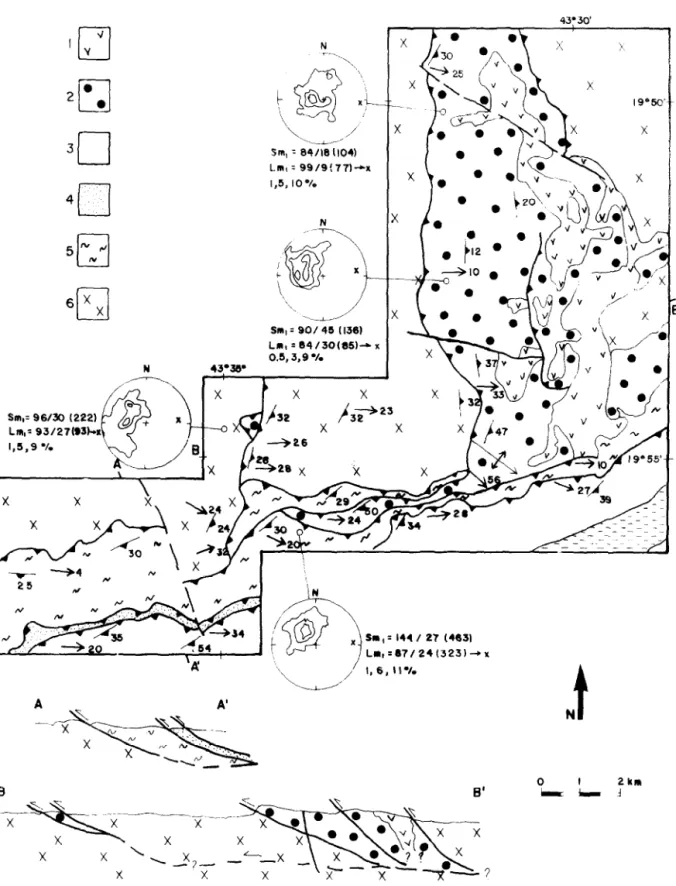
The Cambotas-Fun&o Thrust System (Fig. 7) is the most conspicuous structural feature of the eastern QF. It comprises several arcuate thrusts. The main thrust, the Cambotas Fault, truncates the Serra das Cambotas at its north- eastern end, where it has a NE-SW trend (Simmons and Maxwell, 1961). At its south- eastern end the thrust borders the Caett Gran-
itic Gneissic Dome (Fig. 7). Near the Ouro Fino Syncline, the trace of the thrust trends NW-SE, parallel to the Conta-Historia Sync- line, where it coincides with the Fundgo Fault
(defined by Dorr, 1969). Several major and minor thrust splays are probably the result of duplexing. Further east, the thrusts have in- creasingly linear N-S trends.
Metamorphism in the area varies from
greenschist facies on the west, increasing east-
wards to the formation of a kyan-
ite + chloritoid paragenesis near the Fazendgo Thrust. In the shear zones related to the Cam- botas-Fundgo System, syn- and post-tectonic kyanite occurs defining a mineral stretching lineation Lm 1.
The Cambotas-Fundgo System comprises
the following megastructures: the Cambotas Fault, CaetC Complex, and the Gandarela, Ouro Fino and Santa Rita synclines (Fig. 7). The latter syncline includes the Conta-Histo- ria and Alegria synclines, and the Fazendgo Thrust front. The main structural characteris- tics of each structure are presented in Tables 1, 2 and 3.
The Cambotas Fault corresponds to the
northern oblique ramp of the main fault of the Cambotas-Fundgo Thrust System (Fig. 7). It trends NE-SW and has a dextral transpressive character, thrusting the NE-SW-striking me- tasediments of the RVSG and MSG over the Cambotas quartzites of the ESG and the gran- ite-gneissic rocks of the CaetC Dome, which structure is dominated by the N-S-trending thrusts of the Corrego do Garimpo System
THE TECTONIC EVOLUTION OF THE QUADRILATERO FERRIFERO, M INAS GERAIS 41
Fig. 7. Geologic-structural map of the Cambotas-Fund&o System. 1 = metabasic rocks, 2 = Cambotas Fm., 3 = Itacolomi Group, 4= Piracicaba Group, 5 = Itabira Group, 6= Caraw Group, 7= Maquine Group, 8 = Nova Lima Group, 9= GGT.
F= Fund3o Fault, C= Cambotas Fault, AM= Mariana Anticline, CCa = CaetC Complex, FG= Fazenda Gandarela,
SA = Alegria Syncline, SCa= Sem do Caraw, SCb= Serra das Cambotas, SCH= Conta Historia Syncline, SC= Gandarela Syncline, SOF= Ouro Fino Syncline, SVL = Vargem da Lima Syncline, FT= Fazendao Thrust
the axis trending approximately N-S, inter- preted as an appendix of the Gandarela Sync- line and denominated the Palmital Homocline
(Rosibreetal., 1991).
In the northeastern area of the Gandarela Syncline, the normal limb tectonically overlies
42
F. CHEM ALE JR. E’l- .A1.
3 k-l
4 cl
5 “,” a
6xX cl
--.L.-’ Sm, 1 84116 1104) L.rn,: 99/9!771-+x I$, 10%
0 0
??t 12 ??
\I
A 1, 6, II%
A __ A’
THE TECTONIC EVOLUTION OF THE QUADRILATERO FERRIFERO, MINAS GERAIS 43
srrf7e/st (300)
Lm, :100/53(119)-x 1,5,ii>.l5’~.
Smf96/27(1901
Lm, :99/69(104)--I 1, ‘i.l”,ili “1.
Fig. 9. Geologic-structural map of the Palmital Homocline and SE portion of the central segment of the Gandarela Syn- cline (after Endo and Chemale, 199 lb). I = Gandarela Fm., 2= CauC Fm., 3=Batatal Fm., 4=Moeda Fm., MaquinC Group, 6=Nova Lima Group. Stereograms with Sml foliation (contour lines) and Lml mineral lineation (cross).
main, the MSG strata show well-preserved sedimentary structures such as bedding, cross- bedding, flaser structures and fossil cyanobac-
teria (stromatolites) (Souza and Miiller,
1984). The southern area of the syncline has an elongated shape, roughly resembling a boot (Fig. 9). There, only the basal, elastic forma- tions of the MSG (Caraca Group) crop out, building a weakly folded synformal structure with medium to low strain features in its inte- rior surrounded by shear zones, developed during the W-vergent belt (Tables 2 and 3 ) .
The Ouro Fino structure is a refolded sync- line, that on map scale displays a shape similar to a “mushroom” interference pattern. Like other megascopic folds of the QF, it is the re-
sult of the superposition of the thrust tectonics related to the development of the Cambotas- Fundao System, on folded strata of the MSG
(Tables 1,2 and 3). It can be divided into two segments according to its axial orientation
(Figs. 7 and lo), viz. the northern and south- em segments, respectively with NE-SW- and
NW-SW-trending axes, and northwestward
and southwestward vergence.
44 F. CHEMALE JR. EI 41
Sm, I: 99/45 (36) Lm, =96/39 1151~ w 5,10,15%
Lm, =90/600(21) -x 5,10,15%
Sm,= 60/60 (37) 0 Sm,= 45/46 (69) Lm,=60/57 (266)+X
+
Lm, 2 69/39(51)* 5, IO, I5 % 5, IO,15 %
I cl
2 :-:,: cl
3’ 4w
. . .
??
cl IvNORTHERN SEGMENT SOUTHERN SEGMENT
(not rotated) (rotated)
Sn,: 96153 (159) Lm,=93/49Wi b, = IIf/ 36(22)
Sm,: 50/50 (106) Lm, = 66/45 (7-t) b, = SO/54 (I401
THE TECTONIC EVOLUTION OF THE QUADRILATERO FERRIFERO, M INAS GERAIS 45
Cambotas-Fundfo System, that has been
reactivated during compressional tectonics
(Fig. 10).
The Santa Rita Syncline was also nucleated early during the tectonic history of the QF
(Table 1). Its continuity with the Dom Bosco Syncline has been strongly disrupted by the in- tense thrust tectonics related to the develop-
ment of the Cambotas-Fundgo Thrust System
at the eastern margin of the QF. The thrusts
compressed the folded strata of the MSG
against the structural high of the Serra do Car- aca, resulting in the synclines of Conta Histb ria and Alegria, and the Fazendgo Thrust (Fig. 7).
S tructural model
We believe that much of the Proterozoic tec- tonic history of the QF can be best explained in terms of heterogeneous regional deforma- tion, due to the interference of old structures with later tectonism. Clearly the E-W com- pressional events were superimposed onto an earlier complex arrangement (Fig. 11 B ) , with prominent structural highs between synclines, that display a wide array of axial planar orien- tations. We believe that the effects of this pre- vious framework were particularly significant during D 1, when the location and nucleation of thrust faults were conditioned by the older
structures. The E-W-trending Dom Bosco
Syncline favoured the effects of the thrusts by “channelling” their trajectories along its hinge line. The thrusts sliced the Dom Bosco Sync- line, resulting in the transection of the primary surfaces by N-S-striking faults. In the limbs of the synclines the thrusts were controlled by the morphology of the structural basement, result- ing in curved fault planes and mylonitization parallel to the contact between the supracrus- tal and infracrustal rocks.
The Bacfio Complex, to the north (Figs. 2a and 11B ), acted as a rigid buttress, displaying a mylonitic foliation along its borders, parallel to the contact with the supracrustal rocks. It
obstructed the trajectory of the thrusts in the Dom Bosco Syncline and the southern thrust
ramps related to the Cambotas-Fundgo Sys-
tem. The westward compression also forced the rocks of the Bacgo Complex against those of the Moeda Syncline, attenuating its southern extremity at the junction with the Dom Bosco Syncline (Figs. 2a and 12 ) .
The oroclinal shape of the Cambotas-Fun- d5o System is believed to be due to its obstruc- tion in the north by the CaetC Complex and in the south by the Bacgo Complex, associated with the development of two conjugate, tran- spressive shear zones, respectively with dex- tral and sinistral sense of rotation (Figs. 2a and 12 ) , probably reactivating earlier major base- ment structures. The arcuate trajectory of the thrusts reshaped all previous structures, de- forming the megasynclines formed during the previous extensional event. At the junction be- tween the Santa Rita and Dom Bosco sync- lines, the arcuate shape of the Cambotas-Fun- d8o System gave origin to the Mariana Anticline.
Another important rigid buttress in the QF is the Serra do Caraca, that partially ob- structed the westward trajectory of the Santa Rita Syncline during compression, and condi- tioned the present shape of the structure, with the development of the Alegria (ESE-trending axis ), and Conta Historia (SE-trending axis)
synclines, and the N-S-striking Fazendso
frontal ramp. These structures are all strongly deformed segments of the Santa Rita Syncline. The Serra do Caraca also partially protected the central segment of the Gandarela Syncline from the deformational effects of the compressive event, that produced an intense mylonitiza- tion at the northeastern segment along the Cambotas transpressive zone.
b
-
F. C HEMA 1.t JR. f. I .\ i.
/’ /’
?-, ‘BH
A i- ,IT
A
B
Fig. 11. Sketch maps illustrating the Palaeoproterozoic evolution of the Quadrilatero Ferrifero. (A) The Minas Basin after its deposition. 1 =minimum basin limit based on present MSG distribution, 2=Minas sediments, 3=deformed RVSG units, 4 = Archaean TGG. (B) The Minas Basin after the first extensional event. I= structural low, 2= structural high, 3 to 5 as in (A). SK= Serra do Curral, SM=Moeda Syncline, SDB=Dom Bosco Syncline, SSR=Santa Rita Sync- line, SG= Gandarela Syncline, SaCa= Serra do Caraca, CBu= BacBo Complex, CBo= Bonfim Complex.
zoic era. In the Brasiliano Event this fault is from transpressive deformation, developing in reactivated by several parallel sinistral shear non-planar deformation conditions. The N-S- zones resulting in translation and rotation of trending D3 structures are interpreted to be due
blocks. to the development and reactivation of frontal
The E-W-trending D2 structures resulted ramps as the thrusts reached shallower levels
THE TECTONIC EVOLUTION OF THE QUADRILATERO FERRIFERO, M INAS GERAIS 47
44O 42'
Bt._ SF e+,EM+t+bR tt_* TB --&
0 70 Km
A +CBy-, OF ++-, bR e+, TB -.+
A’
0 50Km L -
8/77-f 91-1 lO[zj Illi.:.':':i:l ‘2[cl
in the crust. The ambiguous relationship ofsu- The tectonic transport during the compres- perposition between the structures of these last sive Brasiliano Event is unambiguously west-
48 F. CHEM ALE JR. ET AI.
indicators in all analysed domains. Northwest-
and southwestward movements are also re-
corded in the QF, but are related to local oblique ramps, conditioned by the pre-existing structural topography. The conjugate tran- spressive zones that limit the Cambotas-Fun- dao System (Fig. 7) also indicate a compres- sive component.
Tectonic evolution
Relating the results of the structural analysis and available geochronological and gravime- tric data we suggest the following evolutionary model for the QF, which is summarized in Ta- ble 4.
The GGTs older than 2920 Ma, possibly as old as 3080 Ma (U/Pb on zircon) (Machado et al., 1989a) are the most complex and little can presently be asserted about their early his- tory. The 2.7-2.8 Ga metagranites and gneisses (Cordani et al., 1980, 1989; Teixeira, 1985; Teixeira et al., 1987; Machado et al., 1989a; Romano, 1990) often display a N-S-striking banding, and a mineral lineation displaying subhorizontal pitches. Machado and Carneiro ( 1992) indirectly dated the deformation of the gneiss between 2772 Ma and 2703 Ma, based on the fact that a 2703+20_25 Ma old aplitic dyke from the Bonfim Complex intersects the N-S-trending fabric of the gneissic country rock whose age was determined as 2772 + 6 Ma
(U/Pb on zircon).
The RVSG comprises an Archaean green- stone belt sequence, older than 2.76 Ga, with
deformation and metamorphism developed at
about 2.7-2.8 Ga (Herz, 1970; Thorpe et al., 1984; Machado et al., 1989a), together with granitic intrusions as at the Serra do Itatiaia and Serra do Ouro Branco (outcrop RVl in Fig. 4), where they are preserved from the events that deformed the MSG. As the sur- rounding granite-gneiss rocks the old fabric of the RVSG attests to transcurrent tectonics. U/ Pb in zircon data for felsic volcanic rocks from the RVSG and some granite-gneiss rocks yield
ages of 2.7-2.8 Ga (Machado et al., 1989a) which is interpreted as the main deforma- tional event affecting the RVSG and surround-
ing GGTs. The superimposition of younger
fabrics that obliterates the older structures in most outcrops, makes it difficult to give a com- plete interpretation of the Archaean tectonics.
The sedimentation of the MSG occurred
mainly upon units of the RVSG, since its basal formation comprises conglomerates with frag- ments from the greenstone belt sequence, while granitic clasts are absent. The stratigraphy of the MSG indicates a long, quiescent period of stabilization of the Archaean crust, with the development of platformal or wide intracra- tonic basin > 10000 km2 (see Fig. I 1 A), in which thick layers of BIF were extensively de- posited. The extent of the Minas Basin is not, at this stage, reconstructable. The Pb/Pb date of undeformed to weakly deformed carbonatic rocks indicates ages of 2420 + 25 Ma for the It- abira Group (Babinski et al., 199 1) and the U/ Pb date from detrital zircon grains of meta-
graywacke indicates a minimum age of
2125 t 4 Ma for the Sahara Formation (Pira- cicaba Group), uppermost formation of the MSG (Machado et al., 1989a). The basal group of MSG, the Caraca Group, is older than
2420% 25 Ma (age of Itabira Group) and
younger than 2703::: Ma (the youngest gran- itic rock of basement). Metamorphic age of 2059 tr 6 determined on sphene from granite- gneiss terrain (Machado et al., 1989a) and Pb/ Pb data for deformed marble of the Piracicaba Group yielding an isochron age of 2 I 10 t- 110
(Babinski et al., 199 1) are considered as min- imum deposition age of MSG rocks.
THE TECTONIC EVOLUTION OF THE QUADRILATERO FERRIFERO, MINAS GERAIS
TABLE 4
Tectonic evolution synthesis of the Quadrilatero Ferrlfero and adjacent regions (see text)
49
Lithological groups of rock formation Age (MaI ( 1) Generation of older granite-gneiss
terrains
(2) Initial phase of the greenstone belt Rio das Velhas
(3) Acid to intermediate magmatism associated with deformation and metamorphism of the RVSG as well granite-gneissic rocks formation
(4) Minas Supergroup deposition (intermediate unit, Itabira Group, deposited _ 2400 Ma)
(5) Isotopic remobilization of Archaean rocks. Pegmatites and amphibolites (probably granites?) in the GGT and RVSG, and low-grade and contact metamorphic rocks in the MSG, were formed
(6) Mafic dyke intrusions
(7) Generation of low-grade rocks (locally in amphibolite facies)
(8) Mesozoic tectonism with formation of basic dykes and sedimentary basin
> 2920
> 2880
2780 to 2703
c 2703 to > 2060
2060 to 2000
1700 to 1500
1200 to 900
650 to 500
<130
Tectonic regime and other characteristics Compressive tectonics with production of a complex structural arrangement
Extensional tectonics with generation of komatiites and tholeiites
Compressive tectonics with a dominant strike-slip deformation which produced a horizontal to subhorizontal mineral lineation at N-S-trending foliation with vertical dip (Rio das Velhas Orogeny ) Initial rift phase followed by a platform deposit (somewhat like an intracratonic basin)
Extensional tectonics with development of ductile-brittle to ductile shear zones, resulting in the uplift of GGTs and formation of interconnected regional synclines
Extensional tectonics associated with the Mesoproterozoic rifting of the SF Craton Extensional tectonics during the opening of the Brasiliano/Pan-African proto-ocean Compressive tectonics related to the Brasiliano fold-and-thrust belt (Brasiliano Orogeny )
Extensional tectonics during the drift of South America and Africa continents
accordance with the vertical movement of un- derlying blocks. Such a peculiar tectonic event could be interpreted as a response to the colli- sion of continental blocks with a west-dipping subduction during the Transamazonian Event at 2.1- 1.7 Ga, involving the eastern portion of the Paramirim Craton. The region could cor- respond to metamorphic core terrains of Ar- chaean age that have been uplifted during ex- tensional tectonism related to a subduction event similar to the Phanerozoic West Cordil- leran Pan-American coast (Davis and Coney, 1979; Coney and Harms, 1984; Parrish et al.,
1988). As alternative explanation, the exten- sional event could be related to a regional pro- cess during continental drift with development of basement uplift, as proposed by Wernicke
( 1990) for Phanerozoic sequences.
The shear zones represent the consequent
dislocation surfaces developed during the
uplift, and together with the megafolds, are the main tectonic features of the Transamazonian Event in the QF. Whole rock Rb/Sr, Pb/Pb in monazite and U/Pb in sphene data record a 2.0 Ga crustal remobilization in the GGTs
50 F. CHEM ALEJK EI \I.
Machado et al., 1989a; Romano, 1990) and radiometric age K/Ar data indicate mineral cooling in the western portion of the QF at 1.7 Ga (Romano, 1990; Carneiro, in prep. ) which region is not affected by younger compres- sional events.
During the extensional event, the metamor- phic conditions reached the greenschist facies in the extensional ductile to ductile-brittle shear zones at the contact between the GGTs and the overlying supracrustal rocks. Distant from the shear zones, in the core of the mega- synclines almost very low greenschist facies metamorphism related to this event can be de- tected. The existing contact metamorphism aureoles, syntectonic to post-tectonic with re- spect to the development of the extensional shear zone (Jordt-Evangelista et al., 1992)) can be interpreted as the result of intrusion of ig- neous during the crustal remobilization asso- ciated to the development of the metamorphic core complexes or the juxtaposition of hotter crustal material against cooler supracrustal rocks.
During Mesoproterozoic times this region behaved as a cratonic area in which different extensional pulses through mafic dyke genera- tions have been identified (Table 4). In con- trast to Cordani et al. ( 1980, 1989), Teixeira (1985), Marshak and Alkmim (1989), a Me-
soproterozoic (Uruacuano ) orogeny is not
recognized in the QF.
At the end of the Mesoproterozoic and the beginning of the Neoproterozoic, a broad ex- tensional event affected the S?io Francisco Craton when the first stages of the Brasiliano/ Pan-African Cycle took place.
Undeformed mafic dykes and other intru- sive bodies that crop out in the western parts of the QF, similar to those occurring in the Serra do Espinhaco which are about 1 .O Ga old (Machado et’ al., 1989b), truncate the Ar-
chaean and Transamazonian terrains (GGTs,
RVSG and MSG), as for instance, in the Ibir- it6 region (IB in Fig. 2a). In the eastern por-
tion of the QF, they are deformed by the E-W compressive event, as at the Raposos Mine (MR in Fig. 2a) and Serra das Cambotas (Fig. 8).
A comparison between data from the Serra do Espinhaco, eastern Sao Francisco Basin and the QF area, indicates that all these regions were affected by similar tectonism, under the same westward kinematic vector (Fig. 12). In the Serra das Cambotas region, where ESG and MSG are juxtaposed, it is clear that the latter is thrust over the former along the Cambotas- Fundgo System (Fig. 8 ) . Both geological facts attest that this compressive event developed during the Brasiliano as a part of the Espin- haco FTB, related to the closure of the eastern margin of the Sao Francisco Craton. K/Ar data from biotite, hornblende and whole rock anal- ysis of amphibolites and granitic rocks from the eastern border of the QF range from 1.0 and 0.43 Ga, with most data between 0.55 and 0.45 Ga, which reflect the thermal overprint asso- ciated with this compressive event (Teixeira,
1985; Cordani et al., 1989).
The infracrustal blocks acted as barriers to the collisional deformation in the QF, result- ing in amplification, translation and rotation of the megasynclines. Pre-existing structures were reactivated and new features, typical of fold-and-thrust belts, developed. In the QF, the collisional deformation affected mainly the su- pracrustal rocks, particularly along their con- tact with the crystalline basement. Significant Brasiliano crustal accretion occurred only in the Mantiqueira Province to the east of the QF (Siga et al., 1987), in response to the closure between the Vitoria and the Brasilia Blocks (Fig. 12 ) . Along the contact of these blocks, a
gravimetric anomaly is detectable in the
THE TECTONIC EVOLUTION OF THE QUADRILATERO FERRIFERO, MIN.AS GERAIS 51
Conclusions
The QF area is a regional interface structure as a result of the following tectonic history: ex-
tensional tectonics, of Transamazonian age
(2 1 OO- 1700 Ma) and compressional tectonics with the development of a fold and thrust belt of Brasiliano age (650-500 Ma). The struc- tural data allow us to define two main struc- tural regions in the QF: the western region which displays mainly extensional records, and the eastern region which has been affected in different magnitude of deformation by the younger Brasiliano FTB (Fig. 12 ) .
The uplift of the Archaean granite-gneiss domes and the formation of interconnected re- gional synclines took place during the Palaeo- proterozoic extensional tectonics, generating a dome and basin architecture for the QF re- gion. The regional synclines of the QF, such as the Gandarela, are also originally extensional in origin and are not only compressive in ori- gin as proposed in other models. The exten- sional tectonics may be related to the develop- ment of a core complex in the hinterland of a collisional area to the east of the QF. This would imply in a subduction zone dipping
westwards under the Transamazonian Para-
mirim Craton. Alternatively, the extensional event could be related to a more extensive con- tinental fragmentation process.
During this extension, metamorphic condi- tions reached the greenschist facies in the ex- tensional shear zones at the contact between the GGTs and the overlying supracrustal rocks. Syn- to post-tectonic metamorphic aureoles (Jordt-Evangelista et al., 1992) can be inter- preted as the result of granitic intrusion, or the juxtaposition of older, hotter crustal material against cooler supracrustal rocks. The kine- matic field of the extensional tectonics is strongly variable, being controlled by the shape of GGTs and their contacts with the supra- crustal rocks; however, the regional vectorial field is oriented WNW-ESE.
Compressional tectonics is believed to be as-
sociated with the closure of the Brasiliano/Pan- African basins. It resulted from the develop- ment of a west-vergent Brasiliano FTB, as is partially described by Belo de Oliveira and Vieira ( 1987) and Marshak and Alkmim
( 1989)) where the QF represents its interme- diate to distal portion without magmatism ac- tivity. Related deformational structures devel- oped in three deformational phases, and are continuous with the Brasiliano age structures of the Sgo Francisco Basin and Espinhaco Meridional. During ductile D 1, the metamor- phic conditions varied from anchimetamorph- ism to low amphibolite facies, while during ductile-brittle D2 and D3 retrograde condi- tions prevailed as the result of a progressive uplift of thrust blocks/wedges during the tec- tonic transport. The uplifted granite-gneiss blocks acted as obstacles during the collisional tectonics, resulting in amplification, transla- tion and rotation of the regional synclines. The intensity of deformation and metamorphism decrease from east to the west as already stated by Almeida ( 1977).
Acknowledgements
Grateful acknowledgments are made to the iron mining companies Companhia do Vale do Rio Dote (CVRD ) , Mineracoes Brasileiras Reunidas (MBR) and Samitri for support of much of the field work, and to the Brazilian
Conselho National de Desenvolvimento Cien-
tifico e Tecnologico (CNPq) and the Finan-
ciadora de Estudos e Projetos (FINEP/
PDACT), respectively for Grants 404983/88.0 and 4.286.0337. We thank Francy Jacobus Baars for helpful discussions, many sugges-
tions and improvement of the manuscript.
Maarten J. de Wit is also thanked for extensive reviewing and critical comments.
References
52 F. CHEMALE JR. ET AI.
de Ouro Branco, Minas Gerais, Brasilien. Unpubl. DSc. Thesis, Tech. Univ. Clausthal, Clausthal-Zeller- feld, 2 17 pp.
Almeida, F.F.M., 1977. 0 C&on de SHo Francisco. Rev. Bras. Geocienc., 7 (4): 349-364.
Babinski, M., Chemale, F. Jr. and Van Schmus, W.R., 199 1. Geochronologia Pb/Pb em rochas carbonaticas do Supergrupo Minas, Quadrilatero Ferrifero, Minas Gerais, Brasil. An. III Congr. Bras. Geoqim., S?io Paulo, Sot. Bras. Geoquim., 2: 628-631.
Belo de Oliveira, O.A. and Vieira, M.B.H., 1987. Aspec- tos da deformaclo ductil e progressiva no Quadrila- tero Ferrifero. In: Bol. Res. I. Simp. Nat. Est. Tect., Salvador, Sot. Bras. Geol., pp. 74-76.
Carneiro, M.A., in prep. Geocronologia e Geoquimica do Complexo Bonfim. Ph.D. thesis, Univ. Sao Paulo, Sgo Paulo.
Castro Alves, J.A., 1991. Reconstrucao Estocastica da Mina Sao Luiz, Complexo FazendBo, MG. M.Sc. The- sis, Univ. Fed. Ouro Preto, Ouro Preto, 2 11 pp. Chemale, F., Jr. and Endo, I., 1990. Projeto Sinclinal
Gandarela, Parte II. Conv. MBR/UFOP, Unpubl. Int. Rep., 39 pp.
Chemale, F., Jr., Quade, H. and Santana, F.C., 1987. Eco- nomic and structural Geology of the Itabira Iron Dis- trict, Minas Gerais, Brazil. Zentralbl. Geol. Palaeon- tol., VI (7/8): 743-752.
Coney, P.J. and Harms, T.A., 1984. Cordilleran meta- morphic complexes: Cenozoic extensional relics of Mesozoic compression. Geology, 12: 550-554. Cordani, U.G., Kawashita, K., Mtiller, G., Quade, H.,
Reimer, V. and Roesler, H., 1980. Interpretacb tec- tonica e petrologica de dados geocronologicos do em- basamento na borda sudeste do Quadrilatero Ferri- fero. An. Acad. Bras. Cienc., 52(4): 785-799. Cordani, U.G., Teixeira, W. and Siga, O., Jr., 1989. Geo-
cronologia do Quadrilatero Ferrffero. Bol. XXI Sem. Estudos, Sot. Interc. Cult. Est. Geol., Ouro Preto, 2 1: 27-44
Costa, C.S., in prep. Geologia Estrutural e Petrologia do Corrego dos Boiadeiros. MSc. Thesis, Univ. Fed. Minas Gerais.
Crocco-Rodrigues, F.A., Costa, A.F., Souza, F.A.C. and Rosibre, C.A., 1989. Sistemas de Cavalgamento do Nordeste do Quadrilatero FerrIfero-MG. An. V Simp. Geol. Minas Gerais, Belo Horizonte, Sot. Bras. Geol., Bol., 10: 6-10.
Davis, G.H. and Coney, P.J., 1979. Geologic develop- ment of the Cordilleran metamorphic core complexes. Geology, 7: 120-l 24.
Dorr, J.N. 2nd., 1969. Physiographic, stratigraphic, and structural development of the Quadrilatero Ferrffero, Minas Gerais. U.S. Geol. Surv. Prof. Pap., 641-A: l-
110.
Endo, I., 1988. Antiise Estrutural Qualitativa do Minerio de Ferro e encaixantes da Mina de Timbopeba-Borda
Leste do Quadrilatero Ferrifero, Mariana, MG. Un- publ. M.Sc. Thesis, Univ. Fed. Ouro Preto, Ouro Preto 130 pp.
Endo, I. and Chemale, F., Jr., 199la. Implicacbes tecton- icas das estruturas extensionais no Quadrilatero Fer- rifero, MG. Bol. III. Simp. Nat. Est. Tect., Rio Claro. pp” 51-53
Endo, I. and Chemale, F., Jr., 1991b. Projeto Sinclinal de Alegria-Aba NE. Unpubl. Int. Rep., SAMITRI, Mar- iana, 16 pp.
Evangelista, M.T.R., 1984. Strukturelle und texturelle Untersuchungen in der Eisenerzlagerstaette “Mutuca” bei Belo Horizonte, Minas Gerais, Brasilien. Unpub. Dr.Sc. Thesis, Tech. Univ. Clausthal, Clausthal-Zel- lerfeld, 17 1 pp.
Fonseca, M.A., 1990. 0 Sinclinal de Ouro Fino: Analise Descritiva e Cinematica de urn segment0 do Sistema Fundb, Quadrilatero Ferrifero, Minas Gerais. Un- publ. MSc. thesis, Univ. Fed. Ouro Preto, Ouro Preto,
102 pp.
Gloeckner, K.H., 198 1. Lithostratigraphie, Sedimentolo- gie, Tektonik und Metamorphose der proterozoischen Itacolomi-Serie bei Ouro Preto, Minas Gerais, Brasi- lien. Claust. Geowiss. Diss., 10: l-22 1.
Guild, P.W., 1957. Geology and Mineral Resources ofthe Congonhas District, Minas Gerais, Brazil. U.S. Geol. Surv. Prof. Pap., 290: l-90.
Hackspacher, P.C., 1979. Strukturelle und texturelle Un- tersuchungen zur intemen Deformation des Eisen- reicherzkoerpers der Grube “ Aguas Clara? bei Belo Horizonte/Minas Gerais, Brasilien. Claust. Geol. Abh., 34: 1-164.
Haraly, N.L.E., Hasui, Y., Mioto, J.A., Hamza, V.M. and Rodrigues, C.V.R., 1985. Ensaio sobre a estruturacfo crustal do Estado de Minas Gerais corn base na infor- macho geofisica e geologica. Contribuifles a geologia e petrologia. Belo Horizonte, Bol. Esp. Sot. Bras. Geol. Minas Gerais, pp. 7 l-93.
Herz, N., 1970. Gneissic and igneous rocks of the Quad- rilatero Ferrifero, Minas Gerais, Brazil. U.S. Geol. Surv. Prof. Pap., 641-B: l-58.
Herz, N., 1978. Metamorphic rocks of the Quadrilatero Ferrifero, Minas Gerais, Brazil. U.S. Geol. Surv. Prof. Pap., 641-C: l-78.
Hoefs, J., Mtiller, G. and Schuster, A.K., 1982. Polyme- tamorphic relations in iron ores from the Iron Quad- rangle, Brazil: the correlation of oxygen isotope varia- tions with deformation history. Contrib. Mineral. Petrol., 79: 241-251.