Abstract— Clinical studies have indicated that deflection of the acetabular cup may influence the generation of high friction and wear in metal-on-metaltotal hip arthroplasty (THA). This may result in micromotion leading to dislocation of hip prostheses requiring revision surgery which is clinically a complicated operation. A successful total hip joint implantation can be achieved when the correct surgical method is used to eliminate cup deflection during implantation. Clearance plays a unique role in squeezing lubricants between contact surfaces allowing the formation of a fluid film, and thus any deflection of the cup during surgery may result in negative action during articulation. This work investigated the effect of cup deflection (~25-30µm) on friction of large diameter (50mm) metal on metal Birmingham Hip Resurfacing (BHR) prosthesis with various clearances (80-306µm) using blood and clotted blood as lubricants. It was found that the physiological lubricants caused higher friction factors at lower diametral clearances which is opposite to the serum-based lubricants causing higher friction at higher clearances.
Keywords—Blood and Clotted Blood; Diametral clearances; Friction and Cup deflection; 50mm diameter metal-on-metal hip resurfacing prosthesis.
I. INTRODUCTION
Hip resurfacing arthroplasty has become increasingly popular for young and more active patients, who may require a second procedure in their lifetime. Metal-on-Metal (MoM) hip resurfacing arthroplasty is currently one of the most common implantation for patients with advanced arthritis disorders. Metal-on-metal hip resurfacing systems were introduced by the majority ofimplant manufacturers by the end of 2004. The goal of hip resurfacing arthroplasty is to remove the two damaged and worn parts of the hip joint, i.e. the arthritic acetabulum and femoral surfaces, and replace them with artificial implants to reproduce the form and function of the natural joint, relief pain, restore function and correct deformity.
The first metal-on-metal resurfacing prostheses were established by McMinn and Wagner [1, 2]. These prostheses were made from Co-Cr-Mo alloys and were initially
Manuscript received January 11, 2010.
S. Afshinjavid, School of Engineering, Design and Technology – Medical Engineering, University of Bradford, Bradford, West Yorkshire, BD7 1DP, United Kingdom ([email protected]).
M. Youseffi., School of Engineering, Design and Technology – Medical Engineering, University of Bradford, Bradford, West Yorkshire, BD7 1DP, United Kingdom ([email protected]).
implanted cementless. To improve the stability and osteointegration,the McMinn prosthesis has been modified to a cemented femoral component and with a hydroxyapatite (HA) coated cup [3] for which a survival rate of 99.8 % at four years has been reported with short rehabilitation periods allowing patients to return to their preoperative levels of activity. It has been acknowledged that the lower friction characteristics of metal-on-metal implants are related to the generation of full or partial lubricating films throughout the walking cycle.
Historically, there have been very few incidences of mechanical failures with metal-on-metal total hip replacements causing dislocation. While the optimal clearance to achieve elastohydrodynamic lubrication and avoid equatorial seizing is still being studied and debated, tribologists recommend that the diametral clearance be as small as possible in large-diameter bearings [4, 5]. This requirement must be balanced against practical limitations of manufacturing tolerances and also must take into account the possibility that deformation of the acetabular cup may occur when it is implanted into the acetabulum with a press-fit of 1 to 2 mm. Initial stability can be influenced by the method of fixation (press-fit), the surgical technique, the quantity and quality of the bone structure, bearing geometry and applied loading conditions. Press-fit fixation involves inserting an acetabular cup into an under reamed acetabulum, where the primary stability is gained through the frictional compressive forces generated about the acetabular periphery. The press-fit procedures have moderate influence on the contact mechanics at the bearing surfaces, but produce remarkable deformation of the acetabular cup.Further deformation of the acetabular cup, and subsequent reduction of the effective clearance, may also occur with physiological loading. The effect of cup deflection on clearance has been studied experimentally in cadaver pelvis and with the use of finite-element modeling [6]. The wall thickness of the cup showed to be the most important factor influencing deformation of the acetabular cup in both studies, although diametral clearance and bearing diameter were also important. Therefore, design and manufacturing parameters such as diametral clearance, femoral head diameter, surface finish or roughness, have shown to significantly influence the contact mechanics and tribology at the bearing surfaces of hip resurfacing arthroplasty. It is therefore important for the orthopaedic manufacturers to ensure that deformation of the component does not adversely affect clearance since this would lead to increased friction and hence joint dislocation [7].
The aim of this work was to investigate the effect of cup deformation on friction between the articulating surfaces of six Birmingham Hip Resurfacing devices with various clearances using blood and clotted blood as lubricants.
Effect of Cup Deflection on Friction of Hip Resurfacing
Prosthesis with Various Clearances Using Blood and
Clotted Blood as Lubricants
S. A s a a M. Y s
Proceedings of the World Congress on Engineering 2010 Vol I WCE 2010, June 30 - July 2, 2010, London, U.K.
ISBN: 978-988-17012-9-9
ISSN: 2078-0958 (Print); ISSN: 2078-0966 (Online)
II. MATERIALS AND METHODS
Immediately after joint replacement, the artificial prosthesis is actually bathed in blood and clotted blood instead of synovial fluid. Blood contains large molecules and cells of size ~ 5 to 20 micron suspended in plasma and is considered to be a non-Newtonian fluid with density of 1060 Kg/m3. The effect of these properties on friction is not fully understood and, so far, hardly any studies have been carried out regarding friction of metal-on-metal bearings with various clearances in the presence of lubricants such as blood or clotted blood. Therefore, we investigated the frictional behaviour of a group of Birmingham Hip Resurfacing devices (supplied by Smith & Nephew Orthopaedics Ltd, UK) with a nominal diameter of 50mm and original diametral clearances in the range ~ 80 to 300µm, in the presence of blood (clotted and whole blood) after cup deflection (See Table 1 for details) using two-point pinching action before friction tests.
Frictional measurements of all the joints were carried out using a Prosim Hip Joint Friction Simulator (Simulation Solutions Ltd, Stockport, UK). The acetabular cup was positioned in a fixed low-friction carriage below and the femoral head in a moving-frame above. The carriage sits on an externally pressurized hydrostatic bearings generating negligible friction compared to that generated between the articulating surfaces, also allowing for a self-centring mechanism. During the flexion-extension motion, the friction generated between the BHR devices causes the pressurized carriage to move. This movement (or rotation) is restricted by a sensitive Kistler piezoelectric force transducer which is calibrated to measure torque directly. A pneumatic mechanism controlled by a microprocessor generates a dynamic loading cycle and the load is also measured by the same piezoelectric force transducer. Friction measurements (friction factor results given in Table 1) were made in the ‘stable’ part of the cycle at 2000N and to obtain accurate measurements for friction, the centre of rotation of the joint was aligned closely with the centre of rotation of the carriage. The loading cycle was set at maximum and minimum loads of 2000N and 100N to represent the stance and the swing phase of the walking cycle, respectively.
In the flexion/extension plane, an oscillatory harmonic motion of amplitude ±24° was applied to the femoral head with a frequency of 1Hz in a period of 1.2s. The load was, therefore, applied to the femoral head with the artificial hip joint in an inverted position, i.e. femoral head on top of the acetabular component, but with a 12° angle of loading between the two bearings as observed in human’s body (12° medially to the vertical).
The angular displacement, frictional torque (T) and load (L) were recorded through each cycle. The frictional torque was then converted into friction factor (f) using the equation: f = T/rL, where r is the femoral head radius. An average of three independent runs (tests) was taken.
Initially, the test was conducted with non-clotted blood (whole blood with Lithium heparin to prevent clotting) and clotted blood as the lubricants for each joint. Viscosity of the non-clotted blood was found to be ~ 0.0083 Pas and that of clotted blood was ~ 0.0108 Pas using an Anton Paar Rheometer.
III. RESULTSANDDISCUSSION
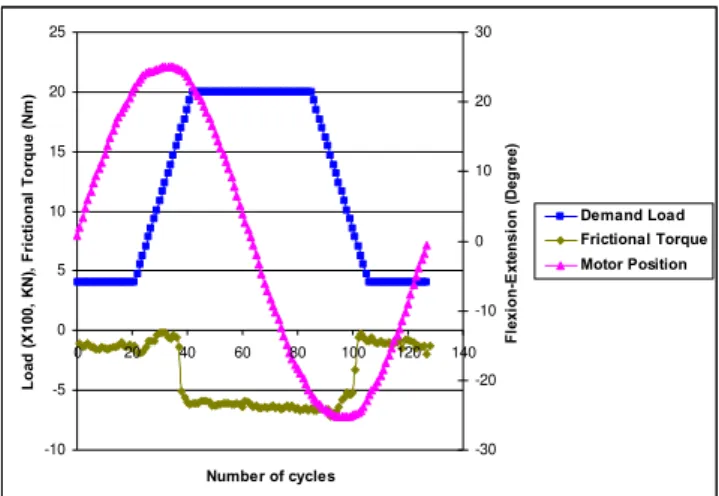
The dynamic loading cycles generated during the friction tests are plotted graphically in Figures 1 and 2 as graphs of load, frictional torque, friction factor and flexion-extension (±24° oscillatory harmonic motion) versus the number of cycles (=127). It is to be noted that the friction factors were taken from the stable part of the cycle at 2000N and thus the frictional torques were also from this part of the cycle which represents the normal loading cycle observed in human’s body having ~ 12° angle of loading between the acetabulum and the femoral head. The friction torques (~4.8-7.2 Nm) obtained during friction tests were within the safe range causing no risk of dislocation.
The average friction factors (average of 3 tests) for different clearances after ~25-35µm deformation is given in Table 1 and Figure 3 which is a graph of friction factor versus diametral clearance after cup deflection.
From Table 1 and Figure 3 it can be seen quite clearly that friction factor has decreased consistently as diametral clearance increases for both blood and clotted blood. These results are in agreement with those before cup deflection, when blood and clotted blood were also used on the original joints [8]. This is a significant finding since the results obtained during this work clearly show that for lower clearances friction increased significantly when the cups were deflected by ~30 µm. It is therefore illustrated that higher clearances can accommodate the amount of distortion introduced in the cups during this investigation or indeed during implantation. The results of this study suggest therefore that reduced clearance bearings have the potential to generate high equatorial friction especially in the early weeks after implantation when blood is indeed the in vivo lubricant. This higher friction in the low clearance bearings may produce micromotion and hamper bony ingrowth resulting in impaired fixation with long-term implications for survival.
Table1. Average friction factors after ~25-35µm cup deformation using blood and clotted blood as lubricants.
Original Diametral Clearance (µm)
Cup deflection
(µm)
Diametra l Clearanc
e after deflectio
n (µm)
Blood η=0.0083
(Pas)
Clotted blood η=0.0108
(Pas)
80 30 50 0.18 0.19
130 35 95 0.201 0.2
175 25 150 0.194 0.2
200 24 176 0.147 0.18
243 26 217 0.13 0.134
306 26 280 0.15 0.16
Proceedings of the World Congress on Engineering 2010 Vol I WCE 2010, June 30 - July 2, 2010, London, U.K.
ISBN: 978-988-17012-9-9
ISSN: 2078-0958 (Print); ISSN: 2078-0966 (Online)
-10 -5 0 5 10 15 20 25
0 20 40 60 80 100 120 140
Number of cycles
Loa
d
(X
1
0
0
,
K
N
),
F
ri
c
ti
on
a
l To
rque
(
N
m
)
-30 -20 -10 0 10 20 30
Fl
e
x
ion-E
x
te
ns
ion (
D
e
gr
e
e
)
Demand Load Frictional Torque Motor Position
Figure 1. Dynamic-Motion profile plotted after friction test showing variation in frictional torque with the applied load in ±24° extension-flexion versus number of cycles for the 50µm diametral clearance after initial deflection, 50mm BHR bearing using Blood as lubricant.
-0.1 -0.05 0 0.05 0.1 0.15 0.2 0.25
0 20 40 60 80 100 120 140
Number of cycles
Loa
d (
X
1
0
, K
N
),
Fr
ic
ti
on
f
a
c
tor
-30 -20 -10 0 10 20 30
F
lexi
o
n
-E
xt
en
si
o
n
(
D
eg
ree)
Friction factor Load Motor Position
Figure 2. Friction factor versus number of cycles for the 50mm BHR prosthesis with a diametral clearance of 217µm after cup deflection using blood as lubricant.
0.12 0.14 0.16 0.18 0.2 0.22
0 50 100 150 200 250 300
Diametral Clearance (µm)
Fr
ic
ti
on f
a
c
tor
Blood, η=0.0083 Pas
Clotted blood, η=0.0108 Pas
Figure 3. Friction factor versus diametral clearance after ~25-35µm cup deflection.
IV. CONCLUSIONS
Six large diameter (50mm nominal) BHR deflected prostheses with various clearances (~ 50-280µm) were
friction tested in vitro in the presence of blood and clotted
blood to study the effect of cup deflection on friction. It was
found that the biological lubricants caused higher friction factors at the lower diametral clearances for blood and clotted blood as clearance decreased from 280µm to 50µm (after deflection). It is postulated that if the cup is deflected by press fitting, this may result in increased contact at bearing surfaces around the equatorial rib of the cup and result in higher frictional torque which can increase the risk of dislocation and hamper fixation. This has been the case for some early loosening of the implants after few weeks of implantation.
This work therefore showed clearly that higher clearances
will lower the friction for large diameter BHR bearings,
which, in turn, may accommodate for the amount of
deflection that occurs in the cups during press-fit arthroplasty.
REFERENCES
[1] D. McMinn, R. Treacy, K. Lin, P. Pynsent, (1996), Metal on metal surface replacement of the hip. Experience of the McMinn prosthesis, Clinical Orthopaedics & Related Research (329 Suppl): S89-98. [2] M. Wagner, H. Wagner, (1996), Preliminary results of uncemented
metal on metal stemmed and resurfacing hip replacement arthroplasty, Clinical Orthopaedics & Related Research (329 Suppl): S78-S88. [3] D.J.W. McMinn, (2009), Modern Hip Resurfacing, Springer-Verlag
London Limited.
[4] D. Dowson, C. Hardaker, M. Flett, G.H. Isaac, (2004), A hip joint simulator study of the performance of metal-on-metal joints, Part II: design, J Arthroplasty, 2004;19(8 Suppl 3):124-30.
[5] C.B. Rieker, R. Schon, R. Konrad, G. Liebentritt, P. Gnepf, M. Shen, P. Roberts, P. Grigoris, (2005), Influence of the clearance on in-vitro tribology of large diameter metal-on-metal articulations pertaining to resurfacing hip implants, Orthop Clin North Am, 2005;36:135-42, vii. [6] Z.M. Jin, S. Meakins, M.M. Morlock, P. Parsons, C. Hardaker, M.
Flett, G. Isaac, (2006), Deformation of press-fitted metallic resurfacing cups, Part 1: experimental simulation, Proc I Mech E [H] 2006;220:299-309.
[7] U. Muller, E. Gautier, C. Roeder, A. Busato, (2003), The relationship between cup design and the radiological signs of aseptic loosening in total hip arthroplasty, J Bone Joint Surg [Br] 2003;85-B:31-6. [8] D.J.W. McMinn; J.T. Daniel; A. Kamali, S. Sayad Saravi, M. Youseffi;
J. Daniel, R. Band Ashton, (2006), Friction testing in metal-metal bearings with different clearances using blood as lubricant, 52nd Annual
Meeting of the Orthopaedic Research Society, 19-22 March, 2006, The Lakeside Center, McCormick Place, Chicago, Illinois, USA.
Proceedings of the World Congress on Engineering 2010 Vol I WCE 2010, June 30 - July 2, 2010, London, U.K.
ISBN: 978-988-17012-9-9
ISSN: 2078-0958 (Print); ISSN: 2078-0966 (Online)