Article
Printed in Brazil - ©2013 Sociedade Brasileira de Química0103 - 5053 $6.00+0.00
A
*e-mail: [email protected]
Speciation and Preconcentration of Chromium from Water and Food Samples by
Synthesized Chelating Resin
Gökhan Çimen,aŞerife Tokalıoğlu,*,aİsmail Özentürkb and Cengiz Soykanb
aDepartment of Chemistry, Faculty of Science, Erciyes University, TR-38039 Kayseri, Turkey
bDepartment of Chemistry, Faculty of Arts and Sciences, Uşak University, TR-64200 Uşak, Turkey
A resina poli(ácido N,N’-dipropionitrila metacrilamida-co-divinilbenzeno-co
-2-acrilamida-2-metil-1-propanosulfonico) foi sintetizada com um novo adsorvente quelante para especiação de cromo em amostras de água e alimento por espectrometria de absorção atômica com chama (FAAS). A resina foi caracterizada por espectroscopia no infravermelho por transformada de Fourier (FTIR), análise elementar, microscopia eletrônica de varredura (SEM) e análise termogravimétrica (TGA). Os efeitos do pH, concentração da solução eluente, vazão e volume de amostra e íons interferentes
na recuperação de Cr(III) foram investigados. A capacidade de sorção da resina foi 12,1 mg g−1 para
Cr(III). Elevado fator de pre-concentração (150) e baixo desvio padrão relativo (2,0%, n= 10) foram
obtidos. O limite de detecção do método foi 1,11 µg L−1. A validação do método foi realizada pelas
análises de materiais de referencia de padrão certificado (TMDA-70 água de lago adulterada e SRM 1568a farinha de arroz) e de amostras adulteradas de água e alimento. O método desenvolvido foi aplicado na determinação de cromo em várias amostras de água e alimentos.
The poly(N,N’-dipropionitrile methacrylamide-co-divinylbenzene-co
-2-acrylamido-2-methyl-1-propanesulfonic acid) resin was synthesized as a new chelating adsorbent for speciation of chromium in water and food samples by flame atomic absorption spectrometry (FAAS). The resin was characterized using Fourier transform infrared spectroscopy (FTIR), elemental analysis, scanning electron microscopy (SEM) and thermogravimetric analysis (TGA). Effects of pH, concentration of elution solution, sample flow rate, sample volume and interfering ions on the
recovery of Cr(III) were investigated. The sorption capacity of the resin was found to be 12.1 mg g−1
for Cr(III). A high preconcentration factor (150) and low relative standard deviation (2.0%, n= 10)
were obtained. The limit of detection of the method was 1.11 µg L−1. The method validation was
performed by analyzing certified standard reference materials (TMDA-70 lake water and SRM 1568a rice flour) and spiked water and food samples. The developed method was applied to the determination of the chromium in various water and food samples.
Keywords: speciation, chelating resin, chromium, water, food, flame atomic absorption
spectrometry
Introduction
Speciation analysis of an element yields information on the individual concentrations of the various chemical forms of that element in environmental samples. The importance of chromium speciation is related with the toxicity and reactivity of their chemical form or oxidation state.1,2 Two stable
chromium species are known in the environment: Cr(III) and Cr(VI). Cr(III) appears to be essential for the mammals, and together with insulin, they are responsible for removing the glucose from the bloodstream. On contrary, the hexavalent
chromium has toxic and carcinogenic effects. The toxic nature of the Cr(VI) ions is attributed to their high oxidation potential and their relatively small size, which enables them to penetrate through biological cell membranes.3-5 Chromium
is widely used in various industries, such as plating, tanning, paint and pigment production and metallurgy, which possibly contaminate the environment. Speciation analysis of trace amounts of Cr(III) and Cr(VI) ions has become an important topic in environmental and biological sciences.6 Therefore,
the knowledge on the speciation of chromium is of particular necessity.
Solid phase extraction (SPE) is one of the widely utilized techniques for the separation and preconcentration of metal ions due to its simplicity, selectivity, flexibility, low cost, safety, ease of automation and high preconcentration factor. The adsorption materials play an important role in SPE process. Hence, the preparation of new materials for selective solid phase extraction of analytes is an important trend of solid phase extraction.18-20 Chelating
resins are superior in selectivity to solvent extraction and ion exchange due to their triple function of ion exchange, chelate formation and physical adsorption. Many researches are concentrated on metal ion recovery using chelating polymers because they are reusable and have higher adsorption capacities as well as high selectivity to some metal ions.21-23
In the present study, poly[N,N’-dipropionitrile
methacrylamide (DPMAAm)-co-divinylbenzene
(DVB)-co-2-acrylamido-2-methyl-1-propanesulfonic acid
(AMPS)] resin (poly(DPMAAm-co-DVB-co-AMPS) resin)
was synthesized and used for the speciation of chromium in various samples. Cr(III) was separated from Cr(VI) and preconcentrated by using a column containing chelating resin. Total chromium was determined after reducing Cr(VI) to Cr(III). The concentration of Cr(VI) was found by subtracting the Cr(III) concentration from the total Cr concentration. Factors affecting the separation and preconcentration of Cr such as pH of the sample, concentration of eluting reagent, flow rate, sample volume, adsorption capacity and matrix components were investigated.
Experimental
Instrument
Spectrometric measurements were carried out with a PerkinElmer AAnalyst 800 model flame atomic absorption spectrometry (Waltham, MA, USA) equipped with hollow cathode lamp operated at 25 mA. The wavelength and spectral band pass were set at 357.9 and 0.7 nm, respectively. A 10 cm long slot burner head and an air-acetylene flame were used. Acetylene/air flow rate
in N2 atmosphere.
Reagents and solutions
All chemicals were of analytical reagent grade. Stock solutions (1000 mg L-1) of Cr(III) and Cr(VI)
were prepared by dissolving appropriate amounts of Cr(NO3)3.9H2O (Merck, Darmstadt, Germany) and K2CrO4 (Merck) in 1 mol L-1 HNO
3, respectively. The working
solutions were prepared by dilution of the stock solutions immediately prior to their use. For the preparation of pH 1 and pH 2 solutions, diluted HCl and diluted NaOH solutions were used. The other pH adjustments were made by the use of buffer solutions. Buffer solutions were prepared by using 1 mol L−1 acetic acid-sodium hydroxide
(pH 3-6) and 1 mol L−1 ammonia-hydrochloric acid (pH 8).
3,3’-Iminodipropionitrile (Aldrich) and methacryloyl chloride (Alfa Easer, MA, USA) were used as received.
N,N’-Dipropionitrile methacrylamide was synthesized
according to the literature.24 2,2’-Azobisisobutyronitrile
(AIBN) (Merck) was purified by successive crystallizations from chloroform-methanol mixture. The crosslinker divinylbenzene (Merck) was used as received. 2-Acrylamido-2-methyl-1-propanesulfonic acid (Merck, 99%) was used without further purification. A glass column (100 mm length and 10 mm i.d.) with a glass wool over its stopcock was used throughout all the study. A total of 900 mg of chelating resin was placed into the column and washed thoroughly with distilled-deionized water. The column was preconditioned by the buffer solution having the same pH with the sample solution prior to use.
Synthesis of N,N’-dipropionitrile methacrylamide (DPMAAm) monomer
Triethylamine (180 mmol), 3,3’-iminodipropionitrile (60 mmol) and acetone (200 mmol) were placed in a three-necked flask equipped with magnetic stirrer, reflux condenser and dropping funnel and the contents were cooled to approximately 0 oC. Methacryloyl chloride
constant stirring, purged with nitrogen gas for 30 min and the system was closed. This mixture was stirred for 3 h at approximately 0 oC in an ice bath. The product, quaternary
ammonium salt, was washed with distilled water, extracted with chloroform, dried over anhydrous sodium sulfate and the solvent was evaporated in vacuum. The resultant monomer was obtained and recrystallized from ethanol as a yellow powder (yield: 75%). The reaction scheme of the monomer is shown in Figure 1.
Synthesis of chelating resin
The preparation of poly(DPMAAm-co
-DVB-co-AMPS) resin was carried out with a radical initiator
in dimethylformamide solution. To a polymerization flask, the two appropriate monomers, DPMAAm (1.09 g, 6.0 mmol) and AMPS (0.41 g, 2.0 mmol), the crosslinking
reagent, DVB (0.26 g, 2.0 mmol), and the initiator, AIBN (0.018 g, 0.1 mmol), were added. The system was kept under N2 for 3 h at 70 ± 1 oC. Subsequently, the resin
was filtered, washed with abundant diethylether and dried under vacuum at 50 oC until a constant weight was
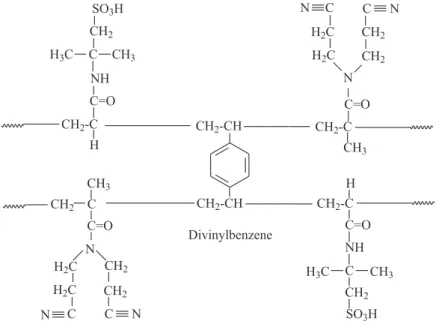
obtained. The conversion of monomer to polymer resin was gravimetrically determined (yield: 80%). The structure of the chelating resin is shown in Figure 2.
Characterization of chelating resin
Characterization of poly(DPMAAm-co
-DVB-co-AMPS) resin was carried out as described below.
Elemental analysis
The elemental analysis results of the
poly(DPMAAm-co-DVB-co-AMPS) resin are as follows: found (%): C, Figure 1. Synthesis of N,N’-dipropionitrile methacrylamide monomer.
stretching due to the methylene and methyl groups are observed at 2980 and 2860 cm-1, respectively. In the FTIR
spectrum of resin, a small band at 2245 cm-1 for the C≡N
group is clearly seen. The absorption at 1651 cm-1 can be
assigned for a complex stretching vibrations of N−C=O. The ring breathing vibrations of the aromatic nuclei are observed at 1600, 1538 and 1480 cm-1. The broad band
at 1446 cm-1 is due to the C−N scissoring vibration of
the –N−C=O group. The asymmetrical and symmetrical bending vibrations of methyl groups are seen at 1380 and 1365 cm-1, respectively. A strong band at 1034 cm-1 is
attributed to ν
SO. The C−H and C=C out of plane bending
vibrations of the aromatic ring nuclei of DVB are observed at 799 and 623 cm-1, respectively.
Morphology of polymer
Scanning electron microscopy (SEM) image of
poly(DPMAAm-co-DVB-co-AMPS) resin is given in
Figure 3. The resin has the morphology with standard cauliflower structure. SEM micrograph of resin reveals big droplets whereas it is cauliflower-like structure in pristine polymers. Microscopic observation suggests that the resin was immersed in a partially haematic exudate. SEM revealed an existence of organized fibrin clot, matrix which is usually evident AMPS and DPMAAm unit after implant. Platelet adhesion and aggregation involved the whole gel surface.
dehydration of partially degradated of amide groups. The initial degradation temperature and 73% weight loss of resin were found to be 215 and 700 oC, respectively. Thermal
degradation of resin was formed by three steps. The weight loss of the first step was found to be 30% between 215-350 oC. The weight loss of the second step was found
to be 34% between 350-480 oC. The weight loss of the third
step was found to be 9% between 480-700 oC.
Recommended procedure
An aliquot of 25 mL of solution containing 40 µg Cr(III) was used for the optimization of column separation and preconcentration. The pH of the solution was adjusted to the desired value (pH 2). The column was preconditioned by passing pH 2 solution and the resulting solution was passed through the column at a flow rate of 6 mL min-1.
The retained Cr(III) was eluted with 10 mL of 1.5 mol L-1
HCl. The chromium in the eluate was determined by FAAS.
Determination of total chromium
Total chromium was determined as Cr(III) by the method described above after reducing Cr(VI) to Cr(III). The reduction of Cr(VI) to Cr(III) was performed by the procedure in the literature.4,25 2 mL of 2 mol L-1 HCl and
then 1 mL of 5% (m/v) hydroxylamine hydrochloride were added to 80 mL of sample solution containing 40 µg Cr(III) and 40 µg Cr(VI), respectively. The solution was left at room temperature for 45 min. After the reduction of
Figure 4. TGA-DTA curves of poly(DPMAAm-co-DVB-co-AMPS) resin.
Cr(VI) to Cr(III), the pH was adjusted to 2 and the volume of the solution made up to 100 mL with distilled-deionized water. The preconcentration procedure was applied and total chromium was determined by FAAS. The concentration of Cr(VI) was calculated by subtracting the concentration of Cr(III) from total chromium concentration.
Sample preparation
The tap water from our research laboratory, river water from Yeşilırmak River (Amasya, Turkey), well water from Kayseri city (Turkey) and two waste water samples from plating plants in Kayseri Organized Industrial Region (Turkey) were collected in pre-washed polyethylene bottles. The samples (except for tap water) were filtered through a Millipore cellulose membrane filter with 0.45 µm of pore size. The pH of the water samples was adjusted to pH 2 by using diluted HCl and diluted NaOH solutions and the developed method was applied.
The food samples (apple, parsley, wheat, marrow and quince) were purchased from a local market in Kayseri city, washed thoroughly with tap water followed by distilled water and dried at 100 oC. 0.20 g of the rice flour
(SRM 1568a) and 0.50 g of the food samples were placed in a 100 mL beaker, and 10 mL of concentrated HNO3 was added
to the beaker. The mixture was evaporated near to dryness on a hot plate at about 130 oC. After cooling to room temperature,
3 mL of concentrated hydrogen peroxide were added. The mixture was again evaporated to dryness. The resulting solution was diluted to 25 mL with distilled-deionized water and the described method was applied.
Results and Discussion
Effect of pH
The pH plays an important role on the metal complex formation and subsequent extraction. The effect of pH on the solid phase extraction efficiency of Cr(III) and Cr(VI) was investigated separately. The pH of model solutions containing one of the chromium species (40 µg Cr(III) or 40 µg Cr(VI)) was adjusted in the range of 1-8 and passed through the column. The retained ions were eluted by 10 mL of 2 mol L−1 HNO
3 and determined by FAAS. The results
are shown in Figure 5. It can be seen that the extraction was quantitative (recovery ≥ 95%) for Cr(III) in the pH range of 1.0-3.0 and the recovery of Cr(VI) was negligible in this pH range. In this case, it is possible to separate Cr(III) from Cr(VI) by checking the pH of the solution. pH 2 was selected for subsequent works. The recovery for Cr(VI) at this pH was 8%. The adsorption efficiency for Cr(III) at the
higher pH values was gradually decreased due to increase in the precipitation of Cr(III) ions in the form of hydroxyl complexes. Similar curve for Cr(III) and Cr(VI) was also found in our previous work.4
Effect of concentrations of eluting reagents
The elution of Cr(III) from chelating resin by HNO3 and HCl at different concentrations (0.5-2 mol L-1)
was investigated. The recovery values for Cr(III) were found to be quantitative for 10 mL of 1.5 mol L−1 HCl,
10 mL of 2.0 mol L-1 HCl and 10 mL of 2.0 mol L-1 HNO 3
eluents. 10 mL of 1.5 mol L−1 HCl were chosen as eluent
in subsequent studies due to the low acid concentration. In addition, the elution of Cr(III) ions with HCl is an advantage that, chloride ion is an acceptable matrix for the AAS techniques.17
Effect of sample flow rate
The sample flow rate should be optimized to ensure quantitative retention along with minimization of the time required for sample processing.26 For this purpose, the
adsorption of Cr(III) ions was investigated at different flow rates (4-14 mL min-1) under the optimum conditions.
It was found that the retention of Cr(III) was quantitative up to 8 mL min-1 flow rate. Above this value, it decreased
gradually due to the insufficient contact time of the sample solution with the resin. For this reason, 6 mL min-1 was
chosen as the optimum flow rate.
Effect of sample volume
In order to explore the possibility of enriching low concentrations of analytes from large volume of solution, the effect of sample volume on the retention of metal ions
Figure 5. Recoveries of Cr(III) and Cr(VI) on chelating resin as a function of pH (40 µg Cr(III) and 40 µg Cr(VI), eluent: 10 mL of 2 mol L−1 HNO
Effect of coexisting ions
The effect of various metal ions found in water and solid samples on the determination of Cr(III) was studied. For this purpose, interferent ions Na(I), K(I), Ca(II), Mg(II), Fe(III), Pb(II), Al(III), Cu(II), Ni(II), Mn(II), Co(II), Zn(II), Cd(II), Cl−, PO
43−, SO42− and NO3− having
different concentrations were added individually to the model solutions containing 40 µg of Cr(III) and the general procedure was applied. It can be seen that the presence of major cations and anions, 1500 mg L-1
Na(I) and K(I), 100 mg L-1 Ca(II) and Mg(II), 1000 mg L-1
Cl−, 250 mg L-1 SO
42−, NO3− and PO43−,10 mg L-1 Al(III),
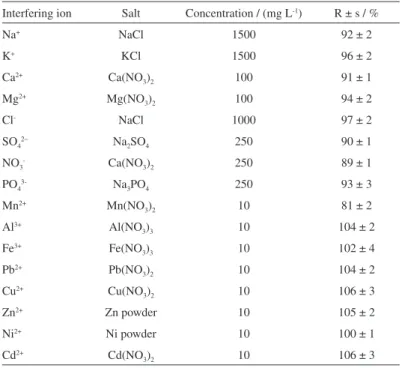
Fe(III), Pb(II), Cu(II), Zn(II), Ni(II), and Cd(II) did not show a significant influence on the determination of Cr(III), except for 10 mg L-1 Mn(II). The results show that
the chelating resin has a good selectivity for Cr(III) and is suitable for the analysis of various samples.
Sorption capacity of the resin
The adsorption isotherm of the resin for Cr(III) was studied by the column method. The adsorption at the solid-liquid interface is commonly described by Langmuir isotherm which is based on the equation given below:
(1)
where C (mg L-1) is the concentration of Cr(III) in solution
at equilibrium and n (mg g-1) is theamount of adsorbed
Cr(III) per g of resin at equilibrium (mg g-1). n
m is the maximum adsorption in monolayered adsorption systems (mg g-1) and K is the adsorption equilibrium constant related
to adsorption energy (L mg-1). A plot of C/n vs. C shows
a linear relationship, and Langmuir constants nm and K
can be calculated from the slope and intercept of the plot, respectively.20 Aliquots of 25 mL of the model solutions
containing 10-950 mg L-1Cr(III) were passed through the
column containing 0.90 g of chelating resin. Adsorption capacity of resin for Cr(III) and adsorption equilibrium
the standard deviation of the blank solutions divided by the slope of the calibration curve was found to be 1.11 µg L-1.
In the calculation of LOD, a 150 fold preconcentration factor was taken into consideration.27
Accuracy and applications of the method
The accuracy of the method was verified by the recovery studies in water and food samples and by analyzing certified reference materials (TMDA-70 and SRM 1568a). Different concentrations of Cr(III) and Cr(VI) were spiked to aliquots of 100 mL of distilled water and tap water, of 250 mL of river water and well water and of 25 mL of waste water samples. The results are given in Table 1. A good agreement was achieved between the added and found concentrations of chromium species. The recovery values for both chromium species changed from 90 to 104%. The concentration of Cr(III) in river water sample was found to be 22.9 ± 2.0 µg L-1. Cr(III), Cr(VI) and total chromium
concentrations in waste water were found to be 3.97 ± 0.21, 9.43 ± 0.37 and 13.4 ± 0.3 mg L-1, respectively. The analysis
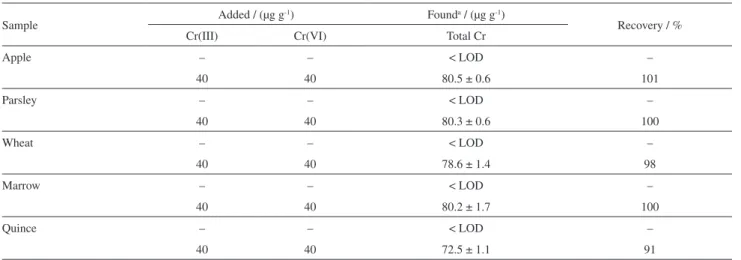
results for chromium in various food samples are shown in Table 2. The recovery values found for total chromium were satisfactorily (91-101%). In order to estimate the accuracy of the method, the total chromium in certified reference materials (TMDA-70 and SRM 1568a) was also determined. The found results are in a good agreement with the certified and/or spiked total chromium values (Table 3).
Comparison of the method with the other solid phase extraction methods
Table 1. Speciation of chromium in various water samples (sample volume: 100 and 250 mL, final solution: 10 mL)
Sample Added for final solution / (mg L
-1) Founda / (mg L-1)
Totala / (mg L-1) Recovery / %
Cr(III) Cr(VI) Cr(III) Cr(VI)b Cr(III) Cr(VI) Total
Distilled water 4.0 – 3.99 ± 0.07 – – 100
3.0 1.0 2.98 ± 0.01 1.03 ± 0.01 4.01 ± 0.01 99 103 100
1.0 3.0 1.07 ± 0.08 2.91 ± 0.08 3.98 ± 0.03 107 97 100
2.0 2.0 2.04 ± 0.17 1.92 ± 0.18 3.96 ± 0.06 102 96 99
– 4.0 – 3.92 ± 0.18 – 98
Tap water – – < LOD < LOD < LOD
1.0 2.0 0.99 ± 0.10 2.07 ± 0.15 3.07 ± 0.11 99 104 102
2.0 1.0 2.04 ± 0.15 0.98 ± 0.17 3.02 ± 0.09 102 98 101
River water – – 0.57 ± 0.05 < LOD 0.57 ± 0.05
2.0 2.0 2.50 ± 0.12 2.07 ± 0.24 4.57 ± 0.21 97 104 100
Well water – – < LOD < LOD < LOD
2.0 2.0 2.02 ± 0.17 1.81 ± 0.34 3.83 ± 0.30 101 90 96
Wastewaterc – – < LOD < LOD < LOD
2.0 2.0 1.95 ± 0.08 2.09 ± 0.12 4.04 ± 0.09 98 105 101
2.0 4.0 2.01 ± 0.06 4.00 ± 0.06 6.01 ± 0.02 100 100 100
Wastewaterd – – 0.79 ± 0.04 1.89 ± 0.07 2.68 ± 0.06
2.0 – 2.76 ± 0.03 – – 99
– 2.0 – – 4.72 ± 0.02 102
4.0 – 4.74 ± 0.05 – – 99
– 4.0 – – 6.65 ± 0.06 100
2.0 4.0 2.76 ± 0.03 6.07 ± 0.04 8.83 ± 0.02 99 105 103
aMean value ± standard deviation, n = 3. bCalculated value. cFrom the copper plating plant, contains 2500 mg L-1 Cu. dFrom the chromium plating plant. It was 25 fold diluted.
Table 3. Determination of total chromium in certified reference materials by described method (sample volume: 50 mL)
TMDA-70 fortified lake water
Recovery / % SRM 1568a rice flour Recovery / % Certifieda / (µg L-1) Foundb / (µg L-1) Addedc / (mg L-1) Foundb / (mg L-1)
Total Cr 389 ± 2.3 386 ± 7 99 4.0 3.9 ± 0.1 98
aAt 95% confidence level. bMean value ± standard deviation, n = 3. cNot certified; 2.0 mg L-1 Cr(III) and 2.0 mg L-1 Cr(VI) were added to the SRM solution. Table 2. Determination of chromium in various food samples (sampleamount: 0.5 g)
Sample Added / (µg g
-1) Founda / (µg g-1)
Recovery / %
Cr(III) Cr(VI) Total Cr
Apple – – < LOD –
40 40 80.5 ± 0.6 101
Parsley – – < LOD –
40 40 80.3 ± 0.6 100
Wheat – – < LOD –
40 40 78.6 ± 1.4 98
Marrow – – < LOD –
40 40 80.2 ± 1.7 100
Quince – – < LOD –
40 40 72.5 ± 1.1 91
to the other adsorbent, the reusability of the chelating resin is perfect.
Conclusions
In this work, a new chelating resin was synthesized and characterized. A new solid phase extraction method for the determination of Cr(III) by chelating resin was developed. The method was successfully applied to the separation, preconcentration and speciation of chromium in various water and food samples. Cr(III) is quantitatively recovered in the acidic pH range (pH 1-3). The method has high flow rate (6 mL min-1), low eluting acid concentration (1.5 mol L-1
HCl) and low limit of detection (1.11 µg L-1). The precision,
accuracy and selectivity of the method are satisfactory. The recovery values for chromium species and total chromium changed in the range of 90-107%. The synthesized resin is highly stable and the recovery value of the Cr(III) after 200 cycles of adsorption and desorption was still quantitative.
Supplementary Information
Supplementary information is available free of charge at http://jbcs.sbq.org.br as PDF file.
Acknowledgments
The authors are grateful to the Unit of the Scientific Research Project of Erciyes University (Project No. FBY-11-3787) for their financial support.
References
1. Kotaś, J.; Stasicka Z.; Environ. Pollut. 2000, 107, 263.
2. Matos, G. D.; dos Reis E. B.; Costa, A. C. S.; Ferreira, S. L. C.;
Microchem. J.2009, 92, 135.
3. Béni, À.; Karosi, R.; Posta, J.; Microchem. J.2007, 85, 103. 4. Tokalıoğlu, Ş.; Arsav, S.; Delibaş, A.; Soykan, C.; Anal. Chim.
Acta2009, 645, 36.
5. Yalçın, S.; Apak, R.; Anal. Chim. Acta2004, 505, 25.
6. Kiran, K.; Kumar, K. S.; Prasad, B.; Suvardhan, K.; Lekkala, R. B.; Janardhanam, K.; J. Hazard. Mater.2008, 150, 582.
7. Aydın, F. A.; Soylak, M.; J. Hazard. Mater. 2009, 162, 1228.
8. Krishna, P. G.; Gladis, J. M.; Rambabu, U.; Rao, T. P.; Naidu, G. R. K.; Talanta 2004, 63, 541.
9. Kartal, Ş.; Tokalıoğlu, Ş.; Özkan, B.; Bull. Korean Chem. Soc.
2006, 27, 694.
10. Ball, J. W.; Bassett, R. L.; Chem. Geol. 2000, 168, 123. 11. Byrdy, F. A.; Olson, L. K.; Vela, N. P.; Caruso, J. A.;
J. Chromatogr., A 1995, 712, 311.
12. Zhu, X.; Hu, B.; Jiang, Z.; Li, M.; Water Res.2005, 39, 589.
13. Matos, G. D.; dos Reis, E. B.; Costa, A. C. S.; Ferreira, S. L. C.;
Microchem. J.2009, 92, 135.
14. Meeravali, N. N.; Jiang, S.-J.; Talanta2009,80, 173. 15. Pramanik, S.; Dey, S.; Chattopadhyay, P.; Anal. Chim. Acta
2007, 584, 469.
16. Liang, P.; Shi, T.; Lu, H.; Jiang, Z.; Hu, B.; Spectrochim. Acta, Part B2003, 58, 1709.
17. Hassanien, M. M.; Kenawy, I. M.; El-Menshawy, A. M.; El-Asmy, A. A.; J. Hazard. Mater.2008, 158, 170.
sepiolite / FAAS
Diphenylcarbazide / Amberlite XAD-4 resin / Spectrophotometry
27 0.85 6 3.8 7 tap, well and waste water 31
Nanometer TiO2 / ICP-AES 50 7.6 0.32 2.4 tap and lake water 32
Melamine based polymeric sequestering succinic acid resin / FAAS
4 3.8 4.2 2-3 20 waste water 33
Acetylacetone modified Amberlite XAD-16 / FAAS
100 15 0.02 2 8 industrial waste water samples 34
Poly(DPMAAm-co-DVB-co-AMPS) / FAAS 150 12.1 1.11 2 200 tap, river, well, waste water and various
food samples
this work
18. Duran, C.; Ozdes, D.; Gundogdu, A.; Imamoğlu, M.; Senturk, H. B.; Anal. Chim. Acta2011, 688, 75.
19. Fan, J.; Wu, C.; Xu, H.; Wang, J.; Peng, C.; Talanta2008, 74, 1020.
20. Pourreza, N.; Zolgharnein, J.; Kiasat, A. R.; Dastyar, T.; Talanta
2010, 81, 773.
21. Pramanik, S.; Dhara, S.; Bhattacharyya, S. S.; Chattopadhyay, P.;
Anal. Chim. Acta2006, 556, 430.
22. Bağ, H.; Türker, A. R.; Coşkun, R.; Saçak, M.; Yiğitoğlu, M.;
Spectrochim. Acta, Part B2000, 55, 1101.
23. Chen, C.-Y.; Chiang, C.-L.; Chen, C.-R.; Sep. Purif. Technol.
2007, 54, 396.
24. Kavaklı, P. A.; Uzun, C.; Güven, O.; React. Funct. Polym. 2004,
61, 245.
25. Filik, H.; Microchim. Acta2002, 140, 205.
26. Zhang, N.; Suleiman, J. S.; He, M.; Hu, B.; Talanta2008, 75,
536.
27. Sahayam, A. C.; Anal. Bioanal. Chem. 2002, 372, 840. 28. Krishna, M. V. B.; Chandrasekaran, K.; Rao, S. V.;
Karunasagar, D.; Arunachalam, J.; Talanta 2005, 65, 135. 29. Monasterio, R. P.; Altamirano, J. C.; Martinez, L. D.; Wuilloud,
R. G.; Talanta2009, 77, 1290.
30. Bağ, H.; Türker, A. R.; Lale, M.; Tunçeli, A.; Talanta2000, 51,
895.
31. Rajesh, N.; Jalan, R. K.; Hotwany, P.; J. Hazard. Mater.2008,
150, 723.
32. Liang, P.; Shi, T.; Lu, H.; Jiang Z.; Hu, B.; Spectrochim. Acta, Part B2003, 58, 1709.
33. Doğutan, M.; Filik, H.; Tor, İ.; Talanta2003, 59, 1053.
34. Memon, J. R.; Memon, S. Q.; Bhanger, M. I.; Khuhawar, M. Y.;
J. Hazard. Mater.2009, 163, 511.
Submitted: January 7, 2013
*e-mail: [email protected]
Department of Chemistry, Faculty of Arts and Sciences, Uşak University, TR-64200 Uşak, Turkey
Table S1. Effect of coexisting ions on the recoveries of Cr(III)
Interfering ion Salt Concentration / (mg L-1) R ± s / %
Na+ NaCl 1500 92 ± 2
K+ KCl 1500 96 ± 2
Ca2+ Ca(NO
3)2 100 91 ± 1
Mg2+ Mg(NO
3)2 100 94 ± 2
Cl- NaCl 1000 97 ± 2
SO42− Na2SO4 250 90 ± 1
NO3- Ca(NO3)2 250 89 ± 1
PO43- Na
3PO4 250 93 ± 3
Mn2+ Mn(NO
3)2 10 81 ± 2
Al3+ Al(NO
3)3 10 104 ± 2
Fe3+ Fe(NO
3)3 10 102 ± 4
Pb2+ Pb(NO
3)2 10 104 ± 2
Cu2+ Cu(NO
3)2 10 106 ± 3
Zn2+ Zn powder 10 105 ± 2
Ni2+ Ni powder 10 100 ± 1
Cd2+ Cd(NO
3)2 10 106 ± 3