enveloped viruses for clinical applications
Innovative tools for rational process optimization
Tiago Manuel Ferreira da Silva Vicente
Supervisors:
Manuel J. T. Carrondo and Paula M. Alves
Dissertation presented to obtain a Ph.D. degree in Engineering and Technology Sciences, Biotechnology at the Instituto de Tecnologia Química e Biológica,
Universidade Nova de Lisboa
Downstream processing development of enveloped viruses for clinical applications
by Tiago Vicente
First edition, September 2010 Copyright number:
Cover:
Baculovirus particle schematic (an enveloped virus) (Product); surface plasmon resonance
adsorption (Measurement); selectivity prediction based on electrostatics (Modeling);
scan-ning electron microscopy (SEM) picture of porous versus bead matrices (Optimization).
Artwork by the author except SEM micrograph obtained from www.sartorius-stedim.com.
ITQB-UNL/IBET, Animal Cell Technology Unit Instituto de Tecnologia Química e Biológica, Universidade Nova de Lisboa
Apartado 12, 2781-901 Oeiras, Portugal Phone: +351 214469362; Fax: +351 214421161 http://www.itqb.unl.pt
Foreword ix
Acknowledgements xi
Jury xiii
Thesis publications xv
Summary xvii
1 Introduction 1
I
Stepping into complexity: downstream processing of a VLP 29
2 Anion-exchange membrane chromatography for purification of
rotavirus-like particles 31
II
Rational design and development of downstream
process-ing for baculoviruses: a challengprocess-ing enveloped virus model
65
3 Purification of an enveloped viral vector for clinical applications using
membrane processes 67
4 Establishing a novel scaled-down chromatographic tool based on sur-face plasmon resonance for binding and elution analysis 93
5 Analysis of adsorption of a baculovirus bioreaction bulk on an
6 Modeling electrostatic interactions of baculovirus vectors for ion-exchange
process development 157
7 Impact of ligand density on the optimization of ion-exchange
mem-brane chromatography for viral vector purification 187
III
Overview
215
Foreword ix
Acknowledgements xi
Jury xiii
Thesis publications xv
Summary xvii
1 Introduction 1
1.1 Introduction . . . 4
1.2 Current choices in DSP of complex biopharmaceuticals . . . 5
1.2.1 Clarification . . . 7
1.2.2 Concentration/purification . . . 9
1.2.3 Polishing . . . 11
1.3 In pursuit of an ideal DSP platform . . . 12
1.3.1 Classicalversus rational process development . . . 13
1.3.2 The special case of adsorptive chromatography . . . 15
1.4 Outlook . . . 20
1.5 Scope of the thesis . . . 21
I
Stepping into complexity: downstream processing of a VLP 29
2 Anion-exchange membrane chromatography for purification of
rotavirus-like particles 31
2.1 Introduction . . . 34
2.2 Materials and methods . . . 37
2.2.1 RLP production . . . 37
2.2.2 RLP standard purification protocol . . . 38
2.2.3 Analyticals . . . 39
2.2.4 Anion-exchange membrane adsorber studies . . . 40
2.2.5 Modeling and theoretical considerations . . . 41
2.2.6 Revisiting downstream purification of RLPs . . . 45
2.2.7 Viral spiking study . . . 46
2.3 Results and discussion . . . 46
2.3.1 Identification of a potential capture/concentration step . . . 46
2.3.2 Evaluation of Sartobind D with purified RLPs . . . 48
2.3.3 Spiking studies . . . 50
2.3.4 Modeling of anion-exchange process . . . 51
2.3.5 Scaled-up integration of the anion-exchange membrane chromatog-raphy . . . 54
2.4 Conclusions . . . 59
References . . . 62
II
Rational design and development of downstream
process-ing for baculoviruses: a challengprocess-ing enveloped virus model
65
3 Purification of an enveloped viral vector for clinical applications using membrane processes 67 3.1 Introduction . . . 703.2 Materials and methods . . . 72
3.2.1 Recombinant baculovirus stock propagation . . . 72
3.2.2 Production of rBV stocks . . . 72
3.2.3 Downstream processing . . . 73
3.2.4 Analyticals . . . 75
3.3 Results and discussion . . . 78
3.3.1 Clarification and concentration . . . 78
3.3.2 Capture . . . 81
3.4 Concluding remarks . . . 88
face plasmon resonance for binding and elution analysis 93
4.1 Introduction . . . 96
4.2 Materials and methods . . . 98
4.2.1 Sensor surface preparation . . . 98
4.2.2 SPR experiments . . . 99
4.3 Supporting theory for SPR data analysis . . . 100
4.4 . . . 104
4.5 Results and discussion . . . 107
4.5.1 Calibration of Biacore signal . . . 107
4.5.2 Analysis of BSA sensorgrams . . . 109
4.6 Conclusions . . . 119
4.7 Appendix: Influence of mass transport on measured binding rate constants 120 References . . . 121
5 Analysis of adsorption of a baculovirus bioreaction bulk on an ion-exchange surface by surface plasmon resonance 125 5.1 Introduction . . . 128
5.2 Materials and methods . . . 130
5.2.1 Cell culture and baculovirus production . . . 130
5.2.2 Purification of baculoviruses and isolation of product-derived impu-rities . . . 131
5.2.3 Process derived-impurities . . . 132
5.2.4 Sensor surface preparation . . . 132
5.2.5 SPR experiments . . . 133
5.3 SPR data analysis . . . 134
5.4 Adsorption/desorption rate model . . . 136
5.5 Results and discussion . . . 139
5.5.1 Calibration of Biacore signal . . . 139
5.5.2 Applicability of sorption model to a complex biological system . . . 140
5.5.3 Prediction of total adsorption capacities . . . 147
5.6 Conclusions . . . 150
5.7 Appendix: Analytical solution of the kinetic model and SPR response in the absence of mass-transport limitations . . . 151
References . . . 154
6.1.1 Model of the virus particle and derived impurities . . . 162
6.1.2 Interaction energy between the model rBV particle and a flat plate . 163 6.1.3 Relationship between interaction energy and chromatographic reten-tion . . . 168
6.1.4 EDL potential . . . 169
6.2 Materials and methods . . . 172
6.2.1 Cell culture, rBV stock propagation and production . . . 172
6.2.2 Purification of rBVi, rBVe.c., rBVgp64− and rBVenv− . . . 173
6.2.3 Dynamic light scattering analysis . . . 174
6.2.4 Modeling calculations . . . 175
6.3 Results and discussion . . . 175
6.3.1 EDL potential . . . 175
6.3.2 Interaction energy . . . 178
6.4 Concluding remarks . . . 182
References . . . 183
7 Impact of ligand density on the optimization of ion-exchange mem-brane chromatography for viral vector purification 187 7.1 Introduction . . . 190
7.2 Materials and methods . . . 193
7.2.1 Cell culture and recombinant virus production . . . 193
7.2.2 Purification of standard baculovirus stocks . . . 194
7.2.3 Main process-derived impurities . . . 194
7.2.4 Dynamic light scattering analysis . . . 194
7.2.5 Surface plasmon resonance . . . 195
7.2.6 Anion-exchange membrane chromatography . . . 198
7.2.7 Analyticals . . . 202
7.3 Results and discussion . . . 202
7.3.1 Impact of ligand density on the adsorption capacity of DEAE-modified surfaces . . . 202
7.3.2 AEXmc experiments with Sartobind D membrane prototypes . . . . 204
7.4 Conclusions . . . 210
References . . . 211
III
Overview
215
8 Discussion and conclusions 217 8.1 Discussion . . . 2198.1.1 Improved tools for process design . . . 219
This thesis represents four years of research undertaken at the Animal Cell Technology Unit of theInstituto de Tecnologia Química e Biológica from theUniversidade Nova de Lisboa/ Instituto de Biologia Experimental e Tecnológica under the supervision of Dr. Paula Alves and Professor Manuel Carrondo.
The work presented in this dissertation intended to create fundamental knowledge in the downstream processing of complex biopharmaceuticals, in particular, of enveloped viral vectors that constitute a relevant system for application in gene therapy and vaccination. The use of rational, sound analytical tools combined with state-of-the-art unit operation principles contributed to build a more solid and cost-effective strategy for the development of the current purification processes for these complex biologicals.
Tiago Vicente
I would like to express my sincere gratitude to the people that contributed in any way to this thesis; without them I would not be able to write this document.
To Prof. Manuel Carrondo, my co-supervisor, for the rigor, the guidance and the con-fidence from the very first day, for allowing me the freedom and opportunities to evolve in this very exciting area. I remember when we first met and you and Paula launched me to the DSP: it was a damned good shot; thank you so much!
To Dr. Paula Alves, my co-supervisor, for being the boss she is at the helm of the ACTU, for the peculiar and sharp view of science and technology, for letting and pushing me to do my very best.
To Dr. Cristina Peixoto, my mentor and “sister in arms” at the downstream processing lab of the ACTU, for the everlasting support, for the illuminating discussions, for sharing with me her deepest experience. I owe you a lot and this thesis as well.
To Dr. Paulo Mota, my other mentor, for conveying me his enthusiasm and encourage-ment and the bright ways of translating what one sees from an experiencourage-ment into a sensible mathematical description and the proper means to explain it.
To David Tomaz and Rimenys Carvalho, for allowing me to learn how to teach what I know best, for technical support during their internships at the ACTU. To Nita Clemente, for her highly skilled and accurate analytical support: this work belongs to you also, wherever you are. To Ana Alves for analytical support during the baculovirus work.
To Dr. Pedro Cruz, for very enlightening and relieving discussions, opening new per-spectives to solve the omnipresent issues of complex biological systems. And, of course, for the great laughs!
To the Baculogenes guys at IBET, Dr. Vicente Bernal, Nuno Carinhas and Dr. António Roldão for the fruitful discussions, companionship and all the fun.
To Dr. Uwe Gottschalk and Sartorius Stedim Biotech, for providing very promptly materials, support and advice, for the opportunities to join the stimulating Downstream Technology Forums at Sartorius College in Göttingen. To Dr. René Fáber, for providing the membrane prototypes and sharing his best knowledge in the development of new materials for purification of biologicals.
To Dr. John Auni¸nš, for the advice and criticisms since the very early days and during his visits at the ACTU. To Dr. John Konz, for the criticisms and very insightful suggestions during the VLP work.
To Dr. Teresa Rodrigues and Dr. Marlene Carmo, for their friendly and prompt support and for introducing me to the nightmare of working with enveloped viruses—their retros— even though I eventually went on working with baculos.
To Dr. António Lopes, for the support in DLS and electrokinetic fundamentals. To Dr. Gonçalo Costa and Dr. Ana Barbas, for the support and advice with our Biacore and SPR.
To Carmen Valle and Cristina Alvarez from GE Healthcare for the support on materials, equipment and opportunities to attend their seminars.
To Marcos Sousa, for the expertise and support at the upstream processing. To Ana Rodrigues, for the support on the cholesterol assays for envelope content determination.
A Cláudia, Rita, Sofia e Liliana, pela amizade especial que criámos nestes anos, por estarem sempre lá quando precisava, pelas gargalhadas, as cervejas ou caipirinhas... Muito obrigado!
A todos os actuais e anteriores membros da UTCA, em especial Helena, Paulo, Fran-cisca, Guida, Carina Silva, Ana Teixeira, Ana Sofia, Gonçalo, pela boa disposição, compa-nheirismo e excelente ambiente de trabalho.
A meus amigos de mais longa data, em especial JP, Rui, Carolina, Filipa, André, Rita, Andreia pelo apoio e amizade.
A meus pais: é por vossa “culpa” que cheguei até aqui; obrigado pelo vosso interminável e incondicional apoio e carinho! A meu irmão pelo fio condutor que me incutiu desde muito, muito cedo. A minha família próxima e a minha avó Júlia por tratar sempre de mim.
A Ivette, especialmente nesta última etapa da tese, por aquele apoio muito especial que faz com que tudo faça realmente mais sentido na vida.
To the funding from the European Commission (Baculogenes, LSHB-2006-037541 and Clinigene – Network of Excellence, LSHB-2006-018933) and the PortugueseFundação para a Ciência e a Tecnologia (PTDC/EQU-EQU/71645/2006 and SFRH/BD/31257/2006),
Dr. Uwe Gottschalk, Group Vice President Purification Technologies at Sartorius Stedim Biotech, Göttingen, Germany.
Dr. John G. Auni¸nš, Executive Scientific Director at Merck Research Labs, West Point PA, USA and Visiting Professor at ITQB-UNL, Oeiras, Portugal.
Prof. Alírio E. Rodrigues, Professor of Chemical Engineering at the Faculdade de En-genharia da Universidade do Porto, Porto, Portugal.
Dr. José P. B. Mota, Associate Professor at the Faculdade de Ciências e Tecnologia da Universidade Nova de Lisboa, Caparica, Portugal.
Dr. Cristina C. Peixoto, Investigator at the Animal Cell Technology Unit, ITQB-UNL/IBET, Oeiras, Portugal.
Dr. Paula M. Alves, Principal Investigator at the Animal Cell Technology Unit, ITQB-UNL/IBET, Oeiras, Portugal.
Prof. Manuel J. T. Carrondo, Professor of Chemical and Biochemical Engineering at the
Faculdade de Ciências e Tecnologia da Universidade Nova de Lisboa, Caparica, Portugal
1. Vicente T, Sousa MQ, Peixoto C, Mota JPB, Alves PM, Carrondo MJT. Anion
ex-change membrane chromatography for purification of rotavirus-like particles. Journal of Membrane Science 2008; 311:270–283.
2. Vicente T, Peixoto C, Carrondo MJT, Alves PM. Virus production for clinical gene
therapy. Methods in Molecular Biology 2009; 542:447–470.
3. Vicente T and Peixoto C, Carrondo MJT, Alves PM. Purification of recombi-nant baculoviruses for gene therapy using membrane processes. Gene Therapy 2009;
16:766–775.
4. Vicente T, Mota JPB, Peixoto C, Alves PM, Carrondo MJT. Modeling protein bind-ing and elution over a chromatographic surface probed by surface plasmon resonance.
Journal of Chromatography A2010; 1217:2032–2041.
5. Vicente T, Peixoto C, Alves PM, Carrondo MJT. Modeling electrostatic interactions of baculovirus vectors for ion-exchange process development. Journal of Chromatog-raphy A2010; 1217:3754–3764.
6. Vicente T, Mota JPB, Peixoto C, Alves PM, Carrondo MJT. Analysis of adsorption
of a baculovirus bioreaction bulk on an ion-exchange surface by surface plasmon resonance. Journal of Biotechnology 2010; 148:171–181.
7. Vicente T, Mota JPB, Peixoto C, Alves PM, Carrondo MJT. Rational design and
optimization of downstream processes of viral particles for biopharmaceutical appli-cations: current advances. Biotechnology Advances; submitted.
8. Vicente T, Fáber R, Alves PM, Carrondo MJT, Mota JPB. Impact of ligand den-sity on the optimization of ion-exchange membrane chromatography for viral vector purification. In final preparation (see Chapter 7).
Additional publication
Viral vectors and virus-like particles hold a tremendous potential in various clinical appli-cations in the areas of gene therapy and/or vaccination, drawing the attention of biotech-nology and pharmaceutical companies. The majority of these products are manufactured in animal cell cultures, inherently making the process costly. A great deal of effort is taking place to generate optimized biological and engineering strategies to find scalable and cost-effective processes, easily transferable to cGMP facilities. However, the imple-mentation of robust downstream processes generating this type of biopharmaceuticals in the amounts required for pre-clinical and clinical trials is still lacking and lagging. By in-cluding a labile lipid membrane layer harboring glycoproteins (often critical for infection) over the viral capsid, enveloped viruses bring extra challenges in terms of their bioprocess-ing particularly downstream. The work developed durbioprocess-ing this thesis aimed at improvbioprocess-ing the state-of-the-art purification processes for these types of viral particles. The rationale was to integrate process understanding with product characterization, still scarce in such biological systems.
An introduction inChapter 1reviews the current advances in the development of the purification processes for these types of complex biopharmaceuticals. A focus is given to the development of rational approaches in detriment of an empirical-based process devel-opment. As starting points, the better known principles and solutions provided by more mature systems as mAbs and recombinant proteins were utilized.
The first part of this thesis, Part I, deals with a somewhat simpler system – a virus-like particle from Rotavirus (RLP).Chapter 2 describes on the integration of an
anion-exchange chromatographic step into the DSP of this RLP vaccine candidate. Ion-anion-exchange chromatography is a separation process of choice, if not the most used, for the recov-ery/purification of biologicals. The objective of this study was to gain preliminary theo-retical and predictive knowledge on this chromatographic process when employed for such a VLP. Membrane chromatography has been studied for the adsorption of these RLPs. Screening studies provided evidence on the sensitive effect of the ionic strength and the pH of the equilibration buffer on final product recovery. We could implement a steric mass action (SMA) model for the prediction of the elution profile of purified RLP pulses and confirm that these VLPs can be purified to clinical grade at almost 50% global recovery yield, with close to 100% removal of host bulk DNA and 98% of host cell protein using the proposed DSP.
virus model. InChapter 3, a scalable, cost-effective DSP is tested and proposed based on membrane processes. These viruses have recently been recognized as promising for human gene therapy or vaccination. A complete downstream process comprising three steps—depth filtration, ultra/diafiltration and membrane sorption—was established as a strong DSP backbone. Global recovery yields of clinical grade material reached 40% using technologies easy to scale under cGMP guidelines, constituting a major breakthrough over the yet much lower yield and non-scalable purification process based on ultracentrifugation density gradients.
Chapter 4andChapter 5report on the development of a scale-down approach based on surface plasmon resonance (SPR); an analytical “pseudo”-chromatographic tool for ana-lyzing binding and elution of the viruses over a surface mimicking the ion-exchange matrix has been developed. Chapter 4describes the necessary theory implementation and test-ing of conditions ustest-ing bovine serum albumin (BSA) as a model protein. A sorption rate model capable of quantitatively describing BSA binding and elution for protein titers from dilute to overloaded conditions and a broad range of salt concentrations was proposed.
Chapter 5 validates this tool for our baculovirus vector system. By separately
study-ing the key component cuts of the baculovirus bioreaction bulk—the product (infective baculovirus), the main product-related impurities (damaged baculovirus particles), and the main process-related impurities (host cell protein, host cell dsDNA and endotoxins)— adsorption isotherms over a broad range of equilibrium conditions were obtained.
Chapter 7works out as a proof of concept study of the developed scaled-down, funda-mental-based tools. From preliminary tests resorting to the insights gained in Chapters 5and6, a more straightforward testing of membrane prototypes for anion-exchange
chro-matography was performed. Such study allowed to draw important conclusions regarding the effect of ligand density in overall process performance in terms of recovery yields and purity. Lowering ligand density was shown to be beneficial for baculovirus particle pu-rification, decreasing host cell protein, host cell dsDNA and non-infective baculoviruses, increasing overall yields by over 20% as compared to the current process. The previously implemented SMA model provided, for this enveloped virus system, a useful predicting tool generating methodologies to help increase resolution/selectivity.
This thesis has contributed to the fields of gene therapy, vaccination and bioengineering of complex biopharmaceuticals by developing innovative analytical tools combined with
in silicomodels grounded on fundamental knowledge. This was possible due to an in-depth
A indústria farmacêutica e de biotecnologia está a focar a sua atenção numa nova classe de produtos biológicos: biofármacos complexos. Vectores virais e partículas semelhantes a vírus (VLPs) representam dois tipos destes produtos com enorme potencial para aplicações clínicas nas áreas de terapia génica e vacinação. Estes biofármacos são na sua maioria produzidos por células animais, o que torna o seu processo de produção inerentemente complexo. Há actualmente um grande esforço na tentativa de obter as melhores estratégias, tanto ao nível biológico como ao nível de engenharia de processos, capazes de encontrar soluções que permitam aumento de escala economicamente viável, facilmente transferíveis e implementáveis em instalações com boas práticas de fabrico (cGMP). No entanto, o desenvolvimento de estratégias de purificação capazes de processar este tipo de material biológico nas quantidades necessárias em testes pré-clínicos e clínicos está ainda bem aquém do que seria desejável. Os vírus com envelope representam um dos tipos de biofármacos mais complexos: incluem não apenas cápside e genoma viral mas também uma membrana lipídica glicoproteica necessária para a sua função biológica, i.e. para a manutenção da sua infecciosidade. De facto, a fragilidade destes envelopes levanta sérias preocupações no que respeita aodesign dos processos de purificação. O trabalho desenvolvido nesta dissertação
teve o objectivo de melhorar o estado actual da arte ao nível dos processos de purificação deste tipo de partículas de elevada complexidade através do desenvolvimento de estratégias inovadoras, contribuindo para o conhecimento mais fundamental. A abordagem consistiu em alcançar um novo patamar de conhecimento, actualmente ainda muito escasso, ao nível da purificação e da caracterização deste tipo de partículas biológicas.
A introdução, apresentada noCapítulo 1, revê os actuais avanços no desenvolvimento dos processos de purificação destes biofármacos complexos. Dá-se especial ênfase ao desen-volvimento de abordagens mais racionais em detrimento do desendesen-volvimento de processos apenas baseado em conhecimento empírico. Existem já algumas abordagens relevantes na literatura focadas neste tipo de biofármacos, além de ser possível ter como base o conhec-imento adquirido de outros sistemas mais bem caracterizados como é o caso de anticorpos monoclonais ou proteínas recombinantes.
O primeiro passo deste trabalho, aqui apresentado na Parte I, trata de um sistema biológico ligeiramente mais simples – uma partícula semelhante a vírus do Rotavírus (RLP) – como modelo biológico relevante. O Capítulo 2 reporta a integração de um passo
recolha/purificação de produtos biológicos. O objectivo deste estudo foi obter conhecimento teórico e predictivo preliminar neste processo cromatográfico quando implementado neste sistema. Para esse efeito, foi usada cromatografia de membranas para estudar a adsorção de RLPs. Estudos sistemáticos permitiram determinar o impacto da força iónica e pH do tampão na recolha final de produto. Foi possível implementar com sucesso um modelo estérico de acção mássica (SMA) para a predição do perfil de eluição de pulsos purificados de RLPs e confirmar que, usando este processo de purificação, este tipo de partículas semelhantes a vírus podem ser processados até elevada pureza com rendimentos globais de 46%,∼100% de remoção de DNA celular e 98% de proteína celular.
NaParte II, entramos num nível de complexidade superior usando baculovírus como modelo de vírus com envelope. No Capítulo 3, testa-se um processo de purificação es-calável e económico baseado em processos de membranas. Estes vírus foram recentemente reconhecidos como altamente promissores em terapia génica humana ou para vacinação. Foi estabelecido um processo completo de purificação baseado em três passos: filtração por filtro de profundidade, ultra/diafiltração e sorção por membranas. Os rendimentos globais de purificação de virus a elevada pureza alcançaram os 40% usando tecnologias muito simples de transferir para escalas de produção em instalações operando com boas práti-cas de fabrico. Esta estratégia integrada de purificação representa um marco importante face ao procedimento clássico baseado em gradientes de densidade por ultracentrifugação tipicamente apresentando muito menores rendimentos e não passível de aumento de escala.
OsCapítulos 4e5desenvolvem um modelo para redução de escala de ensaio baseado em espectroscopia de surface plasmon resonance (SPR). Sendo a cromatografia de troca iónica um passo crucial neste processo e susceptível de melhoramento, foi implementada uma ferramenta “pseudo”-cromatográfica usando esta metodologia analítica com o fim de analisar a adsorção e eluição dos vírus numa superfície mimetizando uma matriz cro-matográfica de troca iónica. O Capítulo 4 descreve a teoria necessária para analisar
celu-condições de equilíbrio. Não seria possível obter tal informação usando os mesmos recursos implementando os típicos ensaios de cromatografia por membranas em pequena escala.
O Capítulo 6 descreve uma estratégia semelhante à utilizada nos dois capítulos an-teriores, usando aqui a técnica de dispersão dinânima de luz (DLS) para a determinação do potencial-ζ(zeta) (uma medida do equilíbrio electrostático) dos diferentes componentes deste sistema de baculovírus. Neste sentido, as principais espécies, produto (baculovírus infeccioso) e principais impurezas relativas ao produto (baculovírus sem, respectivamente, genoma, glicoproteína, e envelope), foram isoladas e os seus potenciais-ζ foram avaliados. De acordo com os dados experimentais, adaptou-se um modelo determinístico baseado nos componentes virais críticos para a função biológica viral. Analisou-se a contribuição destes componentes virais no perfil de energia de interacção electrostática global (experimentado entre a partícula viral e uma superfície hipotética de troca iónica) permitindo distinguir as propriedades electrostáticas dos vírus infecciosos e das impurezas analisadas. Baseado nesta estratégia, conseguiu obter-se uma predição das condições operatórias óptimas para melhorar a selectividade do processo cromatográfico em questão. Tal conhecimento tem um forte impacto na desejada aplicação final dado que a qualidade/potência da preparação viral é melhorada ao reduzir significativamente a razão entre partículas virais totais e partículas virais infecciosas (TP/IP) como pretendido.
NoCapítulo 7faz-se uma prova de conceito da importância e utilidade das ferramen-tas fundamentais aqui desenvolvidas. A partir de testes preliminares usando o conheci-mento apreendido nosCapítulos 5e6foi possível realizar uma análise de protótipos de membranas cromatográficas muito mais rápida e eficiente. Este estudo permitiu tirar im-portantes conclusões acerca do efeito da densidade de ligando nos rendimentos globais do processo e performance em termos de remoção de impurezas. A utilização de densidades relativamente baixas de ligando mostrou ser vantajosa para aumentar (em mais de 20%) o rendimento de purificação de baculovírus, reduzindo a proteína celular, dsDNA celular e baculovírus não infecciosos no produto final. O modelo SMA previamente estabelecido serviu também neste sistema mais complexo como uma boa ferramenta para prever o com-portamento do processo cromatográfico e gerar recomendações úteis para incrementar a resolução/selectividade do processo.
alicerça-dos em conhecimento fundamental. Tal foi possível devido a um estudo em profundidade das propriedades fisico-químicas do produto e dos princípios das operações unitárias us-adas, em particular, cromatografia de troca iónica. Este trabalho de investigação demons-tra como odesign e optimização racionais podem acelerar o desenvolvimento de processos
DEAE diethylaminoethyl
BEVS/IC baculovirus expression vector system / insect cells
dsDNA double-stranded DNA DoE Design of Experiments DSP downstream processing
HC DNA host cell DNA HCP host cell protein
HTS high-throughput screening
IEX ion-exchange
MW molecular weight
PAT process analytical technology
pfu plaque forming units
QbD Quality by Design rBV recombinant baculovirus
RLP Rotavirus like particle
SMA steric mass action
TP/IP total particlesversus infective particles
Chapter
1
INTRODUCTION
Adapted from:
Abstract
CHAPTER 1. Introduction
Contents
1.1 Introduction . . . 4 1.2 Current choices in DSP of complex biopharmaceuticals . . . 5 1.2.1 Clarification . . . 7 1.2.2 Concentration/purification . . . 9 1.2.3 Polishing . . . 11 1.3 In pursuit of an ideal DSP platform . . . 12 1.3.1 Classicalversus rational process development . . . 13 1.3.2 The special case of adsorptive chromatography . . . 15 1.4 Outlook . . . 20 1.5 Scope of the thesis . . . 21 References . . . 22
1.1
Introduction
Over the last 25 years, the pharmaceutical industry has been shifting a great deal of interest and resources into the development of novel pharmaceutical molecules based on biologicals: biopharmaceuticals (Crommelin et al., 2003). Beyond the exponential market growth on monoclonal antibodies (mAbs), there is today great promise for novel biopharmaceuticals based on virus particles, either for vaccination (e.g., virus-like particles (VLPs) (Buck-land, 2005)) or for gene or cell therapies (e.g., recombinant viral vectors (Ferguson et al., 2010)). These products are not only far larger than mAbs—e.g., over107Da for an
HPV-VLP (Hanslip et al., 2006) when compared to the average1.5×105Da molecular weight
of an immunoglobulin G (IgG) (Shukla et al., 2007)—but are also required to contain a well assembled three-dimensional geometry, properly characterized with the necessary sub-units in the proper place and ratio and with the proper post-translational modifications of the exposed proteins. The latter being critical for instance to elicit the desired immune responses (for vaccination purposes) or to allow efficient cell target internalization and ultimately transgene expression (for gene therapy purposes).
the gene transfer process (Carmo et al., 2009). All this complexity raises both biological and technological challenges (Rodrigues et al., 2007a).
As far as the manufacturing process is concerned, there have been great achievements in the implementation of scalable systems using animal cells for improvement of product titer and quality. However, much less effort has been put to the essential downstream purification processes for the more complex biopharmaceutical particles thus constituting currently a major bottleneck.
Due to the intricate nature of these biological particles, there are critical implications on the downstream processing concerning purity, potency and quality of the final product. The regulatory authorities—US Food and Drug Administration (FDA) and the European Medicines Evaluation Agency (EMEA)—require the industry to define strict process and product guidelines. According to the desired final target: i) the process-derived impurities such as host cell protein (HCP) and host cell (HC) DNA contents must be below a certain limit—purity—; ii) the concentration (or titer) must be as high as possible so that the
volume of the required dose is as reduced as possible—potency—; iii) the quantity of
product-derived impurities, damaged, non-functional virus particles should be as low as possible compared to the functional virus particles—quality. The downstream processes should thus be designed to accommodate these requirements. Often, a sensible compromise must be made between cost, throughput, and purity to meet both the quality and potency aimed at in a given pre-clinical or clinical trial. It is the goal of the integrated manufacturing process to ideally deliver the product in large quantities (scalability), with high quality (purity) and in high titer (potency), and doing so in a cost-effective manner.
This chapter discusses the state of the art of the everlasting quest for the design of “the ideal” DSP for these complex biopharmaceuticals. The rising interest in the use of knowledgeable tools for process design and optimization over heuristics-based process de-velopment is discussed, addressing relevant case studies where process knowledge and/or product characterization had an impact on improving current recovery yields and produc-tivities.
1.2
Current choices in DSP of complex
biopharmaceu-ticals
CHAPTER 1. Introduction
2004; Peixoto et al., 2007; Rodrigues et al., 2007a; Konz et al., 2008; Vicente et al., 2009a,b). These unit operations are part of some of the commonly named platform technologies for purification; prominent examples include monoclonal antibodies (mAbs) (Kelley et al., 2009; Li et al., 2009) and adenoviral vectors (Konz et al., 2008), where there is already considerable processing knowledge and maturity.
Hereby we overview the current choices for the three major steps of a general DSP for virus particles—clarification, concentration/purification and polishing (Lightfoot and Moscariello, 2004). For virus particles purification, the scientific community has long made an enormous effort to move away from the single ultracentrifugation, density gradient-based purification protocols that were and, in some cases, still are the standard purification step (Konz et al., 2008). The relevance of understanding/studying in-depth the product of interest—enveloped (or not) virus particle—product lability, the importance of working out the specific biological issues and translate these into process requirements are dis-cussed herein. The statement “the process defines the product” dictated by the regulatory authorities, is, indeed, somewhat bidirectional in these systems.
Fig. 1.1 depicts the schematic of a general DSP flow diagram, encompassing the typical requirements/fed materials, the desired removal targets, i.e., the waste products coming out of each step, the typical unit operations employed, and the potential issues that can be encountered. The schematic is meant to be an outlined strategy for virus particles, to which process practitioners and developers can resort to.
this is likely due to the fact that these particles are generally more labile and prone to irreversible aggregation through flocculation or precipitation procedures.
1.2.1
Clarification
A suitable clarification step should efficiently remove cell debris and large aggregates, while maintaining and protecting the quality of the product in the flowthrough stream. Often, even before the clarification process, due to the presence of a reasonable content in host cell derived proteases (Gotoh et al., 2001), product preservatives may have to be added during bioreaction or while initiating DSP: e.g., in the baculovirus expression vector sys-tem (BEVS) using insect cell hosts, a protease inhibitor cocktail is routinely added for preservation of the virus-like particle produced, avoiding the degradation of the external glycoprotein layer essential for proper bioactivity upon final application (Vieira et al., 2005).
On the other hand, if the product of interest is not secreted to the extracellular medium, cell membrane disruption may be necessary to obtain significant productivities: examples include non-enveloped viruses as adenoviruses (Konz et al., 2008), where detergent is added to the bioreactor for cell membrane solubilization.
Clarification steps widely used in biopharmaceutical purification include the use of centrifugation for cell sedimentation (either continuous or batch). More recently, however, membrane processes appear as an attractive alternative: scalability is guaranteed as the membrane area is easily up-scaled either by using cartridges of larger membrane sheet area or stacking membrane units in parallel mounted in stainless steel holders. These processes either work in dead-end mode, eg., using disposable depth-filtration modules (Peixoto et al., 2007; Mellado et al., 2008; Vicente et al., 2009a,b) or in tangential flow mode, using membrane cassettes or hollow fiber units (Saha et al., 1994) with cut-offs within the micrometric order of magnitude. The use of depth filters makes the sieving and particulate retention process much more efficient because of the depth-dependent size separation factor; also, due to the charged nature of state-of-the-art depth-filter membranes and their three-dimensional arrangement (Prashad and Tarrach, 2006), a higher degree of coarser impurity accumulation is achieved, while still facilitating the passage of the finer particles, which include virus particles from the tens to the hundreds of nanometers size.
C H A P T E R 1 . In tr o d u c ti o n $'"! "$'"!) "!!&$'"! "%! !$")& 3)$"!'"!! 3)% 3,!)$ 3$")&%&.$ 410!'3#$"&%%5 3-%!'* 3)$"!'"!! 3)$4%5 3)% 3"$ )'"!'*% 3$% 3$$&% 3#!& ) 3 3
3#!& ) 2)$'*%
3"%-$& 3 3$")&3$* #)$'% 3*!''")%!&% 33!&$'"! 4110#&3&$'"!5 3!!'"+&$'"! 3!&$)'"! 3&$&$'"!2&$'"! 3"%'* "$" &"$#-4!&-0"!3,!0-$"#" !&$'"!5 3'*$" &"$#-4%.3,)%"!0"!3,!5 3"%'*$" &"$#-4"!3 ,!5 3&$&$'"!2&$'"! 3$")&$&!'"!2"%%!&&$2 $!")! 33!%&-)% #$! #$")&#$ &-3"%&-!&$)'"! 3 $!")! 3 &!!#&-2!! !'% 3)'"!"% #'!#$")& %&&-3 &&#%&&-34;!!&$'&#%&&-34;!&&#%&&-34;$% 3 !%)!&%'*&-3 &!!#&-2!! !'% 3"+&$")#)&2%&-!
Figure 1.1: Overview of DSP strategy for virus particles, potential requirements and removal targets, correspondent state-of-the-art unit operations and
potential issues to be considered; HCP: host-cell protein; HC DNA: host-cell DNA; SEC: size exclusion chromatography.
bioseparation equipment and consumables add every year to their portfolios innovative materials of this kind.
Other alternative for clarification step is expanded-bed chromatography (Hjorth, 1997) where process intensification is achieved by allowing clarification of the bioreaction bulk and capturing of the virus particles simultaneously. Adenovirus type 5 (Ad5) has been successfully processed by these means (Lusky, 2005; Peixoto et al., 2006). However, this unit operation is typically labour-consuming with some technical issues in terms of clean-ing and regeneration, and necessary fluidized bed heights compromisclean-ing robustness. Such drawbacks have failed expanded-bed chromatography when compared to what novel mem-brane technologies can bring in terms of ease of operation.
Concerning more rational process developments, little has been reported besides the implementation of fouling models to predict permeate flux decay over time (Shukla and Kandula, 2009). Process development normally relies on heuristics of critical operating con-ditions, such as fluxes through dead-end filters or recirculation flow rates, in order to find the best options minimizing membrane fouling in tangential flow filtration (TFF) (Grzenia et al., 2006). Important efforts are especially directed to controlling product stability at a very early stage in the purification train. Process development teams therefore invest in clarifying the product as quickly as possible (removing potential impairing agents in the bulk), preventing the virus particles to precipitate or aggregate irreversibly (Fig. 1.1). Nevertheless, important lessons should be learned from high-cell density process platforms where extremely high turbidities are achieved through perfusion cell cultures; a combina-tion of flocculant addicombina-tion, selective precipitacombina-tion of particulates or even sedimentacombina-tion can be rationally devised to improve the clarification step at reasonable throughputs and high recoveries (Shukla and Kandula, 2009). For the typical cell density used for viral produc-tions, membrane processes perform fairly well with recovery yields frequently surpassing 90% (Nayak et al., 2005; Peixoto et al., 2008; Vicente et al., 2009a).
1.2.2
Concentration/purification
CHAPTER 1. Introduction
(MW) HCP, fragmented HC DNA, and possibly fragmented product-related impurities, eg., viral proteins (Fig. 1.1). The concentration factor should be as high as achievable, however, aggregation must be considered as for example in adenovirus (Konz et al., 2005) or baculovirus (Barsoum, 1999) concentration. It is advisable under such situations to eval-uate whether or not aggregation can be prevented by addition of certain additives (Wright et al., 2005). This is also why ultracentrifugation-based purification processes present nor-mally very low recovery yields as irreversible aggregation might be taking place during virus banding or pelleting. It is then critical to have prompt analyticals to assess particle aggregation; dynamic light scattering (DLS) can be used very straightforwardly to monitor this issue during the concentration step (Trilisky and Lenhoff, 2007; Vicente et al., 2010d) in alternative to capillary (zone) electrophoresis and/or analytical ultracentrifugation.
For some of the cell systems used, there is a large content of HC DNA constituting a major threat to the required target purity (10 ng/dose with up to 200 bp fragment length (FDA, 2010)). In order to reduce the amount of nuclease units necessary for efficient nucleic acid digestion (typically BenzonaseTM), it is advisable in most of the cases to perform this
incubation immediately after concentration and prior to the diafiltration step for buffer exchange.
Positive chromatography, i.e., operated in bind-elute mode, constitutes an alternative for the concentration/purification step. When chromatography is operated as a capture step at this stage, good concentration factors can be achieved upon elution if the prod-uct is rather diluted in the bulk and if the capacity of the chosen matrix is significant; this has been an option in purification of retroviral vectors (Rodrigues et al., 2007b) or influenza virus vaccines (Kalbfuss et al., 2007). Membrane adsorbers and monolithic ma-trices constitute relevant options for capture at this early stage, as these materials present higher capacities and faster processing for large bioparticles making them suitable for non-concentrated clarified feedstocks.
Nonetheless, other chromatographic chemistries have been efficiently used including hydrophobic interaction (Chahal et al., 2007; Wolffet al., 2010), hydroxyapatite (O’Riordan et al., 2000; Kuiper et al., 2002) and sulfated (Wolffet al., 2010) ligands, the latter two considered as “pseudo”-affinity chromatography ligands.
et al., 1997) can be used as a guideline for HPTFF of viruses or VLPs. For systems that have other challenges as, for example, a mixture of two virus particles differing slightly in their physico-chemical properties, this kind of approach might be worthwhile pursuing. Adeno-associated viruses (AAVs) produced in insect cells by baculovirus infection (Merten et al., 2005) or lentivirus from baculovirus transduction (Lesch et al., 2008) are such examples where this approach might outperform current concentration steps.
The scalability and cost-effectiveness of the described membrane processes (including membrane chromatography) should be highlighted (van Reis and Zydney, 2007; Peixoto et al., 2008). These unit operations are very amenable to any cGMP process scheme; they often fill the serious gap of the labour- and time-consuming density-gradient procedures, making them impracticable at larger scales for viral vector/VLP manufacturing.
1.2.3
Polishing
Polishing is a critical step for the purification of biopharmaceuticals; purity is mandatory and product quality/potency must be as high as achievable so that its final clinical appli-cation is effective and safe. Therefore, this step is typically quite challenging as it should resolve impurities—either process- or product-related—very closely related to the product of interest.
CHAPTER 1. Introduction
Negative (flowthrough) mode has also potential as it can be implemented for adsorption of resilient impurities as HCP or product-related impurities. Case studies from the mAb process scale purification (Zhou et al., 2006; Gottschalk, 2008) should serve as a basis for implementation of such process also for large biopharmaceuticals.
Gel filtration or size-exclusion chromatography (SEC) and ultrafiltration/diafiltration (usually by TFF) are two other widely used processes at the very latest stage for formulating the product (Rodrigues et al., 2007b; Peixoto et al., 2007; Dormond et al., 2010). Both rely on size making them suitable for buffer exchange, the former permitting milder conditions. TFF scales more easily (adding membrane area) than SEC which is limited to a process scale chromatography column (the load should not exceed 10% of column bed volume).
1.3
In pursuit of an ideal DSP platform
The fundamentaldesideratum in the large scale manufacturing process of any product is
that the technologies and resources involved must be cost-effective. Such “tenet” is also applicable for complex biopharmaceuticals. However, as these products are designed to clinical applications, the safety concerns require complex, thus not inexpensive, DSPs.
The ideal DSP platform for virus particles must decrease the impurity levels to accept-able values while maintaining and concentrating the product in its functional state. Given the complexity of such particles and their physico-chemical properties, variable for different viruses, setting up a universal and high-yield DSP platform shall be extremely challenging or even impossible. For example, non-enveloped viruses as AAVs or adenoviruses are prone to aggregation with HC DNA (Konz et al., 2005) or other impurities whereas enveloped viruses as lenti- or influenza-viruses are much more shear-sensitive, thus labile, due to the extra lipid membrane harboring glycoproteins essential for viral infectivity. Similarly, the requirements for enveloped viruses will be different depending on their use: gene therapy applications will require smoother DSPs to preserve receptors than vaccines, where epitopes are often enough to elicit an immunological reaction.
Nonetheless, more restrict DSP platforms can still be designed for the purification of, at least, subset classes of virus particles. Indeed, if the physico-chemical properties do not differ much, the products should behave similarly upon processing. As in any platform, minor refinements can then be done in order to maximize throughput and recovery yield.
Dis-posable membrane adsorbers and monoliths are being used as excellent alternatives to packed-bed chromatography. A number of reports have shown these to be suitable choices for purification of various virus particles (Branovic et al., 2003; Kramberger et al., 2004; Charcosset, 2006; Etzel and Riordan, 2009; Whitfield et al., 2009; Gutiérrez-Aguirre et al., 2009).
1.3.1
Classical
versus
rational process development
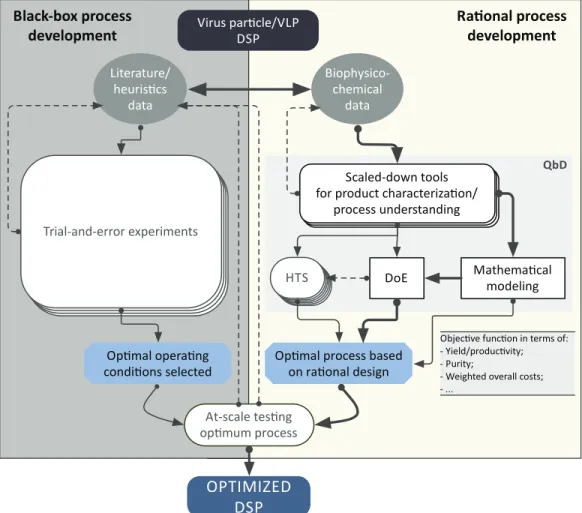
Process optimization still relies mainly on empirical-based strategies because there is much to be known about the biophysico-chemical properties of such particles. However, more rational strategies bringing together a variety of fundamentals, analytical and predictive modeling tools shall provide deeper insights into a more efficient, thus cost-effective and quicker process optimization. This section overviews efforts being taken by researchers and developers towards this trend where product- and process-knowledge is obtained aiming at a more rational design and improvement for the existing processes. These would contribute to a faster process development at very early stages (or even later for fine-tuning) in the product development lifecycle; furthermore, such rationale serves as solid ground for the implementation of Quality by Design (QbD) rules meeting the Process Analytical Technology (PAT) initiative (Mollerup et al., 2008).
CHAPTER 1. Introduction
#!#&!0 &!"$"
#
!&" !$0
1(#" ! !&#!#!+$0
!""&!"#
$'&$#!". 10 !&$'#*-
1&!#*- 1#'!"#"-1///
*"1
#
!11!!!) !#"
$ !$ $""#
#$
$ !""" !$"
#1"#"$ $& !""
resources.
We agree with Nfor and colleagues (Nfor et al., 2009) in that rational purification pro-cess development will become more entrenched in the biopharmaceutical industry. Overly complex and computationally demanding mathematical models may render process opti-mization untractable, which may lead to failure due to lack of basic experimental data, if the tools are chosen based on a sensible rationale, the chances to success make it worth trying. Basic understanding adds value by allowing to identify earlier the critical issues and devising ways to overcome them.
Analyticals and their critical role in process development
Analyticals play a pivotal role for whatever approach used (Kelner and Bhalgat, 2007). When dealing with complex biological particles, a number of assays must be in place to properly assess product identity, quality, titer, purity and consistency throughout the manufacturing process. It is clear that one should determine what is effect of any changes in an operating condition; this applies equally to trial-and-error experimentation or during
in silico design of a certain unit operation. For the case of virus particles the list may
include: infective virus titer determination (via cell based assays using immunocyto- or histo-chemistry assays or FACS), real-time quantitative PCR (for viral genome titration), transmission or scanning electron microscopy (for particle visualization), SDS-PAGE (one-or two-dimensional f(one-or protein profiling), Western Blotting (f(one-or protein identity matching), ELISA (for quantitative particle concentration measurement), total protein assessment, total endotoxin assessment, total DNA assessment, glycoprotein analysis and/or N- or C-terminal protein sequencing (for exposed, essential protein identity matching), mass spectrometry (for protein identity matching), capillary zone electrophoresis (for enhanced particle or protein size/molecular weight measurement), size exclusion chromatography HPLC, dynamic light scattering (DLS) (for size andζ-potential measurements), and surface plasmon resonance (SPR) (for equilibrium or sorption kinetics of product or impurities). This rather extensive wishlist stresses the challenges and complexity underlying purification of these complex biopharmaceuticals.
1.3.2
The special case of adsorptive chromatography
CHAPTER 1. Introduction
are concerned. Due to the increasing costs of chromatography within a given DSP, a great deal of effort is still being devoted to this separation process, especially in the area of complex biopharmaceuticals as viral vectors or vaccines.
We limit our more technical discussion in this review to the rational advances put for-ward in the field of adsorptive chromatography, in particular, to IEX chromatography. Unlike the rather expensive affinity chromatography processes with good recovery yields based on immobilized metal affinity (Jiang et al., 2004; Ye et al., 2004), heparin or others (Chen et al., 2009; Wu et al., 2007; Opitz et al., 2007), IEX processes are generally much more affordable at large scales and offer a broad spectrum of stationary phases for the capture of virus particles. IEX chromatography is based on the charge of the biological particles instead of on the existence of very specific ligands on the stationary phase; the latter may leach from the matrix thus contaminating the product and often require very harsh elution conditions (that may degrade the product). Although there is now consider-able literature reporting on the successful implementation of IEX chromatography for the purification of virus particles, there is still room for improvement and opportunities to take advantage of while using this IEX chromatography for biopharmaceutical purification.
As pointed out in the previous sections, IEX processes can be operated in positive or negative mode. In bind-and-elute mode, a large amount of process-related and/or product-related impurities are removed in the flowthrough, while most of the product from the bulk is retained adsorbed over the matrix surface functionalized with a given IEX ligand. The inverse procedure—retention of impurities in the matrix while the product freely flows through and is collected polished—is also feasible because either the buffer can be adjusted at a given pH or a ligand of opposite charge can be used.
Recently, the interest on the implementation of other types of chromatographic matri-ces based on porous membrane layers or monoliths has risen. These porous matrimatri-ces are particularly suited for very large particles, as viral vectors or VLPs, due to some key rea-sons confirmed by a number of studies. First, the specific surface areas (per unit volume)
of porous matrices with pore sizes of0.8µm (MustangTMmembrane adsorbers from Pall), 3µm (SartobindTMmembrane adsorbers from Sartorius-Stedim Biotech) or>1µm
(Jung-bauer and Hahn, 2008) (CIMTM monoliths from BIA Separations, Ljubljana, Slovenia) are
Second, due to the porous nature of these matrices, diffusional mass transfer resistances are reduced to a minimum. Indeed, they allow the use of fairly high linear velocities pro-moting convective transport. For the case of binding of large particles that have rather small diffusion coefficients, as compared to smaller biologicals as proteins, these matrices clearly present an advantage over packed-bed chromatography. Third, and as a corollary of the latter, these matrices permit very high process throughputs. Due to the very low pressure drops, higher flow rates can be used for loading and eluting the material using a given stepwise or linear gradient.
A very pertinent study has analyzed the influence of the pore size distribution of mono-lith, perfusive and conventional resin matrices (Trilisky and Lenhoff, 2009). Although high adsorption capacities are obtained for porous matrices, entrapment of the virus particles should be considered and the linear flow rates used should be also optimized in order to reduce this phenomenon; indeed, loading the virus bulk at a high flow rate and eluting at a lower flow rate should improve product recovery (Trilisky and Lenhoff, 2009).
Moreover, most of these porous matrices can now be purchased as disposable units representing a leap in processing flexibility, eliminating cleaning and sterilization as well as their validation costs. Other matrices harboring extenders, as tentacle resins, have been used with good results most likely because they improve the accessibility of their binding sites to the large virus particles (Rodrigues et al., 2007a). Yet, it is anticipated that packed-bed chromatography can also be of great interest if flowthrough mode is implemented for polishing purposes, removing low molecular weight biological impurities; however, to our knowledge, the implementation of such strategy has not yet been reported in the literature.
Optimization of IEX processes
CHAPTER 1. Introduction
Brooks and Cramer (1992). This widely used theoretical framework for IEX of smaller and simpler model biologicals appears to be equally applicable to the more complex particles. If good estimations of the characteristic charge, equilibrium constants and steric factors are available, the process can be modeled with significant predictive power. However, in that preliminary study, the contribution of the impurities (with unknown properties for most of them) were not included in the multicomponent model. This is a major drawback when implementing a model that fully predicts the behavior of all the components of an animal cell-derived bioreaction bulk containing a given virus particle.
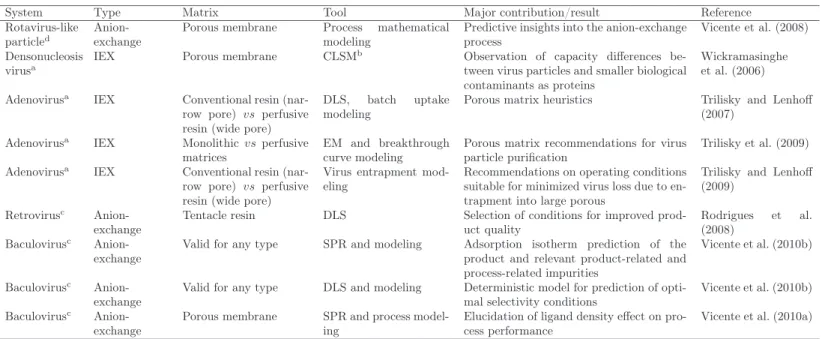
It is thus desirable to create a methodology that allows for a better understanding on the complexity of these virus bulks. This can be done by analyzing the major components of the bulk, including the impurities that in most cases represent the major mass fraction of the bulk. Such study has been performed using recombinant baculoviruses as a model system. The product—the integral virus particle—was compared to major process-related impuri-ties (e.g., protein, DNA) and major product-derived impuriimpuri-ties (damaged virus particles, eg., deprived of viral envelope or external glycoprotein harbored in the virus envelope) in terms of adsorption capacities to an IEX surface (Vicente et al., 2010b). For that purpose, surface plasmon resonance (SPR) was used as a pseudo-chromatography tool for biological adsorption and desorption on an IEX surface (Vicente et al., 2010c). SPR conveniently results in a scaled-down analytical tool for predicting adsorption isotherms at varied ionic strengths. The same type of data typically requires a set of adsorption experiments on a lab-scale chromatographic matrix resulting in quite expensive optimization routines as these biologicals are costly. SPR thus offers the possibility to add more rationale in the typical DoE type of approach at reduced costs given the small volumes required for testing (Fig. 1.2).
scaled-N S T R E A M P R O CE S S I N G DE V E L O P M E N T O F E N V E L O P E D V I R U S E S F O R CL I N I CA L A P P L I CA T I O N S
Table 1.1: Overview of ion-exchange (IEX) chromatographic advances where process development for viral vectors or VLPs included rational tools.
System Type Matrix Tool Major contribution/result Reference
Rotavirus-like particled
Anion-exchange Porous membrane Processmodeling mathematical Predictive insights into the anion-exchangeprocess Vicente et al. (2008) Densonucleosis
virusa
IEX Porous membrane CLSMb Observation of capacity differences
be-tween virus particles and smaller biological contaminants as proteins
Wickramasinghe et al. (2006)
Adenovirusa IEX Conventional resin
(nar-row pore) vs perfusive resin (wide pore)
DLS, batch uptake modeling
Porous matrix heuristics Trilisky and Lenhoff (2007)
Adenovirusa IEX Monolithicvsperfusive
matrices EM and breakthroughcurve modeling Porous matrix recommendations for virusparticle purification Trilisky et al. (2009) Adenovirusa IEX Conventional resin
(nar-row pore) vs perfusive resin (wide pore)
Virus entrapment mod-eling
Recommendations on operating conditions suitable for minimized virus loss due to en-trapment into large porous
Trilisky and Lenhoff (2009)
Retrovirusc
Anion-exchange Tentacle resin DLS Selection of conditions for improved prod-uct quality Rodrigues(2008) et al. Baculovirusc
Anion-exchange Valid for any type SPR and modeling Adsorption isotherm prediction of theproduct and relevant product-related and process-related impurities
Vicente et al. (2010b)
Baculovirusc
Anion-exchange Valid for any type DLS and modeling Deterministic model for prediction of opti-mal selectivity conditions Vicente et al. (2010b) Baculovirusc
Anion-exchange Porous membrane SPR and process model-ing Elucidation of ligand density e
ffect on
pro-cess performance Vicente et al. (2010a)
anon-enveloped virus;bconfocal laser scanning microscopy;cenveloped virus;dtriple-layered VLP
CHAPTER 1. Introduction
down models are being considered relevant options for early stage process development for other more advanced processes, as mAbs (Coffman et al., 2008; Rege et al., 2006; Wensel et al., 2008).
Following this lead, DLS has also been used as a main analytical support for the design of a deterministic model capable of discriminating the contribution of the different virus components of baculoviruses to the overall electrostatic particle potential (Vicente et al., 2010d). Such tool provides fundamental knowledge on the crucial role of the external glycoprotein of these virus particles, while predicting the optimal pH and ionic strength ranges for improved adsorption of integral virus particles with enhanced selectivity to other product-derived impurities. Studies on retroviruses and other viruses have been performed with DLS (Schaldach et al., 2006; Rodrigues et al., 2008).
These studies, yet scarce in the literature, provide strategies for selecting/improving the conditions and materials/technologies available for optimizing the IEX process. The final goal would be to separate with high yield a product in a sharp and clean peak, decreasing to acceptable values the impurity contents. The future, utopian perhaps, is reaching a purelyin silico process optimization as defended by Nfor et al. (2009); however, for these
more complex biologicals, the challenges are still too large. Bringing together relevant and much more advanced work with simpler biologicals should constitute a good starting point. It has been shown that it is possible to predict the IEX chromatographic behavior of proteins directly from their crystal structure (Ladiwala et al., 2005). Furthermore, the examination of the binding orientation of the protein adsorbates (Dismer et al., 2008; Dismer and Hubbuch, 2007) provides a molecular-based approach for designing the ideal matrix support with the ideal ligand spacing and density (Dismer and Hubbuch, 2010).
1.4
Outlook
trend is clear, needed and thus will keep evolving.
1.5
Scope of the thesis
Viral vectors and virus-like particles are examples of biological products holding a remark-able potential in various clinical applications for gene therapy or vaccination. Enveloped viruses are amongst the most complex biopharmaceuticals where basic knowledge to more rationally address their production issues is still lacking. Moreover, the implementation of robust and scalable downstream processes for these biopharmaceuticals is still in its in-fancy. In fact, very little is known about the fundamental issues underlying the purification processes of such viruses. This thesis aimed at improving the state-of-the-art purification processes for these viral particles by means of developing and using fundamental-based approaches for a more rational and efficient process development. We took the path high-lighted in Fig. 1.2 as our rationale.
A virus-like particle from Rotavirus (RLP) system (presented In Chapter 2) provided a model system where the introduced anion-exchange membrane chromatography step could be modeled using mathematical tools. For the first time, a steric mass action (SMA) model for the prediction of the elution profile of purified RLP pulses using membrane chromatography was implemented with reasonable accuracy.
A leap forward was taken towards an enveloped virus system—our target object of study of this thesis—in Part II. Increasing the particle complexity by adding an envelope on top of a much larger viral vector (required to be infective), the VLP-derived knowledge proved extremely useful to tackle more efficiently the issues in the purification of this virus model— virus quality (because of the presence of damaged virus particles due, e.g., to the added lability of the envelope), potency (concentration is often not enough for many applications) and purity (contaminating HCP and/or HC DNA may still be too high depending on the dose required).
REFERENCES
References
Aboud M, Wolfson M, Hassan Y, Huleihel M. Rapid purification of extracellular and intracellular moloney
murine leukemia virus. Arch Virol 1982;71:185–95.
Barsoum J. Concentration of recombinant baculovirus by cation-exchange chromatography. Biotechniques
1999;26:834–6.
Branovic K, Forcic D, Ivancic J, Strancar A, Barut M, Kosutic-Gulija T, et al. Application of short
monolithic columns for improved detection of viruses. J Virol Methods 2003;110:163–71.
Brooks CA, Cramer SM. Steric mass-action ion exchange: Displacement profiles and induced salt gradients.
AIChE J 1992;38:1969–1978.
Buckland BC. The process development challenge for a new vaccine. Nat Med 2005;11:S16–9.
Carmo M, Dias JD, Panet A, Coroadinha AS, Carrondo MJT, Alves PM, et al. Thermosensitivity of the
reverse transcription process as an inactivation mechanism of lentiviral vectors. Hum Gene Ther 2009;
20:1168–1176.
Chahal PS, Aucoin MG, Kamen A. Primary recovery and chromatographic purification of adeno-associated
virus type 2 produced by baculovirus/insect cell system. J Virol Methods 2007;139:61–70.
Charcosset C. Membrane processes in biotechnology: an overview. Biotechnol Adv 2006;24:482–492.
Chen GY, Chen CY, Chang MDT, Matsuura Y, Hu YC. Concanavalin a affinity chromatography for
efficient baculovirus purification. Biotechnol Prog 2009;25:1669–77.
Coffman JL, Kramarczyk JF, Kelley BD. High-throughput screening of chromatographic separations: I.
method development and column modeling. Biotechnol Bioeng 2008;100:605–618.
Crommelin DJA, Storm G, Verrijk R, de Leede L, Jiskoot W, Hennink WE. Shifting paradigms:
bio-pharmaceuticals versus low molecular weight drugs. Int J Pharm 2003;266:3 – 16. A Special Issue for
Professor Hans E. Junginger on the occasion of his 60th birthday.
Cruz PE, Maranga L, Carrondo MJT. Integrated process optimization: lessons from retrovirus and
virus-like particle production. J Biotechnol 2002;99:199–214.
Davidoff AM, Ng CY, Sleep S, Gray J, Azam S, Zhao Y, et al. Purification of recombinant
adeno-associated virus type 8 vectors by ion exchange chromatography generates clinical grade vector stock.
J Virol Methods 2004;121:209–15.
Debelak D, Fisher J, Iuliano S, Sesholtz D, Sloane DL, Atkinson EM. Cation-exchange high-performance
liquid chromatography of recombinant adeno-associated virus type 2. J Chromatogr B Biomed Sci Appl
2000;740:195–202.
Dismer F, Hubbuch J. A novel approach to characterize the binding orientation of lysozyme on ion-exchange
resins. J Chromatogr A 2007;1149:312–320.
Dismer F, Hubbuch J. 3d structure-based protein retention prediction for ion-exchange chromatography.
Dismer F, Petzold M, Hubbuch J. Effects of ionic strength and mobile phase ph on the binding orientation
of lysozyme on different ion-exchange adsorbents. J Chromatogr A 2008;1194:11–21.
Dormond E, Chahal P, Bernier A, Tran R, Perrier M, Kamen A. An efficient process for the purification
of helper-dependent adenoviral vector and removal of helper virus by iodixanol ultracentrifugation. J
Virol Methods 2010;165:83–9.
Etzel MR, Riordan WT. Viral clearance using monoliths. J Chromatogr A 2009;1216:2621–4.
FDA. Center for biologics evaluation and research guidelines. 2010.
Ferguson SD, Ahmed AU, Thaci B, Mercer RW, Lesniak MS. Crossing the boundaries: stem cells and
gene therapy. Discov Med 2010;9:192–196.
Fontes N, van Reis R. Advances in technology and process development for industrial-scale monoclonal
antibody purification. In U Gottschalk, ed., Process Scale Purification of Antibodies, pp. 203–221. John
Wiley & Sons, 2009.
Gotoh T, Miyazaki Y, Sato W, Kikuchi K, Bentley WE. Proteolytic activity and recombinant protein
production in virus-infected sf-9 insect cell cultures supplemented with carboxyl and cysteine protease
inhibitors. J Biosci Bioeng 2001;92:248–55.
Gottschalk U. Bioseparation in antibody manufacturing: The good, the bad and the ugly. Biotechnol Prog
2008;24:496–503.
Grzenia DL, Carlson JO, Czermak P, Han B, Specht RK, Wickramasinghe SR. Purification of
densonu-cleosis virus by tangential flow ultrafiltration. Biotechnol Prog 2006;22:1346–53.
Grzenia DL, Carlson JO, Wickramasinghe SR. Tangential flow filtration for virus purification. J Membr
Sci 2008;321:373–380.
Gutiérrez-Aguirre I, Banjac M, Steyer A, Poljsak-Prijatelj M, Peterka M, Strancar A, et al. Concentrating
rotaviruses from water samples using monolithic chromatographic supports. J Chromatogr A 2009;
1216:2700–4.
Hanslip S, Zaccai N, Middelberg A, Falconer R. Assembly of human papillomavirus type-16 virus-like
particles: Multifactorial study of assembly and competing aggregation. Biotechnol Prog 2006;22:554–
560.
Hjorth R. Expanded-bed adsorption in industrial bioprocessing: recent developments. Trends Biotechnol
1997;15:230–5.
Jiang C, Wechuck JB, Goins WF, Krisky DM, Wolfe D, Ataai MM, et al. Immobilized cobalt affinity
chro-matography provides a novel, efficient method for herpes simplex virus type 1 gene vector purification.
J Virol 2004;78:8994–9006.
Jungbauer A, Hahn R. Polymethacrylate monoliths for preparative and industrial separation of