Marine and coastal environmental education in the context of global climate
changes - synthesis and subsidies for ReBentos (Coastal Benthic Habitats
Monitoring Network)
Flávio Augusto S. Berchez
1,*, Natalia Pirani Ghilardi-Lopes
2, Monica Dorigo Correia
3†, Hilda
Helena Sovierzoski
3, Alexandre de Gusmão Pedrini
4, Suzana Ursi
1, Laura Pioli Kremer
5, Renato de
Almeida
6, Yara Schaefer-Novelli
7, Valéria Marques
8, Daniel Shimada Brotto
91 Instituto de Biociências, Universidade de São Paulo.
(Rua do Matão, 321, Travessa 14, CEP: 05508-900, São Paulo, SP) 2 Centro de Ciências Naturais e Humanas, Universidade Federal do ABC. (Rua Santa Adélia, 166, CEP: 09210-170, Santo André, SP)
3 Setor de Comunidades Bentônicas (ICBS/LABMAR), Universidade Federal de Alagoas. (Rua Aristeu de Andrade, 452, 2º andar, CEP: 57021-019, Maceió, AL)
4 Instituto de Biologia Roberto Alcântara Gomes da Universidade do Estado do Rio de Janeiro. (CEP: 20550-013, Rio de Janeiro, RJ)
5 Instituto Federal de Santa Catarina, Campus Itajaí. (Rua Tijucas, 55, CEP: 88301-160, Itajaí SC)
6 Centro de Ciências Agrárias, Ambientais e Biológicas, Universidade Federal do Recôncavo da Bahia. (Rua Rui Barbosa, 710, CEP: 44380-000, Centro, Cruz das Almas, BA)
7 Instituto Oceanográico da Universidade de São Paulo.
(Praça do Oceanográico, 191, CEP: 05508-120, Cidade Universitária, São Paulo, SP)
8 Departamento de Educação, Instituto de Educação, Universidade Federal Rural do Rio de Janeiro. (CEP: 23890-000, Seropédica, RJ)
9 Departamento de Ciências da Saúde, Universidade Veiga de Almeida. (CEP: 22460-030, Rio de Janeiro, RJ)
† In Memorian.
*Corresponding author: [email protected]
Financial Support: Edital MCT/CNPq/MEC/CAPES/FNDCT, Ação Transversal/FAPs Nº 47/2010, Sistema Nacional de Pesquisa em Biodiversidade - SISBIOTA BRASIL, Processo FAPESP: 2010/52323-0, Processo CNPq: 563367/2010-5.
As changes in coastal and marine environments are expected to negatively afect Brazilian ecosystems, the importance of Marine Environmental Education (MEE) comes to the fore. However, so far only 32 contributions related to this issue have been published in Brazil. The MEE workgroup of ReBentos aims at promoting EE and the communication of marine ecological research to the scholastic public as a whole, as well as to groups which exert an inluence on general perception, such as the media, politicians, and scientists. This paper presents an overview of the initiatives of MEE in Brazil, with emphasis on the ReBentos projects and guidelines. The conceptual background of action is based on the Rio'92 Treaty on Environmental Education, thereby implying an MEE with Transdisciplinar, emancipatory and relexive characteristics, directed to changes in values, principles and attitudes. During the period 2011 to 2015, 10 projects were developed from Alagoas to Santa Catarina States, involving the development, implementation and testing through scientiic research of 16 MEE activity-models. The didactic material subsequently produced comprised three books and 21 book-chapters. A public of around 6,500 Conservation Unit visitors, 250 public school teachers and 800 high school students have been impacted to date. To act as monitors and multipliers, 250 undergraduate students and professionals were trained. Research project evaluation generated the publication of nine papers. As a further step, the need for protocol elaboration for each model is placed in evidence, in order to direct and facilitate future initiatives.
A
bstrAct
Descriptors: Marine environmental education, Climate changes, Marine biodiversity, Long-term monitoring.
A importância da educação ambiental marinha (EAM) vem to-mando relevância à medida que aumenta a expectativa de impac-tos nos ecossistemas brasileiros ocasionados por mudanças nos ambientes costeiros. Entretanto, apenas 32 contribuições sobre esse assunto foram publicadas no Brasil. O grupo de trabalho em EAM da ReBentos objetiva promover a comunicação da pesqui-sa ecológica marinha para o público escolar como um todo, bem como a grupos com inluência na percepção comum, como a mí -dia, políticos e cientistas. Este trabalho apresenta uma visão das iniciativas em EAM no Brasil, com ênfase nos projetos e diretri-zes da ReBentos. A base conceitual de ação é o Tratado de Edu-cação Ambiental da Rio 92, implicando em um ensino com carac-terísticas transdisciplinares, relexivas e emancipatórias, dirigidas a mudanças em valores, princípios e atitudes. Durante o período de 2011 a 2015, 10 modelos de atividade foram desenvolvidos, de Alagoas a Santa Catarina, envolvendo sua concepção, implemen-tação e teste por meio de pesquisa cientíica. O material didático produzido compreendeu três livros e 21 capítulos de livros. Um público total ao redor de 5500 visitantes de UCs, 250 professo-res de escolas públicas e 800 estudantes foi impactado. Como monitores e multiplicadores, foram treinados 250 estudantes de graduação e proissionais. Projetos de avaliação de pesquisa ge -raram nove trabalhos cientíicos. Como uma próxima iniciativa, é salientada a necessidade de elaboração de protocolos para cada modelo, a im de direcionar e facilitar futuras iniciativas.
r
esumo
Descritores: Educação ambiental marinha, Mudanças climáticas, Biodiversidade marinha, Monitoramento de longo prazo.
INTRODUCTION
Environmental education: state of the art
in Brazilian marine and coastal ecosystems
Although marine ecosystems comprise extremely ri-ch natural resources and a fantastic germplasm bank of organisms, both of which must be preserved at all costs, Brazilian Environmental Education has been practically restricted to terrestrial environments alone.
Both abroad and in Brazil, Marine Environmental Education (MEE) is very little cited in specialized
scien-tiic journals. In a synthesis about the literature on Marine
Environmental Education in Brazil (MEEB), PEDRINI (2010) selected 32 published contributions which repre-sented the entire national literature. He also prerepre-sented a typology with six types of MEEB approaches: a) by so-cio-environmental actors, viz., students in an elementary school near Fernando de Noronha National Marine Park (SILVA JR. et al., 2010); b) by ecosystems, such as ur-ban mangroves within Florianópolis city (Santa Catarina State) (PANITZ, 2010); c) by iconic, lagship or charis -matic species, such as dolphins along the Rio de Janeiro State coast (GURGEL et al., 2002); d) by aquariums and oceanariums, such as the Ubatuba Aquarium (Coast of São Paulo State) (GALLO NETO; BARBOSA, 2010); e) by marine biology classes, mainly as free courses directed to elementary or high school students; and f) by virtual envi-ronments (GUERRA, 2002).
It is also possible to ind research on the evaluation
of negative ecological impacts caused by divers, tourists and vessels in marine and coastal environments (CREED; AMADO FILHO, 1999; GHILARDI-LOPES et al., 2015; HAWKINS; ROBERTS, 1993; HAWKINS et al., 1999; PEDRINI et al., 2007; PLATHONG et al., 2000; ROUPHAEL; INGLIS, 2001; SILVA; SILVA JR., 2002; SILVA et al., 2012a; SILVA; GHILARDI-LOPES, 2012; TUNALA et al., 2013), as well as that regarding the ei -ciency of MEE from an educational perspective, and on the reduction of these impacts (BARKER; ROBERTS, 2004; BERCHEZ et al., 2005; CORREIA; SOVIERZOSKI, 2009; 2010; KATON et al., 2013; LUNA et al., 2009; MEDIO et al., 1997; PEDRINI, 2010; PEDRINI et al., 2008; SALM, 1985; TOWATA et al., 2013; TOWSEND, 2000; URSI et al., 2013; WALTERS; SAMWAYS, 2001; WORACHANANANTA et al., 2008).
EE activities that contemplated marine ecosystems and that have already been developed in Brazil, althou-gh equally rare (BERCHEZ et al., 2005; PEDRINI, 2010;
WEGNER et al., 2006), were extremely important for the development of a mindset for their conservation. Although
with a poorly deined conceptual and methodological
structure, and basically involving the simple observa-tion of local ecosystems together with technical learning, activities enthusiastically carried out since the 80’s by diving schools can be cited as an example, through the consequential and substantial reduction in sport
subma-rine-ishing, and the increase of the spirit for conserving
these environments and their organisms.
Examples of conservation activities with well-deined
objectives and structures include that of marine chelonians (Tamar/IBAMA Project), marine mammals along the Rio de Janeiro State coast (GURGEL et al., 2002), the nor-theastern Brazil marine reefs (OLIVEIRA; CORREIA, 2013b; SILVA et al., 2013b), the Abrolhos Marine Park, (MELO et al., 2005) and, inally, southeastern Brazil rocky-coasts (BERCHEZ et al., 2007; PEDRINI et al., 2011). In São Paulo State, and within the Subaquatic Trail Project (BERCHEZ et al., 2007; GHILARDI; BERCHEZ, 2010; URSI et al., 2010; URSI et al., 2009), environmen-tal education-activities models based on interpretative trails, have been developed, applied and afterwards tested
through speciic research projects.
Other conservation activities can be indirectly related to EE, as is the case of the Alcatrazes Project, mainly de-dicated to protection of the Archipelago of the same na-me (São Paulo State), whose ecosystems are threatened through target practice by the Brazilian Navy (CAMPOS, 2008).
MEE activities related to marine trails are cited by WEGNER et al. (2006) on the northern coast of Santa Catarina State, BERCHEZ et al. (2007) on Anchieta Island rocky shores, HADEL and BERCHEZ (2005) within the CEBIMar-USP monitored visitation Program at Segredo Beach (São Sebastião, São Paulo State), and PEDRINI et al. (2011) with the Ecoturismar Project in Rio de Janeiro State.
Most of the accumulated experience has neither been published in specialized journals, nor have the results been
scientiically tested. The little data available has been re -ported in the form of these or other means of publication, with only limited scope of disclosure.
Due, among other factors, to the lack of data, it is
possible to observe diferences in the structural patterns
is underrated, due to conceptual and operational mistakes. In other cases, attempts have even resulted in negative ac-tion, with immediate negative impacts on nature, and the possible assimilation of behaviors contrary to those desi-red. The opening of protected areas to exorbitant, irres-ponsible, impacting and excessively commercial tourism can be cited as an example (REUSS-STRENGEL et al., 1997).
The creation of models with well-deined conceptual
and philosophic bases and structures, and their testing by
means of parallel scientiic studies, is thus of great impor -tance in the management of marine-protected areas, or even of areas which encompass coastal and marine environments and organisms, and where the implementation of activities adapted to local conditions should be encouraged.
Environmental education in the context of
climate changes
The Intergovernmental Panel on Climate Change (IPCC) reports that global changes, besides occurring at a faster rate than at any other period in time over the last 25 million years, are already causing innumerable im-pacts in marine environments (BELLARD et al., 2012; IPCC, 2014). Nowadays, there is a consensus among
scientists as to anthropogenic inluence on global climate
changes (DORAN; ZIMMERMAN, 2009). Furthermore, ROCKSTROM et al. (2009) also pointed out climate changes as being one of the planetary boundaries that have already been crossed by human activities, thereby possibly leading to “the risk of irreversible and abrupt environmen-tal changes”.
The expected changes in coastal and marine environ-ments, such as the average rise in sea levels, changes in both local and global marine currents, and rises in
tem-peratures and seawater-acidiication (BERCHEZ et al., 2008), can negatively afect many Latin American ecosys -tems (TURRA et al., 2013), many of which, besides being unique, constitute biodiversity hotspots (MILOSLAVICH et al., 2011), such as the kelp forests in the Cape Horn Biosphere Reserve (ROZZI et al., 2012), the extensi-ve rhodolith beds in the Southwest Tropical Atlantic (BERCHEZ et al., 2009), and the highly biodiverse co-ral reefs of the Tropical Atlantic, with their high number of endemic species (CORREIA; SOVIERZOSKI, 2012; LEÃO et al., 2003). Thus, not only is concern for the pro-tection of these environments essential, but also critical discussion capable of presenting the complexity of the problem, and improving changes in social structure.
Although the efects of climate change on coastal and
marine environments can be expected, and in a certain
way, understood, in scientiic and academic environments,
a large part of the population is not only ignorant of or has no access to this information, but knows absolutely nothing about these ecosystems and their intrinsic value. Since any posture-change in relation to the environment, which is directed towards minimizing and possibly
rever-ting the anthropogenic inluence on global-climate chan -ges, is not only a government responsibility, but also of concern to each citizen, we are facing a great challenge, for there is clear detachment between comprehension of climate change phenomena and everybody’s ‘day-to-day’ existence (TAMAIO, 2010; 2013). As an example, few pe-ople are conscious that fundamental economic activities,
such as isheries and coastal and marine ecotourism, de -pend on the quality of marine environments, and that any alteration thereof will have a consequential and detrimen-tal impact. New research has demonstrated that people ge-nerally overestimate how common their own opinion is, and in doing so, they are less likely to change their views on climate changes (LEVISTON et al., 2013).
Perception that long-term climate trends are related to human causes has been shown to be dependent on
scienti-ic consensus (LEWANDOWSKY et al., 2013). Moreover, political group consensus on anthropogenic global war-ming has proved to be a primary factor in social-percep-tion (BRECHIN, 2012). Without this, even scientiic agre -ement on climate change may have a limited impact.
In this context, Environmental Education (EE) igures
as the base for accomplishing a transformative and critical approach to the theme, thereby making it possible, in the
near future, to amplify mobilization eforts and intensify
civil-society action, in such a way as to alert world lea-ders on their role in guiding this emergent challenge. It is clear that, besides the general and scholastic public, EE focusing on the media, politicians, and even scientists the-mselves, would clarify the importance of these groups in overall public perception.
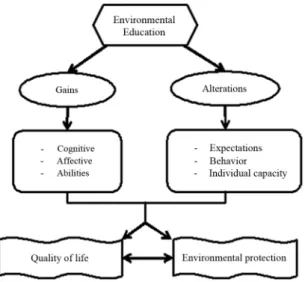
Figure 1. Holistic environmental education.
Figure 2. Expected efects of the diferent approaches of
environmental education activities.
These concepts, drawn from pedagogic assumptions and embodied in the Tbilisi Declaration on Environmental Education, and also expressed in the Rio-92 Treaty on Environmental Education for Sustainable Societies and Global Responsibility (PEDRINI; BRITO, 2006), have been adopted by the Brazilian National Environmental Education Program (BRASIL, 2005). Table 1 shows some of the conceptual indicators of the treaty (BERCHEZ et al., 2007), which, in spite of the inherent premise funda-mentality and favorable credibility sustaining further MEE action, have not been considered in numerous projects.
PEDRINI and SABA (2008) report a new approach to the global environmental changes (GECs) theme. It
Table 1. Short description of some conceptual EE indicators.
Indicator (EE) Indicator description
Transforming Facilitates changes in attitudes for the development of sustainable societies.
Participative Encourages participation in collective mobilization
Embracing Involves all the various social groups
Permanent Performed as a continuous activity (or continued EE)
Contextualized Acts directly on the reality of the activity and on achieving global dimensions
Ethical Respect for human beings and all life-forms
Interdisciplinary Integrates various forms of knowledge
Holistic Aims at transforming the individual, e.g. values and ethical concepts
Multiplying Aims at expanding activities through the formation of multipliers
employs the movie “An inconvenient truth” (produced by Al Gore to make the issue of global warming a recognized problem worldwide), as a strategy for teaching English among public high school students.
Although there are some EE initiatives related to cli-mate changes in Brazil, a clearer relationship between day-to-day actions, their synergies (e.g. locomotion, over--consumption, housing, feeding, land-use, deforestation, ri-ver-silting, desert-formation) and the increase in greenhou-se-gas emission (TAMAIO, 2010; 2013), is still necessary. EE programs and actions should also be conceived in an
accessible language, compatible with the diferent publics, for efective population-awareness of the causes and im -pacts due to climate change (MONZONI, 2009), thereby promoting systemic comprehension, and holistic and con-textualized thinking about the complexity of the problem.
METHODS
Initial rebentos guidelines for marine
environmental education
The aims of the MEE workgroup of the Coastal Benthic Habitats ReBentos Monitoring Network (MCT/ CNPq/ MEC/ CAPES/ FNDCT – Ação Transversal/FAPs, FAPESP process nº 10/52323-0), is to incite
education approach towards marine environments, based
on the creation, implementation and scientiic evaluation
(both educational and ecological) of models.
Description and Conceptual background:
The general structure, common to all models, is based on guided interpretative trails (COSTA; COSTA, 2000), in whichthe participants stop at pre-deined spots, where certain issues
are discussed with the monitor(s). Each spot corresponds to a
stage in an activity with speciic educational objectives invol -ving a holist relationship with the marine environment.
Although greater emphasis is given to the rocky-shore ecosystem, since this is the team’s main focus, other mo-dels have been developed in other coastal environments. The models have been applied mainly in the counties of Ubatuba and São Sebastião, São Paulo State.
Model-structuring was based on the holistic envi-ronmental education concept (Figure 1) adopted by the Brazilian National Environmental Education Program (BRASIL, 2005). The aim is individual transformation and evolution, along with an understanding of natural phe-nomena in an integral way (WEIL, 1991), thereby leading to behavioral, ethical and value changes acquired through cognitive, skill and emotional gains related to the ecosys-tems visited (HEIMLICH, 2002).
Apart from model-elaboration, the main aim is to prepare college educators, capable of spreading information and con-cepts. Operational structure involves not only the activities themselves, but also mainstays, such as personal training and security. The evaluation of both educational outcome, based on EE research techniques, and the negative ecological impacts of the activities within the environment, is complementary.
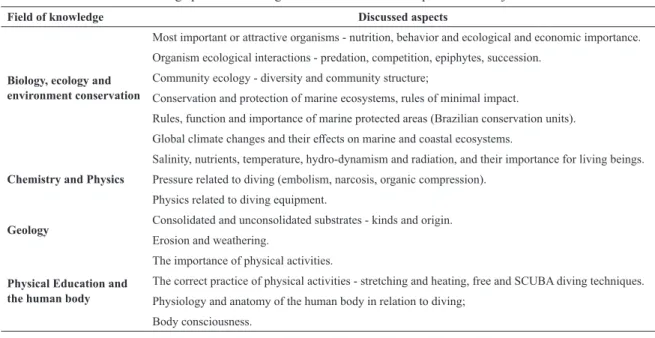
Furthermore, the activities present a multidisciplinary ap-proach to interpretation of the environment (Table 2), through relating the functional aspects of ecosystems with biotic and abiotic factors, and organism adaptation, as well as furthering discussion of conservation and the main anthropogenic im-pacts on marine and coastal environments. As regards diving,
integration is centered on speciic diving equipment techni -ques and performance, and on the action of factors, such as water temperature and human-body pressure, on anatomy, physiology, physical conditioning and health.
Activities are always carried out in groups, with the number of participants per model varying in accordance to security and conservational aspects. Interaction among the elements of the group is incited by the monitor, throu-gh quizzes and educational activities aimed at stimulating participative behavior (Table 1 and Figure 2).
Conceptual issues should be based on the Rio-92
Treaty on Environmental Education for Sustainable Societies and Global Responsibility, which serves as a ba-se for Brazilian EE legislation (Law n° 9.795, April, 1999) and the National EE Program (ProNEA). This implies a holistic vision of EE, mainly directed to changes in values, principles and attitudes (LA TROBE; ACOTT, 2000) of a
multi, trans-discipline emancipatory and relexive charac -ter, capable of facilitating movement towards individual emancipation and more sustainable societies. This vision is not antagonist, but encompasses that which visualizes EE as a form of biological, ecological or social educa-tion. Artistic, physical and philosophic disciplines, among others, become instruments and fall under the EE wing.
Public – The main goals of ReBentos EE action and materials are to reach opinion and policy-makers, with the
aim of maximizing and spreading eforts. Once again, this
is not antagonist, but complementary to more conventio-nal approaches, such as those that deal with elementary and high school students, or local communities.
Lines of action – Based on preliminary ReBentos ex-perience, the EE-ReBentos projects should be related to (1) the production of educational material, (2) the develo-pment of environmental educational models, (3) education evaluation, and (4) long-term evaluation of the perception
of basic GEC concepts, and their consequential efects.
On incorporating the question of marine GECs, education material and methods would acquire a direct approach towards cognitive gains, with the application
of indirect strategies directed to afective gains or the development of speciic skills. In the latter case, the
conceptual relationship with GECs would be clearly shown, both in the project, and to those that will make use of the resource. Explicit reference to ReBentos should appear in the products and projects, and during EE
activities and staf-training courses.
RESULTS
Projects, actions and results from 2011 to
2015
1. Subaquatic Trail
Coordinator: Flávio Berchez, IB-USP
Objectives
Preliminary Results
Protocol - Creation of standard procedures, including (1) chronological teaching sequence, (2) minimum-knowledge base that models should encompass, and (3) intended
cog-nitive, afective and ability gains, and the didactic postu -re needed for their achievement. So far, eight models have complied: underwater trail outside the water, free diving trail, SCUBA diving trail, natural aquarium trail, ecosystem trail, vertical trail, kayak trail, lectures about marine ecosystems.
Didactic material support - books (BERCHEZ et al., under preparation; GHILARDI-LOPES et al., 2012; MARQUES; PEREIRA FILHO, 2013), websites (sites– www.ib.usp.br/ecosteiros2 – and distance education tools (video-classes based on the Moodle Platform).
Monitor training and formation – 250 environmental monitors have been prepared to apply the protocol, this comprising students, professionals in the areas of biology, oceanography, geology and education, protected area tech-nicians and managers from several states of the Brazilian southeastern, southern and eastern regions. The training consisted of participation as extension or undergraduate Univ. of São Paulo students (BIB-0529 - Teoria e prática de educação ambiental em UCs marinhas) in (1) a blended learning theoretical course, followed by one week of prac-tical monitoring in one of the model activities.
Implementation of models – the models were applied to the general public visiting protected areas (7,805 visi-tors), to the recycling of public school teachers (24), and to correspondent students of technical (tourism) schools
(110, 14 with visual or hearing deiciencies). In the case of teachers, special certiied capability was related to the
use of active diving, as a centralizing theme for promoting school-discipline transversal integration. Preparation was also extended to student monitoring.
Evaluation of activities – eiciency and change in per -ception as regards climate changes and the marine environ-ment, was evaluated through research projects. Evaluation of the ecological impacts related to the absence of visiting protocols in the region of the natural aquarium trail, was through a master’s degree monograph (SPELTA, 2011). This was extended to public perception of global clima-te changes, with emphasis on expecclima-ted alclima-terations to and impacts on the marine environment (GHILARDI-LOPES et al., 2013b; GHILARDI-LOPES et al., 2015). Following the extension of the concepts and models to Chile, a com-prehensive review about integrated approaches between ecology and education in South America Marine Protected Areas was prepared (BERCHEZ et al., 2015).
2. Games about Climate Changes and their
effects on Marine and Coastal Environ
-ments Project
Coordinator: Natalia Pirani Ghilardi-Lopes,
UFABC)
Objective
The main aim of the project is to develop, apply and test two educational web-based games with elementary
Table 2. Main ields of knowledge presented during the activities of the Subaquatic Trail Project.
Field of knowledge Discussed aspects
Biology, ecology and environment conservation
Most important or attractive organisms - nutrition, behavior and ecological and economic importance. Organism ecological interactions - predation, competition, epiphytes, succession.
Community ecology - diversity and community structure;
Conservation and protection of marine ecosystems, rules of minimal impact.
Rules, function and importance of marine protected areas (Brazilian conservation units). Global climate changes and their efects on marine and coastal ecosystems.
Chemistry and Physics
Salinity, nutrients, temperature, hydro-dynamism and radiation, and their importance for living beings. Pressure related to diving (embolism, narcosis, organic compression).
Physics related to diving equipment.
Geology Consolidated and unconsolidated substrates - kinds and origin. Erosion and weathering.
Physical Education and the human body
The importance of physical activities.
The correct practice of physical activities - stretching and heating, free and SCUBA diving techniques. Physiology and anatomy of the human body in relation to diving;
school students and their teachers, and also, to promote continuing education for teachers.
Description and Conceptual background
The idea of the project came from the easy access to in-formation through technology, and from people nowadays being active agents of their own knowledge-construction process. When properly done, i.e. through reliable sourcesof information, this behavior can result in signiicant lear -ning, in which the newly acquired information is anchored on relevant concepts already present in the cognitive struc-ture of the apprentice, and on new concepts constructed in an interconnected way and with a real meaning (AUSUBEL et al., 1980). In accordance with this tendency, the use of communication and information technologies is more and more encouraged and prompted in formal educational sys-tems (DEANEY et al., 2003; LIM et al., 2005).
In this context, educational games of free access in the web, or available for restricted classroom use, when adapted to the general public, can serve as powerful
to-ols in the process of disseminating scientiic information,
and for facilitating its apprehension and comprehension, this beyond the direct and experiential interaction of the knowledgeable apprentice, thereby changing behavior and inciting active participation, with the consequential improvements in socio-environmental quality, (Table 1, Figures 1 and 2).
When playing, a person simulates and creates realities, within certain mutually accepted rules, roles, conditions and premises, thence taking the place of somebody else, and so developing an understanding of why people act in certain ways. Thus, the players learn how to act and make mistakes, without negative consequences to the real world, since certain realities can be simulated, played out, mani-pulated and experimented, and the possible consequences felt. If these are negative, things that should not be done are learned, thereby making it possible to plan alternative approaches or objectives. The players can also share their experiences, develop their collaborative spirit, and use the game for self-knowledge, thence understanding their own attitudes, values and thinking processes better, as well as comprehending and feeling their very limitations and pos-sibilities of promoting changes. Moreover, games, besides
generally being fun and pleasurable, aford a way of in -tensifying the emotional bond between the player and the subject of the game.
Systemic games comprise a category speciically
aimed at showing the players how complex systems
function. These games are extremely interesting in the context of global climate changes that result from of the interaction of diverse components of ecological systems. Systemic games facilitate seeing, feeling and experimen-ting several aspects of the system’s behavior that are im-portant in the transformation of reality and in the context of “feeling part of a larger picture”. The player, although
able to inluence the system, cannot always direct it in a
desirable way, which means that attempts must be made
to understand the way things work and ind other ways of
promoting the required changes, such as identifying the crucial points involved in its functioning (DIELEMAN; HUISINGH, 2006).
Preliminary results
The two games developed in the project were: Game-book “Challenge in Apicum” (GHILARDI-LOPES, 2014) – based on RPG (Role Playing Games) solo adventures, in which the participant will play the role of a student, who must discover the causes of the changes that are occurring in the surroundings of Apicum City (a
ictional coastal city specially created for the game). For
this, the participant will have to carry out quizzes, puzzles and activities (GHILARDI-LOPES et al., 2013a; SILVA et al., 2013a). The game is under test. It was applied to 135
elementary school children, who illed in questionnaires
before and after playing, which are being analyzed. The game-book can be accessed at the following link: http:// professor.ufabc.edu.br/~natalia.lopes/jogosmarinhos/in-dex.php/material-de-apoio-2/16-livro-jogo
“Apicum” game – this game basically presents the sa-me story as the gasa-mebook, but in a more interactive inter-face. The educative game was developed in GameMaker®
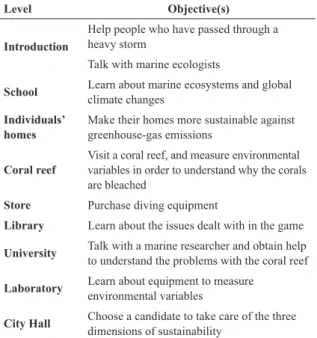
software. One important step in its development was to produce the Game Design Document (GDD), which includes a description of the story, objectives, rules, and all the characters and items of the game, as well as the Level Design Document (LDD), which includes a description of the scenarios, levels of the game (Table 3), the conditions
of entrance and exit of each level, and the low conditions at
each level (what the main character can and cannot do). Both
documents for the game are already inished, and the game
is now being tested. It can be accessed at the following link: http://professor.ufabc.edu.br/~natalia.lopes/jogosmarinhos/ index.php/prototipos-2. A page on facebook has also be-en developed (https://www.facebook.com/apicumgame). Subsequently, it will be applied to elementary and high
Another result of the project was the Extension cour-se for elementary and high-school teachers recycling (GHILARDI-LOPES et al., 2014a). Many teachers say they feel uncomfortable when addressing the subject of global environmental changes in their classrooms, since they know little about it. Taking this into account, an
ex-tension course on global changes and their efects on ma -rine and coastal environments was given to 15 elementary and high school teachers. During the course, they prepared and applied a didactic sequence. At the end, they presented and discussed the results. All didactic sequences, as well as theoretical information on the subject of the course can be accessed at the following link (GHILARDI-LOPES et al., 2014b): http://professor.ufabc.edu.br/~natalia.lopes/jogos-marinhos/index.php/material-de-apoio-2/17-e-book.
3. Learning with the Sea Project
Coordinators: Benjamim Teixeira, Laura Pio
-li Kremer and Renata Costella Acauan, IFSC
Objectives
The main goal is to stimulate the introduction of marine knowledge into school activities, thereby con-tributing to the implementation of marine-environmen-tal education activities in elementary and high schools.
Description and Conceptual Background
The project “Learning with the Sea” was initiated in mid 2012 in Santa Catarina State, and is under way. Santa Catarina, with a long coastline (531 kilometers), has an appreciable population closely related to the marine en-vironment. However, knowledge of marine ecosystems is slight, and subjects related with this environment are rarely present in school activities. One way to develop marine--environmental education is to stimulate the introduction and integration of this theme into the school curriculum. With this in mind, and by using the marine environment as a starting point to teach the concepts of various subjects across the curriculum, the project comprises a means of de-veloping marine-environmental awareness, and generating the understanding of marine processes, and how they are linked to local problems.Project execution is through workshops for students and teachers, the latter as prospective multipliers, and pro-cedures according to conceptual EE indicators (Table 1), with the constant stimulation of interdisciplinary dialogues between marine knowledge and daily school activities. The
educational objectives of speciic-workshop content are
Table 3. Levels of the educational game on global climate
changes and their efects on marine and coastal ecosystems,
with the objectives proposed for each one.
Level Objective(s)
Introduction
Help people who have passed through a heavy storm
Talk with marine ecologists
School Learn about marine ecosystems and global climate changes
Individuals’ homes
Make their homes more sustainable against greenhouse-gas emissions
Coral reef
Visit a coral reef, and measure environmental variables in order to understand why the corals are bleached
Store Purchase diving equipment
Library Learn about the issues dealt with in the game
University Talk with a marine researcher and obtain help to understand the problems with the coral reef
Laboratory Learn about equipment to measure environmental variables
City Hall Choose a candidate to take care of the three dimensions of sustainability
related with and linked to school curriculum disciplines. The basic knowledge content deals with marine biology, oceanography, human culture linked to the sea, the value of marine processes and resources, and global anthropogenic impacts on the marine environment.
Preliminary results
Implementation of models: with the participation of 1.253 students, 74 teachers and 20 monitors.
Evaluation of activities: the results were presented in
three scientiic events (ACAUAN et al., 2014; ACAUAN et al., 2012; KREMER et al., 2013).
Based on this project, a postgraduate course on Marine Sciences, as applied to Teaching (Ciências Marinhas Aplicadas ao Ensino) was created. This is an interdiscipli-nary course with 400 hours, which was initiated in 2014 at the ‘Instituto Federal de Santa Catarina’ Campus at Itajaí. Until now 35 students have participated. It is designed for pre-school, elementary and high school teachers from
se-veral ields of knowledge, such as science, social studies,
languages and arts. The main goals are:
Facilitate the application of marine-science insights to learning environments.
Enhance students’ knowledge of marine environmental sciences.
Stimulate new possibilities of interdisciplinary know-ledge-construction in schools.
Support educators by facilitating learning experience in the marine environment outside the classroom.
Provide students with opportunities to experience and investigate teaching practice.
4. Marvelous Brazilian Mangroves Program
Coordinators: Renato de Almeida, UFRB;
Clemente Coelho Junior, UPE; Yara
Schaeffer-Novelli, USP
Objectives
Support formal education programs in marine protected
areas. The speciic objective is to provide an educational
tool to help teachers and community members to interpret coastal and estuarine systems. In this way, the ‘Marvelous Mangroves’ contributes towards implementing a National Communication Strategy and environmental education in protected areas.
Description and Conceptual background
‘Marvelous Mangroves’ is a curriculum guide that is formally introduced and presented to elementary school te-achers (ALMEIDA et al., 2008). During the16–hour-cour-se, teachers are instructed on classroom and ield use. The
proposals for practical activities in coastal zone and marine ecosystems involve aspects of climate-change in the context of science and environmental education. After classroom ac-tivities, teachers are encouraged to develop projects covering an eight to ten month period. As these activities occupy about 84 hours, the duration of the whole course comes to 100
hours. Participants receive their certiicates on termination. A
system of training and evaluation, with the use of forms for teachers and students alike, facilitates monthly monitoring of all the teachers and schools involved. This strategy elimina-tes the punctual approach, common in educational projects. In Brazil, this program is coordinated by the Instituto Bioma Brasil (IBB), associated to the Mangrove Action Project (MAP), a US Non-Governmental Organization. To date, the Marvelous Mangrove curriculum guide has been applied in the towns of Cariacica and Fundão (Espírito Santo State), Maragojipe (Bahia State), Porto de Pedras (Alagoas State), and Tamandaré (Pernambuco State).
Preliminary Results
Records from circumstantial experience with curricu-lum guides in Brazil has shown that, besides reproducing
the proposed exercises, teachers also used these guides for motivating activities not dealt with therein. Non-course-participants were also involved with the projects developed in their own schools.
Incentives by the Brazilian Ministry of Environment (MMA) for the use of the curriculum guide in interpretati-ve programs in protected marine and coastal areas. Models were implemented in Cariacica (48 teachers, 19 schools), Fundão (61 teachers, 11 schools), Maragojipe (69 teachers, 14 schools), Porto de Pedras (30 teachers, 11 schools), and Tamandaré (30 teachers, 12 schools).
Dissemination of the curriculum guide in Brazil with support from MMA, local councils and other partner or-ganizations. The Ministry of Education (MEC) also gave support to an extension project of the Federal University of Bahia Recôncavo (UFRB).
Human-resource training and studies presented in
do-mestic scientiic events (ALMEIDA et al., 2010; SILVA et al., 2012b).
Evaluation system strengthening and recognizing the potential, as well as educational and administrative limi-tations. Noteworthy is the participation of students and teachers in a discussion forum and Educators Collective, besides the production of a video and interactive blog.
5. Investing in new talent from the public
education network for social inclusion and
development of scientific culture
Coordinators: Monica Dorigo Correia and
Hilda Helena Sovierzoski, UFAL
Objectives
Develop and improve the scientiic and technological
culture of teachers and students alike, in elementary and high schools of the Alagoas State public network, by con-ducting educational activities in the natural sciences area, aimed at encouraging the construction of new academic ac-tivities and teaching acac-tivities from a contextualized theo-retical and experimental viewpoint, in order to awaken and
broaden the vision of natural and scientiic phenomena, as
a strategy for the discovery of vocations and new talent.
Description and Conceptual background
This Project was begun in 2011, with three stages in-volving professors and students from public schools and undergraduate Biological Science courses, with grantsfrom the Scientiic Initiation Program (CAPES/UFAL). It
of the Teaching of Science and Mathematics (PPGECIM/ UFAL). All the students and both professors are associa-ted with the Sector of Benthic Communities of the Federal University of Alagoas.
Information on biodiversity and the preservation of Alagoas coastal ecosystems is still little divulged in the media or presented in the state elementary and high scho-ols. The need is known for expanding and improving hu-man resources directed to increasing studies on biodiver-sity and the preservation of coastal ecosystems in the state of Alagoas, as well as the training of students and teachers in elementary schools. The methodology used in this con-text is based on three steps:
a) Development of experimental and pedagogical kits with the participation of basic education teachers, students of the Undergraduate Program in Science Education and Mathematics of UFAL (PPGECIM) and teacher-researchers of UFAL, thereby targeting the use of alternative educatio-nal and innovative material to be used in activities in stages 2 and 3 in this sub-project. In the future, these will be made available for use by other teachers in basic education.
b) Education courses and the updating of teachers in the area of Natural Sciences from the public basic-edu-cation network, in order to improve the teaching-learning process.
c) Implementation of the program “Saturdays at the Plant Science” consisting of regular visits by public school students and teachers, thereby facilitating access to and operation of our educational collection
compo-sed of scientiic experiments and audiovisual resources,
and thus fostering interaction among students of educa-tion, basic researchers and teachers, all graduate students from the Program in Science Education and Mathematics (PPGECIM/UFAL).
Results
Studies of the biological sciences and environmental education were developed, as a means of integrating stu-dents from the various undergraduate courses at UFAL, in particular those related to promoting improvements in academic performance, and encouraging elementary and high school students to work in future related professions.
The results were reproduced in several articles on scien-ce teaching practiscien-ce (ARAÚJO et al., 2011; OLIVEIRA et al., 2011; SOUZA et al., 2011), biodiversity (LIMA JÚNIOR et al., 2012; SOUZA et al., 2013), and youth and adult education (SOUZA et al., 2011; SOVIERZOSKI et al., 2014). The aspects of science education and marine
biodiversity of Alagoas, including conservation and en-vironmental education, directed to basic education, and produced by the research group on Benthic Communities of UFAL are available on the site (http://www.icbs.ufal.br/ grupopesquisa/comunidadesbentonicas).
6. What we know about the biodiversity of
coastal ecosystems on Alagoas
Coordinators: Monica Dorigo Correia and
Hilda Helena Sovierzoski, UFAL
Objectives
The aims were to increase knowledge of biodiversi-ty in the coastal ecosystems of Alagoas State, and
spre-ad scientiic information on the conservation of reefs,
estuaries, mangroves and beaches by the general pu-blic, with emphasis on teachers and students in public schools.
Description and Conceptual background
This Project, which was initiated in 2012, in Alagoas State, was based on extension activities that concentratedeforts towards the transmission of knowledge about bio -diversity in Alagoas coastal ecosystems.
Marine biodiversity calls for the conservation of Alagoas State coastal ecosystems, which are poorly un-derstood and rarely reported on in elementary and high schools. The information generated and gathered by the Research Group on Benthic Communities served as the base for divulging knowledge and activities in environ-mental education, as directed to coastal conservation. This project involved undergraduate students from Biological Science courses with grants by CNPq/PIBIC, as well as undergraduate students from the programs of Teaching Science and Mathematics (PPGECIM), and Biological Diversity and Conservation in the Tropics (PPGDIBICT), all associated to the Sector of Benthic Communities of the Federal University of Alagoas.
Results
Studies were in the ield and the laboratory, with the
Scientiic results were divulged in several papers on
the biodiversity and coastal ecosystems of Alagoas State, and included topics such as reefs (OLIVEIRA; CORREIA, 2013a; OLIVEIRA et al., 2014; SILVA et al., 2013b), mangroves (OLIVEIRA et al., 2012; SOVIERZOSKI et al., 2014), and environmental education (PEDRINI et al., 2014b). Information on aspects related to the con-servation of coastal ecosystems and biodiversity of the Alagoas coast, including several new and endemic spe-cies, as well as publications on environmental protection that have been produced by this research group, are avai-lable on the site (http://www.icbs.ufal.br/grupopesquisa/ comunidadesbentonicas).
7. The Emancipatory Environmental Educa
-tion by Marine Ecotourism - EcoTourisMar
Project
Coordinator: Alexandre de Gusmão Pedri
-ni, IBRAG / UERJ
Objectives
The main objective of this Emancipatory
Environmental Education (EEE) project is to ofer tourism
products with environmental and economic sustainabi-lity. Focus is placed on: a) environmental managers and analysts from government agencies that grant licenses to enterprises operating in protected areas of sustainable use; b) tourism and ecotourism entrepreneurs involved in deve-loping economic activities with social and environmental sustainability; c) educators seeking alternative work ac-tivities, other than the present that negatively impact the environment.
Description and Conceptual Background
Economic activity derived from Brazilian tourism is mostly a repetition of the wild-capitalist model (un-fair and oppressive). This typical model of mass tou-rism concentrates income among entrepreneurs, while leaving only crumbs, in the form of jobs, to the em-ployees. These are often seasonal and deprived of so-cial security and labor rights (LOUREIRO, 2006). It falls to the underemployed community of dispropor-tionately low income, the option of acquiring touristproducts that are in no way socially or inancially mi -tigatory. Beyond incoming taxes, the local government apportions the entire positive income of the receiving infrastructure. Concomitantly, when appropriating both marine and coastal resources, tourists usually
generate disastrous social and environmental efects,
with a consequential and overwhelming impact on co-astal and marine biodiversity (PEDRINI et al., 2007; SILVA; GHILARDI-LOPES, 2012; TUNALA et al., 2013). Thus, Emancipation Environmental Education (EEE) is indispensable as a structuring strategy for promoting drastic changes in the behavior and attitu-des of active coastal-tourism enterprises (PEDRINI et al., 2011; PEDRINI et al., 2013b; RHORMENS; PEDRINI, 2015). The facile availability of ecotourism products with features directed to the marine environ-ment (GARROD; WILSON, 2004; GARROD et al., 2002; GARROD et al., 2003) undoubtedly enhance the
circumstances of those politicians and inanciers alike,
involved in activities that devastate the sea (PEDRINI et al., 2011.
The conceptual and operational paradigm of EEE (PEDRINI; BRITO, 2006; PEDRINI et al., 2015a; PEDRINI et al., 2013a; PEDRINI et al., 2011; PEDRINI et al., 2012; PEDRINI et al., 2010; PEDRINI et al., 2014b; RHORMENS, 2013; RHORMENS; PEDRINI, 2015) has been discussed by several authors. They propose that en-vironment education be considered as EEE by marine eco-tourism, and that it be characterized as: a) emancipatory; by facilitating the transformation of social actors from illegal citizens into productive ones, thereby involving them in the
ecotourism product, and generating their partial inancial
or overall independence, for example, as entrepreneurs or guides; b) transformative; by allowing those involved in the application of the product to acquire knowledge and skills through experience, thus enabling them to face, solve and prevent environmental problems, including those from the region of the ecotourism route; c) comprehensive; by pla-cing all or most of the social actors in the area under the
inluence of product application; d) globalizing, addressing
This model will generate compatibility between politi-cal action and survival, thus giving rise to a unique ecotou-rism product that presents the following characteristics: a) limitation to 10 participants (PEDRINI et al., 2011); b)
equitable sharing of the inancial beneits thereby genera -ted; c) occurrence in a natural environment involving the local community; d) inducing discussion on contextual socio-environmental subjects (environmental performan-ce); e) entire social and environmental protection as the end result (PEDRINI et al., 2011). Thus, a marine ecotou-rism product could be a feasible substitute for massive and predatory tourism in the marine environment (GARROD; WILSON, 2004; GARROD et al., 2002; GARROD et al., 2003).
Results
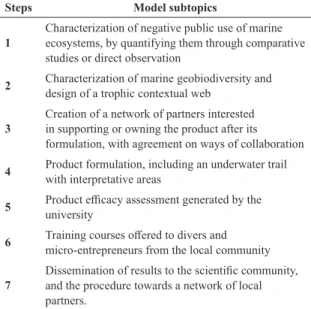
Table 4 presents the adopted methodological model with its main steps (PEDRINI et al., 2011).
Although two products were formulated on a research scale, the only one appropriately tested as a possible com-mercial product was snorkel-diving. Both products attract
tourists worldwide. The irst was launched in the Marine
Environmental Protection Area of Buzios (APAMAB), Rio de Janeiro State. The town of Buzios includes a seasi-de resort with very beautiful beaches. However, of late the town has been receiving visitors from ocean-going crui-sers that disembark thousands of passengers, just to spend the day on the beach. As meals are aboard ship, little use is made of local resources, and the town only receives by-products from such a massive and socially exclusive tou-rism. Fishermen have sold their instalations, and gone to live on the outskirts. Thus, involvement of the local com-munity has not been possible as was desired. However, the local state school has formed tour guides recognized by the Ministry of Tourism and the project has become a discipline in the course (PEDRINI et al., 2011; PEDRINI et al., 2012).
The second Ecoturismar product was developed in the Environmental Protection Area of Tinharé and Boipeba Islands (EPATB), Cairu county, Bahia State. There, mass tourism occurs mainly in the form of coral-reef visits,
re-sulting in clearly noticeable adverse efects. The test re -sults were: a) selection of Tassimirim beach, with variated marine geobiodiversity, for deploying an underwater trail 320 meters long; b) product testing with 28 participants: 89% rated the product as excellent; c) 76% of the tourists are agreeable to paying $ 17.00 to $ 33.00 for the product;
d) 80% of the residents classiied the product as excellent;
Table 4. Main steps of the model which facilitates the development of Emancipatory Environmental Education through Marine ecotourism.
Steps Model subtopics
1
Characterization of negative public use of marine ecosystems, by quantifying them through comparative studies or direct observation
2 Characterization of marine geobiodiversity and design of a trophic contextual web
3
Creation of a network of partners interested in supporting or owning the product after its formulation, with agreement on ways of collaboration
4 Product formulation, including an underwater trail with interpretative areas
5 Product eicacy assessment generated by the university
6 Training courses ofered to divers and micro-entrepreneurs from the local community
7
Dissemination of results to the scientiic community, and the procedure towards a network of local partners.
e) 91% would like to get involved with the product; f) 88% of local entrepreneurs rate the initiative as excellent; g) 55% of these would divulge the product; h) The price of the product is now $ 16.00. Income from the product applied during 10 days generated $ 433.00. If association holds, around 50% of the income would go to pay the di-ver and project technical coordinator, with almost 100%
proit.
8. Project PEAPP: Perception and Environ
-mental Education in a Public Square, as a
strategy to face Sea Global Warming
Coordinator: Alexandre Gusmão Pedrini,
IBRAG / UERJ
General objective
Develop a methodology for keen perception, as an en-vironmental and educational form of applying extension activities of UERJ, with the context of a material deta-chment event that occurs in a public square denominated Edmundo Rego in the city of Rio de Janeiro.
Specifics objectives
Environmental perception
detachment event have a higher level of socio-environ-mental knowledge than mere bypassers; c) check the level
of understanding of the real signiicance of certain selec -ted key-concepts, viz., the environment, the marine
envi-ronment, Global Climate Change (GCC), the efects of sea
global-warming, and the causes of GW; d) evaluate which media are important as sources of information on the stu-died subjects; e) check whether the subjects know who is responsible for GCC; f) learn whether visitors assume a participating attitude and adaptation to GCC.
Environmental Education
The main objectives are: a) develop a methodology for promoting environmental education to face global war-ming in a marine environment within the context ‘Climate Change’, among teens and adults who are visiting a
pu-blic square; b) due to contextual diiculties, through
‘Participatory Planning’ select which are the appropriate methodological strategies for environmental education action in the place chosen; c) test each of the chosen stra-tegies, as to suitability and performance; d) present the composition of the marine environment, its importance
and synergy, and the negative efects of Global Warming;
e) Encourage and discuss, what each can do, both
indivi-dually and collectively, to address the negative efects of
GW at sea.
Description and Conceptual Background
Environmental education, as a strategy for copingwith GCC, more speciically those arising from Global
Warming, and their impact on the sea, is in the very be-ginning. Vasconcelos and TAMAIO (2010) strongly cri-ticized the National Climate Change Plan developed by the Ministry of the Environment, for encouraging impro-vements in education in this area. The federal government subsequently published an interesting book on the subject written by TAMAIO (2013). This very preliminary work presents several guidelines on the way the environmental
educator should address GCC. One is to provide scientiic
information on identifying the phenomenon and its anthro-pogenic causes. He selected certain authors and sites
iden-tiied with the EE chain defended by him. Unfortunately,
in the process such works as those by PEDRINI (2008) and PEDRINI and SABA (2008) among others, and as presented in this article, were excluded.
In fact, in Brazil there is the lack of a comprehensi-ve synthesis of concomprehensi-vergence between EE and GCC. The practical character of the process is presented by VIEIRA
and BAZZO (2007), DEBONI (2007) and PEDRINI and SABA (2008). The irst reports on a case of EE with GW
in the classroom, showing scientiic methodology with a
strong epistemological component. The second is that by PEDRINI and SABA (2008), originally written in English. They proposed a methodology for addressing the main problem arising from GCC, i.e., Global Warming (GW). Work was carried out in three steps, in six classes
direc-ted to the irst and second years of High School. It was the basis of research for the ilm “An Inconvenient Truth”
presented by the former USA Vice President Al Gore. The third, by DEBONI (2007), presented relections on issues arising from global change (also centered in GW) and EE. This involved a series of conjectures on EE and the media, thereby proposing that environmental educators go deeper into the subject in theoretical and conceptual terms, and not be limited to a repetition of what has been seen on
TV or in ilms, such as “An Inconvenient Truth”, with its
plainly visible characteristics of self-promotion.
In fact, DEBONI (2007), besides undertaking
resear-ch in the ield, incited government oicials to assume their
responsibilities for more in depth studies of this delicate problem within the context of Brazilian environmental edu-cation, whence the subject requires the comprehensive trai-ning of the public, teachers, politicians, public authorities, etc. The contribution of this project arises from reaching the public that congregates at a material detachment event in a public square. Thus, this extension work addresses GCC to a congregation in a public space, as understood from the Habermas perspective (HABERMAS, 1984), viz., a locus
for collective claims, both by adults and teenagers.
Results
As to responsibility for GCC, Pedrini et al. (PEDRINI et al., 2015c) veriied whether respondents attributed this to humanity as a whole. However, it is important to point out that there are more important social actors to be hi-ghlighted, apart from those indicated in this naïve answer.
These are unscrupulous entrepreneurs and selish inves -tors, who only think about constantly increasing their
pro-it. In general, these groups attempt to cheat environmental
control systems, and have no scruples about worsening the environmental health of cities and their outskirts. Assign the deterioration of environmental quality by GCC to mankind as a whole could, to a certain extent, be a form of accommodation on the part of respondents, as also a trans-lation of the consumerist-capitalist-media maneuvers that crown our contemporary society. Another alternative is a way of attributing responsibilities to nobody in particular, and thus conceal the real and mainly responsible culprits, in other words, the rich industrial countries.
Some believe that only individual change would sui -ce for confrontation with GCC (GHILARDI-LOPES et al., 2014a; GHILARDI-LOPES et al., 2015). However, it has been shown that the simple acquisition of fresh knowledge
is insuicient to generate these changes (TAMAIO, 2013). PEDRINI et al. (PEDRINI et al., 2015b; PEDRINI et al., 2015c) showed that there are no daily individual attitudes.
The general belief was that collective eicacy would only
be attained through the implementation of mediating, public policies. Neither do they know that government planning is more concerned with plans for adjustments to the situation, and less to facing and situating changes. Furthermore, the existence of federal, state and municipal policies in the City of Rio de Janeiro is unknown, and there is no assessment
of their eicacy. This accommodation, even among envi -ronmentalists, is worrying. A possible explanation could be
discredit in a government oicial who might be the leading igure in formulating laws derived from policies. The sour -ces of information about GCC is one more topic of concern. The predominant ones are Internet (32%) and cable TV (21%). It is widely known that, to a large extent, data from both are either wrongly divulged or outdated. Nonetheless, the hypothesis about GCC tested by environmentalists in the square having an adequate information level, has be-en statistically provbe-en. However, on coping with GCC, this information-set cannot be translated into terms of attitudes in the daily lives of individuals.
The method on how individuals could face and
con-tribute towards solving the adverse efects of GCC pre -sented relative dispersion. Thus, it can be deduced that
the public in general knows nothing about what and how to act. The belief (reinforced by the concept of EE being merely behavioral, see PEDRINI et al., 2015b) is that only the adoption of essentially behavorial action of the three Rs, or eventual simple action, are adequate.
9. Diving in Seropedica’s education
Coordinator: Valéria Marques, UFRRJ,
Guilherme Henrique Pereira Filho, UNIFESP
Objectives:
This Project was started during 2011, with an interdisciplinary and interdepartmental character integrating teachers and students belonging to several
ields of knowledge, notably biology and psychology.
It was afterwards split into two sub-projects “Diving, the connection between Seropedica and UFRRJ: the use of narration in environmental education” (SILVA; MARQUES, 2012; VERAS et al., 2012; VINHAES et al., 2012) and “Dive and ideas, innovation and ideals” (MARQUES et al., 2013). Within the overall aim of
linking high school students to the university scientiic
environment, thereby favoring new possibilities in
knowledge construction, the irst was directed towards
collaboration with teachers, by enriching practical pedagogy through diving experience, and evaluating narration as a methodological tool. The second was aimed at evaluating the use of underwater trails, as an educational activity in high schools (CIEP 155 Maria Joaquina de Oliveira Seropédica/RJ). It was developed in two phases, viz., the training of environmental monitors/ multipliers, and the evaluation of the diving experience of students (Ilha Grande, RJ), through questionnaires and interviews.
Results
1. Development of protocols and implementation of 3 trails: “In loco” Ilha Grande terrestrial and underwater trails; Itinerant trail, in which the marine environment was discussed through comic strips in 10 panels; Virtual elec-tronic track (under development).
2. Development of supporting didatic material (MARQUES; PEREIRA FILHO, 2013; MARQUES et al., 2013).
3. Monitor training and formation –6 high school teachers and 11 monitors were formed.
5. Evaluation of activities – the discussion and activity evaluation were published as abstracts (MARQUES et al., 2013; SILVA; MARQUES, 2012; VERAS et al., 2012), and as an undergraduate dissertation (VERAS, 2014). A master dissertation is also in preparation.
10. Mussels: Evaluating and stimulating
community integration coupled to mussel
farming at Jurujuba, Niterói – Rio de Janeiro
Coordinators: Daniel Shimada Brotto,
Marcia Esteves Capello, Lucilia Ramos
Tristão, UVA; Marli Cigagna Wiefels, UFF)
Objectives
The main goal is to evaluate socio-environment per-ception, and various forms of production of those directly and indirectly involved in mussel farming, prior to imple-menting advisory action aimed at optimizing both activi-ties and social emancipation.
Description and Conceptual Background
Although handicraft ishing, tourism and sea farming
can be considered as natural local vocations, there have been many problems since the end of the 70’s, evidently brought about by the lack of understanding on the part of government
authorities. The formerly traditional ishing community is
now a decadent and disorderly town district, composed of seafood restaurants, and decrepit sardine canning industries,
commercial ishing docks, yachting marinas and mussel far
-ms, in other words, a diversiied human community mainly
composed of lower income citizens (RITTER, 2007). Since the end of the 80’s, mussel farming emerged as
a proitable and economic activity in the region, nowadays
this being the main source of income that sustains many families, independent of the questionable water condi-tions, the lack of organization, and the technological gap among local entrepreneurs.
Project approach is quite in accordance with the pre-cepts of Environmental Education for Sustainable Societies (PEDRINI; BRITO, 2006), by aiming at self-emancipation and the integration of individuals by permanent participa-tion in the soluparticipa-tion of on-the-spot environmental quesparticipa-tions.
Preliminary results
As they belonged to families of mussel farmers and
ishermen, the primary focus was centered on a group of
school students in the region. At the end of 2011, and after
a irst contact with teachers and the director of the CEFEM
(Colégio Estadual Fernando de Magalhães), students were invited by their teachers to participate in environmental
education activities, speciically beach surveys and rapid
assessment protocols, carried out in the neighborhood, and also to attend extra school lectures, when they were asked to respond to questionnaires, to so evaluate perception and
the eicacy of the speciic activity. Those directly invol -ved in mussel farming were informally interviewed and observed in situ during working hours.
Results from the aforementioned approaches should be considered, when planning instructive activities focu-sing the optimization of mussel farming at Jurujuba, and of the use of discarded shells in handcraft and the arts. The implicit aim is to foment critical perception of the world, as well as community integration, focusing on a certain charismatic living marine resource, since in Brazil the
word mexilhão (mussel) can be used to deine, not only an
inquisitive and restless person, but also another important aspect of the cultivated mussel species, Perna perna, a very resilient invasive species that was accidentally brou-ght to South America in slave ships from Africa, as were the ancestors of most of the people living in Jurujuba.
CONCLUSIONS
Marine and coastal environment-education activities in
Brazil are still scarce and need to receive efective support
from such integrated networks as ReBentos, which unite researchers from various regions of the country, thereby facilitating the creation of sub-networks and the exchange of information, data and results. There are several models of Marine Environmental Education under way. They
di-fer mainly as to the theoretical approach (PEDRINI, 2008; PEDRINI, 2013), as for example, being in accordance with the theory of Popular Education by Paulo Freire, or with Critical Environmental Education. They also vary in the methodological strategies selected to obtain data or their analysis (PEDRINI, 2007) such as the selection of action research, interviews, life histories, questionnaires, and con-tent or speech analysis, among others. What can be stan-dardized over short-term are data-analysis methods in the context of a quantitative paradigm, since within the qualita-tive, standardization would only be possible after numerous actions and projects have been completed. Only in this way is it possible to think of establishing standardized procedu-res based on a solid conceptual framework.
work-group is dealing with activities and projects that still do not use the biologic results from the other groups of the network (estuaries, beaches, submersed vegetated bottoms, reefs and rocky shores, mangroves and salt mar-shes). The aim is to increase the use and exchange of these data in the future. Actions should be expanded to public schools, as well as to other states within the country. EE
approaches with the speciic goal of impacting decision --makers and media are also considered fundamental.
ReBentos Directives for Marine-Environ
-ment Education
Climate change is an excellent pedagogical oppor-tunity for inducing desirable outcomes in environmental education. It serves as a means for teaching the science of complex systems, and comprises a teaching opportunity for meaningful learning, through being ideal for debating the application of the precautionary principle. Nonetheless, the complexity and global nature of the phenomenon,
as-sociated with the diiculty of modifying human behavior, complicates the choice of eicient strategies in climate --change education. Therefore, the evaluation of medium and long-term education intervention is crucial. Besides the number of participants or events, evaluation should be
based on achievement of speciic environmental education
indicators.
As a further step, deinite protocols should be elabora -ted for each EE model, to so serve as supports for newco-mers to the area, and for direct action within the network, thereby facilitating the exchange of experience and mate-rial among ReBentos groups.
ACKNOWLEDGMENTS
Thanks to MCT MCT/CNPq/MEC/CAPES/
FNDCT for inancial support through the Edital
Ação, Ação Transversal/FAPs Nº 47/2010, Sistema Nacional de Pesquisa em Biodiversidade - SISBIOTA BRASIL, (Processo FAPESP: 2010/52323-0; Processo
CNPq:563367/2010-5). To FAPESP for inancial support
to N. P. Ghilardi-Lopes (2012/03922-3).
REFERENCES
ACAUAN, R.; KREMER, L. P.; TEIXEIRA, B.; PILOTTO, A. L. S. Aprendendo com o Mar: subsídios ao desenvolvimento da educação ambiental marinha no ensino básico. Congresso Brasileiro de Oceanograia. Itajaí, 2014.
ACAUAN, R. C.; KREMER, L. P.; TEIXEIRA, B.; ZIPPER, G.; GONÇALVES, I.; LIM, M. D. S. D. Aprendendo com o Mar: inserção da mentalidade marítima no ensino fundamental, Itajaí, SC. IV Encontro Nacional dos Núcleos de Pesquisa Aplicada em Pesca e Aquicultura. Itajaí, 2012.
ALMEIDA, R.; FRAGA, R. A.; DEMONER, A. R.; FERRAZ, V. Quando a educação não formal encontra a escola. Projeto po-vos e mangues: 20 meses de monitoramento. Rev. SBENBio., v. 3, p. 2486-2497, 2010.
ALMEIDA, R.; COELHO JÚNIOR, C.; CORETS, E. Os Mara-vilhosos Manguezais do Brasil. Cariacica: Papagaia, 2008. 266 p.
ARAÚJO, E. S. A.; OLIVEIRA, A. P. L.; MORAIS, J. P. S.; SOVIERZOSKI, H. H.; CORREIA, M. D. Trabalho prático aplicado ao ensino de ciências naturais. I Encontro Luso-Bra-sileiro sobre Trabalho Docente: Maceió, 2011 p. 145-150. AUSUBEL, D. P.; NOVAK, J. D.; HANESIAN, H. Psicologia
edu-cacional. 2. ed. Rio de Janeiro: Interamericana, 1980. 626 p. BARKER, N. H. L.; ROBERTS, C. M. Scuba diver behaviour
and the management of diving impacts on coral reefs. Biol. Conserv.,v. 120, n. 4, p. 481-489, 2004.
BELLARD, C.; BERTELSMEIER, C.; LEADLEY, P.; THUILLER, W.; COURCHAMP, F. Efects of climate change on the future of biodiversity. Ecol. Lett., v. 15, n. 4, p. 365-377, 2012.
BERCHEZ, F.; GHILARDI, N.; ROBIM, M. J.; PEDRINI, A. G.; HADEL, V. F.; FLUCKIGER, G.; SIMÕES, M.; MAZZA-RO, R.; KLAUSENER, C.; SANCHES, C.; BESPALEC, P. Projeto Trilha Subaquática: sugestão de diretrizes para a cria-ção de modelos de educacria-ção ambiental em unidades de con-servação ligadas a ecossistemas marinhos. OLAM – Ciênc. Tecnol.,v. 7, n. 3, p. 181-209, 2007.
BERCHEZ, F.; MANSILLA, A.; GHILARDI-LOPES, N. P.; SHWINDT, E.; LEITE, K.; ROZZI, R. Ecology and Educa-tion in Marine Protected Areas: Insights from Brazil and South America. In: ROZZI, R.; CHAPIN III, F. S.; CALLICOTT, J. B.; PICKETT, S. T. A.; POWER, M. E.; ARMESTO, J. J., MAY JÚNIOR, R. H.(Eds.). Earth Stewardship: Linking Ecol-ogy and Ethics in Theory and Practice. Cham: Springer Inter-national Publishing, 2015. v. 2, 2015. p. 351-366.
BERCHEZ, F. A. S.; CARVALHAL, F.; ROBIM, M. J. Under-water interpretative trail: guidance to improve education and decrease ecological damage. Int. J. Environ. Sust. Devel.,v. 4, n. 2, p. 128-139, 2005.
BERCHEZ, F. A. S.; OLIVEIRA FILHO, E. C.; AMÂNCIO, C. E.; GHILARDI, N. P. Possíveis impactos das mudanças climáticas globais nas comunidades de organismos marinhos bentônicos da costa brasileira. In: BUCKERIDGE, M. (Ed.). Biologia & Mudanças Climáticas no Brasil. São Carlos: RiMa, 2008. p.167-180.
BERCHEZ, F. A. S.; TIAGO, C. G.; ROSSO, S.; DIAS, G.; OLIVEIRA, E. C. Structure of a coralline algal bed on south-eastern Brazil. Braz. J. Biol.,v. 13, p. 49-57, 2009.
BRASIL. Ministério do Meio Ambiente e Ministério da Educa-ção. Programa Nacional de Educação Ambiental. 3. ed. Bra-sília: MMA e MEC, 2005. 102 p.
BRECHIN, S. R. Sociology: Shaping US climate opinion. Nat. Clim. Chang.,v. 2, p. 236-237, 2012.