Case Repor
t
Study conducted at the Department of Physical Therapy, Speech-Language Pathology and Audiology, and Occupational Therapy, School of Medicine, Universidade de São Paulo – USP – São Paulo (SP), Brazil.
Conflict of interests: None
(1) Department of Physical Therapy, Speech-Language Pathology and Audi-ology, and Occupational Therapy, School of Medicine, Universidade de São Paulo – USP – São Paulo (SP), Brazil.
(2) Laboratory of Investigation in Phonology, Department of Physical Therapy, Speech-Language Pathology and Audiology, and Occupational Therapy, School of Medicine, Universidade de São Paulo – USP – São Paulo (SP), Brazil.
Correspondence address: Haydée Fiszbein Wertzner. R. Cipotânea, 51, Cidade Universitária, São Paulo (SP), Brasil, CEP: 05360-160. E-mail: [email protected]
Received: 7/11/2012; Accepted: 10/8/2012
therapeutic intervention in speech sound disorders
A efetividade dos testes complementares no acompanhamento
da intervenção terapêutica no transtorno fonológico
Haydée Fiszbein Wertzner1, Luciana de Oliveira Pagan-Neves2
ABSTRACT
Therapeutic planning and evolution of children with speech sound disorders are related to both the initial assessment and to the complementary tests selected to be applied. Monitoring the case by regular evaluations adds important information to the diagnosis, which allows strengthening the initial findings with regards to the underlying deficits identified in the initial evaluation. The aim of this case report was to verify the effectiveness and the efficiency in using the Percentage of Consonants Correct – Revised (PCC-R) index as well as complementary tests of speech inconsistency, stimulability and phonological awareness skills in monitoring therapeutic intervention in children with speech sound disorders. The study included three male children. At the time of initial evaluation, Case 1 was 6 years and 9 months old, Case 2, 8 years and 10 months old, and Case 3, 9 years and 7 months old. In addition to the specific assessment of phonology, complementary tests were used to help in verifying the underlying deficits for each specific case. Subjects were also evaluated on phonological awareness abilities, speech inconsistency and speech stimulability. Data analysis confirmed that the complementary tests selected for this case study were effective and efficient to complement initial diagnostic as well as to demonstrate modifications that occurred in the three subjects with speech sound disorders.
Keywords: Child language; Language disorders; Language tests; Effectiveness; Evaluation
INTRODUCTION
Intervention on Speech Sound Disorders (SSD) for diag-nostic or treatment purposes must consider causal factors ad manifestation characteristics of the disorder. Although speech disabilities (SD) are the most occurring speech disorder ob-served during infancy the identification of its specific cause is still ignored(1,2) especially because children are a heterogeneous
population(3).
Recent researches have focused on the classification of subtypes of SD(2,4). The authors identified four different
sub-types: phonological delay, consistent deviant phonological
disorder, inconsistent deviant phonological disorder and articulation disorder.
Another group of researchers(1,3) described a classification
system for SSD of currently unknown origin based on etiology and typology of the disorder. The aetiologic subtypes consider cognitive-linguistic processing – genetically transmitted in part; auditory-perceptual processing – as a consequence of the fluctuant conductive hearing loss associated with early recur-rent otitis media with effusion; and affective – associated with developmental psychosocial involvement. The typology-based classification includes normalized speech acquisition, speech delay, motor speech disorder and speech errors.
Heterogeneity of children with speech disabilities is an evidence observed in many studies(1,2,5) and indicate the need
of a more detailed diagnostic procedure. At the selection of complementary tests to be applied to each child the speech and language pathologist should consider which tests are able to provide data for a more detailed diagnosis indicating the subtype of the disorder.
The initial evaluation and the complementary tests selected are directly related to both therapeutic planning and evolution monitoring. Regular monitoring of each case adds important new information to the diagnosis and enables to strengthen initial findings regarding the underlying difficulties.
SSD and also quantify children’s evolution on treatment is based on the calculus of the percentage of consonants correct (PCC-R)(5).
The use of complementary tests combined with the result of the disorder allows the clinician to identify of the most impai-red processing for each child. There are many complementary tests adapted to Brazilian Portuguese-speakers that can be used to evaluate different aspects of speech and language behavior in children with and without SD.
Children with SSD, which present phonological impair-ment as strong evidence, also present difficulties in phonolo-gical awareness abilities, speech inconsistency and stimula-bility to the absent sounds from the phonetic inventory. Such manifestations have to be currently evaluated for adjustments on the therapeutic model.
A continuous challenge for speech and language patholo-gists is to currently check the therapeutic model adopted based on its efficiency and effectiveness. The current case study addresses the efficiency and effectiveness of both PCC-R and complementary tests of speech inconsistency, speech stimu-lability and phonological awareness in monitoring therapeutic intervention of children with SSD.
CLINICAL CASES PRESENTATION
This study was approved by the Ethics Commission for the Analysis of Research Projects (CAPPesq) of the Clinical Board of the General Hospital and School of Medicine of the Universidade de São Paulo (nº 0192/11). All parents signed the free and informed consent term.
Three male children with SSD were recruited for the present study. At the time of the first evaluation Case 1 was 6 years and 9 months old; Case 2 was 8 years and 10 months old; and Case 3 was 9 years and 7 months old.
Participants were children attending to weekly therapeutic intervention sessions at the Investigation Laboratory of Phono-logy from the Department of Physical Therapy, Speech-Lan-guage Pathology and Audiology, and Occupational Therapy from the School of Medicine of the Universidade de São Paulo (USP). Responsible therapists were students from the last year of the Undergraduate Program in Speech-Language Pathology and Audiology under the supervision of a PhD assistant and the professor responsible for the laboratory mentioned above.
Diagnostic procedure initiated on the beginning of the year 2011. Picture naming and word’s imitation tasks from the phonology test(6) of the Infantile Language Test ABFW(7)
developed for Brazilian Portuguese-speakers was applied. PCC-R(5) was calculated based on both tasks from the
pho-nology test. We used other complementary tests in order to identify the underlying deficits of the disorder. At the present study we will use the results from the: phonological sensitivity test for both auditory task (PST-A) and visual task (PST-V)(8),
segmentation of words and pseudo-words tests (adapted from the test CTOPP)(9), speech inconsistency test(10) and
stimula-bility test(11,12). Age and gender effects were considered on the
analysis of the results according to the original studies(8-12).
Table 1 presents PCC-R and complementary tests results before therapeutic intervention begins for the three case
stu-dies. Case 1 was consistent and did not present absent sounds; Case 2 was inconsistent and did not present absent sounds either; Case 3 was consistent and presented absent sounds but was not stimulable to none of them.
Participants were revalued at the end of the year 2011 after 20 therapeutic sessions of intervention. The three case studies were submitted to the cycles approach(13) adapted by the
rese-archers from the Laboratory during the therapeutic sessions. The adapted model is compound by five therapeutic ses-sions. The first two therapeutic sessions involved auditory stimulation, articulatory reinforcement and minimal pairs activities with the target sound previously selected. Auditory stimulation, articulatory reinforcement and minimal pairs activities with the target sound were maintained at the third and fourth therapeutic sessions in addiction to phonological awareness activities also involving the same minimal pairs. The fifth and last session involved minimal pairs activities with the target sound and the evaluation of the targeted phonological process using a picture naming and a word imitation task. An 80% accuracy criterion was required to move from one cycle to the next one. For each case study, the selection of the minimal pair was based on the most occurring phonological process ob-served at the initial evaluation previous to therapeutic sessions. The three children were submitted to four cycles of inter-vention between the months of March and November of 2011. The four cycles for Case 1 were based on the error pattern of fricative devoicing including the minimal phoneme contrasts /f/ x /v/ (two cycles) and /s/ x /z/ (two cycles). The four cycles for Case 2 were based on the error pattern of fricative and stops devoicing including the minimal phoneme contrasts /f/ x /v/, /s/ x /z/, /S/ x /Z/ and /t/ x /d/ (one minimal pair per cycle). The same cycle was repeated four times for Case 3 based on the error pattern of velar fronting including the minimal phoneme contrasts /t/ x /k/.
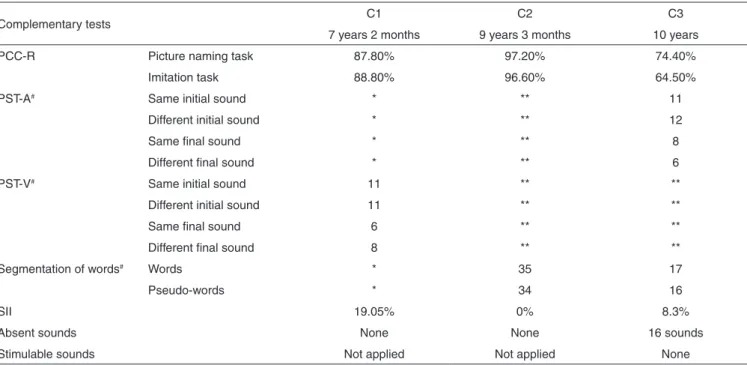
Table 2 presents PCC-R and complementary tests results after the four cycles from the therapeutic intervention for the three case studies. Observations from this table indicated that Case 2 became consistent and Case 3 was still not stimulable to any of the absent sounds.
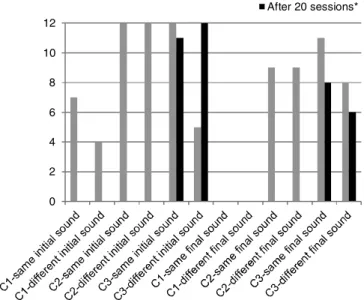
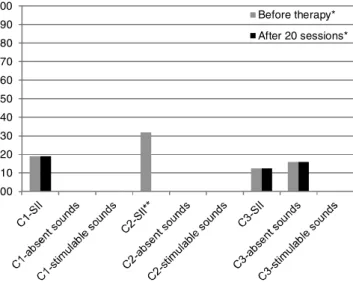
Figures 1 to 5 illustrate a comparison of PCC-R and the complementary tests (PST-A, PST-V, segmentation of words and pseudo-words test, speech inconsistency testand stimu-lability test) of the children’s performance before and after therapeutic intervention sessions respectively.
Figure 1 presents the comparison of PCC-R results be-tween the first (before therapeutic intervention) and the second (after therapeutic intervention) phonological evaluations. The Wilcoxon test indicated no statistically significant differences between PCC-R results for the three cases (p=0.180).
Figure 2 demonstrates the results from the test PST-A be-fore and after the therapeutic sessions. There was no difference between the values of the test comparing the two applications for the three case studies (C1, p=0.180; C2, p=0.157 and C3, p=0.655). Expected mean number of correct answers of the test already published(8) for children without any speech and
for same initial sound, 9.3 for different initial sound, 7.1 for same final sound, and 6.7 for different final sound.
Figure 3 shows the results from the test PST-V(8) before and
after the therapeutic sessions. Results indicated no difference between the values of the test comparing the two applications for C1 (p=0.180) that was the only child to whom the test was applied after the therapeutic sessions. Expected mean
number of correct answers of the test already published(8) for
children without any speech and language impairment were: for 6 year-olds – 7.8 for same initial sound, 4.9 for different initial sound, 5.8 for same final sound and 4.8 for different final sound; for 7 year-olds – 11 for same initial sound, 10.7 for different initial sound, 7.5 for same final sound, and 8.0 for different final sound.
Table 1. Phonological profile from the three case studies at the first evaluation (before 20 sessions of therapeutic intervention)
Complementary tests C1 C2 C3
6 years 9 months 8 years 10 months 9 years 7 months
PCC-R Picture naming task 71.70% 88.80% 66,60%
Imitation task 70.09% 90.65% 56.07%
PST-A# Same initial sound 7 12 12
Different initial sound 4 12 5
Same final sound * 9 11
Different final sound * 9 8
PST-V# Same initial sound 8 11 11
Different initial sound * 11 11
Same final sound * 10 12
Different final sound * 12 11
Segmentation of words# Words * 28 15
Pseudo-words * 28 12
SII 19.05% 32% 12.50%
Absent sounds None None 16 sounds
Stimulable sounds Not applied Not applied None
Note: C1 = Case1; C2 = Case 2; C3 = Case 3; SII = speech inconsistency index; PST-A = Phonological Sensitivity test – auditory version; PST-V = Phonological Sensitivity Test – visual version; # = number of correct responses; * = did not respond to the test
Table 2. Phonological profile from the three case studies at the second evaluation (after 20 sessions of therapeutic intervention)
Complementary tests C1 C2 C3
7 years 2 months 9 years 3 months 10 years
PCC-R Picture naming task 87.80% 97.20% 74.40%
Imitation task 88.80% 96.60% 64.50%
PST-A# Same initial sound * ** 11
Different initial sound * ** 12
Same final sound * ** 8
Different final sound * ** 6
PST-V# Same initial sound 11 ** **
Different initial sound 11 ** **
Same final sound 6 ** **
Different final sound 8 ** **
Segmentation of words# Words * 35 17
Pseudo-words * 34 16
SII 19.05% 0% 8.3%
Absent sounds None None 16 sounds
Stimulable sounds Not applied Not applied None
Figure 4 presents the results from the test of segmenta-tion of words and pseudo-words before and after therapeutic sessions. Wilcoxon test indicated no difference between the two applications of the test for both case 2 and 3 (p=0.180). Expected mean number of correct answers of the test already published(9) for children without any speech and language
im-pairment were: 26 for preschool children, 30.4 for first grade and 29 for second grade.
Figure 5 demonstrates the results from the speech incon-sistency index (SII) before and after therapeutic sessions. Expected mean number of correct answers of the SII for male children already published(10) were: 18.3 at 6 years old, 15.7 at
7 years old, 13.1 at 8 years old, and 10.5 at 9 years old.
Note: C1 = Case 1; C2 = Case 2; C3 = Case 3
Figure 1. Comparison between PCC-R values before and after the-rapeutic intervention
Note: C1 = Case 1; C2 = Case 2; C3 = Case 3; * test was applied only to the cases that demonstrated correct responses below the expected values at the first evaluation (before intervention)
Figure 2. Comparison between PST-A results before and after thera-peutic intervention
Note: C1 = Case 1; C2 = Case 2; C3 = Case 3; * test was applied only to the cases that demonstrated correct responses below the expected values at the first evaluation (before intervention)
Figure 3. Comparison between PST-V results before and after thera-peutic intervention
Note: C1 = Case 1; C2 = Case 2; C3 = Case 3; * age was not sufficient for the application of the test to C1
Figure 4. Comparison between segmentation of words and pseudo--words test before and after therapeutic intervention
DISCUSSION
Case 1
Case 1 was the youngest child of the study and had no knowledge of letters at the first evaluation date (test of seg-mentation of words and pseudo-words was not applied). This child also did not comprehend the initial testing for the pho-nological awareness tests (PST-A and PST-V) so these tests were not applied either.
This child presented the greatest difference between PCC--R measured before and after therapeutic sessions at both phonology tasks. The increased value indicates that the child improved his production even though he still presents speech difficulties, as demonstrated by the speech inconsistency index (SII) that was the same after the second evaluation.
The SSI measured was 19.5% that is in accordance with the expected values for gender and age, which means that the child was consistent(10). Such observations indicate an existent
phonological organization previous to therapeutic sessions facilitating child’s enhancement afterwards.
Speech stimulability test was not evaluated before the be-ginning of the therapeutic intervention because this child did not present absent sounds (as observed at the two phonology tasks).
General analysis of this case study indicated that this child presented great response to the therapeutic intervention because he presented no absent sounds from the phonetic in-ventory. It indicates a predominance of a commitment at the cognitive-linguistic processing level which confirms that such cases tend to present a fast response to treatment.
Case 2
Case 2 did not demonstrate difficulties associated to the phonological awareness abilities. At the laboratory that
con-ducted the study we usually do not retest abilities in which children presented results in accordance with the expected values (except for the cases in which age changes). Considering expected values for this test(9) we observed an improvement
of the number of correct responses for the segmentation of words after therapeutic sessions, but the same is not true for the segmentation of pseudo-words. However it is important to note that even though the ability of segmenting pseudo-words was not in accordance to the expected values after therapeutic intervention, the child improved his results indicating the effectiveness of the test in identifying phonological awareness difficulties.
PCC-R value of this child was high at the initial evaluation indicating a mild SSD. After the therapeutic sessions PCC-R values increased close to 100% what reinforces the effective-ness of the application of this index.
The SSI measured for this case was higher than the ex-pected values for gender and age, which means that the child was inconsistent(13) at the initial evaluation. However after the
therapeutic intervention this case became a 100% consistent. This result indicates that the evaluation of speech inconsistency in children with SSD enables a specific evaluation regarding both sound’s selection and sequencing inside a phonological structure, which indicates a deficit at the phonological proces-sing affecting motor planning (4,11).
The fact that this child did not present absent sounds from the phonetic inventory associated with the decrease of the SSI were favorable factors to the better results observed after the retest using the same complementary tests.
General analysis of this case study indicated that even though this child presented an underlying deficit associated to a cognitive-linguistic difficulty the fact that he was a mild case linked to the therapeutic intervention contributed to effective learning of phonological rules.
Case 3
This was the most severe case study as observed by the results of the complementary tests before and after therapeutic intervention sessions.
Even though this case did not present evident difficulties on phonological awareness abilities he demonstrated the number of correct responses below the expected values for the segmentation of words and pseudo-words test. Such result is compatible to the speech gravity of this child and indicates that his difficulties are related to the more refined phonological awareness abilities.
The value of the SSI decreased after therapeutic sessions indicating that this child developed a better organization on the sounds selection and sequencialization to improve his speech production. Such improvement points out to the importance of the application of the SSI test as a complementary test even for the cases who present values of SSI adequate at the mo-ment of the initial evaluation since it is expected that speech inconsistency decreases according to age(14).
Differently from the two other children Case 3 was the only to present absent sounds at the initial evaluation so stimulabil-ity test was applied. This child presented 16 absent sounds (all
Note: C1 = Case 1; C2 = Case 2; C3 = Case 3; SII = speech inconsistency index; * no absent sounds were observed for cases 1 and 2. ** SII was zero for case 2 after therapeutic intervention
consonantal clusters with /l/ and /R/, /R/ in coda position and velars /k/ and /g/) but he was not stimulable to any of them not even after therapy intervention.
The use of the stimulability test as a complementary tool assists on the selection of the target sound to be focused on speech therapy since absent but stimulable sounds tend to be learned faster than the absent but not stimulable ones(15).
As Case 3 was not stimulable to the tested absent sounds the target sound selected for speech therapy was based on the age of typically developing children(6).
The analysis of the stimulability test results associated to the cognitive-linguistic deficit of the child demonstrated that it was an effective measure to indicate a specific speech production difficulty. Maturational aspects involving sensory and motor information and also the influence of the following sound may interfere at stimulability(15).
FINAL COMMENTS
Data analysis demonstrated that the application of complementary tests was effective and efficient as additional information to diagnostic and also as an indicator of modifi-cations that occurred after speech therapy. Even though the three case studies were submitted to the same therapeutic model, the complementary tests demonstrated to be useful as a therapeutic monitoring to be applied independently of the therapeutic model.
The calculus of PCC-R at the initial evaluation and after
therapeutic intervention provides an objective measure to in-dicate the evolution of the child facilitating clinical reasoning. The use of phonological awareness tests such as PST-A and PST-V reveals important data to the continuity of therapeutic procedure demonstrating which specific strategies have to be included at the therapy activities.
The test of words segmentation applied to scholar aged children as a measure of therapeutic evolution may indicate the most appropriate moment to integrate reading and writ-ing activities to the phonological awareness activities already used in therapy.
The use of the speech inconsistency test indicates the pos-sibility of a difficulty on phonological planning that may affect phonetic planning during speech production. In general speech therapy to inconsistent children should consider a therapeutic model directed to promote a consistent speech so that the therapist could be able to deal with the phonological rules.
Evaluation of speech stimulability (applied to children with absent sounds) reflects the difficulty on the interaction of auditory-perceptual aspects with the speech production. When used as a test for monitoring therapeutic evolution it may indicate specific difficulties on the selection of the sensorial input, selective attention, attribution of meaning to auditory stimuli and on the organization of the adequate motor response to produce the target sound.
The application of such tests when used only to verify the therapeutic evolution is a limitation of this study since they provide quantitative data only which are not always able to explain the evolution of the child during speech therapy.
RESUMO
O planejamento e a evolução terapêutica de crianças com transtorno fonológico estão diretamente relacionados à avaliação inicial e aos testes complementares aplicados. Acompanhar a evolução do caso por meio de verificações regulares acrescenta informações importantes à avaliação diagnóstica, o que permite fortalecer achados iniciais a respeito da dificuldade subjacente identificada na avaliação inicial. Assim, no presente estudo de caso verificou-se a efetividade e a eficiência da aplicação do índice de porcentagem de consoantes corretas revisado (PCC-R) bem como dos testes complementares de inconsistência de fala, de estimulabilidade e de habilidades metafonológicas no acompanhamento da intervenção terapêutica em crianças com transtorno fonológico. Participaram deste estudo três crianças do gênero masculino. Na data da avaliação inicial o Caso 1 tinha 6 anos e 9 meses de idade, o Caso 2, 8 anos e 10 meses, e o Caso 3, 9 anos e 7 meses. Além da avaliação específica da fonologia, foram aplicados testes complementares que auxiliaram na verificação da dificuldade subjacente específica em cada um dos casos. Desta forma, os sujeitos foram submetidos à avaliação de habilidades metafonológicas, à prova de inconsistência de falae de estimulabilidade. A análise conjunta dos dados permitiu constatar que os testes selecionados foram efetivos e eficientes tanto para complementar o diagnóstico como para indicar mudanças nos três casos de crianças com transtorno fonológico.
Descritores: Linguagem infantil; Transtornos da linguagem; Testes de linguagem; Efetividade; Avaliação
REFERENCES
1. Shriberg LD, Fourakis M, Hall SD, Karlsson HB, Lohmeier HL, Mcsweeny JL, et al. Extensions to the Speech Disorders Classification System (SDCS). Clin Ling Phon. 2010;24(10):795-824.
2. Broomfield J, Dodd B. The nature of referred subtypes of primary
speech disability. Child Lang Teach Ther. 2004;20(2):135-51. 3. Shriberg LD, Austin D, Lewis BA, McSweeny JL, Wilson DL. The
4. McIntosh B, Dodd B. Evaluation of core vocabulary intervention for treatment of inconsistente phonological disorder: three treatment case studies. Child Lang Teach Ther. 2008;24:307-27.
5. Shriberg LD, Austin D, Lewis BA, Mcsweeny JL, Wilson DL. The percentage of consonants correct (PCC) metric: extensions and reliability data. J Speech Lang Hear Res.1997;40(4):708-22.
6. Wertzner HF. Fonologia. In: Andrade CR, Befi-Lopes DM, Fernandes FD, Wertzner HF. ABFW: Teste de Linguagem Infantil nas Áreas de Fonologia, Vocabulário, Fluência e Pragmática. São Paulo: Pró-Fono; 2004.
7. Andrade CR, Befi-Lopes DM, Fernandes FD, Wertzner HF. ABFW: Teste de Linguagem Infantil nas Áreas de Fonologia, Vocabulário, Fluência e Pragmática. São Paulo: Pró-Fono; 2004.
8. Herrero SF. Perfil das crianças: pré-escolares e escolares no teste de sensibilidade fonológica. [dissertação]. São Paulo: Universidade de São Paulo, Faculdade de Filosofia, Letras e Ciências Humanas; 2001. 9. Rosal CA. Habilidades de segmentação fonêmica em crianças
normais de primeira, segunda e terceira séries do ensino fundamental. [dissertação]. São Paulo: Universidade de São Paulo, Faculdade de Filosofia, Letras e Ciências Humanas; 2002.
10. Castro MM, Wertzner HF. Speech Inconsistency Index in Brazilian Portuguese-Speaking Children. Folia Phoniatr Logop. 2011;63(5):237-41.
11. Castro MM, Wertzner HF. Influence of sensory cues on the stimulability for liquid sounds in Brazilian Portuguese-speaking children. Folia Phoniatr Logop. 2009;61(5):283-7.
12. Castro MM, Wertzner, HF. Estimulabilidade: medida auxiliar na identificação de dificuldade na produção dos sons. J Soc Bras Fonoaudiol. 2012;24(1):49-56.
13. Hodson BW. Evaluating and enhancing children’s phonological systems: research and theory to practice. 1a ed. Greenville: Thinking Publications; 2007. 231p.
14. Powell TW, Miccio AW. Stimulability: a useful clinical tool. J Commun Disord. 1996;29(4):237-53.