25th PAN AMERICAN SANITARY CONFERENCE
50th SESSION OF THE REGIONAL COMMITTEEWashington, D.C., 21-25 September 1998
Provisional Agenda Item 4.8 CSP25/14 (Eng.)
15 July 1998
ORIGINAL: ENGLISH
VACCINES AND IMMUNIZATION
This report by the Director updates the Pan American Sanitary Conference on the progress Member States have made toward the goals of measles eradication from the Western Hemisphere, control of neonatal tetanus, maintenance of poliomyelitis eradication, introduction of new vaccines into routine immunization programs, and assurance that all vaccines used in immunization programs are of known quality.
It discusses the re-emergence of measles in 1997 and makes a special call to all Member
States to ensure that sufficient resources are allocated for follow-up measles vaccination
campaigns aimed at children 1-4 years of age, and that surveillance for the disease is strengthened so the elimination goal is attained by the year 2000.
The changes taking place in the Region, especially the growing delegation of responsibility for the delivery and management of health services to local levels as well as to the private sector, represent both a challenge and an opportunity for immunization programs. Ministries of health at the central level need to maintain a leadership role to ensure that immunization program goals are met in all areas of a country, in an equitable way, so that no area becomes a reservoir to seed infection into other communities and countries.
The Regional Program is being supported by the U.S. Agency for International Development (USAID), the Governments of Spain and the Netherlands, and the Canadian International Development Agency (CIDA), but there is still a shortfall of US$ 33.1 million for ensuring the needed support to country programs.
CONTENTS
Page
Executive Summary...3
1. Progress to Date...6
1.1 Measles Eradication by the Year 2000 ...6
1.2 Maintenance of Polio-free Status ...8
1.3 Neonatal Tetanus...9
1.4 Vaccination Coverage...9
1.5 Introduction of Vaccines into National Immunization Programs ... 12
1.6 Vaccine Quality Control ... 14
2. Funding ... 15
References... 16
EXECUTIVE SUMMARY
During the period under review, the Program continued to stress the full implementation of PAHO’s recommended measles vaccination strategy, the effectiveness and sustainability of national immunization programs, the introduction of new vaccines into routine vaccination programs, and the importance of quality control of available and new immunizing agents in the Region. A core function of PAHO’s technical cooperation in the area of vaccine-preventable diseases remained the sustainable and equitable delivery of quality immunization programs.
There was a resurgence of measles in the Americas in 1997, which started with an outbreak in São Paulo, Brazil, and subsequently spread to other countries in the Region. The outbreak of measles in Brazil can be considered a wake-up call to the countries of this Hemisphere. The absence of measles virus circulation does not mean absence of risk from measles infection. Important lessons can be learned from these outbreaks that will perfect the Region’s measles eradication strategy. The implementation of the strategy in full by Member States will be critical. The successful eradication of measles from the Americas will require that countries take a proactive approach by maintaining high levels of immunization in preschool children and by further strengthening the capacity of the surveillance system to detect all suspected measles cases.
Some of the four surveillance indicators for acute flaccid paralysis (AFP), such as those measuring the percentage of cases with one adequate stool sample and the rate of AFP per 100,000 children under 15 years of age, have deteriorated during the past year. Results obtained from national surveillance evaluations of neonatal tetanus in 13 of the 16 countries where it is endemic indicate a declining trend of the number of women of childbearing age requiring intensive immunization services. The recent outbreaks of pertussis in the Region among indigenous populations, despite a regional coverage with DPT of 86% in 1996, highlight the importance of the equitable distribution of immunization delivery.
network of quality control laboratories has been established to ensure that Member States have the capacity to determine the quality of vaccines used in immunization programs.
Countries are moving toward delegating greater responsibility for the delivery and management of health care services to local levels. This provides an opportunity to promote community participation and commitment of local health authorities. However, national governments have to be the key actors in mobilizing financial and human resources for immunization programs, and in ensuring a commonality in approach in all areas of a country. It is important that ministries of health give high priority to full implementation of immunization programs and assure that adequate resources are devoted to them. Likewise, it is critical that international agencies continue to provide assistance to national immunization programs. Of the US$ 53 million needed for support to country programs for the eradication of measles during the period 1997-2001, $19.9 million has been raised through external contributions, leaving a $33.1 million shortfall.
The discussion at the 122nd Session of the Executive Committee highlighted the fact that considerable progress has been achieved by national immunization programs, but that much remains to be done, both in terms of maintaining the gains as well as moving forward to the introduction of new vaccines which are or will soon be available. It was pointed out that it would be necessary to take every step to ensure that surveillance for poliomyelitis is strengthened to detect any reintroduction of the disease. As far as measles is concerned, the Committee stressed the fact that follow-up vaccinations should be implemented in those countries in which they are due. This is of paramount importance because of the threat of importations, particularly from Europe and the Far East.
Two other issues highlighted by the Committee were related to decentralization and financing of immunization programs. It was pointed out that, in some countries, the decentralization process has had a negative impact on surveillance indicators. It is therefore necessary that the functions and responsibilities of the central level be well defined during this process. As far as financing is concerned, the Committee pointed out the need for governments to ensure that national budgets allocate resources for the purchase of vaccines, including the new ones now available. It also recommended that mechanisms such as the Revolving Fund for the Expanded Program on Immunization be strengthened to facilitate the procurement of good quality vaccines at affordable prices.
1. Progress to Date
1.1 Measles Eradication by the Year 2000
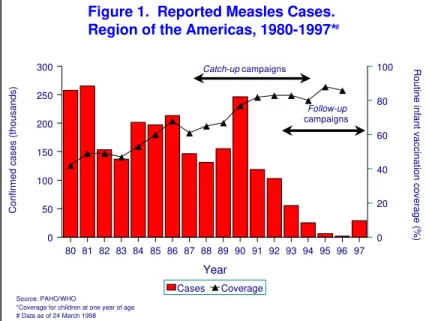
Following an all-time record regional low in the Americas of 2,109 confirmed measles cases in 1996, there was a resurgence of the disease in 1997 in Brazil (Figure 1).
Figure 1. Reported Measles Cases. Region of the Americas, 1980-1997*
Source: PAHO/WHO
*Coverage for children at one year of age # Data as of 24 March 1998
80 81 82 83 84 85 86 87 88 89 90 91 92 93 94 95 96 97
Year
0 50 100 150 200 250 300
Confirmed cases (thousands)
0 20 40 60 80 100 Routine infant vaccination coverage (%)
Cases Coverage
Catch-up campaigns
Follow-up
campaigns
#
Between 1 January 1997 and 24 March 1998, a total of 90,315 suspected measles cases have been reported from the countries of the Americas. Of these, 29,211 (32%) have been confirmed, 35,586 (39%) have been discarded, and 25,518 (28%) remain under investigation. Together, Brazil (27,761 confirmed cases) and Canada (570 confirmed cases) accounted for 97% of the total confirmed cases in the Region.
Other countries and territories reporting confirmed measles cases in 1997 include Paraguay (198), Argentina (125), Guadeloupe (116), Peru (95), Chile (61), Colombia (43), Venezuela (27), Costa Rica (26), Bolivia (8), Guatemala (8), Honduras (5), Uruguay (2), Bahamas (1), Dominican Republic (1), and Trinidad and Tobago (1).
Over 50% of cases in São Paulo occurred in young adults 20-29 years of age. An investigation of these cases found that the majority were young adults who were members of certain risk groups, including young adults who were perhaps less likely to have been exposed to measles previously or to have been immunized, and who had recently migrated to cities from rural areas in the northeast of the country to work in construction projects and other manual labor, as well as students, health care workers, persons working in the tourist industry, and military recruits (2).
Genomic sequencing of virus isolates from this outbreak revealed that the virus circulating in São Paulo is identical to the virus currently circulating in western Europe, strongly suggesting that the virus responsible for the São Paulo outbreak was imported from Europe(3).
Another measles outbreak with a link to an importation occurred in the French department of Guadeloupe (116 cases) between October 1996 and May 1997. The island had not implemented PAHO’s recommended measles eradication strategy. The source of the outbreak was an unvaccinated 10-year-old child visiting from metropolitan France (4). The English-speaking Caribbean had not reported a single confirmed case of measles in over five years. However, in 1997 two laboratory-confirmed measles cases were detected in the Bahamas (1) and Trinidad and Tobago (1). Both have also been linked to importations from Europe. No further spread in this subregion was identified despite careful investigation.
Canada reported a total of 570 confirmed measles cases during 1997. A large outbreak with over 300 cases occurred in a university community in British Columbia. Most cases occurred in young adults who had been vaccinated previously with one dose of measles vaccine. Genomic analysis of measles virus obtained from patients during this outbreak suggested that the measles virus circulating in British Colombia was imported from Europe. Measles virus from the British Colombia outbreak spread to the neighboring province of Alberta, where 245 cases were reported (5).
The resurgence of measles in the Americas during 1997 offers important lessons which can be used to perfect the Region’s measles eradication strategy and to assure its full implementation in all countries. The successful achievement of the measles eradication goal will require the implementation of PAHO’s recommended vaccination strategy in all countries of the Region (7). The overall objective of the strategy is the prevention of measles outbreaks. It is far more efficient and less costly to prevent an outbreak than to be forced to attempt to control one. Therefore, follow-up campaigns targeting all children 1-4 years of age, regardless of prior vaccination status or disease history, must be conducted every four years to assure the highest possible level of measles population immunity.
There are several countries that are overdue for follow-up campaigns or are due for such a campaign in 1998. Countries overdue for campaigns are at increased risk for a measles outbreak and should conduct follow-up campaigns as soon as possible. These include Argentina, Costa Rica, Cuba, Dominican Republic, Haiti, and Mexico. Countries that should conduct a follow-up campaign during 1998 include Bolivia, Ecuador, Guatemala, Uruguay, and Venezuela.
Furthermore, the outbreaks in Brazil, Canada, and other countries of the Region suggest that there may be a significant number of young adults who remain susceptible to the disease. While PAHO’s recommended vaccination strategy for measles eradication primarily targets infants and children, a small percentage of adolescents and young adults may have escaped both natural measles infection and measles vaccination. Persons in these age groups who either work or live in environments with an increased relative risk of exposure to measles virus need to be identified and targeted for vaccination.
The immediate implementation of these measures will be critical, given the constant challenge of importations of measles virus in the Americas from other regions of the world where measles remains endemic. During 1997, there were 23 separate importations of measles virus detected from Europe, 17 from Asia, and 2 from Africa, that resulted in measles transmission.
1.2 Maintenance of Polio-free Status
cases are being detected and entered into the surveillance system, which subsequently impacts the other surveillance criteria. This deterioration in surveillance raises concerns that future importations of wild poliovirus could be missed.
It is therefore critical for all countries to ensure that adequate resources are devoted to polio surveillance. Effective AFP surveillance must identify at least one case annually per 100,000 children <15 years of age. Stool specimens should be collected for laboratory diagnosis from at least 80% of AFP cases. Finally, an inventory of all laboratories in the hemisphere which have wild poliovirus stocks should be completed as a first step toward the eventual destruction of all wild polioviruses as part of the global certification process.
1.3 Neonatal Tetanus
Acceleration of neonatal tetanus elimination activities in the Region of the Americas began in 1988, and great progress has been made. NNT is endemic in all Latin American countries except Chile, Costa Rica, Cuba and Uruguay. The annual number of cases in the Region decreased from 1,470 in 1988 to 240 in 1997. Over 99% of the districts in the endemic countries are reporting zero or less than 1 case of NNT per 1,000 live births, the target set by the World Summit for Children to be achieved by all countries by the year 2000. National NNT surveillance evaluations have been carried out in 13 of the 16 countries where NNT is endemic. Findings indicate a declining trend of the number of women of childbearing age requiring intensive immunization services (Attack Phase). Of the total number of women of childbearing age in 12 countries (26,000,000) where data are available, only 14% (3,640,000) remain in high-risk areas in the Attack Phase, and 35% (9,100,000) are now living in areas already in the Maintenance Phase.
Based on the results of these evaluations, endemic countries should continue to improve epidemiological surveillance and case investigation in high-risk areas, particularly those from which information on coverage and cases is lacking. Vaccination of all women of childbearing age in these risk areas is essential to continue controlling the disease. In this regard, emphasis should also be given to the complete elimination of missed opportunities to vaccinate. The vaccination status of mothers who bring their children to health facilities to receive their first dose of DPT should be monitored, and they should be immunized when appropriate.
1.4 Vaccination Coverage
of DPT vaccine, and, in the case of BCG, in 1995 and 1996 97% and 98%, respectively, received this vaccine. Several countries evaluated show that the population’s access to immunization services is between 80%-90%. This indicates the capacity of primary health care health workers to successfully carry out immunization activities and reach specific objectives.
However, despite regional vaccination coverage with three doses of DPT vaccine of 86% in 1996, there were outbreaks of whooping cough in Guatemala and Brazil, all among indigenous people (2). The outbreak in Guatemala started in a community inhabited primarily by indigenous populations that live in geographical isolation. By the end of January 1998 the Ministry of Health had reported 693 cases and 17 deaths. Vaccination coverage in these communities is estimated to have been approximately 13%.
Factors contributing to the high case-fatality rate include malnutrition (especially among children under 5 years of age), poor hygiene, and crowded living conditions. The outbreak in Brazil occurred among indigenous populations that had low vaccination coverage. Both outbreaks were preventable and, therefore, increased efforts are needed to provide all recommended vaccines to the target populations throughout the Region, especially to persons living in areas with poor access to health services.
PAHO has intensified its collaboration with Member States to reduce the number of districts with excessively low vaccination coverage. The approach used in some countries has been that of targeting high-risk areas, thereby intensifying vaccination activities among priority population groups. This has also allowed for a better distribution of resources.
All countries are moving toward delegating greater responsibility for delivery and management of health care services to local levels. This provides an opportunity to promote community participation and commitment of local health authorities, necessary for the success of vaccination programs. However, with decentralization there remains a requirement at the central level to ensure that immunization program goals are met in all areas of a country. Because almost all vaccine-preventable diseases can spread widely, successful control or elimination requires coordinated national and international efforts so that no area becomes a reservoir to seed infection into other communities and countries. It is therefore recommended that ministries of health at the central level maintain authority to monitor the implementation of immunization programs at the state and local levels and to take corrective actions should problems be detected(8).
(in selected Member States and Territories)
Region/Country Population DPT-3 OPV-3 BCG Measles
Andean Region
Bolivia 230,246 67 68 82 94
Colombia 893,469 84 85 98 76
Ecuador 295,898 75 77 94 74
Peru 589,405 88 88 94 81
Venezuela 561,035 55 72 79 63
Brazil 3,161,042 48 59 80 71
Central America
Belize 7,460 85 85 95 85
Costa Rica 81,357 96 99 92 99
El Salvador 160,023 97 96 93 97
Guatemala 360,558 78 78 84 74
Honduras 187,726 93 95 99 95
Nicaragua 147,813 94 99 99 94
Panama 60,354 95 99 99 92
English-speaking Caribbean
Anguilla 168 99 99 99 95
Bermuda 830 91 94 - 88
British Virgin Islands 320 99 96 99 99
Cayman Islands 602 95 96 86 92
Grenada 2,036 95 95 - 92
Guyana 20,952 88 89 94 82
Jamaica 57,370 90 90 97 88
Montserrat 118 86 87 70 76
St. Vincent and the Grenadines 2,297 99 99 - 99
Turks and Caicos Islands 350 99 99 99 99
Latin Caribbean
Cuba 152,261 98 96 85 99
Dominican Republic 241,102 80 81 88 80
North America
Mexico 2,069,993 94 94 99 89
Southern Cone
Paraguay 154,464 67 67 75 46
TOTAL 9,432,878 72 77 89 78
Vaccination and surveillance programs should be considered essential public goods and be funded with public resources. Within the context of a changing environment to improve access to health services, vaccination coverage should be an indicator of the success of local and state delivery of services and a measure of the success of the health care reform and decentralization process (8).
National interagency committees remain a focal point for guidance in the implementation of plans of action in each country and in coordinating international input. These committees have assumed the additional responsibility of coordinating the collaboration of the private sector and local NGOs. The interagency committees deserve the full support of all partners as an initiative that will strengthen the sustainability of vaccine-preventabledisease programs (8).
1.5 Introduction of Vaccines into National Immunization Programs
Vaccines are among the most important public health tools for preventing infant and childhood morbidity and mortality. In the Americas, the commitment of governments will be essential to allow for a wider range of vaccines to be part of the immunization schedule. PAHO is working with countries to find alternative strategies for introducing new vaccines, suited to each country’s situation. This includes promoting the enactment of legislation that calls for the financing of the national immunization programs and the utilization of the PAHO Revolving Fund for vaccine purchases in order to take advantage of economies of scale. It should be noted that these new vaccines, particularly
Haemophilus influenzae type b (Hib) and hepatitis B, are highly cost-effective when their cost is compared with the cost of the burden of these diseases in the populations of the Member States.
1.5.1 Haemophilus influenzae type b (Hib)
In the Americas, the example set by Uruguay and Chile of introducing the vaccine against H. influenzae in their regular immunization schedules in 1994 and 1996, respectively, has been important in promoting the benefits of Hib vaccination in the Region (9,10). The Cayman Islands and the Netherlands Antilles have also introduced Hib vaccine in their routine immunization programs. Other countries, including Argentina, Colombia, Costa Rica, Mexico, and Peru, have announced plans to introduce Hib vaccine in their regular vaccination programs and are currently allocating the necessary resources to purchase the vaccine in 1998.
immunization programs in additional countries during 1999. PAHO is working with countries to establish well-structured surveillance systems to monitor illnesses due to Hib and to demonstrate vaccine impact.
1.5.2 Rubella and Congenital Rubella Syndrome
The Regional Measles Surveillance System has highlighted rubella as a health problem. Cases of congenital rubella syndrome (CRS) and fetal infection have been documented in Barbados, Belize, Brazil, Cuba, Jamaica, Mexico, Panama, and Trinidad and Tobago. It has been estimated that there are more than 20,000 infants born with CRS each year in the Americas in the absence of major epidemics.
In the Andean region, only Colombia has introduced (1995) the measles, mumps, and rubella vaccine (MMR) into the national vaccination schedule for children between the ages of 1 and 3 years. In Central America, Costa Rica, El Salvador, and Honduras are using MMR vaccine. In the English-speaking Caribbean, 20 of the 22 countries utilize MMR. The Bahamas implemented a major campaign with MMR targeting all individuals 4-40 years of age in July 1997 and aimed at the interruption of rubella transmission. The lessons from this campaign will be extremely useful to all countries that are planning to eliminate rubella and CRS. PAHO continues to stress the strengthening of surveillance to better determine disease burden. Surveillance of CRS (and rubella) should be initiated throughout the Americas and should begin before, or at the same time as, implementation of a rubella vaccination program.
All countries should incorporate rubella vaccine (as MR or MMR) into childhood vaccination programs, both as part of routine childhood immunization at 12-15 months and as part of the measles follow-up campaigns reaching children 1-4 years of age every four years. This will provide immediate protection to those vaccinated and, over the course of several years, will prevent epidemic rubella among children. However, these measures will have only a limited immediate impact on the transmission of rubella among adults or on the occurrence of CRS. Those countries wishing to prevent and control CRS promptly should carry out a one-time mass campaign to vaccinate all females 5-39 years of age with rubella or MR vaccine. Those countries wishing to prevent and control both rubella and CRS should promptly carry out a one-time mass campaign to vaccinate both males and females 5-39 years of age with rubella or MR vaccine (9).
1.5.3 Hepatitis B
and Venezuela). Brazil, Peru, and Venezuela have introduced hepatitis B vaccine into routine immunization of children in identified high-endemic areas and among high-risk groups. Vaccination against hepatitis B has also been continued among high-risk groups in Argentina, Chile, and Honduras. Colombia, Costa Rica, Cuba, and the Dominican Republic have also established universal vaccination for hepatitis B in all children <1 year of age within the regular vaccination program.
1.5.4 Yellow Fever
Between 1990 and 1996, 1,298 cases of yellow fever were reported in the Americas. During the decade of the 1980s, 80% of these cases came from Amazon Basin areas of Bolivia and Peru. However, important risk areas for yellow fever are also present in Brazil, Colombia, Ecuador, and Venezuela. PAHOhas worked with countries to stress the need to incorporate vaccination into routine immunization programs in high-risk areas, and to ensure that adequate quantities of vaccines and other supplies are available to local health services. It is recommended that epidemiological surveillance be intensified for yellow fever cases because of the risk of its introduction into urban areas, which now have extensive infestation with the Aedes aegypti vector.
1.6 Vaccine Quality Control
PAHO’s efforts in the area of vaccine quality seek to address the great diversity in the Region with regard to policy and practices of quality control systems. Some countries still lack well-defined national control authorities (NCA). Others which are more advanced, such as the vaccine-producing countries, have already organized national control laboratories (NCL).
Governments in the Region must institute national control authorities appropriate to their vaccine production and purchasing policies. The NCA must be responsible for six basic functions—licensing vaccines, lot release, post-marketing surveillance, laboratory testing of vaccines, good manufacturing practices (GMP) inspections, and evaluations of vaccines—if they are to be used for clinical trials in the country. Furthermore, national immunization program managers and national control authorities in all countries should cooperate to implement a national system of surveillance of and response to adverse events following vaccination. In countries where vaccines are produced, there must be a national control laboratory responsible for performing laboratory testing of vaccines prior to their release.
Venezuela). Participating laboratories have been connected in a communication network to facilitate the exchange of information. The Network provides participating laboratories with back-up services for their regular functions and serves as an external quality control system. Other activities have included the development of regional reference reagents and reference vaccines, as well as the harmonization of quality control methodologies. In 1997, a network of national control authorities was organized with the participation of 12 countries. This network is promoting the implementation of the six basic functions of a national control authority. The main function of this network will be the harmonization of all regulatory activities related to vaccines. Both entities are fundamental for assuring that vaccines used in national immunization programs are of known quality.
Support also continued for the program for certification of vaccine producers, which guarantees that vaccines produced in the Region follow international regulations and good manufacturing practices. This certification program was initiated with visits to the DPT-producing facilities in Brazil (Instituto Butantán), Chile, and Mexico. Workshops on GMP and validation were held to train personnel from the vaccine-producing laboratories and to prepare GMP inspectors at national control authorities. This program is being extended to other vaccines being produced in the Region, such as BCG, rabies, measles, polio, and hepatitis B.
2. Funding
The national immunization programs, including the initiative to eradicate measles from the Americas by the year 2000, will cost approximately $710 million for the period 1997-2001, not including Canada and the United States. Of this total, $657 million will have to come from national budget allocations and approximately $53 million is being sought from external program collaborators. Of the $53 million, USAID has already contributed $8 million, and it is estimated that PAHO will have contributed $9.9 million when the five-year period is completed. The Government of Spain has contributed $1.5 million and the Government of the Netherlands, another $0.5 million. This brings total external contributions to $19.9 million, with approximately $33.1 million still being sought. The smooth implementation of the Regional Plan of Action for the Elimination of Measles by the year 2000 will depend greatly on the availability of these funds to support national programs.
The Canadian International Development Agency (CIDA) has contributed $1.5 million for the projects related to vaccine research and development, particularly the strengthening of the regional network for surveillance of Streptococcus pneumoniae and
References
1. Pan American Health Organization. Measles Outbreak in São Paulo. EPI
Newsletter 1997; 19 (June):1-2.
2. Pan American Health Organization. Update: São Paulo Measles Outbreak.
Reported by the Center for Epidemiological Surveillance, São Paulo State Health Secretariat, Brazil. EPI Newsletter 1998; 20 (February):5-6.
3. World Health Organization. Progress Towards Measles Elimination in the
Americas. Weekly Epidemiological Record (WER) 1998; 73 (20 March):81-85.
4. Pan American Health Organization. Update Recent Measles Outbreaks in the
Americas. EPI Newsletter 1997; 19 (April):3.
5. Pan American Health Organization. Measles in the Americas. EPI Newsletter
1997; 19 (December):1-3.
6. Pan American Health Organization. Measles in the United States. EPI Newsletter. 1997; 19 (April):1-2.
7. de Quadros CA, Olivé JM, Hersh BS, et al. Measles Elimination in the Americas: Evolving Strategies. JAMA 1996:275:224-229.
8. Pan American Health Organization. Twelfth Meeting of the Technical Advisory Group on Vaccine-Preventable Diseases. Final Report. Guatemala City, Guatemala. 8-12 September 1997.
9. Pan American Health Organization. Impact of Uruguay’s Introduction of the
Haemophilus influenzae type b (Hib) Vaccine. EPI Newsletter 1996; 18 (December):6.
10. Pan American Health Organization. Haemophilus influenzae type b in Chile. EPI Newsletter 1997; 19 (April):8.
VACCINES AND IMMUNIZATION
THE 122nd SESSION OF THE EXECUTIVE COMMITTEE,
Having considered the report of the Director on vaccines and immunization (Document CE122/16),
RESOLVES:
To recommend to the 25th Pan American Sanitary Conference the adoption of a resolution along the following lines:
THE 25th PAN AMERICAN SANITARY CONFERENCE,
Having considered the progress report of the Director on vaccines and immunization (Document CSP25/14);
Noting with satisfaction the progress being achieved in the control/eradication of some of the vaccine-preventable diseases, e.g. measles eradication by the year 2000, control of neonatal tetanus, and maintenance of polio free status;
Recognizing that several countries have already introduced or are considering the introduction of additional vaccines, e.g., measles-mumps-rubella (MMR) and
Haemophilus influenzae type B (Hib) into their national immunization programs; and
RESOLVES:
1. To urge Member States to:
(a) strengthen their acute flaccid paralysis (AFP) surveillance system to ensure that the Region remains polio free;
(b) emphasize the critical need of implementation of follow up measles campaigns in those countries that have accumulated a considerable number of children susceptible to measles;
(c) introduce vaccines against rubella and Haemophilus influenzae type B into their national vaccination schedule, and against yellow fever in all the areas endemic for this disease;
(d) recognize the importance of guaranteeing the financing of their national
immunization programs with funds from their national budgets;
(e) utilize vaccination coverage and epidemiological surveillance indicators for vaccine-preventable diseases at the district level, as indicators to measure the impact of the decentralization of the health services.