*e-mail: [email protected]
1. Introduction
With continuous depletion of petrochemical feedstock and their rising prices, the chemical industry is now looking for alternative renewable and sustainable materials. It is essential to plan substitution of these materials with environmentally friendly materials and this can be classiied as non renewable ones, known since a long time. Cardanol derived from cashew nut shell liquid (CNSL) has reactive phenolic group and aliphatic double bonds that could produce novel functional materials for polymer and coating applications. Resole type phenolic resins were prepared using phenol and formaldehyde under basic environment in a step growth polymerization process1. These are very highly cross linked materials and have a wide range of commercial applications such as molding compounds, coatings, and binders etc.2,3. The molecular structure of these resins depend on the ratio of formaldehyde to phenol, temperature, pH, etc. The resole resins synthesis are halted when the appropriate degree of condensation in the resin (viscosity) have been achieved. These are usually polymerized with molar excess of formaldehyde and the resin contains methylene and dimethylene ether bridges and methylol groups4-6. The ease of synthesis, attractive cost factor, excellent track, good thermal stability, char yielding properties, and ablative characteristics are some of the features responsible for their dominance in the ield. They are characterized by additional dimethylene ether bridges and remaining methylol groups in the ortho and para positions of the phenolic rings7,8.
Cardanol is isolated from cashew nut shells by vacuum distillation. Utilization of CNSL in polymer chemistry has been well experimented and commercialized9. These new cardanol based resole resin are prepared to replace traditional resole that are used in applications as diverse as industrial and commercial, because of their excellent ablative properties and structural integrity. Long chain phenols contained in cardanol, serves as a natural and renewable sources to ine chemical products, such as solvents, varnishes, surfactants, and plasticizers, and also are well known in coating and resin industries. These are also used as high temperature polymers10-13. These prepared resole resins may further be modiied by epoxidation with epichlorohydrin to duplicate the performance of such phenolic resoles.
Epoxy resins are one of the most important classes of thermosetting polymer having several outstanding characteristics14. These epoxy resins are industrially very important polymeric materials and these are used in the formulation of electronic materials, adhesives, coatings and structural application due to their excellent attributes such as chemical resistance, dielectric and insulating properties15-17. These epoxy polymers display interesting advantages by perticulary the use of renewable resources in order to synthesize bio-based chemicals and products18.
In the present work, it has been synthesized cardanol-based epoxidized resole resin and evaluated their mechanical, thermal, and chemical properties.
Studies on the Thermal, Mechanical and Chemical Resistance Properties
of Natural Resource Derived Polymers
Shrawan Kumar Shuklaa, Kavita Srivastavab, Deepak Srivastavaa*
aDepartment of Plastic Technology, Harcourt Butler Technological Institute, Kanpur, 208002, India bDepartment of Chemistry, Vikramajit Singh Sanatan Dharma College - V. S. S. D. College,
Kanpur, 208002, India
Received: July 24, 2015; Revised: August 29, 2015
Cardanol-based epoxidized resole resins (ERCF) were synthesized by reacting resole type phenolic resin (RCF) and epichlorohydrin in basic medium, at 120 °C. Resole type phenolic resins were synthesized by reacting cardanol (C) and formaldehyde (F) in the presence of sodium hydroxide, as catalyst, at ive different temperatures ranging between 60-80 °C with an interval of 5 °C for a maximum period of 6h. These prepared samples were cured using 15% polyamide as curing agent at 120 ± 2 °C for 1h. Mechanical and chemical resistance characteristics of prepared samples were evaluated to assess the possibility of using such thermosetting resins as a new eco-friendly material for engineering applications. Upon evaluation, it was found that the prepared resins systems exhibit better properties compared to commercial epoxy resin in term of increase in tensile strength, elongation-at-break and impact strength, of castings and gloss, scratch hardness, adhesion and lexibility of the ilms. The anticorrosive properties from chemical resistance of the prepared resin systems are found to be superior than unmodiied epoxy resins. The TG/DTG thermograms showed two step decomposition behaviors in all the prepared samples.
2. Experimental
2.1. Materials
Cardanol (M/s Dheer Gramoudyog Ltd. Kanpur), Formaldehyde (37% wt solution from M/s Qualikem Industries, New Delhi), sulphuric acid obtained from M/s E. Merck, New Delhi. Sodium hydroxide (M/s CDH Pvt. Ltd, New Delhi), epicholorohydrin (M/s Ranbaxy Laboratories Ltd. Punjab), Polyamide (amine value 200-400 mg KOH/g, M/s Thomas Baker Pvt. Ltd., Mumbai) were used during synthesis.
2.2. Synthesis of cardanol-based epoxidized
resole resin
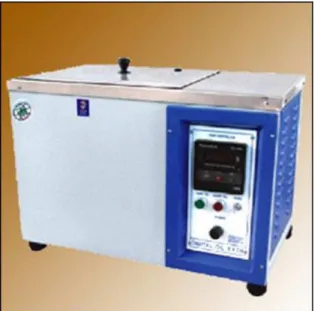
The resole-type phenolic resins were synthesized by reacting cardanol (C) and formaldehyde (F) in the presence of sodium hydroxide as a catalyst. The synthesis of these resins was carried out in a high temperature oil bath (Model PT-266,) (Figure 1), laboratory glass reactor equipped with a stirrer, thermometer and relux condenser. The reaction mixture of cardanol and 37% wt formaldehyde was taken into R.B. lask and heated upto a temperature of 40 °C. After complete addition, the temperature of reaction kettle was maintained to 60 °C and the pH was maintained between 7-8 by the addition of 10% wt sulphuric acid solution in the mixture of C and F. The resole-type phenolic resin synthesized by aforesaid method was further epoxidized by the addition of excess of epicholorohydrin (more than six times for complete epoxidation) at temperature of 60 °C with continuous stirring along with 40% aq. NaOH, added drop wise continuously. After addition, the temperature of the reaction mixture was raised to 120 °C. Five samples of cardanol-based epoxidized resole resins were prepared and are designated as per Table 1. The extent of epoxidation was measured which was found to be in the range 0.81-0.93 as given in Table 1.
2.3. Preparation of castings and ilms
The prepared cardanol-based epoxidized resole resin was mixed with 15 wt% polyamide as a curing agent. The mixture of cardanol-based epoxidized resole resins and curing agent was taken in small glass vials and mixed uniformly with the help of glass rod at room temperature. Thereafter, glass vials were kept in pre heated air oven at 120 °C for a period of 1h. The tin and glass panels were used subjected to difference performance test.
The samples of cardanol-based epoxidized resole resins were prepared by casting in a self- designed iron mould. The mould was kept in pre heated air oven at 120 °C for the curing of samples.
The ilms of cardanol-based epoxidized resole resins were applied on the steel and glass panels of the size of 150 × 50 × 1.25 mm for the evaluation of mechanical and chemical resistance to water, acid, alkalis and solvents. The panels were prepared by applying the ilms of resin samples by using Bird ilm applicator (M/s Khushboo Scientiic Ltd., Mumbai, India). The dry ilm thickness of about 100 microns was maintained on all the panels. These ilms were then cured as per the curing schedule obtained from DSC (85° ± 1 °C/90 min).
2.4. Mechanical properties
Dumb-bell shaped samples were prepared and were used for the determination of tensile strength and elongation-at-break as per ASTM speciication ASTM-D63819. For each mole ratio ive specimens were prepared for the calculating tensile strength was measured.
Both ends of samples were tightened in metallic grips of Universal testing machine (UTM) (Figure 2). The cross-head speed was kept at 25 mm per minute. The tensile strength and percentage elongation-at-break of castings of cured
Figure 1. High Temperature Oil Bath.
cardanol-based epoxidized resole resin samples were measured UTM (M/s Khushboo Scientiic Ltd., Mumbai, India).
Notched rectangular samples were used for determining the impact strength with the help of a pendulum Izod impact tester. The test specimens were cut from the cured block according to ASTM standard D25620. The size of specimens are 63.5 × 12.7 × 45.72 mm with a recommended notch depth of 2.54 mm. The test specimen clamped into position so that the notched end of specimen edge of pendulum. Now, the pendulum hammer released, allowed strike the specimen, and swing through. If the specimen does not break, more weights are attached to the hammer and test is repeated until failure is observed. The impact strength was read directly in it-lbf from the scale.
The scratch hardness of the cured ilm of cardanol-based epoxidized resole resins was evaluated as per IS: 101-199021. The test was performed by “Automatic Hardness Tester” (M/s Khushboo Scientiic Ltd., Mumbai, India). In this test, a hard hemisphere needle of the diameter of 1 mm was allowed to run on the test panel at the rate of 30-40 mm s–1. A speciied load was placed on the top of needle and the panel was examined for sign of bare metal.
The impact resistance of the cured ilm of cardanol-based epoxidized resole resins was evaluated as per IS: 101-199021. The tests were performed by “Tubular Impact hardness Tester” (M/s Khushboo Scientiic Ltd., Mumbai, India). The apparatus consisted of a steel block (500 g) which sides vertically between two guides. This was mounted under the block, commonly known as the tool holder, where it was ixed as the indenter. The block and tool were allowed to fall under gravity onto the die blocks with a hole in centre. The test panel between the die blocks was impacted by tool. The depth of indentation was varied by inserting washer of known thickness between indenter and tool holder. The failure of coatings ilm was shown by cracking by the loss of adhesion at the deformed portions of the test panels.
The adhesion and flexibility of the cured film of cardanol-based epoxidized resole resins were evaluated as per IS: 101-199021. The test was performed on “Mandrel” (M/s Khushboo Scientiic Ltd., Mumbai, India). In this test, the panel was passed through a cylindrical bar of different diameters. At speciied cylindrical bar, the panel was examined for sign of cracking, laking and detachment from the substrate, after the sample had been bent through 180 °C.
The gloss of the cured ilm of cardanol-based epoxidized resole resins was evaluated as per IS: 101-1990 standards21. The test was performed on triglossometer (M/s Khushboo Scientiic Ltd., Mumbai, India) by watching the ilms from
60º angle for gloss. Initially, the instrument was standardized with the supplied standard sample from the company.
2.5. Thermal properties
The percent weight loss and thermal degradation characteristics of prepared samples were evaluated by thermogravimetric analyzer (TGA) recorded on Perkin-Elmer (Model Pyris 1 TGA, Switzerland) control unit. The dynamic thermo grams between temperature and weight loss were recorded by using plotter attached with the instrument. A preweighted sample was put on the pan which was placed on the thermal balance of the instrument at a heating rate of 20 °C min–1 in nitrogen atmosphere, the sample was run in the temperature range of 50-600 °C. The stability of epoxy samples was determined by a comparison of the onset degradation temperature (up to 5% weight loss) of cured samples.
2.6. Chemical resistance
The prepared glass panels, as per procedure given in section 2.3 of this article, such as mild steel panel, tin plate panel and glass panels (as per IS-101, 1964) were used to evaluated for their chemical properties. The panels were prepared by applying the ilms of resin samples by using Bird ilm applicator (M/s Khushboo Scientiic Ltd., Mumbai, India). The dry ilm thickness of about 100 microns of cardanol based epoxidized resole resin on glass panels of the size 150 × 50 × 1.25 mm for evaluation of resistance to water, acids, alkalies and solvents.
3. Results and Discussion
3.1. Tensile strength, elongation-at-break
and impact strength of cardanol-based
epoxidized resole resin
The variation of tensile strength, elongation-at-break and impact strength in the casting of cardanol-based epoxidized resole resins containing varying molar ratios cured with polyamide has been given in Table 2.
A gradual increase in tensile strength was noted as the concentration of the formaldehyde was increased as the molar ratio increased from 1:1.2 to 1:2.0. An increase in tensile strength might be attributed to the increase in crosslink density due to interaction between curing agent and epoxy resin, which might have been mechanically stronger than commercial epoxy resin system in ranging between 31-37 MPa[22]. The ∆H values related to the cure process were determined from the area of the exotherm peak obtained from DSC analysis
Table 1. Sample designation and epoxy equivalent weight.
S.N. Cardanol
(mole)
Formaldehyde (mole)
Sample code of corresponding epoxidized
resole
EEW
Degree of epoxidation
B/A
Actual (A) Expected (B)
1 1 1.2 ERCF112 486 402 0.82
2 1 1.4 ERCF114 460 430 0.93
3 1 1.6 ERCF116 490 398 0.81
4 1 1.8 ERCF118 532 498 0.93
taken in dynamic mode, which were found in the range of 33.91 - 94.00 Jmol–1. Sample with higher concentration of formaldehyde viz. ERCF120 was found to show maximum elongation-at-break amongst all other samples. A higher elongation might be due to the result of straightening of entangled chains of cardanol- based epoxidized resole resin. the prepared resin sample with highest molar ratio (ERCF120) was found to show increased impact strength which indicate the absorption of greater impact energies. The properties of casting of all cured samples of cardanol- based epoxidized resole resin samples revealed that the ERCF120 was found to be exhibit increased tensile and impact strength and higher elongation-at-break of all samples. The chemical structure of cardanol-based epoxidized resole resin has been proposed as in Scheme 1 and epoxidation reaction mechanism has been given in Scheme 2.
3.2. Scratch hardness, adhesion, lexibility,
gloss, impact resistance of cardanol-based
epoxidized resole resin
Table 2 showed the surface and mechanical properties of the cured ilms of the cardanol-based epoxidized resole resins. All the cured ilms showed over all good performance. The scratch hardness was found to be in the range 900-1500g. All the coatings on mild steel panels passed the scratch performance test up to 1.5 kg load. As the concentration of formaldehyde increased, the scratch hardness of the cured ilms of cardanol-based epoxidized resole resins was found to be also increased. The ilms of all prepared samples passed
the bend test indicating good lexibility. The ilms showed no sign of damage, detachment, cracking or removal of coating during and after test23. This is primarily due to the long aliphatic carbon-carbon chain in the cardanol molecule which balances the rigid and hard nature of cured ilms by incorporating this chain in crosslinked structure. All the prepared resin samples exhibited better impact resistance as compared to the impact resistance of commercial epoxy resin. The gloss of all ilms was found to be excellent.
3.3. Thermogravimetric Analysis (TGA)
TGA is one of the most widely used techniques for measuring the thermal stability of polymeric samples. In this technique, the rate of weight loss is measured as a function of a programmed rate of increase in temperature. Thermal stability of cross-linked networks plays an important role and is greatly inluenced by structure and chemical decomposition24,25. The thermogravimetric (TG) trace for sample ERCF112 is shown in Figure 3. From the scan, the temperature of onset (T0), peak temperature (TP), and the temperature of completion (TF) were noted and tabulated in Table 3. Initial degradation temperature (IDT) was considered after 3-5% weight loss as in the initial stages impurities and moisture present in the system decomposes irst It is clearly indicated, from the results (Table 3), that the sample showed two-step mass loss in TG traces and
Scheme 2. Epoxidation of cardanol-based resole resin.
Scheme 1. Chemical structure of cardanol-based epoxidised resole
the shoulders observed in DTG traces indicated a two-step thermal degradation process.
The irst oxidative degradation was in between 200-450 °C and second degradation started at a temperature of around 450 °C. The improved resistance of thermo-oxidative degradation might be due to the participation of the aromatic groups of cardanol in the decomposition reaction26. Lin & Ma27 studied that as the temperature increased the strength of the C-H bond of aliphatic bridge decreased, and this indicated the cleavage of the methylene bridges. The aromatic content would give higher thermal stability in prepared cardanol-based epoxidized resole resin.
3.4. Chemical resistance
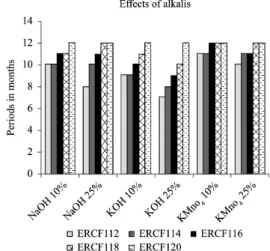
The comparative acid and alkali test (refer Figures 4-5) evaluated for twelve months immersion in different concentration of acid and alkali solutions, showed improvement in the performance as the formaldehyde content was increased. It was seen from the results as the concentration of acid and alkali solutions increased, the resistance of cured ilms were slightly decreased (Figures 4-5). The cured ilm of samples ERCF118 and ERCF120 showed better resistance as compared to ERCF112, ERCF114 and ERCF116. The higher concentration of alkali solution less affected the ilm surface lower than alkali resistance.
The comparative resistance of cured ilms of different epoxy samples against different solvents and they reveals almost same behavior as shown with acids and alkalies. It could be also seen from Figure 6 that cured ilm surface was strongly affected by solvents like methanol and acetone whereas the cured ilms retained their surface in solvents like toluene and xylene for a period of twelve months.
It is clearly indicated from the results, that the coating ilms of prepared resin system offered improvement towards resistance to water, solvents, speciied concentration of acids and alkalis due to overall balanced chemical backbone.
Table 2. Mechanical Properties of cardanol- based epoxidized resole resin.
Sample code
Properties of Casting Properties of Films
Tensile Strength
(MPa)
Impact Strength
(KJ/m2)
Elongation at - Break (%)
Gloss (60º angle)
Scratch hardness
(Kg)
Adhesion & Flexibility
Impact resistance
(Kg cm)
ERCF112 60.3±1.5 21.8±0.15 13.1±0.10 95.2±0.33 0.9±0.08 Pass 50±18
ERCF114 64.2±1.6 19.6±0.62 12.2±0.11 96.7±0.66 1.1±0.04 Pass 55±17
ERCF116 67.8±1.3 18.9±0.09 11.9±0.17 95.8±0.20 1.2±0.08 Pass 65±19
ERCF118 71.5±1.4 17.3±0.05 11.1±0.09 97.3±0.44 1.4±0.11 Pass 70±22
ERCF120 77.4±1.2 16.7±0.10 10.1±0.32 98.4±0.34 1.5±0.09 Pass 75±22
Table 3. Thermal Behavior of isothermally cured sample.
S.N. Sample Ti Tp Tf Mass
Loss (%)
Ti Tp Tf Mass
Loss (%)
Char Yield (%)
I stage II stage
1 ERCF112 250 315.51 305 41.53 310 445.32 520 53.18 4.78
2 ERCF114 240 315.54 370 43.46 370 450.14 520 51.99 3.42
3 ERCF116 190 320.70 390 42.77 390 449.07 530 48.01 10.22
4 ERCF118 230 325.30 395 45.46 395 447.81 545 47.82 7.32
5 ERCF120 245 335.90 345 48.19 345 451.35 510 49.98 5.83
Figure 4. Graph of effects of Acids in epoxidized resole resin.
This behavior could be attributed to the reaction of cross linking agent with epoxide and hydroxyl groups which were relatively stable bonds, resulting in high chemical and solvent resistant ilm28,29.
4. Conclusion
From the results it can be concluded that modiication of cardanol-based resole resin via modiication has resulted into improvement in their properties. As the increase in concentration of formaldehyde, the tensile strength of prepared resin increased whereas the percent elongation-at-break of the prepared samples decreased. The increase in formaldehyde content in epoxy resin increased the values of scratch hardness and impact resistance whereas all the samples passed through adhesion and lexibility tests. This showed good mechanical properties of coating ilm of prepared epoxy samples. The ilms showed no sign of damage, detachment, cracking or removal of coating. From TGA results, the sample showed two-step mass loss in TG traces and two-step thermal degradation process. The chemical resistance of cured ilms of epoxy resin showed good resistance to acids, alkalis and solvents. Therefore, this work provides a new way of utilizing renewable resource materials to prepare cost-effective and eco-friendly bio-based epoxy resole resin with high performance for coating applications. Such work has never been reported by other workers in the ield as revealed from the literature.
References
1. Żmihorska-Gotfryd AZ. Coating compositions based on
phenol- formaldehyde resin and urathane prepolymers. Progress
in Organic Coatings. 2004; 49(2):109-114. http://dx.doi.
org/10.1016/j.porgcoat.2003.09.002.
2. Airebe GA, Echeverria JM, Martyn MD, Etxeberria AM and
Mondragon I. Influence of the initial formaldehyde to molar ratio (f/p) on the formation of a phenolic resole resin catalyst with amine. Polymer. 2000; 41(18):6797-6802. http://dx.doi. org/10.1016/S0032-3861(00)00044-6.
3. Lei Y, Wu Q and Lian K. Cure kinetics of aqueous
phenol-formaldehyde resins used for oriented stanboard manufacturing: analytical technique. Journal of Applied Polymer Science. 2006; 100(2):1642-1650. http://dx.doi.org/10.1002/app.23756.
4. Monni J, Alvila L and Pakkanen TT. Structural and physical changes in phenolformaldehyde resol resin, as a function of the degree of condensation of resol solution. Industrial &
Engineering Chemistry Research. 2007; 46(21):6916-6924.
http://dx.doi.org/10.1021/ie070297a.
5. Alonso MV, Oliet M, Garcia J, Rodriguez F and Echeverría J. Gelation and isoconversional kinetic analysis of
lignin-phenol-formaldehyde resin cure. Chemical Engineering Journal. 2006; 122(3):159-166. http://dx.doi.org/10.1016/j.cej.2006.06.008.
6. Helle H, Välimäki H and Lekkala J. Comparing a 10 MHz thickness–shear mode quartz resonator with a commercial process viscometer in monitoring resol manufacture process.
Sensors and Actuators. B, Chemical. 2002; 81(2-3):133-140.
http://dx.doi.org/10.1016/S0925-4005(01)00943-1.
7. Lee YK, Kim DJ, Kim HJ, Hwang TS, Rafailovich M and
Sokolov J. Activation energy and curing behavior of resol- and novolac-typephenolic resins by differentialscanning calorimetry and thermogravimetric analysis. Journal of Applied Polymer
Science. 2003; 89(10):2589-2596. http://dx.doi.org/10.1002/
app.12340.
8. Niimura N and Miyakoshi T. Structural characterization of cashew resin film using twostage pyrolysis-gas chromatography/ mass spectrometry. International Journal of Polymer Analysis Figure 6. Graph of effects of solvents in epoxidized resole resin.
and Characterization. 2003; 8(1):47-66. http://dx.doi.
org/10.1080/10236660304886.
9. Gopalakrishnan S and Sujatha R. Synthesis and thermal
properties of polyurathanes from cardanol-furfural resin. Journal
of Chemical and Pharmaceutical Research. 2010; 2:193-205.
10. Li S, Yang X, Huang K, Li M and Xia J. Design, preparation
and properties of novel renewable UV-curablecopolymers based on cardanol and dimer fatty acids. Progress in Organic
Coatings. 2014; 77(2):388-394. http://dx.doi.org/10.1016/j.
porgcoat.2013.11.011.
11. Biswas BK, Biswas S, Khan M and Chandraray B. Preparation
and characterization of CNSL modified phenol-formaldehyde resin. Journal of Polymer Materials. 2009; 26(1):7-15.
12. Nguyen LH, Nguyen DT, La TH, Phan KX, Nguyen TTT and
Nguyen HN. Effects of nanoclay on the properties of cardanol-modified-resol-epoxy-novolac composite materials. Journal
of Applied Polymer Science. 2007; 103(5):3238-3242. http://
dx.doi.org/10.1002/app.24976.
13. Dominguez JC, Oliet M, Alonso MV, Rojo E and Rodriguez F. Structural, thermal and rheological behavior of a bio-based phenolic resin in relation to a commercial resol resin. Industrial
Crops and Products. 2013; 42:308-314. http://dx.doi.org/10.1016/j.
indcrop.2012.06.004.
14. Lahlali D, Naffakh M and Dumon M. Cure kinetics and modeling of an epoxy resin crosslinked in the presence of two different diamine hardeners. Polymer Engineering and Science. 2005; 45(12):1581-1589. http://dx.doi.org/10.1002/pen.20274.
15. Chen W, Wang Y and Chang F. Study on the curing kinetics and curing mechanism of epoxy resin based on diglycidyl ether of bisphenol-A and melamine phosphate. Journal of
Applied Polymer Science. 2004; 92(2):892-900. http://dx.doi.
org/10.1002/app.20054.
16. Gu A and Liang G. Thermal stability and kinetics analysis of
17. Benyahya S, Aouf C, Caillol S, Boutevin B, Pascault JP and Fulcrand H. Functionalized green tea tannins as phenolic prepolymers for bio-based epoxy resins. Industrial Crops
and Products. 2014; 53:296-307. http://dx.doi.org/10.1016/j.
indcrop.2013.12.045.
18. Tao Z, Yang S, Chen J and Fan L. Synthesis and characterization
of imide ring and silioxane-containing cycloaliphatic epoxy resin. European Polymer Journal. 2007; 43(4):1470-1479. http://dx.doi.org/10.1016/j.eurpolymj.2007.01.039.
19. American Society for Testing and Materials - ASTM. ASTM
D638-14: standard test method for tensile properties of plastics.
West Conshohocken: ASTM International; 2014.
20. American Society for Testing and Materials - ASTM. ASTM D256-10: standard test methods for determining the izod
pendulum impact resistance of plastics. West Conshohocken:
ASTM International; 2010.
21. Bureau of Indian Standards. IS-101: 1990: methods of sampling
and test for paints, varnishes and related products. New Delhi;
2008.
22. Takeichi T. Epoxy resins and phenol-formaldehyde resins.
Polymer Science: A Comprehensive Reference. 2012;
5:723-751. http://dx.doi.org/10.1016/b978-0-444-53349-4.00157-6.
23. Bajpai M, Shukla V and Kumar A. Film performance and curing
of epoxy acrylate resins. Progress in Organic Coatings. 2002; 44(4):271-278. http://dx.doi.org/10.1016/S0300-9440(02)00059-0.
24. Choudhary V, Agarwal N and Varma IK. Evaluation of bisacrylate
terminated epoxy resins as coatings. Progress in Organic
Coatings. 2006; 57(3):223-228. http://dx.doi.org/10.1016/j.
porgcoat.2006.09.004.
25. Tai HJ, Wang JB, Chen JH and Chou HL. Synthesis and properties of vinyl siloxane modified cresol novolac epoxy for electronic encapsulation. Journal of Applied Polymer
Science. 2001; 79(4):652-661.
http://dx.doi.org/10.1002/1097-4628(20010124)79:4<652::AID-APP90>3.0.CO;2-U.
26. Menon ARR, Aigbodion AI, Pillai CKS, Mathew NM and
Bhagawan SS. Processability characteristics and physico-mechanical properties of natural rubber modified with cashew nut shell liquid and cashew nut shell liquid-formaldehyde resin.
European Polymer Journal. 2002; 38(1):163-168. http://dx.doi.
org/10.1016/S0014-3057(01)00165-3.
27. Lin JM and Ma CCM. Thermal degradation of phenolic resin/ silica hybrid creamers. Polymer Degradation & Stability. 2000; 69(2):229-235. http://dx.doi.org/10.1016/S0141-3910(00)00068-9.
28. Devi A and Srivastava D. Studies on the blends of cardanol-based epoxidized novolac resin and CTPB. European Polymer
Journal. 2007; 43(6):2422-2432. http://dx.doi.org/10.1016/j.
eurpolymj.2007.03.006.
29. Motawei AM, Badr MM, Amer MS, Mostafa HY and Ali IM. Some coating studies on phenolic epoxy/poly (Vinyl Acetate)5 resins. Journal of Applied Scientiic Research. 2008;