There are two types of speciications: prescriptive and performance based. The prescriptive speciications focus on materials properties, materials proportions, mixing and transporting procedures and on a variety of processes, such as placing and curing. In these speciications, the concrete desired performance it is not necessarily described.
On the other hand, performance speciications stipulate what is required from the product and do not prescribe how the product should be produced. In other words, they focus on the desired performance rather than on the concrete ingredients, materials selection, proportioning or construction methods. These are the responsibility of those individuals who contractually have to comply with the speciications. In this case, con-crete is deined in terms of measurable fresh and hardened properties and durability and as there are no restrictions regarding materials and their proportions in the performance speciications, innovative solutions may be used in order to achieve the performance requirements.
Currently, most concrete speciications are predominantly prescriptive with some performance requirements. Nevertheless, there is a consensus that in order to extend the service life of concrete structures, this has to be changed. This paper gives an overview of the international speciica-tions and describes the international efforts on the performance speciication implementation in the concrete industry.
Keywords: speciication; performance, concrete; durability.
Há dois tipos de especiicações: prescritivas e por desempenho. As especiicações prescritivas focam nas características das matérias-primas, na dosagem do concreto, na mistura e no transporte e numa grande variedade de operações, tais como lançamento e cura. Nestas especiicações, o desempenho desejado do concreto não é necessariamente descrito.
Por outro lado, as especiicações por desempenho estipulam o que se requere do produto e não prescrevem como o produto deve ser produzido. Em outras palavras, elas focam no desempenho desejado ao invés de focarem nos materiais constituintes, dosagem e métodos construtivos. Esses aspectos são responsabilidade daqueles individuos que devem cumprir contratualmente com as especiicações.
Em contraste, as especiicações por desempenho tratam daquilo que se requer do
produto, e não prescrevem como esse produto deve ser produzido. Em outras palavras, ao invés de partirem dos materiais que compõem o concreto, partem do desempenho desejado, em termos de suas propriedades mensuráveis no estado plástico,endurecido e em termos de du -rabilidade, deixando a seleção dos materiais, a dosagem e os métodos construtivos a cargo daqueles que, contratualmente, devam atender às especiicações. Nesse caso, como não há restrições dos materiais ou de suas proporções, soluções mais inovadoras podem ser usadas. Atualmente, a maioria das especiicações de concreto é predominantemente prescritiva com alguns aspectos de desempenho. No entanto, há um consenso de que essa realidade deve ser mudada para um aumento de vida útil das estruturas. Esse artigo apresenta um panorama das especiica -ções internacionais e descreve os esforços internacionais para a implementação de especiica-ções por desempenho na indústria do concreto.
Palavras-chave: especiicações; desempenho; concreto; durabilidade.
From prescription to performance: international trends
on concrete speciications and the Brazilian perspective
Da prescrição à especiicação de concreto por
desempenho: tendências internacionais e a
perspectiva brasileira
J. Tanesi a
M. G. da silva b
v. GoMes c
G. CaMarini d
a Manager, Global Consulting (USA)
b Professor, Department of Civil Engineering , Technology Center , UFES (Brazil) c Professor, School of Civil Engineering, Architecture and Urbanism, UNICAMP (Brazil) d Professor, School of Civil Engineering, Architecture and Urbanism, UNICAMP (Brazil)
Received: 04 Aug 2010 • Accepted: 11 Oct 2010 • Available Online: 17 Dec 2010
abstract
would be conducted to determine if the concrete meets the per -formance criteria.
n A clear set of instructions outlining what happens when con -crete does not conform to the performance criteria.
Unfortunately, in the past few years in Brazil, the construction industry concentrated all its efforts on quality management and process rationalization and not much was done regarding the im -provement of the inal product performance [2]. Some of the ac -tions that should be taken in this direction are:
n Education of designers, contractors, suppliers and owners re -garding performance concepts;
n Creation of performance based standards and codes; n Creation of performance speciications.
2. Opportunities and challenges
It is believed that the implementation of performance speciications could potentially improve the performance of the concrete in ser -vice and could offer new opportunities for organizational and tech -nological innovations in the construction industry [4].
The performance speciication should guarantee that any unsat -isfactory concrete is detected and penalized; no sat-isfactory con -crete is rejected, and should promote an adequate quality control that avoids any concerns about the delivered concrete [14]. The primary advantage to specifying performance is that a knowl -edgeable concrete producer-contractor team has the lexibility to develop a unique combination of materials and construction meth -ods that will achieve the owner designer’s objectives and speciic condition of the project. They are an alternative for prescriptive speciications because prescriptive speciications [5; 3; 15]:
n Do not guarantee that the requirements will result in the de -sired performance;
n Prevent innovations;
n Limit competitiveness;
n Describe the source, composition and proportion of materials;
n The risks are taken by the owner and speciier;
n Must be suficiently detailed in order to consider all the factors that impact the long term performance;
n Need an intense supervision in order to guarantee that all the requirements are met;
n Do not include requirements of the inal product or its perfor -mance, such as durability;
n Do not take into account the materials variability during con -struction and do not allow mixture design changes;
n Can promote workability problems during construction when the requirement for w/cm is very low.
n Eliminate any motivation for the producer to improve the mix -ture design and the quality control.
It is important to point out once more that the biggest advantage of the performance speciications, in comparison to prescriptive speci -ications, is that, in the former, the behavior of the concrete during its service life and the properties of the inal product are speciied, not only the compressive strength as in the prescriptive speciications. However, the implementation of performance speciications en -counters some challenges [3; 8; 9], especially in Brazil:
n Lack of reliable, repeatable test methods that evaluate the re -quired performance characteristics (along with performance com -pliance limits that take into account the inherent variability of each test method);
deinitions for “performance speciication”. Nevertheless, this con -cept is not new. Apparently, the roots of performance based proj -ect have been planted more than 2000 years ago in an archit-ecture paper written by Vitruvius.
However, the approach normally used in speciications and codes is still based on the achievement of the required performance through a set of prescriptive requirements based on previous ex -periences [4].
Currently, most concrete speciications are predominantly pre -scriptive with some performance requirements, such as minimum service life and requirements on compressive strength and at the same time, limitations on the water-cementitious materials ratio (w/ cm). Nevertheless, it is common sense that, in order to increase the service life of concrete structures, this practice shouldn’t be used [8].
However, concrete speciications are still prescriptive in nature, indicating maximum w/cm, maximum and minimum volume of supplementary cementitous materials, but excluding the require -ments the material should comply with in order to guarantee that its service life is achieved. These requirements are the performance requirements, which in the prescriptive speciications, are believed to be indirectly attained through the speciication, for example, of the maximum w/cm allowed.
The Nordic model is a procedure that was irst conceptually stan -dardized in ISO 6240/1980 [10], ISO 6241/1984 ([11] and ISO 6242/1992 [12]. It has been adopted recently by the ICC Perfor -mance Code [13] and by the Australian-NZ Building Code [4]. Most performance speciications in construction currently in use or under development follow this model. The structure of the Nordic model applied to concrete performance speciication is, as follows:
n Establishment of the user needs; n Establishment functional requirements;
n Establishment of the performance requirements. The specii -cation should clearly state the performance requirements for the fresh and hardened concrete, including durability. The per -formance requirements should not only take into account the characteristics of the structure in service and durability, but its constructability, as well. The performance requirements must be deined in terms of properties with clear limits, through pre-determined testing. Regarding durability, performance speci -ications must take into account the environmental conditions, the service life, the most likely deterioration mechanisms, such as carbonation, chloride ingress, alkali-silica reaction, just to name some.
Nonetheless, in order to guarantee the proper performance of the concrete in service, the general concept of performance speciica -tion concrete should be applied as follows [3]:
n There would be a qualiication/certiication system that estab -lishes the requirements for a quality control management sys -tem, qualiication of personnel and requirements for concrete plants.
n The speciication would have provisions that clearly deine the functional requirements of the hardened concrete.
Producers and contractors would partner to ensure the right mix -ture is developed, delivered and installed.
n The submittal would not be a detailed list of mixture ingredients but rather a certiication that the mixture will meet the speciica -tion requirements, including pre-qualiica-tion test results.
n Need to establish reliable service life models, calibrated for
the Brazilian conditions and materials, and based on long term results;
n Need to revise standards, speciications and codes, such as
NBR 6118-03 [17], as they prevent innovation, by limiting, for example, the w/cm and maximum volume of supplementary cementitious materials;
n The construction industry is conservative and generally op -posed to changes and it is an industry easily inluenced by the interests of big organizations;
n In Brazil, there is not much trust among the parts involved in
a project, and this complicates the changes on the roles and responsibilities of the parties involved in the construction pro -cess. In order to overcome this feeling, the ready mixed con -crete companies may have to develop quality systems and may have to be certiied by independent and reliable entities;
n There is a need to correlate the tests used during pre-qualii -cation of mixtures and those used in the quality control of the construction;
n A quality control process must be implemented in each stage of the product production, when there is a change in the re -sponsibilities, namely, for the delivered concrete, for the placed concrete and for the cured concrete;
n Some speciiers and designers are not yet familiarized with performance criteria;
n As the ability to meet the performance requirements depend on many factors which involve the ready mixed concrete plant, the equipment and the personnel, it is imperative to establish a certiication program for the plants, contractors and person -nel, as well as the maintenance of a satisfactory quality control system;
n Need for some uniformity veriication testing when the con -crete is received, which should be much more relevant than the slump test, speciic gravity or water content (microwave test).
3. responsibilities
The implementation of performance speciications requires a change of the mindset in terms of responsibilities, as well. Each professional should have his/her responsibility clearly deined in order to state the exposure condition and the performance to be met. This redeinition of responsibilities creates a new environment for the establishment of bonus and penalties.
4. Initiatives
Although the concept of performance speciications is not new, only recently the international discussion has taken the spotlight, aim -ing to develop speciications focused on performance, especially regarding durability and as a result provide long lasting structures. A good example of the efforts in the direction of establishing a performance speciication in the construction industry is the Su -perpave (SUperior PERforming Asphalt PAVEments). In 1987, the American congress established a ive year research program seeking to improve the performance, durability, safety and efi -ciency of the highway system in USA. The budget for the research program and the implementation program was 150 million dollars. The research carried out between 1987 and 1993 resulted in a performance speciication for asphalt, a mixture design method,
test methods and models to predict the performance of the mate -rial. This speciication is entirely performance based and has being used with success.
Performance speciications have been attracted lots of interest in Europe. The Performance Based Building Network (PeBBu) is a thematic network funded under the European Commission’s EU) 5th framework – Competitive and Sustainable Growth and man -aged by the CIBdf, The Netherlands. More than 70 international organizations are involved in the project. The PeBBU has been facilitating and enhancing the existing performance based building research activities by networking with the main European stake -holders and other international stake-holders. The network has also been producing synergistic results for dissemination and adapta -tion of performance based building and construc-tion.
It may seem that there is a need for the preparation of a European performance-based Model Code for Buildings, similar to and more comprehensive than the ICC 2003, which will cover all the per -formance attributes, and for administrative documents, which will address all the links between the four markets when such a code is applied. These attributes have been included in the curricula of professional education of many Building and Civil Engineering de -partments in universities in Europe, New Zealand, Israel, Canada and USA [4].
Relecting this European tendency, a joint committee between CIB and RILEM was created in 1996, focusing on service life method -ology – service life prediction for construction materials and com -ponents (CIB W080/RILEM 175 SLM), which produced a report presenting the tools for performance speciications [18].
The European structural codes (CEN) are a set of project docu -ments based on performance concepts, very detailed and follow a semi-probabilistic approach. Their analysis is based on the user’s point of view, namely, the construction must be safe and the user must feel safe. The Eurocodes establish safety targets and service conditions in physical terms related to the factors that impact the building performance under the user’s point of view, such as de -formations, cracking and vibrations, and establish limits for these physical factors. The Eurocodes do not contain prescriptive re -quirements, not even for minimum cross section for columns [4]. Structural ire safety engineering is following an approach simi -lar to the Eurocodes, offering a performance design option. The American Society of Fire Protection Engineering, SFPE, is also try -ing to generalize a performance-based approach to the overall Fire Safety design process [19; 20].
The Energy Codes that were adopted by most American States in -clude two design options. The prescriptive option follows the tradi -tional provisions for thermal resistance of envelope elements, sizing of windows, etc. The performance option requires analysis of energy demand and its comparison to a calculated energy budget. While following the irst option does not require highly speciied knowledge beyond the regular architectural or building engineering education, the second option can be applied only by professionals who are well versed in the area of energy analysis and engineering [21].
Other design ields that are developing tools for performance-based design include acoustics, moisture protection and Indoor Air Quality.
focusing on the performance of the building as a whole, not spe -ciically the performance of the concrete. In 2008, ABNT approved the irst performance based speciication for the Brazilian construc -tion industry, the NBR 15.575/2008 [7], Residential buildings up to ive stories – Performance and will be in probation until 2010. This new standard aims at the performance of the system and does not evaluate the quality of each individual component of the system. More speciically related to concrete, one can mention initiatives such as Prescription to Performance (P2P).This is an initiative pro -moted by the engineering and standard committee of the National Ready-Mixed Concrete Association – NRMCA. NRMCA is one of the main entity that promotes the performance approach in the concrete industry in USA.
Federal Highway Administration (FHWA) launched the Road Map, that is, a detailed strategic plan for concrete pavements that will guide the research investments for the next ten years. This plan is divided into 13 focus areas and three of them are related to performance: i) Performance based concrete pavement mix design system with expected investment of 68 million dollars; ii) Performance based design guide for new and rehabilitated concrete pavements with an -ticipated investment of 60 million dollars and iii) concrete pavement performance with projected investment of 4 million dollars [22]. Following this international trend, in 2007 ACI created the commit -tee ITG-8 Performance Criteria for Concrete Materials. Its mission is to develop a report on performance criteria and test methods for concrete materials that could be used in codes and speciications. In 2009 this created another committee ACI 329 (Performance
criteria for ready-mixed concrete), which had its irst meeting in March 2010. Its mission is to develop and report information on performance criteria for ready-mixed concrete.
RILEM organized a committee AAM (Alkali activated materials) which main objective is to develop performance speciications and recom -mendations for the creation of performance standards of alkali activat -ed materials, such as slag cement (ground granulat-ed blast furnace slag), ly ash, geopolimers and other emerging technologies. In 2010, the annual meeting of the Transportation Research Board (TRB) presented a workshop on case studies of projects that im -plemented performance speciications.
5. Main codes, standards and speciications
5.1 USA
5.1.1 aCi 318-08 (2008)
The ACI 318-08 [16] is a prescriptive speciication regarding the durability aspects. Chapter 4 of the ACI 318-08 [16] presents exposure classes and limits the w/cm, entrained air, maximum supplementary cementitious materials content, maximum chloride content and speciies the type of cement to be used in particular exposure conditions (Table 2).
matrix densiication in order to decrease the ingress of ions. The ACI 318-08 [16] tries to promote the matrix densiication, or to improve the properties related to permeability by limiting the w/cm and by the use of supplementary cementitious materials. Neverthe -less, ACI 318-08 [16] does not take into account the microstructure differences between mixtures with same w/cm but different cemen -titious materials. In other words, it considers that independently of what combination of materials is employed, the same level of permeability is achieved for each w/cm.
As it can be observed, this is a simplistic document which does not consider relevant factors regarding the exposure environment and the concrete quality, as they are not only dependent on the compressive strength and w/cm, but also the use of supplementary cementitious materials, cure, among other factors. In its commen -taries, ACI 318-08 [16] presents ASTM C 1202 [23] as a perfor -mance-based indicator of low permeability.
5.2 Canada
The Canadian standard CSA A23.1 [6] offers two options for speciica -tion: prescriptive and performance (in reality a hybrid speciication). In Table 5 of the standard annex, the criteria to be speciied are presented. The CSA A23.1 [6] standard presents 5 exposure classes and several subclasses, which relect different levels of exposure (Table 4). Although it limits the w/cm, requires minimum compressive strength and entrained air, it also speciies the type of cure and, in case there is exposure to chlorides, it limits the maximum Coulombs at 56 days [23], as an indirect way to guarantee a certain level of impermeability of concrete.
The performance requirements are used when the owner requires that the ready-mixed concrete plant assumes the responsibility for the concrete performance. The contractor assumes the responsi -bility for placing, consolidating and curing the concrete, by meeting the compressive strength and the expected durability.
5.3 Europe
5.3.1 en 206-1
In 2000, the EN 206-1 – Concrete – Part I: Speciication, perfor
-mance, production and conformity [24] was published. Neverthe -less, each country created its own national annex, in order to con -sider the peculiarities of each country and ease the consensus. As a result, the limits for the concrete components and the cover can vary from country to country.
The committee CEN/TC 104 considered the use of perfor -mance specification approach but decided to adopt a pre -scriptive approach, claiming lack of reliable test methods. Nevertheless, it allows the use of performance requirements when the country has national test methods and feels suffi -ciently confident in using them. CEN/TC 104 will continue the development of performance test methods related to durabil -ity on the European level.
EN 206-1 [24] speciies criteria for the materials, for the fresh and hardened properties and their veriication, presents limits for the concrete proportions and speciies the quality control procedure, the conformity criteria and the conformity evaluation.
The main deterioration mechanism considered by EN 206-1 [24] is the corrosion of the reinforcement, no matter if it is the result of chloride ingress, freeze-thawing or chemical attack. The environ -ment effect is classiied in terms of exposure classes (Table 5). For each class, only prescriptive requirements are speciied, including type and class of materials, w/cm, entrained air, minimum cement content and strength class (Table 6).
Regarding the use of supplementary cementitious materials, only silica fume is mentioned. Ground granulated blast furnace slag is not allowed to be used as a replacement for the Portland cement but can be used if it is part of the blended cement.
Nevertheless, EN 206-1 [24] presents the equivalent performance concept, which allows the modiications of the prescriptive require -ments for cement content and w/cm. It is applicable to a speciic combination of cement-supplementary cementitious materials, as long as the concrete presents equivalent performance regarding the durability, when compared to the reference concrete for the same exposure class.
Annex J of EN 206-1 [24]: Performance-related design methods with respect to durability, does not present any guidance on how to choose the performance requirements and criteria. It only provides a deinition of performance methods and guidelines of when this option should be considered.
5.3.2 Durable concrete structures - design guide [25]
Among the documents which use prescriptive requirements, this is one of the most complete documents. Its recommendations in -clude all the construction process, from the design, identiications of responsibilities and interactions of project planning, to the deliv -ery of the project, maintenance and use.
This guide presents some factors and recommendations in order to guarantee the quality of the concrete:
n Motivation, information and education of staff;
n Design and detailing, with focus on draining, spray, cracking
and spalling;
n Materials: cement, aggregates, water, admixtures and supple -mentary cementitious materials;
n Construction; n Cure;
n Service conditions;
This guide also presents a classiication related to exposure condi -tions, based on limits for pH, CO2 concentration, ammonia, magne -sium and sulfate limits. This classiication is presented in Table 7. The document presents recommendations for minimum compres -sive strength, maximum w/cm, minimum cement content, entrained air and permeability (Table 8), minimum cover, rebar spacing and maximum cracking width for each exposure class.
5.3.3 France
Boroghel-Bouny [26] uses the concept of durability indicators. The durability indicator is a material property with a clear physical meaning [3]. These properties are porosity, diffusion coeficient,
permeability and calcium hydroxide content and deine the durabil -ity class of the concrete (Table 9).
5.3.4 United Kingdom
i) development of speciications with low risk and low beneits; ii) performance speciication for maintenance; iii) performance speci -ication that transfers the risk from the agency to the producer, and allows him to implement innovative solutions.
5.4 Brazil
5.4.1 NBR 15.575/2008
NBR 15.575/2008 [7], Residential buildings up to 5 stories– Perfor -mance, deals with the overall performance of the system and does not evaluate the quality of each individual part of the system, such as
-sents the evolutions of the mindset of the construction industry in Brazil. It contains 6 parts:
Part 1: General requirements Part 2: Structure
Part 3: Indoor loors
Part 4: Facades and internal parts Part 5: Rooing
Part 6: Hydraulic and sewer systems.
The 15.575/2008 [7] part 1 presents several general considerations, including the structural performance and durability. Although it does not address concrete structures speciically, it can represent the basis for the development of a performance speciication for concrete. Moreover, it already deines service life, warranties, du -rability and performance. For example, structural elements which cannot be repaired or maintained, such as foundations, should have the same service life as the building. If no service life is ad -dressed by the speciier, it recommends the minimum service lives in Table 11.
5.4.2 NBR 6118 (2003)
In 2003, NBR 6118 [17] was published and the scope of its pre -vious version was split into two standards, NBR6118/2003 [17] (design) and NBR 14931/2003 [28] (construction); they became effective in 2004.
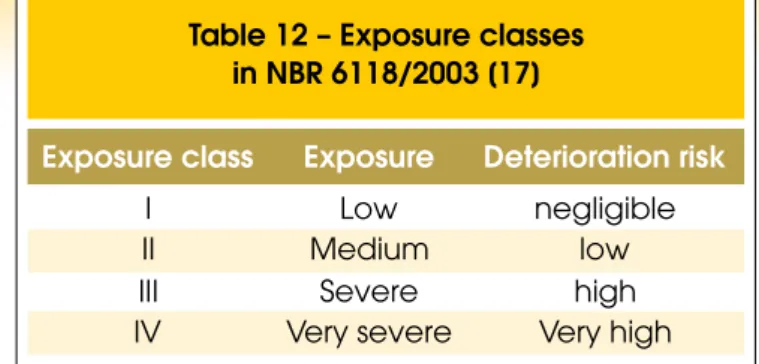
The NBR 6118/2003 [17] presents exposure classes (Table 12) and for each of them recommends maximum w/cm, minimum com -pressive strength (Table 13) and minimum cover.
The exposure classes are very subjective and there are no clear parameters to guide the speciier on choosing the correct exposure class. Deinitely, a detailed classiication, such as the CSA A23.1 [6] and EN 206-1 [24] would be more helpful and convenient. Table 13 shows explicitly that concrete quality is a function of the w/cm and the compressive strength. It does not take into account the type of cement used, the presence of supplementary cementi
-tious materials, curing quality and other relevant aspects. Although the w/cm importance is indisputable, it is not the only determinant factor that controls the deterioration mechanism in concrete.
6. summary and Conclusions
The performance approach in the construction industry is not a new concept. Nevertheless, it was only in the past ifteen years, when globalization became more important in the construction industry, that the international community has become more aware of the need to create and use performance speciications and started to implement them. Several current international initiatives aim to cre -ate the base for the creation of performance speciications. Many concrete codes, standards and speciications have already included this concept by, for example, deining exposure classes. These documents are mostly hybrid documents, which still present some prescriptive requirements such maximum as w/cm, maximum supplementary materials content and minimum cement content. The increase need to use recycled materials or by-products, due to sustainability requirements, as well as the use of concretes with very speciic purposes, have been promoting the design of more sophis -ticated concretes which are not a simple mixture of cement, water and aggregates, but also include different blends of supplementary cementitious materials, several different types of admixtures and ill -ers. Performance speciications open a new perspective for the de -velopment of such concretes. There is a consensus that this reality should change in order to achieve longer lasting concrete structures. Nevertheless, performance speciications must be based on scien -tiic evidence that the desired performance can be achieved.
7. References
[01] American Concrete Institute (ACI). ACI 116R-00: Cement and Concrete Terminology, reaprovado em 2005, Michigan, EUA, 2005.
PeBBu 2nd International SotA report, Final Report, 2005.
[05] Federal Highway Administration (FHWA)
“Performance Speciications Strategic Roadmap-A Vision for the Future”. FHWA, 2004.
[06] Canadian Standards Association, CSA A23.1 Concrete Materials and Methods of Concrete Construction Methods of Test and Standard Practices for Concrete, 2004.
[07] Associação Brasileira de Normas Técnicas. NBR 15.575-1: Edifícios habitacionais de até cinco pavimentos - Desempenho - Parte 1: Requisitos gerais. Rio de Janeiro, 2008.
[08] Taylor, P. Performance-Based Speciications for Concrete. Concrete International, V.26, Issue 6, Michigan, August, 2004.
[09] Lobo, C. Speciications and Submittals: Is a change in order? Concrete International, V 24 Issue 11 Michigan, November 2002.
[10] International Organisation for Standardisation, ISO 6240, “Performance Standards in Building – Contents and Presentation”, 1980
[11] International Organisation for Standardisation, ISO 6241, “Performance Standards in Building - Principles for their Preparation and Factors to be Considered”, 1984
[12] International Organisation for Standardisation, ISO 6242, “Building construction - Expression of users’ requirements - Part 1: Thermal requirements, Part 2: Air purity requirements, Part 3: Acoustical requirements” 1992.
[13] ICC, “2003 ICC Performance Code for Buildings and Facilities”, International Code Council, USA. [14] Day, K. Cash Penalty Speciications Can be Fair
and Effective. Concrete International, V4 Issue 9 Michigan, September 1982.
[15] Day, K. Perspective on Prescriptions: Can America learn from the Australian experience? Concrete International, V27 Issue 7 Michigan, July, 2005. [16] American Concrete Institute (ACI). ACI 318-08:
Building Code Requirements for Structural Concrete and Commentary, Michigan, EUA, 2008.
[17] Associação Brasileira de Normas Técnicas.
NBR 6118: Projeto e execução de obras de concreto armado. Rio de Janeiro, 2003.
[18] Conseil International Du Bâtiment (CIB), “Performance Based Methods for Service Life Prediction”. CIB Report Publication 294, 2004. [19] SFPE, “The SFPE Code Oficial’s Guide to
Performance-based Design Review”. SFPE, USA, 2004.
[20] Rosenbaum, E., R. “SFPE Engineering Guide to Performance-based Fire Protection Analysis and Design of buildings”, SFPE.
http://www.sfpe.org/sfpe30/index.htm, 2005. [21] DOE, 2005, “Building Energy Codes Program”.
http://www.energycodes.gov/
[22] Ferragut, T. Rasmussen, R.; Darter, M.;
Harrington, D; Anderson-Wilk, M. Long-Term Plan
Pennsylvania, 2005.
[24] Eurocode EN 206-1 Concrete: Speciication, performance, production & conformity, 2000. [26] Baroghel-Bouny, V. “Durability Indicators: A Basic
Tool for Performance –Based Evaluation and Prediction of Durability”, Proceedings of International Seminar on Durability and Lifetime Evaluation of Concrete Structures”, Higashi-Hiroshima, September, 2004.
[25] Comite Euro-International du Beton (CEB). Durable concrete structures - Design Guide. Great Britain, 1989.
[26] Baroghel-Bouny, V. Durability Indicators: A Basic Tool for Performance –Based Evaluation and Prediction of Durability. In: Proceedings of International Seminar on Durability and Lifetime Evaluation of Concrete Structures”,
Higashi-Hiroshima, September, 2004.
[27] British Standards Institution. BS 8500-1: Concrete. Complementary British standard to BS EN 206-1. Part 1. Method of specifying and guidance for the speciier, London, 2006.