Abstract
Duplex stainless steels (DSS) with austenite-ferrite microstructure are high strength and corrosion resistant steels frequently used as pipes and accessories in chemical/ petrochemical on/and off-shore industries. Low temperature heat treatments (400-475oC) may increase the hardness and wear resistance of duplex steels, due to a spinodal decomposition reaction of the ferrite, whose small particles a’ precipitate in the matrix. In this work, several heat treatments at 400oC and 475oC with short duration (<24h) were performed on UNS S32304 and UNS S32205 grades. The kinetics of a’ precipitation was studied by hardness measurements. Tensile tests were also carried out for some heat treatment conditions to evaluate the effect of the aging on the ductility of both grades. The hardening of duplex UNS S32205 was more intense than that of UNS S32304, although both steels have shown an interesting increase in tensile strength. Specimens of duplex steel heat treated at 475oC for 4 h and 8 did not show any detectable decrease of corrosion resistance in anodic polarization and critical pitting temperature tests were carried out in NaCl media.
Keywords: Duplex stainless steels, aging, mechanical properties.
Resumo
Os aços inoxidáveis duplex (AID) com microestrutura austeno-ferrítica são aços de alta resistência mecânica, sendo utilizados em tubos e componentes nas indústrias química e petroquímica. Tratamentos térmicos em baixas temperaturas (400-475oC) podem aumentar a dureza e a resistência ao desgaste, devido à reação
de decomposição espinoidal da ferrita, quando inas partículas de a’ se precipitam na matriz. Nesse trabalho, diversos tratamentos térmicos de curta duração a 400oC
e 475oC foram realizados nos aços UNS S32304 e UNS S32205. A cinética de
precipitação foi estudada por meio de medidas de dureza. Ensaios de tração foram
Effects of low temperature aging
on the mechanical properties
and corrosion resistance of
duplex and lean duplex
stainless steels UNS S32205
and UNS S32304
Efeitos de envelhecimentos em baixas
temperaturas nas propriedades mecânicas e
resistência à corrosão dos aços duplex e lean
duplex UNS S32205 e UNS S32304
Francis Gabriel Wasserman
Universidade Federal Fluminense,
Departamento de Engenharia Mecânica/PGMEC [email protected]
Sergio Souto Maior Tavares
Universidade Federal Fluminense,
Departamento de Engenharia Mecânica/PGMEC [email protected]
Juan Manuel Pardal
Universidade Federal Fluminense,
Departamento de Engenharia Mecânica/PGMEC [email protected]
Fernando Benedicto Mainier
Universidade Federal Fluminense,
Departamento de Engenharia Química/PPQ [email protected]
Ricardo Augusto Faria
Arcelor Mittal Inox do Brasil - Timóteo MG [email protected]
Cristiana dos Santos Nunes
Universidade Federal do Ceará, Departamento de Engenharia Metalúrgica e de Materiais.
realizados em algumas condições para se avaliar o efeito do envelhecimento na ductilidade dos dois aços. O endurecimento do aço UNS S32205 é mais pronunciado do que o do aço UNS S32304, embora ambos os aços apresentem um ganho considerável de resistência com tratamentos térmicos de curta duração. Amostras de aço duplex tratadas a 475oC por 4 h e 8 h não apresentaram qualquer prejuízo na
resistência à corrosão nos ensaios de polarização cíclica e temperatura crítica de pites em meio contendo NaCl.
Palavras-chave: Aços inoxidáveis duplex, envelhecimento, propriedades mecânicas.
1. Introduction
Austenitic-ferritic stainless steels present an excellent combination of corrosion resistance and mechanical properties in critical operation condi-tions. The higher mechanical and cor-rosion resistance is responsible for the increasing substitution of traditional austenitic grades by austentic-ferritic grades. The steels with austenitic-ferritic microstructure may be divided into lean
duplex, duplex, superduplex, and, more recently, hyperduplex (Tavares et al., 2010). The steels with a low Mo content (<0.60%) are called lean duplex. Typical lean duplex steels have a corrosion resis-tance comparable to the most popular traditional austentic grades (AISI 316L and AISI 317L), but with superior yield limit and ultimate strength. The increase of Cr and N, and the addition of Mo in
the chemical composition created the more corrosion resistant duplex and superduplex steels. The parameter used to distinguish these two sub-groups is the pitting resistance equivalent (PRE), which gives an indication of the pit-ting corrosion resistance of corrosion resistant alloys (CRA). The most used formulae for this parameter are the PREN
and PREW (ASM, 1994):
PRE ou PRE
N= %Cr + 3,3(%Mo) + 16(%N)
(1)PRE
W= %Cr + 3,3(%Mo+%W) + 16(%N)
(2)Austenitic-ferritic steels with PRE ≥ 40 are called “superduplex”. The elements Cr, Mo and N are the most important for pitting corrosion resistance. Tungsten is also mentioned in Equation (2), and is used in some superduplex steels. These steels contain high contents of Cr, Mo and N, and also Ni, which are added to maintain the ferrite/austenite ideal proportion.
It is important to note that the PRE number is only a reference parameter. For instance, superduplex and hyperdu-plex steels may present very poor pitting corrosion resistance, if undesirable phase transformations take place during the manufacturing process (Gunn, 2003; Lin-ton et al., 2004; Hitchcock et al., 2001). Intermetallic compounds (sigma and chi), chromium nitride (Cr2N), and a’ chro-mium rich precipitates are all prejudicial
to corrosion resistance (Nilsson, 1992). One of the most studied phase transformations in ferritic-astenitic steels is the spinoidal decomposition of ferrite into ine a’ chromium rich precipitates and a Cr-depleted matrix (d → a’ + a”). This reaction occurs in the 350-550oC range, and is faster at 475oC. As the prolonged aging causes hardening and decrease of toughness, this phenomenon is often referred to as 475oC embrittlement. The a’ precipitates can only be directly observed by trans-mission electron microscopy, as shown in some previous works (Otárola et al., 2005; Solomon et al., 1979; Padilha et al., 2004). The a’ precipitation has also been studied by other indirect methods, such as electrochemical tests (Yi et al., 1996), hardness tests (Tavares et al.,
2000), Mossbauer spectroscopy (Lem-oine et al., 1998; Solomon et al., 1978), and magnetic measurements (Tavares et al., 2000; Maeda et al., 1997; Isobe et al., 1996). The decrease of corrosion resistance, due to prolonged aging in the 350-550oC range, was investigated by double loop electrochemical poten-tiodynamic reactivation tests (DL-EPR), and with the proper choice of the test solution, an increase of the degree of sensitization with aging time could be observed (Tavares et al., 2005).
In this work, the use of a’ precipita-tion as a hardening mechanism for lean duplex UNS S32304 and duplex UNS S32205 steels was studied. Short duration heat treatments at 400oC and 475oC were performed to evaluate the beneits and prejudicial effects.
2. Materials and methods
The UNS S32304 and UNS S32205 steels studied were purchased as sheets of 1.8 mm thickness, both in the annealed condition. Chemical compositions are presented in Table 1.
The annealing of this class of
ma-terial is a type of solution treatment in which the material must be soaked at 1000-1050oC and rapidly cooled to avoid deleterious phase precipitation on cool-ing. Light optical microscopy (LOM) was used to determine ferrite and
aus-tenite percentages, and also to investigate about the presence of deleterious tertiary phases. For austenite/ferrite quantiica-tion, the specimens were prepared with Behara’s etching (80ml H2O + 20ml HCl + 0,3g potassium metabissulite), and the
Table 1
Chemical composition of UNS S32304 and UNS S32205 studied.
Grade Cr Ni Mo Mn Si N Cu C P S
UNS S32304 23.0 4.50 0.30 1.00 0.50 0.100 0.30 0.030 0.04 0.040
analysis was performed by image analysis using Image Tool software (UTHSCSA, 2002). For deleterious phase investigation 5-10%KOH electrolytic etching (3V, 15 s) was used.
Specimens with 12 x 12 mm were cut and heat treated at 400oC and 475oC for 2, 4, 6, 8, 10, 12, 14, 16, 18, 20, 22 and 24 hours. These specimens were put through Vickers hardness tests with a load of 30 kgf.
For some heat treatment conditions uniaxial tensile tests were performed to evaluate the variation of mechanical properties in tension. The specimens for uniaxial tension tests were cut and ma-chined according to ASTM E370 standard (ASTM, 2009), with initial length (lo) equal to 75 mm. The tests were carried out at room temperature with velocity at 12 mm/minute.
Three types of corrosion tests were also carried for some heat treatment conditions. Double loop electrochemical potentiodynamic tests (DL-EPR) are used
to detect and quantify the sensitization of stainless steels (Cihal et al., 2001). In this work the tests for lean duplex and duplex steels were carried out at ambient tempera-ture, using a potentiostat-galvanostat mi-cro-AUTOLAB. For lean duplex steel, the test solution was 2M H2SO4 + 0.01KSCN, and for duplex steel, the test solution was 2M H2SO4 + 0.5M NaCl + 0.01M KSCN. The DL-EPR tests were conducted in a conventional three-electrode cell using a Pt foil as the auxiliary electrode and a saturated calomel electrode (SCE) as the reference one. The working electrode was constructed using the lean duplex or du-plex specimens embedded in epoxy resin, ground with 400 emery paper, degreased with alcohol and cleaned in water. The tests were initiated after nearly steady-state open circuit potential (Eoc) had been achieved, followed by the potential sweep in the anodic direction at 1 mV.s-1 up until the potential of 0.3 VSCE was reached. The scan was then reversed to the cathodic di-rection until the Eoc. The loss of corrosion
resistance due to the chromium-depleted regions, i.e. the degree of sensitization (DOS), was evaluated from the ratio Ir/Ia, where Ia is the activation peak current of the anodic scan and Ir is the reactivation peak current in the reversed scan.
The two other corrosion tests were the cyclic polarization test and the critical pitting temperature (CPT) measurement. These tests were carried out only in some heat treatment conditions for duplex stain-less steel UNS S32205.
Cyclic polarization tests were carried out at 40oC in 3.5% NaCl solution, ac-cording to ASTM G61 standard (ASTM, 1998). The CPT measurement was per-formed by the potentiostatic method. The potential was ixed in 0.700 VSCE and the temperature was raised in a constant rate of 3oC/min. The CPT was the temperature correspondent to a current density of 100µA/cm2. The method was similar to the ASTM G150 standard (ASTM, 2004), except for the higher heating rate applied in this work.
3. Results and discussion
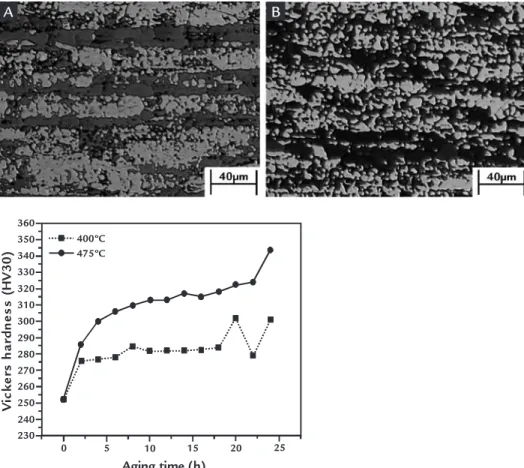
Figures 1(A-B) shows the micro-structures of the materials in the as-received condition. Lean duplex UNS S32304 has 63% ferrite and duplex UNS S32205 has 65% ferrite. Deleterious phases such as chi (c) and sigma (s) were
not detected with KOH electrolytic etch-ing (not shown).
Figures 2 and 3 show the hardness versus aging time curves at 475oC and 400oC for duplex UNS S32205 and lean duplex UNS S32304, respectively. Some
important observations can be made in the light of these two igures. First, the aging at 475oC is more pronounced in both steels, as expected. In the irst 10 hours of aging at 475oC the hardness of duplex steel was raised from 252HV to
Figure 1 Microstructures of UNS S32304 (A)
and UNS S32205 (B) in the as-received condition.
Figure 2 Hardness versus aging time curves for
duplex UNS S32205 steel.
A B
0 230 240 250 260 270 280 290 300 310 320 330 340
350 400ºC
475ºC 360
5
Aging time (h)
Vi
c
k
e
rs
h
a
rd
n
e
s
s
(
H
V
3
0
)
313 HV (DHV = 61 HV). In the lean du-plex steel the variation of hardness in the same period and temperature is from 234 HV to 286 HV (DHV = 53 HV). Figure 4
compares the hardness variation of duplex and lean duplex steels during aging at 475oC, where it is possible to note that the hardening is more intense in the duplex
steel than in the lean duplex. This can be attributed to the higher Mo content of the duplex steel, which enhances the kinetics of a’ precipitation.
Figure 3
Hardness versus aging time curves for lean duplex UNS S32304 steel.
Figure 4
Variation of hardness during aging lean duplex UNS S32304 steel and duplex UNS S32205 steels.
The age hardening curves may be roughly divided into two parts. The initial
stage is that of aging time up to 14 hours. At this initial stage the increase of
harden-ing can be described by Equation 3:
HV
(t)= HV
i1 - a. t
b (3)Where:
HV(t) – Hardness as function of time (HV) HVi – Initial value of hardness (HV) a – constant
b – aging exponent t – aging time (h)
Figure 5(A-B) shows the curves ad-justed for lean duplex and duplex steels
aged at 475oC, respectively. Table 2 shows the values of the a and b constants and the correlating coeficients obtained.
The interest in the initial stage of age hardening is the possibility to perform heat treatments capable of hardening the material, with minimum prejudicial ef-fects on corrosion resistance, ductility and
toughness. In order to evaluate this pos-sibility, two short duration heat treatments were chosen for a more deep analysis by tensile and corrosion tests in both steel grades (duplex and lean duplex). The heat treatments chosen were 475oC/4 hours and 475oC/8h. These heat treatments promote signiicant hardness variations (DHV), as
Figure 5
Curves itted with equation (3) and parameters of Table 2:
(A) lean duplex. (B) duplex.
0 230 240 250 260 270 280 290 300 310 320 330 340
350 400ºC
475ºC 360
5
Aging time (h)
Vi
c
k
e
rs
h
a
rd
n
e
s
s
(
H
V
3
0
)
10 15 20 25
0 0
10 20 30 40 50 60 70 80
90 Lean duplex Duplex 100
5
Aging time (h)
Vi
c
k
e
rs
h
a
rd
n
e
s
s
(
H
V
3
0
)
10 15 20 25
0 2 4 6 8 10 12 14 16
220 240 260 280 300 320 340 360
Aging time (h)
V
ic
k
e
rs
H
a
rd
n
e
s
s
(
H
V
3
0
)
V
ic
k
e
rs
H
a
rd
n
e
s
s
(
H
V
3
0
)
0 2 4 6 8 10 12 14
220 240 260 280 300 320 340 360
Aging time (h)
Table 2 Constants of Equation (3) adjusted for lean duplex UNS S32304 and UNS S32205 aged at 475oC.
shown in Figure 4.
Two tensile test specimens were produced per condition. Average values of yield limit (sYL, 0.2%), ultimate strength (sUTS), total elongation (El.), and nominal uniform ductility (eunif.) are presented in Table 3.
Table 3 also contains the values of toughness measured in the tensile tests. Toughness is commonly measured by impact tests, such as Charpy and Izod. However, as the sheets of duplex and lean duplex studied have thickness 1.88 mm, Charpy impact tests could not be done. The area under the curve tension-deformation curve gives a measure of the energy necessary to fracture per unit of area. Since the tests were conducted with the same experimental parameters (strain rate, temperature and specimens size), the toughness values obtained can be used to compare the different heat treatment applied.
The interest in the initial stage of age hardening is the possibility to perform heat treatments capable of hardening the material, with minimum prejudicial ef-fects on corrosion resistance, ductility and toughness. In order to evaluate this
pos-sibility, two short duration heat treatments were chosen for a more deep analysis by tensile and corrosion tests in both steel grades (duplex and lean duplex). The heat treatments chosen were 475oC/4 hours and 475oC/8h. These heat treatments promote signiicant hardness variations (DHV), as shown in Figure 4.
Two tensile test specimens were produced per condition. Average values of yield limit (sYL, 0.2%), ultimate strength (sUTS), total elongation (El.), and nominal uniform ductility (eunif.) are presented in Table 3.
Table 3 also contains the values of toughness measured in the tensile tests. Toughness is commonly measured by impact tests, such as Charpy and Izod. However, as the sheets of duplex and lean duplex studied have thickness 1.88 mm, Charpy impact tests could not be done. The area under the curve tension-deformation curve gives a measure of the energy necessary to fracture per unit of area. Since the tests were conducted with the same experimental parameters (strain rate, temperature and specimens size), the toughness values obtained can be used to compare the different heat treatment
applied.
The data exposed in Table 3 shows that a simple heat treatment at 475oC for 4 hours increases the yield limit of about 100 MPa in both steels. The ultimate strength increases 55 MPa in lean duplex and 69 MPa in duplex steel.
Table 4 shows the percentage varia-tions of each tensile property based on the data of Table 3. The spinodal decomposi-tion of ferrite works as a typical hardening mechanism which decreases ductility and toughness. However, it seems that the choice for short duration heat treatments may increase the mechanical resistance with a small decrease of toughness and ductility. It must be pointed out that all fractures presented a typical ductile behavior.
Another important aspect to be evaluated is the effect of the heat treat-ments at 475oC for 4h and 8h on the cor-rosion resistance of steels. The corcor-rosion tests were more concentrated on duplex steel because lean duplex has a corrosion resistance signiicantly inferior to duplex, due to its lower PRE value.
Figure 6(A) shows the anodic po-larization curve of UNS S32205 in the
Table 3 Tensile properties and hardness values
for lean duplex steel UNS S32304 and duplex UNS S32205 in the heat treatment conditions indicated.
Properties
Lean duplex UNS S32304 Duplex UNS S32205
annealed 475oC/4h 475oC/8h annealed 475oC/4h 475oC/8h
sYL, 0.2% (MPa) 534 632 660 573 676 706
sUTS (Mpa) 722 779 803 798 867 891
Hardness (HV) 234 276 284 252 300 310
El. (%) 29.7 27.1 23.9 28.2 24.2 23.5
eunif. 22.2 18.5 17.0 21.1 18.6 18.4
Toughness (106 J/m3) 216.0 209.8 203.4 205.5 195.3 182.0 Material
Constants of Equation (1) Correlation
coeficients (R)
HVi a b
UNS S32304 233 0.128899 0.132986 0.996
UNS S32205 252 0.110621 0.242834 0.977
Table 4 Variations of tensile properties with the
short duration treatments at 475oC.
Tensile Properties
Lean duplex UNS S32304 Duplex UNS S32205
475oC/4h 475oC/8h 475oC/4h 475oC/8h
sYL, 0.2% + 18.4 + 23.6 + 18.0 + 23.2
sUTS + 7.9 + 11.2 + 8.6 + 11.7
Elongation - 8.8 - 19.5 - 14.2 - 16.7
0 10 20 30 40 50 60 70 0,0000 0,0002 0,0004 0,0006 0,0008 0,0010 0,0012 0,0014 Temperature (°C) Temperature (°C) Temperature (°C) C u rr e n t d e n s it y ( A /c m ²) C u rr e n t d e n s it y ( A /c m ²) C u rr e n t d e n s it y ( A /c m ²)
Duplex - un-aged
CPT = 52°C
10 20 30 40 50 60
0,0000 0,0002 0,0004 0,0006 0,0008 0,0010 0,0012
0,0014 Duplex - 475°C / 4h
CPT = 57°C
10 20 30 40 50 60
0,0000 0,0001 0,0002 0,0003 0,0004 0,0005 0,0006
0,0007 Duplex - 475°C / 8h CPT = 53°C
as-received condition, i.e. with the an-nealing treatment. Figure 6(B) is from the same material aged at 475oC for 8 hours. Both curves were constructed at 40oC. The material aged at 475oC for 8 hours maintains high values of pitting and re-passivation potentials, denoting that the critical pitting temperature is kept above 40oC after the treatment.
A second set of experiments was done speciically to determine the effect of the aging at 475oC on the critical pit-ting temperature (CPT) of duplex UNS S32205. Figure 7(A-C) shows the poten-tiostatic curves for the determination of CPT in the specimens that were un-aged,
aged at 475oC for 4 hours, and aged at 475oC for 8 hours, respectively. The CPT for the un-aged specimen is 52oC, which is in accordance to other previous results (Gunn, 2003). The aging for 4 hours pro-motes a slight increase of CPT, which can be associated to diffusion of Cr, Mo and N in the material, eliminating the local gradients of these elements. The speci-men aged for 8 hours has a CPT = 53oC, which means that this aging time is not suficient to decrease the pitting resistance of the material.
DL-EPR tests were applied in duplex and also lean-duplex steels. Figures 8(A-B) and 9(A-B) show the DL-EPR curves for
duplex and lean duplex, un-aged and aged at 475oC for 8 hours, respectively. Table 5 shows the Ir/Ia values obtained in each test. The results for the duplex steel show that aging for 8 hours was not suficient to create Cr-depleted zones and provoke detectable sensitization. The results for the lean duplex are quite different. The curve of the un-aged material presents a reactivation peak, which indicates that the test solution is still very aggressive to this class of material. The aging at 475oC for 4 h and 8 h promotes a further increase of the Ir/Ia ratio, indicating that the material becomes sensitized with these treatments.
Figure 6
Cyclic polarization curves for duplex UNS S32205: (A) Annealed.
(B) Treated at 475oC for 4 hours.
Figure 7
Density current x temperature curves for E = 0.700VSCE for determination of CPT in duplex UNS S32205: (A) Annealed.
(B) Treated at 475oC for 4 hours. (C) Treated 475oC for 8 hours.
4. Conclusions
The results obtained in this work show that low temperature (475oC) and low duration (4h and 8h) heat treatments may be employed to increase the yield limit and ultimate strength of duplex and lean duplex steels with minimum effects
on ductility and toughness. For instance, the heat treatment of duplex UNS S32205 steel at 475oC for 4 hours promoted an increase of 103 MPa in the yield limit and 69 MPa in the ultimate strength.
The aging at 475oC for 4 h and 8h
did not cause any detectable damage to the corrosion properties of duplex UNS S32205 steel. Lean duplex, on the other hand, became more suscep-tible to sensitization according to the DL-EPR tests.
1E-10 1E-9 1E-8 1E-7 1E-6 1E-5 1E-4 1E-3 0,01 0,1 -0,4 -0,2 0,0 0,2 0,4 0,6 0,8 1,0 1,2
Current density (A/cm²)
P o te n ti a l (V ) S C E P o te n ti a l (V ) S C E
Current density (A/cm²)
1E-9 1E-8 1E-7 1E-6 1E-5 1E-4 1E-3 0,01 0,1 -0,4 -0,2 0,0 0,2 0,4 0,6 0,8 1,0 1,2 E = 1.07 Vpite SCE
E = 1.07 Vpite SCE
E = 0.90 Vpite SCE
E = 0.92 Vrep SCE
A B
A B
Figure 8 DL-EPR curves of duplex UNS S32205:
(A) un-aged (annealed). (B) 475oC / 8 hours.
Figure 9 DL-EPR curves of lean
duplex UNS S32205: (A) un-aged (annealed). (B) 475oC / 8 hours.
Table 5 Ir/Ia obtained from DL-EPR curves.
Material Annealed 475oC / 4 h 475oC / 8h
Lean duplex UNS S32304 0.125 0.280 0.301
Duplex UNS S32205 0.000 0.000 0.000
5. Acknowledgements
The authors acknowledge the Bra- zilian research agencies (CAPES, FA- PERJ and CNPq) for inancial support.
6. References
ASM Speciality Handbook Stainless Steels, American Society for Metals, Metals Park, OH 1994. ASTM G61-98 - Standard Method for conducting cyclic potentiodynamic polarization
measurements for localized corrosion susceptibility of iron-, nickel- or cobalt-based alloys. ASTM International, 1998.
ASTM G150-04 - Standard method for electrochemical critical pitting temperature testing of stainless steels. ASTM International, 2004.
ASTM E370-09 - Standard Test Methods and Deinitions for Mechanical Testing of Steel Products. ASTM International, 2009.
CIHAL, V., ŠTEFEC, R. On the development of the electrochemical potentiokinetic method. Electrochim. Acta, n. 46, p. 3867-3877, 2001.
GUNN, R.N. Duplex Stainless Steels-microstructure, properties and applications. Abbington Publishing, Cambridge, 2003. p. 203.
HITCHCOCK, G. R., DEANS, W. F., THOMPSON, D. S., COATS, A. Pin-hole and crack formation in a duplex stainless steel downhole tool. Engineering Failures Analysis, v. 8, p. 213-226, 2001.
ISOBE, Y, AOKI, K., NAKAYASU, F. Inspection of thermal aging of primary piping systems in nuclear power plants with squid magnetometer, INTERNATIONAL CONFERENCE ON NUCLEAR ENGINEERING-ASME 1996, v. 5, p. 295-300, 1996.
LEMOINE, C., FNIDIKI, A., TEILLET, J., HÉDIN, M., DANOIX, F., Mössbauer study of the ferrite decomposition in unaged duplex stainless steels. Scipta Materialia, v. 39, n. 1, p. 61-66, 1998.
LINTON, V. M., LAYCOCK, N. J., THOMSEN, S. J., KUMPERS, A. Failure of a superduplex stainless steel vessel. Engineering Failure Analysis, v. 11, p. 243-256, 2004.
-0,4 -0,3 -0,2 -0,1 0,0 0,1 0,2 0,3 0,4 0,0000
0,0005 0,0010 0,0015 0,0020 0,0025
0,0030 Duplex - annealed Duplex - 475°C / 8h
I /I = 0.000ra I /I = 0.000ra
-0,45 -0,30 -0,15 0,00 0,15 0,30 -0,001
0,000 0,001 0,002 0,003 0,004 0,005 0,006 0,007
Potential (VSCE)
C
u
rr
e
n
t
(A
)
C
u
rr
e
n
t
(A
)
Potential (VSCE)
A B
Duplex - annealed
Duplex - 475°C / 8h I /I = 0.12537ra
I /I = 0.30116ra
-0,60 -0,45 -0,30 -0,15 0,00 0,15 0,30
0,000 0,005 0,010 0,015 0,020 0,025
-0,60 -0,45 -0,30 -0,15 0,00 0,15 0,30
0,000 0,005 0,010 0,015 0,020
Potential (VSCE) Potential (VSCE)
C
u
rr
e
n
t
(A
)
C
u
rr
e
n
t
(A
)
MAEDA, N., GOTO, T., KAMIMURA, T., NAITO, T., KUMANO, S., NAKAO, Y. Changes in electromagnetic properties during thermal aging of duplex stainless steel, Int. Journal of Pressure Vessels & Piping, v. 71, p. 7-12, 1997.
NILSSON, J.O. Super duplex stainless steels. Materials Science and Technology, v.8, p. 685-700, 1992.
OTARÓLA, T., HOLLNER, S., BONNEFOIS, B., ANGLADA, M., COUDREUSE, L., MATEO, A. Embrittlement of a superduplex stainless steel in the range of 550-750oC, v. 12, p. 930-945, 2005.
PADILHA, A.F., GUEDES, L.C. Aços inoxidáveis austeníticos: microestrutura e propriedades. Ed. Hemus, 2004. p.170.
SOLOMON, H.D., LEVINSON, L.M. Mössbauer effect study of 475oC embrittlement
of duplex and ferritic stainless steels. Acta Metallurgica, v. 26, p. 429-442, 1978.
SOLOMON, H.D., KOCH, E.F. High temperature precipitation of a’ in a
multicomponent duplex stainless steel. Scripta Metallurgica, v. 13, p. 971-974, 1979.
TAVARES, S.S.M., da SILVA, M.R., NETO, J. M. Magnetic property changes during embrittlement of a duplex stainless steel. Journal of Alloys and Compounds, v.313, p. 168-173, 2000.
TAVARES, S.S.M., TERRA, V.F., LIMA NETO, P., MATOS, D. Corrosion resistance evaluation of the UNS S31803 duplex stainless steels aged at low temperatures (350 to 550oC) using DL-EPR tests. Journal of Materials Science, v. 40, p. 4025-4028, 2005.
TAVARES, S.S.M., PONZIO, E.A., PARDAL, J.M., LOUREIRO, A., SOUZA, J. A. Inluence of microstructure on the corrosion resistance of hyperduplex stainless steel. Materials and Corrosion, v. 61, n. 4, p. 313-317, 2010.
UTHSCSA, Image Tool Version 3.0 Department of Dental Diagnostics Science at Texas Health Science Center (UTHSCSA), San Antonio, Texas, 2002. Available in the website http://ddsdx.uthscsa.edu/dig/itdesc.html
YI, Y.S., SHOJI, T. Detection and evaluation of material degradation of thermally aged duplex stainless steels: electrochemical polarization test and AFM surface analysis. Journal of Nuclear Materials, v. 231, p. 20-28, 1996.