Abstract
Stainless steel is largely used in the car exhaust market and will be applied now for truck and off-road vehicles. In that ield of application, designs are more and more complex with the integration of a catalytic converter and particle ilter, consequence of more and more severe diesel depollution regulations. In particular, due to the necessity of reducing NOx emission established by Euro 5 standard (2009), Euro 6 (2014) and American Tier 4 (2014), new equipment were developed for diesel vehicles (truck as well as car). The most promising technology is called Selective Catalytic Reduction (SCR) and takes advantage of the reduction feature of ammonia (NH3) on NOx. As NH3 cannot be stored directly within the vehicle for safety reasons (toxicity & lammability of ammonia) urea in water solution was selected to initiate the reaction by means of a spraying nozzle. To get a better understanding of the involved hot corrosion mechanisms and afterward to improve material selection, a dedicated laboratory test was developed at Isbergues Research Center. The simulated test consists of spraying urea solution on cyclic heated stainless steel in a range from 200°C to 600°C. We evidenced a nitriding mechanism due to the urea decomposition on the surface of stainless steel at high temperature, and also the very different behaviours between austenitic and ferritic grades. The last one, in particular K41X (1.4509-441) and K33X (1.4513-molybdenum stabilized ferritic) grades show the best performance in particular when compared to the standard 304 austenitic grade. The paper will review the test set-up, the result obtained and will discuss the stainless steel grade selection for the SCR application.
Keywords: Stainless steel, molybdenum and pitting corrosion.
Resumo
O aço inoxidável é amplamente utilizado no sistema de exaustão de carros de passeio e será aplicado, agora, em caminhões e veículos off-road. Nesse campo de aplicação, os projetos são cada vez mais complexos com a integração de catalisador e iltro de partículas, como consequência dos cada vez mais severos regulamentos sobre despoluição de veículos diesel. Notadamente, devido à necessidade de redução das emissões de óxidos de nitrogênio (NOx), estabelecida pelas normas Euro 5 (2009), Euro 6 (2014) e American Tier 4 (2014), novos equipamentos foram desenvolvidos para veículos a diesel (caminhões, bem como viaturas). A tecnologia mais promissora é chamada de Redução Catalítica Seletiva (do inglês SCR), que aproveita o recurso
Inluence of Selective Catalytic
Reduction (SCR) system on
stainless steel durability
Influência do sistema de redução
catalítica seletiva na durabilidade
de aços inoxidáveis
Claudine Miraval
Aperam R&D, Isbergues France [email protected]
Saghi Saedlou
Aperam R&D, Isbergues France [email protected]
Romain Evrard
Aperam R&D, Isbergues France [email protected]
Pierre-Olivier Santacreu
Aperam R&D, Isbergues France [email protected]
Johan Leseux
Aperam Stainless Europe, Isbergues France [email protected]
de redução por amônia (NH3) em NOx. Como NH3 não poderia ser diretamente armazenada no interior do veículo, por razões de segurança (toxicidade e inlamabilidade da amônia), a solução aquosa de uréia foi escolhida para iniciar a reação por meio de um bico de pulverização. Para se obter uma melhor compreensão dos mecanismos de corrosão a quente envolvidos e, depois, para se melhorar a seleção de materiais, um teste de laboratório foi desenvolvido no Centro de Pesquisa de Isbergues. O teste simulado consiste em pulverizar uma solução de uréia no aço inoxidável aquecido ciclicamente na faixa de 200°C a 600°C. Evidenciou-se um mecanismo de nitretação, devido à decomposição da uréia sobre a superfície de aço inoxidável à temperatura elevada e, também, foram observados comportamentos bastante diferentes entre as famílias austenítica e ferrítica. A última família, em particular os tipos K41X (1.4509-441) e K33X (1.4513 molibdênio-ferrítico estabilizado), mostra o melhor desempenho, em especial em relação ao padrão da classe 304 austenítica. O artigo faz uma revisão do teste de set-up, apresenta os resultados obtidos e discute a escolha do tipo de aço inoxidável para a aplicação em SCR.
Palavras-chave: Aço inoxidável, molibidênio, corrosão por pite.
Since 1995, tolerance in terms of pollutants emission (CO, HC, PM, NOx) for heavy duty vehicles has be-come increasingly drastic. With the arrival of the new standard Euro 5 (NOx<2.0g/kWh) and even moreso with Euro VI (0.5g/kWh) and Tier 2 Bin 5 (US regulation, 0.4g/kWh), op-mitization of the engine is no longer suficient (Rajasekar, 2010) and most of the diesel heavy duty vehicles must be equipped with the NOx emission reduction system to meet with these requirements. In this context, two major tehnologies were particularly developed: Lean NOx Trap (LNT) and Selective Catalyst Reduction (SCR) system (Johnson, 2008).
SCR technology is currently the most studied for heavy duty and off road application as it is effective and applicable to the exhaust system in short terms.
This system takes advantage of the ammonia property of NOx reduction in the presence of high temperature and is accelerated by a catalystic presence. As ammonia itself could not be used in ve-hicle because of safety reasons, urea was chosen as the ammonium producer due to its speciicity to decompose in ammonia when temperature exceeds 150°C (Koe-bel. Et al, 2002) (See reactions schematic Figure 1). Urea could be stored under two states: either liquid at 32% in water solu-tion, or solid. Both storage media work use the same mechanism but the solid state requires pre-heating from 180 to 200°C in water vapour presence (Forzatti, P. et al., 2010).
Thus, above 400°C (Koebel M., et al.,2000), a high ratio of ammonia and other decomposition products of urea at high temperature comes into contact with stainless steel internal shells of the
exhaust system. This contact could induce severe damages on material durability by corrosion and oxidation under ammoniac components.
While the mechanisms and the in-luence of urea decomposition products on catalyst (vanadium of zeolite based) have been largely studied during last decade (Johnson, 2008), the inluence of these products, in addition to cyclic heat treatment, on the corrosion of the stain-less steel tube wall at the injection point upstream of the catalyst shows only little interest in literature. The irst conclusion of the few studies is that a lot of work remains before urea corrosion on stain-less at high temperatures (Forzatti, P. et al, 2010) is completely understood. To estimate the risk of damage acceleration, we were interested in investigating the durability of a stainless steel tube around the injection point in this speciic
environ-Figure 1
Schematic of ammonia generation from urea thermolysis
1. Introduction
2
NH
+
NO
+
NO
2
N
+ 3
H O
2 2 23
⇒
N
H
CO
NH
NH
HNCO
2
-
-
2(aq)⇒
3(g)
+
HNCO
H
NH
CO
(ad)
+
2O
(ad)⇒
3(ad)
+
2(g)4
NH
+ 2
NO
+
O
3
N
+ 6
H O
2 2 23
⇒
4
NH
+ 4
NO
+
O
4
N
+ 6
H O
2 2 23
⇒
(
NH
)
CO
2 2
NH
3+
N
2NO
x heat
catalyst on catalyst
T > 150°C
Ammonia generation by urea decomposition
NOx reduction by ammonia on catalyst
(major reactions)
ment that forms from cyclic heat treat-ment, urea decomposition products and pressure of exhaust gas. To help exhaust
manufacturers to choose the appropriate grade for future exhaust lines equipped with the SCR system, we carried out
laboratory tests, simulating urea spraying on a stainless steel specimen in exhaust line conditions.
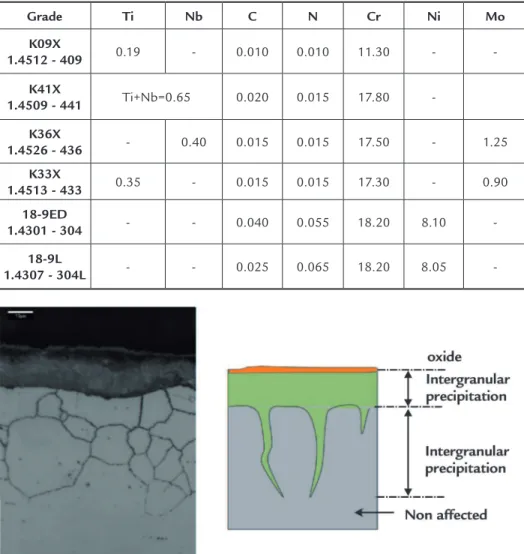
The materials studied were standard automotive grades from the ArcelorMit-tal Stainless Europe offer. The chemical composition is presented in Table 1.
The simulation bench consists of laboratory handmade rigs dedicated to SCR technology studies and adapted to allow in the same time 1) injection of commercial AdBlue® and 2) cyclic heat treatment in the range of temperature and frequency of the application
(be-tween 400 and 700°C for Tmax – cycle duration between 2min and 2h (Kjäll, 2007). The samples could undergo dif-ferent thermal cycles which could reach up to 700°C and then represent different engine load.
After the test, the samples are cut and the cross-section observed. We proceeded to 1 measurement every 1mm on 10 mm width area in the cen-ter of the sprayed zone and evaluated
the mean value of the total degrada-tion by addidegrada-tion of the distinguished contributions (Figure 2). Indeed two contributions were observed and called intragranular and intergranular pre-cipitation (see results for analysis of the nature of every contribution).
Nota Bene: As we protected the sur-face of the sample for technical reasons, the oxide growth is limited and its thick-ness negligible.
2.
Materials & Methods
Table 1 Chemical composition of materials.
Figure 2 Picture and schematic of the different contributions observed and measured on a sample cross section after laboratory simulation test.
The irst step was to verify that the deterioration mechanisms were tempera-ture activated. Whereas the urea decom-position products present different ratios of ammonia as a function of temperature, it was important to conirm in which scale temperature had an inluence on the
mechanisms and at which temperature the degradation could be detected at labora-tory test duration scale.
To stay close to ield conditions, the temperatures tested were above 250°C to ensure a complete urea decomposition and did not exceed 700°C which appears as a
very maximum temperature which could be measured on the tube wall upstream the catalyst.
We decided to test 2 representative grades, one austenitic (1.4301) and one ferritic (1.4509) as is presented in the Figure 3.
Grade Ti Nb C N Cr Ni Mo
K09X
1.4512 - 409 0.19 - 0.010 0.010 11.30 -
-K41X
1.4509 - 441 Ti+Nb=0.65 0.020 0.015 17.80
-K36X
1.4526 - 436 - 0.40 0.015 0.015 17.50 - 1.25
K33X
1.4513 - 433 0.35 - 0.015 0.015 17.30 - 0.90
18-9ED
1.4301 - 304 - - 0.040 0.055 18.20 8.10
-18-9L
1.4307 - 304L - - 0.025 0.065 18.20 8.05
-3. Results & Discussion
Me
chanisms investigations
Figure 3
Temperature inluence on the stainless steel degradation (150h test).
After 150h test duration, samples were cross cut and investigated. Two representative samples are presented after SEM investigation (secondary electrons and concentration proiles of involved elements Figure 4).
These observations clearly identify a nitriding phenomenon of the surface on both characterized grades and moreover probably a carbonitriding mechanism
on the 189ED (1.4301) austenitic grade. This diffusion mechanism was already highlighted by (Kjäll. J, 2007). A more detailed analysis of this grade permits to exhibit chromium nitrides particles in area [3] (Figure 5).
TEM investigations permitted to identify the nature of particles generated. We evidenced CrN precipitation in the upper layer close to the oxide layer and
Cr2N disseminated through the substrate preferentially at the grain boundaries (Simmons, J.W, 1996) in the zone [3] layer (Figure 5). This precipitation, due to nitrogen enrichment from external environment, can lead to a decrease of corrosion resistance due to chromium depletion close to the grain boundaries at the temperature range of the application (Wang, J. et al., 2008).
Figure 4
Concentration proiles of
O, Cr, C and N observed on 189ED.
(1): Fe and Cr oxide layer. (2): carbonitriding layer.
(3): substrate material with intergranular
precipitation (not detected here). 400
0 20 40 60 80 100 120 140 160
450
Temperature (°C)
T
o
ta
l
p
e
n
e
tr
a
ti
o
n
d
e
p
th
(
µ
m
)
500 550 600 650 700 750
Moreover understanding of the mechanisms, the grade selection is critical for exhaust manufacturers and must be motivated by technical per-formance arguments. To this aim, we carried out trials with several grades largely used in the exhaust ield (see Figure 6). The Cr content above 16%
appears as a minimal condition to ensure good urea/ammoniac hot cor-rosion performance.
If the molybdenium content present undoubtedly advantage against internal corrosion by condensate inwide the muf-ler, it does not exhibit a positive role in hot corrosion by urea. However as the
role of stabilized elements in excess, which could catch nitrogen and carbon diffused from the outside, present the best perfor-mance, K33X presents a good material selection by combining high resistance to hot corrosion by urea and high internal corrosion resistance insured by the mo-lybdenium content.
Figure 5 TEM investigation of chromium
nitride particles
G
rade ranking
Figure 6 Total penetration of nitriding corrosion
attack on laboratory simulation bench after 300h test.
Correlation with the ield tests was possible thanks to some of our customers, in particular due to a ield validation test of the system with austenitic 304 (1.4301) material selection. Courtesy by Tenneco,
a SRC system could be examinaned after 2500h of ield tests. Their investigations highlighted the presence of 4 different ar-eas (Figure 7): 1)oxide, 2)oxide + nitrided particles + pollutant, 3) nitrided layer and
4) base metal. These observations are equivalent to what we showed with this grade during our accelerated simulation tests in 2008 (Figure 8). The thickness of oxide layer is thinner on laboratory sample
Correlation with ield test
300h - total penetration
0 20 40 60 80 100 120 140
K33X 436Ti 1.4513
K41X 441 1.4509
K36X 436 1.4526
18-9L 304L 1.4307
18-9E 304 1.4301
K09X 409 1.4512
C
o
rr
o
si
o
n
d
ep
th
(
µ
m
due to the presence of isolation material on surface of the sample to ensure contact
between liquid urea and hot material. This correlation conirms necessity
of accelerated simulations in the laborato-ry and the relevance of the test developed.
7 8
Figure 7
Off-road part in 304
after 2500h, courtesy of Tenneco.
Figure 8
304 after 150h, AMSE-Isbergues simulation test.
The laboratory simulations evi-dence the consequence of injection of liquid urea in water solution within the exhaust line undergoing cyclic heat treat-ments on several stainless steels usually used for exhaust line manufacturing. By its decomposition on the stainless steel surface, urea releases nitrogen and carbon species, which are interstitial elements susceptible to diffuse through the steel matrix. Unfortunately, this type of physicochemical reaction, if un-controlled, as is the case in exhaust gas environment, may have a detrimental effect on the stainless steel durability. Indeed, in this background, the com-plex nitriding mechanisms combining oxidation and corrosion of the material by diffusion and precipitation generates
brittle layers and precipitation at grain boundaries. The affected zones could generate several major damages as: • Hot corrosion + oxidation on the
surface:
– Decreased material durability (ac-celerated if chloride or exhaust gas condensate are present).
• Nitriding mechanism:
– Local chromium depletion and then intergranular corrosion risk.
– Brittleness in nitrided area.
• Scaling of the oxide layer in surface and then poisoning of the catalyst.
• Perforations due to erosion. In addition to the understanding of the mechanism for which complemen-tary experiments need to be carry out (in
particular on lab casts to demonstrate the inluence of stabilizing elements, Mo, and level of Cr content), the laboratory simulations exhibited another practical interest which is to be helpful to rank material durability performance quicker than in ield tests while staying close to real conditions.
Among all tested grades, K33X (436Ti) and K41X (441) present the best behavior against urea decomposition products at high temperature. However the K33X (436Ti) constitutes the best material selection to combine good dura-bility in presence of SCR system and high corrosion resistance to internal pollutants, thanks to low depassivation pH (<2) and Mo content which increase pitting poten-tial and slow corrosion propagation.
4.
Conclusions
FORZATTI, P. et al. Diesel NOx aftertreatment catalytic technologies: Analogies in LNT and SCR catalytic chemistry. Catalysis Today, 2010. doi:10.1016/j. cattod.2010.02.025
JOHNSON, T. Diesel engine emission and their control. Platinium Metals Rev., 2008.
KJÄLL, J. High temperature corrosion in urea-exhaust environment, Diploma Work
85/2007, ISSN 1652-8913 (2007)
KOEBEL. M, et. al. Selective catalytic reduction of NO and NO2 et low temperature.
Catalysis Today, 2002.
KOEBEL M. et al. Urea SCR: a promising technique to reduce NOx emissions from automotive diesel engines. Catalysis Today, 2000.
RAJASEKAR, E. et al. Review of NOx reduction technologies in CI engines fuelled with oxygenated biomass fuels. Renew Sustain Energy Rev., 2010. doi:10.1016/j. sers.2010.03.005.
SIMMONS, J.W. Effect of nitride (Cr2N) precipitation on the mechanical, corrosion and wear properties of austenitic stainless steel. ISIJ International, 1996.
WANG, J. et al. Effects of DC plasma nitriding parameters on microstructure and properties of 304L stainless steel. Materials Characterization, 2008.