159
Abstract
A representative set of diamonds from the Borrachudo River (114 stones) was described for the irst time as to their physical characteristics, among them weight, morphology, dissolution igures, and abrasion. Most samples are low in weight (~51% less than 0.30 ct) and only ~3.5% are above 3.0 ct. However, considering the total weight, ~47% of it is concentrated in the range above 3 ct. On the other hand, there even occur diamonds with dozen of carats. The most common crystallographic forms are originated from the octahedral form by dissolution, although irregular shapes like chips and lats also occur. The diamonds show differences in form compared to their weight ranges; those up to 0.30 ct have various shapes; in the range of 0.31 to 1 ct the most common are octahedral forms and their descendants; and in stones larger than 1 ct chips and lats predominate. The general habitus of the crystals, identiied by their inal tetrahexahedroid shapes, chips and lats, corroborated by the dissolution igures, indicate that the diamond were submitted to strong dissolution in a magmatic environment. Residual hillocks and holes represent the inal stage of dissolution. The study indicates that the abrasion by the luvial transport was not expressive enough to cause mechanical wear, thus ca. 97% shows no sign of wear. This fact suggests a proximal source for most of these diamonds.
Keywords: Diamond, Borrachudo River, São Francisco Basin
Resumo
Uma população representativa de diamantes do rio Borrachudo (114 cristais) é pela primeira vez descrita quanto às suas características físicas, envolvendo peso, mor-fologia, iguras de dissolução e abrasão. A maioria das amostras possui peso reduzido (~51% inferior a 0,30 ct) e apenas ~3,5% acima de 3,0 ct. No entanto, em relação ao peso total, ~47% concentra-se na faixa de peso acima de 3 ct, sendo observados, ainda, diamantes com dezenas de quilates. As formas cristalográicas mais comuns são oriundas da dissolução da forma original octaédrica, embora formas irregulares como chips e lats também ocorram. Os diamantes apresentam diferenciações quanto às suas formas em relação às faixas de peso; os com até 0,30 ct mostram-se em formas variadas; entre 0,31 a 1 ct ocorrem formas octaédricas e suas descendentes; e, nas amostras maiores que 1 ct, predominam os chips e lats. O habitus geral dos cristais, identiicado pelas formas tetraedróides inais, chips e lats, juntamente com as iguras de dissolução, indicam que os diamantes sofreram uma forte dissolução no ambiente magmático. No estágio inal do processo, são, ainda, observadas iguras de corrosão como hillocks residuais e buracos. O estudo da abrasão luvial indica que o transporte
Diamonds from Borrachudo
River, São Francisco Basin
(Tiros, MG): Morphologic and
Dissolution Aspects
Diamantes do rio Borrachudo,
bacia do São Francisco (Tiros, MG):
aspectos morfológicos e de dissolução
Luis Alberto de Deus Borges
Geologist of the Petrus Mineração Patos de Minas, Minas Gerais, Brasil [email protected]
Mario Luiz de Sá Carneiro Chaves
Associate Professor
Universidade Federal de Minas Gerais Instituto de Geociências
Belo Horizonte – Minas Gerais – Brasil [email protected]
Joachim Karfunkel
Associate Professor
Universidade Federal de Minas Gerais Instituto de Geociências
Belo Horizonte – Minas Gerais – Brasil [email protected]
Geosciences
160
não foi expressivo para causar desgaste mecânico, logo cerca de 97% não apresenta sinais abrasivos. Este fato sugere uma fonte proximal para a maioria desses diamantes.
Palavras chaves: Diamante, Rio Borrachudo, Bacia do São Francisco
1. Introduction
The Borrachudo River is a left margin tributary of the São Francisco River, flowing in NE-SW direction parallel to the Abaeté (west) and Indaiá (east) rivers, both also diamondiferous (Figure 1). Diamonds were discovered in the Abaeté River, considered the richest among the three, in the mid-eighteenth century by runaway slaves from the Dia-mantina District, which was at this time
the main area of the country where the mineral was explored (Barbosa, 1991).
Since 2001, a paleochannel located on the banks of the Borrachudo River, in the locality called Canastrão (munici-pality of Tiros, Minas Gerais State), has been exploited by Petrus Mineração, a company from Patos de Minas (Figure 1). The objective of this research is the study of a complete parcel of diamonds,
with 114 stones, recovered of this allu-vial mine during the irst half of 2010. The study emphasizes the morphologi-cal aspects of the diamonds, as well as their relationships with the different types of dissolution and/or abrasion. The source rock(s) of such diamonds in the region is still unknown.
2. Regional geology and diamond deposits
The focused area is part of the “Western São Francisco Diamondifer-ous Province” (Chaves & Chambel, 2003), one of the four major diamond provinces of Minas Gerais. No detailed study of this region has been made,
although it has been mapped recently at a 1:100,000 scale (Reis, 2011). The oldest rocks belong to the Canastra and Bambuí groups, of Neoproterozoic ages (Figure 1), consisting mostly of quartz-ites for the irst group, and
metasilt-stones with interbedded limemetasilt-stones for the latter group, which were folded and metamorphosed during the Brasiliano orogenic cycle (0.65 to 0.50 Ga).
Figure 1
Geological map of the region related to the Abaeté, Borrachudo and Indaiá rivers, in the center-west of Minas Gerais State (modified from Heineck et al., 1993). In detail, on the right side, diamond occur-rences in the Borrachudo River and its surroundings (Borges, 2013).
The covering sediments of the Precambrian rocks have been deposited mainly during the Cretaceous Era. The oldest deposits correspond to the Areado Group (Lower Cretaceous), consisting of
thin grained sandstones with large cross stratiications, and the Mata da Corda Group (Upper Cretaceous) which consists of sandstones and volcanoclastic rocks. Local unconsolidated sandy sediments
161 follows a normal fault system that was
originated from extensional events (Fuck & Pereira, 2005). The diamond deposits of this region and their possible source have been the subject of studies by some authors (e.g. Barbosa et al., 1970; Tomp-kins & Gonzaga, 1989; Read et al., 2004). Alluvial diamond deposits occur in the Borrachudo River and some of its
tributaries (Figure 1, featured on the right side). In the studied area, the deposits are related to three periods, all of them probably of Holocene Era (Reis, 2011). The oldest one occurs as alluvial ter-races, elevated up to 20 m relative to the current channel of the river and consists of unconsolidated gravels with variable thickness up to 2 m. Paleochannels of
younger eras occur on both banks of the river (about 2 m above its actual trough), whose remnants are up to 8 m thick (2-3 m of basal gravel and 30-35 m wide); these deposits are currently undergoing mining activity and its diamonds are the focus of this study (Figure 2A-B). The younger deposits are alluvial sediments of the riverbed.
Figure 2 (A) Mined diamondiferous gravels (pale-ochannel) at the Borrachudo River, where
the diamonds were recovered (contact in red). (B) General view of part of the studied diamond parcel.
3. Physical aspects of the diamonds from the Borrachudo River - Results
The physical characteristics of the diamonds are very important to under-stand their primary sources, to deine different genetic "families”, as well as to understand their primary paths, the sur-face distances from the source rock until its deposition site in the alluvium. Several authors have studied the morphology and dissolution igures of diamonds, using both descriptive and statistical methods in primary and secondary deposits (e.g.
Svisero, 1971; Harris et al., 1975; Chaves, 1997; Martins, 2006), as well as by purely experimental methods (e.g. Orlov, 1977; Kosai & Arima, 2005; Khokhryakov & Pal'yanov, 2007).
The knowledge of the diamond transformation processes from their origi-nal form may indicate the fundamental conditions of formation of their host bod-ies, and the dissolution of the crystals in the ascent magma presents aspects other
than those occurring in the river system. In the present study, the physical parameters are shown in four different interconnected parameters: characterization of crystal weight and morphological patterns, both indicating the transformation degree by dissolution; their dissolution igures, which show the relative stage of this pro-cess; and the abrasion, which is the inal shape produced by mechanical wear dur-ing the luvial transport.
Weight (ct)
The weight ranges were selected according to the general pattern observed in diamonds from the Western São Fran-cisco Diamondiferous Province, accord-ing to the original proposal of Chaves & Chambel (2003). In the studied parcel,
a numerical predominance of samples weighing up to 0.30 ct (~51%) occurs, followed by another range between 0.31 and 1.00 ct (~37%) (Figure 3A). The presence of some diamonds weigh-ing over 20 ct was also detected. Thus,
taking into consideration all weight cat-egories, including isolated larger stones, this situation changes considerably, showing a signiicant percentage (~47%) concentrated in the range heavier than 3 ct (Figure 3B).
Figure 3 (A) Weight patterns of weight recorded in
diamonds from the Borrachudo River in relation to the number of studied crystals. (B) The same situation in relation to total weight of stones (both in %).
Morphology
The most common growth forms of the studied diamonds are the cube {100}, octahedron {111}, and rhombic dodecahedron {110} (Figure 4). The
crystals may often not have deinite shapes (as chips and lats) due to dis-proportions in the growth given by different speeds along speciic
162
Figure 4
Theoretical scheme of the diamond mor-phological evolution from its fundamental forms during the dissolution processes (A, rhombic dodecahedron; B, octahedron; C, cube) (according to Khokhryakov & Pal'yanov, 2007).
Recent experimental studies by Khokhryakov & Pal'yanov (2007) showed a change in morphology from octahedrons, rhombic dodecahedrons and cubes to inal tetrahexahedroids forms by
progressive dissolution, though involving different rates of mass loss (Figure 4). In this way, rhombic dodecahedrons only lose 10% of mass, while octahedron loses 20-25%, and in cubes, the mass
loss is greater than 50%. A complete presented sequence of the form evolution (Figure 5) was based on Svisero (1971), Khokhryakov & Pal'yanov (2007), and Borges (2013).
Figure 5
The crystallographic forms of dia-mond separated by the primary stage of growth, and its different secondary combined forms (adapted on Svisero, 1971; Khokhryakov & Pal'yanov, 2007; and Borges, 2013 – numbers 1 to 9 refer to the shapes observed in the studied diamonds).
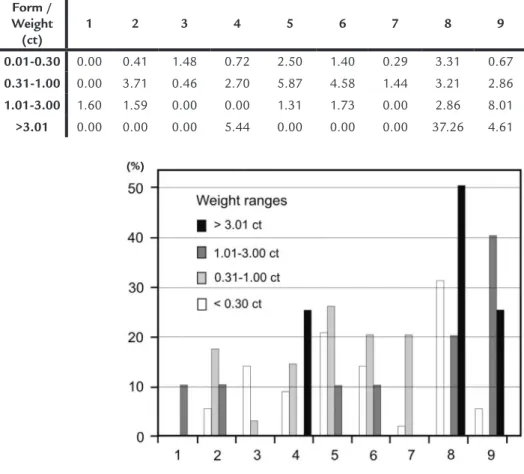
Diamonds from the Borrachudo River have interesting differences regard-ing their shapes in relationship with the weight ranges. Weights between 0.01 and 0.30 ct present very different forms, while the 0.31 to 1 ct range only shows
octahedral shapes and its descendants. In samples over 1 ct, the chip and lat types predominate. The morphology of the crystals indicates that the dissolution process has been highly developed, as identiied by inal tetrahedroid forms, as
well as the chips and lats (Tables 1 and 2, Figure 6). By the detailed study of the parcel, it could be demonstrated that all of it was formed by the progressive dis-solution of octahedral shapes, or by twin of octahedron, chips and lats (Figure 5).
Form / Weight
(ct) 1 2 3 4 5 6 7 8 9
0.01-0.30 0.00 2.63 7.02 4.39 10.53 7.02 0.88 15.79 2.63
0.31-1.00 0.00 5.26 0.88 4.39 7.89 6.14 2.63 5.26 4.39
1.01-3.00 0.88 0.88 0.00 0.00 0.88 0.88 0.00 1.75 3.51
>3.01 0.00 0.00 0.00 0.00 0.88 0.00 0.00 1.75 0.88
Table 1
163 Form /
Weight (ct)
1 2 3 4 5 6 7 8 9
0.01-0.30 0.00 0.41 1.48 0.72 2.50 1.40 0.29 3.31 0.67
0.31-1.00 0.00 3.71 0.46 2.70 5.87 4.58 1.44 3.21 2.86
1.01-3.00 1.60 1.59 0.00 0.00 1.31 1.73 0.00 2.86 8.01
>3.01 0.00 0.00 0.00 5.44 0.00 0.00 0.00 37.26 4.61
Table 2 Relationship between weight ranges and
crystallographic forms, considering the total weight of the sample (in %; shape numbers as in figure 5).
Figure 6 Relationship between the weight ranges according to the number of samples in the respective crystallographic forms (shape numbers as in figure 5).
Dissolution igures
According to many authors (e.g. Kozai & Arima, 2005; Khokhryakov & Pal'yanov, 2007) the dissolution igures develop in a sequential line, where three stages in the process are recognized: (1) initial stage, where negative or positive trigons appear, as well as hillocks in blocks
or pseudopyramids; (2) intermediate stage, showing secondary cleavage, residual hill-ocks, lamination and undulation lines; and (3) inal stage, with the formation of holes and patina like.
Among the dissolution figures, hillocks in blocks and pseudopyramids
predominate, followed by positive trigons and secondary cleavage, mainly in chip type diamonds. Another observation is that in the octahedron the morphological evolution is accompanied by dissolution figures in their respective dissolution stages (Table 3).
Shapes /
Dissolu-tion figures 1 2 3 4 5 6 7 8 9 Trigons 0.00 50.00 44.44 18.18 4.55 12.50 25.00 25.00 23.08
Hillocks in blocks/
pseudopyramids 0.00 20.00 44.44 45.45 36.36 12.50 75.00 25.00 30.77 Secondary cleavages 0.00 10.00 22.22 27.27 13.64 12.50 25.00 39.29 69.23
Residual hillocks 0.00 0.00 0.00 0.00 4.55 0.00 0.00 7.14 7.69
Lamination lines 0.00 20.00 0.00 0.00 4.55 0.00 0.00 10.71 7.69
Undulations 100.00 0.00 0.00 9.09 0.00 18.75 0.00 3.57 0.00
Holes 0.00 0.00 0.00 9.09 18.18 12.50 0.00 25.00 15.38
Patina like 0.00 0.00 11.11 0.00 9.09 6.25 0.00 3.57 0.00
Table 3 Dissolution figures present in the initial (trigons, hillocks in blocks or
pseudopyra-mids), intermediate (secondary cleavage, residual hillocks, lamination lines and undulation), and final (holes and patina like) stages (form numbers as in figure 5). Individual stones were examined under a binocular microscope with 40x magnifier.
Evolution of the crystallographic form of the diamonds from the Borra-chudo River can be seen in igure 7. The original faces are gradually replaced
following the sequence from the octa-hedron to the rhombic dodecaocta-hedron: {111} → {111} + {110} → {110} + {111} → {110}. In octahedral and descendant
164
Figure 7
Relation between crystallographic forms and dissolution figures in diamonds from the Borrachudo River and sample frequency.
Abrasion
Abrasion is the mechanical wear process given by luvial transport. In the studied population, diamonds of the
Bor-rachudo alluvium without wear largely predominate (97.4%). Only three samples (2.6%) showed some small signs of wear.
This means negligible transport, and therefore the source area was relatively near (Figure 8).
Figure 8
Frequency diagram of abrasion in dia-monds from the Borrachudo River: 1. No original facet; 2. Small visible original facets; 3. Worn vertex and edges; 4. No signs of mechanical wear and/or bearing.
4. Concluding remarks
more inal-stage dissolution igures ap-pear. In chip and lat diamond types,
dissolution igures show the three dis-tribution stages approximately in the
same proportions.
The origin of diamonds from the region related to the Abaeté, Borrachudo, and Indaiá rivers has always been a co-nundrum. Unlike the adjacent province to the southwest (Alto Paranaiba Province), where dozens of kimberlite intrusions in Coromandel and surrounding
municipali-ties are known (although a real connection between these intrusions and mineralized alluvial deposits has never been estab-lished), in the Western São Francisco Dia-mondiferous Province certain problems are added.
In the headwater areas of these three
165
5. Acknowledgements
6. References
The irst author thanks the IGC/ UFMG, where he inalizes his Master's
Thesis. M. Chaves thanks CNPq for granting the research productivity
schol-arship and the facilities granted by Petrus Mining Co.
BARBOSA, O. Diamante no Brasil – histórico, prospecção e lavra. Rio de Janeiro: CPRM Editora, 1991. 136p.
BARBOSA, O. et alii. Geologia da região do Triângulo Mineiro. Boletim DNPM/DFPM, v.136, p.1-140, 1970.
BORGES, L.A.D. Mineralogia e aspectos gemológicos do diamante da região do rio Borrachudo (Tiros. MG). Belo Horizonte: IGC - Universidade Federal de Minas Ge-rais, 2013.185p. (Master in Sciences Disssertation).
CHAVES, M.L.S.C. Geologia e mineralogia do diamante da serra do Espinhaço em Mi-nas Gerais. São Paulo: IG - Universidade de São Paulo, 1997, 289p. (Doctorade Thesis). CHAVES, M.L.S.C., CHAMBEL, L. Diamante: a pedra, a gema, a lenda. São Paulo:
Oicina de Textos, 2003. 231p.
FUCK, R.A., PEREIRA, R.S. Archean nucleii and the distribution of kimberlite and rela-ted rocks in the São Francisco craton. Brazil. Revista Brasileira de Geociências, v.35, p.93-104, 2005.
HARRIS, J.W. et alii. A classiication scheme for diamond and a comparative study of South African diamond characteristics. Physics and Chemistry of the Earth, v.9, p.765-783, 1995.
HEINECK, C.A. et alii. Mapa geológico do Estado de Minas Gerais, Escala 1:1.000.000. Belo Horizonte: COMIG/CPRM Agreement, 2003. 1 folha.
KHOKHRYAKOV, A.F., PAL’YANOV, Y.N. The evolution of diamond morphology in the process of dissolution: experimental data. American Mineralogist, v.92, p.909-917, 2007.
KOZAI, Y., ARIMA, M. Experimental study on diamond dissolution in kimberlitic and lamproitic melts at 1300-1420 °C and 1 GPa with controlled oxygen partial pressure.
American Mineralogist, v.90, p.1759-1766, 2005.
MARTINS, M.S. Geologia dos diamantes e carbonados da bacia do Rio Macaúbas (MG). Belo Horizonte: IGC-Universidade Federal de Minas Gerais, 2006. 231p. (Doc-torate Thesis).
ORLOV, L.Y. The mineralogy of diamond. New York: Wiley & Sons, 1977. 235p. READ, G. et alii. Stratigraphic relations, kimberlite emplacement and lithospheric thermal
evolution, Quiricó basin, Minas Gerais State, Brazil. Lithos, vol.77, p.803-818, 2004. REIS, H.L.S. Folha SE.23-Y-B-V – Serra Selada, Mapa Geológico, Escala 1:100.000. Belo
Horizonte: UFMG/CODEMIG/CPRM Agreement, 2011. 1 sheet.
SVISERO, D.P. Mineralogia do diamante da região do Alto Araguaia. Mato Grosso. São Paulo: IG - Universidade de São Paulo, 1971. 127p. (Doctorate Thesis).
TAPPERT, R., TAPPERT, M.C. Diamonds in nature: a guide to rough diamonds. Berlin: Springer, 2011. 142p.
TOMPKINS, L., GONZAGA, G.M. Diamonds in Brazil and a proposed model for the origin and distribution of diamond in the Coromandel region, Minas Gerais, Brazil.
Economic Geology, v.84, p.591-602, 1989.
Received: 15 Abril 2013 - Accepted: 13 May de 2014. detail) is also known. Such streams do
not emanate from the headwaters of the Borrachudo River, indicating the pos-sible existence of more than one area of primary mineralizing rock sources, not discarding the possibility of Cretaceous deposit reworking. Similar to what occurs in other alluvial systems in the region, such as in the Abaeté and Sono rivers (Chambel & Chaves, 2003), it is probable that a mixture of diamonds from different
sources occur.
The weight pattern showed that most of the parcel is below 0.30 ct, al-though larger samples are also found, in the shape of chips or lats. Thus, the study characterized two distinct families identiied by: (1) well-formed crystals, always from octahedral shapes and its descendants, and (2) larger size chips and lat crystals. The morphology associated with the dissolution igures indicates that