Luciene Dias Villar* Instituto de Aeronáutica e Espaço São José dos Campos – Brazil
Rafael Filadelfo da Silva
Universidade de São Paulo Lorena – Brazil [email protected]
Milton Faria Diniz
Instituto de Aeronáutica e Espaço São José dos Campos – Brazil
Marta Ferreira K. Takahashi
Instituto de Aeronáutica e Espaço São José dos Campos – Brazil
Luis Cláudio Rezende
Instituto de Aeronáutica e Espaço São José dos Campos – Brazil [email protected] * author for correspondence
The role of antioxidant on
propellant binder reactivity during
thermal aging
Abstract: Thermal aging of hydroxy-terminated polybutadiene (HTPB) stabilized with 2,6-di(tert-butyl)hydroxytoluene (BHT) was carried out at 60oC from 1 to 11 weeks. Samples of 200 mL were stored in sealed 500-mL Erlenmeyer lasks under atmospheric pressure or vacuum and periodically withdrawn for physical and chemical analysis, infrared spectroscopy characterization and measurement of HTPB/IPDI (isophorone diisocyanate) reactivity, expressed as pot life. Mechanical properties of the cured polyurethane, prepared from aged HTPB, were assayed by uniaxial tension tests. Despite the unchanged chemical structure, an increase in HTPB/IPDI binder reactivity was observed, being correlated with BHT depletion measured as color change (yellowing). Aging of HTPB showed no interference on mechanical properties of the cured polyurethane. Keywords: Antioxidant, Composite propellant, HTPB propellant, Polyurethane resin, Storage.
INTRODUCTION
Although there has been an increasing research effort into development of energetic polymer binders for solid rocket propulsion, hydroxy-terminated polybutadiene (HTPB) is still widely used in the formulation of composite propellant. This 1,3-butadiene homopolymer contains terminal and reactive hydroxyl groups, introduced during free radical polymerization by peroxide or azo compounds. During solid propellant processing, these hydroxyl groups react with a diisocyanate resulting in polyurethane, which acts as a binder for the solid particles of the propellant composition.
Due to the unsaturated character of the repeated unit, polybutadiene is known to be sensitive to oxidation, thus being usually supplied with the addition of stabilizers (Ninan et al., 1996), namely antioxidants, especially hindered phenol compounds.
The mechanisms and kinetics of HTPB oxidation have been a matter of great concern since the 1960’s. More recently, Coquillat et al. (2007a, b, c) have defended the occurrence of radical addition to double bonds and allylic methylene consumption, meanwhile Guyader
et al. (2006) have emphasized the mechanism of
epoxide formation during HTPB aging. In spite of this, both works agree that oxidation of HTPB is highly dependent on sample thickness and oxygen partial pressure, a condition hardly mentioned in previous studies (Hinney and Murphy, 1989; Pecsok
et al., 1976).
In one of these studies (Hinney and Murphy, 1989), the effect of HTPB aging over its reactivity with isocyanates was investigated by measuring the decrease in pot life,
deined as the time necessary to reach a pre-established
viscosity value. The authors attributed the increase in reactivity to the higher functionality derived from HTPB oxidation through a mechanism of hydroperoxide formation.
In our study, an assessment of the inluence of usual
storage conditions over aging of HTPB was carried out by submitting large samples (200 mL) of this resin, stabilized with the primary antioxidant BHT, to thermal aging under stagnated atmospheric pressure or under vacuum. Physical and chemical analysis, infrared spectroscopy and pot life measurement showed that, being diffusion-dependent, the observed increase of HTPB reactivity was not due to change in its chemical structure. Instead, an overview of the concerned literature indicated that it was related to BHT depletion and conversion into quinone derivatives, which may eventually react with isocyanates to graphitize into the polyurethane.
EXPERIMENTAL
Material
Samples of uncrosslinked HTPB (Mn = 2,900 g/mol) of predominant trans 1,4 structure (Takahashi and Diniz,
2002) were supplied by Petrolex (Brazil) containing 1%
w/w of BHT (2,6-di(tert-butyl)hydroxytoluene, CA index name as 2,6-bis(1,1-dimethylethyl)-4-methyl-phenol). The material was maintained in tightly closed vessels at room temperature until they were used.
Aging conditions
Aging experiments were conducted on 200-mL samples of uncured liquid HTPB placed in sealed 500–mL
Erlenmeyer lasks. Flasks were placed into forced
circulating air oven at 60 ± 1oC and protected from day
light exposition. Headspace of the lasks was kept either at atmospheric pressure or under 99% vacuum. Duplicated lasks were withdrawn after 1, 2, 4, 6, 9 and 11 weeks and
placed for characterization at the same day of collection (pot life and physical and chemical analysis) or within a maximum of two days (mechanical properties). Samples were maintained in desiccators at room temperature until analyses were performed.
Characterization
Determination of pot life was made by stoichiometric reaction of HTPB with IPDI (isophorone diisocyanate, CA index name as
5-isocyanato-1-(isocyanatomethyl)-1,3,3-trimethyl-cyclohexane) in the presence of 0.012%
w/w of the catalyst ferric acetylacetonate (tris(2,4-pentanedionato-iron). The catalyst was blended with HTPB in a mechanical stirrer. The mixture was heated for bubble removal. After addition of IPDI, the mixture was manually stirred and immediately placed for viscosity measurement at 50oC. The time required to reach 20 Pa.s
was considered as the pot life. At each sampling time, an unaged sample of HTPB was also analyzed for pot life as a control.
Yellowing of HTPB was measured by using a spectrometer in the visible region (PerkinElmer Lambda 3B UV/VIS). In preliminary tests, a range of wave length varying from 220 to 320 nm was evaluated. Maximum absorption was obtained at 295 nm. Samples were diluted in toluene (1:1) and analyzed in duplicate with toluene as the blank.
Determination of physical and chemical properties included: hydroxyl number (Takahashi et al., 1996);
viscosity at 25oC measured in a small sample device
(Brookield LVDV-II+ with software Wingather 2.2) and humidity (Karl Fischer Metrohm 633).
Fourier transform infrared spectra (FT-IR) were collected
by using a PerkinElmer Spectrum One spectrometer.
HTPB was analyzed as thin ilms, while BHT was
analyzed as potassium bromide pressed-pellet. Analyses were carried out under transmission mode at the following conditions: spectral range 4000 - 400 cm-1; 40 scans and 4
cm-1 resolution.
Pot life and color change were evaluated by using the
property retention index (PRI) as deined by ASTM
D5870-95 (2003) for destructive tests. Determination of the PRI for each replicate exposed to aging, zi , is deined
by Eq. (1).
z p
p
i i x,
0
= (1)
Where,
Pi,x: property of the i replicate at exposure time, x, and
p0: initial value of the property.
Determination of the mean PRI, , is deined by Eq. (2).
Z z
n
i i
n
=
∑
=1 (2)Where,
zi: PRI for each replicate exposed to aging;
n: number of replicates.
Mechanical properties
Samples of HTPB aged for 1, 5, 8 and 10 weeks were also used to prepare polyurethane samples with 2 mm thickness and compared with polyurethane prepared from unaged HTPB. Dumbbell specimens were assayed for uniaxial tension tests, according to ASTM D412-06a in
a Zwick 1474 testing machine at 500 mm/min and 25oC.
Hardness was measured in circular specimens with 70 mm thickness by following ASTM D2240-05.
RESULTS AND DISCUSSION
with recommended speciications (MIL-H-85497-81) for
application of HTPB in solid propellants. Some of the
properties investigated have no speciied limits.
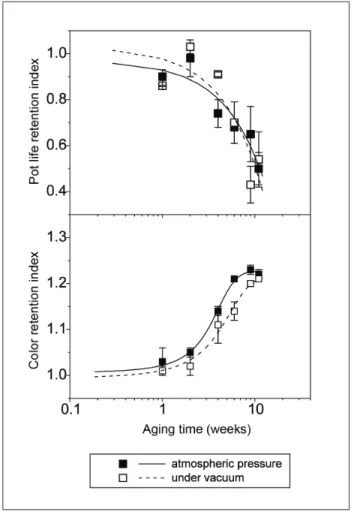
In order to improve the comparison between both treatments (atmospheric pressure and vacuum), property retention index was applied to the processing property of pot life and to HTPB color changing (yellowing),
as showed in Fig. 1. A remarkable decrease of pot life
retention index was followed by a sigmoidal increase of color retention index during the course of the aging
experiment (Fig. 1). A linear correlation between them is presented in Fig. 2, showing that the decrease in pot
life is related to yellowing increase by a correlation factor of 0.90 and 0.94 for atmospheric pressure and vacuum, respectively.
Figure 1: Pot life and color change retention indexes as a
function of aging time.
Figure 2: Correlation between pot life and color change
retention indexes.
Figure 3: Physical and chemical properties of HTPB as a
function of aging time.
The values of hydroxyl number, viscosity and humidity are
presented in Fig. 3. Dashed lines represent upper (UL) and lower (LL) limits (Table 1). Although some luctuations
can be observed, the investigated properties were kept
under the speciied limits and showed no signiicant
Infrared spectra were obtained on samples of HTPB exposed to 0, 1, 2, 4, 6, 9, and 11 weeks under thermal
aging at both pressure conditions. For practical
reasons, only the first and the last exposure time
spectra are presented in Fig. 4. Aged and unaged HTPB
samples presented similar spectra for both atmosphere conditions investigated. Increase in the absorption at the region of 3394 cm-1(nOH), which could account
for increase in functionality, was not observed. Additionally, the absorption at the region of 1639 cm-1
(nC=C olefinic) remained unchanged, indicating no radical addition to double bonds up to the detection level of this technique. The absence of absorptions at the regions around 1740-1800 cm-1 (nC=O) and
830-1000 cm-1 (nOO) in the aged samples also indicates
no built-up of carbonyl or hydroperoxide groups. A
BHT spectrum was also included in Fig. 4. Due to its low concentration (1%) on HTPB, peaks of BHT or
its quinone derivatives were not apparent in HTPB spectra.
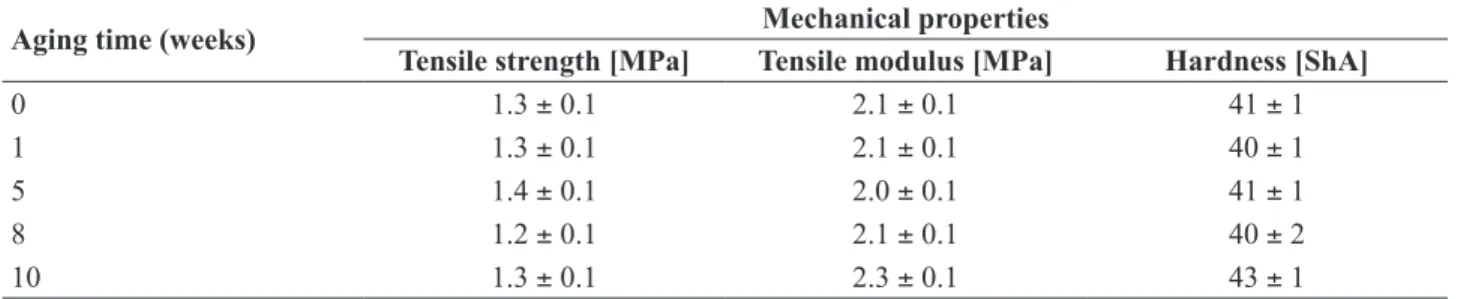
In order to verify if the change in reactivity of the binder system could interfere in the mechanical properties of the cured polyurethane, properties of tensile strength, Young modulus and hardness (Shore A) of the HTPB/ IPDI polyurethanes were assayed. They showed not to be changed with the aging of HTPB (Table 2).
Although the readily oxidative nature of HTPB is well established, Coquillat et al. (2007 a, b, c) and Guyader et
al. (2006) have demonstrated its dependency on oxygen
diffusion. Considering the aging testing conditions of this study, which used large samples (200 mL) exposed
to mild temperature, without shaking the lasks, oxygen diffusion was quite dificult even at atmospheric
pressure. In these conditions, oxidation of HTPB backbone may have hardly occurred as pointed by the
Table 1: Physical and chemical properties of unaged HTPB and recommended speciications
Physical and chemical property HTPB unaged MIL-H 85497-81 type I
Hydroxyl number (m mol/g) 0.75 ± 0.01 0.75 to 0.85
Humidity (%) 0.05 ± 0.02 0.10 max.
Acid number (mg KOH/g) 0.16 ± 0.01 ns
Viscosity (Pa.s, 25oC) 6.8 ± 0.1 4.0 to 8.0
Refraction index (ηd) 1.516 ± 0.001 (20oC) ns
Density (20oC) 0.902 ± 0.001 ns
ns: not speciied.
Figure 4: Infrared spectra of aged and unaged HTPB and BHT
antioxidant. A: unaged HTPB; B: aged HTPB under atmospheric pressure for 11 weeks; C: aged HTPB under vacuum for 11 weeks; D: BHT.
Table 2: Mechanical properties of cured polyurethane obtained from aged and unaged HTPB
Aging time (weeks) Mechanical properties
Tensile strength [MPa] Tensile modulus [MPa] Hardness [ShA]
0 1.3 ± 0.1 2.1 ± 0.1 41 ± 1
1 1.3 ± 0.1 2.1 ± 0.1 40 ± 1
5 1.4 ± 0.1 2.0 ± 0.1 41 ± 1
8 1.2 ± 0.1 2.1 ± 0.1 40 ± 2
results of physical and chemical properties, especially
hydroxyl number (Fig. 1), and by infrared spectra (Fig.
4). It is important to state that the dark condition of aging and the analysis of aged samples had minimized
any effect of UV light in the results presented (Fig. 1
and 3).
The unchanged values of humidity (Fig. 3) indicated
that the reactivity increase cannot be attributed to the reaction between IPDI and any absorbed atmospheric humidity.
In addition, the occurrence of HTPB homopolymerization or oxidative cross-linking during aging could not be
veriied, respectively, by the results of viscosity of uncured HTPB (Fig. 3) or by any change in the mechanical
properties of the cured polyurethane (Table 2).
On the other hand, the correlation between pot life
decrease and color change (Fig. 2) indicated that the
well-known yellowing of hindered phenol antioxidants (Vulic et al., 2002), even in the absence of oxygen (Bangee et al., 1995), may be related to the apparent change in HTPB reactivity, which was observed independently of the oxygen partial pressure. In fact, some studies (Celina et al., 2006; Désilets and Côté, 2006; Shanina, Zaikov and Mukmeneva, 1996) have demonstrated that quinone derivatives from hindered phenol antioxidants react quite readily with isocyanates and graphitize into HTPB backbone. Based on this literature evidence, our results indicate that the apparent increase of the HTPB/IPDI binder reactivity is due to a side-reaction between BHT quinone derivatives and IPDI.
CONCLUSION
The observed increase of reactivity after thermal aging of HTPB was correlated to antioxidant depletion and quinone by-products formation, which was assigned the role to react with IPDI, thus resulting in the observed pot life decrease. No experimental evidence was obtained in order to correlate the change in reactivity with change in chemical structure of HTPB.
ACKNOWLEDGMENTS
Thanks are due to Prof. Dr. Gilmar P. Thim (ITA) for allowing the use of spectrometer UV/Vis. Technical support of the Laboratories of Chemical Division, specially PPR-I, PPM, EPE and CAQ, are recognized.
Financial support from AEB is acknowledged. RFS
acknowledges CNPq for the undergraduate scholarship (PIBIC-IAE).
REFERENCES
Bangee, O.D. et al., 1995, “Antioxidant-induced yellowing of textiles”, Polymer Degradation and Stability, Vol. 50, No 3, pp. 313-317.
Celina, M. et al., 2006, “Correlation of antioxidant depletion and mechanical performance during thermal degradation of an HTPB elastomer”, Polymer Degradation and Stability, Vol. 91, No 8, pp. 1870-1879.
Coquillat, M. et al., 2007a, “Thermal oxidation of polybutadiene. Part 1: effect of temperature, oxygen pressure and sample thickness on the thermal oxidation
of hydroxyl-terminated polybutadiene”, Polymer
Degradation and Stability, Vol. 92, No 7, pp. 1326-1333.
Coquillat, M. et al., 2007b, “Thermal oxidation of polybutadiene. Part 2: mechanistic and kinetic schemes
for additive-free non-crosslinked polybutadiene”,
Polymer Degradation and Stability, Vol. 92, No 7, pp. 1334-1342.
Coquillat, M. et al., 2007c, “Thermal oxidation of polybutadiene. Part 3: molar mass changes of additive-free non-crosslinked polybutadiene”, Polymer Degradation and Stability, Vol. 92, No 7, pp. 1343-1349.
Désilets, S., Côté, S., 2006, “Chemical bond between stabilizers and HTPB-binders in propellants”, Propellants, Explosives, Pyrotechnics, Vol. 25, No 4, pp. 186-190.
Guyader, M. et al., 2006, “Epoxides in thermal oxidation of polybutadiene”, Polymer Degradation and Stability, Vol. 91, No 11, pp. 2813-2815.
Hinney, H.R., Murphy, J.R., 1989, “Suppression of reactivity changes in poly BD® R-45M resin”, Proceedings
of the 20th International Annual Conference of ICT, Karlsruhe, Germany, pp. 49-(1-11).
Ninan, K.N. et al., 1996, “Thermoanalytical investigations on the effect of atmospheric oxygen on HTPB resin”. Propellants, Explosives, Pyrotechnics, Vol. 21, No 4, pp. 199-202.
Pecsok, R.L. et al., 1976, “Fourier transform infrared studies of the mechanism of oxidation of cis-1,4-polybutadiene”, Rubber Chemistry and Technology, Vol. 49, No 4, pp. 1010-1018.
Takahashi, M.F.K., Diniz, M.F., 2002, “Avaliação por
espectroscopia no infravermelho da microestrutura de poliuretano baseado em resina polibutadiênica hidroxilada”, Eclética Química, Vol. 27, No special, pp. 263-271.
Takahashi, M.F.K. et al., 1996, “Determinação de índices
de hidroxila em polibutadienos hidroxilados e de grupos NCO em diisocianatos e pré-polímeros por espectroscopia
no infravermelho com transformada de Fourier”,