*e-mail: [email protected]
Low Temperature Synthesis of Magnesium Oxide and Spinel Powders
by a Sol-Gel Process
Li-Zhai Peia,*, Wan-Yun Yinb, Ji-Fen Wanga, Jun Chena, Chuan-Gang Fana, Qian-Feng Zhanga,b
a
School of Materials Science and Engineering, Institute of Molecular Engineering and Applied
Chemistry, Key Lab of Materials Science and Processing of Anhui Province,
Anhui University of Technology, Ma’anshan, Anhui 243002, P. R. China
b
Technique Center, China MCC17 Group Co., Ltd, Ma’anshan, Anhui 231001, P. R. China
Received: January 26, 2010; Revised: June 18, 2010
Magnesium oxide and magnesium aluminate (MgAl2O4) spinel (MAS) powders have been synthesized by a simple aqueous sol-gel process using citrate polymeric precursors derived from magnesium chloride, aluminium nitrate and citrate. The thermal decomposition of the precursors and subsequent formation of cubic MgO and MAS were investigated by X-ray diffraction (XRD), scanning electron microscopy (SEM), thermogravimetry-differential scanning calorimetry (TG-DSC) and Fourier transform infrared spectra (FTIR). The single phase cubic MgO powder and MAS powder form after heat treatment at 800 and 1200 °C, respectively. The particle size of the MgO and MAS powders is about 100 nm and several micrometers, respectively. Ball milling eliminates the size of MgO and MgAl2O4 spinel powders by decreasing the conglomeration of the powders.
Keywords: magnesium oxide, spinel, sol-gel, characterization
1. Introduction
Magnesium oxide is a traditional raw material for use in a wide range of products, e.g. refractory, paints, paper, plastics, rubber, oil, pharmaceutical, fertilizer, animal feed, additive in superconductor products, waste treatment agent for neutralizing acids or cleaning water and as a catalyst material1,2. Most commercial MgO powders are synthesized by the calcinations of forms of Mg(OH)2, such as brucite or precipitate from sea water, and thermal decomposition of MgCO3, such as magnesite3. In such powders, the primary particles remain aggregated, usually in a shape similar to that of the precursor compound. The calcination at higher temperature destroys the agglomeration due to the propagation of cracks resulting in the formation of finely dispersed powders. However, calcination at higher temperature also increases the crystal size of the powders and reduce the surface area. For more specific applications, an inexpensive method to synthesize finer and less aggregated powders with controllable structure and morphology is necessary. For instance, fine powders can facilitate component sintering at lower temperature for refractories while the ratio of high surface area to volume of the powder may provide a higher activity as catalyst and higher removal efficiency in waste water treatment2. Some groups have devoted to the synthesis of fine MgO powders4,5. However, theses methods take the disadvantages of complex process, expensive cost etc. One effective method to synthesize fine MgO powders is the sol-gel process6. Klabunde et al.7 prepared MgO powders with the average size of about 5 nm and ultrahigh surface area via a sol-gel process followed by a hypercritical drying procedure. However, the need to synthesize and handle the costly and hazardous metal-organic precursors in the sol-gel procedure seems inconvenient and is not economically acceptable. Magnesium aluminate (MgAl2O4) spinel (MAS) has also received a great deal of attention as a technologically important material on account of its attractive properties such as high melting point, high mechanical strength at elevated temperature, high chemical inertness and good thermal shock resistance which has been extensively used
for various purposes, such as refractory material and humidity sensor etc.8. However, it is very difficult to synthesize fine spinel powders with high purity from conventional solid-state reaction route since the technique requires repeated grinding and calcination steps to get the desired properties, which invariably contaminate the powders. Although some methods, such as hydrothermal synthesis, plasma spray decomposition of oxides could be used to prepare high-purity oxide powders. However, these techniques have not received much commercial importance because of the use of expensive raw materials and many processing steps9,10.
In this paper, a relatively simple, efficient, low-cost aqueous sol-gel process based on the in situ generation of water soluble metal complexes with magnesium chloride, aluminum nitrate and citric acid as raw materials has been developed to synthesize fine magnesium oxide and spinel powders. Decomposition of the citrate precursor and morphology of the synthesized powders are investigated.
2. Experimental
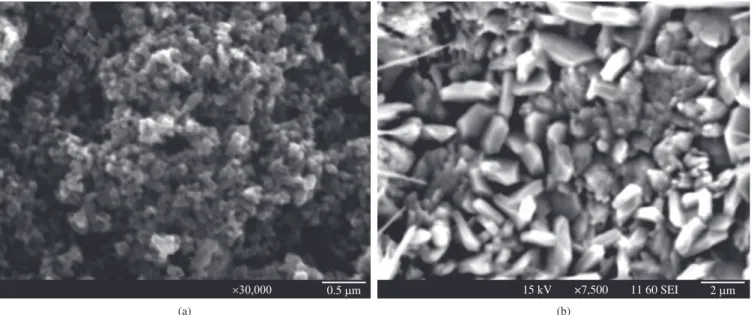
Figure 2. SEM images of the MgO and MAS powders. a) and b) MgO powder; and c) and d) MAS powder.
voltage. Fourier transform infrared spectra (FTIR) spectroscopy (Perkin Elmer PE.One WQF-410 spectrometer) was used at room temperature in the range of 450-4000 cm−1 with a resolution of 4 cm−1. Thermal analysis of the precursor was done by thermogravimetry-differential scanning calorimetry (TG-DSC) on a Netzsch STA 449C instrument. The mass spectra (MS) of the gaseous products evolving from the precursor in TG-DSC are simultaneously monitored with a Balzers termostarTM quadrupole mass spectrometer.
3. Results and Discussion
Figure 1 shows the XRD patterns of the as-synthesized magnesium oxide and MAS powders obtained by heat treatment of the precursors at 800 and 1200 °C for 2 hours, respectively. According to the JCPDS card (JCPDS card, No. 45-0946), the phase of the powders (Figure 1a) obtained from magnesium precursor can be indexed to be cubic MgO structure which is consistent with the results reported in the literatures3-6. The intense peaks show that the powders are
Figure 1. X-ray diffraction patterns of the MgO and MAS powders. a) MgO
Figure 3. SEM images of the samples treated by ball milling for 12 hours. a) MgO powder; and b) MAS powder.
high crystalline. The powders obtained from the MAS precursor are composed of MAS cubic structure (JCPDS card, No. 21-1152) which is similar to those reported by Ganesh and Pati et al.9,10. No other diffraction peaks are detected showing the high pure phase.
The morphology and size of the powders are analyzed by SEM observation. The average diameter of the MgO powders with regular sphere particles (Figure 2a and b) is about 100 nm. However, some particles are in microns size. These results demonstrate that the fine MgO powders can be prepared by the simple sol-gel process using MgCl2. The MAS powders with irregular morphology obtained from MAS precursor (Figure 2c and d) exhibit definite distribution in the size range of microns. The size of the most particles is less than 2 µm. However, the size of a small amount of powders is larger than 10 µm (Figure 2c). Obviously, the aggregation phenomenon can be observed by the SEM images which may originate from the powder aggregation under high temperature sintering conditions. In order to further refine the powders, the ball milling (raw materials: balls: water = 1:2.5:1.5) experiment was conducted. Figure 3 shows the SEM images of the MgO powder (a) and MgAl spinel powder (b) treated by ball milling for 12 hours. The particle size of the powders decreases obviously. The average particle size of the MgO and MgAl spinel powders is about 70 nm and 2 µm, respectively. The strong agglomerated phenomenon of the powders is considered to be caused by the high sintering temperature. The kind of agglomeration is relatively loose and can be dispersed after ball milling. The results show that the ball milling can relieve the agglomeration phenomenon of the powders obviously refining the powders.
The FTIR spectra at 450-4000 cm−1 for the Mg precursor and MAS precursor calcined at different temperature are shown in Figure 4. This clearly shows a broad absorption at 3000-3800 cm−1 with the absorption peak of 3441, 3435, 3437, 3443 and 3438 cm−1, respectively, which is the characteristic stretching vibration of hydroxylate (−OH). Peaks localized at 1631-1637 cm−1 and 1383-1385 cm−1, respectively in Figure 4a-e are assigned to asymmetrical and symmetrical stretching vibration of carboxylate (O-C=O). No characteristic band of nitrate ions at 1464 cm−1 is observed from the FTIR spectra indicating the complete decomposition of Mg precursor and MAS precursor during the heat treating process with different temperature. In the FTIR spectum (Figure 4c) of the MgO powder calcined at 800 °C,
Figure 5. TG-DSC curve of the as-synthesized Mg precursor.
Figure 6. TG-DSC curve of the as-synthesized MAS precursor.
temperature, the characteristic vibration of cubic MgO increases. It can be seen that the intense characteristic vibration of cubic MgO exists in the band ranging from 500-1000 cm−1 with the absorption peak at 860 cm−1 indicating the complete formation of cubic MgO. For the samples of the MAS spinel precursor calcined at 800 °C and 1200 °C (Figure 4d and e), significant spectroscopic bands at 512, 547, 703 and 799 cm−1 appear which are identified to be the characteristic absorption bands of MAS structure. With the increase of the calcination temperature, the absorption peaks are intensified exhibiting the totally formation of MAS phase.
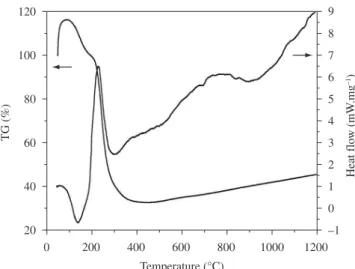
The thermal decomposition of the citrate precursors and the phase transition of MgO and MAS spinel have been analyzed. The TG-DSC curves of the Mg precursor and MAS precursor are shown in Figure 5 and 6, respectively. For the thermal decomposition of the Mg precursor shown in Figure 5, in the range of RT-250 °C, an endothermic peak at about 230 °C with a mass loss of about 8% appears which may be associated to the vaporization of physically bound absorbed water. In the temperature region 250-700 °C, a broadened and maximum exothermic peak at about 310 °C is relatively sharp and intense, accompanied by a drastic mass loss. It indicates the dehydration reaction of the citrate precursor and the decomposition of the precursor from Mg precursor to MgO. The mass
Mg precursor is determined to be 800 °C for the formation of high crystallized cubic MgO. The TG-DSC curve of the as-synthesized MAS precursor is similar to that of the Mg precursor. However, in the RT-300 °C, an endothermic peak at about 250 °C with a mass loss of about 4% appears which is associated to the vaporization of physically bound absorbed water. The maximum mass loss of the MAS precursor is obviously far less than that of the Mg precursor with the value of about 38%. A relatively sharp endothermic peak at about 800 °C occurs which may be associated to the nucleation process of the MAS. The relatively broad endothermal bands with the peak at about 1130 °C in the temperature range of 1000-1200 °C may contribute to the crystal growth of the MAS structure.
4. Conclusions
In summary, fine MgO and MAS powders were synthesized using citrate precursors derived from magnesium chloride, aluminium nitrate and citrate. At about 400 °C citrate precursors decompose and MgO, MAS are initially formed. The pure cubic MgO and MAS phases form at the heat treatment of Mg precursor and MAS precursor at 800 and 1200 °C, respectively with the particle size in the range of nanometer and micrometer size. Further experimental results show that ball milling treatment can eliminate the conglomeration and size of the powders. From a practical point of view, the synthesis of fine MgO and MAS powders from less expensive precursors inorganic salts instead of alkoxide precursors following this reported could be of great interest.
Acknowledgments
This work was supported by the National Basic Research Program of China (863 Program, 2009AA03Z529) and the National Key Construction New Technique of China (2009-161).
References
1. Yuan YS, Wong MS and Wang SS. Solid-state processing and phase
development of bulk (MgO)w/BPSCCO high-temperature superconducting
composite. Journal of Materials Research. 1996; 11:8-17.
2. Bhargava A, Alarco JA, Mackirmon IDR, Page D and IIyushechkin A. Synthesis and characterization of nanoscale magnesium oxide powders and their application in thick films of Bi2Sr2CaCu2O8. Materials Letters. 1998; 34:133-142.
3. Chhor K, Bocquet JF and Pommier C. Syntheses of submicron magnesium
oxide powders. Materials Chemistry and Physics. 1995; 40:63-68.
4. Znaidi L, Chhor K and Pommier C. Batch and semi-continuous synthesis of magnesium oxide powders from hydrolysis and supercritical treatment of Mg(OCH3O)2. Materials Research Bulletin. 1996; 31:1527-1535. 5. Alvarado E, Torres-Martinez LM, Fuentes AF and Quintana P. Preparation
and characterization of MgO powders obtained from different magnesium
salts and the mineral dolomite. Polyhedron. 2000; 19:2345-2351.
6. Ding Y, Zhang GT, Wu H, Hai B, Wang LB and Qian YT. Nanoscale magnesium hydroxide and magnesium oxide powders: control over size, shape, and structure via hydrothermal synthesis. Chemistry of Materials. 2001; 13:435-440.
8. Ganesh I, Bhattacharjee S, Saha BP, Johnson R, Rajeshwari K, Sengupta R et al. An efficient MgAl2O4 spinel additive for improved slag erosion and penetration resistance of high-Al2O3 and MgO–C refractories. Ceramics International. 2002; 28:245-253.
9. Ganesh I, Johnson R, Rao GVN, Mahajan YR, Madavendra SS and Reddy BM. Microwave-assisted combustion synthesis of nanocrystalline MgAl2O4 spinel powder. Ceramics International. 2005; 31:67-74.
10. Pati RK and Pramanik P. Low-temperature chemical synthesis of nanocrystalline MgAl2O4 spinel powder. Journal of American Ceramics Society. 2000; 83:1822-1824.
11. Li J, Pan YB, Xiang CS, Ge QM and Guo JK. Low temperature synthesis
of ultrafine α-Al2O3 powder by a simple aqueous sol-gel process.