Fluconazole Susceptibility of Brazilian Candida Isolates Assessed
by a Disk Diffusion Method
Arnaldo L. Colombo, Daniel da Matta, Division of Infectious Diseases - UNIFESP, São
Leila Paula de Almeida andRobert Rosas Paulo, SP; Santa Marcelina Hospital, São Paulo, SP, Brazil
The increasing magnitude of antifungal resistance as well as the advent of new antifungal drugs has generated a renewed interest in fungal susceptibility testing. We used a previously described disk diffusion method to evaluate the susceptibility profile of a large collection of recent clinical Candida spp. isolates against fluconazole. A total of 1,784 yeast isolates were tested, including the following species: Candida albicans (1,036), C. tropicalis (279), C. parapsilosis (202), C. glabrata (119), C. guilliermondii (90), C. krusei (32), C. lusitaniae (7), Candida spp. (14) and other yeasts (5). Susceptibility ranking to fluconazole obtained with all yeasts tested was: C. parapsilosis ≅≅≅≅≅ C. tropicalis ≅≅≅≅≅C. guilliermondii > C. glabrata > C. krusei. The majority (94%) of all yeast isolates tested were susceptible to fluconazole. Isolates of C. glabrata and C. krusei exhibited the highest rate of DDS/resistance among all isolates tested but they represented only 9% of all yeasts routinely sent to our lab. Careful periodical surveillance is needed in order to identify any changes in the susceptibility patterns of fluconazole with the increased use of this antifungal agent in Brazilian tertiary care hospitals.
Key Words: Candida, fluconazole, antifungal resistance, disk diffusion method.
Received on 08 March 2002; revised 04 June 2002.
Address for correspondence: Dr. Arnaldo Lopes Colombo, MD, PhD. Division of Infectious Diseases-Escola Paulista de Medicina-UNIFESP. Rua Botucatu, 740- Zip Code: 04023-062, São Paulo-SP. Phone/Fax: +11-5549 6585.
Email: [email protected]
The Brazilian Journal of Infectious Diseases 2002;6(3):118-123 © 2002 by The Brazilian Journal of Infectious Diseases and Contexto Publishing. All rights reserved.
1413-8670
The increasing magnitude of antifungal resistance, as well as the advent of new antifungal drugs, has generated a renewed interest in antifungal susceptibility testing. Unlike in vitro antibacterial susceptibility testing, which has been routinely used as a guide for clinicians in the selection of appropriate therapy, antifungal susceptibility assays remain in evolution [1,2,3,4,5].
Given the need to standardize methods for testing major agents of mycoses, the National Committee for Clinical Laboratory Standards (NCCLS) established a subcommittee on antifungal susceptibility testing. Several multicenter studies were conducted by the
NCCLS to address all key technical problems affecting the interlaboratory reproducibility of testing [3,5]. Based on these efforts, the NCCLS published a guideline for antifungal susceptibility testing and interpretative breakpoints for triazoles and 5-flucytosine. The proposed method is a broth dilution method that has good inter- and intralaboratory reproducibility for testing yeast [6,7].
Measuring the performance of antifungal drugs on a large scale by susceptibility tests with the NCCLS method is difficult because it is time consuming and labor intensive. Recent efforts have been devoted to developing more simple agar-based methods that generate results compatible with the NCCLS methodology, including Etest and disk diffusion tests [6,8,9,10].
Fluconazole is a well-tolerated and safe triazole antifungal agent that has good clinical activity against
simple disk diffusion test was developed for testing the susceptibility of Candida spp. isolates against fluconazole. Despite some limitations for identifying truly resistant fluconazole clinical isolates on an individual basis, the fluconazole disk diffusion method may be a useful tool for the evaluation of epidemiological trends in fluconazole sensibility [6,9,10].
We used a disk diffusion method to evaluate the susceptibility profile of a large collection of recent clinical Candida spp. isolates to fluconazole.
Materials and Methods
Microorganisms: From January 1998 to December 2000 we selected all recent clinical yeast isolates that were sent to our laboratory from cultures made at two public institutions: Hospital São Paulo and Hospital e Maternidade Santa Marcelina. These cultures were originated from various types of biological material, including oral cavity swabs, urine, blood, and bronchoalveolar lavage. The yeasts were identified at the species level by standard methods, and stored as water suspensions at room temperature [11].
Antifungal susceptibility testing: We used a previously described disk diffusion assay to test all yeast isolates [10,12,13]. The test disks contained 25µg/mL. fluconazole (Becton Dickinson, Sparks, MD), kindly supplied by Pfizer Inc. They were stored in a desiccator at 4°C. Initially, a yeast inoculum suspension adjusted to match a 0.5 McFarland density standard was prepared. A sterile cotton swab moistened with the inoculum suspension was used to applied to a 90 mm diameter plate containing Mueller-Hinton agar supplemented with 2% glucose and 0.5 µg/ml methylene blue. The plates were allowed to dry for 5-15 minutes before a 25µg/mL fluconazole disk was placed in the center of the agar. The plates were incubated for 18-24 hours at 35-37° and the slowly-growing isolates could be read after 48 hours incubation. A quality control (QC) strain, C. albicans
ATCC 90028 with a recommended acceptable performance range of 32-43 mm, was tested once a
week. Test results with an out-of-range QC were excluded from analysis.
Reading and interpretation of zone diameter measurements: all inhibition zone diameters generated by disk diffusion tests were read and recorded by using the BIOMIC Plate Reader System [14], a semi-automatic electronic image-analysis system. This system is connected to a high-resolution video camera able to capture each plate image and measure the inhibition zone diameter generated by the disk diffusion test. The zone diameters were measured at the transitional point where growth pattern abruptly decreased. The BIOMIC system has software that transforms inhibition zone diameter sizes into corresponding fluconazole MIC values by using a previously obtained standard regression analysis curve. The interpretive breakpoints used for fluconazole disk tests were based on zones that correlated with US-NCCLS recommended category breakpoints for the reference broth dilution method. Fluconazole breakpoints were: S ≤ 8 µg/ml, SDD =16-32 µg/ml, and R ≥ 64 µg/ml. In accordance with NCCLS indications, all C. krusei isolates were considered resistant to fluconazole [5,7].
Results
We were able to test 1,784 yeast isolates sequentially sent to our laboratory, including the following species: Candida albicans (1,036), C. tropicalis (279), C. parapsilosis (202), C. glabrata
(119), C. guilliermondii (90), C. krusei (32), C. lusitaniae (7), Candida spp. (14) and other yeasts (5). Clinically significant yeast isolates were obtained from different body sites, as shown in Table 1. Except for the oral cavity specimens, all strains were isolated from hospitalized patients.
performed with C. glabrata and C. krusei isolates generated smaller inhibition zones than in the assays of C.albicans, C. parapsilosis and C. tropicalis
strains. C. krusei isolates generated the smallest inhibition zones.
The values of MIC-50% and MIC-90% for the isolates representative of the most frequently isolated species of Candida are shown in Table 3. The susceptibility ranking for fluconazole was:
C.parapsilosis≅C.tropicalis≅C. guilliermondii >
C. albicans > C. glabrata > C.krusei.
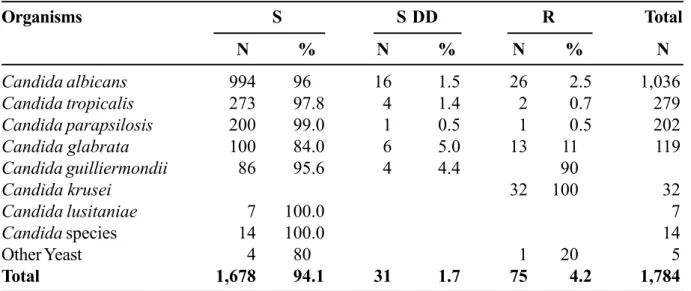
Fluconazole susceptibility categories are summarized by Candida species in Table 4. Overall, 94% of the 1,728 yeast isolates tested were susceptible to fluconazole. The incidence of isolates judged as DDS/resistant to fluconazole was 1% for C. parapsilosis, 2.1% for C.tropicalis, 4% for C. albicans, 4.4% for C. guilliermondii, 16% for
C.glabrata and 100% for C. krusei isolates.
Discussion
Agar disk diffusion tests with antifungal drugs are not standardized and a direct correlation between disk diffusion test results and clinical outcome has not yet been reported. Consequently, antifungal disk diffusion tests should not be used as a guide for the selection and monitoring of antifungal therapy [6]. However, considering that disk-diffusion assays are simple to perform and inexpensive, they may be a useful tool in large-scale surveys of clinical isolates to identify population distribution patterns of susceptibility to fluconazole. The disk diffusion test using 25µg fluconazole disks on an MH agar plate containing 2% glucose and 5mg methylene blue/mL issufficiently reproducible and accurate to be used as a screening test [9,10,12,13]. Recently, this methodology has been used by different investigators for global surveillance of fluconazole susceptibility [14,15].
In our study the fluconazole disk diffusion procedure was used to survey a clinical collection of 1,728 yeasts sent to our laboratory for further identification. The BIOMIC System image-analyses of plates provided
consistent and objective inhibition zone endpoint readings. In addition, it was able to eliminate uncontrolled results as it facilitated data analysis. This is the largest surveillance study of fungal susceptibility to fluconazole performed in Brazil.
We were able to test a significant number of isolates representative of the most clinically relevant species of
Candida. The non-albicans species isolates accounted for as much as 42% of all yeasts tested. The appearance of non-albicans isolates among patients admitted to tertiary care hospitals has been reported by different centers, including medical institutions from Brazil [16-19]. Contrary to the United Statesand Europe, where
C. glabrata is the second or third most commonly species of Candida isolated from patients with invasive infections [17,20], C. glabrata and C. krusei isolates together represented only 9% of all yeast isolates in our study in Brazil.
As antifungal drug resistance may become more prevalent, it is increasingly important to evaluate current susceptibility profiles and emerging trends [2-4,20]. In our study most of the clinical yeast isolates were susceptible to fluconazole. However, it is clear that there are some species-specific differences in susceptibility to this antifungal agent. Notably, resistance rates to fluconazole ranged from 0 to 100% of the isolates tested, depending on the species of Candida considered for analysis. In agreement with data reported by other investigators [4,17,20,21], DDS/resistance to fluconazole was most commonly reported among C. glabrata and C. krusei strains.
In our series, we had 4% C.albicans isolates considered DDS/resistant to fluconazole. Most of these isolates were obtained from the oral cavity of HIV-infected/AIDS patients (data not shown). Invasive infections due to fluconazole-resistant C. albicans isolates are still considered a rare phenomenon [2,3,17,20]. Most strains of C. parapsilosis and C. tropicalis tested were very susceptible to fluconazole.
Our data indicate that fluconazole has good in vitro activity against most clinically relevant strains of
Table1. Identification and sources of all 1,784 Candida spp. isolates
Species (number) Blood Urine Oral cavity BAL Miscellaneous
C. albicans (1,036) 160 (15.5%) 262 (25.5%) 305 (29.5%) 48 (4.5%) 261 (25%)
C. tropicalis (279) 94 (33.5%) 105 (37.5%) 32 (11.5%) 1 (0.5%) 46 (17%)
C. parapsilosis (202) 99 (49%) 61 (30%) 27 (13.5%) 0 (0%) 15 (7.5%)
C. glabrata (119) 20 (17%) 68 (57%) 9 (7.5%) 0 (0%) 22 (18.5%)
C. guilliermondii (90) 78 (86.5%) 1 (1%) 4 (4.5%) 0 (0%) 7 (8%)
C. krusei (32) 6 (19%) 15 (47%) 3 (9%) 0 (0%) 8 (25%)
Candida spp.(27) 17 (62%) 3 (11%) 4 (15%) 1 (4%) 2 (8%)
Total (1,784) 474 (26.5%) 515 (29%) 384 (21.5%) 50 (3%) 359 (20%)
Table 3. Fluconazole MICs 50% and 90% obtained with the most frequently isolated species of Candida tested
MIC (µµµµµg/ml)
Organism MIC- 50% MIC- 90% N % of all isolates
Candida albicans <0.25 4.6 1036 58
Candida tropicalis 0.3 1.6 279 16
Candida parapsilosis <0.25 1.3 202 11
Candida glabrata 2.5 55.7 119 7
Candida guilliermondii 0.5 1.3 90 5
Candida krusei 16.0 >128.0 32 2
MIC-50%: MIC value able to inhibit 50% of all isolates tested. MIC-90%: MIC value able to inhibit 90% of all isolates tested.
Breakpoints: Susceptible £ 8. Resistant ³64. Test Range <0.25 to >128 µg/ml).
Table 2. Average Zone Diameters (mm) by Specimen Type and Species of Candida spp.
Species/number Blood BAL* Oral cavity Urine Miscellaneous Total/Specie
C. albicans (1,036) 38.9 34.2 39.7 37.2 38.1 37.4
C. parasilosis (202) 42.5 0.0 44.8 39.2 39.7 41.6
C. tropicalis (279) 35.8 27.0 37.7 35.6 34.1 35.8
C. glabrata (119) 25.0 0.0 21.7 29.3 28.1 27.5
C. krusei (32) 12.5 0.0 17.4 16.7 17.4 17.4
C. guilliermondii (90) 35.4 0.0 35.8 36.0 33.4 35.1
Other Yeasts 32.0 42.0 34.8 34.5 0.0 35.8
public institutions has been limited due to cost considerations. Careful periodical surveillance is needed in order to identify potential changes in the susceptibility pattern of fungi to fluconazole, with the increased use of fluconazole in Brazil.
Acknowledgements
We acknowledge the contribution of Dr Patricia Rangel. This study was partially funded by Pfizer Pharmaceuticals.
References
1. Neely M.N., Ghannoum M.A. The exciting future of antifungal therapy. Eur J Clin Microbiol Infect Dis 2000; 19:897-914.
2. Rex J., Rinaldi M.G., Pfaller M.A. Resistance of Candida species to fluconazole. Antimicrob Agents Chemother
1995;39:1-8.
3. Espinel-Ingroff A. Clinical relevance of antifungal resistance. Infect Dis Clin North Am 1997;30(suppl 1):19-28. 4. Milan E.P., Burattini M.N., Kallás E.G., et al. Azole
resistance among oral Candida species isolates from AIDS patients under ketoconazole exposure. Diagn Microbiol Infect Dis 1998; 32:211-6.
5. Rex J.H., Pfaller M.A., Galgiani J.N., et al. Development of interpretive breakpoints for antifungal susceptibility testing: conceptual framework and analysis of in vitro-in vivo correlation data for fluconazole, itraconazole, and candida infections. Subcommittee on Antifungal Susceptibility Testing of the National Committee for Clinical Laboratory Standards. Clin Infect Dis
1997;24(2):235-47.
6. Espinel-Ingroff A., Brachiesi F., Hazen K.C., et al. Standardization of antifungal susceptibility testing and clinical relevance. Med Mycol 1998;36(Suppl 1):68-78. 7. National Committee for Clinical Laboratory Standards Reference method for broth dilution. Antifungal susceptibility testing of yeasts; Approved Standard. Document M27-A 17, 1997.
8. Colombo A.L., Barchiesi F., McGough D.A., Rinaldi M.G. Comparison of Etest and National Committee for Clinical Laboratory Standards broth macrodilution method for azole antifungal susceptibility testing. J Clin Microbiol
1995;33(3):535-40.
9. Pfaller M.A., Dupont B., Kobayashi G.S., et al. Standardized susceptibility testing of fluconazole: an international collaborative study. Antimicrob Agents Chemother 1992;36(9):1805-9.
10. Barry A.L., Brown S.D. Fluconazole disk diffusion procedure for determining susceptibility of Candida species. J Clin Microbiol 1996;34(9):2154-7.
11. Warren N.G., Hazen K.C. Candida, Cryptococcus, and other yeasts of medical importance. In: Manual of Clinical Microbiology. Murray PR., Baron EJ, Pfaller MA, Tenover FC, Yolken RH. eds. Washington DC; ASM Press, 1995.
Table 4. Fluconazole category of susceptibility in 1,784 yeast isolates
Organisms S S DD R Total
N % N % N % N
Candida albicans 994 96 16 1.5 26 2.5 1,036
Candida tropicalis 273 97.8 4 1.4 2 0.7 279
Candida parapsilosis 200 99.0 1 0.5 1 0.5 202
Candida glabrata 100 84.0 6 5.0 13 11 119
Candida guilliermondii 86 95.6 4 4.4 90
Candida krusei 32 100 32
Candida lusitaniae 7 100.0 7
Candida species 14 100.0 14
Other Yeast 4 80 1 20 5
Total 1,678 94.1 31 1.7 75 4.2 1,784
12. Sai-Cheong L., Chang-Phone F., Lee N., et al. Fluconazole disk diffusion test with methylene blue-and glucose-enriched Mueller-Hinton agar for determining susceptibility of Candida species. J Clin Microbiol 2001; 39(4):1615-7.
13. Kirkpatrick W.R., Turner T.M., Fothergill A.W., et al. Fluconazole disk diffusion susceptibility testing of Candida species. J Clin Microbiol 1998;36(11):3429-32. 14. Meis J., Petrou M., Bille J., et al. A global evaluation of
the susceptibility of Candida species to fluconazole by disk diffusion. Diagn Microbiol Infect Disease
2000;36:215-23.
15. Bille J., Glauser M.P., the Fluconazole Global Susceptibility Study Group. Evaluation of the susceptibility of pathogenic Candida species to fluconazole. Eur J Clin Microbiol Infect Dis 1997;16:924-8.
16. Abi-Said D., Anaissie E., Uzun O., et al. The epidemiology of hematogenous candidiasis caused by different Candida species. Clin Infect Dis 1997;24(6):1122-8. 17. Pfaller M.A., Jones R.N., Doern G.V., et al. Bloodstream
infections due to Candida species: SENTRY antimicrobial surveillance program in North America and Latin America, 1997-1998. Antimicrob Agents Chemother 2000;44(3):747-51.
18. Wingard J.R. Importance of Candida species other than C. albicans as pathogens in oncology patients. Clin Infect Dis 1995;20(1):115-25.
19. Colombo A.L., Nucci M., Salomao R., et al. High rate of non-albicans candidemia in Brazilian tertiary care hospitals. Diagn Microbiol Infect Dis 1999;34(4):281-6. 20. Pfaller M.A., Jones R.N., Doern G.V., et al. International surveillance of blood stream infections due to Candida species in the European SENTRY Program: species distribution and antifungal susceptibility including the investigational triazole and echinocandin agents. SENTRY Participant Group (Europe). Diagn Microbiol Infect Dis 1999;35(1):19-25.
21. Pfaller M.A., Diekema D.J., Jones R.N., et al. International surveillance of bloodstream infections due to Candida species: frequency of occurrence and in vitro susceptibilities to fluconazole, Ravuconazole, and Voriconazole of isolates collected from 1997 through 1999 in the SENTRY Antimicrobial Surveillance Program. J Clin Microbiol 2001;39(9):3254-9.