1Museo de Zoología “Alfonso L. Herrera,” Facultad de Ciencias, Universidad Nacional Autónoma de México, Apartado Postal 70-399, Mexico, D.F. 04510, Mexico;
2Natural History Museum and Biodiversity Research Center, The University of Kansas, Lawrence, Kansas 66045 USA
3Corresponding Author: Adolfo G. Navarro-Sigüenza, Museo de Zoología “Alfonso L. Herrera,” Facultad de Ciencias, Universidad Nacional Autónoma de México, Apartado Postal 70-399, México, D.F. 04510, México;
E-mail: [email protected]
Abstract
Extensive debate has surrounded the application of alternative species concepts in Ornithology. The biological species concept (BSC) and phylogenetic species concept (PSC) have typically been set in opposition, with extensive debate on the relative merits of each. An alternative is the evolutionary species concept (ESC), which offers a perspective similar to that of the PSC, yet with several significant differences. To date, no major avifauna has been examined and compared among taxonomic viewpoints. Herein, we develop an alternative phylogenetic/evolutionary species taxonomy to the current BSC treatment for the more than 1000 bird species of Mexico. A total of 135 biological species was divided to produce a total of 323 phylogenetic/evolutionary species, 122 of which represent “new” endemic forms in Mexico.
Key words: Species concepts, avifauna, Mexico
Resumen
Gran debate ha rodeado la aplicación de conceptos de especie alternativos en la Ornitología. El concepto biológico de especie (CBE) y el concepto filogenético de especie (CFE) han estado típicamente en contraposición, existiendo mucha discusión acerca de las ventajas relativas de cada uno. Una alternativa es el concepto evolutivo de especie (CEE), que ofrece una perspectiva similar a la del CFE, aunque con algunas diferencias importantes. A la fecha, no se ha examinado y comparado alguna avifauna regional desde el punto de vista del CBE y de los conceptos alternativos. En este trabajo desarrollamos una taxonomía alternativa a la existente en la actualidad bajo el CBE para las más de 1000 especies de aves de México. Un total de 135 especies biológicas fue dividido hasta producir un total de 323 especies filogenético/evolutivas, 122 de las cuales son “nuevas” formas endémicas al país.
Palabras-claves: Conceptos de especie, avifauna, México.
Biota Neotropica v4 (n2) – http://www.biotaneotropica.org.br/v4n2/pt/abstract?taxonomic-review+BN03504022004 Adolfo G. Navarro-Sigüenza1,3and A. Townsend Peterson2
AFTERMANYDECADES of dominance by the biological
species concept (BSC) (e.g. Mayr 1942; Mayr and Short 1970; AOU 1983, 1998), alternative species concepts have been introduced to avian taxonomy only relatively recently (Cracraft 1983). Specifically, the phylogenetic species cept (PSC) was introduced to ornithology in a series of con-troversial papers (Cracraft 1983, McKitrick and Zink 1988, Zink and McKitrick 1995), sparking acrimonious discussion and debate (e.g. Amadon and Short 1992). In contrast to the BSC’s emphasis on reproductive isolation, the PSC identi-fies as species taxa those populations that are monophyl-etic lineages made diagnosable by the presence of unique characters or character combinations.
An alternative concept that has been all but ignored in ornithology (see Prum 1994) is the evolutionary species concept (ESC). Originally proposed by Simpson (1961), this concept was revisited by Wiley (1978), and discussed in detail in more recent contributions (Wiley and Mayden 2000). The ESC focuses on broad issues of theoretical importance: lineage independence, “identity,” and evolutionary tenden-cies. These issues relate to those on which the BSC and PSC focus—lineage independence refers loosely to repro-ductive isolation, and identity to diagnosability. Evolution-ary tendencies focus on the true Grail of an understanding of species—an evolutionary future independent of that of other such species. The ESC differs, however, in that its practical application does not specify a discovery method, leaving the definition of “evolutionary independence” to respond to the particulars of the evolutionary mechanisms and patterns of each major taxon. For avian applications, the PSC and ESC arrive at operational implementations that are quite similar (Zink and McKitrick 1995).
A special problem for the penetration of such alter-native ideas into avian taxonomy is the paucity of real ex-amples to which they have been applied. Although applied to single clades as systematic treatments have appeared (e.g. Cracraft 1992; Escalante-Pliego and Peterson 1992; Zink 1988, 1994), alternative species concepts have yet to be applied across any regional avifauna. The only region-wide avian taxonomic treatments remain the large-scale BSC ef-forts such as AOU (1983, 1998), Peters (1931-1987), and Sibley and Monroe (1990). For this reason, alternative species lists have not been integrated into comparative studies that cross significant taxonomic diversity, and such studies have been limited to traditional BSC lists.
The purpose of the present paper is to develop a first regional treatment of bird diversity under alternative species concepts. Mexico is considered a megadiverse coun-try (Mittermeier 1988), and its birds number more than 1000 biological species (Escalante-Pliego et al. 1993, Navarro and Benítez 1993). This extraordinary diversity makes Mexico both a fertile testing ground and a challenge for such a trial effort.
Alternative Species Concepts and Discovery Methods
We consider that the ESC and PSC can be imple-mented similarly for avian applications, as has been con-cluded by PSC proponents (Zink and McKitrick 1995). The focus on diagnosability of the PSC can be reconciled with that of the ESC on evolutionary independence—an inde-pendently evolving lineage will likely have evolved charac-teristics that distinguish it from other lineages. Clearly, the detailed phylogenetic, molecular, and phenotypic studies that would best elucidate these phenomena are lacking for most of the species in a large and complex avifauna such as that of Mexico, making necessary use of less direct evi-dence—in particular, phenotypic variation such as plum-age coloration, size, and shape. Hence, our development of an evolutionary species taxonomy for the birds of Mexico used an operational criterion of diagnosability, which we feel satisfies the theoretical bases of both the ESC and the PSC.
Methods
4
92
24
13
1 1
0 20 40 60 80 100
1 2 3 4 5 6
Number of phylogenetic/evolutionary species per biological
species
F
reque
ncy
Peabody Museum.
Biological species (sensu AOU 1983, 1998, and supplements by Banks et al. 2000 and 2002) constituting multiple evolutionary species were compiled, and charac-ters and citations detailed. We used as a working, opera-tional definition (“discovery method”) of evolutionary spe-cies that they represent essentially 100% diagnosable as-semblages of populations for which reproductive continu-ity is at least credible. Characters on which our decisions were based were principally of external morphology, although molecular genetic and vocalization data were incorporated when available. Size and shape variation were inspected carefully in order to avoid the confusion produced by clinal and/or ecological variation. Examples were divided into those affecting species diversity and endemism of the Mexican avifauna, those only affecting names of Mexican birds, and those for which available specimen material and/or other sources of evidence were insufficient to determine whether geographic differences were at the level of species. Each group, after initial inclusion, was checked for veracity in at least one additional scientific collection based on different specimen material. We present general lists of described subspecies from the BSC treatments that would be sub-sumed in each evolutionary species; these data are not in-tended to constitute an authoritative list of synonyms, but rather to avoid introducing confusion into the literature by imprecise definition of geographic distributions (see Zink 2004).
Results and Discussion
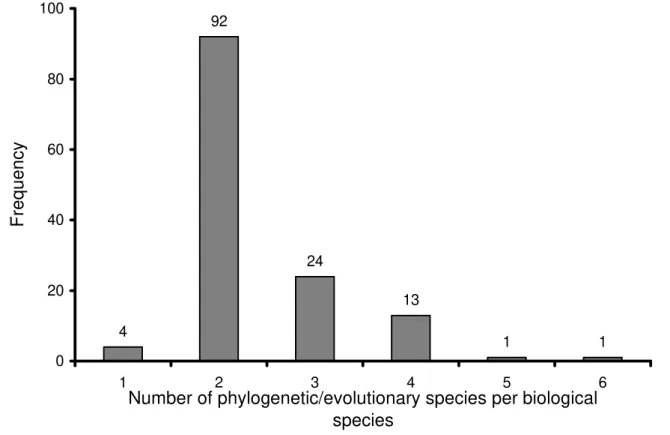
In all, 135 biological species were found to hold mul-tiple evolutionary species units (Appendix); 29 species were likely additional candidates, but sufficient specimen mate-rial was lacking for definitive decisions (Table 1). At least 42 additional species were involved in splits outside of Mexico, affecting nomenclature but not species diversity or patterns in the country, and are not considered further herein (Table 2). The 135 species for which information was sufficient were divisible into 323 evolutionary species, revising num-bers of species known to occur in Mexico upwards by 188 (about 18%), and numbers of endemic species from 100 to 222 species (about 125%). Most biological species were simply divided into two evolutionary species, but several groups were more complex, divisible into as many as six evolutionary species (Colinus virginianus, Fig. 1).
Case studies.—We present three examples of
spe-cies that would be subdivided using the ESC. These ex-amples are provided to illustrate the diversity of situations in which our decisions were made.
1. Ergaticus ruber.— The BSC authorities treat all
populations of this species together. However, populations of the northern Sierra Madre Occidental (melanauris=, have
a distinct leaden gray ear patch, as opposed to the pearly silver ear patch of the populations to the east and south (ruber). The two groups are disjunct from one another.
Table 1. List of biological species likely including multiple evolutionary species, but in need of further study. In most cases, patterns of variation are very complex and paucity of specimens prevented a decision. However, for all cases, information from several suites of characters (both phenotypic and genotypic) are needed to clarify the taxonomic status of the forms.
Species Geographic
situation
Crypturellus cinnamomeus
E Mexico vs. Chiapas and Central America
Oceanodroma leucorhoa
Isla Guadalupe (2 distinct breeding populations) (Ainley
1980, AOU 1998)
Rallus elegans
and
R.
longirostris
Yucatan Peninsula vs. mainland Mexico vs. extreme NW
Mexico; very complex variation (Olson 1998)
Dactylortyx thoracicus
W Mexico vs. E Mexico vs. Chiapas (Banks 1987)
Zenaida aurita
N Yucatan Peninsula vs. Caribbean
Otus guatemalae
W vs. E Mexico and Central America (Marshall 1967)
Crotophaga sulcirostris
Mainland Mexico vs. extinct populations of southern
Baja California
Picoides scalaris
Yucatán Peninsula vs. E Mexico vs. W Mexico, complex
variation
Veniliornis fumigatus
E Mexico vs. W Mexico vs. Central America
Lepidocolaptes souleyetii
E Mexico vs. W Mexico
Rhynchocyclus brevirostris
E Mexico vs. SW Mexico
Empidonax affinis
N and S of the Isthmus of Tehuantepec
Tyrannus melancholicus
W vs. E Mexico and Central America (AOU 1998)
Pachyramphus major
E Mexico vs. Yucatan Peninsula vs. Chiapas
Corvus corax
Clarión Island vs. mainland
Cistothorus palustris
E vs. W United States vs. C Mexico
Salpinctes obsoletus
Isla Guadalupe vs. Mainland (Omland et al. 2000)
Uropsila leucogastra
Yucatan Peninsula vs. E Mexico
Regulus satrapa
N Mexico vs. S Mexico and Central America
Catharus frantzii
Mexico vs. Central America, east vs west slopes (Phillips
1969)
Myioborus miniatus
Complex variation, Mexico vs. Central and South
America
Spindalis zena
Isla Cozumel population vs. disjunct populations in
Bahamas (Garrido et al. 1997)
Saltator grandis
E Mexico and Central America vs. Pacific slope of
Chiapas
Passerina versicolor
USA and Mexico vs. Baja California vs. Central America
Passerina ciris
E vs. C United States, one population wintering in
Mexico (Thompson 1991)
Haplospiza rustica
Oaxaca and Veracruz vs. Central America (Barajas and
Phillips 1993)
Aimophila rufescens
W vs E Mexico vs. Central America
TABLE 2. List of biological species for which splits outside of Mexico affect only nomenclature, but do not change status or species diversity within Mexico.Based partly on "groups" recognized by AOU (1998) and Banks et al. (2000, 2002).
Biological species Phylogenetic species References
Cochlearius cochlearius C. zeledoni (Ridgway 1885)
Branta bernicla B. nigricans (Lawrence 1846)
Anas crecca A. carolinensis Gmelin 1789
Melanita fusca M. deglandi (Bonaparte 1850)
M. nigra M. americana (Swainson 1832)
Circus cyaneus C. hudsonius (Linnaeus 1766)
Accipiter gentilis A. atricapillus (Wilson 1812) Thiollay (1994)
Geranospiza caerulescens G. nigra (Du Bus 1847)
Asturina nitida A. plagiata (Schlegel 1862)
Vanellus chilensis V. cayennensis (Gmelin 1789)
Charadrius alexandrinus C. nivosus (Cassin 1858)
Numenius phaeopus N. hudsonicus Latham 1790 Zink et al. (1995)
Larus canus L. brachyrhynchus Richardson 1831
Gygys alba G. candida (Gmelin 1789)
Leptotila rufaxilla L. plumbeiceps Sclater and Salvin 1868
Glaucidium brasilianum G. ridgwayi Sharpe 1875 König et al. (1999)
Phaethornis striigularis P. adolphi Gould 1857
Amazilia cyanura A. guatemalae Dearborn 1907
Trogon collaris T. puella Gould 1845
Galbula ruficauda G. melanogenia Sclater 1852
Formicarius analis F. moniliger Sclater 1856
Mionectes oleagineus M. assimilis Sclater 1859
Onychorhynchus coronatus O. mexicanus (Sclater 1857)
Contopus cinereus C. brachytarsus (Sclater 1859)
Myiarchus tyrannulus M. magister Ridgway 1884
Myiozetetes similis M. texensis (Giraud 1841)
Schiffornis turdinus S. veraepacis (Sclater & Salvin 1860)
Vireo leucophrys V. amauronotus Salvin and Godman 1881
Hirundo rustica H. erythrogaster Boddaert 1783 Zink et al. (1995)
Baeolophus bicolor B. atricristatus Cassin 1850
Henicorhina leucosticta H. prostheleuca (Sclater 1857)
Nannus troglodytes N. hiemalis (Vieillot 1819)
Ramphocaenus melanurus R. rufiventris (Bonaparte 1837)
Polioptila plumbea P. bilineata (Bonaparte 1850)
Thraupis episcopus T. cana (Swainson 1836)
Eucometis penicillata E. spodocephala (Bonaparte 1854)
Habia fuscicauda H. salvini (Berlepsch 1883)
Cyanocompsa cyanoides C. concreta (DuBus 1855)
Melozone leucotis M. occipitalis (Salvin 1878)
Sporophila americana S. corvina (Sclater 1860)
Haplospiza rustica H. uniformis (Sclater & Salvin 1873)
2. Chlorospingus ophthalmicus.—The
populationsof this species are disjunctly distributed in iso-lated patches of montane forests. Morphological variation is very complex, with each major mountain mass having a population essentially completely distinguishable from the others in terms of morphometrics, plumage coloration, and vocalizations. Recent studies using genetic characters (Garcia-Moreno et al. 2004) support this extreme differentia-tion, identifying genetically distinct lineages in the Sierra Madre Oriental, Sierra Madre del Sur, Sierra de Los Tuxtlas, and Chiapas highlands. Thus, the BSC treatment of a single species appears quite clearly over-lumped, and we recog-nize a total of 5 species just within Mexico.
3. Piaya cayana. —Populations of this cuckoo are
distributed almost continuously from southern Sonora and northern Tamaulipas south through Central and South America. Populations along the Pacific lowlands from Sonora to the Isthmus of Tehuantepec are long-tailed, pale in col-oration of the underparts, whereas the forms of eastern Mexico and Central America are shorter-tailed and darker in color. Although a narrow contact zone is present in eastern Oaxaca between the two forms, only one “hybrid” speci-men is known and the differences are maintained even in close parapatry.
Comparison of concepts.—One aim of the present
paper is to present a comparison of different species con-cepts in a real-world, regional-fauna application. The BSC presents an attractive theoretical basis (reproductive isola-tion), but is plagued by biases well-known even to its pro-ponents (e.g. Mayr 1963) and subjects of extensive discus-sion (Cracraft 1983, McKitrick and Zink 1988, Zink and McKitrick 1995, Zink 2004). Especially apparent in our de-velopment of an evolutionary species’ list was the BSC’s problem with allopatric taxa, which we found to have been treated in distinct manners in different taxa (e.g. Geotrygon carrikeri was split from G. lawrencii, but the similarly
dis-tinct Columba vioscae not split from C. fasciata). Although
the “evolution” of the BSC in recent years towards a more split taxonomy (e.g. AOU 1998 and supplements, Pitman and Jehl 1998) eliminates some of these inconsistencies, the concept’s inability to deal with disjunct populations effec-tively and consistently presents a serious and ongoing prob-lem.
The evolutionary/phylogenetic species concepts, in contrast, are both operational, and so present fewer prob-lems with application to complex situations (Zink and McKitrick 1995)—variation and diagnosable units in most complexes were easily delineated once sufficient series of specimens were assembled and compared. The monophyly criterion under the PSC is clearly more difficult to apply on a fauna-wide basis, given the paucity of phylogenetic and phylogeographic studies of birds. Nevertheless, given the extensive discussion of the application of monophyly
crite-ria to species questions (e.g. Wiley 1981, De Queiroz and Donoghue 1990, Davis and Nixon 1992, Graybeal 1995, Wiley and Mayden 2000), as well as the complications that they introduce into real-world applications, we were less con-cerned about their exclusion. The ESC, which does not specify a criterion of monophyly, avoids this complication, but otherwise coincides fairly closely with the PSC .
Data types.—The lists presented herein are intended
as a preliminary summary of phylogenetic/evolutionary spe-cies taxa of Mexican birds. They are presented as a starting point, rather than as a final answer. Our extensive museum studies led us to appreciate the depth of the task—many additional taxa will be found to be distinct as additional specimens become available, and as other character sets (e.g., song characteristics and molecular characters), are considered. These increasingly detailed views of popula-tion differentiapopula-tion will certainly spark further debate re-garding the relative merits of different species concepts. Hence, we view this contribution as an ongoing one, which will be updated and revised based on further studies by us, as well as by others.
An important consideration is that of which types of data are necessary for such a revision. Ideally, one would have information on geographic distributions, ecological distributions, morphology, coloration, vocalizations, genetic differentiation, and phylogenetic position, for each group under examination. Practically speaking, though, such com-plete information is never available—even if specimens in scientific collections are adequate, which is rarely the case (Peterson et al. 1998), time, logistics, and expenses often prevent such exhaustive study.
Considering in more detail two character sets that were not included extensively or at all in older taxonomic efforts, it is interesting to note the relative rarity of truly cryptic species of birds in Mexico. Thirteen biological spe-cies were split up with the help of molecular characters; of these, however, six were easily distinguishable without the independent confirmation of the molecular data. The excep-tions—e.g., Wetmore’s Bush-Tanager of the Los Tuxtlas massif of southeastern Mexico (Chlorospingus wetmorei)—are not strikingly different from other
popula-tions, and likely would not have been distinguished had genetic data not been available (Peterson et al. 1992, García-Moreno et al. 2004).
Considering the importance of vocal characteristics, twelve biological species were split up with the help of vo-cal characteristics; of these, only three (Crypturellus cinnamomeus, Caprimulgus vociferus, possibly Uropsila leucogastra) would have been identifiable without this
char-acter set. Interestingly, two of the remaining species are nocturnal (Glaucidium gnoma, Otus cooperi). In this
Prospects for a world list.—Preparation of this work
has provided interesting lessons about the process of pre-paring large-scale taxonomic revisions. Our interest in Mexi-can bird taxonomy began with ten years of more traditional, species-by-species efforts, usually presenting both BSC and PSC opinions regarding species limits. These efforts, al-though not unproductive (Benítez-Díaz 1993; Escalante-Pliego and Peterson 1992; Escalona-Segura and Peterson 1996; Navarro et al. 1992a, b; Peterson 1992, 1993; Peterson et al. 1992; Navarro et al. 2001; Ortíz-Pulido et al. 2002), treated 18 biological species complexes, for a rate of 1.8 per year. Given the summary of evolutionary species concept changes presented herein, which affects 135 biological spe-cies, at our present rate of productivity, revision of Mexican bird taxonomy would take another 75 years! Expansion to a world scale would make the challenge more than prohibi-tive. Addition of work of others, although likely to intro-duce heterogeneity of taxonomic viewpoints, would reintro-duce the time span somewhat, but not likely to an acceptable 2-5 years. This rate of advance would clearly not arrive at a synthetic, fauna-wide view of Mexico (much less for the world!) in anything approaching a timely fashion. In addi-tion, this species-by-species approach would serve to pro-duce a long-term imbalance among groups that would cause many biases and confusions. For this reason, we decided to attack the challenge on the broader-scale, rapid approach presented herein.
We argue that such regional treatments are impor-tant to providing a uniform set of species criteria across avian taxonomy worldwide. The most recent attempt at a world bird taxonomy (Sibley and Monroe 1990), in spite of systemic problems compromising seriously its usefulness (Peterson and Stotz 1992), has been widely incorporated into avian biodiversity studies simply because a recent world list exists! We suggest that a world list under new criteria and species concepts—on the scale of Peters’ check-list— is feasible by means of regional committees working in co-ordination with one another.
Implications.—The value of sweeping taxonomic
re-visions such as this one, however, is great, with implica-tions in diverse fields. First, for evolutionary studies, re-casting the taxonomy in terms of diagnosable units pro-vides a much clearer view of interesting questions. For ex-ample, species diversity in the genus Colinus under the
BSC differs little from other quail genera (e.g. Dendrortyx, Cyrtonyx, Callipepla); under the alternative species
con-cepts, however, the rapid diversification and speciation of
Colinus virginianus into six distinct
phylogenetic/evolu-tionary species in Mexico alone is apparent. In this way, interesting and appropriate questions are much more avail-able to those investigators not intimately familiar with the fauna.
Considering broader issues related to biodiversity, revising the Mexican avifauna from an evolutionary
spe-cies concept viewpoint made clear that patterns of diversity and endemism are far from independent of species concepts. It is tempting to assume that the alternative concept spe-cies, representing subsets of biological spespe-cies, will pro-duce identical geographic patterns, just with more detail (Amadon and Short 1992). Nevertheless, careful analyses of species lists presented herein demonstrated clear shifts in geographic foci of endemism between species concepts (Peterson and Navarro 1999), suggesting that evaluation of the systematic basis for taxonomic authority lists used in biodiversity analyses is critical.
Perhaps most importantly, the alternative taxonomy of Mexican birds changes dramatically the geographic view of avian diversity in Mexico (Peterson and Navarro 1999). Several areas depauperate of BSC endemic forms under the alternative concepts emerge as concentrations of narrowly endemic species. The Islas Tres Marías lack endemic bio-logical species entirely, but hold nine endemic phylogenetic/ evolutionary species. Whereas the Cape Region of Baja California Sur (Rojas-Soto et al. 2003) and Cozumel Island hold two endemic biological species each, each holds six phylogenetic/evolutionary species, emphasizing their im-portance as foci of endemism. Hence, under the alternative viewpoints, geographic patterns of endemism change, re-flecting zones of isolation and historical separation. Thus, our taxonomic proposal represents a working list that will help future research and conservation efforts in the study of Mexico’s avian diversity.
Acknowledgments
We thank numerous students and colleagues for as-sistance in understanding the diversity and species limits of Mexican birds, especially Octavio Rojas, Luis Antonio Sánchez, and Hesiquio Benítez. Thanks to Ed Wiley for a thoughtful review of the manuscript. Comments on differ-ent versions of this manuscript were obtained from Joel Cracraft, Richard Prum, John Bates, Robert Dickerman, Ken-neth Parkes, George Barrowclough, Robert Zink, J. Van Remsen, Mark Robbins, Nathan Rice, Juan José Morrone, Octavio Rojas, Luis Antonio Sánchez, the late Ned Johnson, and several anonymous reviewers. Thanks also to the cura-tors and staff of the museums listed above for kind hospi-tality and access to specimens and information under their care. Finally, thanks to the National Science Foundation, Comisión Nacional para el Uso y Conocimiento de la Biodiversidad (Conabio), Consejo Nacional de Ciencia y Tecnología (CONACYT), Dirección General de Asuntos del Personal Académico de la Universidad Nacional Autónoma de México (PAPIIT IN-214200 and 233002), and British Coun-cil (Mexico) for funding necessary for these studies.
AINLEY, D. C. 1980. Geographic variation in Leach’s Storm-petrel. Auk 97:837-853.
ALDRICH, J. W. 1944. Notes on the Steller’s jays (Cyanocitta stelleri) of southern Mexico. Proceedings Biological
Society of Washington 57:23-24
ALDRICH, J. W. 1984. Ecogeographical variation in size and proportions of Song Sparrows (Melospiza melodia).
Ornithological Monographs 35:1-135.
ALDRICH, J. W. & JAMES, F. C. 1991. Ecogeographic varia-tion in the American robin (Turdus migratorius). Auk
108:230-249
AMADON, D., & SHORT, L. L. 1992. Taxonomy of lower categories—suggested guidelines. Bulletin of the Brit-ish Ornithologists’ Club Supplement 112A:11-38. AOU. 1983. Check-list of North American birds, 6th ed.
Ameri-can Ornithologists’ Union, Washington, D.C.
AOU. 1998. Check-list of North American birds, 7th ed. Ameri-can Ornithologists’ Union, Washington, D.C.
BAKER, J. M., LÓPEZ-MEDRANO, E., NAVARRO, A.G., ROJAS-SOTO, O. R. & OMLAND, K. E. 2003. Recent speciation in Orchard Orioles group: divergence of Ict-erus spurius spurius and Icterus spurius fuertesi. Auk
120: 848-859.
BANKS, R. C. 1987. Taxonomic notes on Singing-quail (Ge-nus Dactylortyx) from Western and Southern Mexico.
Occasional Papers Western Foundation of Vertebrate Zoology 4:1-6
BANKS R. C., CICERO, C., DUNN, J. L., KRATTER, A. W., OUELLET, H., RASMUSSEN, P. C., REMSEN JR., J. V., RISING, J. A. & STOTZ, D.F. 2000. Forty-second supple-ment to the American Ornithologists’ Union Check-list of North American Birds. Auk, 117: 847-858.
BANKS, R. C., CICERO, C., DUNN, J.L., KRATTER, A.W., RASMUSSEN, P. C., REMSEN JR., J. V.& STOTZ, D. F. 2002. Forty-third supplement to the American Ornitholo-gists’ Union Check-list of North American Birds. Auk 119: 897-906.
BAPTISTA, L. F. 1978. A revision of the Mexican Piculus
(Picidae) complex. Wilson Bulletin 90:159-181.
BARAJAS L., F. C. & PHILLIPS, A. R. 1993. A Haplospiza
Finch in Western Mexico; the lessons of an enigma. Bulletin British Ornithologists’ Club 114:36-46
BARROWCLOUGH, G. F. 1980. Genetic and phenotipic dif-ferentiation in a wood warbler (genus Dendroica)
hy-brid zone. Auk 97:655-668.
BARROWCLOUGH, G. F. & GUTIERREZ, R. J. 1990. Genetic variation and differentiation in the Spotted Owl (Strix occidentalis). Auk 107:737-744.
BENÍTEZ-DÍAZ, H. 1993. Geographic variation in morphol-ogy and coloration of the Acorn Woodpecker (Melanerpes formicivorus). Condor 95:63-71.
BERLIOZ, J. 1943. Etude critique des trochilidés du genre
Lampornis Swainson. Oiseaux 13:74-83.
BINFORD, L. C. 1965. Two new subspecies of birds from Oaxaca, Mexico. Occasional Papers Museum of Zool-ogy Louisiana State University 30:1-6.
BINFORD, L. C. 1989. A distributional survey of the birds of the Mexican state of Oaxaca. Ornithological Monographs 43:1-405.
BURNS, K. J. 1998. Molecular phylogenetics of the genus
Piranga: implications for biogeography and the
evolu-tion of morphology and behavior. Auk 115:621-634. CORTÉS-RODRÍGUEZ, M. N. 2003. Filogeografía de
Lampornis amethystinus Swainson (Aves: Trochilidae).
Unpubl. B. S. Dissertation Facultad de Ciencias, UNAM, Mexico.
CRACRAFT, J. 1983. Species concepts and speciation analy-sis. Current Ornithology 1:159-187.
CRACRAFT, J. 1992. The species of the birds-of-paradise (Paradisaeidae): applying the phylogenetic species con-cept to a complex pattern of diversification. Cladistics 8:1-43.
DAVIS, J. I., & NIXON, K.C. 1992. Populations, genetic varia-tion, and the delimitation of phylogenetic species. Sys-tematic Biology 41:421-435.
DICKERMAN, R.W. 1965. The nomenclature of the Red-winged Blackbird (Ageliaus phoeniceus) of
south-cen-tral Mexico. Occasional Papers Museum of Zoology Loui-siana State University 31:1-6.
DICKERMAN, R.W. 1981. Geographic variation in the scrub
Euphonia. Occasional Papers Museum of Zoology
Loui-siana State University 59:1-6.
DICKERMAN, R.W. 1990. The Scaled Antpitta, Grallaria guatimalensis in Mexico. Southwestern Naturalist
35:460-463.
DICKERMAN, R.W. 1997. Geographic variation in south-western U. S. and Mexican Spotted Owls, with the de-scription of a new subspecies. Pp 45-48 In: Dickerman, R. W. (ed.) The era of Allan R. Phillips: a festschrift. Albuquerque, New Mexico, USA.
DICKERMAN, R.W. & PHILLIPS, A. R. 1970. Taxonomy of the common meadowlark (Sturnella magna) in Central
and southern Mexico and Caribbean Central America. Condor 72:305-309.
ESCALANTE P., P. & PETERSON, A. T. 1992. Geographic variation and species limits in the hummingbird genus
Thalurania. Wilson Bulletin 104:205 219.
ESCALANTE P., P., NAVARRO S., A. G. & PETERSON, A. T. 1993. A geographic, historical, and ecological analysis of avian diversity in Mexico. In The biological diversity of Mexico: origins and distribution (T. P. Ramamoorthy, R. Bye, A. Lot, and J. Fa, Eds.). Oxford University Press, New York. Pp. 281 307.
ESCALONA-SEGURA, G. & PETERSON, A.T. 1997. Vari-able plumage ontogeny in the Black (Turdus infuscatus)
and Glossy-black (T. serranus) robins. Wilson Bulletin
109:182-184.
GARCÍA-DERAS, G. M. 2003. Límites de especies dentro del complejo Cynanthus latirostris (Aves: Trochilidae).
Unpubl. B. S. Dissertation Facultad de Ciencias, UNAM, Mexico.
GARCÍA-MORENO, J., NAVARRO-SIGÜENZA, A. G., PETERSON, A. T. & SÁNCHEZ-GONZÁLEZ, L. A. 2004 (in press). Genetic variation coincides with geographic structure in the common bush tanager (Chlorospingus ophthalmicus) complex from Mexico. Molecular
Phylogenetics and Evolution 33:186-196.
GARRIDO, O. H., PARKES, K. C., REYNARD, G. B., KIRKCONNELL, A. K. & SUTTON, R. 1997. Taxonomy of the Stripe-headed Tanager, genus Spindalis (Aves:
Thraupidae) of the West Indies. Wilson Bulletin 109:561-594.
GARRIDO, O. H., PETERSON, A. T., & KOMAR, O. 1999. Geographic variation and taxonomy of the Cave Swal-low (Hirundo fulva) complex, with the description of a
new subspecies from Puerto Rico. Bulletin British Orni-thologists’ Club 119:80-91
GORDILLO-MARTÍNEZ A. 2000. Modelling distributions of Mexican Odontophoridae: implications in conserva-tion. Proceedings of the 2nd International Galliformes Symposium. Kathmandu and Royal Chitwan National Park, Nepal. Pp. 79-85.
GRAYBEAL, A. 1995. Naming species. Systematic Biology 44:237-250.
GRISCOM, L. 1934. The ornithology of Guerrero, Mexico. Bulletin Museum of Comparative Zoology 75: 367-422. GROTH, J. G. 1993. Evolutionary differentiation in
morphol-ogy, vocalizations, and allozymes among nomatic sib-ling species in the North American Red Crossbill (Loxia curvirostra) complex. University of California
Publica-tions in Zoology 127:1-143.
HILTY, S. L. & BROWN, W. L. 1986. A guide to the birds of Colombia. Princeton University Press, USA.
HINKELMANN, C., & SCHUCHMANN, K. L. 1997. Phy-logeny of the hermit hummingbirds (Trochilidae: Phaethornithinae). Studies of Neotropical Fauna & En-vironment 32:142-163.
HOLT, E. G. 1928. The status of the Great White Heron (Ardea occidentalis Audubon) and Wurdemann’s Heron (Ardea würdemanni Baird). Special Publications Cleveland
Museum of Natural History 1:1-35.
HONEY-ESCANDÓN, M. B. I. 2002. Filogeografía de las poblaciones del Carpintero Arlequín Melanerpes formicivorus (Aves: Picidae). Unpubl. B. S. Dissertation
Facultad de Ciencias, UNAM, Mexico.
HOWELL, S. N. G. 1993. Taxonomy and distribution of the hummingbird genus Chlorostilbon in Mexico and
north-ern Central America. Euphonia 2:25-37.
HOWELL, S. N. G. 1994. The specific status of Black-faced Ant-thrushes in Middle America. Cotinga 1:21-25. HOWELL, S. N. G. 1993. A taxonomic review of the
Green-fronted Hummingbird. Bulletin British Ornithologists’ Club 113:179-187.
HOWELL, S. N. G., & ROBBINS, M. B. 1995. Species limits of the Least Pygmy-Owl (Glaucidium minutissimum)
complex. Wilson Bulletin 107:7-25.
HOWELL, S. N. G., & WEBB, S. 1995. A guide to the birds of Mexico and northern Central America. Oxford Univer-sity Press, Oxford.
HUBBARD, J. P. 1977. The biological and taxonomic status of the Mexican Duck. New. Mexico Department of Game & Fish Bulletin 6:56.
HUEY, L. M. 1930. Comments on the marsh sparrows of southern and Lower California, with the description of a new race. Transactions San Diego Society of Natural History 6:203-206
IBÁÑEZ-HERNÁNDEZ, P. G. 2000 Sistemática del complejo “Momotus momota” (Aves: Momotidae). Unpub.
Dis-sertation M. Sc., Maestría en Ciencias, Biología Animal, Facultad de Ciencias, UNAM.
JARAMILLO, A. & BURKE, P. 1999. New world blackbirds: the icterids. Princeton University Press, USA.
JEHL, J. R. JR. 1971. The status of Carpodacus mcgregori.
Condor 73:375-376.
JEHL, J. R. JR. 1975. The biology and taxonomy of Townsend’s Shearwater. Le Gerfault 72:121-135. JEHL, J. R. JR. & BOND, S. I. 1975. Morphological variation
and species limits in murrelets of the genus
Endomychura. Transactions San Diego Society of
Natu-ral History 18:9-24.
JOHNSON, N. K., &. MARTEN, J. A 1992. Macrogeographic patterns of morphometric and genetic variation in the Sage Sparrow complex. Condor 94:1-19.
KÖNIG, C., WIECK, F. & BECKING, J. H. 1999. Owls: a guide to the owls of the world. Pica Press, The Banks, Sussex, UK.
LEGER, D. W. & MOUNTJOY, D. J. 2003. Geographic varia-tion in song of the Bright-rumped Attilla (Tyrannidae:
Attila spadiceus): Implications for species status. Auk
120:69-74
LOUSADA, S. A., & HOWELL, S. N. G. 1996. Distribution, variation, and conservation of Yellow-headed Parrots in northern Central America. Cotinga 5:46-53.
LOVETTE, I. J. & BERMINGHAM, E. 2001. Mitochondrial perspective on the phylogenetic relationships of the
Parula Warblers. Auk 118:211-215.
LOWE, P. R. 1912. Observations on the genus Coereba,
together with an annotated list of the species. Ibis July 1912: 489-528.
MARANTZ, C. A. 1997 . Geographic variation of plumage patterns in the woodcreeper genus Dendrocolaptes
(Dendrocolaptidae) in South America. Ornithological Monographs 48:399-499
MARÍN, M. 1997. Species limits and distribution of some New World Spine-tailed Swifts (Chaetura spp.).
Orni-thological Monographs 48:399-42
MARSHALL, J. T. JR. 1967. Parallel variation in North and Middle American Screech-owls. Monographs Western Foundation of Vertebrate Zoology 1:1-72
MAYR, E. 1942. Systematics and the origin of species. Co-lumbia University Press, New York.
MAYR, E. 1963. Animal species and evolution. Harvard University Press, Cambridge.
MAYR, E., & SHORT, L. L. 1970. Species taxa of North Ameri-can birds: A contribution to comparative systematics. Publications of the Nuttall Ornithological Club 9:1-127. MCKITRICK, M. C., & ZINK, R. M. 1988. Species concepts
in ornithology. Condor 90:1-14.
MENNILL, D. J. 2001. Song characteristics and singing be-havior of the Mangrove Warbler (Dendroica petechia bryanti). Journal of Field Ornithology 72:327-337.
MILÁ, B., GIRMAN, D. J., KIMURA, M. & SMITH, T. B. 2000. Genetic evidence for the effect of a postglacial population expansion on the phylogeography of a North American songbird. Proceedings Royal Society of Lon-don B. 267:1033-1040.
MILLER, A. H. 1941. Speciation in the avian genus Junco.
University of California Publications in Zoololgy 44:173-434
MILLER, A. H., FRIEDMANN, H., GRISCOM, L. & MOORE, R. T. 1957. Distributional check-list of the birds of Mexico. Part II. Pacific Coast Avifauna 33. Cooper Ornithological Society.
MITTERMEIER, R. A. 1988. Primate diversity and the tropi-cal forest. In Biodiversity (E. O. Wilson, Ed.), National Academy Press, Washington, D.C. Pages 145-154 MONROE, B. L. & HOWELL, T. R. 1966. Geographic
varia-tion in Middle American parrots of the Amazona ochrocephala complex. Occasional Papers Museum of
Zoology Louisiana State University 34:1-18.
MOORE, R.T. 1939. A review of the house finches of the subgenus Burrica. Condor 41: 177-205.
MOORE, R.T. & MARSHALL, J. T. JR. 1959. A new race of Screech-owl from Oaxaca. Condor 61:224-225.
MUNDY, N. I., BADCOCK, N. S., HART, T., SCRIBNER, K., JANSSEN, K. & NADEAU, N. J. 2004. Conserved ge-netic basis of a quantitative plumage trait involved in mate choice. Science 303:1870-1873
NAVARRO, A. G. 1998. Distribución geográfica y ecológica de la avifauna del estado de Guerrero, México. Unpubl. Ph. D. Dissertation, UNAM, Mexico.
NAVARRO S., A. G., PETERSON, A. T., P. ESCALANTE P., & BENÍTEZ D., H. 1992. Cypseloides storeri: A new
spe-cies of swift from Mexico. Wilson Bulletin 104:55 64. NAVARRO, A. G., & BENÍTEZ-DÍAZ, H. 1993. Patrones de
riqueza y endemismo de las aves. Ciencias 7:45-54. NAVARRO, A. G. & PETERSON, A. T. 1999. Comments on
the taxonomy of the genus Cynanthus (Swainson), with
a restricted type locality for C. doubledayi. Bulletin
Brit-ish Ornithologists’ Club 119:109-112.
NAVARRO, A. G., PETERSON, A. T., LÓPEZ-MEDRANO, E. & BENÍTEZ D., H.2001. Species limits in Mesoamerican
Aulacorhynchus toucanets. Wilson Bulletin 113:363-372.
OBERHOLSER, H. C. 1903. The North American forms of
Astragalinus psaltria (Say). Proceedings Biological
So-ciety of Washington 16:113-116
OLSON, S. L. 1998. Towards a less imperfect understanding of the systematics and biogeography of the Clapper Rail and King Rail complex (Rallus longirostris and R. elegans). In: Dickerman, R. W. (ed.) The era of Allan R.
Phillips: a festschrift. Albuquerque, New Mexico, USA. Pp 93-112
OMLAND, K. E., TARR, C. L., BOARMAN, W. I., MARZLUFF, J. M. & FLEISCHER, R. B. 2000. Cryptic genetic variation and paraphyly in ravens. Proceedings Royal Society London B. 267:2475-2482.
ORTIZ-PULIDO, R., PETERSON, A.T., ROBBINS, M. B., DIAZ, R., NAVARRO S., A. G. & ESCALONA-SEGURA, G. 2002. The Mexican Sheartail (Doricha eliza):
morphol-ogy, behavior, distribution, and endangered status. Wil-son Bull. 114:1-8.
OUELLET, H. 1992. Speciation, zoogeography and taxonomic problems in the Neotropical genus Sporophila (Aves:
Emberizinae). Bulletin British Ornithologists’ Club, Centennary Supplement 112a:225-235
PARKES, K. C. 1954. A revision of the Neotropical finch
Atlapetes brunnei-nucha. Condor 56:129-137.
PETERS, J. L. 1931-1987. Check-list of birds of the world [16 vols]. Museum of Comparative Zoology, Harvard Uni-versity. Cambridge, Massachusetts.
PETERSON, A. T. 1990. Evolutionary relationships of the
Aphelocoma jays. Unpub. Ph.D. Dissertation,
Univer-sity of Chicago, USA.
PETERSON, A. T. 1992. Phylogeny and rates of molecular evolution in the jays of the genus Aphelocoma
(Corvidae). Auk 109:134 148.
PETERSON, A. T. 1993. Species status of Geotrygon carrikeri. Bulletin British Ornithologists’ Club
113:166-168.
PETERSON, A. T. 1998. New species and new species limits in birds. Auk 115:555-558.
PETERSON, A. T., NAVARRO-SIGÜENZA, A. G. & BENÍTEZ-DÍAZ, H. 1998. The need for continued scientific col-lecting: A geographic analysis of Mexican bird speci-mens. Ibis 140:288-294.
PETERSON, A. T., & NAVARRO-SIGÜENZA, A. G. 1996. Review of: A guide to the birds of Mexico and northern Central America. Auk 113:975-977.
PETERSON, A. T., & NAVARRO-SIGÜENZA, A.G. 1999. Al-ternate species concepts as bases for determining prior-ity conservation areas. Conservation Biology 13:427-431.
PETERSON, A. T. & NAVARRO, A.G. 2000. A new taxon in the Amazilia viridifrons (Chordata: Aves: Trochilidae)
complex of southern Mexico. Proceedings Biological Society of Washington 113:864-870.
PETERSON, A. T., RICE, N. H. & NAVARRO-SIGÜENZA, A. G. in press. Geographic variation in the Rosy Thrush-tanager (Rhodinocichla rosea) complex. Biota
Neotropica 4(2):1-7).
PETERSON, A. T., & STOTZ, D. F. 1992. Review of: Distri-bution and taxonomy of birds of the world. Ibis 134:306 308.
PETERSON, A. T., ESCALANTE, P., & NAVARRO-SIGÜENZA, A. G. 1992. Genetic differentiation among Mexican populations of Chestnut capped Brush Finches (Atlapetes brunneinucha) and Common Bush Tanagers
(Chlorospingus ophthalmicus). Condor 94:242 251.
PHILLIPS, A. R. 1965. Notas sistemáticas sobre aves mexicanas. I. Anales Instituto de Biología UNAM 32:333-381.
PHILLIPS, A. R. 1965. Notas sistemáticas sobre aves mexicanas. III. Revista Sociedad Mexicana de Historia Natural 25:217-242.
PHILLIPS, A. R. 1969. An ornithological comedy of errors:
Catharus occidentalis and C. frantzii. Auk 86:605-623.
PHILLIPS, A. R. 1981. Subspecies vs. forgotten species: the case of Grayson’s Robin (Turdus graysoni). Wilson
Bul-letin 93:301-309.
PHILLIPS, A. R. 1986. The known birds of North and Middle America: Part I. Allan R. Phillips, Denver, Colorado. PHILLIPS, A. R. 1991. The known birds of North and Middle
America: Part II. Allan R. Phillips, Denver, Colorado. PHILLIPS, A. R. 1995. The northern races of Icterus
pustulatus (Icteridae), Scarlet-Headed or
Streaked-backed Oriole. Bulletin British Ornithologists’ Club 115:98-105
PHILLIPS, A. R., MARSHALL, J. & MONSON, G. 1964. The birds of Arizona. University of Arizona Press, Tucson. PITELKA, F. A. 1951. Speciation and ecologic distribution
in American jays of the genus Aphelocoma. University
of California Publications in Zoology 50:195-464. PITMAN, R. L., &. JEHL, J. R JR. 1998. Geographic variation
and reassessment of species limits in the “Masked” Boobies of the eastern Pacific Ocean. Wilson Bulletin 110:155-170.
PRUM, R. O. 1994. Species status of the White-fronted Manakin, Lepidothrix serena (Pipridae), with comments
on conservation biology. Condor 96:692-702.
RAITT, R. J. 1967. Relationships between black-eared and plain-eared forms of bushtits (Psaltriparus). Auk 84:
503-528.
RICE, N. H., PETERSON, A. T., & ESCALONA-SEGURA, G. 1999. Phylogenetic patterns in the Neotropical Troglo-dytes wrens. Condor 101:446-451.
RISING, J. D. 1996. The sparrows of the United States and Canada. Academic Press, San Diego, California, USA. RISING, J. D. 2001. Geographic variation in size and shape of
Savannah Sparrows (Passerculus sandwichensis).
Stud-ies in Avian Biology 23:1-65.
ROBBINS, M. B. & HOWELL, S. N. G. 1995. A new species of Pygmy-owl (Strigidae: Glaucidium) from the eastern
RODRÍGUEZ-ESTRELLA, R., MATA, E. & RIVERA, L. 1992. Ecological notes on the Green Parakeet of Isla Socorro, Mexico. Condor 94:523-525.
RODRÍGUEZ-YÁÑEZ, C. A., VILLALÓN, R. M. & NAVARRO, A. G. 1994. Bibliografía de las aves de México (1825-1992). Publicaciones Especiales del Museo de Zoología de la Facultad de Ciencias, UNAM. 8:1-146. ROJAS-SOTO, O. R. 2003. Geographic variation of the Curve
billed Thrasher (Toxostoma curvirostre) complex. Auk
120:311-322
ROJAS-SOTO, O. R., ALCÁNTARA-AYALA, O. & NAVARRO, A. G. 2003. Regionalization of the avifauna of the Baja California Peninsula, Mexico: a parsimony analysis of endemicity and distributional modelling ap-proach. Journal of Biogeography 30: 449-461
RUEGG, K. C. & SMITH, T. B. 2002. Not as the crow flies: a historical explanation for circuitous migration in Swainson’s Thrush (Catharus ustulatus). Proceedings
Royal Society London B (On Line) D:O:I: 10.1098. RSPB 2002.20032.
SÁNCHEZ-GONZÁLEZ, L. A. 2002. Variación geográfica y límites de especies en el complejo Chlorospingus ophthalmicus (Aves: Thraupidae) de Mesoamérica.
Unpubl. B. S. Dissertation Facultad de Ciencias, UNAM, Mexico.
SELANDER, R. K. 1959. Polymorphism in Mexican Brown Jays. Auk 76:385-417.
SELANDER, R. K. 1964. Speciation in wrens of the genus
Campylorhynchus. University of California Publications
in Zoology 74:1-259.
SELANDER, R. K. & GILLER, D. R. 1963. Species limits in the Woodpeckers of the genus Centurus (Aves).
Bulle-tin American Museum of Natural History 124:217-273. SEUTIN, G., KLEIN, N. K., RICKLEFS, R. E. &
BERMINGHAM, E. 1994. Historical biogeography of the bananaquit (Coereba flaveola) in the Caribbean region:
a mitochondrial DNA assessment. Evolution 48:1041-1061.
SIBLEY, C. G. 1950. Species formation in the red-eyed to-whees of Mexico. University of California Publications in Zoology 50:109-194.
SIBLEY, C. G. 1954. Hybridization in the red-eyed towhees of Mexico. Evolution 8:252-290.
SIBLEY, C. G. & WEST, D. A. 1958. Hybridization in the red-eyed towhees of Mexico: the eastern Plateau popula-tions. Condor 60:85-104.
SIBLEY, C. G., & MONROE, B. L. JR. 1990. Distribution and taxonomy of the birds of the world. Yale University Press, New Haven, Connecticut.
SOSA, J. R. 2004. Variación geográfica de las vocalizaciones en las poblaciones de Chlorospingus ophthalmicus de
México (Passeriformes: Thraupidae). Unpubl. B. S. Dis-sertation, Facultad de Ciencias, UNAM, México. STORER, R. W. 1952. Variation in the Sharp-shinned Hawks
of Mexico. Condor 54:283-289.
SWEET, P. R., BARROWCLOUGH, G. F., KLICKA, J. T., MONTAÑEZ-GODOY, L. & ESCALANTE-PLIEGO, P. 2001. Recolonization of the flicker and other notes from Isla Guadalupe, Mexico. Western Birds 32:71-80. THIOLLAY, J. M. 1994. Accipitridae. In: Del Hoyo, J., J.
Sargatal & J. Elliott (Eds.) Handbook of the birds of the world. Vol. 2. New World Vultures to Guineafowl. Lynx Edicions, Barcelona, Spain.
THOMPSON, C. W. 1991. Is the Painted Bunting actually two species? Problems determining species limits be-tween allopatric populations. Condor 93:987-1000. VAN ROSSEM, A. J. 1931. Notes on the races of Saltator
grandis (Lichtenstein). Transactions San Diego Society
of Natural History 7:21-24.
WEBSTER, J. D. 1963. A revision of the Rose-throated Becard. Condor 65:383-399.
WELLER, A. A. 1997. On types of Trochilids in the Natural History Museum, Tring. I. Amazilia sumichrasti Salvin,
in relation to morphology and biogeography within the
A. beryllina complex. Bulletin British Ornithologists’
Club 118:249-255
WILEY, E. O. 1978. The evolutionary species concept re-considered. Systematic Zoology 27:17-26.
WILEY, E. O. 1981. Phylogenetics: The theory and practice of phylogenetic systematics. J. Wiley and Sons, New York.
WILEY, E. O. & MAYDEN, R. L. 2000. The evolutionary species concept. In Wheeler, Q.D., and Meier, R., Eds., Species concepts and Phylogenetic Theory: A Debate, pp. 70-89. New York: Columbia University Press. 230 pp. WINKLER, H., CHRISTIE, D. A. & NURNEY, D. 1995. Wood-peckers. A guide to the Woodpeckers, Piculets and Wry-necks of the World. Pica Press, Sussex, UK.
ZINK, R. M. 1988. Evolution of brown towhees: Allozymes, morphometrics, and species limits. Condor 90:72-82. ZINK, R. M. 1994. The geography of mitochondrial DNA
variation, population structure, hybridization, and spe-cies limits in the Fox Sparrow (Passerella iliaca).
Evolu-tion 48:96-111.
Title: An Alternative Species Taxonomy Of The Birds Of Mexico
Authors: Adolfo G. Navarro-Sigüenza, A. Townsend Peterson
Biota Neotropica, Vol. 4 ( number 2): 2004
h t t p : / / w w w. b i o t a n e o t r o p i c a . o rg . b r / v 4 n 2 / p t / abstract?taxonomic-review+BN03504022004
Date Received 11/18/2003 - Revised 08/17/2004 Accepted 09/09/2004
ISSN 1676-0611
ZINK, R. M. & DITTMANN, D. L. 1993. Gene flow, refugia, and the evolution of geographic variation in the Song Sparrow (Melospiza melodia). Evolution 47:717-729
ZINK, R. M., & MCKITRICK, M. C. 1995. The debate over species concepts and its implications for Ornithology. Auk 112:701-719.
ZINK, R. M., ROHWER, S., ANDREEV, A.V. & DITTMAN, D. L. 1995. Trans-Beringia comparisons of mitochondrial DNA differentiation in birds. Condor 97: 639-649 ZINK, R., BLACKWELL, R. & ROJAS-SOTO, O. 1997.
http://www.biotaneotropica.org.br
Appendix. A working list of biological species that are divisible into multiple evolutionary species. Status column is coded as: E endemic to
Mexico, and Q quasiendemic to Mexico (i. e., with northern or southern limits of range more or less coincident with Mexico’s borders).
Subspecies with question marks indicate that not enough specimens were available for definite allocation into a given species. References
are given when available, though only when they add critical details to the understanding of variation in a particular species complex. NA=
North America, SA= South America, CA= Central America.
Biological species Evolutionary
species
Author Distribution Status Characters Mexican subspecies
included
References and comments
C. cinnamomeus (Lesson 1842) E Mexico to Costa Rica - rufous, both sexes barred above, vocal characters
cinnamomeus, goldmani, sallaei,
mexicanus, soconuscensis,
vicinior, intermedius Crypturellus cinnamomeus
C. occidentalis (Salvadori 1895) W Mexico, S Sonora to C Guerrero
E grayish, male not barred above,
vocal characters
occidentalis
Howell and Webb (1995)
Puffinus auricularis P. auricularis C. H. Townsend 1890
Islas Revillagigedo E black extends farther down
behind eye than in Hawaiian populations
auricularis Excludes newelli of Hawaii (Jehl 1982)
O. leucorhoa (Vieillot 1818) Pacific and Atlantic oceans - large size, white rump willeti, chapmani, cheimomnestes Oceanodroma leucorhoa
O. socorroensis C. H. Townsend 1890
Isla Guadalupe E small size, dark rump socorroensis
Ainley (1980)
A. herodias Linnaeus 1758 Continental NA, Galapagos - gray coloration hyperonca, herodias, treganzai,
wardi, sanctilucae, lessonii Ardea herodias
A. occidentalis Audubon 1835 Caribbean, Quintana Roo, and Florida, S to Venezuela
- white coloration occidentalis
The form wurdemannii is
considered to be either an hybrid of
A. herodias x A. occidentalis, or a naturally occurring color morph of
A. herodias (Holt 1928)
C. caerulescens (Linnaeus 1758) E arctic America, winter to N Mexico
- blue coloration caerulescens
Chen caerulesens
C. hyperborea (Pallas 1769) W arctic America, winter to N Mexico
- black and white coloration hyperborea
Although both forms are diagnosable, the current genetic exchange may prove that they are not longer evolving as independent lineages. If so, just one species should be recognized (see Mundy et al. 2004)
B. canadensis (Linnaeus 1758) NA, wintering to Mexico - very large size, breast gray to base of throat, bill relatively long
parvipes, moffitti
B. hutchinsii (Richardson 1832) E arctic Canada, wintering to Mexico
- relatively large size, breast gray
to base of throat, bill long
hutchinsii
B. leucopareia (Brandt 1836) NW NA, wintering to Mexico
- relatively small, white ring at
base of neck
leucopareia Branta canadensis
B. minima Ridgway 1885 NW Alaska, wintering to Mexico
- extremely small, breast gray to
base of throat
minima
A. platyrhynchos Linnaeus 1758 N Hemisphere - brightly colored male plumage platyrhynchos Anas platyrhynchos
A. diazi Ridgway 1886 SW USA to C Mexico Q female-like male plumage diazi, novimexicana
Hubbard (1977)
A. striatus Vieillot 1808 Breeds Alaska to Oaxaca, winters to Panama
- slate-blue back, reddish breast striatus, velox, suttoni, madrensis Accipiter striatus
A. chionogaster (Kaup 1852) Highlands, Chiapas to Nicaragua
- blackish back, white breast chionogaster
Storer (1952)
B. magnirostris (Gmelin 1788) Lowlands, Mexico S to SA - large size, gray mantle direptor, petersi, griseocauda,
conspectus, xantusi Buteo magnirostris
B. gracilis (Ridgway 1885) Islas Cozumel and Holbox E small size, brown mantle gracilis
Peters and Griscom (1929)
B. lineatus (Gmelin 1788) Canada and E USA S to C Mexico
- underparts pale and streaked
rusty, wings less boldly patterned
lineatus, texanus, alleni Buteo lineatus
B. elegans Cassin 1855 W NA S to Baja California and Sinaloa
- underparts rich and almost solid
rusty
elegans
F. sparverius Linnaeus 1758 Breeds N NA to Guerrero, winters to Panama
- rufous crown patch, underparts
rusty
sparverius, peninsularis Falco sparverius
F. tropicalis (Griscom 1930) Breeds Chiapas and Guatemala S to SA
- no rufous in crown, male whitish
underneath
tropicalis
South American forms may also represent a species complex given extreme variation in coloration (Hilty and Brown 1986)
C. montezumae (Vigors 1830) SW USA to TV Belt and N Oaxaca
Q sides and flanks spotted white,
ground color of sides blackish
mearnsi, montezumae, merriami Cyrtonyx montezumae
C. sallei J. Verreaux 1859 Sierra Madre del Sur, Michoacán to Oaxaca
E posterior flanks spotted rufous,
ground color of sides medium gray
sallei, rowleyi
C. ridgwayi Brewster 1885 Arizona (formerly) and Sonora
E head and throat black, forehead
and crown brick, belly rusty
ridgwayi
C. coyolcos (P. L. S. Müller 1776)
Pacific slope, Guerrero to Chiapas
E head black, forehead and crown
brick, throat white, belly rusty
coyolcos, atriceps, insignis,
salvini C. virginianus (Linnaeus 1758) USA S to NE Mexico - head brown and black, with white
eyeline, belly barred black and white
texanus, maculatus, aridus
C. pectoralis (Gould 1843) Foothills, C Veracruz E head black, white eyeline, throat white, breast black, belly rusty
pectoralis, nigripectus
C. graysoni (Lawrence 1867) C N Mexico and Balsas Basin
E head black, white eyeline, throat
white, upper breast black, belly rusty
nigripectus, graysoni Colinus virginianus
C. godmani Nelson 1897 Extreme S Veracruz to interior Chiapas
E head black, white eyeline, throat
white, breast and belly black or rusty heavily streaked with black
godmani, minor
Coturnicops noveboracensis
C. goldmani (Nelson 1904) C Mexico, Transvolcanic Belt
E large size compared with northern
populations
goldmani Population in C Mexico disjunct
from NA populations.
Synthliboramphus hypoleucus
S. hypoleucus (Xántus de Vesey 1860)
Isla Guadalupe (breeding) E white of throat reaches around
front of eye, bill shape
hypoleucus
S. scrippsi (Green and
Arnold 1939)
Islands off California and Baja California (breeding)
Q black crown includes eye, bill
shape
scrippsi
Jehl and Bond (1975)
C. fasciata Say 1823 W NA to Guatemala - tail with black subterminal band dorsally, and marked broad white tips
monilis, fasciata Columba fasciata
C. vioscae Brewster 1888 Sierra de la Laguna, Baja California Sur
E tail band and definition of white
tips greatly reduced
vioscae
A. brewsteri Nelson 1928 NW Mexico, Sonora, Sinaloa and Chihuahua
E bill small, tail shorter, slightly bluish crown
brewsteri
A. holochlora (Sclater 1859) Tamaulipas to Veracruz; E Oaxaca and Chiapas
E smaller body size, bill large, tail
shorter
holochlora Aratinga holochlora
A. brevipes (Lawrence 1871) Isla Socorro E very large bill relative to body size, tail long
brevipes
Rodríguez Estrella et al. (1992). Related populations in CA have
been referred to A. rubritorques
and A. strenua (AOU 1998).
F. cyanopygius (Souancé 1856) Sonora to Colima E yellow-green overall, bill small pallidus, cyanopygius Forpus cyanopygius
F. insularis (Ridgway 1888) Islas Tres Marias E yellow-green washed glaucous overall, bill large
insularis
A. oratrix Ridgway 1887 C and S Mexico on both slopes to Belize
Q small yellow hood extends to
throat and nape, averages smaller
oratrix Amazona oratrix
A. tresmariae Nelson 1900 Islas Tres Marias E broad yellow hood extends to chest, averages larger
tresmariae
Monroe and Howell (1966), Lousada and Howell (1996)
P. mexicana (Swainson 1827) W Mexico, Sonora to Oaxaca E paler, underside of tail, rufous, black subterminal band, white tips
mexicana Piaya cayana
P. thermophila Sclater 1859 E Mexico to Panama - darker, underside of tail black, white tips
thermophila
Binford (1989)
S. occidentalis (Xantus 1860) British Columbia to N Baja California
- molecular characters occidentalis
Strix occidentalis
S. lucida (Nelson 1903) Utah and Colorado S to C Mexico
- molecular characters lucida, huachucae,
juanaphillipsae
Barrowclough and Gutiérrez (1990), Dickerman (1997)
O. kennicottii (Elliot 1867) W NA S to Transvolcanic Belt in highlands
- voice, less reddish coloration quercinus, cardonensis, xantusi,
gilmani, suttoni, yumanensis Otus kennicottii
O. vinaceus (Brewster 1888) Lowlands S Sonora and W Chihuahua S to N Sinaloa
E voice, red-wine base coloration,
habitat
vinaceus, sinaloensis
König et al. (1999), AOU (1998)
Otus cooperii O. cooperii (Ridgway 1878) Pacific coast, Chiapas to Costa Rica
- voice, larger size, light crown chiapensis, cooperi Binford (1989), König et al.
O. lambi (Moore and Marshall 1959)
Pacific coast, Oaxaca E voice, , smaller size, dark crown lambi
G. hoskinsii Brewster 1888 Cape Region, Baja California Sur
E slow, doubled song hoskinsii
G. gnoma Wagler 1832 S Arizona to Oaxaca Q fast, doubled song gnoma
G. californicum Sclater 1857 Alaska to N Sonora and N Chihuahua
- vocalizations, molecular
characters, ecology
grinnelli, californicum, swarthi, pinicola
Glaucidium gnoma
G. cobanense Sharpe 1875 Chiapas to Honduras - vocalizations, molecular characters
cobanense
Robbins and Howell (1995), König et al. (1999)
G. palmarum Nelson 1901 W Mexico E small size palmarum, oberholseri
Glaucidium palmarum
G. griscomi Moore 1947 Upper Balsas Basin, Morelos and Guerrero
E large size griscomi
Howell and Robbins (1995), M. B. Robbins (pers. comm.)
C. vociferus Wilson 1812 Breeds USA, winters E Mexico to Honduras
- faster song, more white in tail,
eggs heavily marked
vociferus Caprimulgus vociferus
C. arizonae (Brewster 1881) Mexico to Honduras - slower, simpler song, reduced white in tail on average, eggs unmarked
arizonae, oaxacae, chiapensis
Phillips et al. (1964)
C. vauxi (Townsend 1839) Breeds N America, winters to Guatemala
- large size, back brownish, tail
rachises protrude, pale chest and belly
vauxi, tamaulipensis
C. richmondi Ridgway 1910 S Mexico S to Panama - large size, back brownish with blue-black cast, tail rachises protrude, dusky chest
richmondi Chaetura vauxi
C. gaumeri Lawrence 1882 Yucatan Peninsula E small size, back brownish with blue-black cast, tail rachises do not protrude, dusky chest
gaumeri
Marín (1997)
P. longirostris (DeLattre 1843) E Mexico to Honduras - small size, bill relatively short and curved, short tail, contrasting plumage
veraecrucis, longirostris
P. mexicanus Hartert 1897 Guerrero and Oaxaca E large size, bill long and straight, tail long, plumage dusky, crown dusky
mexicanus Phaethornis longirostris
P. griseoventer Phillips 1962 W Mexico, Nayarit to Jalisco E Coloration paler overall, crown greenish
griseoventer
Phillips (1962), Hinkelmann and Schuchmann (1997)
C. curvipennis (Lichtenstein 1830)
E Mexico, San Luis Potosí to to N Oaxaca
E long bill, coloration duller curvipennis
Campylopterus curvipennis
C. pampa (Lesson 1832) Yucatan Peninsula S to Guatemala,disjunctly in NE Honduras
- short bill, coloration deeper pampa
http://www.biotaneotropica.org.br
C. salvini Cabanis and Heine 1860
Chiapas and CA - short tail, tail pattern salvini
C. latirostris Swainson 1827 SW USA to C Mexico Q throat blue-violet, crown green, throat green, molecular characters
magicus, propinquus, latirostris, toroi
C. lawrencei (Berlepsch 1887) Islas Tres Marias E throat turquoise green, crown green
lawrencei Cynanthus latirostris
C. doubledayi (Bourcier 1847) Coastal lowlands, Colima and Guerrero to Oaxaca
E crown turquoise blue, throat
violet blue, molecular characters
doubledayi, nitida
Navarro and Peterson (1999), García-Deras (2003)
A. beryllina (Lichtenstein 1830)
Sonora to Oaxaca E tail rufous, belly buffy gray viola, beryllina
Amazilia beryllina
A. devillei (Bourcier and Mulsant 1848)
Chiapas to Nicaragua - tail bronzy purplish, belly green devillei, lichtensteini, sumichrasti
Weller (1997)
A. graysoni Lawrence 1866 Islas Tres Marias E very large size, dark bronzy upperparts, tail long
graysoni Amazilia rutila
A. rutila (DeLattre 1843) W Mexico to Honduras - Small size, tail shorter rutila
A. viridifrons (Elliott 1871) SW Mexico, Guerrero-Oaxaca
E green sides of neck and flanks,
small size
viridifrons
A. wagneri Phillips 1964 SW Oaxaca, Miahuatlán E cinnamon sides of neck and flanks, small size
wagneri Amazilia viridifrons
A. villadai Peterson and Navarro 2000
E Oaxaca to Chiapas-Guatemala border
Q large size, green sides of neck
and flanks
villadai
Howell and Webb (1995), Phillips (1965), Howell (1993), Peterson and Navarro (1998). Subspecies
rowleyi considered invalid (Peterson and Navarro 1998).
L. margaritae (Salvin and Godman 1889)
Sierra Madre del Sur Guerrero and Oaxaca
E blue-violet gorget, molecular
characters
margaritae, circumventus?
L. amethystinus Swainson 1827 E Mexico, Tamaulipas to N Oaxaca; Transvolcanic Belt
E pink gorget, molecular characters amethystinus, brevirostris
Lampornis amethystinus
L. salvini (Ridgway 1908) Chiapas to El Salvador - pink gorget, molecular characters salvini
Cortés-Rodríguez (2003)
E. fulgens Swainson 1827 SW USA to Oaxaca Q breast blackish below gorget fulgens Eugenes fulgens
E. viridiceps Boucard 1878 Chiapas to Nicaragua - breast green below gorget viridiceps
Trogon elegans T. ambiguus Gould 1835 SW USA and Mexico S to Oaxaca
Q tail pattern canescens, ambiguus, goldmani
M. coeruliceps (Gould 1836) NE Mexico, Tamaulipas to N Veracruz
E crown blue, forehead green coeruliceps
Momotus momota
M. lessonii Lesson 1842 E Mexico from C Veracruz to Panama
- crown and forehead black, edged
blue
lessonnii, exiguus
http://www.biotaneotropica.org.br
Aulacorhynchus prasinus A. wagleri (Sturm 1841) Sierra Madre del Sur: Guerrero and Oaxaca
E base of maxilla black wagleri
A. prasinus (Gould 1834) E Mexico to Nicaragua - base of maxilla yellow prasinus, stenorhabdus,
chiapensis, warneri
Navarro et al. (2001)
M. bairdi (Ridgway 1881) Oregon to N Baja California - broad chest band, white irides martirensis
M. angustifrons Baird 1870 Baja California Sur E brown irides angustifrons
Melanerpes formicivorus
M. formicivorus (Swainson 1827) SW USA to Nicaragua - narrow chest band, white irides formicivorus, lineatus, albeolus
Benítez-Díaz (1993), Honey-Escandón (2002)
M. aurifrons (Wagler 1829) Texas to NE and C Mexico - nasal tufts and nape yellow, nape separated from back by gray band, belly yellow, white bars on back wide, rectrices black
aurifrons, incanescens
M. grateloupensis (Lesson 1839) SE Mexico and Yucatan Peninsula to N Chiapas
E nasal tufts and nape red, belly
red, white bands on back narrow, central rectrices black, lateral rectrices with white bands
dubius, leei, veraecrucis,
grateloupensis
M. santacruzi (Bonaparte 1837) Extreme SE Chiapas to Nicaragua
- nasal tufts yellow, nape red, belly
yellow, white bands on back narrow, all rectrices black
frontalis, santacruzi Melanerpes aurifrons
M. polygrammus (Cabanis 1862) Pacific slope, E Oaxaca to S Chiapas
E nasal tufts and belly yellow, nape
yellow and separated from back by thin gray band, white bars on back wide, rectrices with wide white bands
polygrammus
Selander and Giller (1963)
P. villosus (Linnaeus 1766) W NA to N Baja California - large, contrasting black and white plumage
hyloscopus, scrippsae,
P. jardinii (Malherbe 1845) SW USA to Oaxaca Q small, short bill, underparts sooty intermedius, jardínii, icastus Picoides villosus
P. sanctorum (Nelson 1897) Chiapas to Panama - small, short bill, underparts brown, pale flanks
sanctorum
north-south cline in size, variation complex; Winkler et al. (1995)
P. yucatanensis (Cabot 1844) E Mexico from C Veracruz to Nicaragua
- supercilium red, underparts
barred
yucatanensis, maximus Piculus rubiginosus
P. aeruginosus (Malherbe 1862) NE Mexico E supercilium gray, underparts scalloped
aeruginosus
Baptista (1978), Winkler et al. (1995)
C. cafer (Gmelin 1788) W NA to C and S Mexico - crown and nape gray-brown, remiges red
collaris, martirensis, nanus,
mexicanus
C. auratus (Linnaeus 1758) E NA to NE Mexico - crown and nape gray, remiges yellow
luteus?
Colaptes auratus
C. mexicanoides Lafresnaye 1844 Mountains, Chiapas and N Central America
- crown and nape cinnamon,
remiges red
mexicanoides