Pollination and fruit set in pumpkin (Cucurbita pepo) by honey bees
MARIA DAS GRAÇAS VIDAL
1,5, DAVID DE JONG
2, HANS CHRIS WIEN
3and
ROGER A. MORSE
4(received: May 20, 2009; accepted: February 03, 2010)
ABSTRACT – (Pollination and fruit set in pumpkin (Cucurbita pepo) by honey bees). Species of Cucurbitaceae are cultivated worldwide and are depend on bee pollination for fruit set. Field and lab experiments were conducted at Cornell University, Ithaca, NY, during 1996 and 1997 to determine “Howden” pumpkin (Cucurbita pepo L.) pollen removal and deposition by
honeybees and factors relating to male flower attractiveness. Several parameters were evaluated in flowers at anthesis: (1)
removal of pollen from anthers by honey bees, (2) pollen deposition on the stigma by honey bees, (3) amount of pollen on the
body of honey bees, (4) fruit set after bee pollination, and (5) male flower nectary’s pores and flower attractiveness. Honey bees
carried between 1,050 to 3,990 pollen grains and 13,765 were removed from an anther after one visit. The amount of pollen deposited on the stigma by the honey bees varied according to the number of visits, from 53 grains with one visit, to 1,253 grains with 12 visits, and the mean number of grains in each visit varied from 53 to 230 grains. The percentage of established
fruits was higher (100%) when the flowers received 12 visits of Apismellifera, corresponding to a load 1,253 pollen grains.
The attractiveness of the male flower for pollen and nectar collection was increased by the degree of opening of the access pore to the nectary in the flower.
Key words - Apis mellifera, bee attractiveness, nectary pore, pollen deposition
RESUMO – (Polinização e estabelecimento de fruto em abóbora (Cucurbita pepo) por abelhas). Espécies de Cucurbitáceas são cultivadas mundialmente e são dependentes de abelhas para polinizacão e estabelecimento de fruto. Experimentos de campo e laboratório foram conduzidos na Universidade de Cornell, na cidade de Ithaca, em Nova York, durante os anos de 1996 e 1997 para determinar a remoção e deposição de pólen por abelhas em abóbora (Cucurbita pepo L.) variedade Howden e fatores
relacionados com atratividade da flor masculina. Vários parâmetros foram avaliados depois da antese da flor: (1) remoção de
pólen das anteras por abelhas, (2) deposição de pólen no estigma por abelhas, (3) quantidade de pólen no corpo das abelhas,
(4) estabelecimento de frutos depois da polinização por abelha, e (5) atratividade da flor masculina via poros nectaríferos. Com uma visita as abelhas removeram 13.765 grãos de pólen, ficando no corpo entre 1.050 a 3.990 grãos. A quantidade de pólen
depositada no estigma pelas abelhas variou de acordo com o número de visitas, de 53 grãos com uma visita, para 1.253 grãos com 12 visitas, e o número médio de grãos em cada visita variou de 53 a 230 grãos. A porcentage de frutos estabelecidos foi
máxima (100%) quando as flores receberam 12 visitas de Apis mellifera, correspondendo a uma carga de 1.253 grãos de pólen.
A atração da flor masculina por pólen e néctar foi aumentada pelo grau de abertura do poro do néctario da flor. Palavras-chave - atratividade das abelhas, poro nectarífero, deposição de pólen, Apis mellifera
1. Universidade Federal da Bahia, Departamento de Zootecnia, Escola de Agronomia, 44380-000 Cruz das Almas, BA, Brazil.
2. Universidade de São Paulo, Departamento de Genéetica da Faculdade de Medicina, Ribeirão Preto, SP, Brazil.
3. Cornell University, Department of Fruit and Vegetable Science, Ithaca, NY, USA.
4. Cornell University, Department of Entomology, Ithaca, NY, USA, deceased.
5. Corresponding author: [email protected]
Introduction
Pumpkins are a major crop in the Northeast US that depends on honey bees for pollination. Since 1989, bee colonies of A. mellifera have been reduced
by more than 50% by chalkbrood fungus (Ascosphera
apis), tracheal mite (Acarapis woodi), varroa mites (Varroa jacobsoni) (Morse 1994) and colony collapse disorder (Ragsdale 2007). In order to manage pumpkin
production effectively, it is necessary to know how many bee visits are required for adequate fruit set and fruit size, and the conditions under which fruit set is limited by factors other than pollen. The low fruit set can be due to a lack of honey bees, or to some biotic or abiotic stresses. Unfavorable environmental conditions such as high temperatures, drought and low irradiance can cause
the abortion of flower buds in pumpkin and other crops (Wien 1997). The absence of sufficient pollinators can
result in low fruit yield and reduced fruit size (Walters & Taylor 2006). Therefore, to properly manage pumpkin production, it is necessary to know the required number of visit for adequate fruit set and size, as well as conditions that limit fruit set besides the lack of pollen.
Stephenson et al. (1988) found lower fruit set, fruit
growth rate and fruit size in zucchini, from flowers
treated with low and medium pollen load (240 and 480
with high pollen load or free visitation. Nicodemo et al.
(2009) reached highest fruit set level when the number of visit by Apis mellifera was 16 per female flower of
pumpkin. Although pumpkin fruit set will occur with natural pollinators, the addition of honey bee colonies will ensure the presence of pollinators, to maximize fruit size (Walters & Taylor 2006)
The specific objectives of this work were: (a)
determine the amount of pollen removed from anthers after different number of bee visits and the amount of pollen collected per bee at different periods of the day; (b) Estimate the number of pollen grains deposited on the stigma by honey bees; (c) Relate pollination and fruit set of the pumpkin to pollen load on the stigma, and
(d) evaluate the influence of the male flower nectary’s opening on the flower’s attractiveness to honey bees.
Materials and methods
Experiments were carried out in 1996 and 1997 at Cornell University, Ithaca, NY (USA). “Howden” pumpkin (Cucurbita pepo L.) were sown in trays with 100 cm3 individual cells,
filled with 2:1 (v/v) vermiculite:peatmoss, supplemented
with nutrients and maintained in a greenhouse. Twenty days
after sowing, the plants were transferred to a field, which had
previously been fertilized with 100 kg ha-1 of nitrogen as urea.
The spacing was 2.00 m between rows by 0.30 m between plants, giving a density of 16,666 plants per hectare. In 1996, 75 plants were cultivated in an area of 45 m2, and in 1997, 100
plants were planted in 60 m2. A honey bee colony was placed
at the edge of the field. Flowers were randomly selected before
anthesis and bagged with a net to prevent visits from honey bees and other insects. At anthesis, they were uncovered and the studies described below were performed.
Pollen removed from anther by bees – In this experiment the number of pollen grains removed from anthers by honey bees in different numbers of bee visits was determined on different days, according to Vidal et al. (2006). Male flowers were
bagged prior to anthesis and uncovered after anthesis to allow bee visits. Six treatments (number of visits) were evaluated: no visit (remained bagged after anthesis = control), 1, 2, 4, 6,
and 8 visits in three replications (flowers) per treatment. After
visiting, the anthers were cut off and placed in vials with 70% ethanol. The anthers were washed with ethanol until all pollen grains were removed. The pollen grains were decanted and the supernatant was removed by micropipet. Glycerol 50% was added to the remaining pollen in a graduated vial to make up 5 mL. The vials were shaken by a vortex mixer in order to get a uniform pollen suspension. Five samples of 50 uL were taken from the pollen suspension and all
pollen grains were counted under 60X magnification. Total
number of pollen grains per anther (in 5 mL) was estimated based on the amount of pollen counted in all subsamples
(50 µL × 5 = 250 µL). This evaluation was performed in 1996 (29 July to 22 August).
Pollen on bee body – The amount of pollen adhering to the body of honey bees was evaluated at 7h00, 8h00, 9h00 and
10h00 am Six honey bees were collected in the field, just after their visit to a flower. Each flower was bagged before anthesis
and uncovered after anthesis to allow just one visit of the collected bees. The collected bees were put in tubes with 70% ethanol and washed until all the pollen was removed from the
bees’ bodies and counted. The evaluations were performed
from 26 to 31 August 1997.
Pollen deposition on stigma – This experiment was conducted between 3rd and 21st August, 1996. Three treatments were
evaluated (1, 2, and 4 bee visits on stigmas). Twelve female
flowers were bagged prior to anthesis (four flowers per
treatment) and uncovered after anthesis to allow bee visits according to treatments, in the period from 8h00 to 10h00 am Another experiment was conducted between July 29th and
August 15th, 1997. Four treatments were evaluated (2, 4, 8,
12 bee visits on stigmas). Twenty-four female flowers were bagged prior to anthesis (six flowers per treatment) and
exposed after anthesis. After the different number of visits,
the uncovered flowers were cut off and placed in individual
vials and frozen. The stigmas were thawed and the pollen
grains washed and counted under a 60X magnifier without
staining. The pollen grains remaining on the stigma were removed with a needle probe and also counted.
Pollination and fruit set – In this experiment pistillate flowers
were bagged prior to anthesis and uncovered after anthesis to
allow 2, 4, 8, and 12 visits (4 levels), using 20 flowers for each
level. These visits were permitted from 8h00 to 10h00 am daily on August 6 to 10, 14, 15, 19, 26, and 27, 1997. Only one
flower per plant was pollinated and flowers were randomly
assigned to treatments in a completely random design. After
each visit the flowers were bagged, labeled, and fruit set was
evaluated 5 days after pollination when differences in ovary swelling or abscission were obvious. Fruits were removed after fruit set evaluation (8 days after pollination).
Opening of nectaries and attractiveness – This experiment
evaluated 32 staminate flowers during 8 days (4 flowers per day). On each day four flowers were surgically manipulated
to enlarge the nectary slit to different widths (0, 1, 2, and
3 mm). Each flower was placed with pedicel in a vial of
water within the pumpkin planting during a 15-min interval between 7h00-8h00 am, 8h00-9h00 am, or 9h00-10h00 am
So, in a 1-hour interval all four flowers were observed during
15 minutes. The number of honey bee visits and the duration of each visit were determined.
Results and discussion
flowers in 1996, honey bees removed nearly two thirds with the first two visits and with eight visits, honey bees
had taken away nearly 90% of the total pollen (table 1). Considering the short period of anthesis in pumpkin
(6 to 12 h), the efficient pollen removal in the first visits is advantageous for pumpkin. It may be related to flower
morphology, with anthers well exposed to pollinators (Nepi & Pacini, 1993), increasing the contact probability between insect and anther. In studies with six species,
Harder (1990) confirmed that pollen removal is more efficient when anthers are well exposed. The influence of flower morphology on the pollen transfer was also verified by Nilsson (1988) and Murcia (1990), who emphasized that flower morphology can affect pollen
removal more than pollen deposition on the stigma. Besides the favorable location of anthers in C. pepo, pollen removal was also facilitated by its large stamens and big and abundant pollen (Free 1993, Harder 1990, Murcia 1990). Honey bees forage on one trip for only
pollen or nectar, depending on the flower species and
availability of its pollen and nectar. In this work the duration of honey bee visits varied without pattern. This behavior has been found other experiments (Free, 1993)
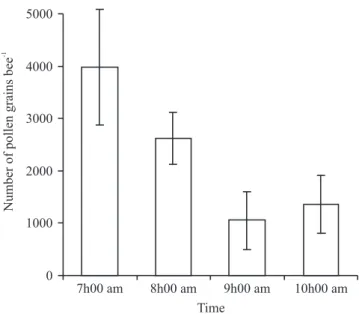
Pollen on the bee body – The average number of pollen grains adhering to the body of the bee was high early in the day (4,000 grains), declining as pollen was removed
from flowers to 1,000 grains by 9h00 am (figure 1). The bees visit begins soon after uncovering the male flowers of
pumpkin and reached the maximum at 8h00 am. Similar results were recorded on pumpkin by Cady (1993) and Nicodemo et al. (2009). During the visit the bees land on reproductive plant parts and remove pollen grains. The hairs on the bee body brush the anthers and pollen adheres to them. When pollen is abundant the bees that
carry more pollen grains are those that visit the flower
Table 1. Pollen removal activities by honey bees in male pumpkin flowers. Average of four replications, 1996.
Number of visits
Number of pollen grains in the anther
Number of removed pollen grains
Pollen grains removed per visit
Time (s) Total Per visit
0 42,765 a 0 0 0 0
1 29,000 b 13,765 c 13,765 a 12 c 12 b
2 17,245 c 25,520 b 12,760 a 84 c 42 a
4 8,660 d 34,105 a 8,526 b 217 b 54 a
6 10,205 cd 32,560 a 5,427 bc 272 b 45 a
8 4,365 d 38,400 a 4,800 c 443 a 55 a
CV (%) 18.2 20.9 29.3 29.8 35.4
Means followed by different letters in columns are different (Tukey test, P < 0.05).
Figure 1. Number of pumpkin pollen grains adhering to the body of bees at different times of the day. Average of six bees, 1997. Bars represent standard deviation.
first, behavior also observed by Nepi & Pacini (1993).
This allow bees gathering more pollen at 8h00 am than at later hours in the morning, where decrease of the
number of pollen was observed (figure 1).
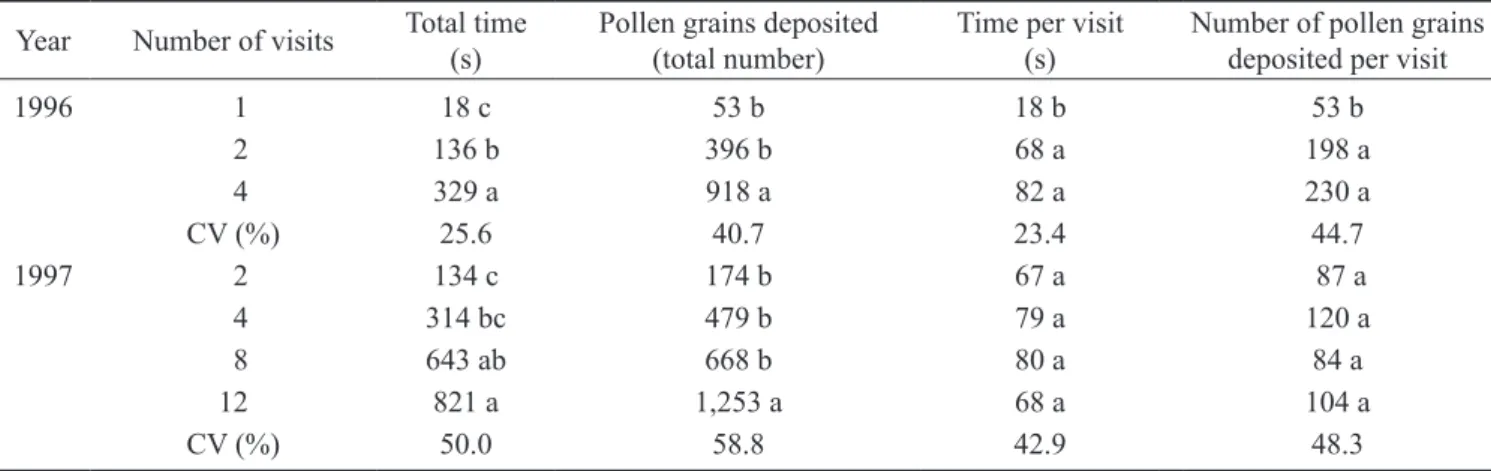
Pollen deposition on stigma – Bees deposited from 53 to 230 pollen grains per visit, and the duration of each bee visit varied from 18 to 82 seconds (table 2). In 1996, the average number of pollen grains deposited on the stigma by one bee visit was 53, increasing to 918 grains after four visits. In 1997, the number of grains deposited increased from 174 (after 2 visits) to 1,253 (after 12 visits).
Honey bees deposit pollen on the stigma when
the amount of pollen deposited on the stigma in the
first visit (53 grains) (table 2). This difference is due
to pollen loss by the pollinator during pollen collection
and transfer. Similar findings have been made by others
with pumpkins, in which honey bees deposited 215 pollen grains in a single visit (Tepedino 1981), and in cucumber (Cucumis sativus), in which 129 pollen grains
were placed on the stigma on the first visit, and 33 or
fewer grains in subsequent visits (Collison & Martin, 1979). In contrast, our study indicated that the amount of pollen deposited on the stigma was 7 to 9 times greater
when the flowers received two visits compared to one
(table 2). Therefore, the amount of pollen transferred in each visit is not constant. Factors such as high pollen concentration and favorable climatic conditions for bee
activity and pollinator efficiency influence the amount
of pollen transferred (Collison & Martin 1979).
Pollination and fruit set – Pumpkins required 12 bee
visits per flower to transfer enough pollen that it was
not limiting to fruit set. According to previous results of this experiment (Vidal et al. 2006), in the period from 39 to 66 days after planting (DAP), the number of male
flowers per plant increased from 15 to 34 and female flowers increased from 0.3 to 2.2 flowers. In this period, in which the honey bees started to visit the flowers, the influence of different frequencies of visits on fruit set
was evaluated (2, 4, 8 and 12 visits). The percentage
of fruits set was highest when flowers received 12 bee
visits, with a fruit set of 100% (table 3). There was no difference in the treatments with 2, 4 and 8 visits, in
which the average of fruit set was 55% (figure 2). The
effect of the number of visits on percentage fruit set was consistent with other studies with several Cucurbit
species (Aldrez 1966, Collison & Martin 1979, Free 1993, Grewal & Sidhu, 1979, Hochmuth et al. 1995, Stapleton et al. 2000, Stanghelini et al. 1997).
The success of the pollination depends on pollinator
efficiency during the period in which the flowers are
viable to receive pollen. Pollen viability of C. pepo is
higher right after flower opening (around 92%), and
decreases to 75% at the end of anthesis (Nepi & Pacini 1993). Therefore, in the data collection period
(8h00-10h00 am) the flowers should have had high receptivity,
favoring pollination and fertilization.
The average duration of bee visit to the female flower
in the period between 8h00 and 10h00 am was short (18
sec.) when the flower was only visited once. On multiple visits, duration per visit did not vary significantly with
the number of visits (table 3), averaged 75 seconds in 1996 and 79 sec. in the two experiments in 1997 (tables 2, 3). This variation is comparable to observations made
Table 2. Pollen deposit activities by honey bees on female pumpkin flowers. Average of four and six replications in 1996 and
1997, respectively.
Year Number of visits Total time (s)
Pollen grains deposited (total number)
Time per visit (s)
Number of pollen grains deposited per visit
1996 01 18 c 53 b 18 b 53 b
02 136 b 396 b 68 a 198 a
04 329 a 918 a 82 a 230 a
CV (%) 25.6 40.7 23.4 44.7
1997 02 134 c 174 b 67 a 87 a
04 314 bc 479 b 79 a 120 a
08 643 ab 668 b 80 a 84 a
12 821 a 1,253 a 68 a 104 a
CV (%) 50.0 58.8 42.9 48.3
Means followed by different letters in columns are different (Tukey test, P < 0.05).
Table 3. Bee visit duration and fruit set in pumpkin female
flowers during different numbers of bee visits in 1997.
Average of 20 replicates. Number of
visits
per flower
Visit duration (sec)
Fruit set (%) Total Per visit
2 182 c 91 a 050 b
4 351 c 88 a 050 b
8 664 b 83 a 065 b
12 907 a 76 a 100 a
CV (%) 053.4 45.5 019.0
12 visits, which provided 1,253 ± 484 pollen grains (table 2). If bee populations provided fewer visits, fruit set would likely be reduced. With 8 visits, when 668 grains were deposited on the stigma (table 2), fruit set was 65% (table 3). The need for many pollen grains per ovule is due to reduction in pollen viability by low temperatures, rains, low activity of the bees and no germinating pollen left on the stigma (Stanley & Linskens 1974, Nepi & Pacini 1993).
Many bee visits were necessary because honey bees
were relatively inefficient at transferring pollen. On a first visit, a bee would remove about 14,000 grains, of which 1,000 to 4,000 would adhere to the bee’s body (figure 1). Of these, only 50 to 200 would be transferred to the stigma of the next female flower visited (table 2).
The low pollen deposition on the stigma can be attributed partly to pollen loss when the bees enter and leave a
flower. Honey bees usually lose pollen when entering a flower, especially if they come from a male flower that is loaded with pollen. When bees leave the male flower
many grains fall to the base of the stamen and corolla. In addition, pollen transfer to the stigma depends on the
extent to which the pollen on the bee’s body is brushed
off by contact with the stigma.
Opening of nectaries and attractiveness – Honey
bees visit pumpkin flowers for nectar, as well as for
pollen. Therefore it might be possible to increase the
attractiveness of flowers by making the nectar easier to access. The attractiveness of flowers to pollinators in the field is generally associated with nectar availability and pollen abundance in the flower (Thorp 1979, Pierre et al. 1996). The influence of the size of the nectary pore
opening on the attractiveness of the male flowers was
evaluated through: (a) number of visits in 15 minutes
of observation (figure 2A), (b) time spent on each visit (figure 2B), and (c) flower occupation time in 15 minutes of observation (figure 2C). In the nectaries with pores, the number of visits in flowers with a 1 mm pore (6 visits) was significantly smaller than in flowers with pores of 2 and 3 mm (10 and 11 visits, respectively) (figure 2A). In the flowers without pores the number of visits was similar to the flowers with 2 and 3 mm pores, however, the time spent in each visit was significantly shorter in those without pores than in flowers with enlarged openings (figures. 3A and 3B). Therefore in the flowers without
pores, where the access to the nectar was blocked, the bees stayed about 30 seconds collecting only pollen,
while in flowers with openings, bees took more time (48 to 62 s; figure 3B) collecting both pollen and nectar. Previous investigators have confirmed that in addition,
Figure 2. Number of bee visits in 15 minutes (A), duration
of each visit (B) and flower occupation time in 15 minutes (C), in male flowers of pumpkin with different degrees of nectary pore opening in 1996. Average of seven flowers. Bars
represent standard deviation.
in C. pepo by other authors (Couto et al. 1990, Nepi & Pacini 1993).
Complete fruit set in pumpkins requires 1500 to
2000 pollen grains per flower (Cady 1993, Masierowska
the type of sugar, its concentration and the total amount of sugars in the nectar also play a role in visit duration (Wykes 1952, Lepage & Boch 1968, Crane 1985).
The flower visit time increased with the size of the nectary pore opening (figure 2C). Flowers without pores
were visited for only 3.8 minutes per 15-min observation
while the flowers with pores of 3 mm were visited for 8.2
minutes. Nectar availability prolongs the time spent by
pollinators on a particular flower, apparently increasing
the probability of pollen deposition and successful pollination (Manetas & Petropoulou 2000). Considerable variation has been observed among pumpkin varieties in the size of the nectary pore opening and in the form
and height of the style in female flowers. These results
indicate that selecting for larger pores should result in
varieties that increase the pollinators’ visits, the amount
of pollen gathered and, therefore, fruit set.
The number and duration of honey bee visits
varied with the time of day (figure 3). Early in the day
Figure 3. Number of bee visits per flower (A) and duration of each (B), in male flowers of pumpkin in different daytime
periods in 1996. Bars represent standard deviation.
(7h00-8h00 am), bees made many short visits. Later, (9h00-10h00 am) visits were less frequent but longer.
There were 50 visits of 29 seconds each in the first
hour, and 17 visits of 72 seconds in the last hour of the
three-hour period (figure 3).
Fruit set in pumpkins is maximized with around
1,200 pollen grains per flower, which is accomplished
by 12 honey bee visits during the few hours that the
flowers are open. Large nectary openings increase male flowers’ attractiveness to pollinators, and can increase
visit frequency and pollination success.
Acknowledgements – The authors wish to thank the Department of Fruit and Vegetable Sciences, Cornell University, for Crop and Lab facilities. Thanks also to Carlos Augusto Vidal, Dulce Vidal and Ragendra de Sousa for helping in data collection, and Dr. Thomas Bjorkman for revising assistance. A special gratitude to Alfredo A.C. Alves
for field and lab assistance.
References
ALDREZ, W.C. 1966. Honey bee visit numbers and watermelon pollination. Journal of Economic Entomology 59:28-30.
CADY, S.W. 1993. Pollination and flowering patterns of field-grown pumpkin (Cucurbita pepo). PhD dissertation, Cornell University, Ithaca.
COLLISON, C.H. & MARTIN, E.C. 1979. The relationship of foraging activity to fruit set and shape in the pollination of pickling cucumbers (Cucumis sativus). Agricultural Experimental Station. Special Miscellaneous Publication 1:183-188.
COUTO, R.H., PEREIRA, J.M.S. & COUTO, L.A. 1990.
Estudo da polinização entomófila em Cucurbita pepo (abóbora italiana). Científica 18:21-27.
CRANE, E. 1985. O livro do mel. Editora Nobel, São Paulo. FREE, J.B. 1993. Insect pollination of crops. Academic Press,
San Diego.
GREWAL, G.S. & SIDHU, A.S. 1979. Note on the role of bees in the pollination of Cucurbita pepo. Indian Journal of Agriculture Science 49:385-388.
HARDER, L.D. 1990. Pollen removal by bumble bees and its implications for pollen dispersal. Ecology 71:1110-1125.
HOCHMUTH, G.J., MAYNARD, D.N., VAVRINA, C.S., STALL, W.M., KUCHAREK, T.A., JOHNSON, F.A. & TAYLOR. T.G. 1995. Cucurbit production in Florida: cantaloupe, cucumber, muskmelon, pumpkin, squash, watermelon (HS 725). In Vegetable production guide for Florida (SP 170) (G.J. Hochmuth and D.N. Maynard, eds.). University of Florida, Gainesville, p.179-207. LEPAGE, M. & BOCH. R. 1968. Pollen lipids attractive to
MANETAS, Y. & PETROPOULOU, Y. 2000. Nectar amount, pollinator visit duration and pollination success in the Mediterranean shrub Cistus creticus. Annals of Botany 86:815-820.
MASIEROWSKA, M. & WIEN, H. 2000. Flowering, pollination and fruit set of two pumpkin (Cucurbita pepo L.) cultivars under field conditions. Apiacta 35:97-105.
MORSE, R.A. 1994. The new complete guide to beekeeping. The Countryman Press, Woodstock.
MURCIA, C. 1990. Effect of floral morphology and temperature on pollen receipt and removal in Ipomoea trichocarpa. Ecology 71:1098-1109.
NEPI, M. & PACINI, E. 1993. Pollination, pollen viability and pistil receptivity in Cucurbita pepo. Annals of Botany 72:527-536.
NICODEMO, D., COUTO, R.H.N., MALHEIROS, E.B. & DE JONG, D. 2009. Honey bee as an effective pollinating agent of pumpkin. Scientia Agricola 66:476-480. NILSSON, L.A. 1988. The evolution of flowers with deep
corolla tubes. Nature 334:147-149.
PIERRE, J., LE GUEN, LE GUEN, J. DELÈGUE, M.H.P., MESQUIDA, MARILLEAU, J.R. & MORIN, G. 1996. Comparative study of nectar secretion and attractivity to bees of two lines of spring-type faba bean (Vicia faba L var equina Steudel). Epidologie 27:65-67.
RAGSDALE, N.N. 2007. Vanishing honey bees – colony collapse disorder. Outlooks on Pest Management 28:280-282.
STANGHELLINI, M.S., AMBROSE, J.T. & SCHULTHEIS, J.R. 1997. The effects of honey bee and bumble bee pollination on fruit set and abortion of cucumber and watermelon. America Bee Journal 137:386-391.
STANLEY, R.G. & LINSKENS, H.F. 1974. Pollen: biology biochemistry management. Springer-Verlag, New York. STAPLETON, S.C., WIEN, H.C. & MORSE, R.A. 2000.
Flowering and fruit set of pumpkin cultivars under field
conditions. HortSciences 35:1074-1077.
STEPHENSON, A.G., DEVLIN, B. & HORTON, J.B. 1988. The effects od seed number and prior fruit dominance on the pattern of fruit production in Cucurbita pepo (zucchini squash). Annals of Botany 62: 653-661.
TEPEDINO, V.J. 1981. The pollination efficiency of the squash bee (Peponapis pruinosa) and the honeybee (Apis mellifera) on summer squash (Cucurbita pepo). Journal of Kansas Entomology Society 54: 359-377.
THORP, R.W. 1979. Structural, behavioral, and physiological adaptations of bees (Apoidea) for collecting pollen. Annals of Missouri Botanic Garden 66:788-812. VIDAL, M.G., DE JONG, D., WIEN, H.C. & MORSE,
R.A. 2006. Nectar and pollen production in pumpkin (Cucurbita pepo L.). Revista Brasileira de Botânica
29:267-273.
WALTERS, S.A. & TAYLOR, B.H. 2006. Effects of honey bee pollination on pumpkin fruit and seed yield. HortScience 41:370-373.
WIEN, H.C. 1997. The cucurbits: cucumber, melon, squash and pumpkin, In The physiology of vegetable crops (H.C. Wien, ed.). CAB International, Wallingford, p.345-386.