Ana Maria Müller de Magalhães
I, Caren de Oliveira Riboldi
II, Célia Guzinski
II,
Roberto Carvalho da Silva
II, Gisela Maria Schebella Souto de Moura
II Universidade Federal do Rio Grande do Sul, Escola de Enfermagem, Departamento de Assistência e Orientação Profi ssional. Porto Alegre-RS, Brasil.
II Hospital de Clínicas de Porto Alegre, Serviço de Enfermagem Cirúrgica. Porto Alegre-RS, Brasil.
How to cite this article:
Magalhães AMM, Riboldi CO, Guzinski C, Silva RC, Moura GMSS. Level of dependence among patients in a surgical unit. Rev Bras Enferm. 2015;68(5):542-7. DOI: http://dx.doi.org/10.1590/0034-7167.2015680509i
Submission: 11-29-2014 Approval: 06-16-2015
ABSTRACT
Objective: to identify the complexity of the nursing care of inpatient surgical unit patients, using the Perroca patients classifi cation scale. Method: a descriptive, cross-sectional study with 546 reviews of 187 patients between October and December of 2012. Data were analyzed using SPSS 18.0 and the Kappa test, to measure interrater agreement. Results: a predominance of patients
in the categories of semi-intensive (46.5%) and intermediate care (44.0%) was found, with a prevalence of unassisted bath (58.4%) in the total sample, and bed bath (69.3%) in the semi-intensive care patients. The level of agreement between two pairs of raters was considered good. Conclusion: the systematic application of the instrument was useful as a complementary measure of the level of patient dependence, and may contribute to the improvement of the working process, refl ecting on management decision-making with regard to nursing workload
Key words:Personnel Administration, Hospital; NursingCare; Workload.
RESUMO
Objetivo: identifi car a complexidade do cuidado de enfermagem dos pacientes em unidade de internação cirúrgica, utilizando a escala
de classifi cação de pacientes de Perroca. Método: estudo transversal descritivo, com 546 avaliações de 187 pacientes, entre outubro e dezembro de 2012. Os dados foram analisados no programa SPSS 18.0 e teste Kappa, para medir a concordância interavaliadores.
Resultados: constatou-se predomínio de pacientes nas categorias de cuidados semi-intensivo (46,5%) e intermediário (44,0%), com prevalência de banho sem auxílio (58,4%) no total da amostra e banho de leito (69,3%) entre os pacientes de cuidado semi-intensivo. O grau de concordância entre duas duplas de avaliadores foi considerado bom. Conclusão: a sistematização da aplicação do instrumento mostrou-se viável como medida de acompanhamento do grau de dependência dos pacientes, podendo contribuir para o aprimoramento do processo de trabalho, repercutindo na tomada de decisão gerencial quanto à carga de trabalho de enfermagem.
Descritores: Administração de Recursos Humanos em Hospitais; Cuidados de Enfermagem; Carga de Trabalho.
RESUMEN
Objetivo: identifi car el tipo de la atención de enfermería de los pacientes en una unidad de internación quirúrgica, con la escala de clasifi cación de pacientes de Perroca. Método: estudio transversal, descriptivo, con 546 evaluaciones de 187 pacientes, entre octubre y diciembre de 2012. Los datos fueron analizados con el programa SPSS 18.0 y el test Kappa para medir la concordancia entre evaluadores. Resultados: se encontró un predominio de pacientes en las categorías de cuidados semi-intensivos (46,5%) e intermediarios (44,0%), con prevalencia de baño sin ayuda (58,4%) en el total de la muestra y baño en la cama (69,3%) entre los pacientes de cuidados semi-intensivos. El grado de concordancia entre dos pares de evaluadores se consideró bueno. Conclusión: la sistematización de la aplicación del instrumento demostró ser viable como una medida de acompañamiento del grado de dependencia de los pacientes y puede contribuir para la revisión y perfeccionamiento del proceso de trabajo, refl ejando en la toma de decisión gerencial sobre la carga de trabajo de enfermería.
Palabras clave: Administración de Personal en Hospitales; Atención de Enfermería; Carga de Trabajo.
Level of dependence among patients in a surgical unit
Grau de dependência de pacientes em unidade de internação cirúrgica
Grado de dependencia de los pacientes en unidade quirúrgica
Ana Maria Müller de Magalhães E-mail: [email protected]
INTRODUCTION
Technological advances evidenced in health care have not yet brought answers to the adequacy of nursing personnel needs in order to meet the demands of hospitalized patients. The staffing of personnel remains a challenge for managers of health and nursing services, and is continually referred to as one of the main problems of the institutions.
Nursing leaders still face strong resistance for adjusting the number of professionals to the demands of care, especially due to budgetary arguments, despite recognizing the importance of human resources for quality of care and patient safety(1-2).
The personnel scheduling and nursing staff workload provide an estimated number of professionals to provide care to a cer-tain patient or group of patients. Setting the number of patients assigned to each nursing professional, nurse or technician, be-comes more accurate when the profile of care complexity or degree of dependence on the care to be provided is known.
A local study showed that the lack of a tool for systemic monitoring of classification of the degree of patient depen-dence is critical, and contributes to the difficulty of analysis of the workload in inpatient units(3). Thus, the knowledge gap
on the subject prejudges the assessment of the required care demands and the adequacy of staff to meet the inpatients needs. Nevertheless, the lack of systematic evaluation of the degree of dependence of patients can cause internal distor-tions within the institution and jeopardize a real appreciation of the nursing staff workload.
Despite the definition of parameters for staffing of person-nel having been released by representative organizations of Brazilian nursing in the last decade(4), there is no legal
pro-tection through specific legislation that regulates the ratio of the number of patients and professional nurses in health in-stitutions. Thus, there are still major challenges in the field of human resources in nursing, and the practice environments conditions in Brazilian hospitals, to achieve safe health care.
Patient classification scales have been essential tools to as-sist in measuring the degree of dependence on nursing care, as well as the adequacy of nursing staff workload(5-6). Among these
scales, Perroca’s proposition is based on the Theory of Basic Hu-man Needs of Wanda Horta, and was later enhanced in 2008, incorporating new trends in nursing care practice and manage-ment. This measurement scale for classification of the patient’s degree of dependency is an instrument validated for the Brazil-ian scenario in medical and surgical adult inpatient units, which assesses aspects of nursing related to the standardization of care, proiding care, health education and emotional support(5,7).
Patient classification systems enable equalizing the rela-tionship between the demand generated by patients and the care supply enabled by a number of nursing staff, in order to substantiate the adequacy of safer, quality care practices for patients and professionals, considering and adjusting situ-ations of work overload(11). In addition, these systems allow
for the identification of changes in the healthcare complexity profile of hospitalized patients due to seasonality of diseases or an increase in chronic diseases resulting from the aging process and changes in the population profile(12).
Given these considerations and the assumption that instru-ments for patient classification help nursing managers with decision-making for personnel staffing associated with the nursing team workload, this study aimed to use Perroca’s rat-ing scale to measure the degree of dependence in patients admitted to a surgical inpatient unit, by assessing its applica-bility for monitoring this measure in other units of the hospital studied.
METHOD
This was a cross-sectional, descriptive study in a surgical unit of a university hospital, of tertiary and quaternary care, in the south of Brazil. The unit had 34 beds and provided care to adult patients with clinical and surgical pathologies, especially related to cancer, digestive, genitourinary and respi-ratory diseases, rheumatology, neurology and orthopedics(13).
The predominant age group among the patients in the sample was 40-59 years (38.2%), followed by patients older than 59 years (33.2%); hospital length of stay was 5.6 days.
The study population consisted of patients admitted in the unit between October 16 and December 14 of 2012. The stratified random sampling included 187 patients of both sexes, who were hospitalized in twelve predefined beds dur-ing the delimited period. The sample size calculation was de-fined with a marginof error of 5% and a confidence level of 95%. The study adopted three exclusion criteria for subjects: patients who died, transferred to another sector, and who un-derwent procedures outside the unit within the past 24 hours prior to data collection.
Patients were assessed daily during the morning shift, from Monday to Friday, based on clinical condition and nursing records of the past 24 hours, with a total of 546 ratings. The evaluation was performed by two clinical nurses who worked in the unit during this shift. The instrument selection was based on the construct and content validity criteria in the Bra-zilian scenario(5,7), its use in previous studies in the institution,
and by familiarity of nurses with the scale.
The agreement between the evaluations of nurses was test-ed by 202 reassessments of patients, performtest-ed by another nurse from the unit. The number of revaluations was calcu-lated considering a Kappa of 0.6, margin of error of 0.1, and a 95% confidence level. The total number of assessments was not equivalent to the total number of patients because, de-pending on the length of stay on the unit, some patients were classified more than once.
In addition to data collection, specifics information about the type of care for the body was also collected, considering three categories: bath without assistance from the nursing staff, in wheelchair, or in bed. The inclusion of this variable was due to previous research in which nurses highlighted the impact of this care activity, both in terms of workload and patient safety(3).
The collected data were organized in the Excel spreadsheet program for Windows, and analyzed with the Statistical
Pack-age for the Social Sciences (SPSS / PASW), version 18.0, for
descriptive statistics and the Kappa test was used to measure interrater agreement. Kappa values between 0.6 and 0.8 were considered good, and those above 0.8 were very good(14).
The research project was approved under protocol number 12-0332 by the Ethics Committee of the institution, for the field of study, and met the requirements established by Reso-lution 466/12 of National Committee in Ethics and Research (Comissão Nacional de Ética em Pesquisa CONEP)(15),
ensur-ing privacy and confidentiality of data.
RESULTS
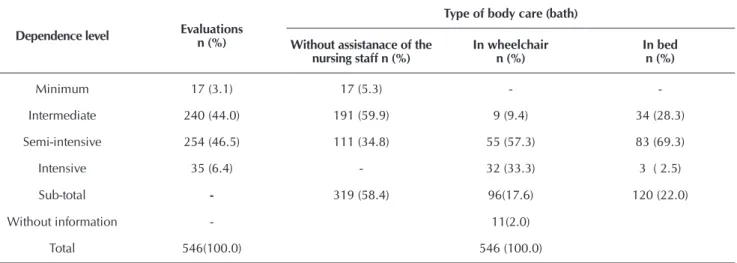
Table 1 presents the results concerning classification of the degree of patient dependency during the studied period, with a predominance of semi-intensive (254, 46.5%) and interme-diate care (240, 44.0%).
Regarding the type of care provided for the body, there was a predominance of bath without assistance of nursing staff in 319 (58.4%) evaluations, that is, patients autonomouslymanaging their bathing in the shower. The 216 (39.6%) remaining classifications indicated that the care for the body was done in a wheelchair in the shower, or in bed, which demanded greater time and resources of care from the nursing staff. There was an increase in the preva-lence of bed baths or those in wheelchairs among patients classi-fied in semi-intensive and intensive care categories. Among the records relating to the type of body care, 11 (2.0%) ratings did not include the information on the data collection instrument, and were disregarded for calculation and sampling purposes.
Table 1 - Classification of dependence level of hospitalized patients and type of care for the body, Porto Alegre, Rio Grande do Sul, Brazil, in 2012
Dependence level Evaluations n (%)
Type of body care (bath)
Without assistanace of the nursing staff n (%)
In wheelchair n (%)
In bed n (%)
Minimum 17 (3.1) 17 (5.3) -
-Intermediate 240 (44.0) 191 (59.9) 9 (9.4) 34 (28.3)
Semi-intensive 254 (46.5) 111 (34.8) 55 (57.3) 83 (69.3)
Intensive 35 (6.4) - 32 (33.3) 3 ( 2.5)
Sub-total - 319 (58.4) 96(17.6) 120 (22.0)
Without information - 11(2.0)
Total 546(100.0) 546 (100.0)
Note:
Classification of dependence level according to the Perroca scale(5)
Table 2 - Degree of interobserver agreement (Κ) on the level of dependence scores of the patients in surgical units, Porto Alegre, Rio Grande do Sul, Brazil, in 2012
Evaluators E1
n (%)
E2 n (%)
E1 n (%)
E3 n (%)
E2 n (%)
E3 n (%)
Minimum Care (9 -12) 2 (2.6) 3 (3.9) - - 2 (3.2) 2 (3.2)
Intermediate Care (13-18) 35 (45.5) 24 (31.2) 19 (30.2) 18 (28.6) 30 (48.4) 27 (43.6)
Semi-intensive Care (19-24) 35 (45.5) 41 (53.2) 33 (52.4) 35 (55.5) 28 (45.2) 31 (50.0)
Intensive Care (25-36) 5 (6.4) 9 (11.7) 11 (17.4) 10 (15.9) 2 (3.2) 2 (3.2)
Κ 0.51
% agreement (70.1%) % agreement (84%)Κ 0.73 % agreement (85%)Κ 0.74
Note:
The level of interrater agreement was good between the nurses, E1 and E3 (0.73), and E2 and E3 (0.74). A good level of agreement was not observed between the evaluators E1 and E2 (0.51), as shown in Table 2. The discrepancies identi-fied between evaluators occurred in one or two areas of care within Perroca’s classification scale, resulting in changing the degree of dependence score to a level below or above, only in some situations. There were no differences in evaluation score changes between the extremes of the scale, minimum to intensive care, for example.
DISCUSSION
The use of Perroca’s scale to rate the level of dependence of hospitalized patients in a surgical unit of a teaching hos-pital provided objective criteria to assess the complexity of care, with regard to the categorization proposed by the Fed-eral Board of Nursing: minimum, intermediate, semi-intensive and intensive care(4). The prevalence of semi-intensive 254
(46.5%) and intermediate 240 (44.0%) care categories is close to the results of other studies(11,16-17) that used patient
classi-fication instruments in clinical and surgical inpatient unitst with a predominance of elderly people, which led to greater complexity of care and demand for nursing care hours due to functional limitations and associated comorbidities.
In contrast, the concentration of patient evaluations in semi-intensive and intermediate 494 (90.5%) care categories differs from other studies that found a predominance of pa-tients classified in the minimum care category(18-21) in previous
research in the same institution, and in hospitals with similar characteristics to the present study.
The difference between t he results can be related to the time interval of the previous studies(18-19) and to the changes
in the care profile of patients in high complexity hospitals, as with the institution that was the focus of this study. These considerations may indicate that the capacity of the unit re-mains the same over the years, but with the dependence of patients on nursing care of greater complexity, technology and increased therapeutic approach, requiring more hours to be dispensed to the patient, as shown by the degree of depen-dence assessment scales
The increase of new technologies and therapies enable home clinical follow-up, often of the character of outpatient treatment. Thus, it is plausible to consider that patients who require hos-pitalization present major complications resulting from chronic diseases or comorbidities, and treatments required are more complex, such as chemotherapy, radiation therapy and elective or emergency surgery, contributing to a change in the care pro-file with greater dependence on nursing care, which reflects the predominance of patients classified as intermediate and semi-intensive care (494, 90.5%), as shown in this study.
During the application of Perroca’s classification instru-ment, it was necessary to standardize the assessment crite-ria due to the fact that the indicators show some degree of subjectivity, as some of them are related to behavior and patient-nurse ratio (coordination and planning of the nursing process, health education and emotional support), and may
be influenced by evaluator and environmental interference. In the perception of evaluators, the relationships of bonding with the patients requires greater time of nurses for educational ac-tivities, guidance and emotional support in some situations. So, individualized criteria were listed and detailed for evalu-ation in each of the nine areas of nursing care required by patients, ensuring greater uniformity in assessments.
The revaluations of 202 patients, with a good degree of agreement between two pairs of evaluators, were fundamental to understanding the group in terms of the criteria that required clearer definition and standardization. The uniformity of criteria for promoting the understanding by the evaluators to not under-estimate or overunder-estimate the data should be the initial tonic for gathering informations; being familiar with the collection instru-ment is needed to minimize possible subjectivities.
Throughout the data collection period, the importance of qualified nursing records for accurate administration of the pa-tient classification instrument was identified. The information transmitted in the reports at shift change were instrumental in collecting data, however, the effectiveness of communication, both oral and written, still requires improvement, which has been a challenge for nursing.
The characterization of care for the body related to bathing of a patient was allowed to describe the prevalence of care for bed baths, and the assistance in wheelchair use in the shower among inpatients was around 40.0%. The inclusion of the pa-tient’s bath in assessing the degree of dependence was very important, as it was one of the care activities highlighted among those that had more repercussions on the nursing staff workload and contributed most to the change in the patient’s care cat-egory(3,17,22). The execution of this care requires the dedication
of two nursing professionals, for a considerable period of time, and requires a major investment in preparing and organizing material for its performance. Thus, whether there was depen-dence for care of the body due to locomotion, it is a procedure that burdens team management, as it implies and overlap of the time of professionals hired to care for the same patient.
Data collection during the weekdays was not uniform due to administrative and organizational issues on the inpatient unit, which did not allow for evaluating the distribution of the variation of the degree of dependence throughout the days of the week, to standardize data collection on other hospital units. From this study, the application of this scale in other sec-tors will be proposed, taking into account the daily and con-secutive sample of patients in a specific week of the month, with systematic monitoring.
CONCLUSION
In addition to measuring the degree of patient dependence, the use of this scale allowed nurses to reflect on the organiza-tion of the patient evaluaorganiza-tion process and the definiorganiza-tion of pri-orities, and facilitated the standardization of nursing care and the establishment of more accurate nursing diagnoses for each patient. The fact that the patient was evaluated daily, consider-ing the last 24 hours of care, provided a reflection on the care process of nurses and all staff, attempting to record, prescribe care and nursing outcomes related to the patient´s health, which must be increasingly complete.
Perroca´s scale of patient classification demonstrates a certain degree of subjectivity, leading to the need for stan-dardization of each indicator on the instrument, listing all the care that would be considered within each item. This initiative
enabled more uniform data collection, minimizing interfer-ence of the subjectivity of each nurse.
The applicability of this patient classification scale proved to be feasible as an accompanying measure for the depen-dence level of patients. Conducting research to develop, test and refine tools to support management practices promotes the construction of knowledge about nursing management, strengthening the dialogue between academics and service. The study demonstrated the viability of systematic imple-mentation of the scale within the daily activities of the inpa-tient nurse. The adoption of the scale facilitates the review of work process and subsidizes managerial decision-making in view of the nursing staff workload for the care of hospital-ized patients.
REFERENCES
1. Magalhães AMM, Riboldi CO, Dall’Agnol CM. [Planning human resources in nursing: challenge for the leadership]. Rev Bras Enferm [Internet]. 2009 Jul-Aug [cited 2012 Oct 12];62(4):608-12. Available from: http://www.scielo.br/pdf/ reben/v62n4/20.pdf Portuguese.
2. Aiken LH, Sermeus W, Van denHeede K, Sloane DM, Busse R, McKee M, et al. Patient safety, satisfaction, and quality of hospital care: cross sectional surveys of nurses and patient in 12 countries in Europe and the United States. BMJ [Internet]. 2012 Mar [cited 2015 Jan 03];344:e1717. Available from: http://www.bmj.com/content/344/bmj.e1717
3. Magalhães AMM, Dall’Agnol CM, Marck PB. Nursing workload and patient safety - a mixed method study with an ecological restorative approach. Rev Latino-Am Enferma-gem [Internet]. 2013 Jan-Feb [cited 2012 Oct 11];21(Spec No):146-54. Available from: http://www.scielo.br/pdf/rlae/ v21nspe/19.pdf
4. Conselho Federal de Enfermagem (BR). Resolução CO-FEN-293/2004. Fixa e estabelece parâmetros para o dimen-sionamento do quadro de profissionais de Enfermagem nas unidades assistenciais das instituições de saúde e assemelha-dos [Internet]. Diário Oficial da União 2004 [cited 2012 Oct 12]. Available from: http://www.cofen.gov.br/wp-content/ uploads/2012/03/RESOLUCAO2932004.PDF
5. Perroca MG. Development and content validity of the new version of a patient classification instrument. Rev Latino-Am Enfermagem [Internet]. 2011 Jan-Feb [cited 2013 Oct 13];19(1):58-66. Available from: http://www.scielo.br/pdf/ rlae/v19n1/09.pdf
6. Streiner DL. Kottner J. Recommendations for reporting the results of studies of instrument and scale development and testing. J Adv Nurs [Internet] 2014 Sep [cited 2015 Mar 20];70(9);1970-9. Available from: http://onlinelibrary.wiley. com/doi/10.1111/jan.12402/pdf
7. Perroca MG. The new version of a patient classification instrument: assessment of psychometrics properties. J Adv Nurs [Internet] 2013 Aug [cited 2015 Mar 20];69(8):1862-8. Available from: http://onlinelibrary.wiley.com/doi/10.1111/ jan.12038/pdf
8. Santos NC, Fugulin FT. Creation and validation of an instrument to identify nursing activities in pediatric wards: information for determining workload. Rev Esc Enferm USP [Internet]. 2013 Oct [cited 2015 Mar 21];47(5):1052-9. Available from: http:// www.scielo.br/pdf/reeusp/v47n5/0080-6234-reeusp-47 -05-1052.pdf
9. Camuci MB, Martins JT, Cardeli AAM, Robazzi MLCC Nurs-ing Activities Score: nursNurs-ing work load in a burns Intensive Care Unit. Rev Latino-Am Enfermagem [Internet]. 2014 Mar-Apr [cited 2015 Mar 18];22(2):325-31. Available from: http://www.scielo.br/pdf/rlae/v22n2/0104-1169-rla e-22-02-00325.pdf
10. Leite IRL, Silva GRF, Padilha KG. Nursing Activities Score and demand of nursing work in intensive care. Acta Paul Enferm [Internet] 2012 [cited 2015 Mar 20];25(6):837-43. Available from: http://www.scielo.br/pdf/ape/v25n6/en_v25n6a03.pdf 11. Moraes M, Linch GFC, Souza EN. [Classification of patients in a traumatology unit]. Rev Gaúcha Enfermagem [Internet]. 2012 Jun [cited 2012 Oct 16];33(2):52-9. Available from: http://www.scielo.br/pdf/rgenf/v33n2/09.pdf Portuguese. 12. Brito AP, Guirardello EB. Nursing workload in an
inpa-tient unit. Rev Latino-Am Enfermagem [Internet]. 2011 Sep-Oct [cited 2012 Oct 26];19(5):1139-45. Available from: http://www.scielo.br/pdf/rlae/v19n5/11.pdf 13. Hospital de Clínicas de Porto Alegre (BR). Informações
Gerenciais - IG-BSC. Utilização de dados de prontuários de pacientes em bases de dados em projetos de pesquisa. Porto Alegre (RS): HCPA; 2012.
14. Hulley SB, Cummings SR, Browner WS, Grady D, Hearst N, Newman TB. Delineando a pesquisa clínica: uma abor-dagem epidemiológica. Porto Alegre (RS): Artmed; 2015. 15. Ministério da Saúde (BR), Conselho Nacional de Saúde.
Re-solução nº. 466, de 12 de dezembro de 2012. Define as di-retrizes e normas reguladoras para as pesquisas envolvendo os seres humanos [Internet]. Diário Oficial da União 2012 [cited 2012 Oct 16]. Available from: http://conselho.saude. gov.br/resolucoes/2012/Reso466.pdf
hospitalized elderly according to the patients’ classi-fication system]. Rev Bras Enferm [Internet]. 2012 Nov-Dec [cited 2013 Mar 20];65(6):950-4. Available from: http://www.scielo.br/pdf/reben/v65n6/a10v65n6.pdf Portuguese.
17. Barbosa HB, Paiano LAG, Nicola AL, Fernandes LM. [Complexity level of patient assessment and the amount of professional nursing]. Rev Enferm UFSM [Internet]. 2014 Jan-Mar [cited 2015 Mar 21];4(1):29-37. Available from: http://cascavel.ufsm.br/revistas/ojs-2.2.2/index.php/ reufsm/article/view/9230/pdf Portuguese.
18. Fonseca JP, Echer IC. [Dependence degree of patients with respect to nursing care in a hospital clinical unit]. Rev Gaúcha Enferm [Internet]. 2003 Dec [cited 2012 Oct 20];24(3):346-54. Available from: http://seer.ufrgs.br/RevistaGauchadeEnfer magem/article/view/4482/2421 Portuguese.
19. Laus AM, Anselmi ML. [Characterization of inpatients at the medical and surgical units of the University of São Paulo at
Ribeirão Preto Medical School Hospital, according to the level of dependence on nursing care]. Rev Latino-Am Enfermagem [Internet]. 2004 Jul-Aug [cited 2012 Oct 26];12(4):643-9. Avail-able from: http://www.scielo.br/pdf/rlae/v12n4/v12n4a10.pdf Portuguese.
20. Matos SC, Cardoso SMM, Soares NV, Silva MB. [Sizing of nursing staff in a clinicl unit]. Rev Pesqui Cuid Fundam [Internet]. 2012 Oct-Dec [cited 2013 Jan 12];4(4):3052-9. Available from: http://www.seer.unirio.br/index.php/cui dadofundamental/article/view/1884/pdf_645 Portuguese. 21. Cucolo DF, Perroca MG. Restructuring the Nursing Staff and
its Influence on Care Hours. Rev Latino-Am Enfermagem [Internet]. 2010 Mar-Apr [cited 2012 Oct 10];18(2):31-9. Available from: http://www.scielo.br/pdf/rlae/v18n2/06.pdf 22. Araújo VB, Perroca MG, Jericó MC. Variability in the