59
Radiol Bras. 2011 Jan/Fev;44(1):59–67
Ultrasonography of adnexal masses: imaging findings
*
Ultrassonografia nas massas anexiais: aspectos de imagem
Francisco Andrade Neto1, Ricardo Palma-Dias2, Fabrício da Silva Costa3
Transabdominal and transvaginal ultrasonography performed by a skilled and experienced investigator is currently considered as a highly accurate method in the differential diagnosis of adnexal masses. The authors set out a review based on sonographic images demonstrating the main presentations of adnexal masses, describing their characteristics and locations.
Keywords: Ultrasonography; Ovarian neoplasms; Adnexal diseases; Pelvis.
A ultrassonografia realizada por um habilidoso e experiente examinador é considerada, atualmente, método de ele-vada acurácia no diagnóstico diferencial das massas anexiais. Os autores expõem uma revisão baseada em imagens ultrassonográficas das principais apresentações das massas anexiais, descrevendo suas características e localiza-ções.
Unitermos: Ultrassonografia; Neoplasias ovarianas; Doenças dos anexos; Pelve.
Abstract
Resumo
* Study developed at Clínica Mater Imagem, Fortaleza, CE, Brazil, and at Ultrasound Department, The Royal Women’s Hos-pital, Melbourne, VIC, Australia.
1. MD, graduated at Universidade Estadual do Ceará (UECE), formerly holder of a scholarship of Undergraduate Research – PIBIC/CNPq, Fortaleza, CE, Brazil.
Andrade Neto F, Palma-Dias R, Costa FS. Ultrasonography of adnexal masses: imaging findings. Radiol Bras. 2011 Jan/Fev;44(1): 59–67.
erential method in the complementary in-vestigation(2). Transvaginal
ultrasonogra-phy (TVUS) is currently considered as a highly accurate method in the evaluation of adnexal masses and ovarian cysts(1–3).
This diagnostic modality has been di-rectly related to the operator ability and ex-perience, particularly in the differential
di-INTRODUCTION
Ultrasonography is an important tool in the evaluation of adnexal masses and in the definition of differential diagnosis for such conditions(1). In children, because of the
limitations of clinical examination, ab-dominal ultrasonography becomes a
pref-agnosis between malignant and benign ad-nexal masses, although several authors have reported similar results demonstrat-ing a high diagnostic accuracy of the method(3–9). The operator must be familiar
with all possible presentations of a normal ovary as well as with the characteristics of probably benign or malignant lesions.
2. PhD, Staff Specialist Obstetrician, The Royal Women’s Hospital, Melbourne, VIC, Australia.
3. PhD, Associate Professor, Division of Gynecology and Ob-stetrics, Universidade Estadual do Ceará (UECE), Fortaleza, CE, Brazil, Postdoctoral Fellow, Department of Perinatal Medicine, The Royal Women’s Hospital, Melbourne, VIC, Australia.
Mailing Address: Dr. Fabrício Costa. Ultrasound Department, Royal Women’s Hospital. Locked Bag 300, Grattan St & Fleming-ton Rd, Parkville 3052 VIC, Australia. E-mail: fabricio.costa@ thewomens.org.au
Received September 3, 2009. Accepted after revision July 23, 2010.
Andrade Neto F et al. Ultrasonography of adnexal masses: imaging findings
Tridimensional ultrasonography and Doppler as well as tumor markers, namely, CA-125, CA-15.3, CA-19.9, CA-72.4 and alpha-fetoprotein blood tests are recom-mended as adjuvant methods in the differ-ential diagnosis of adnexal masses, consid-ering that they increase the sensitivity and specificity in the differentiation of ovarian tumors(9–12).
With a view on the challenges of differ-ential diagnosis as well as the possibility of morphological suspicion of ovarian neo-plasias at ultrasonography, the present ar-ticle provides a brief description of the most common presentations of adnexal masses.
FUNCTIONAL CYSTS
Among the cystic adnexal masses, func-tional cysts resulting from the normal
ova-rian function are the most common ones, but their actual incidence is still to be known because in most of cases such cysts are asymptomatic (Figure 2)(1,7).
Follicular cysts are frequently observed during menacme and may occur in up to 17% of postmenopausal women. Classi-cally, such cysts present with unilocular aspect, thin walls and may achieve up to 8 cm in diameter(1,13). Frequently anechoic
fluid serous content is observed, with the possibility of complicating with hemor-rhage(13).
Corpus luteum cysts are frequently found in the first trimester of gestation, commonly achieving the maximum size at the tenth week, with spontaneous regres-sion around the 16th week of gestation. Corpus luteum cysts are also a usual find-ing in the second phase of the menstrual
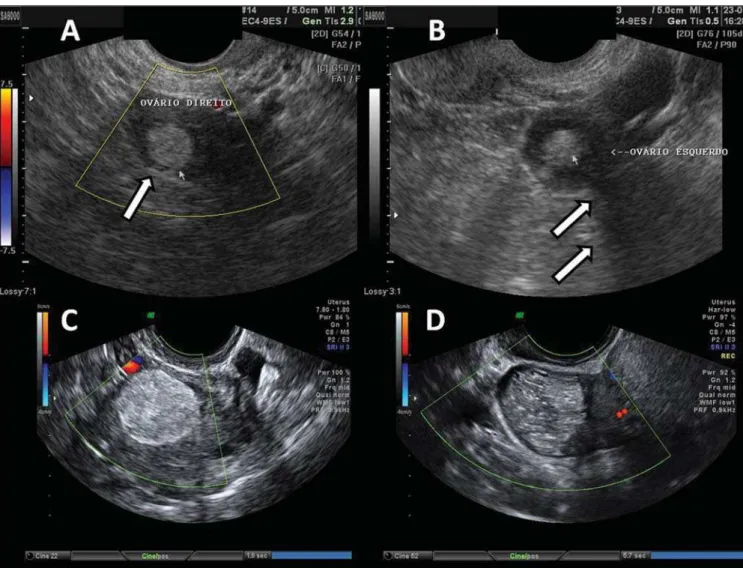
cycle in non-pregnant women. Their typi-cal sonographic aspect consists of findings of cystic mass with echogenic walls and oc-casional hyperechogenic contents in the cases of hemorrhagic cysts (Figure 3)(7).
Theca-lutein cysts are usually large, multiloculated and bilateral, and result from hormonal stimulation by high circu-lating levels of hCG. Such cysts may be found in cases of gestational trophoblastic disorder, multiple gestation, or in the con-dition known as hyperreactio luteinalis(13).
Hemorrhagic cysts (Figure 4) are most frequently observed in premenopausal women and may present with pelvic pain, typically at mid-cycle(7). Characteristically,
they present with a linear heterogeneous echographic pattern in several planes. Blood clots (Figure 5) may be demon-strated as echogenic, heterogeneous masses
Figure 2. Functional cyst. A: TVUS demonstrating left ovary with a dominant follicle (F). B: Abdominal ultrasonography demonstrating a simple cyst, with anechoic fluid content, with defined contour and thin walls. C,D: Images depicting the same characteristics, with TVUS of different patients.
A
B
within the cyst, with no sign of vascular-ization at Color Doppler, sometimes with images suggesting neoplasia(7,13). Serial
follow-up is suggested for such patients, as such cysts usually disappear within eight weeks(7,13).
PARATUBAL/PARAOVARIAN CYSTS
These cysts originate from mesonephric (Wolffian), paramesonephric (Müllerian) structures, or mesothelial inclusions(1). The
vesicular appendix (Morgagni hydatid) is the most common type of paramesonephric cyst, frequently found at one of the fim-briae at the end of the uterine tube. Echographically, they present with thin, deformable walls, generally with the
larg-Figure 3. Corpus luteum. A: Right ovary with a cystic, thin-walled mass in its interior, with echogenic content, characteristic of corpus luteum (arrow). B: Color Doppler – the halo of vascularization around the corpus luteum (CL) characterizes the “ring-of-fire” image pattern. C: Right ovary with corpus luteum (arrow) with debris suggestive of hemorrhage in its interior – heterogeneous linear echogenic content with a reticular aspect. D: Right ovary with three corpus lutea (arrows) and free peritoneal fluid (LV) in a patient submitted to ovulation induction therapy.
Andrade Neto F et al. Ultrasonography of adnexal masses: imaging findings
est diameter measuring up to 10 mm, next to a normal ovary but separated from it (Figure 6)(1,7).
PERITONEAL INCLUSION CYSTS
Peritoneal inclusion cysts classically oc-cur as a result from accumulation of ova-rian fluid trapped by peritoneal adhesions in patients with a history of abdominal sur-gery, trauma, pelvic inflammatory disease or endometriosis. Typically, these are large cystic multiloculated masses, separated
from the ovaries, which present with a nor-mal echographic aspect (Figure 7)(7).
ENDOMETRIOMAS
Endometriomas are homogeneous and well delimited structures, with low to me-dian echogenic density contents, and may commonly present septations. Presenta-tions with hyperechoic walls or nodula-tions(13–15) are described. Endometriomas
may present with an avascular calcified solid component, with the presence of
pos-terior attenuation or acoustic shadow. In the presence of solid or mixed components they may be confused with hemorrhagic cysts or neoplasia, but differ from these be-cause of the more homogeneous echogenic pattern (Figure 8)(1,13–15).
FIBROMAS
Fibromas are the most common benign solid neoplasias of the ovaries. They may be found at any age, however their inci-dence is higher in middle-aged patients(14). Figure 5. Blood clot in a hemorrhagic cyst. A,B: Hemorrhagic cyst (C) with a mass with heterogeneous echogenicity in its interior, compatible with retracted clot (arrow) in right ovary at abdominal ultrasonography. B: The use of color Doppler US in the same patient, rules out the presence of vascularization within the mass interior (arrow), supporting the characterization of the clot.
Figure 7. Peritoneal inclusion cyst. TVUS showing a large cyst-like septate mass with irregular echogenic content (arrow), separated from the ovary, and with no sign of vascularization at color Doppler US. Such cysts may occur at the center of the pelvis in patients previously submitted to pelvic surgery. Figure 6. Paraovarian cyst. Ultrasonography of the right annex,
At ultrasonography they are visualized as solid, hypoechoic and homogeneous im-ages, with the possibility of presenting with acoustic beam attenuation. Dense calcifi-cations may be observed in fibromas, and may be visualized as an posterior acoustic shadowing (Figure 9)(14,16,17).
The association of ovarian fibroma, as-cites and hydrothorax characterizes Meigs syndrome(14).
EPITHELIAL SURFACE TUMORS
Epithelial surface tumors comprise ap-proximately 60% of all ovarian neoplasms and up to 90% of primary ovary neo-plasms(1).
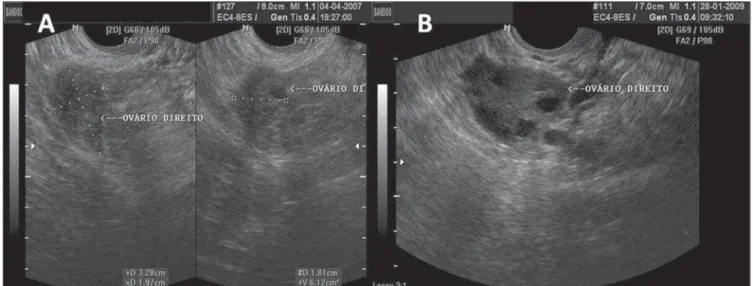
Serous cystadenomas comprise ap-proximately 20% of the benign ovarian masses. They present as complex thin-walled, uni- or multilocular cysts, with variable sizes, sometimes achieving more than 20 cm. The image of its interior shows echogenic contents, possibly also revealing areas of papillary projections (Figure 10)(13,14,16,17).
Mucinous cystadenomas represent up to 25% of all ovarian neoplasias(1). Usually,
ultrasonography reveals echogenic, thin walled multiloculated cystic mass, with echographic content that may vary accord-ing to the presence of variable amounts of
blood or protein in its interior. Such pos-sible differences in density of the cystic content confer various echogenic presen-tations in multiple compartments(14,16). The
presence of variable echogenic contents in a multiloculated adnexal cystic mass is suggestive of mucinous cystadenoma (Fig-ure 11)(14).
Cystadenocarcinomas represent up to 10% of the primary ovarian neoplasias. They are usually multiloculated, with mul-tiple projections and gross septations. The use of Doppler ultrasonography
demon-strates vascularization of the contents (Fig-ure 12). Massive ascites frequently dispro-portional to the demonstrated adnexal masses is a usual finding(1,7,14,16).
Transitional cell tumors, clear cell car-cinoma and undifferentiated carcar-cinoma are less frequently found and difficult to dif-ferentiate at ultrasonography. Generally, they are unilateral(7).
Endometrioid tumors present both as cystic masses with papillary projections and solid masses in some cases. These tu-mors are predominantly malignant
(ap-Figure 8. Endometriomas. A: Endometrioma in left ovary – cystic mass filled by low intensity echoes, with more homogeneous pattern than hemorrhagic cysts and with well delimited walls. B: The same endometrioma, with visualization at color Doppler US, showing absence of vessels in its interior, thus ruling out the presence of a solid mass.
Andrade Neto F et al. Ultrasonography of adnexal masses: imaging findings
proximately 80%), and endometrioid car-cinoma is the second most frequently found malignant epithelial ovarian tumor(7). Clear
cell carcinoma comprises from 5% to 10% of the malignant ovarian epithelial-stromal tumors, and presents with nonspecific sonographic characteristics, as large com-plex, generally cystic masses.
Transitional cell tumors (Brenner tu-mors) represent the minority of the ovarian neoplasias (1.55 to 2.5%) and most of times are benign(7,13). The sonographic pattern of
such tumors is characterized by small and solid hypoechoic masses, and sometimes calcifications are identified(1,7).
Figure 10. Serous cystadenoma. A: TVUS of left ovary demonstrating serous cystadenoma with fine septation. B: TVUS demonstrating a unilocular mass with anechoic content, with well delimited wall, that may achieve a large volume characteristic of serous cystadenoma. The finding of minute papillary projection from the wall of the serous cystadenoma is frequent.
Figure 11. Mucinous cysta-denoma. TVUS of ovary dem-onstrating mucinous cystad-enoma – a multiloculated mass with fine and numer-ous septations, with echo-genic content varying among the several compartments of the mass (arrows), a cluster of small cysts and fine ech-oes resulting from the thick content.
GERM CELL TUMORS
Mature cystic teratomas of the ovary, or ovarian dermoid cysts, are the most com-mon ovarian neoplasms(1,2).They may be
identified in all age groups, however in the childhood and adolescence they are fre-quent causes of ovarian torsion and may be bilateral in up to 10% of cases(2). Typical
sonographic findings are the presence of focal or diffuse high-amplitude echoes, areas with posterior acoustic beam attenu-ation, and visualization of hyperechogenic lines and spots within the mass (Figure 13). In mature cystic teratomas, such heteroge-neous findings translate into the presence of calcified tissues similar to bones and teeth, hair and fat tissue(2,7,14,16,17).
MISCELLANEOUS
Ovarian torsion is a gynecological emer-gency and it is very frequently associated with significant abdominal pain. Mature cystic teratomas and paraovarian cysts are known to be common causes of such tor-sion(1,2). In children, the excessive
mobil-ity of the normal ovary in the pelvis is its main cause(2). At ultrasonography, the more
frequent presentation is the increase in size of the affected ovary, normally by more than 4 cm. However, such increase in size may achieve up to 28 times the normal di-mensions(18). Ovarian stroma may present
with a heterogeneous pattern, with areas of hemorrhage and edema. Complex adnexal or pelvic-abdominal mass with solid or
mixed cystic components, as well as the presence of free pelvic fluid is a frequent finding. Color Doppler may demonstrate the absence of vascularization of the af-fected ovary, however this method is not considered as being a reliable in the evalu-ation of this condition(2,18). The differential
diagnosis is difficult, and can be done with hemorrhagic cyst, endometriosis, ectopic pregnancy or pelvic inflammatory dis-ease(1,7,18).
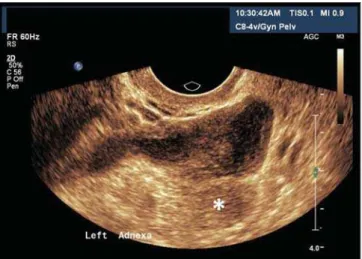
Tubo-ovarian abscess results from lower genital tract infection that ascends and causes salpingitis (Figure 14) and ova-rian inflammation, to the extent of chang-ing the normal morphology of adnexal structures. The sonographic findings de-pend upon the mass presentation after
Andrade Neto F et al. Ultrasonography of adnexal masses: imaging findings
lution of the infectious condition. A purely cystic mass with multiple loci, fine septa-tions, or with debris(7,13,15,16) may be
visu-alized. In the abscess, the ovary may not be separately distinguishable from the adnexal structures, while in the tubo-ovarian com-plex, the ovary is distinguishable from the local inflammatory process(7,13).
At ultrasonography, hydrosalpinges is characterized by the finding of uterine tube dilation, usually in the segments of the am-pulla and infundibulum, showing a tubu-lar and elongated, sometimes serpiginous format, with a clear serous content(7). The
presence of incomplete septations and
small linear projections are predictors of hydrosalpinges. At ultrasonography, the tubular shape of the mass, and the presence of diametrically opposed protrusions along the mass walls are reliable sonographic markers for the diagnosis (Figure 15)(14,15).
CONCLUSION
The correct sonographic identification of adnexal masses is fundamental both for screening of benign conditions and for the early diagnosis and better follow-up of malignant lesions(2,9,11).
The sonographer must, therefore, be
well prepared and aware of the different usual presentations of adnexal masses, in order to be able to interact with the assist-ing physician with the purpose of propos-ing strategies that may best guide the spe-cific therapy for the patient.
Acknowledgments
To the PIBIC/CNPq Program, for fi-nancing the scholarship for scientific ini-tiation.
REFERENCES
1. Dill-Macky MJ, Atri M. Ultra-sonografia ova-riana. In: Callen PW, editor. Ultra-sonografia em obstetrícia e ginecologia. 4ª ed. Rio de Janeiro, RJ: Guanabara Koogan; 2002. p. 803–41. 2. Martins WP, Leite SP, Nastri CO.
Ultrassonogra-fia pélvica em crianças e adolescentes. Radiol Bras. 2009;42:395–401.
3. de Kroon CD, van der Sandt HAGM, van Houwe-lingen JC, et al. Sonographic assessment of non-malignant ovarian cysts: does sonohistology ex-ist? Hum Reprod. 2004;19:2138–43. 4. Murta EFC, Nomelini RS. Early diagnosis and
predictors of malignancy of adnexal masses. Curr Opin Obstet Gynecol. 2006;18:14–9. 5. Yazbek J, Raju SK, Ben-Nagi J, et al. Effect of
quality of gynaecological ultrasonography on management of patients with suspected ovarian cancer: a randomised controlled trial. Lancet Oncol. 2008;9:124–31.
6. Bagheban AA, Zayeri F, Anaraki FB, et al. The reliability and distinguishability of ultrasound di-agnosis of ovarian masses. Indian J Med Sci. 2008;62:217–21.
7. Joshi M, Ganesan K, Minshi HN, et al. Ultrasound of adnexal masses. Semin Ultrasound CT MR. 2008;29:72–97.
Figure 14. Salpingitis. TVUS demonstrating an echogenic image with tubular shape, adjacent to the ovary (asterisk) with heterogeneous content in its interior. The patient reported important pain in the left adn-exal region during the performance of the examination.
8. Valentin L, Ameye L, Testa A, et al. Ultrasound characteristics of different types of adnexal ma-lignancies. Gynecol Oncol. 2006;102:41–8. 9. Fernandes LRA, Lippi UG, Baracat FF. Índice de
risco de malignidade para tumores de ovário in-corporando idade, ultra-sonografia e o CA-125. Rev Bras Ginecol Obstet. 2003;25:345–51. 10. Reis FJC. Rastreamento e diagnóstico das
neo-plasias de ovário – papel dos marcadores tumo-rais. Rev Bras Ginecol Obstet. 2005;27:222–7. 11. Van Calster B, Timmerman D, Bourne T, et al.
Discrimination between benign and malignant
adnexal masses by specialist ultrasound exami-nation versus serum CA-125. J Natl Cancer Inst. 2007;99:1706–14.
12. Kurjak A, Prka M, Arenas JMB, et al. Three-di-mensional ultrasonography and power Doppler in ovarian cancer screening of asymptomatic peri-and postmenopausal women. Croat Med J. 2005; 46:757–64.
13. Brown DL. A practical approach to the ultrasound characterization of adnexal masses. Ultrasound Q. 2007;23:87–105.
14. Joshi M, Ganesan K, Munshi HN, et al.
Sonog-raphy of adnexal masses. Ultrasound Clin. 2008; 3:369–89.
15. Kocakoc E, Bhatt S, Dogra VS. Endometriosis. Ultrasound Clin. 2008;3:399–414.
16. Patel MD. Practical approach to the adnexal mass. Radiol Clin North Am. 2006;44:879–99. 17. Jeong YY, Outwater EK, Kang HK. Imaging
evaluation of ovarian masses. Radiographics. 2000;20:1445–70.