ABSTRACT
http://dx.doi.org/10.1590/1678-775720130523
Rat subcutaneous tissue response to calcium
silicate containing different arsenic concentrations
Paloma Gagliardi MINOTTI, Ronald ORDINOLA-ZAPATA, Raquel Zanin MIDENA, Marina Angélica MARCIANO, Bruno Cavalini CAVENAGO, Clovis Monteiro BRAMANTE, Roberto Brandão GARCIA, Marco Antonio Hungaro DUARTE, Ivaldo Gomes de MORAES
Department of Operative Dentistry, Endodontics and Dental Materials, Bauru School of Dentistry, University of São Paulo, Bauru, SP, Brazil.
Corresponding address: Paloma Gagliardi Minotti - Al. Octávio Pinheiro Brisolla, 9-75 - Bauru - SP - Brazil - 17012-901 - Phone/Fax: +55 (14) 32358344 - e-mail: [email protected]
Submitted: September 10, 2013 - Modiication: May 5, 2014 - Accepted: May 12, 2014
O
bjective: To evaluate the response of rat subcutaneous tissue in implanted polyethylene tubes that were illed with GMTA Angelus and Portland cements containing different arsenic concentrations. Material and Methods: Atomic absorption spectrophotometry was utilized to obtain the values of the arsenic concentration in the materials. Thirty-six rats were divided into 3 groups of 12 animals for each experimental period. Each animal received two implants of polyethylene tubes illed with different test cements and the lateral of the tubes was used as a control group. After 15, 30 and 60 days of implantation, the animals were killed and the specimens were prepared for descriptive and morphometric analysis considering: inlammatory cells, collagen ibers, ibroblasts, blood vessels and other components. The results were analyzed utilizing the Kuskal-Wallis test and the Dunn´s Multiple test for comparison (p<0.05). Results: The materials showed, according to atomic absorption spectrophotometry, the following doses of arsenic: GMTA Angelus: 5.01 mg/kg, WPC Irajazinho: 0.69 mg/kg, GPC Minetti: 18.46 mg/kg and GPC Votoran: 10.76 mg/kg. In a 60-day periods, all specimens displayed a neoformation of connective tissue with a structure of ibrocellular aspect (capsule). Control groups and MTA Angelus produced the lower amount of inlammatory reaction and GPC Minetti, the highest reaction. Conclusions: There was no direct relationship between the concentration of arsenic present in the composition of the materials and the intensity of the inlammatory reactions. Higher values, as 18.46 mg/kg of arsenic in the cement, produce characteristics of severe inlammation reaction at the 60-day period. The best results were found in MTA angelus.Keywords: Arsenic. Endodontics. Dental materials. Subcutaneous tissue reaction. Portland
cement.
INTRODUCTION
MTA is a mixture of hydrophilic powder consisting of tricalcium silicate, tricalcium oxide, silicate oxide and tricalcium aluminate2,21. Several in vivo and in
vitro studies demonstrated the beneicial properties
of MTA, such as biocompatibility20, promoting
dental pulp and periradicular tissue regeneration1,
excellent sealing ability23,24 and antimicrobial
effects8,22. Due to these properties, MTA has been
recommended for several clinical applications. Portland cement (PC) is the main component of MTA25 and has been studied since 1999. Studies
revealed similar chemical composition8,12,14, action
mechanism10,11 and cytotoxicity17,19 for both
materials. The only difference between them is the absence of bismuth oxide in PC, used as
radiopaciier in MTA. It has been reported that
Portland cement may contain some heavy metals in its composition, such as arsenic (As)3,4,7,15,18. The
concentration of this metal varies according to the origin of the raw material used for the production of the Portland cement4.
As is a metalloid found in water, air and soil, in organic and inorganic forms and in different stages of oxidation. The trivalent and pentavalent stages are the most toxic11. The soluble As salts
the extent of absorption depends on the solubility of the compound. From the bloodstream, it is deposited into tissues, liver, kidneys and lungs11.
The chronic exposure to inorganic As is associated to the deleterious effects to human health, such as hyperkeratosis, hyperpigmentation, cardiovascular diseases, central nervous system and peripheral vascular disorders, skin cancer and gangrene in the limbs16.
Due to its high toxicity, As may cause generalized tissue necrosis in the oral cavity when used for endodontic purposes9,26. A study by Duarte, et al.7
(2005) evaluated the release of As in two gray
PCs, one white PC, MTA Angelus and MTA ProRoot and found similar As levels between the materials, much below the limit established by the ISO
9917-1 speciications13, which state that a material may
only be used in dental procedures when it does not contain more than 2 mg of As per kg of material.
Regarding the concerns of the arsenic content in PC and MTA, a previous study3 observed the
presence of As in several materials, including white and gray MTA Angelus, white and gray PC, MTA ProRoot, PCM, MTA-Obtura and an experimental MTA. Only MTA-Obtura, white MTA Angelus and white PC (Irajazinho, Cimento Rio Branco, Rio de Janeiro, RJ, Brazil) presented levels below the limits recommended by ISO3.
Despite the variable presence of arsenic in these materials, no studies in the literature have compared the biocompatibility of Portland cement and MTA according to the arsenic concentrations. The aim of this study was to microscopically evaluate the tissue response in the subcutaneous tissue of rats to the implantation of polyethylene tubes containing MTA and Portland cements with different arsenic concentrations.
MATERIAL AND METHODS
Animals and sample grouping
The present study was approved and performed according to the guidelines of the Research and Ethics Committee of the Bauru School of Dentistry, University of São Paulo, Bauru, SP, Brazil (Process no. 024/2009). A total of 36 male animals (Rattus norvegicus albinus Wistar), approximately 2 to 3
months old and weighing around 200±50 grams, were used for this experiment. The animals received appropriate granular food and water ad libitum.
The thirty-six rats were divided into 3 groups of 12 animals per experimental period of 15, 30 and
60 days and each animal received two-polyethylene tubes containing different cements. The following materials were investigated: group 1: Gray MTA Angelus (MTA - Angelus, Angelus Indústria de Produtos Odontológicos S/A, Londrina, PR, Brazil); group 2: White Portland cement Irajazinho
(Irajazinho, Cimento Rio Branco, Rio de Janeiro, RJ, Brazil); group 3: Gray Portland cement Minetti (Minetti, Juan Minetti S/A, Cordoba, Cordoba, Argentine) and group 4: Gray Portland cement Votoran (Votoran, Votorantim Cimentos, Cubatão, SP, Brazil).
The cements were analyzed by the Hidrocepe - Quality Services Ltda. (Belo Horizonte-MG)
laboratory, which quantiied the levels of arsenic
according to a previous related methodology3.
Sample preparation
The test materials were placed in sterile polyethylene tubes with 1.5 mm inner diameter and 10 mm length. GMTA Angelus (MTA - Angelus, Angelus Indústria de Produtos Odontológicos S/A, Londrina, PR, Brazil) was mixed according to the manufacturer’s instructions. The powder/liquid ratio used for the Portland cements was 1 g/0.35
mL distilled water. The sterilized tubes were illed
with the test materials with the aid of endodontic condensers.
Surgical procedures
The animals were anesthetized with 0.008
mL/100 g of ketamine (Dopalen® - Vetbrands,
CEVA, Pauĺnia, SP, Brazil) and 0.004 mL/100 g of
xylazine hydrochloride 2% (Calmium® - Agener
União, União Qúmica, Embu-Guaçu, SP, Brazil). A dorsal shaving was performed, and the area was disinfected with an iodine solution (Riodene, Rioqúmica Indústria Farmacêutica, São José do Rio Preto, SP, Brazil). The backs of the animals were incised over a length of 2 cm, using a no. 15 blade (Embramac, Embramac - Empresa Brasileira de Materiais Cirúrgicos, Campinas, SP, Brazil) in a head-to-tail alignment orientation. A blunt dissecting instrument was used to create a 18 mm deep pocket in the subcutaneous tissue to receive
the implants. Polyethylene tubes illed with the
materials were then introduced into spaces created by a blunt dissection; one in each side, parallel to the incisions, and the skin was closed with 4.0 silk suture. The distance between the tubes was 16 mm to avoid interaction between the materials. Each animal received 2 implants of the different materials. Immediately after implantation, the animals were observed until they recovered their physical activities with no feeding restrictions. The animals were seen every day for a maximum period of 60 days.
Histological procedures
15 Days 30 Days 60 Days
MTA 2.0b(0-15)A 2.0a (0-10)B 1.0a(0-6)C
WPC 2.0b(0-16)A 1.0b (0-7)B 2.0b(0-10)A
GPC MINETTI 4.0d(0-21)A 2.0d(0-15)B 4.0d(0-18)A
GPC VOTORAN 6.0c(0-28)A 5.0c(0-20)A 3.0c(0-10)B
CONTROL 0a(0-4.39)A 0e(0-1)A 0e(0-0)B
Table 1- Numerical density of inlammatory cells in the capsule adjacent to the empty tubes (control group) and to the tubes
illed with cements
Same letters represent absence of statistical signiicance. Uppercase letters represent period. Lowercase letters represent
material
margin of 1 cm. The specimens were kept in 10% formaldehyde solution (Merck & Co, Darmstadt, Germany) for 2 weeks, until they were histologically processed.
The polyethylene tubes were removed from the
specimens, which were then set in prepared parafin
blocks. Sections 5 µm thick were cut by a microtome and stained with hematoxylin and eosin and three sections from each specimen were selected.
Morphometric analysis
For histological analysis, 6 histological sections
per animal of each cement were included. Each
section was analyzed in ten microscopic ields from the region of interest. In total, 60 microscopic ields
were evaluated per animal.
The volume density (Vvi) or the fraction of ibrous capsule volume occupied by the ibroblasts, collagen
fibers, blood vessels, inflammatory infiltrate
(including acute and chronic inlammatory cells)
and other structures (spaces occupied by interstitial liquid) was determined by the point volumetric method, using an optical microscope (Aristoplan, Leitz Wetzlar, Germany) with a 100× objective and 8× Zeiss Kpl eyepiece containing a Zeiss II integration grid with 100 points symmetrically distributed over a quadrangular area. For this
purpose, the number of points coinciding with
each structure (Pi) and the total points analyzed (P) were determined to calculate the percentage of the studied structures and cells.
Statistical analysis
The data were analyzed using the Kruskal-Wallis
test and when statistically signiicant differences
were present among the groups, the Dunn’s Multiple Comparison test was utilized. A p value of less
than 0.05 was considered statistically signiicant.
Statistical analyses were performed utilizing the SigmaPlot 12 analysis.
RESULTS
The amount of arsenic (mg/kg) obtained from each material was: GPC Minetti: 18.46 mg/kg; GPC Votoran: 10.73 mg/kg; GMTA Angelus: 5.91 mg/ kg and WPC Irajazinho: 0.69 mg/kg.
Microscopic analysis
The analysis of each material includes 360 microscopic areas (60 microscopic fields in 6 animals). At the 15-, 30- and 60-day periods, all specimens displayed a neoformation of connective tissue with a structure of fibrocellular aspect (capsule)
.
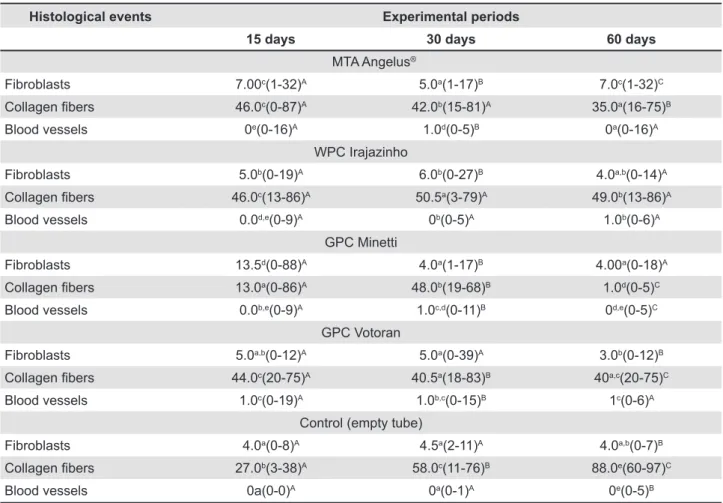
Summarized morphometric data of thevolume density of collagen ibers, ibroblasts, blood vessels and inlammatory cells are presented in
Table 1 and Table 2.
Overall, the lower amount of inflammatory
cells was found at the 60-day period, signiicant
differences were found among the materials (p>0.05). The control group showed the lower
values of inlammatory cells, followed by MTA
Angelus, WPC Irajazinho, Votoran cement and Minetti cement, which showed the higher values of
inlammatory cells. Other statistical signiicances
can be found in Table 1.
At 60 days, the experimental groups MTA Angelus, WPC Irajazinho and GPC Votoran showed similar vascular neoformation (Table 2) with exception of GPC Minetti and control group.
Regarding the presence of collagen ibers there was
an increment of this parameter at the 60-day period
in the control group. The number of ibroblasts
was constant. The GPC Minetti showed the lower
values of collagen ibers in comparison to the other
groups. MTA Angelus cement, WPC Irajazinho and GPC Votoran showed similar result. In addition, GPC
Minetti showed the higher values of ibroblasts at
the initial periods.
Morphologic analysis
MTA Angelus
At 15 days, a thick capsule was juxtaposed to
Several inlammatory cells were seen mainly in
the inner portion of the capsule. After 15 days, multinucleated giant cells were found adjacent to MTA (Figure 1). At 30 days, more organized
capsules were found with collagen ibers containing several ibroblasts. Collagen ibers were thicker
and blood vessels less numerous and there was
fewer empty spaces. A signiicant reduction of the inlammatory process was veriied after 30 and
60 days in comparison to 15 days (Table 1). The
inlammatory process contained mainly plasma
cells and macrophages, which were mainly situated around the blood vessels. Usually, a connective
tissue exhibiting well-deined bundles of collagen ibers was present at 60 days. Few interstitial spaces and several elongated ibroblasts were also
found at this period (Figure 2).
WPC Irajazinho
At 15 days, a thick ibrous capsule was observed
around the implanted material, besides disorganized
collagen iber network with several formed vessels and ibroblasts (Figure 1 and Table 2). After 15 days of implantation, several inlammatory cells
were present in the capsule and macrophages were often observed in close juxtaposition to the material (Figure 1). At 30 days, lymphocytes, macrophages and multinucleated giant cells were present throughout the capsule. At 60 days, the thickness
of the ibrous capsule decreased and presented few inlammatory cells (Figure 2 and Table 1). Organized collagen ibers and several elongated ibroblasts with an arrangement rather parallel to
cement surface constituted the capsule. At 30 days,
a reduction in the number of inlammatory cells was veriied when compared to 15 days; however, an increase in the amount of inlammatory cells was
found at 60 days (Table 1).
GPC groups (Minetti and Votoran)
At 15 days, the capsule was thick with collagen
ibers arranged around the cement. A disorganized collagen iber network with several newly formed vessels and a large number of ibroblasts (Table 2)
was present, showing high synthetic activity. A high
numerical density of inlammatory cells was veriied
in the capsule surrounding the implants containing GPC (Table 1). Several mononuclear macrophages
Histological events Experimental periods
15 days 30 days 60 days
MTA Angelus®
Fibroblasts 7.00c(1-32)A 5.0a(1-17)B 7.0c(1-32)C
Collagen ibers 46.0c(0-87)A 42.0b(15-81)A 35.0a(16-75)B
Blood vessels 0e(0-16)A 1.0d(0-5)B 0a(0-16)A
WPC Irajazinho
Fibroblasts 5.0b(0-19)A 6.0b(0-27)B 4.0a,b(0-14)A
Collagen ibers 46.0c(13-86)A 50.5a(3-79)A 49.0b(13-86)A
Blood vessels 0.0d,e(0-9)A 0b(0-5)A 1.0b(0-6)A
GPC Minetti
Fibroblasts 13.5d(0-88)A 4.0a(1-17)B 4.00a(0-18)A
Collagen ibers 13.0a(0-86)A 48.0b(19-68)B 1.0d(0-5)C
Blood vessels 0.0b,e(0-9)A 1.0c,d(0-11)B 0d,e(0-5)C
GPC Votoran
Fibroblasts 5.0a,b(0-12)A 5.0a(0-39)A 3.0b(0-12)B
Collagen ibers 44.0c(20-75)A 40.5a(18-83)B 40a,c(20-75)C
Blood vessels 1.0c(0-19)A 1.0b,c(0-15)B 1c(0-6)A
Control (empty tube)
Fibroblasts 4.0a(0-8)A 4.5a(2-11)A 4.0a,b(0-7)B
Collagen ibers 27.0b(3-38)A 58.0c(11-76)B 88.0e(60-97)C
Blood vessels 0a(0-0)A 0a(0-1)A 0e(0-5)B
Table 2- Mean of density volume (%) and standard deviation of histological events shown in connective tissue (capsule) adjacent to the implanted materials and empty tube (control group)
Same letters represent absence of statistical signiicance. Uppercase letters represent period. Lowercase letters represent
Figure 1- Histological images of inlammatory cells iniltration at the end of implanted tubes at the end of the 15-day period.
(A) GMTA. (B) WPC. (C) GPC Minetti. (D) GPC Votoran. (E) Control group. Presence of collagen ibers arranged to the cement (asterisks), ibroblasts (black arrows), blood vessels (blue arrows) and macrophages/multinucleated giant cells (yellow arrows). Hematoxylin and eosin staining, bars represent 50 µm
and multinucleated giant cells in close juxtaposition to the implanted cement surface were seen in the
capsule (Figure 1). Moreover, the inlammatory
process contained mainly lymphocytes. At 60 days,
the number of inlammatory cells was signiicantly
lower in comparison to 15 days in the Votoran cement (Table 1). The Minetti cement showed an
improvement of the inlammatory reaction at the 30 days period but an increase in the inlammatory
reaction was observed at the 60 days period (p>0.05). Besides the reduction in the inlammatory
reaction in the Votoran cement, several ibroblasts and collagen ibers were present in the capsule.
At 60 days, the capsule was formed by a dense connective tissue containing evident bundles of
collagen ibers (Figure 2).
Control group (empty tube)
At 15 days, the capsule adjacent to the empty tubes implanted in the subcutaneous tissue exhibited
a mild inlammatory process; evident ibroblasts and
blood vessels were present (Table 2). The adjacent area of tube surface presented some macrophages
and no other type of inlammatory cells (Table 1)
was observed (Figure 1). At 30 days the capsule was formed by a typical dense connective tissue, in
addition to a signiicant reduction in the number of inlammatory cells (Table 1). At 60 days, the ibrous
capsule was well organized with denser collagen
ibers, few interstitial spaces, several elongated ibroblasts and absence of inlammatory process
(Table 1 and Figure 2).
DISCUSSION
Endodontic materials are frequently placed in close contact with the periodontium, such as pulp capping, apical barrier, perforation repair, root-end
illing material, and orthograde illing material. Thus
the materials require the necessary preliminary test, because the toxic components present in these materials could produce irritation or even degeneration of the surrounding tissues.
Implantation of endodontic materials into the subcutaneous connective tissue in rats is considered a valid secondary screening test for biocompatibility27. The implantation of materials in
Figure 2- Histological images of inlammatory cells iniltration at the end of implanted tubes at the end of the 60-day period.
(A) GMTA. (B) WPC. (C) GPC Minetti. (D) GPC Votoran. (E) Control group. Presence of collagen ibers arranged to the cement (asterisks), ibroblasts (black arrows), blood vessels (blue arrows) and macrophages/multinucleated giant cells (yellow arrows). Hematoxylin and eosin staining, bars represent 50 µm
tubes help ix the material at the site to maintain
proper contact between the material and tissues. In this study, the lateral walls of the polyethylene tubes were used as the control group because the material by itself has been proven to be biocompatible27, a
inding that was conirmed in the current study.
The presence of arsenic in the Portland cement and the MTA is a problem with regards to biocompatibility14. Although a signiicant amount
of arsenic is present in the different types of these materials3,4, its release is usually small6,7,15. The
ISO 9917-1 standard13 speciies the limit of 2 mg/
kg for the total arsenic content in the materials and not for the release. Studies have shown that the levels of arsenic released by MTA Angelus and Portland cement are below what is considered toxic to human health7.
The materials analyzed in this study showed, according to atomic absorption spectrophotometry, the following doses of arsenic: GPC Minetti 18.46 mg/kg, GPC Votoran 10.76 mg/kg, GMTA Angelus 5.01 mg/kg and WPC Irajazinho 0.69 mg/kg. Overall, all materials in the three experimental periods
showed a greater inlammatory response than the
control group. The gray Portland cements Minetti and Votoran showed the highest concentration of arsenic in the atomic absorption spectrophotometry (18.46 mg/kg and 10.73 mg/kg, respectively) and were the materials that showed a more pronounced inflammatory response, specially GPC Minetti. However, the little amount of arsenic present in
WPC Irajazinho did not necessarily represent a
lower inlammatory reaction.
An interesting inding was observed in the GMTA
Angelus group: even with a higher concentration of arsenic (5.91 mg/kg) according to the ISO standard, it showed statistically lower values of inflammatory response in comparison to WPC
Irajazinho (0.69 mg/kg) in the initial and inal periods. The lower inlammatory reaction in GMTA
Angelus, compared to the other Portland cements may be related to the presence of some impurities and other heavy metals within these non-dental cements4,6,15,18 . This depends on where the mineral
was extracted4, which may affect the proportion of
heavy metals in the composition of the cement. Heavy metals are incorporated from the substitution of primary fuels to reduce costs with alternate fuels, which are usually wastes, and also by the utilization of wastes, an alternative inorganic raw material along with limestone and shale19. In
addition to the arsenic content, Portland cement has been reported to contain more heavy metals, such as manganese and strontium, than MTA, and
may induce rejection, inlammation, or allergic
reactions5,18. Another study19 showed that variable
amounts of chromium, nickel, and cobalt were contained in some commercial Portland cements4.
for an individual weighing 70 kg would be 140 to 210 mg, whereas this amount is considerably higher than the arsenic content present in the Portland
cement used for a root end illing. Despite the fact
that the cement with the lower amount of arsenic according to the ISO standard (WPC Irajazinho) has
not produced lower values of inlammatory cells,
cements with higher amounts of arsenic, as 18
mg/kg, are able to produce a severe inlammatory
reaction that showed a statistically lower amount
of ibers and higher amount of inlammatory cells.
CONCLUSIONS
There was no direct relationship between the concentration of arsenic present in the composition of the materials and the intensity of the
inlammatory reaction. Higher values as 18.46 mg/
kg of arsenic in the cement produce characteristics
of severe inlammatory reaction at the 60-day
period. The best results were found in MTA Angelus.
ACKNOWLEDGEMENTS
The authors deny any conflicts of interest related to this study. The authors thank the
Nacional Council for Scientiic and Technological
Development (CNPq) [Process no. 134982/2009-6]
for the inancial support.
REFERENCES
1- Abdullah D, Pitt Ford TR, Papaioannou S, Nicholson J, McDonald F. An evaluation of accelerated Portland cement as a restorative material. Biomaterials. 2002;23:4001-10.
2- Asgary S, Parirokh M, Eghbal MJ, Brink F. Chemical differences between white and gray mineral trioxide aggregate. J Endod. 2005;31:101-3.
3- Bramante CM, Demarchi AC, Moraes IG, Bernardineli N, Garcia RB, Spångberg LS, et al. Presence of arsenic in different types of MTA and white and gray Portland cement. Oral Surg Oral Med Oral Pathol Oral Radiol Endod. 2008;106:909-13.
4- Chang SW, Shon WJ, Lee W, Kum KY, Baek SH, Bae KS. Analysis of heavy metal contents in gray and white MTA and 2 kinds of Portland cement: a preliminary study. Oral Surg Oral Med Oral Pathol Oral Radiol Endod. 2010;109:642-6.
5- Dammaschke T, Gerth HU, Züchner H, Schäfer E. Chemical and physical surface and bulk material characterization of white ProRoot MTA and two Portland cements. Dent Mater. 2005;21:731-8
6- De-Deus G, Souza MC, Sergio Fidel RA, Fidel SR, Campos RC, Luna AS. Negligible expression of arsenic in some commercially available brands of Portland cement and mineral trioxide aggregate. J Endod. 2009;35:887-90.
7- Duarte MA, Oliveira Demarchi AC, Yamashita JC, Kuga MC, Campos Fraga S. Arsenic release provided by MTA and Portland cement. Oral Surg Oral Med Oral Pathol Oral Radiol Endod. 2005;99:648-50.
8- Estrela C, Bammann LL, Estrela CR, Silva RS, Pécora JD. Antimicrobial and chemical study of MTA, Portland cement, calcium hydroxide paste, Sealapex and Dycal. Braz Dent J. 2000;11:3-9. 9- Garip H, Salih IM, Sener BC, Göker K, Garip Y. Management of arsenic trioxide necrosis in the maxilla. J Endod. 2004;30:732-6. 10- Holland R, Souza V, Nery MJ, Faraco Júnior IM, Bernabé PF, Otoboni Filho JA, et al. Reaction of rat connective tissue to implanted dentin tube illed with mineral trioxide aggregate, Portland cement or calcium hydroxide. Braz Dent J. 2001;12:3-8. 11- Hughes MF. Arsenic toxicity and potential mechanisms of action. Toxicol Lett. 2002;133:1-16.
12- Hwang YC, Lee SH, Hwang IN, Kang IC, Kim MS, Kim SH, et al. Chemical composition, radiopacity, and biocompatibility of Portland cement with bismuth oxide. Oral Surg Oral Med Oral Pathol Oral Radiol Endod. 2009;107:e96-102.
13- International Standardization Organization. ISO 9917-1: Dentistry – Waterbased cements - Part 1: Powder/liquid acid-base cements. Geneva: ISO; 2003. 22 p.
14- Islam I, Chng HK, Yap AU. Comparison of the physical and mechanical properties of MTA and Portland cement. J Endod. 2006;32:193-7.
15- Matsunaga T, Tsujimoto M, Kawashima T, Tsujimoto Y, Fujiwara M, Ookubo A, et al. Analysis of arsenic in gray and white mineral trioxide aggregates by using atomic absorption spectrometry. J Endod. 2010;36:1988-90.
16- Rossman TG. Mechanism of arsenic carcinogenesis: an integrated approach. Mutat Res. 2003;533:37-65.
17- Saidon J, He J, Zhu Q, Safavi K, Spångberg LS. Cell and tissue reactions to mineral trioxide aggregate and Portland cement. Oral Surg Oral Med Oral Pathol Oral Radiol Endod. 2003;95:483-9. 18- Schembri M, Peplow G, Camilleri J. Analyses of heavy metals in mineral trioxide aggregate and Portland cement. J Endod. 2010;36:1210-5.
19- Tanomaru-Filho M, Tanomaru JM, Barros DB, Watanabe E, Ito IY. In vitro antimicrobial activity of endodontic sealers, MTA-based cements and Portland cement. J Oral Sci. 2007;49:41-5. 20- Torabinejad M, Ford TR, Abedi HR, Kariyawasam SP, Tang HM. Tissue reaction to implanted root-end illing materials in the tibia and mandible of guinea pigs. J Endod. 1998;24:468-71. 21- Torabinejad M, Hong CU, McDonald F, Pitt Ford TR. Physical and chemical properties of a new root-end illing material. J Endod. 1995;21:349-53.
22- Torabinejad M, Hong CU, Pitt Ford TR, Kettering JD. Antibacterial effects of some root end illing materials. J Endod. 1995;21:403-6.
23- Torabinejad M, Smith PW, Kettering JD, Pitt Ford TR. Comparative investigation of marginal adaptation of mineral trioxide aggregate and other commonly used root-end illing materials. J Endod. 1995;21:295-9.
24- Torabinejad M, Watson TF, Pitt Ford TR. Sealing ability of a mineral trioxide aggregate when used as a root end illing material. J Endod. 1993;19:591-5.