Composing with Soundscapes
Capturing and Analysing Urban Audio for a Raw Musical Interpretation
Thesis submitted to the Portuguese Catholic University for the Doctoral Degree in Science and Technologies of the Arts - Computer Music
by
José Alberto Gomes
SCHOOL OF THE ARTS April 2015
Composing with Soundscapes
Capturing and Analysing Urban Audio for a Raw Musical Interpretation
Thesis submitted to the Portuguese Catholic University for the Doctoral Degree in Science and Technologies of the Arts - Computer Music
By José Alberto Sousa Gomes
Dissertation supervised by Prof. Doutor Álvaro Mendes Barbosa and co-supervised by Doutor Rui Luís Nogueira Penha.
SCHOOL OF THE ARTS April 2015
The sound environment is increasingly more relevant in contemporary culture. It is a ‘picture’ of a place, an X-ray of its character and activities, shapeless and amorphous, whilst full of meanings and subtleties. It is a transmission that is complementary to what a picture retains and transports. Therefore it is a unique, tangible impression of the place to which it belongs, and intrinsically, its history, and that of the people who inhabit it, and their relations. Murray Schafer termed this element as Soundscape. Although always a present element, it was only from the end of the Twentieth Century that it has been studied in a systematic way, initially in a more ecological and socio-cultural function approach, but slowly it has been seen as an artistic tool, both in direct use of the sounds as well as being an inspiration, and a starting point, for creation. The exploratory research project presented here aims to study the capture and analysis of the urban soundscape, with a special focus on its temporal evolution, and its application in the creative and artistic context. At the first stage, we try to understand how and, if possible, to capture and represent the most challenging part of this massive sound element, which is its constant changing on the time axis. Grasping its nuances on both small and large time scales. The second phase is to understand the pertinence of such information and its direct influence in the act of music and sonic creation. To achieve these goals a multidisciplinary approach based on two main pillars was necessary: Soundscape and Computer Music. These disciplines determine the scientific areas in which this research had to be focused. Due to the fact that this thesis has a relatively broad scope of interests, there is a survey of the state of the art relating to projects and approaches that relate to the interests of this investigation in different ways. In areas such as: Music Information
Retrieval, Algorithmic Composition, Eco Composition, and Sound Maps. This survey confirms the
contemporaneity, relevance and originality of the project, both scientifically and artistically.
In order to evaluate the proposed approach to the soundscape, URB, an experimental system to capture, analyse and store the urban soundscape was developed and implemented. The system is based on current technology, but is affordable and robust. To ensure the sustainability of the project, development was based in open source technology, to ensure the possibility of the project expanding and shaping according to the interests and needs of specific places, populations, research centres and/ or artistic interests. Three main goals have guided the development of this system: addressing the lack of temporal perspective of the sound representation of urban spaces; the design of a free and autonomous system that depends only on the users, which results in a public free access database; to facilitate and systematize the access to data on the sound characteristics of an urban soundscape for both ecological studies as well as for creative and artistic purposes. A server keeps a record of the collected data, which can either be read directly, through an application developed for this purpose, or through a visual interface with a time-line approach, but always allowing for the possibility of creating original access tools that best serve the user’s purposes. After implementing the system, through four listening points, and confirming its robustness, we advance to the system’s application in the development of artistic works. For this purpose a challenge was proposed to a number of artists with distinct aesthetic backgrounds and training. This challenge resulted in different works that were presented to the public in different formats and media, such as works for classical instrumental, electro-acoustic works, improvisational moments with real-time sonification of the soundscape, sonic installations and sculptures powered by the system presented. This practice leads to a fundamental
reflection in this research. We describe the different approaches chosen by each creator and primarily assess the pertinence in the artistic result of using a continuous and discrete system of urban soundscape analysis, from a creator’s point of view as well as from a listener’s point of view.
With this research we are able to present a functional approach to the lack of temporal perspective in the usual sound maps that focus on the geographic origin of the recordings. We conclude that soundscapes can provide useful data for artistic creation and we promote a direct connection between that kind of approach and the artists. Even before the works developed and the artist’s feedback, whilst not ignoring the different approaches and opinions, we can conclude that this approach seems to promote new and functional soundscape composition ideas, making URB a relevant resource to compose original soundscape based music. Also, through analysis of the pieces, we could point out patterns of the technical and artistic choices on how to deal with information from the soundscape data, both in deferred time and real-time.
A paisagem sonora é cada vez mais relevante na cultura contemporânea. É uma ‘fotografia’ de um lugar. Uma radiografia ao seu carácter e atividades, simultaneamente disforme e amorfa como repleta de significados e subtilezas. Uma transmissão complementar ao que a imagem retém e transporta. É portanto uma impressão única , tangível do lugar a que pertence e, intrinsecamente , da sua história , das pessoas que o habitam, das suas relações. Murray Schafer batizou este elemento como Sounds-cape (Paisagem Sonora). E embora tenha sido sempre um elemento presente, só a partir do final do séc. XX é que tem vindo a ser estudado de uma forma sistematizada, inicialmente numa abordagem mais ecológica e das suas funções socioculturais, mas lentamente encarado como uma ferramenta artística tanto no uso direto dos sons, como sendo o ponto de partida de inspiração para a criação. O projeto de investigação de carácter exploratório que aqui apresentamos visa o estudo da recolha e análise da paisagem sonora urbana, com especial enfoque na sua evolução temporal e da sua aplica-ção no contexto criativo artística. Como tal, numa fase inicial, procurar entender como e, se possível, capturar e representar o elemento mais desafiante que é a permanente mutação sonora no eixo tem-poral, apreendendo as suas nuances tanto numa escala de tempo diminuta como em grandes escalas temporais. Numa segunda fase entender a pertinência desta informação e da sua influência direta no ato da criação musical e sonora. Para cumprir estes objectivos foi necessária uma abordagem multi-disciplinar fundamentada em dois pilares principais: Paisagem-Sonora e Informática Musical. Estas disciplinas determinam as áreas científicas em que esta investigação se debruçou. Tendo esta tese um âmbito de interesses relativamente amplo, há um levantamento do estado da arte referente a projetos e abordagens de áreas distintas que ,de diferentes formas , se relaciona com os interesses da nossa investigação. Em áreas como: Musical Information Retrieval, Composição Algorítmica, Eco Composição, Mapas Sonoros. Este levantamento confirma a atualidade, a pertinência e a originalidade do projeto, tanto cientificamente como artisticamente.
A fim de avaliar a abordagem proposta à paisagem sonora, foi desenvolvido e posto em prática um sis-tema experimental de captura, análise e armazenamento de ambiente sonoro urbano, de nome URB. Sistema esse baseado em tecnologia atual, mas acessível e robusta para garantir a sustentabilidade do projeto e apoiado em desenvolvimento código aberto para garantir a possibilidade do projeto se ex-pandir e se moldar de acordo com os interesses e necessidades concretas de locais, populações, centros de investigação e interesses artísticos. Três objetivos principais guiaram o desenvolvimento deste sis-tema: colmatar a falta de perspectiva temporal em grande escala de uma representação sonora de um espaço urbano; o desenho de um sistema que livre e autónomo, que apenas dependa dos utilizadores, que resulte numa base de dados de acesso público e gratuito; facilitar e sistematizar o acesso à infor-mação sobre as caraterísticas sonoras de um ambiente sonoro urbano tanto para estudos ecológicos como para função criativa e artística. É mantido num servidor o registo de toda a informação recolhi-da, que tanto pode ser consultado diretamente, através de uma aplicação desenvolvida para o efeito, através de um interface visual ao estilo de linha temporal, deixando sempre a possibilidade para a cria-ção de ferramentas de acesso originais que sirvam melhor os propósitos do utilizador. Após a imple-mentação do sistema, através de quatro pontos de escuta, e a confirmação da sua robustez, avançamos para a aplicação do sistema no desenvolvimento de obras artísticas. Para tal, foi lançado um desafio a um conjunto de artistas que partem de diferentes formações e identidades estéticos. Esse desafio
resultou em diferentes obras que foram apresentadas ao público com diferentes formatos e suportes, como obras integralmente para formatos instrumentais clássicos, obras electroacústicas, momentos de improvisação em tempo real com a sonorização do ambiente sonoro, instalações e esculturas sonoras alimentadas pelo sistema apresentado. Desta prática resulta uma reflexão fundamental nesta investi-gação. Descrevemos as diferentes abordagens escolhidas por cada criador e acima de tudo avaliamos a pertinência no resultado artístico do uso de um sistema contínuo e discreto de análise de ambiente sonoro urbano, tanto do ponto de vista do criador como do ponto de vista do ouvinte.
A partir desta investigação, apresentamos uma abordagem funcional para a falta de perspectiva tempo-ral nos mapas sonoros clássico que incidem principalmente sobre as origens geográfica das gravações. Concluímos que as paisagens sonoras podem fornecer dados úteis para a criação artística e promove-mos uma conexão direta entre essa abordagem e os artistas. Perante os trabalhos e análises desenvol-vidos por diferentes criadores, concluímos que esta aproximação promove ideias novas e funcionais para a composição. Além disso, através da análise de peças, apontamos padrões nas escolhas técnicas e estéticas sobre como lidar com as informações a partir dos dados da paisagem sonora, tanto em tempo diferido como em tempo real.
To my supervisor, Doctor Álvaro Barbosa, for all confidence, support and freedom that he gave me to pursue my goals and for the insightful contribution to my own thinking in this area. To Doctor Rui Penha, my co-adviser, for his incredible availability and thoroughness, and for being a guidance both in scientific and artistic fields. Their kindness in helping, guiding and clarifying me through this adventure is deeply appreciated.
To the other PhD students enrolled in the Doctoral Program of Science and Technology of The Arts in particular, André Baltazar, André Perrotta, Joana Gomes, Samuel Van Ransbeeck, Vasco Carvalho, and Mailis Rodrigues for their help, feedback and ideas.
Special thanks to Diogo Tudela for setting up the MySQL database and his precious help with UNIX, Pitton and Java Script, and João Cordeiro, for being more then a colleague, a friend and a beacon, with ideas, guidance and encouragement, and latter for his hospitality during my time at São Joseph University – Macau.
A very special thank you for Filipe Lopes, Rui Dias, Gustavo Costa, Nuno Peixoto de Pinho, Diogo Tudela, Eduardo Magalhães, Luís Fernandes and Miguel Pedro for their participation with their art. Their altruistic participation and belief in my ideas were fundamental to the conclusions of this thesis. It was a pleasure and an honor.
Thank you to Sonoscopia Associação Cultural and Digitópia to embrace the artistic part of this project, and André Covas for letting me use his home to install the first URB-box.
To my long-term employer, Educational Department of Casa da Música Foundation for all their support in facilitating and encouraging this work, namely Director Jorge Prendas, who was always diligent in accommodating my schedules and obligations to my research.
To Doctor Carlos Guedes for introducing me, in 2004, to this amazing world of music, composition and computation. Without his guidance this thesis and most of my work would not be possible. Last, but not less important, I would like to thank my nuclear family for all the patience and unconditional support, in particular my parents Maria Alzira and Humberto, and my sister Mariana who, besides the support, contributed with an infinite good taste to posters, presentations and pagination of this same thesis.
I want to thank my friend and partner Sofia for her affection, for putting up with all my moods arising from the writing of this thesis and to all my friends who have been constantly there for me.
To the grant institution, Fundação para a Ciência e a Tecnologia, Portugal, grant number SFRH/ BD/71405/2010, whose gracious and steady financial support made this endeavor possible.
Chapter 1 - Introdution
1.1 Motivation
1.2 Objectives of this Dissertation 1.3 Methodoly Overview
1.4 Main Challenges
1.5 Applications of this Study 1.6 Structure of this Dissertation
Chapter 2 - Framework
2.1 Related Areas and Scope of this Dissertation 2.2 Context Information
2.3 The Soundscape - Concept and Movement 2.4 Soundscape Ecology
2.5 Soundscape Analysis / Mapping
2.5.1 Socio-cultural and Aesthetic functions 2.5.2 Perceptual Properties
2.5.3 Sound Distribution in Space 2.5.4 Time and Emotional Perspective 2.5.5 Design of Auditory Displays Contexts
2.5.6 Sound Design for Cinema and Design of Auditory Displays Contexts 2.5.7 Sound Maps
2.6 Soundscape Composition
2.7 Eco-Composition and Eco-Structuralism 2.8 Related Scope
2.8.1 Musical Information Retrieval Brief Overview 2.8.2 Algorithmic Composition Brief Overview
Chapter 3 - State of the Art
3.1 Sound Maps
3.1.1 Montréal Sound Map 3.1.2 Stanley Park Soundmap 3.1.3 Sound Around You
3.1.4 Sound Wonders - Sound Tourism for Travellers 3.1.5 Open Sound New Orleans
3.1.6 The Roaring Twenties
3 5 7 8 9 11 11 15 16 16 21 22 24 24 24 25 26 27 27 28 29 32 33 33 35 43 44 44 45 46 48 49 50 Abstract Resumo Acknownledgments List of Figures List of Tabels V IX XIII XXIII XXIX
3.1.7 Radio Aporee ::: Maps
3.1.8 British Library Sounds - Sound Maps 3.1.9 Stereopublic: Crowdsourcing The Quiet 3.1.10 Porto Sonoro
3.1.11 Locustream Sound Map & Locustreambox
3.2 Metadata Database From Soundscapes Based Projects
3.2.1 WideNoise 3.2.2 NoiseSpy 3.2.3 SoundFishing 3.2.4 Hurly-Burly
3.2.5 A Pilot Study of Urban Noise Monitoring Architecture using Wireless Sensor Networks 3.2.6 SENSEable Pisa
3.2.7 Ear-it
3.3 (Re)Composing (With) Soundscapes 3.3.1 X Marks The Spot
3.3.2 Sundial 3.3.3 Sonic City
3.3.4 Cities and Memory
3.4 Research Projects
3.4.1 Soundscape of European Cities and Landscapes 3.4.2 Recomposing the City: Sonic Art and Urban Architectures
Chapter 4 - Perliminary Experiments on Soundscape Composition
4.1 Antonomásia_O Porto - Padrões Sociais Invictos 4.2 Snapshot - Som Urbano sob Fundo Branco 4.3 Concerto X (Section)
4.4 L’arbre des Songes 4.5 PORTOphone 4.6 Chapter Conclusions
Chapter 5 - Research Metholodology
5.1 Analysis and Comparison of Research Procedures and Methodologies of Science and Art
5.1.2 Science and Art
5.2 Towards and Interdisciplinarary Methodology 5.3 Methodological Procedure 5.3.1 Subject Selection 5.3.2 Test Groups 53 54 54 56 58 60 60 61 62 62 65 66 67 68 68 70 71 71 72 72 73 77 79 80 83 89 92 93 97 98 99 101 103 103 104
Chapter 6 - URB: Prototype System for Experimental Research
6.1 System Overview 6.2 Conceptual Framework 6.3 Listening Points - URB-box 6.3.1 Hardware
6.3.2 Software Architecture Description 6.3.3 Listening Points Implementation
6.4 Database Consultation Software 6.4.1 URB-app Description
6.5 Project Website and Graphic Identity 6.5.1 Graphic Identity
6.5.2 Website
6.6 Chapter Conclusion
Chapter 7 - URB Artistic Applications
7.1 ...URB to B... 7.2 Rascunho
7.3 Control and Unpredictability 7.4 Urban Sonic Impressions 7.5 (25/04/2013) x 2
7.6 URB XY
7.7 Re-Interpretação Urbana 7.8 Chapter Conclusion
Chapter 8 - System Evaluation and Result Analysis
8.1 Questionnaire Design
8.1.1 Introduction – Respondent Identification 8.1.2 Section One – URB Technical Usability 8.1.3 Section Two – Personal Choices
8.1.4 Section Three – Artistic Choices and Perspectives 8.1.5 Section Four – Personal Opinion
8.2 Data Evaluation - Questionnaire 8.2.1 User Characterisation
8.2.2 Technical Usability
8.2.3 Artistic Choices and Perspectives
Chapter 9 - Conclusions and Future Work
9.1 Summary Conclusion 9.2 Future Work 9.2.1 Practical 9.2.2 Theoretical 107 108 109 110 110 113 124 128 130 136 136 137 140 143 145 148 149 151 153 154 157 159 161 162 162 163 163 163 164 164 164 166 168 177 178 180 180 181
References Acronyms Appendixes
Appendix C - Concerto X ( Soundscape section) - Full Score Appendix G - Questionnaire used in URB research
Annex
Annex A - ...URB to B... - Full Score
Annex G - O fluxo de som da cidade do Porto inspira obras de arte article
183 195 199 201 231 235 237 249
Sound Zones example.
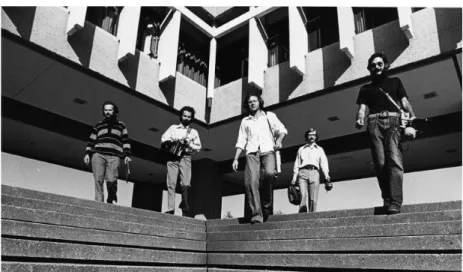
The World Soundscape Project group at Simon Fraser University, 1973 The Vancouver Soundscape 1973
Produced by the World Soundscape Project, Simon Fraser University Mozart’s Musical Dice Game
ILLIAC I computer Componium
Extract from a stochastic piece
Montréal Sound Map website interface Stanley Park Soundmap website interface
Sound Around You Soundmap website interface Sonic Wonders sound map with raking classification
Open Sound New Orleans sound map interface with ambient, music and voice sounds discrimination
Sound Interface. The Roaring Twenties project Space Interface. The Roaring Twenties project Time Interface. The Roaring Twenties project Project radio aporee ::: maps interface
Stereopublic: Crowdsourcing The Quiet sound map.
Stereopublic project: On the left a not filled circle marking a quiet spaces. On the right a filled circle marking a quiet space with a musical piece associated to that place. Porto Sonoro sound map with a colour code identification.
Locusonus Sound Map interface with live stream active LocustreamBox + LocusMic
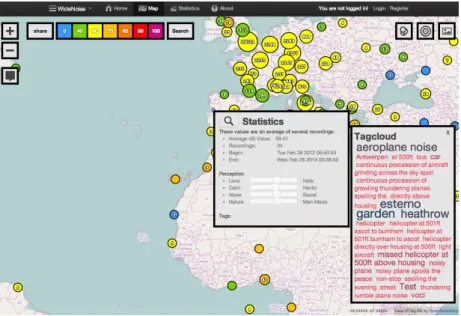
Widenoise Sound Map This
NoiseSPY Noise Mapping. Colored traces represent the loudness in dBA Hurly-Burly’s GUI explained.
Temporal monitoring of sound and movement. Hurly-Burly project Architecture of the proposed scheme based
Noise level data from SENSEable Pisa project.
X Marks the Spot- One telecommunication box with the QRcode for the composition. Sundial Vienna production photo, 2003-2013
Cities and Memory interface with field recording (city version) and rework (Memory version)
Antonomásia_O Porto – Padrões Sociais Invictos live performance at Manobras Festival
Snapshot - Som Urbano sob Fundo Branco sound installation Vinyl labels. illustrations by José Cardoso
Snapshot - Som Urbano sob Fundo Branco Max patch.
The analysis was made above the -35db amplitude threshold and the polyphonic transcription in midi notes respective midi conversion.
Extract of Max patch to create a table of transition probabilities from one note to another for each group.
Figure 1 Figure 2 Figure 3 Figure 4 Figure 5 Figure 6 Figure 7 Figure 8 Figure 9 Figure 10 Figure 11 Figure 12 Figure 13 Figure 14 Figure 15 Figure 16 Figure 17 Figure 18 Figure 19 Figure 20 Figure 21 Figure 22 Figure 23 Figure 24 Figure 25 Figure 26 Figure 27 Figure 28 Figure 29 Figure 30 Figure 31 Figure 32 Figure 33 Figure 34 Figure 35 Figure 36
Extract of the orchestration of the soundscape
Extract of the motifs collected from the Catalogue d’oiseaux – XIII. Le courlis cendré for the improviser’s section
Extract of the score with the groups of orchestration Extract from the chords guide for the pianist improvisation. Max patch to analyse and collect soundscape data
Sound descriptors extract list.
MIDI score created by soundscape features. PORTOphone application interface
The three phases of the URB System: capture and analysis system, database with soundscape features, tools to access the data.
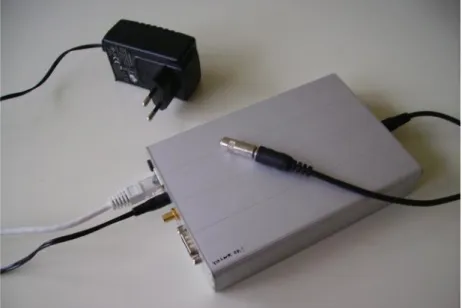
Raspberry Pi Model B Common USB ADC The Locus Mic DIY circuit
Construction of the shell command on a Pd patch. Structure of a generic URB MySQL table
Web interface to delete one row of information
Web interface to delete a section of rows of information pd input
pd equalizer pd descriptors
Listening points distribution in Porto
First listening point on Sá da Bandeira Street Second listening point on Oliveira Monteiro Street Third listening point at Casa da Música
Fourth listening point at Sonoscopia cultural association. Database web browse consultation
Database text file URB-app map
URB-app main window URB-app time converter URB-app about descriptors URB-app about window URB-app raw data window Example of searching by date Example of searching by value.
Example of searching between two values. URB logo
URB graphic identity URB project Site Map. Web site’s main menu Figure 37 Figure 38 Figure 39 Figure 40 Figure 41 Figure 42 Figure 43 Figure 44 Figure 45 Figure 46 Figure 47 Figure 48 Figure 49 Figure 50 Figure 51 Figure 52 Figure 53 Figure 54 Figure 55 Figure 56 Figure 57 Figure 58 Figure 59 Figure 60 Figure 61 Figure 62 Figure 63 Figure 64 Figure 65 Figure 66 Figure 67 Figure 68 Figure 69 Figure 70 Figure 71 Figure 72 Figure 73 Figure 74 Figure 75
URB web site examples
Excerpt of ...URB to B... musical composition (bar 84) Control and Unpredictability sound installation
Urban Sonic Impressions Workflow diagram
Urban Sonic Impressions Source spatial position configuration
URB XY starting interface
Descriptor and data in URB XY grid URB XY side view
Re-interpretation sound installation Age distribution of the users Age distribution of the users
The degree of difficulty in the accessibility and consultation of the database The degree of difficulty of the data’s technical application in the work’s creation Tool used to access the database
Data use
Number of sound descriptors used in each piece Number of listening points used in the final work Final work format
Soundscape sounds used in the final work
The difficulty degree of the conceptually application of the data in the artistic environment
The degree to which the final work fulfilled the initial individual expectations Proximity between the original soundscape and the final work
Figure 76 Figure 77 Figure 78 Figure 79 Figure 80 Figure 81 Figure 82 Figure 83 Figure 84 Figure 85 Figure 86 Figure 87 Figure 88 Figure 89 Figure 90 Figure 91 Figure 92 Figure 93 Figure 94 Figure 95 Figure 96 Figure 97
Descriptions of subjective semantic differential scales. Sound Around You project. Similar factors involved in creativity, science and social science
The following table depicts the rhythmic and melodic cell values Table 1
Table 2 Table 3
Soundscapes
Capturing and
Analysing Urban
Audio for a Raw
Chapter 1
The human presence has conditioned the world in a way and with repercussions that are very hard to evaluate, and the exercise of imagining a planet without any human interference could lead us to an enormous journey of possibilities and situations. But the fact is that humankind and its relation to everything that surrounds it, marks and represents a very interesting matter to study.
Humans are naturally inclined to exist in society, to develop relationships, to work, to live together. This necessity pushes it to organize itself in groups and to find hierarchies and structures. Obviously this development has more consequences than only the social relations, organizations and adaptations. Humans had to arrange large spaces to live together with specific characteristics to fulfil their necessities. This evolution was not always simple or peaceful. Most of the times it was a trial and error process to achieve models that were good enough. However this process is infinite and the characteristics of these groups are in perpetual mutation. One thing though, was coherent: these groups became increasingly larger and larger and the needs of the surrounding environment have became increasingly demanding. In this process densely populated areas slowly appeared. A built-up area with a name, defined
boundaries, and local government. (...) Especially as contrasted with the country or suburbs1. These areas not only
represent social structure but naturally represent a major difference to the landscape in comparison to the countryside areas and to the wild nature.
This dissertation subject material is about a consequent element of this social and geographic areas: the urban soundscape, the way to capture and represent it, and a possible relation with creativity and art. This dissertation - Composing with Soundscapes: Capturing and Analysing Urban Audio for a Raw Data Musical Interpretation - has two different points:
1. Capture and Analysis of an Urban Audio Environment, is directly related to an ecological
point of view. It is rather simpler to understand than the visual transformation between a wild landscape to an urban one, between two cities, between today and last year’s landscape of the same city, and we can stretch that time range, because it is easy to resort to pictures or paintings. With soundscapes2 however, it is not quite the same. It is not so simple to describe the difference
between the sound of today and last year’s sound and if we are going to increase that gap it is going to be harder and harder. If we go back in time more than 50 years, in most of the cases we can only rely on indirect sources and most of the time they are not very precise or have a great deal of subjectivity. There is a big difference between our ears and eyes. The eyes we can close. So we can decide to stop seeing. But we can not close our ears. So sound is always there. Our degree of awareness is very different. We are “programed” to respond to a siren or an alarm or to any sound signal that stands out from the background sound. But we are less prepared to be conscious of the evolution and the transformations that background over time, mostly because
1 “town”. Oxford Dictionaries. Oxford University Press
2 During this thesis Soundscape, capitalized, refers to the ecological, artistic and scientific movement, and soundscape,
it is always there. There are two different reasons for this: one is that the human being has more developed vision perception than the hearing perception and it is the main sense related to the surrounding reality. As an example, for the majority of humans it is easier to recognize faces than voices, and that is probably the reason why the car manufacturers generally spend more time and resources into make a car look nicer than to sound better; the second is that sound’s “canvas” is time, and this is a major a problem. You can go to the top of the hill and take a picture to the city, a picture only needs an instant, but with sound it is different. What is a picture of a soundscape? An instant of a sound represents nothing. You need a larger window of time to represent the sound. How large should that window be? So it is harder to represent and to capture the sound part of a place. In this investigation we work on these problems.
2. As a Source Material to Music Creation. “No man is an island /Entire of itself /Every man
is a piece of the continent /A part of the main (...)”3 In this famous poem by John Donne it is
very well described as a human is part of something beyond itself, it is not born and does not die only in itself. It transforms and affects what surrounds it and the opposite is also verified. What surrounds us is an important element that defines us, either by contagion, by resistance or in extreme cases by cancellation So the same man today may not be the same as if he was born in a different era or area. So starting with this premise, how does the environmental sound transform a man, the art works being a crystallization of a time and space, how does the environmental sound affect his work? This investigation works on this subject in a way of how, and if it is important, to approximate the soundscape and the creator. After the capture and analysis of an urban sound system has been worked we “offer” it to the art community. The final part of this investigation is to study and to propose an artistic approach, to compare the results between them and also to analyse the feedback and opinions from the authors and peers. Finally, we try to conclude the relevance of this approach to soundscape as a gigantic sensor to be used in artwork.
To conclude, the present dissertation connects two key subjects - Soundscapes and Music Creation - with the purpose of presenting an innovative framework for urban sound researchers and sound artists based on the approach to the soundscape in a time based system.
1.1 Motivation
The youth has been completely conquered by this electronic world that is acoustic, intuitive, “holistic”, this is, global and total, a new world that put on the shelf of the old scientific world with its quantities, its immensities,
4 www.worldlisteningproject.org
According to McLuhan’s critical thought, the 60’s and 70’s electronic revolution marked the return of the ear as a sovereign organ for cultural human perception. This sociocultural transformation underlined the Western man’s necessity of constant absorption. It is within this framework that the soundscape studies become more systematic and its presence as an artistic tool more persistent. This was not a new subject, but rather a new one that found fresh stable grounds within the constant multidirectional cultural and ecological awareness that dictates the Electronic Era. The notion of soundscape is increasingly relevant not only in contemporary culture and acoustic ecology, but also in many other fields, such as artistic production.
The first time that this topic caught my attention was in 2006 when I read this passage for the first time:
We are also disadvantaged in the pursuit of a historical perspective. While we may have numerous photographs taken at different times, and before them drawings and maps to show us how a scene changed over the ages we must make inferences as to the changes of the soundspace. We may know exactly how many new buildings went up in a given area in a decade or how the population has risen, but we do not know by how many decibels the ambient noise level may have risen for a comparable period of time. More than this, sounds may alter or disappear with scarcely a comment even from the most sensitive of historians. Thus, while we may utilize the techniques of modern recording and analysis to study contemporary soundscapes, for the foundation of historical perspectives, we will have to turn to earwitness accounts from literature and mythology, as well as to anthropological and historical records. (Schafer, 1993, p.8)
Apart from my academic artistic evolution and development, that passage insisted on appearing in my mind. Even so, the opportunity or how it might be related to my wprk never appeared.
This thesis, embedded in the Computer Music area, appears with the will to find new mechanisms to turn to the soundscapes as a source to relevant artistic creations. Due to this, the investigation appears not only as a continuation of the work already done, but also as a new artistic interpretation to the sound material that surrounds us and in what way it can, directly, influence music creation.
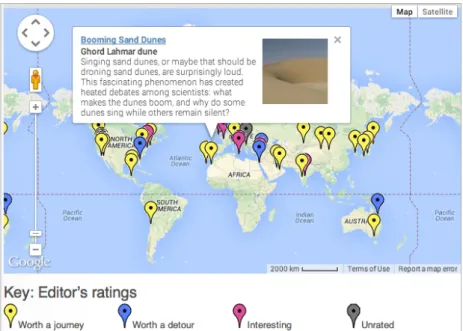
The first main subject was in what way we can contribute to the already well-developed Soundscapes community in the capture and cataloguing of environmental sound. Usually the sound maps are based on a Google-style map that is used to situate the geographic origin of the recordings, e.g. World Listening Project4. However, as Barry Truax indicates, lacking any coherent temporal perspective:
Sound maps have become increasingly common on the Internet, where instead of files organized by subject matter (or not at all), a Google-style map is used to situate the geographic origin of the recordings (e.g. www. our super-industrialized “First World”. The youth prefers the Third World because it is still acoustic and oral, and invites to total immersion (…) (Babin & M. McLuhan, 1978, p.191)
1.2 Objectives of this Dissertation
The urban soundscape is probably one of the most present elements in our everyday life but simultaneously the one that we are least conscious of. Studies in the sound ecology field have been developed working on the capture and analysis of the soundscape field about its characteristics, evolution and repercussions. It is common sense that what surrounds us, in one way or another, is an influence on us and naturally on our artistic results too.
As such the objective of this dissertation is to contribute to the fields of Sound and Music Computing and Soundscape by:
1
• Presenting and studying knowledge of projects, models and theories proposed in the literature of soundscape analysis;
• Presenting and studying knowledge of the relation between soundscape and music creation;
2
• Pointing out new forms of capture and storage of an urban soundscape;
• Pointing out new methodologies for the analysis of soundscape characteristics in real time;
3
• Developing a model of an autonomous system (hardware and software) that captures, analyses and stores a urban soundscape;
• Creating a public database with the a local urban soundscape analysis;
worldlisteningproject.org). I have found that the sound map is useful to orient people who are unfamiliar with the soundscape concept to the idea that soundscape recordings are markers of place. However, lacking any coherent temporal perspective, and usually lacking any interpretative analysis, the listener is left trying to imagine what has been recorded and what significance it has. (Truax, 2012, p.11)
This becomes our main subject, to work and become clear that it could be a very important contribution to the Soundscapes area of investigation. So we developed a system called URB, creating a database accessible to the public, from a permanent analysis of the environmental sound of a great urban space. The second subject was, if relevant, to promote a direct connection between that kind of approach to the soundscape. So we conclude that we could contribute; systematize the information from the database, to be the basis for different artistic musical works, both in real and non real-time. In the last instance the better way to validate that approach was to promote a situation that different music creators, apart this investigation, apply this approach to the system and help us to conclude its pertinence.
1.3 Methodology Overview
In this sub-chapter we present an overview of our research design, listing and describing the most relevant steps that led to the conclusion of this project.
1. Formulation of the research problem.
During the first year of research I came across with the assumption by Barry Truax, presented earlier, about the lack of coherent temporal perspective of the typical sound maps (Truax, 2012). It seemed to be the perfect opportunity to relate the soundscape issue with my musical and artistic interests. Throughout the rest of the research year, the topic experienced its maturation process, being iteratively discussed with colleagues, as well as the confirmation of relevance of the issue having been reinforced by the advisor. Finally submitted to the scientific council with the topic Composing with Soundscapes: Capturing and Analysing Urban Audio for a Raw Data Musical Interpretation.
2. Extensive literature review.
The first two years were dedicated to literature review and state-of-the-art research, which encompassed the main areas of Soundscapes and Music Creation and with related areas like music information retrieval, Eco-Structuralism and Algorithmic Composition.
3. Preliminary Research Experiments.
In order to ground our main research, we developed four experiences with different uses of soundscapes in sound art creation. Those four pieces were been presented in public and were fundamental to understand and point out what problems we should approach to design a new soundscape capture and analysis system with potential use in artistic creation.
4. Prototype formulation
After a good understanding of the theoretical and artistic background, we draw a theoretical system and started to experiment with several options, software and hardware, until stabilizing in the final
• Promoting conditions of accessibility, interpretation and use of the database content; • Leaving a model that can be applied in other cities, or other spaces, that can be expanded in a more complex design and can be applied and used by artists and other areas of interest;
4
• Disseminating and presenting the scientific and artistic work produced from these new approaches to the soundscape in music creation;
• Eliciting the production of knowledge and innovation in the field of the relationship between the soundscape, music creation and sound art;
design. That system was called URB.
5. Experimental research project
The chosen approach was based on empirical research and consisted in the development of a proof-of-concept system (software and hardware to the soundscape capture, database to store the information, and software to access the database) to assess the validity of the initial two issues – how to approach the absence of time perspective in the regular sound maps and how the environmental sound is able to directly catalyse music creation. Four listening points (the micro computer to capture and analyse the sound) were disposed in different places of downtown Porto. Those points were collecting the data, filling in the database with the history of the soundscape since the moment they were on.
6. Artistic application
The data collected and the software developed to access it, was published on a website created exclusively for it. A group of artists from different areas and backgrounds were then invited to work with the database in their musical work and to present the results in public venues.
7. Description and analyses
The artistic works were analysed and the approaches and processes described in detail. Firstly, a individual point of view, and secondly, comparing the processes and individual opinions with the aim of finding mutual elements and to understand the relevance of the project.
8. Discussion of the results
This thesis represents the outcome of the whole research, whilst being the main support of the description and representation of the entire process. It also has a fundamental and valuable critical analysis, the main conclusions and thus pointing towards the future directions of the project.
1.4 Main Challenges
Throughout the research we came across problems, challenges and situations that sometimes put us in a state of despair. Invariably though, each challenge was an opportunity that made us evaluate an mature as researchers and artists. With planning most of the problems were expected, and therefore welcome, but others appeared requiring an unexpected amount of time and attention, but it was exactly those situations that we now recognized that made this research what it is now. The challenges made us turn to solutions and approaches that we never thought of initially, and just going through that process is what permitted us to achieve several key findings presented in this thesis. The problems can be divided in two major groups: Those related to technological approaches, and the artistic ones. Even though the second group ended up being less demanding in the amount of time and effort, it was eventually more difficult to achieve solid conclusions in a scientific research perspective.
5 http://locusonus.org/soundmap/
On the technological side we had to deal with the overwhelming and incredibly fast evolution of computer technology. The creation of the technology for the listening points, that later we called URB box, was not easy. The market didn’t have any final product that satisfied our needs so we turned to microcomputer technology. We had a great starting point by studied the locus sonus sound map project5
quite extensively. It was especially useful to solve the microphone problem but the microcomputer solution that they presented seemed too expensive for us, and the software too complex. These two characteristics were a deterrent for the creation of the project, and would be a major constraint for the dissemination of the project in the soundscape and artistic community. While we dealt with this problem the Raspberry Pi project appeared and offered a very interesting and robust tool. It was not a solution per se but we decide to invest in it as a starting point to our URB box. These and other limitations are discussed in detail further ahead.
The last phase of research was the artistic application. This is always a difficult subject in scientific research. We thought about different approaches to several parts:
• How to promote artistic creation?
• To what extent can we or should we condition the act of creation?
• Follow a line of greater diversity of artists with different characteristics amongst each other or a large number of similar artists?
• How many artists is enough to be representative, to prove that a creative process is good; does this number exists or is only one enough?
• Is an audience evaluation relevant in this context?
• Should we focus more on jury of peers review or more on a self-experience conclusion? • Should we centre our attention only on to the fluidity of working with URB or are the artistic concerns equally important in a scientific thesis?
• Up to which point can we generalize the artistic conclusions?
This area of research is always more difficult to point out the best and most solid path, much more difficult than in the technological challenges, but that is the reason that we think that multidisciplinary theses are special and important to the area, and this is probably the major opportunity to achieve results that were less likely to be reached if we do not mix, in the same group of work, the two interests, the scientific and the artistic.
Nevertheless, all the mentioned challenges were always seen from a point of view of rigor and relevance with the ultimate purpose of bringing knowledge and new ways for the communities concerned and strengthening the bonds that unite them.
In this sub-chapter we present the structure of the thesis with a brief description of each chapter, providing a guide for the reader. The thesis is divided in two major conceptual sections: contextualization and experimental process.
1. Contextualization
In this section we present the results of the literature review on the thesis topic:
Chapter 2
Framework covers the literature review and contextualization of the research in its relation with Soundscape and Music
1.6 Structure of this Dissertation
The study of sound in a soundscape context is not new. How to do it, as history has already shown us, is not only one path. However, what we propose is a different approach to soundspace capture and a new way to deal with it and it properties. This approach is a reaction to the human’s (not all) most natural passive and casual listening (Chion, 1994) before their ambient sound habitat. Such a proposal presents an innovative approach based on time perspective and on reduced listening (Chion, 1983), meaning that the focus is more on the sound characteristics and how to ready them, rather than in the sound itself. Being proven that soundspace can carry very useful information about context and society characteristics and activity, and is an element that could determine the quality of life level, may even be a public health issue, there are plenty concrete situations that could benefit from the application of our research.
Our research had, as its main focus, the application of this temporal approach on soundscape applied in music creation, but the whole project has enormous potential for other areas, especially for sound ecology (as an automatic system that alerts in real time when the sound level passes a certain threshold) and historical acquis (as an automatic system to record and store important sound heritage).
Facing a huge range of applications, more than we could predict and handle, even inside our research universe (music creation application) we decided that it was fundamental to embrace an open source policy and, preferentially, easy access hardware. Towards our proof of concept, URB was developed with the purpose of being extremely easy and even inviting to adapt to each idea and necessity, whether it be within an entertainment, artistic or ecological context.
Chapter 3
State of the Art presents a survey on the state of the art projects and technologies regarded as a reference to our study.
2. Experimental Process
In this section we present the description of the experimental process and developement of the research tool , along with its applications, analysis and conclusions on the collected data and further findings:
Chapter 4
Preliminary Experiments On Soundscape Composition presents projects developed by the author that provides important insights for the this doctoral study.
Chapter 5
Research Methodology presents several approaches that contributed with methods and techniques for our study and describes the methodology followed in the course of this interdisciplinary research.
Chapter 6
URB: Prototype System for Experimental Research is dedicated to present all the details regarding the development and implementation of the proposed research tool.
Chapter 7
URB artistic applications is dedicated to present in detail all the artistic works developed through the URB system.
Chapter 8
System Evaluation and Result Analysis is dedicated to evaluate the results of the questionnaires made to the artists that used URB.
Chapter 9
Conclusions and Future Work presents the main contributions of this research project and future work to be done in this field.
Chapter 2
This chapter has the function of providing a good overall understanding of the scientific areas related to our research process. We are going to dedicate these next lines to exploration, on the general topic Sound and Technology, the Soundscapes subject in particular, while expounding the different perspectives and purposes that have been widely presented and discussed in specialised literature. Being such a vast subject, with so many different perspectives and goals, during our exposure we are going to favour and narrow the aspects that are more related to our agenda.
This dissertation was developed under the scope of the framework of Sound And Music Computing (Serra, leman & Widmer, 2007) a multidisciplinary field that crosses two broad areas: Sound and Technology. Narrowing down the subject to Soundscapes and Sound and Music Technology we focus on the environmental sound dimension related to music creation.
The heart of this dissertation is constituted by two major scientific disciplines, intrinsically connected to the main framework of Computer Music:
• Sound and Music Technology • Soundscapes
Seeing as though this research has a relatively wide range of interests, there is a 15 survey of related projects and approaches from different areas in different ways that relate to the interests of our investigation, such as:
• Musical Information Retrieval • Algorithmic Composition • Eco Composition
• Sound Maps
This survey confirms the timeliness, relevance and originality of the project, both scientifically and artistically.
Sound, Audition and Society
What is Sound? According to the dictionary sound is a group of vibrations that travel through the air or
another medium and can be heard when they reach a person’s or animal ear6. At a first look with a more superficial
approach, sound is a physical phenomenon.
2.1 Related Areas and Scope of this Dissertation
2.2 Context Information
Sound became an object of study in Classical Greece through studies and reflections by Pythagoras and Aristotle (Aristotle, 1987). Those first approaches were mainly from a musical practice point of view, with a profound relation between math and musical intervals. Those theories also had great philosophical reflections, contextualizing the musical creation and its function. in this period there was also a very deep incrustation of the meanings and systematization of musical practice, theorizing and organizing the musical sounds in modes (Grout & Palisca, 1988). This work was so profound, pioneering and fundamental that this theory and system marked the practice in Western music for the next millennium. During that time, the evolution on the study of sound was mainly in the musical point of view. It was only in the 19th century that a major breakthrough in the area of sound outside the musical field happened. The main people responsible were the German scientist Hermann von Helmholtz, in 1863, with On The Sensations Of Tone As A Physiological Basis For The Theory Of Music (Helmholtz, 2009), and the English scientist Lord Rayleigh with The Theory of Sound (Rayleigh, 1896).
Beside the musical and aesthetic point of view that monopolized most of the research on sound in Western history, according to Olson (1967) the physical and the physiological properties took a very important place in the sound field in the Twentieth century. It is quite clear to all, including the scientific community, that the significance that each individual gives to sounds is different. In other words, for example, a J.S. Bach suite does not provoke the same sensations in an Egyptian as it does in an Austrian. This is a consequence of an intrinsic part of the listening activity, a cognitive part. So along the two scientific fields mentioned before, the physical that focuses on the vibrations that travel through the air, or another medium, and the physiological that deals with the auditory system behaviour and the process from the pressure waves to the electric impulses into the brain, it is fundamental to extend to other scientific areas: anthropology, psychology and cognition (Erlmann, 2004). So not only due to the air vibrations and the auditory system, a musical piece, as is common knowledge, has different meanings and different impacts in distinct listeners. And the reason is quite complex. The cultural and musical background, the state of mind and body, a personal and emotional experience with a particular music passage, etc., are all reasons that influence and affect the act of listening. This complexity applies not only to musical contact but also to all of the listening experience. As an extreme example, an ambulance siren has completely different impacts on a resident of New York compared to an isolated Amazonian tribe inhabitant (MacAdams & Bigand, 1993).
The auditory system tends to be put at a lower level of importance than vision, mostly because the act of listening is processed effortlessly and unnoticed. At the same time, the auditory sense has a different function than vision. It is a permanently-on sense; it never shuts off. Naturally this characteristic has a survival function, providing us with the ability of permanent three-dimensional awareness, with the capacity to identify the location of a sound source, being our main door to what surrounds us outside of the view angle. To conclude, the process of perception is different to vision (Middlebrooks & Green, 1991). That permanent act of listening forced humans to develop different levels of listening or conscience about it. Most of the time a normal person relates to the sound around them in a casual listening mode (Chion, 1994), which is identifying the source and the origin
7 “language”. Oxford Dictionaries. Oxford University Press
through analytical and descriptive listening, called reduced listening (Chion, 1983). This process has to be placed in passive listening, because sound is always there and the auditory system is always working. Only against a disruptive sound does our listening process turn on an active mode. As an example, if we are in a conversation in the middle of a crowd, even a very loud one, we know that the sound is there but we are in a very low awareness mode, we are not following any conversation or words beside our interlocutor. If however, a child starts to cry or someone asks for help automatically we change to an active mode. These aspects in the nature of sound have an impact on the relation that we have with our soundscapes and more importantly how we shape them and how we let them evolve.
Remaining in the same approach of the importance of sound in human evolution and behaviour, it is impossible not to approach the importance of sound as a means of communication. During most of the time of mankind’s existence, we lived in the “magical world of the ear” (MacLuhan, 2011). According to the dictionary language is the method of human communication, either spoken or written, consisting of the use
of words in a structured and conventional way7. This protocol was created and developed mainly in an aural
medium. Until around the fourth millennium BC all knowledge was transmitted orally and even after that, the ability to read and right was confined to so few that, according to MacLuhan, the visual era only took the place from the aural empire with the invention of typography (2011). During the visual era in the common world, even written media, most of the world’s population only had access through aural processes by indirect routes. It was only during the twentieth century that direct access to the visual language became widespread and common. The information era also started also using sound: radio broadcasting. With a purpose of education, entertainment or information, people would gather around the radio device. Radio broadcasting, was the main window, and the fastest, to the world during a big part of the first half of the twentieth century. It was the most important medium in houses in the West. To sum up, language used sound as the main means of communication between man and as transference of knowledge.
Sound is also a form of identity. Just as we have distinctive landmarks that define a specific place, sound can also have the same function. A sound which is unique or possesses qualities which make it specially regarded
or noticed by the people in that community. (Schafer, 1993). These specific sounds are called Soundmarks, and
are derived from the term landmark. This can be a natural or an artificial sound, such as the sound of a waterfall, or the way that the wind blows in that specific canyon. The fauna of certain areas, especially in the places rich in diversity of species, create very amazing and unique soundscape. The sound created by the animals can be a very strong element of representation of a geographic location. Artificial sounds are probably the more obvious soundmarks, like a factory siren et the beginning of the work shift.
From the analysis of this dimension of sound, it is very natural to start to see that these Soundmarks can also have a social and community dimension. A church bell can produce a very unique sound
that can be recognized by the locals, but also has a very concrete message for all the Catholics. These sound signals are like a bond to all the religious community, as the Islam as also huge impact in the soundspace with the five daily calls to pray from the top of the minaret. In these cases it is more than a Soundmark, is also defines a community, is the acoustic space of it. This happens when a soundscape identity is coherent, pervasive and plays an important role in the life of the community, conveying signals and cues
about its rhythms and relevant events (Cordeiro, 2013). The definition of community is a group of people living in the same place or having a particular characteristic in common8. So from that definition, the sound identity of
a specific community is when shares the same sound that creates a sense of belonging, identification and meaning to a restricted and particular group. This dimension of the sound has such an enormous importance in our social lives. A community can have different sizes and characteristics.
Therefore, the boundary of the community is arbitrary and may be as small as a room of people, a home or a building, or as large as an urban community, a broadcast area, or any other system of electroacoustic communication. (Truax, 2001, p.66)
Therefore, it can be a gigantic community, like the religious one we saw before, with the calling sounds for rituals, a special calling invented for an old group of friends, a political shout, a national anthem, it can be more entertaining like a soccer team chant, but it can also be more complex such as the group of people that listen to that specific radio show every day.
After all, the soundscape is not an alien force but a reflection of ourselves. (Truax, 2001, p.117)
Aesthetics and Nature - Brief Overview
Plato stated that the form is the universal prototype of everything in nature. Every tree is struggling to achieve the pure form of “the tree”. Although all the trees are not perfect in an imperfect reality, they are still guided toward that pure form. The beauty of the tree can be assessed in regard to their participation in the realization of the form. This principle is also connected to the idea of mimesis a philosophy and practice where the artist tries to mimic nature. With this introduction of the idea of form, Plato gave the first model for a connection of aesthetics and nature. (Plato, n.d.)
Kant presents an idea somewhat similar to Plato’s, except that the place of origin of the form is different. The aesthetic pleasure of nature comes about only if an object’s form agrees, accidentally, as it were, with a form that the imagination could have invented on its own. It is the comparison of the actual form with the counterfactual form that decides on whether we judge the object to be beautiful (Rueger, 2007). According to Kant, when compared to the aesthetic experience of artistic beauty, the aesthetic experience of nature is only basic.
Hegel’s point of view about the relation of nature and aesthetics was more sceptical than that of Plato or Kant. He suggests that an aesthetic philosophy cannot be based on the beauty of nature because our assessment before it has a lack of solid criteria. Such aesthetic theory should be focused on high art with objective categories, in opposition to beauty of nature. When judging it we are before a great feeling of imprecision (Rueger, 2007).
In his commentaries, Schopenhauer comments on the aesthetic appeal of a group of natural objects. However he was cautious when contemplating the aesthetic appeal of any individual natural object. He was unable to contextualize his perspectives of the relation of aesthetics and nature with his already presented structure, with art.
Some people face nature as a phenomenal and ingenious creation of God and relate to it from that point of view, a complex construction. Others start from the assumption that aesthetics exist intrinsically to nature. Through the description of this, Malcolm Budd presents a parallel where some appreciate the object while others the creator/artist. However, he makes the distinction between that which is man-made, and that which is from nature. Non-man-made creations appreciation must be made on its own terms, and not as in an artefact. He suggested that when you experience a sound produced by natural means it is certainly not a sound intentionally determined by artistic consideration criteria (Budd, 1996). For example, a frog chant has a biological purpose like territorial domain or a mating call and not a function to provide pleasure or the questioning of dogmas. This does, however, not remove the aesthetic relevance.
An attractive conception of the aesthetic represents a response as being aesthetic insofar as the response is directed at the experienced properties of an item, the nature and arrangement of its elements or the interrelationships among its parts or aspects, and which involves a felt positive or negative reaction to the item, considered in itself, rather than as satisfying a pre-existing desire for the existence of something of that kind, so that what governs the response is whether the object is intrinsically rewarding or displeasing to experience in itself. (Budd, 1996)
Therefore, the arrangement of its elements does not predetermine the aesthetic qualities. Based on their experiences, it is possible to make an aesthetic judgement of an art piece.
According to this position, Opie and Brown say that an artist that is using eco sound structures will opt for a specific base material according to their experience of that sound, because this artistic approach is to embody the natural characteristics of the initial experience to the final art piece. However, a transfer of aesthetic experience from the natural origin is in no way guaranteed, so the art piece will be always judged as to its intrinsic value. In this way the artist is responsible for the aesthetic value. (Opie & Brown, 2010)
The Soundscape concept and movement was presented to the world in the 1970s, in Murray Schafer’s considerations and research. The book The Soundscape: Our Sonic Environment the Tuning of
the World (Schafer, 1993) is the great promoter and a reference point to the Soundscape movement’s
dissemination. In this publication Schafer systematizes and gathers all the research already done and which was dispersed in the World Soundscape project9 and The Book of Noise written in 1968.
• Soundscape
The sonic environment. Technically, any portion of the sonic environment regarded as a field for study. The term may refer to two different sound environments:
1. Actual/real environments,
2. Abstract constructions such as musical compositions and tape montages, particularly when considered as an environment. (Schafer, 1993, p.274)
It is reasonable to say that the soundscapes movement, because for its intrinsic material and the use that is given to it, is situated between ecological activism, documentary/reporting, the artistic documentary and acousmatic music10. According to Iges (1999), Schafer’s utopia would be to implement some type of order
and organization in the sound ambient with the purpose to achieve a “Sound Ecology” balance.
From the 1980s, the movement grew and became international. During this process it split into three groups:
• Sound Ecologists (Schafer followers)
• Artists that use the Sound Ambient material and freely reorganize it to create new soundspaces
• La ville Die Stadt, Metropolis Paris, Pierre Henry (1984) • Sound bridge Koln-San Francisco, Bill Fontana (1987) • ...
• Artists that mix, edit and process the Sound Ambient material until it is no longer identifiable. This group became more relevant and active from the year 2000 because the technological necessities, inherent to the work characteristics, only then became available on a large scale.
• Immersive sound, Francisco López (2008) • Electric Fauna Emiliano, Zelada (2009) • ...
2.3 The Soundscape - Concept and Movement
9 www.worldlisteningproject.org
10 “acousmatic music”: The term acousmatic dates back to Pythagoras. The philosopher lectured the students behind a
curtain because he believed that his physical presence could distract from the content of his speech. Acousmatic music is a form of electroacoustic music that is specifically composed for presentation using speakers, as opposed to a live performance. Like the Pythagoras lectures, in acousmatic music the concerts take place without seeing the source of the sound. This term was applied for the first time in musique to define the listening experience of musique concrète. ( Schaefer, 1966) )
2.4 Soundscape Ecology
During his life, Schafer noticed that the ability to listen was being lost. In his experience this was linked to a strong dominance of a visual modality in society at the expense of the aural one. Wrightson confirms that with is own experience:
As a lecturer in Music Technology, I often begin a lecture series with these exercises and I can confirm Schafer’s experience: many students do not recall “consciously” having heard any sounds during the day, and many do not complete the sound list even after fifteen minutes. (2000, p.11)
This concept called the dominance of eye culture was developed and detailed by Berendt (1988), and faced with it he argued that listening skills should become an integral part of the Canadian curriculum. In his studies, Schafer, with a music composition background, aims towards a balance between the natural soundscape, produced by non-human means and the non-natural soundscapes or human produced soundscapes (Schafer, 1993). This balance is subjective but, in order to be discussed, it is necessary to develop in society a high level of awareness of sound, and what surrounds it, and the inherent repercussions and characteristics. This issue had already been explored in Acoustic Ecology as a scientific subject, promoted by Schafer. To support this scientific approach, Schafer proposes a program, Ear Cleaning, for training the ear to listen more discerningly to sounds, particularity those of the environment (Schafer, 1969).
• Acoustic Ecology
Ecology is the study of the relationship between living organisms and their environment (...) and the study of the effects of the soundscape physical response or behavioural characteristics of creatures living within it. Its particular aim is to draw attention to imbalances which may have unhealthy or inimical effects. (Schafer, 1993, p.271)
So the perspective of this movement before Acoustic Ecology and soundscape studies is more than the momentary relation between the sound ambient and humans. As a big anthropological component, is also about the sustainability of humankind with the world, about Sound history and sources, but mainly about premeditation, consequences and art. Schafer, with a freer approach, considers all humans as musicians, which contribute to the soundscape in real time, and potential composers, that provoke permanent changes (losses and new introductions), in which he assumes that the musical work is a global soundscape.
With this we can perceive that at the heart of this movement was a large concern related to ecology and sustainability. This lack of sustainability is highly representative in a one of the most extreme situations, the industrial revolution. During the 17th century, the contrast between pre-industrial and post-industrial acoustic environments it was quite dramatic. New non-natural sounds were injected into the acoustic environment. It was described and illustrated as a perfect example for the use that Schafer uses to characterize the “quality” of a soundscape: