1
Evaluation of the ability of powdered milk to produce minitablets
containing paracetamol for the paediatric population
Joana T. Pintoa, Maryia I. Brachkovaa, Ana I. Fernandesa, João F. Pintob, *
a
CiiEM, Instituto Superior de Ciências da Saúde Egas Moniz, Monte de Caparica, 2829- 511 Caparica, Portugal
b
iMed.ULisboa – Dep. Tecnologia Farmacêutica, Faculdade de Farmácia, Universidade de Lisboa,
Av. Prof. Gama Pinto, 1649-003, Lisboa, Portugal
*Corresponding author: João F. Pinto
Dep. Farmácia Galénica e Tecnologia Farmacêutica Faculdade de Farmácia de Lisboa
Av. Prof. Gama Pinto P - 1640-003 Lisboa Portugal
Tel./fax.: (+351) 217946434 e-mail: [email protected]
2 Abstract
The work aims at evaluating the usefulness of powdered milk as a drug matrix for the production of minitablets specifically designed for children. Mixtures made of powdered milk, paracetamol, mannitol, sodium croscarmellose and magnesium stearate (evaluated for flow properties, cohesiveness and caking tendency) were compacted into beams (evaluated for deformation, elasticity and stiffness) and minitablets (evaluated for uniformity of mass, thickness, tensile strength and paracetamol mean dissolution time) and a 23 factorial design performed. The increase on milk fraction in the formulation improved the compressibility of paracetamol and hardness of compacts, reducing weight variation and paracetamol release. A marked decrease on the dissolution time was observed as sodium croscarmellose was added to the milk rich formulations. The increase of the compression force resulted in the production of thinner compacts but had little effect on dissolution time. The production of beams has shown that deformation, bending strength and stiffness increased with both milk and compaction pressure, and decreased with sodium croscarmellose, whereas elasticity decreased when all variables increased. Tensile strength and mean dissolution time described minitablets well, unlike compaction force. The study has proved that powdered milk is suitable for the production of minitablets by direct compression of poor compressible drugs.
Highlights
- Powdered milk can be used as a matrix to deliver poorly compressible drugs. - Minitablets can be produced by direct compression of drug and powdered milk. - Materials’ behaviour is different as powders, compacts or tablets.
- The complexity of milk materials justifies unexpected outcomes for compacts and tablets. - Mean drug dissolution time was the most sensitive parameter to assess tablets’ performance.
Keywords
3 1. Introduction
Over the years paediatric patients have been medicated by compounding or manipulating medicines designed to the adult population to obtain the required dose or to aid administration (Richey et al., 2012). In recent years the need to reconsider the dosage forms available in order to make them child-friendly has resulted in the publication of European Union (EMEA/CHMP/PEG/194810/2005, 2006, EMA/CHMP/QWP/180157/2011, 2011) and World Health Organization (WHO) guidelines concerning medicines designed for children (WHO, 2010) and essential medicines for children (WHO, 2013), thus increasing awareness and encouraging research on the paediatrics' drug delivery field. These guidelines assert that solid dosage forms are the first choice when developing new medicines for children.
Paediatric patients represent a very heterogeneous group in need of individualized dosing and ease of administration of palatable medicines. Difficulties in swallowing encountered by the youngsters often result in administration of liquid formulations which, in comparison to solid dosage forms, present disadvantages namely, reduced stability, difficulty to find non-toxic excipients / preservatives (Krause and Breitkreutz, 2008) and to ascertain the measurement/administration of the right dose by the caretaker. In contrast, minitablets (Thomson et al., 2009, Stoltenberg and Breitkreutz, 2011), pellets (Kayumba et al., 2007) and granules (Mambrini and Kibleur, 2013) may be preferred alternatives when formulating new dosage forms for children providing the required drug stability, and dose accuracy as well as flexibility. Some children seem to prefer uncoated tablets to suspensions, syrups or powders (van Riet-Nales et al., 2013) but the age at which they are able to swell minitablets (2-3 mm diameter (Lennartz and Mielck, 1998)) remains undetermined and probably varies with the individual. Recent studies showed that round uncoated tablets are well accepted by 1 to 4 year old children (van Riet-Nales et al., 2013), while others deemed their usage safe in children as young as 2 years old (Thomson et al., 2009). Small-sized multiparticulates, on the other hand, can be swallowed by children over 6 months of age when dispersed in soft food or liquid beverages (Krause and Breitkreutz, 2008) if an adequate delivery device (e.g. dosing spoon or a counting device) is considered (Walsh et al., 2011).
Direct compression of powder blends has some advantages (e.g. fewer processing steps, increasing productivity, reduced costs and elimination of heat and moisture effects on the final product (Martinello et al., 2006)) but it requires a good flow (for consistent tablet weight) and the right balance between brittle fracture and plastic behaviour of the mixture components (Thoorens et al., Jivraj et al., 2000). Factors such as the characteristics of individual particles, applied pressures and environmental conditions affect the powder mixture
4 and tablet performance (appropriate site of action, stability and palatability). Thus, optimal flow properties, at the expense of adjuvants, are often required for reliable design and proper manufacture operation (Sinka et al., 2009, Leturia et al., 2014) and these excipients have to be carefully considered when developing new paediatric solid dosage forms. Excipients, which are innocuous to adults, may pose a risk to the different age groups within the paediatric population (Salunke et al., 2012) and, therefore, powdered milk a complete, universally accepted food is an innovative and attractive excipient in formulating dosage forms for children. Due to its complex composition, milk has been proposed as a vehicle for physiologically active entities (Fox and McSweeney, 1998, Meurant, 1995, Livney, 2010) and resulted in a wide variety of novel applications in milk technology, namely as a solubilising/dispersing agent for oral drugs (Charkoftaki et al., 2010, Kytariolos et al., 2013). Paracetamol is regarded as a very effective drug for the relief of pain and fever in adults and children (Bosch et al., 2006), considered by WHO palliative in care of children (WHO, 2013).
When developing new dosage forms an experimental design (factorial design) approach is advisable to collect as much as possible information from experimental data using a small number of trials, thus minimizing costs, saving time and improving the properties of the resulting products (Djuris et al., 2013). To that end, it is crucial to identify the variables that most affect the quality of the final product. In this study a full factorial design (Lewis et al., 1998) was employed to identify the variables (both formulation and manufacturing) and their interactions with significant impact on selected properties of minitablets made of paracetamol and powdered milk and produced by direct compression. Thus, the study aims at assessing the feasibility of using powdered milk in the oral delivery of drugs to children in minitablets based on a factorial design (Lewis et al., 1998) to optimize both the process and the formulation parameters.
2. Materials and Methods
2.1. Materials
Powdered milk (Nido®, Nestlé Portugal, Oeiras, Portugal), paracetamol (Lusifar, Lisbon, Portugal), sodium croscarmellose (Ac-Di-Sol®, FMC BioPolymer, Philadelphia, USA), D-mannitol (Carlo Erba, Cornaredo, Italy) and magnesium stearate (Sigma-Aldrich, Munich, Germany) were used in the different formulations.
5
2.2. Experimental design and statistical analysis
To investigate the properties of powder mixtures and compacts (beams and minitablets), full factorial designs were considered (Tables S1 and S2, Annex 1). The factorial design was constructed based on preliminary experiments (results not shown), which have revealed that the milk/drug ratio and disintegrant fraction in the formulation, and the compression pressure applied were critical to the manufacture of the minitablets, as assessed for weight and thickness variations, mechanical strength and paracetamol dissolution time. The milk/paracetamol ratio (m/M), the fraction of disintegrant in the mixtures (d/D) (22 factorial design), plus the compression pressure (p/P) on the manufacture beams and minitablets (23 factorial design) were considered as independent variables.
The dependent variable(s) for the powders' analysis were flowability (i.e., cohesion coefficient and index, flow rate dependency, the coefficient of compaction and the caking tendency), for the beams mechanical properties (i.e., bending strength, elasticity, deformation and stiffness) and for the minitablets uniformity of weight, thickness, tensile strength and release of paracetamol.
Results were analyzed by ANOVA to identify the significant (p<0.05) variables and interactions, and determine their impact on the properties of powders, beams or minitablets. The statistical analysis (IBM SPSS Statistics, IBM Corporation, Endicott, NY, USA) proceeded by application of multiple linear regressions to identify the relationships between each response and the variables studied, and their respective interactions (Zhan et al., 2013, Juslin et al., 1995). The inclusion, or exclusion, of variables in the equations was based on the significance (p<0.05) of each variable, examination of the residuals (expressed as the root mean square error, RMSE), adjusted coefficient of correlation (R2adj), mean square error (MSE) and significance based on the F-test (Pinto et al., 1997). Linear relationships between the independent and dependent variables were established according to the following general equation (Pinto et al., 1997).
Where, is any dependent variable, is the interception, is the transposed factor matrix
of the influencing independent variables and is the vector of the regression coefficients.
2.3. Formulation and characterization of powder mixtures, beams and minitablets
Raw materials were weighted (Table S3, Annex 1) and blended in a planetary mixer (Kenwood Chef, Hampshire, UK) at 60 rpm for 10 min, prior to the addition and mixing of
6 magnesium stearate for another 5 min. These powder mixtures were compacted either into beams or minitablets at two distinct pressures (73 and 178 GPa), applied at a punch compression displacement of 5 mm/min by a universal testing machine (LR 50K, Lloyds Instruments, Leicester, UK) equipped with flat faced punches and dies (3.5 x 2 cm) for beams, or 2.5 mm diameter for minitablets.
2.3.1. Evaluation of the flowability of powder mixtures: Raw materials and their mixtures
were evaluated using a powder rheometer (Powder Flow Analyzer, Stable MicroSystems, Godalming, UK) (Landillon et al., 2008). 70 g of each blend was placed in the measuring vessel and evaluated for cohesiveness (cohesion index), powder flow rate dependency (based on the compaction coefficient, when the flow speed increased from 20 to 50 mm/s due to higher blade speed rate) and caking tendency. For definition of terms please refer to Annex 2.
2.3.2. Evaluation of the mechanical properties of beams: The bending strength, deformation,
stiffness and Young’s modulus of elasticity (R.C. Rowe, 1996) of beams were found by using a three-point bend rig test (TA.XT Plus, Stable Microsystems, Godalming, UK) after recording the probe’s force and displacement (0.5 mm/min) on the beams. For equations used in calculations, see Annex 3.
2.3.3. Evaluation of minitablets: Uniformity of weight: The uniformity of weight (n=20) was
carried out according to the European Pharmacopoeia (2010) using an analytical balance (Mettler-Toledo AG204DR, Columbus, OH, USA); Tensile strength and thickness: All minitablets were stored at room temperature (21C) and 65% relative humidity (RH), at least two weeks prior evaluation. Tablets (n=6) of each batch were evaluated for thickness (calliper) and diametric crushing strength (Texture Analyzer, TA-XT Plus, Stable Micro Systems, Godalming, UK), at a constant rate of 0.5 mm/s, allowing for the calculation of their tensile strengths (σ) (Fell and Newton, 1970); Dissolution test: The release of paracetamol was assessed by dissolution testing (n=12) in conformity with the European Pharmacopoeia (2010) (paddle apparatus, at 50 rpm in phosphate buffer solution, pH=5.8, Sotax AT7, Sotax AG, Allschwil, Switzerland). Paracetamol was quantified by high pressure liquid chromatography (HPLC, Merck-Hitachi LabChrom, L-7100 pump, a L-7200 auto-sampler and a L-7450 diode array detector, Tokyo, Japan), using a C-18 reverse-phase column (Purospher®, Merck, Darmstadt, Germany) according to a previously described method (Zhang et al., 2006). For equations used in calculations, see Annex 3.
7 3. Results
To evaluate the potential use of milk as a drug delivery vehicle a stepwise procedure was considered to characterize the behaviour of the raw materials, their compaction ability and the performance of the minitablets, thus maximizing the significance of the selected variables combined in factorial designs of experiments. The variables and levels of variables were selected based on previous experiments as described before.
3.1. Powders. The analysis of the raw materials (Table 1) has shown that the five materials had distinctive properties: paracetamol and magnesium stearate were cohesive requiring a large work of the blade to move within the bed (41.4 and 37.8 J/g for paracetamol and magnesium stearate, respectively) contrasting with mannitol, sodium croscarmellose and milk (respectively 8.27, 10.1 and 19.1 J/g). In a static powder bed, paracetamol and magnesium stearate did show high cohesions between particles. However, when the powder beds of the different materials were assessed in a dynamic condition, the patterns were quite different. Paracetamol and magnesium stearate powders started to flow easily (coefficients of compaction of -49.1 and -40.8N/mm, respectively), as did mannitol (-4.90 J/g) and sodium croscarmellose (-22.2 J/g) whose flow improved in a dynamic test. Overall, this suggests the existence of agglomerates which have broken thus improving the flow of powders. Similarly sodium croscarmellose and mannitol have showed a middle value coefficient of compaction, but milk had its flow decreased by the stirring of the probe showing a unique increase on the coefficient of compaction (7.95 N/mm). The ability of materials to cake was assessed by the measurement of the height of cakes formed and respective strength. Table 1 shows that powdered milk did not form a cake whereas paracetamol and mannitol were able to build up small cakes (0.26 and 0.25mm, respectively) with strengths of 2.05 and 1.45 N, in the same order. Sodium croscarmellose and magnesium stearate although not forming cakes with significant height (0.08 and 0.09 mm, respectively), they produced cakes harder (1.76 and 2.45 N, respectively) than those made by other materials.
3.2. Blends of powders. This part of the work considers the combined effect of processing (mixing) and formulation according to a 22 factorial design of experiments. It must be underlined that powders were mixed prior to the analysis and, therefore, the process of mixing may have affected the properties of the raw materials. Table 2 summarizes the effects on the blends when each and all independent variables (paracetamol milk ratio and sodium croscarmellose/mannitol ratios) were changed (see Tables S1-S3, for supplementary material). The increase in the milk fraction resulted in an increase of the cohesion index (5.75 J/g, Table
8 3). This was surprising because paracetamol, which has shown poor flow, had its cohesion index decreased in the formulation when replaced by milk. The increase in milk fraction (m/M) resulted in an increase of the coefficient of compaction (14.37 N/mm), i.e., formulations with larger milk fractions were less prone to flow than those with smaller milk fractions (22.9 versus 17.2 J/g, Table 2). On contrary, increasing fractions of disintegrant in the powder mixtures originated formulations that flew better (-6.90 N/mm). The increase of the fractions of both materials (variables md/MD) presented an effect similar to the increase in the milk’s fraction but, due to the presence of the disintegrant with an antagonistic effect, the overall interaction was smaller than that observed when only the milk fraction increased (only 5.62 N/mm, Table 3).
Regarding the cake formed, either its height or its strength decreased with the increase on the milk fraction (m/M, -0.054 mm and -0.043 N, respectively, the latter not significant; Table 3). Here, the effect was mostly due to the other components in the mixture, particularly to milk. The fraction of disintegrant in the formulations resulted in a significant increase on the cohesion index (d/D, 18.2 up to 22.0 J/g) but a significant decrease on the coefficient of compaction (-6.90 N/mm). This suggests that static mixtures have difficulty to flow (even after a process of mixing) but, once they have been challenged to flow, their flow improved significantly. The increase of both variables (md/MD) resulted in formulations with a propensity to cake. The effect of the interaction revealed a decrease on the cohesion index and an increase on the coefficient of compaction (-1.50 J/g and 5.62 N/mm, respectively), suggesting that the flowability decreased when both milk and disintegrant fractions were increased and, this significant interaction effect was likely to be related with cake formation and cake strength (0.039 mm and 0.190 N, respectively; Table 3).
From the observations the following multiple linear regression equations were proposed:
Cohesion index = 20.619 + 2.863 M+ 1.903 D eq.1
(R2Adj =0.695, MSE= 4.294, RMSE = 2.072, F=32.928)
Coefficient of compaction (N/mm) = -12.627 + 7.120 M– 3.432 D + 2.791 MD eq.2
(R2Adj =0.805, MSE= 14.430, RMSE = 3.799, F=39.563)
Cake Height (mm) = 0.254 - 0.027 M + 0.020MD eq.3
9 Mean cake strength (N/mm) = 2.383 – 0.095 MD eq.4
(R2Adj =0.130, MSE= 0.041, RMSE = 0.202, F=5.331)
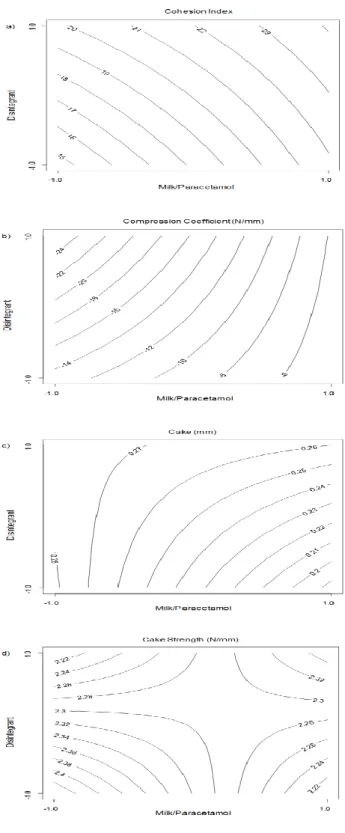
The graphical representation of these equations can be found in the supplementary material (Figure S1, Annex 4). As anticipated the equations reflect the significance found in the ANOVA and the coefficient of compaction has shown to be the best predictor to anticipate the effect of formulation changes on flowability, which was not surprising because this property itself reflects the flow of particles.
3.3. Compacts (beams). Mechanical properties of compacts (Table 4) are very sensitive to changes on the materials and processing conditions, often with antagonistic outcomes. Therefore, the lack of significance observed for the results (Table 5) was not surprising. Indeed the results are, for each group of variables, already an average of different conditions (4 groups). It follows that changes on the 3 variables did not have an impact on the properties of beams, turning the design robust from the mechanical properties measured perspective.
In general terms deformation of beams increased with the milk fraction and compaction pressure and decreased with disintegrant fraction alone or in interaction with milk fraction. The pressure alone promoted the deformation of materials but the md/MD interaction decreased deformation. The bending strength increased with the milk fraction and pressure but decreased with disintegrant fraction and interaction of pressure. The elasticity decreased (i.e., the Young’ modulus of elasticity increased) when all variables and variables interactions, increased. Finally, stiffness increased with milk fraction and pressure and decreased for all other variables and interactions (Table 5).
An increase on the disintegrant fraction resulted in a marginal decrease of deformation (-0.283x10⁻² mm) suggesting that sodium croscarmellose promoted a decrease on elasticity and eventually plasticity of the beams produced. Elasticity decreased since the Young’s modulus of elasticity has shown an increase of 0.820 GPa. The interaction (md/MD) showed a decrease of elasticity (the Young’s modulus increased by 0.809 GPa). These changes were likely to be due to the increase of the disintegrant fraction rather than to milk fraction. The bending strength, i.e., the resistance of the beams to deformation was also marginally significant to the effect of the pressure required to bend the beams (0.955 kPa, Table 5). Furthermore, the effect of elasticity was significantly negative (Young’s modulus increased by 0.968 GPa). This suggests that the compaction pressure turned the materials in the compacts less elastic. Finally, the stiffness of the compacts did not change with variables, with the
10 marginal exception of the compaction pressure, for which the stiffness increased by 0.056 N/mm (Table 5).
3.4. Minitablets. Table 6 summarizes the results of the 23 factorial design. The weight of tablets was dependent on the flow of materials, thus the fraction of milk in formulations affected the flow of powder mixtures and consequently the weight of the tablets (Table 7) in which the m/M effect and the md/MD interaction were the only significant effects. An increase on the fraction of milk improved the flowability of the mixtures for tableting and the mean weight of minitablets increased by 0.20 mg (Table 7). On the other hand, the combined effect of milk fraction and disintegrant fraction (md/MD) decreased tablet mean weight (-0.13 mg, Table 7). Nevertheless, all batches of minitablets produced complied with compendial (Pharmacopoeia, 2010) specifications for uniformity of mass for single dose preparations. The mean weight variation for all interaction was not a relevant property in tablet evaluation, with the exception of milk fraction increase.
The variables to significantly impact the thickness were the milk fraction and the pressure applied. A decrease on tablet thickness occurred (m/M) probably due to the plastic and elastic properties of milk components in contrast to paracetamol, which is a well-known problematic compacting material. Without surprise an increase on the compaction pressure (f/F) was also followed by a significant decrease on tablet thickness (-0.07 mm, Table 7). Interesting to notice the antagonist effect between the milk fraction and pressure (md/MD) for which an increase in tablet thickness was observed (0.03 mm, Table 7). Possibly the increase in pressure emphasized the elastic recovery of the materials with tablet relaxation, but further characterization should be carried out. The tensile strength of minitablets has shown a significant dependency on the fraction of milk (m/M, 0.668N/mm2, Table 7), suggesting that milk components acted as binding agents in the tablet. With small significance, the fraction of disintegrant in the formulation promoted a decrease on the tensile strength (d/D, -0.090 N/mm2, Table 7) suggesting that sodium croscarmellose was not as good binder as mannitol, or that it showed higher elasticity than mannitol or other components in the formulations. Also with modest significance was the interaction between the milk and the disintegrant fractions in which an antagonist effect was observed with a slight increase on the tensile strength (0.091N/mm2, Table 7). Interesting is to point out the lack of significance of the pressure effect (f/F) alone or in combination with the other variables (mdf/mdF) on the tensile strength of minitablets. It would be expected that the higher the pressure, the higher the tensile strength but that was not the case and probably the materials, e.g., milk components, were able to accommodate higher pressures.
11 Dissolution tests show (Figure 1) that milk rich tablets disintegrate at a much slower rate than those containing higher fractions of paracetamol. Furthermore, a significant difference is observed when 1% or 5% of disintegrant was used. When a higher fraction of croscarmellose sodium is used a t50 of 5-8 min is observed, whereas smaller fractions of
disintegrant resulted in t50 of 14-16 min. As anticipated the formulation related variables, milk
and disintegrant fractions, presented a significant impact on the release of paracetamol (MDT). The increase on milk fraction translated into a significant increase on the dissolution time of 8.40 min (Table 7), likely due to the formation of a matrix within the tablets which prevented the release of paracetamol. This matrix was formed due to the presence of milk fat (which increased the hydrophobicity of tablets) or the increase in polymeric structure (due to milk proteins) in the minitablets. On the contrary, when the fraction of disintegrant increased, the mean dissolution time decreased (-5.13 min, Table 7). This was expected as tablet disintegrated with exposure of contents, followed by a faster dissolution of paracetamol. Noteworthy is the antagonist effect between the milk and disintegrant fractions for which a decrease on the dissolution median time (-5.13 min, Table 7) was observed. Minitablets containing more paracetamol disintegrated almost instantly resulting in more than 90% drug release within the first 2 minutes of test. However, even the batches with the slowest dissolution profiles showed 80% drug release after 40 min, complying with the Pharmacopoeial monograph for paracetamol tablets (Pharmacopoeia, 2010). Pressure did not show a significant effect (p<0.869, Table 7) on the dissolution time probably because materials were able to accommodate the effect of increased pressure and, consequently, no changes were observed. Results for the dissolution tests for the different formulations are presented in Figure 1, reflecting the previous observations: an increase in milk fraction largely decreased drug release and an increase in the disintegrant fraction (from 1 up to 5%) decreased drug release. Nevertheless, even tablets with the slowest dissolution profiles showed 80% drug release after 40 min complying with the European Pharmacopoeia (2010).
From the observations the following multiple linear regression equations were proposed for the significant independent variables:
Weight (mg) = 11.888 + 0.111 M - 0.064 MD eq.5
(R2Adj =0.039, MSE= 0.273, RMSE = 0.523, F=8.222)
Thickness (mm) = 2.029 – 0.056 M – 0.034 F + 0.014 MF eq.6
(R2Adj = 0.498, MSE= 0.004, RMSE = 0.063, F=36.325)
Tensile Strength (N/mm2) = 0.599 + 0,334 M eq.7
12 t50 (min)= 6.139 + 4.199 M – 2.572 D – 2.566 MD eq.8
(R2Adj = 0.952, MSE = 1.252, RMSE = 1.120, F= 241.756)
These equations reflect the quality of each property on the evaluation of the minitablets. Weight uniformity and thickness of tablets were poor descriptors of the tablets produced, whereas the tensile strength and particularly the mean dissolution time of paracetamol were better descriptors of the independent variables, reflecting more adequately the effects of the latter on the minitablets.
4. Discussion
The design of tablets requires not only the compaction of materials but also its adequate characterization. As such, an excipient intended for direct compression when added to the formulation should produce tablets with enough tensile strength to withstand handling, a low friability, a low weight variation, a short disintegration time and a high drug dissolution rate (Taylor and Aulton, 2013).
Preliminary experiments (results not shown) have identified the relevant variables to be considered in the factorial designs. The latter have allowed to define a design space for the characterization of raw materials and production of minitablets for paediatric applications. The study reflects the complexity of the materials used, in particular powdered milk, providing unexpected results.
The flowability of raw materials was deemed important for further processing, namely mixing and filling of tablet dies. It was interesting to realize the different behaviour of raw materials in repose and after being challenged to move. Paracetamol and magnesium stearate were highly cohesive while at rest by comparison to powdered milk, mannitol and sodium croscarmellose. However, when the powder beds were challenged on measuring the coefficient of compaction, paracetamol and magnesium stearate presented high coefficients, suggesting that the movement of particles had a positive effect on their cohesion. In contrast, mannitol and sodium croscarmellose have shown a slight increase on their flowability. From a complementary perspective the ability of mannitol to form cakes was also different. Paracetamol, sodium croscarmellose and mannitol formed small cakes (in experimental conditions) unlike powdered milk. However, the cakes of sodium croscarmellose and milk were strong and difficult to break. While paracetamol and mannitol particles favour interlocking bonds due to differences on sizes and shape, milk particles are complex in nature showing
13 different sensitivity to changes on processing conditions. It can be anticipated, for instance, that milk fat and protein played a role in adhesion of particles, while lactose might have diluent and glidant effects on the all powdered milk mixtures. Upon mixing, changes on the materials, with effects not immediately related to the observations made on pure raw material, certainly occurred. In fact, results have shown that the properties of mixed raw materials were not the sum of the properties of individual powders. For instance, and in contrast to the results on cohesion, an increase on the fraction of powdered milk in the blends resulted in a lower caking tendency and a higher cohesion index, even when the paracetamol fraction (known to be difficult to flow) was decreased. It must be pointed out that either temperature or the relative humidity (experimental conditions were 21˚C and 65% RH) may not have been the optimal for the materials. In fact, cohesion and caking tendency of amorphous powders is highly dependent on environmental conditions, thus cohesiveness and cake formation must consider these conditions (Fitzpatrick et al., 2007). This is particularly relevant for powdered milk due to its complex nature. Fat content (from the milk) in the formulations have been described to promote cohesion between particles (Rennie et al., 1999), although powdered milk has shown a free flowing behaviour once processed (Özkan et al., 2002) with a positive effect on decreasing the caking tendency in paracetamol powder mixtures.
An increase on the milk fraction in formulations (m/M) largely increased the coefficient of compaction reflecting the poor flowability of static milk rich formulations. As the speed of mixing increased, milk rich formulations flowed better. Following an increase on sodium croscarmellose in the formulations (d/D) the cohesion index increased but the coefficient of compaction decreased significantly. Taking into consideration that when sodium croscarmellose fraction augmented, the fraction of mannitol diminished, the overall result was in accordance with the known behaviour of both materials. Mannitol is a slightly more free flowing material than sodium croscarmellose (Rowe et al., 2012). On the other hand, sodium croscarmellose particles do not flow so well due to their twisted and varying length fibrous morphology, although the production of this raw material minimizes the effect of these characteristics on flow (Larry et al., 2006). Overall an increase on sodium croscarmellose content in the formulations resulted in a more difficult flow but, once the blend was challenged, the flow improved with a slight increase on cake formation, though weaker in strength. Data shows that the flowability of sodium croscarmellose is dependent on flow rate, i.e., when the flow rate increases the disintegrant’s coefficient of compaction diminishes, by opposition to mannitol which has been shown more flow rate independent.
14 The model equations (1 to 4) have demonstrated that, with the exception of the strength of the cake, direct relationships between variables are observed: increase for the cohesion index and cake height and decrease for the coefficient of compaction.
Far more complex was the interaction between the milk and sodium croscarmellose fractions. Although the cohesion indexes increased for either milk or sodium croscarmellose fractions, the simultaneous increase of both (md/MD) resulted in a decrease of the cohesion index, i.e., the mixtures flowed better, but the flow was not as good as for sodium croscarmellose alone. This is likely due to the tendency of the mixture to cake with a high strength.
As anticipated, the mechanical properties of compacts in the form of beams did not provide a clear cut evidence of materials properties and, in fact, the complex nature of materials, particularly milk, prevented a more informative outcome. Deformation of beams decreased with sodium croscarmellose fraction suggesting that this material provides plasticity to the compacts, which was not reverted by the increase on milk, showing an antagonistic effect possibly due to the surrounding of sodium croscarmellose plastic fibbers by milk particles. A similar pattern was presented by the bending strength. Interesting to point out that elasticity decreased when all variables increased, suggesting interactions between the different materials.
The pattern of results for stiffness followed those obtained for deformation and bending strength which increased particularly when the milk fraction and the compaction pressure increased. The process of manufacturing powdered milk based minitablets depends on the ability of materials to flow, thus filling the dies properly, with implication on tablets weight and thickness, and on the mechanical properties of materials affecting their compactibility and compressibility into tablets, and tablet’s performance. It was without surprise that major changes on tablets weight were observed when the fraction of milk increased. In fact, formulations with higher milk fractions did have their flow increased and consequently higher die filling ability resulted in increased weight, in agreement with the results observed for measurements in dynamic conditions. On the other hand, the simultaneous increase on both sodium croscarmellose and milk fractions produced a worse flow than that observed for milk fraction increase alone. This is in good agreement with the study on powder flowability.
It was expected that an increase on the thickness of tablets would have been observed when the milk fraction increased. However, tablets showed a significant decrease on this property suggesting that milk was compressed more easily than paracetamol. This makes sense if one considers that changes observed were not due to the mechanical properties of
15 milk (e.g. plasticity, elasticity, brittleness), as discussed for the production of beams, but mostly due to flow inside the die, under pressure, namely by a better packing of milk components as compared to paracetamol.
A significant reduction on tablet’s thickness was also expected when higher pressures were applied, but that was not evident. It was discussed previously that, in combination, paracetamol and milk showed modest elasticity, which is probably the reason why only a small change on thickness was observed. It should be stressed, however, that both tablet weight variation and thickness were not good predictors of changes on tablets, as reflected by the low correlation in the equations (5 to 8) presented for these properties.
The process of compaction subjects materials to stresses and changes on their physical properties leading to deformation and breakage of particles. The properties of the final product are, therefore, dependent on the physical properties of the materials (R.C. Rowe, 1996). Accordingly, physical properties of powders influence the formation and final properties of tablets, particularly the balance between plasticity and elasticity (Malamataris et al., 1996) which will promote, or not, a large number of strong bonds between particles.
In the present work when the powdered milk fraction was increased in the formulation the tensile strength of tablets also increased. This suggests that milk components provided good binding properties to tablets, as reflected by a significant increase on the tensile strength, by opposition to paracetamol, which is known to have a poor compressibility behaviour, producing weak tablets with tendency to cap (Krycer et al., 1982) due to high elasticity and week interparticle bonding ability (Malamataris et al., 1996). The ability of milk to provide compacts has been described in dairy products in which milk components were used to promote cohesion within complex matrices (Özkan et al., 2002). Results have shown that the increase on fat contents in powdered milk composition promoted the cohesion, thus facilitating the production of milk-based tablets (Rennie et al., 1999). Additionally, the melting range of milk’s fat components (approximate 40˚C), suggests that softening, if not melting, of milk’s fat occurred in the production of tablets. Consequently this component acts as a binding agent promoting the formation of tablets (Foster et al., 2005). Once the pressure was removed, solidification, if not crystallization, of fat components promoted the formation of bonds between particles. Also of significance is that the moisture present in the materials (e.g. lactose, milk proteins) emphasized the action of fat components by localized particle dissolution of recrystallised materials once the pressure was removed (Rennie et al., 1999, Fitzpatrick et al., 2007). It is anticipated that for skimmed powdered milk the latter effect is more important than for high fat content milk in which the previous effect should be more relevant. The increase on sodium croscarmellose did have a marginal deleterious effect on the
16 tensile strength. Authors concluded (Ferrero et al., 1997) that, in spite of the significant influence of sodium croscarmellose on disintegration time, it does not play an important role in the binding of materials. Our work confirms this observation restricting the effect of sodium croscarmellose to the increase in the dissolution of paracetamol due to a smaller disintegration time of tablets. The interaction between milk and sodium croscarmellose fractions tends to be antagonic, but the effect of milk in the tablets overlapped that of the disintegrant, under these experimental conditions. Super disintegrants such as sodium croscarmellose are excipients used to promote rapid breakdown of oral solid dosage forms and because they can be present at lower concentrations in the overall formulation any possible adverse effect on flowability or compactibility is minimized (Larry et al., 2006). Therefore, it was not surprising that this work revealed similar results: on one hand the increase of croscarmellose in the formulations showed to be crucial in promoting the rapid disaggregation of the mini-tablets and on the other seems to adversely affect powder milk flowability (Fitzpatrick et al., 2007), producing lighter tablets.
As anticipated, the dissolution of paracetamol was a better predictor of formulation and processing conditions. In fact, an increase in the milk fraction led to a significant decrease on paracetamol release, likely due to the matrix effect of milk components within the structure of the tablet. This matrix was made of fat and protein components of the milk which have surrounded the particles of paracetamol preventing dissolution in the media and release from the tablets. On the contrary and as anticipated, an increase on the disintegrant fraction resulted in a decrease of the mean dissolution time of paracetamol due to a faster disintegration of tablets. It is worth to point out that in the interaction between milk and sodium croscarmellose fractions the effect of the latter was stronger as reflected by a decrease on the mean dissolution time. The magnitude of such decrease was in the same order as that observed for the single main effect (d/D). This suggests that the matrix effect discussed previously for milk, was easily disrupted in the presence of high contents of disintegrant. Overall, these observations are in good agreement with the findings that sodium croscarmellose action is concentration dependent (Iwao et al., 2013) and its effect on disintegration time is dependent on the plastic deformation capacity of the powder mixture (Ferrero et al., 1997). Regarding dissolution, the addition of higher fractions of disintegrants seems to be particularly important when powdered milk was the main component in the formulation. In fact, a marked decrease of nearly 50% in the mean dissolution time, was detected. This may be explained by the concentration-dependent croscarmellose action (Iwao et al., 2013) and by its effect in disintegration time, with the former being dependent on the plastic deformation capacity of the powder mixture (Ferrero et al., 1997).
17 It was without surprise that tensile strength and mean dissolution time were the best predictors to evaluate changes on tablets properties (Ferrero et al., 1997, Riippi et al., 1998), as confirmed by the significance and robustness of the multiple linear regression equations. These equations have shown a minimal weight variation for a center point between disintegrant and milk fractions, a decrease on tablet thickness due to compression force and milk fraction, whereas dissolution time decreased with the disintegrant fraction but increased with milk fraction.
It is known that compression forces influence tablets properties as thickness, porosity, crushing strength, friability and disintegration time (Riippi et al., 1998, Pabari and Ramtoola, 2012). However, in this study it was only possible to detect a significant influence of the compression force on the tablets’ thickness. At high pressures, crushing strength shows a tendency to level off, contrary to its increase by a power function with increasing pressure, when lower pressures are applied (Sonnergaard, 2006). It is also worth to mention that at high pressure particle deformation becomes paramount in disintegration due to hindrance of fluid penetration by further reduction of porosity (Larry et al., 2006). The former may explain why only non-significant effects for compression force increase and its respective interactions were detected in tensile strength and dissolution profile. Uniformity of weight and thickness models showed a weaker correlation with the studied variables. One possible reason for this is the fact that both responses are highly dependent on appropriate powder rheology and environmental conditions, such as humidity and temperature, which may have influenced powder characteristics (Sinka et al., 2009), preventing better correlations. Stronger models were found for the mean dissolution time and the tensile strength responses. Dissolution rate is a highly sensitive test that can be influenced by numerous factors related to the physicochemical properties of the drug substance, product formulation, manufacturing processes and dissolution testing conditions (Lee et al., 2008). The mechanical strength of a tablet depends on both formulation and processing parameters (van Veen et al., 2000). So, on one hand, it was not surprising that formulation variables correlated so strongly with the mean dissolution time and tensile strength and, on the other, it was interesting to note, as discussed before, that no quantifiable effect was found for the manufacture process.
5. Conclusions
The study has proved the ability of powdered milk to provide a suitable matrix system for drug delivery in minitablets, which can be used in paediatrics or other age groups. In fact, milk complies with the characteristics of an excipient intended for direct compression when
18 added to the formulation, producing tablets with enough tensile strength to withstand handling, with low friability and weight variation, a short disintegration time and a high drug dissolution rate.
The assessment of the flow of each excipient and respective blends revealed the complexity of interactions between materials. Increasing quantities of milk in the powder mixtures presented contradictory effects. In one hand the cohesion index increased and, on the other, the caking tendencies decreased. Differences were observed when measurements were done on static powder beds versus dynamic beds revealing the need for a balance to obtain a powder mixture with the most desirable flowability characteristics. Increasing disintegrant percentages seem to reduce powder mixtures flowability, but because they are present in low concentrations in the overall formulation any possible adverse effect on flowability is minimized. Globally the regression equations explained adequately the responses with high significance, indicating that formulation variables display a more distinguishable influence in the chosen responses than the manufacture conditions, in particular milk/paracetamol ratio which proved to be a critical variable affecting the proprieties of the final product.
Considering the results, powdered milk is a promising excipient for direct compression of poor compressible drugs. The minitablets obtained were well characterized by the tensile strength and paracetamol mean dissolution time, but the uniformities of weight and thickness were poor predictors of formulation and processing variables effects on the final product. Due to the complex nature of the materials, the mechanical behaviour of powder blends was difficult to understand, requiring further investigation.
Ackowledgments: Authors acknowledge the financial support provided by Fundação para a Ciência e a Tecnologia, Lisboa, Portugal (PTDC/DTP-FTO/1057/2012).
19 6. References
BOSCH, M. E., SÁNCHEZ, A. J. R., ROJAS, F. S. & OJEDA, C. B. 2006. Determination of paracetamol: Historical evolution. Journal of Pharmaceutical and Biomedical Analysis, 42, 291-321.
CHARKOFTAKI, G., KYTARIOLOS, J. & MACHERAS, P. 2010. Novel milk-based oral formulations: proof of concept. International Journal of Pharmaceutics, 390, 150-9.
DJURIS, J., IBRIC, S. & DJURIC, Z. 2013. 3 - Experimental design application and interpretation in pharmaceutical technology. In: DJURIS, J. (ed.) Computer-Aided Applications in
Pharmaceutical Technology. Woodhead Publishing.
EMA/CHMP/QWP/180157/2011 2011. Draft guideline on pharmaceutical development of medicines for paediactic use.pdf.
EMEA/CHMP/PEG/194810/2005 2006. Reflection paper formulations of choice for paediatric population. In: EMEA (ed.).
EUROPEAN PHARMACOPOEIA 2010. Strasbourg, Council of Europe: European Directorate for the Quality of Medicines and Healthcare.
FELL, J. T. & NEWTON, J. M. 1970. Determination of tablet strength by the diametral-compression test. Journal of Pharmaceutical Sciences, 59, 688-691.
FERRERO, C., MUÑOZ, N., VELASCO, M. V., MUÑOZ-RUIZ, A. & JIMÉNEZ-CASTELLANOS, R. 1997. Disintegrating efficiency of croscarmellose sodium in a direct compression formulation. International Journal of Pharmaceutics, 147, 11-21.
FITZPATRICK, J. J., BARRY, K., CERQUEIRA, P. S. M., IQBAL, T., O’NEILL, J. & ROOS, Y. H. 2007. Effect of composition and storage conditions on the flowability of dairy powders.
International Dairy Journal, 17, 383-392.
FOSTER, K. D., BRONLUND, J. E. & PATERSON, A. H. J. 2005. The contribution of milk fat towards the caking of dairy powders. International Dairy Journal, 15, 85-91.
FOX, P. F. & MCSWEENEY, P. L. H. 1998. Dairy Chemistry and Biochemistry, London, Blackie Academic & Professional.
IWAO, Y., TANAKA, S., UCHIMOTO, T., NOGUCHI, S. & ITAI, S. 2013. An easy-to-use approach for determining the disintegration ability of disintegrants by analysis of available surface area. International Journal of Pharmaceutics, 448, 1-8.
JIVRAJ, M., MARTINI, L. G. & THOMSON, C. M. 2000. An overview of the different excipients useful for the direct compression of tablets. Pharmaceutical Science & Technology
Today, 3, 58-63.
JUSLIN, L., ANTIKAINEN, O., MERKKU, P. & YLIRUUSI, J. 1995. Droplet size measurement: II. Effect of three independent variables on parameters describing the droplet size distribution from a pneumatic nozzle studied by multilinear stepwise regression analysis. International Journal of Pharmaceutics, 123, 257-264.
KAYUMBA, P. C., HUYGHEBAERT, N., CORDELLA, C., NTAWUKULIRYAYO, J. D., VERVAET, C. & REMON, J. P. 2007. Quinine sulphate pellets for flexible pediatric drug dosing: formulation development and evaluation of taste-masking efficiency using the electronic tongue. European Journal of Pharmaceutics and Biopharmaceutics, 66, 460-5.
KRAUSE, J. & BREITKREUTZ, J. 2008. Improving Drug Delivery in Paediatric Medicine.
Pharmaceutical Medicine, 22, 41-50.
KRYCER, I., POPE, D. G. & HERSEY, J. A. 1982. The prediction of paracetamol capping tendencies. Journal of Pharmacy and Pharmacology, 34, 802-804.
KYTARIOLOS, J., CHARKOFTAKI, G., SMITH, J. R., VOYIATZIS, G., CHRISSANTHOPOULOS, A., YANNOPOULOS, S. N., FATOUROS, D. G. & MACHERAS, P. 2013. Stability and physicochemical characterization of novel milk-based oral formulations. International
20 LANDILLON, V., CASSAN, D., MOREL, M.-H. & CUQ, B. 2008. Flowability, cohesive, and
granulation properties of wheat powders. Journal of Food Engineering, 86, 178-193. LARRY, L. A., ALBERT, W. B., UMANG, S. & HUIJEONG ASHLEY, H. 2006. Super Disintegrants:
Characterization and Function. Encyclopedia of Pharmaceutical Technology, Third
Edition. Informa Healthcare.
LEE, S., RAW, A. & YU, L. 2008. Dissolution Testing. In: KRISHNA, R. & YU, L. (eds.)
Biopharmaceutics Applications in Drug Development. Springer US.
LENNARTZ, P. & MIELCK, J. B. 1998. Minitabletting: improving the compactability of paracetamol powder mixtures. International Journal of Pharmaceutics, 173, 75-85. LETURIA, M., BENALI, M., LAGARDE, S., RONGA, I. & SALEH, K. 2014. Characterization of flow
properties of cohesive powders: A comparative study of traditional and new testing methods. Powder Technology, 253, 406-423.
LEWIS, G. A., MATHIEU, D. & PHAN-TAN-LUU, R. 1998. Pharmaceutical Experimental Design, New York, Marcel Dekker, Inc
LIVNEY, Y. D. 2010. Milk proteins as vehicles for bioactives. Current Opinion in Colloid &
Interface Science, 15, 73-83.
MALAMATARIS, S., HATJICHRISTOS, T. & REES, J. E. 1996. Apparent compressive elastic modulus and strength isotropy of compacts formed from binary powder mixes.
International Journal of Pharmaceutics, 141, 101-108.
MAMBRINI, P. & KIBLEUR, Y. 2013. Successful development of an orphan drug for the pediatric population. International Journal of Pharmaceutics, 457, 350-1.
MARTINELLO, T., KANEKO, T. M., VELASCO, M. V. R., TAQUEDA, M. E. S. & CONSIGLIERI, V. O. 2006. Optimization of poorly compactable drug tablets manufactured by direct compression using the mixture experimental design. International Journal of
Pharmaceutics, 322, 87-95.
MEURANT, G. 1995. Handbook of milk composition, San Diego, Academic Press.
ÖZKAN, N., WALISINGHE, N. & CHEN, X. D. 2002. Characterization of stickiness and cake formation in whole and skim milk powders. Journal of Food Engineering, 55, 293-303. PABARI, R. M. & RAMTOOLA, Z. 2012. Application of face centred central composite design to
optimise compression force and tablet diameter for the formulation of mechanically strong and fast disintegrating orodispersible tablets. International Journal of
Pharmaceutics, 430, 18-25.
PINTO, J. F., PODCZECK, F. & NEWTON, J. M. 1997. Investigations of tablets prepared from pellets produced by extrusion and spheronisation. II. Modelling the properties of the tablets produced using regression analysis. International Journal of Pharmaceutics, 152, 7-16.
ROWE, R.C. 1996. Mechanical Properties, Basel, Marcel Dekker, Inc.
RENNIE, P. R., CHEN, X. D., HARGREAVES, C. & MACKERETH, A. R. 1999. A study of the cohesion of dairy powders. Journal of Food Engineering, 39, 277-284.
RICHEY, R. H., CRAIG, J. V., SHAH, U. U., FORD, J. L., BARKER, C. E., PEAK, M., NUNN, A. J. & TURNER, M. A. 2012. The manipulation of drugs to obtain the required dose: systematic review. Journal of Advanced Nursing, 68, 2103-12.
RIIPPI, M., ANTIKAINEN, O., NISKANEN, T. & YLIRUUSI, J. 1998. The effect of compression force on surface structure, crushing strength, friability and disintegration time of erythromycin acistrate tablets. European Journal of Pharmaceutics and
Biopharmaceutics, 46, 339-345.
ROWE, R. C., SHESKEY, P. J., COOK, W. G. & FENTON, M. E. 2012. Handbook of Pharmaceutical
Excipients, London, Pharmaceutical Press and American Pharmacists Association
SALUNKE, S., GIACOIA, G. & TULEU, C. 2012. The STEP (safety and toxicity of excipients for paediatrics) database. Part 1-A need assessment study. International Journal of
21 SINKA, I. C., MOTAZEDIAN, F., COCKS, A. C. F. & PITT, K. G. 2009. The effect of processing
parameters on pharmaceutical tablet properties. Powder Technology, 189, 276-284. SONNERGAARD, J. M. 2006. Quantification of the compactibility of pharmaceutical powders.
European Journal of Pharmaceutics and Biopharmaceutics, 63, 270-277.
STOLTENBERG, I. & BREITKREUTZ, J. 2011. Orally disintegrating mini-tablets (ODMTs)--a novel solid oral dosage form for paediatric use. European Journal of Pharmaceutics and
Biopharmaceutics, 78, 462-9.
TAYLOR, K. M. G. & AULTON, M. E. 2013. Aulton's Pharmaceutics: The Design and Manufacture
of Medicines.
THOMSON, S. A., TULEU, C., WONG, I. C., KEADY, S., PITT, K. G. & SUTCLIFFE, A. G. 2009. Minitablets: new modality to deliver medicines to preschool-aged children. Pediatrics, 123, e235-8.
THOORENS, G., KRIER, F., LECLERCQ, B., CARLIN, B. & EVRARD, B. Microcrystalline cellulose, a direct compression binder in a quality by design environment—A review. International
Journal of Pharmaceutics.
VAN RIET-NALES, D. A., DE NEEF, B. J., SCHOBBEN, A. F., FERREIRA, J. A., EGBERTS, T. C. & RADEMAKER, C. M. 2013. Acceptability of different oral formulations in infants and preschool children. Archives of Disease in Childhood, 98, 725-31.
VAN VEEN, B., VAN DER VOORT MAARSCHALK, K., BOLHUIS, G. K., ZUURMAN, K. & FRIJLINK, H. W. 2000. Tensile strength of tablets containing two materials with a different compaction behaviour. International Journal of Pharmaceutics, 203, 71-79.
WALSH, J., BICKMANN, D., BREITKREUTZ, J. & CHARIOT-GOULET, M. 2011. Delivery devices for the administration of paediatric formulations: overview of current practice, challenges and recent developments. International Journal of Pharmaceutics, 415, 221-31.
WHO 2010. Development of paediatric medicines: points to consider in pharmaceutical development.
WHO 2013. 4th Model List of Essential Medicines for Children's.
ZHAN, X., LIANG, X., XU, G. & ZHOU, L. 2013. Influence of plant root morphology and tissue composition on phenanthrene uptake: Stepwise multiple linear regression analysis.
Environmental Pollution, 179, 294-300.
ZHANG, M., MOORE, G. A., GARDINER, S. J. & BEGG, E. J. 2006. Determination of celecoxib in human plasma and breast milk by high-performance liquid chromatographic assay.
Journal of Chromatography B-Analytical Technologies in the Biomedical and Life Sciences, 830, 245-248.
22 Supporting information: this manuscript contains the following support information:
Annex 1: Tables related to the design of the factorial design experiments
Table S1: Independent variables and their levels in the full factorial designs Table S2: Complete matrices for the full factorial designs
Table S3: Formulations and compaction pressures according to the design matrices
Annex 2: Definitions of powder’s properties
Annex 3: Equations considered in the study
Annex 4: Figures produced from the multiple linear regression analysis
Figure S1: Graphical representation of the multiple linear regression equations (powder blends).
Figure S2: Graphical representation of the multiple linear regression equations (minitablets).
23 Figure 1: Dissolution profiles of the different batches of minitablets
(a) minitablets produced using 73 MPa: mdf (), Mdf (), mDf () and MDf () and (b) minitablets produced using 178 MPa: mdF (), MdF (), mDF () and MDF ()
24 Table 1: Properties of powdered raw materials a)
Substance Cohesion indexb)
(J/g) Coefficient of compression (N/mm) Cake height (mm) Cake strength (N) Paracetamol 41.4 ± 3.60 - 49.1 ± 8.30 0.26 ± 0.01 2.05 ± 0.04 Milk 19.1 ± 1.10 7.95 ± 1.40 0.00 ± 0.00 0.00 ± 0.00 Mannitol 8.27 ± 0.80 - 4.90 ± 2.19 0.25 ± 0.01 1.45 ± 0.30 Sodium croscarmellose 10.1 ± 1.85 - 22.17 ± 6.97 0.08 ± 0.01 1.76 ± 0.16 Magnesium stearate 37.8 ± 2.56 - 40.81 ± 0.32 0.09 ± 0.00 2.45 ± 0.13 a) n=3 b)
25 Table 2: Properties of powdered blends of raw materials according to a 22 factorial design a)
Factor Cohesion indexb) (J/g) Coefficient of compaction (N/mm) Cake height (mm) Cake strength (N/mm) md 14.56 ± 1.23 -13.2 ± 1.62 0.28 ± 0.03 2.44 ± 0.07 Md 21.80 ± 2.05 -4.44 ± 4.30 0.19 ± 0.03 2.20 ± 0.17 mD 20.42 ± 2.10 -23.6 ± 7.83 0.28 ± 0.02 2.24 ± 0.13 MD 24.15± 1.92 -4.64 ± 2.07 0.25 ± 0.03 2.33 ± 0.09 a) n=3 b)
26 Table 3: Evaluation of the results for different properties of powdered blends of raw materials according to the 22 factorial design by ANOVA a)
Factor increased Cohesion Index (J/g) Coefficient of compaction (N/mm) Cake Height (mm) Cake Strength (N) Mean Effect MSq b) Fc) / Sig. Mean Effect MSq b) F c) / Sig. Mean Effect MSq b) F c) / Sig. Mean Effect MSq b) F c) / Sig. m/M 17.2 / 22.9 5.75 114 44.3 / .000 -19.4 / -5.08 14.37 6E7 41.6 / .000 0.277 / 0.223 -.054 .010 12.1 / .000 2.32 / 2.28 -.043 .433 41.5 / .296 d/D 18.2 / 22.0 3.79 57.9 22.5 / .000 -8.81 / -15.7 -6.90 1E7 9.83 / .000 0.233 / 0.267 .034 .004 5.47 / .011 2.32 / 2.28 -.045 .433 41.5 / .296 md/MD 20.8 / 19.3 -1.50 24.9 9.66 / .001 -15.0 / 9.46 5.62 9E5 6.67 / .002 0.230 / 0.269 .039 .006 6.86 / .004 2.20 / 2.39 .190 .535 51.3 / .000 a) n=3 b) MSq – Mean Square c)
27 Table 4: Properties of beams made of powdered raw materials according to the 23 factorial design a)
Factor Deformation (x 10-2 mm) Bending strength (KPa) Young’s modulus (GPa) Stiffness (N/mm) mdf 2.54 ± 0.48 6.42 ± 0.89 9.37 ± 0.72 0.40 ± 0.04 Mdf 2.23 ± 0.61 5.84 ± 0.64 9.64 ± 2.19 0.36 ± 0.04 mDf 1.90 ± 0.55 5.59 ± 1.27 11.03 ± 0.21 0.37 ± 0.10 MDf 2.31 ± 0.38 6.38 ± 0.90 10.61 ± 1.69 0.42 ± 0.06 mdF 2.48 ± 0.38 6.73 ± 1.22 10.12 ± 0.71 0.44 ± 0.05 MdF 2.47 ± 0.98 8.66 ± 2.94 11.82 ±1.32 0.47 ±0.17 mDF 1.98 ± 0.38 5.89 ± 1.29 11.71 ± 0.88 0.43 ± 0.09 MDF 2.40 ± 0.71 6.77 ± 1.75 10.87 ± 0.76 0.42 ± 0.10 a) n=5
28 Table 5: Evaluation of the results for different properties of beams made of powdered blends of raw materials by ANOVA a)
Factor Deformation (x10-2 mm) Bending strength (kPa) Young’s modulus (GPa) Stiffness (N/mm) Mean Effect MSqb) (x10-4) Fc) / Sig. Mean Effect MSq b) F c) / Sig. Mean Effect MSq b) F c) / Sig. Mean Effect MSq b) F c) / Sig. m/M 2.23 / 2.36 0.128 4.10 1.26 / .293 6.16 / 6.91 0.754 3.76 1.77 / .182 10.56 / 10.73 0.175 .383 .269 / .766 0.409 / 0.417 0.007 .001 .123 / .884 d/D 2.43 / 2.15 -0.283 8.16 2.51 / .092 6.91 / 6.16 -0.756 3.85 1.81 / .175 10.23 / 11.05 0.820 4.31 3.02 / .058 0.415 / 0.410 -0.005 .001 .099 / .906 md/MD 2.44 / 2.15 -0.289 8.13 2.50 / .093 6.58 / 6.49 -0.084 .378 .178 / .838 10.24 / 11.05 0.809 4.15 2.91 / 0.64 0.419 / 0.407 -0.012 .001 .192 / .826 f/F 2.25 / 2.34 0.086 3.57 1.10 / .342 6.06 / 7.01 0.955 5.85 2.75 / .074 10.16 / 11.13 0.968 5.90 4.14 / .022 0.385 / 0.441 0.056 .019 2.53 / .091 mf/MF 2.33 / 2.25 -0.074 3.49 1.07 / .351 6.86 / 6.21 -0.647 2.88 1.35 / .268 10.77 / 10.52 0.251 .574 .402 / .671 0.414 / 0.412 -0.003 .001 .085 / .919
29 df/DF 2.29 / 2.29 -0.003 3.14 .966 / .388 6.84 / 6.23 -0.608 2.59 1.22 / .305 10.89 / 10.40 0.496 1.677 1.18 / .318 0.425 / 0.401 -0.023 .004 .499 / .610 mdf/MDF 2.25 / 2.33 0.744 3.52 1.08 / .347 6.23 / 6.84 0.606 2.60 1.22 / .304 10.41 / 10.88 0.464 1.477 1.36 / .363 0.395 / 0.430 0.035 .008 1.04 / .363 a) n=5 b) MSq – Mean Square c)
30 Table 6: Properties of minitablets made of powdered raw materials according to the 23 factorial design
Factor Uniformity of weight a) (mg)
Thickness b) (mm)
Tensile strength c) (N/mm2)
Mean Dissolution Time d) (t50 / min) mdf 11.68 ± 0.65 2.14 ± 0.07 0.35 ± 0.18 2.1 ± 0.08 Mdf 12.10 ± 0.39 1.99 ± 0.06 0.89 ± 0.37 15.48 ± 2.11 mDf 11.81 ± 0.54 2.14 ± 0.07 0.13 ± 0.10 1.94 ± 0.24 MDf 11.95 ± 0.60 2.01 ± 0.06 0.91 ± 0.31 5.12 ± 1.22 mdF 11.76 ± 0.57 2.04 ± 0.05 0.37 ± 0.21 1.88 ± 0.26 MdF 11.99 ± 0.48 1.96 ± 0.05 0.97 ± 0.26 15.58 ± 0.71 mDF 11.90 ± 0.64 2.05 ± 0.07 0.22 ± 0.18 2.05 ± 0.06 MDF 11.89 ± 0.45 1.96 ± 0.06 0.96 ± 0.24 5.40 ± 0.94 a) n=20 b) n=6 c) n=6 d) n=3
31 Table 7: Evaluation of the results for different properties of minitablets made of powdered blends of raw materials by ANOVA
Factor Mean weight
(mg)
Thickness (mm)
Mean tensile strength (N/mm2)
Mean dissolution time (min) Mean Effect MSq F / Sig. Mean Effect MSq F / Sig. Mean Effect MSq F / Sig. Mean Effect MSq F / Sig. m/M 11.8 / 12.0 0.20 3.18 10.61 / .001 2.09 / 1.98 -0.11 .299 77.7 / .000 0.265 / 0.933 0.668 10.71 182 / .000 1.99 / 10.4 8.40 610 684 / .000 d/D 11.9 / 11.9 0.01 .004 .013 / .911 2.03 / 2.04 0.01 .001 .277 / .600 0.644 / 0.554 -0.090 .192 3.27 / .074 8.76 / 3.63 -5.13 227 255 / .000 md/MD 11.9 / 11.8 -0.13 1.31 4.381 / .037 2.04 / 2.04 0.00 .000 .004 / .948 0.553 / 0.645 0.091 .202 3.44 / .067 8.76 / 3.63 -5.13 228 256 / .000 f/F 11.9 / 11.9 0.00 .000 .000 / .992 2.07 / 1.96 -0.07 .112 29.1 / .000 0.568 / 0.630 0.063 .094 1.59 / .210 6.16 / 6.23 0.068 .039 .044 / .869 mf/MF 11.9 / 11.9 -0.08 .570 1.900 / .169 2.02 / 2.05 0.03 .018 4.71 / .033 0.596 / 0.602 0.005 .001 .011 / .917 6.16 / 6.25 0.123 .130 .146 / .706
32 df/DF 11.9 / 11.9 0.01 .014 0.046 / .830 2.04 / 1.96 -0.00 .000 .004 / .948 0.592 / 0.606 0.014 .004 .076 / .784 6.13 / 6.26 0.128 .141 .158 / .694 mdf/MDF 11.9 / 11.9 0.01 .005 .018 / .894 2.04 / 2.03 -0.01 .002 .433 / .512 0.611 / 0.587 -0.024 .013 .228 / .634 6.21 / 6.17 -0.038 .012 .014 / .908 MSq – Mean Square
33 Annex 1: Tables related to the design of the factorial design experiments
Table S1: Independent variables and their levels in the full factorial designs a
Factor Variables Levels Low (-) High (+) Beam s and M in itabl et s P o wder m ix tures
Milk / Paracetamol ratio m/M 20/80 80/20
Disintegrant (%) d/D 1 5
Compression pressure (GPa) f/F 73 178
a
34 Table S2: Complete matrices for the full factorial designs a
(22 for mixtures of powders and 23 for beams and minitablets)
Factorsb Variables’ levels Variables’ interactions c M D F MD MF DF MDF B ea ms an d Min ita b le ts Po w d er m ixtu re s (1) - - - + + + - Mdf + - - - - + + mDf - + - - + - + MDf + + - + - - - mdF - - + + - - + MdF + - + - + - - mDF - + + - - + - MDF + + + + + + + a
Shadowed area represents the formulations considered in the studies for the blends of powders. b
m/M, d/D and f/F represent milk content, sodium croscarmellose content and compression pressure at low and high levels, respectively.
c
35 Table S3: Formulations and compaction pressures according to the design matrices a
Factors
Formulation (%) Compression
Pressure (MPa)
Paracetamol Milk Sodium
croscarmellose Mannitol Magnesium stearate B ea ms an d Min ita b le ts Po w d er m ixtu re s (1) 64 16 1 18 1 73 Mdf 16 64 1 18 1 73 mDf 64 16 5 14 1 73 MDf 16 64 5 14 1 73 mdF 64 16 1 18 1 178 MdF 16 64 1 18 1 178 mDF 64 16 5 14 1 178 MDF 16 64 5 14 1 178 a