How to Grow, Create and
Capture Value in
Domestic and
International Markets
Luis Filipe Lages
Working Paper
# 599
HOW TO GROW, CREATE AND CAPTURE VALUE IN DOMESTIC AND INTERNATIONAL MARKETS?
Luis Filipe Lages a, b a
Nova School of Business and Economics, Lisbon, Portugal b
Massachusetts Institute of Technology, Cambridge, MA, USA
NOVA SBE WORKING PAPER December 2015
– Do not use or distribute without permission – Copyright 2015
The development of the Frameworks presented in this working paper took two decades. Many contributed in different forms throughout these 20 years. I start by acknowledging the support of the MIT-Portugal program, while a Visiting Scholar at the MIT Deshpande Center for Technological Innovation (2007, 2015) and while a Visiting Faculty at MIT Sloan School of Management (2010). Special acknowledgements should be addressed to Carlos R. Marques (ISEGI), Carmen Lages (Nova SBE), Charles Cooney (MIT), Dava Newman (NASA, MIT), Fernanda Lussa (FCT), Fionna Murray (MIT), Frank Piller (RWTH Aachen University/MIT), John Huffstot (Nova SBE), José A. Girão (Nova SBE), Ken Zolot (MIT), Manuel Nunes da Ponte (FCT), Nuno Catarino (Deimos), Philip Kim (Babson College), Richard Hartmann (University of Applied Sciences Aschaffenburg), and Sara Jahanmir (Nova SBE, MIT). I also thank Christian Whimmler (MIT Portugal), Douglas Hart (MIT), Felipe Calabria (MIT Portugal), Frank Piller (RWTH Aachen University & MIT), James Uterback (MIT), Jan Bell (Babson Globe), Koh Foo HAU (National Research Foundation Singapoure), Márcio Felizardo (Nova SBE), Michael A. Cusumano (MIT), Jeff Karp (The Karp Lab & Harvard University), Paulo Gomes (Babson College, Florida International University), Ricardo Greenfield (MIT Portugal), Scott Stern (MIT), Steven Eppinger (MIT) and Vânia Fonseca (Nova SBE) for their comments on earlier versions of the frameworks. I would like to thank Bob Langer (MIT), Isabel Rocha (Minho University), Lino Ferreira (MIT, CNC/Biocant), Luis Perez Brava (MIT), Miguel Prazeres (IST), and Pedro Saraiva (Coimbra University) for the input provided on the BioRuber case. Finnaly, I acknowledge all the students and executives who contributed during the last two decades with many insights for both frameworks.
Send correspondence to Luis Filipe Lages, Nova School of Business and Economics, Universidade Nova de Lisboa, Faculdade de Economia, Campus de Campolide, 1099-032 Lisboa, Portugal ([email protected].) Phone: + 351.21.3801.600, http://www.lflages.com.
2/11
Abstract
The Value Creation Framework (VCF) and the BeGloCal Framework are independent yet complementary tools that can be used by executives, engineers, scientists and entrepreneurs to bring new ideas, goods, technology, science, and services to the domestic and international markets. In order to grow, create and capture value, they have to deal with a variety of complex choices that can create tensions and to adjust their challenging go-to-market strategies to limited resources and time-frames. Moreover, they have to capture in a simpler manner the attention of potential stakeholders and investors.
The VCF and BeGloCal Framework, which emerged from two decades of close-work with companies and academia, present circular, structured yet flexible, quick and efficient ways to bring ideas, goods, technology, science, and services to the market, while dealing with the technology-push and market-pull, global and local paradoxes. These frameworks can aid in decision making through exploring new ideas and new markets while facilitating choice reduction, by creating value while simplifying processes, by helping to manage team cognitive conflict while avoiding affective conflict, and by addressing economies of scale while satisfying local needs.
Keywords: Value Creation Framework; BeGloCal Framework, Value Creation Radar, GloCal Radar, Global and Local Vision; Diffusion of Ideas; Technology, Science, and Services Transfer; International Marketing; Decision Making Tool
3/11
1. Introduction
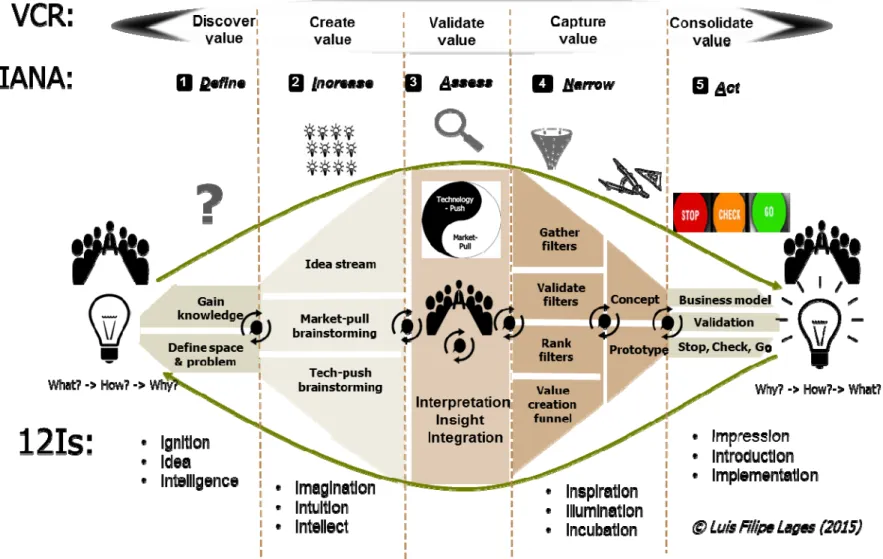
This paper presents the Value Creation Framework (VCF) and the BeGloCal Framework. The VCF allows for moving from an abstract product/idea (i.e. products, patents, technologies, goods, services, ideas, concepts, and persons) to a specific market application. The BeGloCal Framework promotes the growing process and the move from a clear specific market application to the (international) market with the highest potential. Both frameworks enable companies, managers, professionals, entrepreneurs, scientists, and researchers to capitalize on their products/ideas, create and capture added value, and grow in domestic and international markets. Very often organizations, science labs, and start-ups are slow to market their ideas and locate the right market opportunity in domestic and/or international markets. In some cases, despite investing considerable time and resources in R&D, the final product languishes on the shelf. This situation occurs because the agents do not have an adequate tool that helps them to deal with the paradox of choice. Facing this predicament, managers, scientists, and entrepreneurs tend to follow a go-to-market approach that is rigidly based on strict planning or, alternatively, an approach that is unstructured and relies on constant improvisation. In this paper I present two frameworks, the Value Creation Framework (VCF) (Figure 1) and the BeGloCal framework (Figure 2), both of which address these challenges. As shown in Figure 1, the VCF consists of five Phases (DIANA) composed of 12Is. The BeGloCal framework presented in Figure2 also has five Phases (TIAGO) composed of 8 Steps (BEGLOCAL). In both frameworks, the steps do not need to be followed in order but are presented here sequentially in order to facilitate clarity in their operationalization.
The reader may wonder, why add two more models? Four major reasons are the following: First, there is a need for structured approaches that are prepared to mold innovation to internal and external constraints (Christensen 2013). Managers suffer constant pressure toward both planning and improvisation. In innovation and new product development, the tension in this duality becomes even more obvious when the composition and execution of strategy occur simultaneously (Moorman and Miner 1998). As such, the VCF and BeGloCal Framework present a dynamic approach closer to reality. They could be seen as “flexible stage-gate models”, which follow a cyclical process, naturally repeating and inter-related with the environment. Contrary to purely linear models (i.e., those comprising isolated steps and lacking repetition), in this cyclical
4/11 approach it is expected to build on an effects loop in which the process becomes clearer, more defined, and more pronounced. This effects loop can be applied to the whole process and/or within each of the individual phases as well.
Second, there is a need for tools that provide teams with a systematized route to deal with the paradox of choice. Empirical evidence demonstrates that the variety of choice can be demotivating and might create tensions (Iyengar & Lepper, 2000; Schwartz, 2004). In the presence of (almost) unlimited possibilities to bring an idea to the domestic and/or international markets, the frameworks we discuss can help to decide among a variety of complex options to increase value. Teams can thereby be aligned in terms of cognitive conflict, avoid affective conflict, and consequently select the solution with the greatest potential for entering the market as quickly as possible.
Third, there is a need for frameworks that are adaptable to available resources and existing time frames. While having an helicopter or bird’s-eye view of both frameworks, depending on the time and financial resources available, these frameworks might be explored in more or less detail, as needed.
Fourth, there is a need for easy-to-use tools to discover the “Why” in a simpler manner (Sinek 2009) that helps to quickly capture the attention of potential stakeholders and investors. The VCF and BeGloCal frameworks help scientists, engineers, managers, and entrepreneurs to make the perfect bridge between the WHAT (i.e. technology, patent, science, services) and the WHY (i.e. why there is a need, a market pain, a problem) in a specific market, while explaining the HOW to achieve a solution (i.e. prototype, business model). This will help to better understand the value that has been created in the market, have a much stronger business model, and clear elevator pitch. By finding and starting with the “Why”, CEOs, business angels, venture capitalists, and public funds will be more predisposed to invest in these projects. Since both frameworks help to focus on the market need and solution with the greatest potential, this information can be used to justify the allocation of funds required for R&D projects.
2. The Value Creation Framework (VCF)
Regarding the VCF, at a less profound level of observation, a Value Analysis is conducted at five levels – Discover, Create, Validate, Capture, and Consolidate. This type of analysis is presented as the Value Creation Radar (VCR). To do this I use the five DIANA phases: Define, Increase, Assess, Narrow, and Act (see Figure 1). At a profound level of observation, I recommend the use
5/11 of the 12Is, not discussed in this working paper. The 12Is include Define (Ignition, Idea, Intelligence), Increase (Imagination, Intuition, Intellect), Assess, Narrow (Inspiration, Illumination, Incubation), and Act (Impression, Introduction, Implementation), and include a wide range of new and established instruments and methodologies that have been tested several times in long-term projects. The 15Is include three additional IS (Interpretation, Insight, Integration) used in the Assess phase to validate te projects inside and/or with the cooperation of firms.
3. The BeGloCal Framework
Regarding the BeGloCal Framework, at a less profound level of observation, a GloCal Analysis is conducted at five levels – Space, Funnel, Validation, Value, and Wave. This type of analysis is presented as the GloCal Radar. To do this I use the five TIAGO phases: Territory, Illumination, Assess, Ground, Opportunity (see Figure 2). At a profound level of observation, I recommend the use of the BeGloCal Steps, not discussed in this working paper. The BeGloCal steps consist of Territory (Background and Engagement), Illumination (Global Funnel and Local Funnel), Assess, Ground (Orientation and Creating Value), and Opportunity (Adaptation and Launch), and include a wide range of new and established instruments and methodologies that have been tested several times in long-term projects. Three additional IS (Interpretation, Insight, Integration) are used on the Assess phase to validate the projects inside and/or with the cooperation of firms.
4. The Poker Method
The development of the VCF and BeGloCal Framework is the result of over 20 of R&D combining both theoretical development and managerial practice. Over the years, different phases have gradually appeared. These phases should not be seen as sequential, but rather as part of an agile framework for Value Analysis. In the words of an executive they can be seen as “a structured circular approach” that allows one to start with an idea (which teams often expect will be the final one) and then go back, to rethink it over and over again until becoming happy with the final output.
Each of the five phases in both frameworks was refined several times with executives, academics, students, and across five continents. In order to receive and give feedback in a structured way to the five phases of the framework, the teams are encouraged to apply the “poker method” (Figure 3). The poker method is based on the principle that nothing is written in stone and during the whole VCF process there is a constant need to gather additional primary and secondary data. The
6/11 poker method was jointly developed with Richard Hartmann and consists of optimizing the feedback process by analyzing the existing outputs: 1- Inform (“bet”), 2- Review (“check”), 3- Keep (“call”), 4- Multiply (“raise”), and 5- Kill (“fold”).
5. The use the frameworks in academia
During the last decade the frameworks have been discussed and purified with Executives, EMBA, MBA, Undergraduate, Masters, Doctoral students and Researchers. The schools that have included the VCF, VCR or some of its tools, into their programs are specialized in Accounting/Finance, Business, Biotechnology/Chemistry, Law, Engineering, Medicine, Social Sciences, Sciences, Technology, and Tourism and are spread across the globe: Austria, Armenia, Belgium, China, Cyprus, Finland, France, Germany, Portugal, Slovenia, South Korea, Spain, UK, and USA. Innumerable projects have been developed in the last two decades to find new markets in a wide range of industries and services: e.g. aerospace, agriculture, arts, automotive, biology, bioengineering, biological chemistry, chemistry, consultancy, defense, beverages, energy, engineering design, entertainment, banking, government (national and local), health, higher education, hotels, incubation cities, fab-labs, law, manufacturing, mobile apps, mobility, nanotechnology, NGOs, plant sciences, recycling, retailing, start-ups, technology, transportation systems, and water purification.
Depending on the context, the frameworks are presented in different formats. The short formats (i.e. VCR and GloCal Radar) build on the main ideas and presents an overview of the frameworks. This format is normally designed for three and a half or four day intensive courses. It works very well with executives, EMBA, Part-Time MBA, and in-house training courses in which the participants have considerable experience and time limitations. The longer format is designed for half-semester or one-semester courses and builds on the 15IS or BeGloCal Steps using an intermediate level of detail . This type of format is typically used in undergraduate, Master, MBA, and PhD programs. The impact on participants has been significant, contributing in some cases to receiving well recognized Innovation/Entrepreneurship awards (e.g. EDP/Richard Branson award), helping the winning teams to build successful start-ups and move to the next level in terms of fund raising in Silicon Valley (e.g. Emove Waves).
6. The use frameworks in companies
Both frameworks were tested across a wide range of scenarios, from award winning start-ups to Fortune 500 companies, from leading consultancy firms to worldwide exporters, from
lab-7/11 projects to incubation cities, from not-for-profit organizations to governments. Projects have been developed across the world for organizations such as Altran, Air Products, Elecnor Deimos, everis, Eurocopter/Airbus Helicopters, GDF Suez, Gemalto, INCM, MIT Langer Lab, Renova, thecamp, and Rio Tinto Alcan. Many of the developed ideas, products and/or services have already been launched in the marketplace.
Due to non-disclosure agreements (NDAs), it is not possible to go into details of specific projects undertaken within companies. Nevertheless, managers across different industries have been expressing the usefulness of these frameworks when bringing their ideas, services, science, and technologies to the market. In addition to this positive impact at the firm level, there is a wide range of opinions that can be shared in this paper. For example, according to the manager of a German industrial firm, due to fact of being a “highly structured approach, it is very important for this conservative industry because it helps to show the customers a step by step approach to a new product.” Similarly, the partner of a Portuguese law firm mentioned that the VCF allowed them to change their approach to the market. She mentioned: “we used to try to find clients that could be interested in our knowledge and then we would go to the market to find them. Indeed, we used to make an unconscious funnel. Now it is different. Now we are conscious about how to approach them and we have things more structured.”
Finally, the frameworks also allow for creating new markets. For example, a managing director of a French biotech firm mentioned that his industry is focused on products with limited number of technical attributes and corresponds to a niche market. The frameworks could be “helpful to identify high value creation topics that could be not focused on easy-copy technical points and permit us to swim in a blue ocean.” Similarly, the partner of an Angolan firm mentioned: “We used to do a kind of a funnel but we would finish in markets that are really red oceans. (…) Now, I realized that there is no point to try to compete with the big ones. We will try to run away from the sharks. I realized that the advantage for our firm should rely on doing precisely the opposite. I will invest in the skills that the sharks do not have, I will build on competitors’ weaknesses, to see if I can build my blue ocean.”
7. Conclusion
An MIT Professor who is an inventor, co-founder, and board member of three venture funded companies, when commenting on an earlier version of this work, said: “As an individual you might have some ideas where to start searching for a lost airplane in the Ocean. However, if you
8/11 develop a process for a group searching for airplanes, it becomes much stronger to argue where you should start searching”. These frameworks are structured, yet flexible, tools to build on an idea like searching for airplanes in the Ocean. In addition to ideas, it can also help to bring service, science, and technology to the market. Contrary to several frameworks in the fields of marketing, technology, innovation, and entrepreneurship, which tend to lack flexibility, be biased either toward the market or the technology, be biased toward economies of scale or adaptation to local markets, these frameworks combine principles of international business, marketing, new product development (NPD), technology-transfer, and technology-based innovation, and can therefore be applied across fields. Because the tools are structured and yet flexible, they give room to creativity and promote affective conflict within teams, with the final goal of bringing ideas, science, technologies, and products/services to the marketplace with success. Contrary to the traditional approaches of “ticking the boxes”, both frameworks build on adaptive innovation. This makes it possible to implement across different countries. To conclude, the next time you and your team apply the VCF, VCR, the BeGloCal Framewok, BeGloCal Radar, I hope that your opinion will fall right into line with that of the director of a technological company who recently commented that it is “a quick and efficient way to bring our ideas to the market while getting the team deeply involved in the process.”
8. References
Christensen, C. (2013). The innovator's dilemma: When new technologies cause great firms to fail. Harvard Business Review Press.
Iyengar, Sheena S. & Lepper, M. R. (2000). When choice is demotivating: Can one desire too much of a good thing?, Journal of Personality and Social Psychology, 76: 995-1006.
Moorman, C. & Miner, A. S. (1998). The convergence of planning and execution: improvisation in new product development. Journal of Marketing, 1-20.
Schwartz, B. (2004). The paradox of choice: Why more is less. January, New York: Ecco. Sinek, S. (2009). Start with why: How great leaders inspire everyone to take action. Penguin.
10/11 Figure 2: The GloCal Radar and BeGloCal Framework - Be Global, Be Local
11/11 Figure 3: The Poker Method: Brainstorming and Getting Feedback on Your Ideas
Nova School of Business and Economics
Faculdade de Economia Universidade Nova de Lisboa Campus de Campolide 1099-032 Lisboa PORTUGAL Tel.: +351 213 801 600