Purges of 1964 and anticorruption discourse in the caricature
by mainstream press
Abstract This article addresses the visual and verbal discourses of mainstream press in the context of the 1964 Brazilian Coup, with an emphasis on the ‘secondary target’ of the purges undertaken by the new regime, namely, corruption. The study analyzes the role played by periodicals – especially caricatures – in building representations that provided the dictatorship with support, mainly regarding the fight against corruption. In order to adequately approach the object, we try to grasp the political aims and discursive manipulations of the players involved, who were often driven by reasons very far from fighting against corruption. Keywords: Caricature; Politics; Dictatorship; Brazil – History – 1964 ‐ 1985. Rodrigo Patto Sá Motta Ph.D. in Economic History from the University of São Paulo. Professor at the Federal University of Minas Gerais. Brazil [email protected] Translator Evandro Lisboa Freire Translator and copy editor in English and Spanish. MA in Applied Linguistics (PUC‐SP). Specialist in Translation (UNIBERO). Brazil [email protected] How to cite this article: MOTTA, Rodrigo Patto Sá. Purges of 1964 and anticorruption discourse in the caricature by mainstream press. Revista Tempo e Argumento, Florianópolis, v. 8, n. 18, p. 488 ‐ 518. maio/ago. 2016. Original title: Os expurgos de 1964 e o discurso anticorrupção na caricatura da grande imprensa. DOI: 10.5965/ 2175180308182016009 http://dx.doi.org/10.5965/ 2175180308182016009
Os expurgos de 1964 e o
discurso anticorrupção na
caricatura da grande imprensa
Resumo Este artigo aborda os discursos visuais e verbais da grande imprensa no contexto do Golpe de 1964, com ênfase no “segundo alvo” dos expurgos empreendidos pelo novo regime, qual seja, a corrupção. O estudo analisa o papel dos periódicos – em especial das caricaturas – na construção de representações que sustentaram a ditadura, notadamente no que se refere ao combate à corrupção. Para abordar adequadamente o objeto, busca‐se perceber os interesses políticos e as manipulações discursivas dos atores envolvidos, que muitas vezes foram movidos por razões bem distantes da luta contra a corrupção. Palavras‐chave: Caricaturas; Política; Ditadura; Brasil ‐ História ‐ 1964‐1985.
Introduction
This article derives from academic research in progress whose focus are the
representations constructed by the mainstream press about the military regime1. It aims
to grasp the relations between news companies from the Rio‐São Paulo axis and the
dictatorship. All major media companies – except Última Hora – chose to support the
military intervention, contributing to set up the outstanding civilian support conquered by the 1964 coup participants. However, the press support did not mean lack of criticism and disagreement with the new holders of power. During the long‐lived Brazilian dictatorship, there were episodes of tension involving some major media companies and
1 The research is funded by the Brazilian National Council for Scientific and Technological Development
(CNPq), through productivity grant, and it also relied on resources from the Minas Gerais State Foundation for Research Support (FAPEMIG).
the State. At such times, in general, the crises involved the boundaries between devotion to order and love of freedom, in other words, the definition of the degree of State
authoritarianism that the press regarded as tolerable – and needed – to fight against
threats to order.
The mainstream media supported the purges (in some cases it even required them) and the authoritarian actions regarded as fair to fight against the left‐wing and ensure the maintenance of social and economic order. However, at the same time, it did not want that authoritarianism implied constraints on its freedom, thus it disagreed with censorship. Most of the newspapers were in line with the ‘liberal’ wing of the 1964 supporters, sectors that combined their love of freedom to a remarkable commitment to authoritarian interventions to protect the status quo. Hence, the relations between the press and the State throughout the dictatorship years were marked by complexities and ambiguities, ranging from enthusiastic support to criticism, a situation similar, in fact, to other sectors of society.
In this article, the focus lies on the representations of purges by the press, one of the permanent and defining actions taken by the authoritarian regime. We address, especially, the early months of the new regime, when the ‘cleaning operation’ set the tone of the inaugural procedures of the dictatorship. It is key to study carefully this initial time, because the primary lines of the new political regime were defined there, including the construction of its pair of main enemies (and targets): subversion (more precisely, communism) and corruption. The text emphasizes the second theme, in order to show the role played by the press and caricatures in constructing the representations of corruption and its place in the discourses of foundation and legitimation of the dictatorship. We particularly approach two landmark cases in the fight against corruption, where stellar figures of the Brazilian political universe were at stake: Juscelino Kubitschek (JK) and Ademar de Barros. Caricatured representations of both cassation procedures demonstrate the boundaries between moralizing certainty and the political interests of the players concerned.
Although the research that underlies this article simultaneously encompasses the visual discourses and verbal discourses by the press, the text mainly deals with
caricatures2. We are driven by the interest in grasping the role played by caricatures and editorial cartoons in political discourses by the press, whose importance is accredited by the prominent position they occupied in newspapers, almost always published on their main pages. In order to conduct a proper analysis of this form of visual discourse, we must give due attention to specificities of the caricatured language and its communicative potential towards the broad reading audience. The funny graphic artworks consist in daily comments of events and the actions taken by political leaders, something which makes them a sort of visual chronicle of political events. So, they help newspapers in their role of producing news and influencing the political opinion. It is worth emphasizing the latter: caricatures not only passively commented the events, but they also participated in the clashes and helped providing the political debate with some rules, lobbying for the newspaper owners’ viewpoints.
It is worth highlighting the expressive and communicative peculiarities of graphic humor. As they mobilize humor resources and considering their ability for concision, caricatures are a significant instrument of popularization of the political debate, especially in a context of high illiteracy rate. However, analyzing the political effects of the funny graphic artworks results in harder work, as they are often dubious. Certain caricatured attacks may be corrosive towards their targets, when conveying negative images, weakening certain leaders. However, they may also contribute to humanize a
leader’s figure, making her/him closer and clear to the average citizen3. Still concerning
the political effects of caricature, another complex issue is whether funny criticism stirs up the spirits and stimulates mobilization or, conversely, promotes relaxation of tensions and encourages tolerance.
2 Herein, the terms caricature and editorial cartoon are used interchangeably, based on the concept that
caricature is the original word to name the art of graphic humor (while charge [editorial cartoon] is a translation into French) and it serves as a generic denomination for many forms of funny drawing. However, there is a conceptual debate of the specificities and differences between the two terms, where some authors advocate different uses for caricature and editorial cartoon. For a recent examination of this debate see ROMERO, Marcelo. O governo Fernando Henrique Cardoso na charge de Angeli: os tons e contornos da crítica política no traço do artista. Tese de Doutorado em História, UFJF, Juiz de Fora, 2015.
3 In this regard see DELPORTE, Christian. Les ambivalences du pouvoir e des politiques. In DELGADO, Marie‐
Melódie (org.). La caricature ... et si c’était sérieux? Décryptage de la violence satirique. Paris, Nouveau Monde Éditions, 2015, p.48‐57.
In any case, we should not exaggerate the theme of singularities of caricatured language. On the one hand, because usually the images express, rather than personal opinions, the newspaper’s point of view. Some graphic designers can have some autonomy, however, situations of mismatch between the caricatures and the editorial line of the periodical are rare. Often, caricatures are restricted to the function of editorial cartoon, whose role is illustrating and establishing the company’s thinking. So, many drawings are just the visual translation of ideas or arguments previously formulated in verbal language, with the function of reiterating them and disseminating them to a wider audience.
In spite of these observations, there were times when the caricatures by the
mainstream media brought an original contribution to the political discourses – and
controversies. In some cases, graphic designers used the creative potential of their art to create new images or work out old concepts in a new format, producing remarkable funny and political effects. We will come back to the theme of original contribution latter, analyzing the caricatural representation of corruption.
Considering the above, the challenges in face of any attempt to evaluate the political effects of caricatures become apparent. Also because it is hard – but not impossible – to study the reception of images or their impact on the audience. Anyway, such a finding does not reduce the importance of the object in focus. It is still relevant to investigate the ways how the press represented the actions taken by the dictatorship and produced images related to the new power. In these visual representations, we find a strong support to the dictatorship, but also criticism and pressure to try driving the State’s actions in the direction desired by newspapers’ controllers.
The final introductory, and summary, observations with a methodological nature. Because of the country’s size, it might be very hard to work with newspapers nationwide. The option of using newspapers from the Rio‐São Paulo axis was due to their greater
circulation and ability to influence the press from other states4. The research has resulted
in the collection of a large number of images, however, for this article, we selected those
4 The research that provided this article with a based has focused on the following daily newspapers: O Estado de São Paulo, O Globo, Jornal do Brasil, Folha de São Paulo, Correio da Manhã and Última Hora.
that seemed more relevant according to the criterion of political and funny expressivity. Even excluding many pictures during the selection process, in the end we obtained a large number of editorial cartoons and caricatures, whose inclusion in the article implied the need for a synthesis due to the limited space for analysis. It was a conscious choice, based on the belief that it is preferable to show a significant number of images, even if it requires a summary analysis, instead of using a few pictures and unpacking them in detail. A larger sample better translates the richness of caricatured representations by the press, besides highlighting the political relevance of certain themes, due to their incidence and repetition. For the same reason, neither it will be possible to analyze with due attention the peculiarities of each artist’s work, with equal justification. The goal, herein, is interpreting the central political message contained in the images5, in an attempt to grasp the views
advocated by the newspapers. Differences concerning political opinion between the newspapers are pointed out over the text, particularly with regard to the issue of purges, as we will see.
Purges in the mainstream media’s view
In the early years of the dictatorship and until at least the IA5 crisis, several major newspapers claimed the ‘revolution’ as one of their works as well, so the word was used without quotation marks. As early ‘revolutionaries,’ they claimed the right to influence the directions of the new regime, acting to increase pressure and allying to certain political factions. The most striking case was O Estado de São Paulo, which engaged in dictatorship with body and soul through the militancy of its owner, Júlio de Mesquita Filho. After the IA5, the Estadão went into a collision course with the dictatorship (as well as its cartoonists), so it underwent the mechanism of prior censorship between 1972 and 1975. However, in the early months after the coup, this newspaper strongly supported
5 The methodology used in the analysis and interpretation of caricatures was developed in previous
publications, notably in MOTTA, Rodrigo P.S. Jango e o golpe de 1964 na caricatura. Rio de Janeiro, Zahar, 2006 and MOTTA, Rodrigo P.S. A ditadura nas representações verbais e visuais da grande imprensa: 1964‐ 1969. Topoi, v. 14, n. 26, jan./jul. 2013, p. 62‐85.
the repressive policy of the new regime. Another major newspaper with equal enthusiasm for the dictatorship was O Globo, which published numerous texts in favor of the coup‐led government and the purges that it promoted. However, at that time the newspaper did not publish political caricatures, unlike the Estadão, which had the talent
of Hilde and Biganti6.
Between April 1964 and the late 1965, O Estado de São Paulo was a kind of representative of the hardline, requiring rigorous repression of ‘communists and subversives.’ In the newspaper controllers’ view, the new government should be a dictatorship within a limited period of time, soon returning to liberal normality. However, throughout its administration, the authoritarian government should use the means needed to promote a comprehensive cleaning of institutions. Hence the insistence of the Estadão to prevent the dictatorship from lessening the fight against its enemies. The editorial cartoons by Hilde e Biganti followed faithfully the editorial line of O Estado de São Paulo and provided a visual expression of the opinion of the newspaper from São Paulo. Sometimes, they merely illustrated the texts, but in other cases they were more creative, developing visual devices that opened new possibilities to represent the newspaper’s views, especially concerning the theme of corruption, as we will show.
Figure 1. O Estado de São Paulo, 08/04/1964. Biganti.
In the early days of the dictatorship’s administration, when the coup participants were still defining the name to occupy the Brazilian presidency, Biganti adopted the metaphor of the Castle to represent the 1964 regime. The metaphor revealed a preference for General Castelo Branco between the candidates for the position of president and pointed out the expectations with regard to the new government, as well as the leading role of the military men. As seen in the editorial cartoon of Figure 1, the fortress represented the strength of the new power and its ability to preserve the ‘democratic’ order against any opponent. Figure 2. O Estado de São Paulo, 15/04/64, Hilde. The alleged respect for democracy was not seen as contradictory in relation to the purge of defeated enemies and the suspension of their rights, which the drawings published in the newspaper boldly supported. The cartoonists in the Estadão supported the purges and cassations with a singular enthusiasm, as shown in Figure 2, which illustrates the Brazilian Congress being metaphorically fumigated. The editorial cartoon suggests the presence of pests and diseases to be exterminated in the Congress and it provides a crude metaphor, although depicted in a funny way, of the nature of purges, since, besides the right to defense has not been offered, many parliamentarians and
and reproduced in Figure 3, Hilde came back to the purge of parliamentarians in an unsubtle way, depicting his approval to the cudgel of ‘revolution’ breaking the statute of parliamentary immunity. An eloquent image of the repressive significance of March 31. The target of punishment was Moisés Lupion (notice the M.L. in the editorial cartoon), a politician from the state of Paraná, Brazil, accused of corruption when he was the state governor, and his federal deputy mandate was revoked in the early days of the coup. Figure 3. O Estado de São Paulo, 17/04/64, Biganti. Figure 4. O Estado de São Paulo, 01/05/64. Biganti.
In Figure 4 we see again the ‘revolution’ as a castle/fortress, this time in a rather aggressive version, because the main enemy is hit with arrows. The image refers to the day celebrating labor, May Day, and it talks to the editorial published in the same issue of the newspaper. According to this editorial, President Castelo Branco would attend the celebrations along with the working class and he should convey a key message. According to the text, the defeat of the extreme left‐wing and demagoguery announced a new era in the relations between the State and the workers. It was hoped that in his speech Castelo Branco would invite the working class to accept ‘the regime of austerity and discipline that the national situation required.’ In the editorial cartoon, the dawn of a new Labor Day shows the Castle shooting arrows and warding the communist tiger off, a suggestion of how workers’ ‘discipline’ might be achieved.
Another significant allusion to the cleaning operation can be seen in Figure 5, a representation of the purges in the Legislative Assembly of São Paulo, which were under discussion in the political backstage. As there was still nothing concrete, it becomes rather apparent the favorable position to purge the São Paulo state legislature, more than that, the editorial cartoon meant a call to action. The drawing alludes to coffee growing as a symbol of São Paulo, suggesting that the state parliament should act as the
coffee farmers, removing the bad fruit.
Anyway, there are numerous charges in the Estadão favorably commenting on the purges, with a tendency to favor the attack on the left‐wing in early April, and immediately afterwards the main target became corruption, especially focusing on JK and Ademar, as we show in the next section. Such an engagement makes the editorial cartoon in Figure 6 unsurprising, setting a clear expression of regret due to the end of the
period of political mandate cassation7. Hilde joked the end of the IA cassations as a cat
leaving the scene, making the mice of subversion, tax evasion, and corruption happy. There will be more about the mouse figure soon.
Figure 6. O Estado de São Paulo, 23/06/64. Hilde.
Let us see how other major newspapers addressed the theme of purges. Within the group of newspapers surveyed, the Jornal do Brasil and Folha de São Paulo also supported the ‘cleaning,’ especially against the left‐wing. However, they did not show the same repressive commitment and even criticized what they saw as exaggerated and unfair actions. Of course, it is due to this rather cautious editorial line the absence of
caricatural comments favorable to purges. When the editorial cartoons of the Jornal do
Brasil and Folha addressed the purges they did it in a tone of critical irony.
7 The Institutional Act had given a two‐month period to the Executive Power for the cassation of
parliamentary mandates and suspension of political rights (for the purge of civil servants the period was longer, six months).
Visual and verbal discourses severely criticizing the purges were found in the newspapers Última Hora and Correio da Manhã. In the first case, it was an expected attitude, given the links of the newspaper to the deposed government. However, in the case of the Correio, there was a position change, since this traditional newspaper had supported the João Goulart’s deposition, but it soon became disenchanted when the new regime declared to be a dictatorship. In the series of images joking the purges that we see in editorial cartoons by Última Hora and Correio are noteworthy, due to their
expressiveness and style, some drawings by Augusto Bandeira8 published in the latter. In
Figure 7, we see a Christmas scene, with the generals Castelo Branco and Costa e Silva (then the Minister of War) using the ‘severed’ heads of several prominent politicians as decorative balls for their tree. There are already hanging Goulart, Miguel Arraes, and JK, removed from office the previous months, and Castelo Branco is looking for a place in the tree to the head of Mauro Borges, governor of Goiás, who had just been removed from office. However, there are other options to use in order to complete the decoration and Costa e Silva looks at a group of heads that may be the next victims of the purge, such as Magalhães Pinto, Ademar de Barros, and Carlos Lacerda (later, the last two were actually removed from office). Figure 7. Correio da Manhã, 27/11/64. Augusto Bandeira. 8 Carlos Augusto Moniz Bandeira (1937‐2000).
In the case of Figure 8, we see a hilarious scene drawn by Bandeira alluding to ridiculous situations and exaggerations that occurred amid the witch hunt. In the box, there is a group of ‘revolutionary’ agents with predominance of police officers and soldiers, one of them carrying a military police investigation (MPI). Castelo Branco and Carlos Lacerda are highlighted, like group leaders surrounding the statue of St. Sebastian, as if the saint was also a subversive communist, and it answers indignantly against such nonsense, reiterating its innocence. Figure 8. Correio da Manhã, 21/01/64. Augusto Bandeira.
Targeting the second goal of the ‘Revolution’: the fight against corruption
The discourses of the 1964 victors had the goal of ridding the country of two evils, which would be their main enemies: communist subversion and corruption. The pair of enemies was, at the same time, a motivation for the coup movement and a justification for violence and disrespect for the citizens’ rights and guarantees committed by the dictatorship. In the campaign against the Goulart administration, the anticommunist theme was clearly more important than the denunciation of corruption, although this was also highlighted. The study of journalistic representations prior to the 1964 coup supportsthis statement9, as well as the early discourses of the new political regime, such as the Institutional Act of April 9, 1964, which justified the actions claiming that the deposed president intended to bolshevize the country and it had as a major goal ‘crushing the Bolshevik focus.’
The fight against corruption as a theme became central in the discourse of the coup leaders only after the success of the military movement, when it became clear that the communist threat had been overstated. Indeed, it was within the period immediately after March 31, 1964, that the discourse on the double enemy got consolidated, pointing out that for some right‐wing groups it was about the same problem, as they saw communism and corruption imbricated in each other. It is a must mentioning that the press favorable to the coup played a key role in building the double enemy image, especially the corruption figure, with outstanding contribution of O Globo and the Estadão. After the initial emphasis on the anticommunist tone, both started pointing their guns also against corruption, a guideline established by two landmark editorials.
In the case of the newspaper from Rio de Janeiro, the milestone was the editorial “Início de uma era de honestidade e decência,” published on 04/18/1964, where the editorialist commented favorably when Castelo Branco took office. After celebrating the arrival of the new government and reinforcing positive expectations, the editorial warns that it is not enough to punish those ‘who agreed to replace our regime by Marxism‐ Leninism.’ There was also a need to clean up corruption and corrupt people, who, incidentally, according to the text, might have aided the communists’ campaign. The same inflexibility towards agitators and communists, said the newspaper, the government should also apply towards the ‘thieves of public money.’ The fight against corruption might be one of the main population’s expectations, said the text, as a call action and showing the government a way to increase its popularity.
As for the Estadão, surely corruption had appeared in earlier texts as a problem to be tackled by the new government. However, the initial emphasis lied on the anticommunist purge, as in the editorial of 04/07/1964, which associated the cleaning
operation with the punishment of subversive forces obedient to ‘plans of international communism.’ Hence, the editorial of 04/21/1964 (“Os postulados da Revolução”) represented a remarkable inflection by establishing the idea that there were two main enemies to fight and not just one. It is worth quoting two excerpts of the initial part of the text:
In the political circles of Brasilia people begin, finally, to understand that the revolutionary movement of March 31 did not look only at the dismantling of communist positions in the various sectors of the State. If the work of the Revolution had stopped there, soon we might see ourselves along with the same, but harder, problems than those which forced us to militarily overthrow the administration of Mr. Goulart. [...]
Not only the supporters of Kruchev and Chu En‐lai are in disagreement with the sanitizing goals of the Brazilian Revolution. There are, the same way and to the same degree, all those who, through corruption, nepotism, and bribery, strongly contributed to the economic, political, and moral collapse we have reached.
Despite the relevance of editorials, caricatures and editorial cartoons played a key role in building the theme of corruption and corrupt people. Significantly, in the issue of Estadão on April 14, 1964, therefore, before the editorial mentioned above, Biganti published an editorial cartoon entitled “Segundo objetivo” (Figure 9). In this drawing, the artist adopted a visual metaphor for corruption that might have wide use in the following months, the rat. This editorial cartoon helped constructing the visual representations of corruption by adding to the theme a repellent creature in the popular imagination, which was mobilized to allude to the ‘dirt’ that was intended to be cleaned10. It is worth noticing the representation of the ‘Revolution’ as a lady like a housewife, a visual solution widely used in editorial cartoons due to the female form of the word revolution, but also a reference to the support of right‐wing women’s groups to the coup. In the image, the lady had used the stick to slaughter the communist ‘snake’ and she was preparing to take
10 They were black‐haired rats, which are most often associated in the popular imagination with dirt and
filth. Of course, it was not the first political reference to the rat as a synonym for corruption. For instance, in the context of the 1945 presidential elections, the candidate supported by the communists, Yedo Fiúza, was nicknamed the rat by Carlos Lacerda, as a reference to allegations of corruption in public positions he had occupied earlier. Lacerda published a collection of newspaper articles he wrote against the ‘rat Fiúza.’
another repulsive animal, the rat, which represents corruption, i.e. the ‘second goal’ of the purges. Figure 9. O Estado de São Paulo, 14/04/64, Biganti.
In the process of constructing anticorruption discourses, images appeared
simultaneously with verbal discourses, sometimes before, so that, instead of a text inspiring an editorial cartoon, in this case the reverse may have occurred, i.e. the drawings provided a unique contribution to fight against corruption as the second goal/target. Anyway, the funny drawing offered new alternatives to discursive attacks against the dictatorship’s enemies, achieving unique effects. Other metaphors were used
to depict corruption, such as pirates and hydras11, for instance, but the image of rats
brought better effects and it inspired many editorial cartoons, sometimes also referring to subversion, as in the Hilde’s editorial cartoon reproduced in Figure 6.
Two additional editorial cartoons of the Estadão that mobilized the theme of rats
are noteworthy and they were reproduced in figures 10 and 11. In the first case, it is a reference to the purge of state public servants in São Paulo, who were retired or dismissed having Article 7 of the Institutional Act as a basis. The bowling pins knocked
down by the IA mainly represent teachers and scientists retired at USP and the Butantan Institute, depicted through graphic conventions that evoke men of knowledge – glasses, beards, bald head. However, among them there are also some rats, a suggestion that corrupt officials might have been affected by the purge. It is worth noticing in the image a sense of approval to the act, especially due to the title. Figure 10. O Estado de São Paulo, 10/10/64, Biganti. In the case of Figure 11, it is the cartoonist’s criticism of the government, but as he disagrees with the purges, on the contrary, he attacks its alleged inefficiency and incompleteness. The editorial cartoon points out a failure in the ‘cleaning’ of the new regime, using the rat to mention that corruption was not hit by the government’s useless broom. Many other editorial cartoons having similar content were published within this period, generally with implicit or explicit mention of certain political leaders accused of corruption.
Figure 11. O Estado de São Paulo, 14/08/64. Biganti.
Juscelino Kubitschek and Ademar de Barros in the crosshairs
The campaign by the ‘revolutionary’ press for the purge of corruption, quite often, indicated precise targets to be hit by the dictatorship’s exception instruments. Among the political leaders observed in the scene, two figures stood out in the representations by the press fighting against corruption: JK and Ademar de Barros.We begin with the case of former President JK, hit by the repression cleaver before Ademar de Barros. It is worth noticing that, especially in relation to JK, it was not the fight against corruption that was at stake indeed, but the elimination of an opponent
in the race for power. The potential candidacy of the politician from Minas Gerais for the
1965 presidential elections (if they were held) concerned an influential row of the 1964 coup participants, which distrusted JK, even though he supported the overthrow of Goulart. The reasons for distrust appear in the editorial published by the Estadão on 04/21/1964, quoted above. JK was accused of using demagogic and opportunistic methods when he ruled the country, something which also involved an alliance with communists and easy ways so that they could get into public agencies. Also, as the text
accused, the demagogic way how JK used to rule produced a financial and inflationary debacle. After claiming that the government should go beyond the anticommunist purge and also shoot down corruption, the editorial mentioned above made a peremptory statement: ‘the candidacy of Mr. Juscelino Kubistchek, for instance, is clearly and frontally opposite to the moralizing purposes of the Revolution.’ The text ends accusing JK to have a fortune incompatible with his income and it states that his return to power might mean a defeat of the ‘revolution.’ Under these conditions, the editorial said, allowing JK’s candidacy would be the height of absurdity.
Figure 12. O Estado de São Paulo, 28/05/64. Hilde.
Of course, there was a campaign for the government to suspend JK’s political rights, thus eliminating him from the presidential race. It is worth noticing that at this time, May and June 1964, there was still a strong belief in the presidential elections scheduled for 1965. The caricatures provided extensive coverage of the fight against JK, helping to reverberate the campaign for the cancellation of that politician through funny
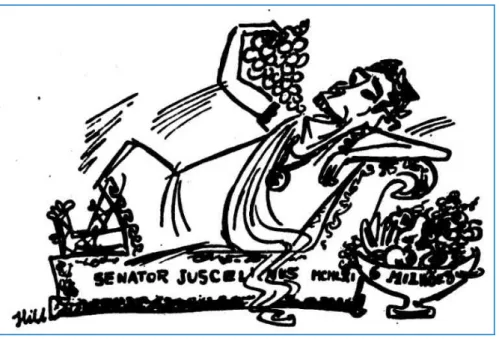
and metaphoric resources. In Figure 12, JK is portrayed in a Roman setting, in a drawing
with funny appropriation of imagery about corruption during the decay of the Old Republic. The drawing shows the then Brazilian senator as if he was a member of the ancient Roman senate, lying comfortably and eating tasty fruit, which actually allude to a fortune (6 million) undoubtedly having dubious origins.
One of the most common metaphoric resources observed in editorial cartoons against JK was the fish figure, a funny reference to the song ‘Peixe Vivo,’ which was very appreciated by the former president and often sung by his admirers. The use of fish allowed the cartoonist Hilde to mobilize various funny resources. In the editorial cartoon of Figure 13, we see a lady, a housewife, in fact an investigation commission of the dictatorship, looking at the ‘old refrigerator’ of the JK administration. The spoiled and smelly fish that she finds is used to evoke the imagination of rotten stuff that might have been produced during the JK administration. Figure 13. O Estado de São Paulo, 12/05/64. Hilde. Hilde drew other editorial cartoons adopting the fish as a metaphor for JK. In one of the most striking ones (Figure 14), JK is a big fish caught in a net, therefore fished. There are no text accompanying the image, so that a complete identification is avoided and ambiguity still remains about the identity of the fish. However, the facial features clearly depict JK, as shown in other drawings by Hilde. Perhaps, the lack of explicit mention was due to the seriousness of the situation, because the subtle reference points out the negotiations, then underway behind the scenes, for the senator’s impeachment.
And the image does not suggest any disagreement with the possible capture of JK using the nets of dictatorship... Figure 14. O Estado de São Paulo, 04/06/64. Hilde. Figure 15. O Estado de São Paulo, 07/06/64, Hilde. A few days later, the same cartoonist published another funny representation of the probable exit of JK from the political stage in a caricature that mobilizes a theatrical metaphor (Figure 15). In the image, the Senator is represented as a ballerina who performs a Swan’s dance on the stage, a classic scene of ballet that ends with the protagonist’s death. A metaphor for the JK’s political death, of course, who would be removed from office the next day, and his political rights were suspended for ten years.
In order to characterize the exit of the ‘swan’ from the scene, Hilde drew the stage being inclined so that the ‘ballerina’ could slide faster out. The caricature might also represent the popular image of the swan song, i.e. the last manifestation of an artist or an outstanding figure at the time of her/his death. On 06/03/1964, therefore a few days before the editorial cartoon, JK had delivered his last speech in the Senate, where he tried to record a discursive piece before being removed from office, then regarded as quite likely, so that the senator himself mentioned it. That was his swan song.
Figure 16. Folha de São Paulo, 30/05/64. Nelson Coletti.
The JK’s cassation was not only desired, but required by a part of the press, however, the subject was controversial due to the popularity of the former president, confirmed in opinion polls. Also, some government leaders were against the cassation,
something which made the case even more complex12. Editorial cartoons published in
other newspapers also commented on the episode, but in a tone different from the Estadão. In the example of Figure 16, the editorial cartoon by Nelson Coletti in Folha de São Paulo shows the fight to remove JK from office, but with an alleged tie between the 12 A survey by the Brazilian Institute of Public Opinion and Statistics (IBOPE), conducted in the then state of Guanabara, in May 1964, concerning the subject of cassation showed the JK’s image strength. While 56% of respondents said they were in favor of the politicians’ purge as a whole, only 25% said to be in favor of the former president’s cassation. Source: Arquivo Edgar Leuenroth.
forces favorable to the purge and the PSD (Partido Social Democrático), which clings tightly to his candidate to save him.
In the end, the efforts to avoid cassation were defeated and the act was published on 06/08/1964, bringing the JK’s political career to an end. In an image that suggests satisfaction due to the outcome of the case, Hilde came back to the theme of cassation inspired by the June festivals (Figure 17), with a caricature where the boy JK, disappointed, looks at his ‘1965’ lost balloon.
Figure 17. O Estado de São Paulo, 19/06/64. Hilde.
In the case of Ademar de Barros, the pressures for his cassation were equally intense, but without the ingredient of the future presidential race. The objectives of the groups that attacked him had to do with regional disputes in São Paulo, but there was also a strong desire to meet the moralizing eagerness, which was sincere in some
segments of the coup participants. Since the 1940s, when he was an interventor in São
Paulo during the New State dictatorship, Barros was regarded as a corrupt politician. He was involved in several scandals and lawsuits, something which did not prevent his election to the city hall and the state government in São Paulo. The two newspapers from São Paulo examined in this research had issues with Barros, especially the Estadão, which
was at war with the governor since the 1950s Hence, the newspaper reverberated the sharpest criticism of Ademar, also aligning with the hardline military men, who wanted his head amid the anticorruption purge.
However, the political fate of Ademar also interested to the press from Rio de Janeiro, as seen in the caricature of Figure 18, which addressed the main difficulty for those interested in the cassation of the politician from São Paulo: his participation in favor of the coup. Using a sophisticated metaphor based on a Shakespeare’s play, Augusto Bandeira depicted Ademar kissing the hand of the lady ‘Revolution’ (Porcia) and verbalizing the speech of the Merchant of Venice (Antonio): “My sweet lady, you have
returned me to life and the means to live...”13.
Figure 18. Correio da Manhã, 31/05/1964. Augusto Bandeira.
The irony of the drawing suggests the opportunistic relationship between the politician and the 1964 coup, he was an early supporter and key player of it. As governor
13 The drawing is a part of a brilliant series of caricatures by Augusto Bandeira on the main leaders of the
time, interpreted in the light of Shakespeare’s tragedies. The 1964 crisis inspired the creative artist to associate tragedy with comedy in order to represent the Brazilian political drama.
of São Paulo, Ademar played a major role in the right‐wing mobilization before the events, as well as in its military success. As he took position among the main civil leaders of the movement, it became hard to remove him from office, because he used the ‘revolution’ as a shield. Incidentally, this theme was particularly mobilized by cartoonists, who showed Ademar using the dictatorship as armor or as camouflage against investigations and inquiries (figures 19 and 20). In the case of Figure 19, it is worth noticing ‘March 31’ written on armor and the ‘little box’ hanging behind the armor, a frequent metaphorical adornment to associate Ademar de Barros to corruption. In the case of Figure 20, in the military helmet that camouflages the politician there is a flag that reads ‘3 31,’ also an allusion to the coup’s date. Figure 19. O Estado de São Paulo, 20/08/64. Biganti.
Figure 20. O Estado de São Paulo, 06/06/64. Hilde.
Within the same period when pressures for JK’s cassation took place, the crosshairs of cartoonists also turned against Ademar. He was portrayed in many situations related to investigations against corruption and always looking for ways to hide and escape, or counting the hours to finish the term of the Institutional Act, as in Figure 21. At the end of the period, he actually escaped cassation, something which inspired the caricature “O Intocável,” published by Hilde in the Estadão (Figure 22), where Ademar appears as a skilled and well‐armed gunman, hard to put down. Regarding weapons, in the political backstage there were rumors that one of the trump cards held by the São Paulo governor was the state armed forces, consisting of 30,000 men, which Barros
threatened to mobilize if the federal government acted against him14.
14 Information taken from reports by the U.S. Consulate in São Paulo, Brazil. National Archives and Records
Administration (NARAII). RG: 286 – 250 – 66 /3/01, box 20, folder 3. On the cassation process of Ademar de Barros cf. HAYASHI, Marli Guimarães. A gênese do ademarismo (1938‐1941). Dissertação de Mestrado defendida na Universidade de São Paulo, 1996.
Figure 21. O Estado de São Paulo, 09/06/64. Biganti. Figure 22. O Estado de São Paulo, 13/08/64. Hilde. However, Ademar’s ‘weapons’ were not enough to save him from a second crisis, which ended with his removal from São Paulo government and the cassation of political rights, in June 1966. The press from São Paulo, which kept pressure on the governor over the period, of course celebrated his removal from power, in editorial cartoons showing
relief despite the delay (‘better late than never’ was the title of one of these editorial cartoons). Nevertheless, the actual reason for Ademar’s cassation was not the problem of corruption, because, despite pressure from the press and the hardliners, the Castelo
Branco administration had prevented investigations to reach the São Paulo governor15.
The cassation was due to the closeness between Ademar de Barros and the opposition and connections to win the indirect elections in São Paulo (in late 1966), going against the will of Brasília. Figure 23. Folha de São Paulo, 03/06/66. Orlando Mattos. 15 According to sources close to the U.S. consulate, Castelo Branco even removed a military officer from the position of head of an investigation commission who aimed to find evidence of corrupt acts committed by Ademar. (NARAII). RG 59, box 29, folder 6.
Two editorial cartoons published days before federal intervention in São Paulo mentioned the political movements by Ademar that sealed his fate. The editorial cartoon of Figure 23 comments, ironically, the passage of Ademar’s troops to the side of the party opposing the dictatorship, the MDB (Movimento Democrático Brasileiro). Orlando Mattos, caricaturist of the Folha, drew Ademar taking his pictures from the defunct Partido Social Progressista (PSP) to the party that would occupy the opposition space in the two‐party system created by the dictatorship. In turn, in the image of Figure 24, the governor appears making appointments profusely for public positions in São Paulo, in an attempt to influence the result of future elections. These were his last acts as state governor. Figure 24. O Estado de São Paulo, 04/06/66. Hilde.
Final remarks
In their work, the newspapers contributed to justify the authoritarian regime and attract public support for the dictatorship, with the exceptions that have been identified. However, this was not passive support, since they acted according to an agenda of their own and they have lobbied so that the State responded to their demands and preferences.As we tried to show, the caricatures by the mainstream press played a key role in the construction of representations about the purges promoted by the dictatorship, helping to establish the theme of the two main enemies of the ‘revolution,’ which constituted its raison d’être. Such a contribution was especially relevant in the case of corruption, as the caricatures had funny traits and popular metaphors, in contrast to the anything but funny violence of the purges.
In the text, two exemplary cases of the campaign against corruption were emphasized, although other prominent figures have been involved in episodes that took place in the following years. The theme of the fight against corruption remained important in the discourses and practices of dictatorship and it mobilized the certainty and the hope of many of its supporters. Due to the authoritarian resurgence in the context of the IA5, the anticorruption campaign gained new momentum, but ephemeral. The dictatorship’s economic growth projects generated big works and businesses, but also opportunities for shady deals. Prominent figures of the military governments were involved in shady cases, all duly drowned out by official agencies, especially because the press operated under the weight of censorship.
For a correct understanding of the theme, therefore, we must be aware of other uses of the anticorruption campaign, especially the pursuit of popularity for the government and the removal of opponents from the political scene. The actions taken by the dictatorship against corruption have never reached the end line, neither touched major leaders in the ruling field. In practice, people actually punished due to corruption were small fish in the political scene (like Moisés Lupion) or inexpressive civil servants. Prominent figures in the field favorable to the dictatorship did not undergo investigation (e.g. Delfim, Maluf, Andreazza), while certain personalities were excluded due to reasons that had nothing to do with the fight against corruption, like JK and Ademar de Barros. By analyzing these episodes, we tried to reveal the potential for opportunistic use of the fight against corruption, whose manipulation sought to justify the purge of troublesome leaders to the governments of dictatorship.
Corruption would follow a major theme in the Brazilian political debate, as we know it today. Anticorruption campaigns would provide new opportunities for caricatural
mobilization and opportunistic appropriation, with purposes different from the so‐called goal of improving the institutions of the republic.
References
DELPORTE, Christian. Les ambivalences du pouvoir e des politiques. In:DELGADO, Marie‐ Melódie (Org.). La caricature ... et si c’était sérieux? décryptage de la violence satirique. Paris: Nouveau Monde Éditions, 2015, p.48‐57.HAYASHI, Marli Guimarães. A gênese do ademarismo (1938‐1941). 1996. Dissertação (Mestrado em História) ‐Universidade de São Paulo, São Paulo, 1996.
MOTTA, Rodrigo P.S. Jango e o golpe de 1964 na caricatura. Rio de Janeiro: Zahar, 2006. MOTTA, Rodrigo P.S. A ditadura nas representações verbais e visuais da grande imprensa: 1964‐1969. Topoi, v. 14, n. 26, p. 62‐85, jan./jul. 2013.
ROMERO, Marcelo. O governo Fernando Henrique Cardoso na charge de Angeli: os tons e contornos da crítica política no traço do artista. 2015. Tese (Doutorado em História), UFJF, Juiz de Fora, 2015. Received on 07/07/2016 Approved on 09/09/2016 Universidade do Estado de Santa Catarina – UDESC Programa de Pós‐Graduação em História ‐ PPGH Revista Tempo e Argumento Volume 08 ‐ Número 18 ‐ Ano 2016 [email protected]