Article
, Vol. 29, No. 8, 1663-1671, 2018 Printed in Brazil - ©2018 Sociedade Brasileira de Química*e-mail: [email protected]
Ketalization of Ketones to 1,3-Dioxolanes and Concurring Self-Aldolization
Catalyzed by an Amorphous, Hydrophilic SiO
2-SO
3H Catalyst under
Microwave Irradiation
Sandro L. Barbosa,*,a Myrlene Ottone,a Mainara T. de Almeida,a Guilherme L. C. Lage,a Melina A. R. Almeida,a David Lee Nelson,a Wallans T. P. dos Santos,a Giuliano C. Clososki,b
Norberto P. Lopes,b Stanlei I. Kleinc and Lucas D. Zanattad
aDepartamento de Farmácia, Universidade Federal dos Vales do Jequitinhonha e Mucuri (UFVJM),
R. da Glória, 187, Centro, 39100-000 Diamantina-MG, Brazil
bDepartamento de Física e Química, Faculdade de Ciências Farmacêuticas de Ribeirão Preto,
Universidade de São Paulo (USP), Av. do Café s/n, 14040-903 Ribeirão Preto-SP, Brazil
cDepartamento de Química Geral e Inorgânica, Instituto de Química,
Universidade Estadual de São Paulo (Unesp), R. Prof. Francisco Degni, 55, Quitandinha, 14800-900 Araraquara-SP, Brazil
dLaboratório de Química Bioinorgânica, Departamento de Química,
Faculdade de Filosofia, Ciências e Letras de Ribeirão Preto, Universidade de São Paulo, Av. Bandeirantes, 3900, 14040-901 Ribeirão Preto-SP, Brazil
The amorphous, mesoporous SiO2-SO3H catalyst with a surface area of 115 m2 g-1 and
1.32 mmol H+per g was very efficient for the protonation of ketones on a 10% (m/m) basis, and
the catalyst-bound intermediates can be trapped by polyalcohols to produce ketals in high yields or suffer aldol condensations within minutes under low-power microwave irradiation. The same catalyst can easily reverse the ketalization reaction.
Keywords: protonated ketones, self-aldolization, ketalization, ketal hydrolysis, sulfonated silica
Introduction
Sulfuric acid can be considered to be the standard acid for all organic reactions that are catalyzed by strong Brønsted-Lowry acids, but its anti-Green-Chemistry nature impairs its widespread use: its residues are highly acidic and its corrosiveness is widely avoided. On the other hand, solid acids such as sulfonated silicas have been shown to bear a sufficient number of acidic sites, with little tendency for lixiviation,1
to make them versatile candidates for the replacement of the homogeneous sulfuric acid. The SiO2-SO3H catalysts
can be prepared in several ways. Examples range from the simple addition of H2SO4 to slurries of silica and ether2,3
or the treatment of silica with chlorosulfonic acid4 to more
complex synthesis of mesoporous materials where the sulfonic groups are separated from the surface of the silica by carbon chains.5 This method is also a form of diminishing
the hydrophilicity of the catalyst.6 We recently developed
a mesoporous, sulfonated silica as a Brønsted acid, whose high hydrophilicity made it ideal for the catalysis of water-forming, proton-assisted organic transformations, such as the formation of ethers from alcohols and the esterification of acids with alcohols, equations 1 and 2.7 SiO
2-SO3H8 and
SiO2-(CH2)3-SO3H6 have been reported to catalyze ketal
formation from ketones and ethylene glycol, which is also a water-forming reaction involving the equilibrium shown in equation 3.
(1)
(2)
might be destroyed. Usually this protection is accomplished by the reaction of the carbonyl compound with ethylene glycol in the presence of an acid catalyst.9 The products
are usually referred to as an acetal if prepared from an aldehyde, or ketal, if formed from a ketone. They contain the backbone of the 5-membered 1-3-dioxolane ring. This ring must be hydrolyzed in the presence of an acid catalyst, to liberate the ethylene glycol and the carbonyl compound after the desired transformation. Apart from the great importance of such protection and deprotection reactions, some ketals are useful themselves, such as those from glycerol; these ketals can be used as precursors for the synthesis of monoglycerides, as food emulsifiers,10 as chiral
building blocks in organic synthesis11 or as fuel additives
for biodiesel.12 1,3-Dioxolanes have also been shown to
exhibit antimicrobial activity against Gram-positive and Gram-negative bacteria and can be used as antiseptics for sterilization of working surfaces and instruments.13
The six-membered ring ketals, or m-dioxanes, are also of interest for the pharmacy and fuel industries.14 We now
report that reactions such as equation 3 can be greatly enhanced by microwave irradiation using our hydrophilic catalyst and that the procedure can be extended to other polyols such as trimethylol propane, neopentyl glycol and crude glycerol. In the absence of alcohols, the ketones tested were rapidly protonated to produce aldol condensates (equation 4), except for benzophenone.
(3)
(4)
Experimental
Raw materials
The alcohols ethylene glycol, 2-ethyl-2-hydroxy-methylpropane-1,2-diol (trimethylol propane), and 2,2-dimethylpropane-1,3-diol (neopentyl glycol) and the ketones propanone, cyclohexanone, acetophenone, 4-methylacetophenone and benzophenone were used as purchased; crude glycerol was obtained from the transesterification of waste cooking oil with methanol.
Instrumentation
The infrared spectra of solid samples were recorded
as KBr pellets in the 4000-400 cm-1 range on a Varian 640
spectrophotometer operating in the FT mode. X-ray diffraction (XRD) patterns were collected on a Rigaku diffractometer at 30 kV and 20 mA using CuKα radiation. Differential thermal analysis (DTA) was carried out using a PerkinElmer 1700 analyzer. Ketal contents and yields were determined with a gas chromatography mass spectrometer GC-MS-QP 2010 Shimadzu equipped with an AOC 5000 Auto Injector and a 30 m Agilent J&W GC DB-5 MS column. Direct insertion spectra were measured at 70 eV. Quantitative analyses were performed on a Shimadzu GC-2010 gas chromatograph equipped with a flame ionization detector (FID). 1H and 13C nuclear magnetic
resonance (NMR) spectra were recorded on Bruker Avance 400 and Avance 500 spectrometers. All the reactions were performed under atmospheric pressure, using microwave irradiation and monitored by thin layer chromatography (TLC) with Silica Gel 60 F254 on aluminum. The chromatograms were visualized by UV or by using an ethanolic vanillin developing agent. Silica gel (Merck 230-400 mesh) was used for purification of products by flash column chromatography using hexane/ethyl acetate (8:2) as eluent.
Preparation of the silica gel and the sulfonated silica, SiO2-SO3H7
A mixture of 300.0 g of sand and 600.0 g of sodium carbonate were homogenized and transferred to porcelain crucibles, which were heated at 850 °C for 4 h. The hot solid mixtures were transferred to a glass filter frit and washed with 600-900 mL of boiling water. The filtered solution was acidified to pH = 1 with hydrochloric acid, the white precipitate was filtered, and dried at 400 ºC. The resulting silica was passed through a 24 mesh sieve for standardization. 10.0 g of the prepared silica was mixed with 10.0 mL of H2SO4 and stirred at room temperature
for 12 h, filtered and dried at 150 °C for 4 h, cooled and stored in a desiccator. The acid strength of 1.32 mmol of H+per gram of catalyst was determined by potentiometric
titration.
Typical procedures
shaking and, immediately, irradiated. The silica catalyst does not allow the final temperature of the slurries to exceed 73 ºC (see also reference 7). To each of the cooled vessels from the reactions, 30.0 mL of diethyl ether was added, and the mixture was filtered. The organic extracts were washed with 10.0 mL of saturated NaHCO3, dried
over anhydrous MgSO4 and concentrated under reduced
pressure. The residues were purified on chromatographic columns using hexane/ethyl acetate 8:2 as eluent (with the exception of solketal, which was distilled) to furnish the pure products as colorless oils. For the synthesis of ketals, the amounts of ketone (1.0 mmol) and alcohol (5.0 mmol) were maintained throughout; the amount of catalyst used in each run was adjusted to maintain a constant 10% mass-to-mass ratio to the ketone, and the reactions were irradiated for 2 to 7 min. The ketals were identified by GC-MS, electrospray ionization time-of-flight (ESI-TOF) mass spectrometry and 1H and 13C NMR spectroscopy. For
the synthesis of α,β-unsaturated ketones, the amount of catalyst was adjusted to 10% (m/m) relative to 1.0 mmol of the ketones (acetone, methyl ethyl ketone, cyclohexanone, acetophenone and p-methylacetophenone). All the reaction media were irradiated for 6 min, except for acetone, whose reaction was performed in a conventional heating mantle (12 h of reflux). The α,β-unsaturated ketones were identified by GC-MS and 1H and 13C NMR
spectroscopy.
All the reactions were performed under atmospheric pressure, using a heating mantle and, except for acetone, microwave irradiation, and monitored by TLC with Silica Gel 60 F254 on aluminum. The chromatograms were visualized by UV or by using an ethanolic vanillin developing agent. Silica gel (Merck 230-400 mesh) was used for purification of products by flash column chromatography using hexane/ethyl acetate (9:1) as eluent.
For the hydrolysis of the ketals, the amount of catalyst was adjusted to 20% (m/m) in relation to the ketal (1.00 mmol), and an excess of water (10.00 mL) was added to minimize the auto condensation reactions of the ketone products. After irradiating 2 min at 360 W, the mixture was cooled, mixed with 20.00 mL of ethyl ether and filtered. The organic mixture was extracted with an aqueous NaCl solution, dried with MgSO4 and concentrated; GC-MS
analyses of these extracts confirmed 94-98% yields. The alcohols and ketones were finally separated by column chromatography using a mixture of hexane/ethyl acetate 8:2 as eluent. Ethylene glycol and 20% (m/m) SiO2-SO3H
was irradiated for 6 min to produce diethylene glycol in 96% yield after the same chromatographic purification procedure.
Results and Discussion
Silica gel and catalyst, SiO2-SO3H, characterization
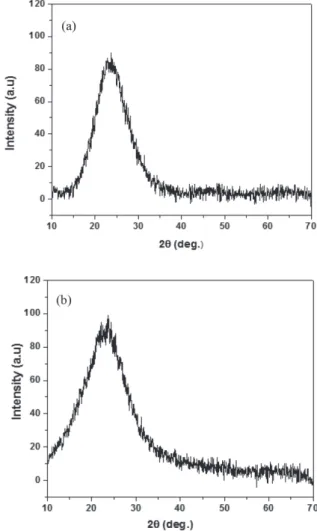
The non-crystalline natures of the silica gel and of the SiO2-SO3H catalyst were confirmed by XRD, which
presented broad peaks centered at 2θ = 23º,7 Figure 1.
The infrared spectrum of the silica (Figure 2a) is also representative of an amorphous silica gel.7 The characteristic
absorption bands around 3400 and 1630 cm-1 are associated
with the stretching and bending modes of molecular water, whereas the shoulder at 3200 cm-1 and the weak absorption
at 960 cm-1 are related to the –OH and Si–OH vibrations of
the silica silanol groups.7 The bands at 1090 cm-1 and the
associated shoulder at 1190 cm-1 are characteristic of the
asymmetric stretching modes of the Si–O–Si bonds.7 The
absorption at 800 cm-1 of the ring-structured tetrahedral
SiO4 (Si–O–Si symmetric stretchings), the Si–O–Si bending
vibrations at 470 cm-1 and the overtones typical of the
amorphous silicas in the region of 1800-1900 cm-1 complete
the spectrum of the gel.7 The infrared (IR) spectrum of
the SiO2-SO3H catalyst (Figure 2b) presented remarkable
differences. For instance, the H2O bands at 3400 cm-1 are
much broader, with additional intramolecular hydrogen bond
features at 2900-2100 cm-1 and the concomitant increase
of the H2O bending at 1637 cm-1. These changes certainly
reflect the accommodation of additional water molecules via hydrogen bonds to the –SiOH and –O–SO3H groups of
the SiO2-SO3H. The splitting of the absorptions from 1210
to 1040 cm-1 in the spectrum of the catalyst, which indicates
a profound modification of the overall surface structure of the Si–O–Si original arrangement, are also reflected in the further weakening of the Si–OH band at 960 cm-1. The
contributions of the –O–SO3H groups to the absorptions of
the IR spectrum of the catalyst are ambiguous because of the close proximity of the atomic weights of tetrahedral silicon and sulfur. However, one might assume that the enhancement of the Si–O–Si longitudinal-transverse optical vibration (LO) absorption at 1210 cm-1 and the transversal optical (TO)
rocking of the Si–O–Si bonds at 592 cm-1 may be due to the
presence of the –OSO3H groups of the catalyst.7
The striking differences between the original silica and the SiO2-SO3H catalyst is also evident from the field
emission scanning electron microscopy (FE-SEM) images shown in Figures 3 (silica) and 4 (catalyst) at different magnifications. It is apparent that the even distribution of the particles of the silica, which are responsible for its large surface area, tend to form aggregates upon sulfonation. The aggregates formed upon sulfonation are well separated by macropores several nanometers in diameter.
Textural parameters of materials were studied by N2
adsorption/desorption isotherms, Figure 5, that showed a type IV behavior with H1 hysteresis, typical of mesoporous materials, which are related to pores with a constant transversal section.7 After silica surface modification with
–SO3H groups, there was a decrease in surface area of 507
to 115 m2 g-1, and a volume of pores decrease of 0.78 to
0.38 cm3 g-1.
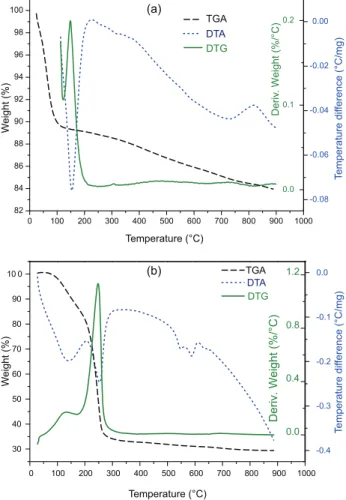
The thermal behaviors of the new silica gel and catalyst were evaluated. The thermogravimetric analysis Figure 2. FTIR spectra of the (a) silica gel and (b) SiO2-SO3H.
(TGA/DTG/DTA) curves for silica and catalyst, respectively, are presented in Figure 6.
The decomposition of silica gel in a synthetic air atmosphere takes place in one step. This step, from room temperature to 149.71 ºC, is related to the endothermic elimination of water molecules and the formation of anhydrous silica. The decomposition of the catalyst takes place in two stages. The first step, from room temperature to 169.39 ºC, is also related to the endothermic elimination of water molecules and the formation of anhydrous catalyst; the second step, up to 240 °C, corresponds to the endothermic loss of sulfur trioxide.
General remarks
Of particular interest for this work, both SiO2-SO3H8
and SiO2-CH2-CH2-CH2-SO3H6 have been used with
success for ketalization reactions using conventional heating with reaction times extending up to 12 h. An
example involves the preparation of the cyclohexanone ketal in 90% yield using toluene as the solvent and heating at reflux temperature for 3 h.6 The same reaction was
performed using SiO2-SO3H as the catalyst in the absence
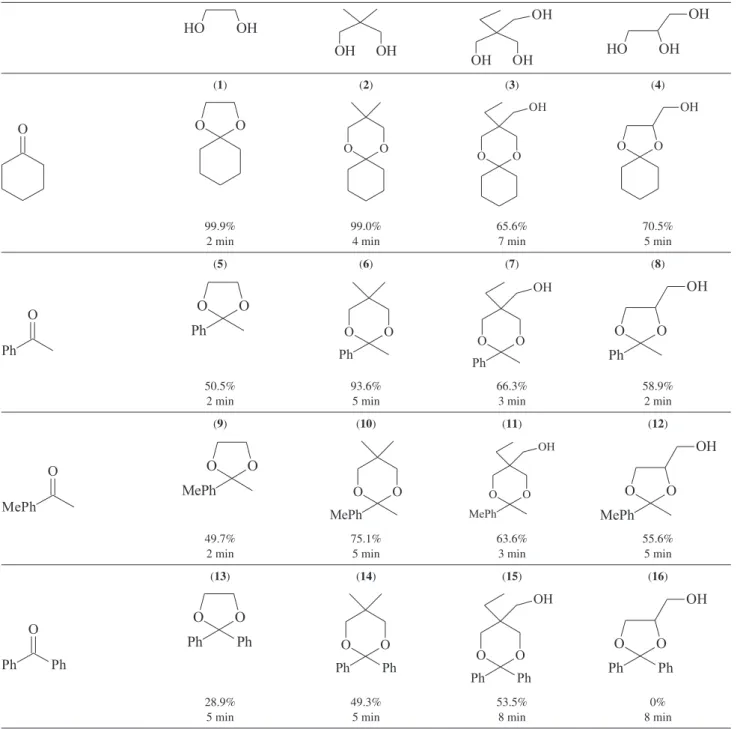
of solvent under low microwave irradiation power (360 W). The temperature of the slurry did not exceed 73 ºC, and a 99.9% yield was obtained in only 2 min (entry 1 in Table 1). Figure 4. FE-SEM images of the SiO2-SO3H.
Figure 5. N2 adsorption/desorption isotherms and (inset) Barrett-Joyner-Halenda (BJH) method to pore size distributions for pure silica (SiO2) (black squares) before modifications and SiO2-SO3H (red squares).
However, these experimental conditions yielded only about 50% of the acetophenone ketal (entry 5, Table 1), against 93% yield (10 h reflux) using the propyl-modified catalyst.6
The formation of six-membered ketals seems to be favored over the formation of 1-3-dioxolanes, in particular those of the seemingly less reactive benzophenone (entries 14 and 15, Table 1). No formation of the six-membered isomers of the ketals involving glycerol, which did fail to react with benzophenone under our solvent-free condition, was observed. Amongst those glycerol ketals shown in Table 1, the ciclohexanone
derivative had already been obtained in 90% yield by high power microwave irradiation (600 W, 140 ºC, 15 min).15
All the ketalization reactions in Table 1 can be reversed by the addition of water to the ketals in the presence of SiO2
-SO3H, as has already been pointed out by Rajput et al.;2
under microwave irradiation, this reaction takes only 2 min to complete (see Experimental section).
During our attempts to carry on the ketalization reactions using conventional heating, it became clear that concurrent reactions occurred using our SiO2-SO3H
catalyst, namely, etherification and aldol condensation.
Table 1. Ketalization of ketones with polyalcohols using SiO2-SO3H catalyst and MW irradiation. Alcohol to ketone ratio 5:1, 10% (m/m) catalyst
(1) (2) (3) (4)
99.9% 2 min
99.0% 4 min
65.6% 7 min
70.5% 5 min
(5) (6) (7) (8)
50.5% 2 min
93.6% 5 min
66.3% 3 min
58.9% 2 min
(9) (10) (11) (12)
49.7% 2 min
75.1% 5 min
63.6% 3 min
55.6% 5 min
(13) (14) (15) (16)
28.9% 5 min
49.3% 5 min
53.5% 8 min
Because we had already noted the strong tendency of our catalyst to catalyze the formation of ethers from benzyl alcohol,7 we decided to perform the detailed study of
the interaction of cyclohexanone and ethylene glycol at different ketone to alcohol ratios and different catalyst loads using 360 W MW irradiation. The load of the catalyst, from 7 to 20% (m/m), had only a minor effect on the reaction product distribution, which was very dependent on the alcohol to ketone ratio. Figure 7 resumes these findings.
Figure 7 shows that cyclohexanone readily self-condenses in the presence of the sulfonated catalyst, but this reaction becomes negligible at 2:1 or higher ratios of glycol to ketone. However, at these higher ratios, the condensation of the alcohol becomes important. In the absence of a ketone, ethylene glycol is converted to bis-ethylene glycol (17) in 96% yield (see Experimental section). It must be noted that the catalyst could be used three times, with very little loss in activity (under microwave irradiation conditions). Table 2 summarizes the self-condensation of the ketones.
Proposed mechanism
While examining the esterification of benzoic acid with Figure 7. Product distribution of the reaction of 1 mol equiv. of cyclohexanone to 0-3 mol equiv. ethylene glycol, 10% (m/m) of catalyst to ketone; 2 min MW irradiation at 360 W; final temperature ca. 70 ºC.
benzyl alcohol, we observed that, at higher concentrations, the catalyst SiO2-SO3H had an increased affinity for
organic alcohols versus organic acids, and we proposed5
the existence of a catalyst-bound species of the type [Bz−OH2]+** (Bz-OH = benzyl alcohol; ** = catalyst
bound species) as important intermediates, so that reactions such as equations 5 and 6 could result in the exclusive formation of dibenzyl ether from a mixture of benzyl alcohol and benzoic acid.7
BzOH + H+** → [BzOH
2]+** (5)
[Bz-OH2]+** + Bz-OH → Bz-O-Bz + H2O** + H+** (6)
We propose that the catalyst is even more selective for the protonation of ketones over alcohols, and, therefore, the following sequence of reactions could apply, where ** stands for the catalyst bound species, Scheme 1.
An examination of the yields in Table 1 shows that, as the stability of the intermediates [R2C+–OH]** increases
from [Cy+–OH] to [Ph
2C+–OH], the yields of the ketals
decrease. This observation probably indicates that the catalyst holds those stable species more tightly. This effect, along with the difficult diffusion of glycerol through SiO2-SO3H in solvent-free reactions, also explains the
lack of products in the reaction between benzophenone and glycerol. The six-membered ring ketals seemed to be preferred over the 5-membered ethylene glycol derivatives when the [R2C+–OH]** species are stabilized by aromatic
rings, but this rule was not followed by glycerol, which gave exclusively the 5-membered ketal, entries 5-12 in Table 1. This is probably another evidence of the difficulty of the diffusion of the third CH2–OH group of glycerol through the
hydrophilic pores of the catalyst. It would seem, therefore, that the mesoporous sulfonated silica used as catalyst in this and previous works7 showed a higher affinity for substrates
following the order: organic acids < alcohols < ketones. The results suggest that the outcome of the reactions promoted by these highly hydrophilic catalysts are dependent on both the concentration of the catalyst and of the ratio of the reactants.
Table 2. Direct aldol condensation of acetone, cyclohexanone, acetophenone and p-methyl acetophenone with SiO2-SO3H catalyst using MW irradiation
(18) (19) (20) (21)
95.3% 98.5% 96.1% 99%a
7 min 6 min 7 min
Conclusions
For the first time it is reported that a mesoporous sulfonated silica with a small surface area, large pore diameters and high hydrophilicity presented a higher affinity for ketones than for alcohols and easily promoted aldol condensations when used in concentrations from 7 to 24% (m/m) to the concentrations of ketones. In the presence of the poly-alcohols ethylene glycol, glycerol, trimethylolpropane and neopentylglycol, the ketones acetophenone, p-methylacetophenone and benzophenone were converted to the respective ketals in reasonable to good yields. However, benzophenone failed to react with glycerol; pure alkyl ketones such as cyclohexanone were more easily condensed and ketalized. In the absence of ketones, ethylene glycol was smoothly converted to bisethylene glycol. All the reactions occurred within minutes under solvent-free conditions using microwave irradiation at 360 W.
Supplementary Information
Supplementary data (FTIR spectra and GC-MS) are available free of charge at http://jbcs.sbq.org.br as PDF file.
Acknowledgments
The financial support of the Brazilian agencies CNPq, CAPES and FAPEMIG were greatly appreciated.
References
1. Helwani, Z.; Othman, M. R.; Aziz, N.; Kim, J.; Fernando, W. J. N.; Appl. Catal., A 2009, 363, 1; Huang, Y.; Chao, P.-Y.; Cheng, T.-Y.; Ho, Y.; Lin, C.-T.; Hsu, H.-Y.; Wong, J.-J.; Tsai, T.-C.;
Chem. Eng. J. 2016, 283, 778; Hasan, Z.; Jhung, S. H.; Eur. J. Inorg. Chem. 2014, 2014, 3420.
2. Rajput, V. K.; Roy, B.; Mukhopadyay, B.; Tetrahedron Lett.
2006, 47, 6987.
3. Maleki, B.; Shirvan, H. K.; Taimazi, F.; Akbarzadeh, E.; Int. J. Org. Chem.2012, 2, 93.
4. Zolfigol, M. A.; Madrakjan, E.; Ghaemi, E.; Molecules2002,
7, 734.
5. Testa, M. L.; la Parola, V.; Venezia, A. M.; Catal. Today2010,
158, 109.
6. Shimizu, K.; Hayashi, E.; Hatamashi, T.; Kodama, T.; Higuchi, T.; Satsuma, A.; Kitayama, Y.; J. Catal.2005, 231, 131. 7. Barbosa, S. L.; Ottone, M.; Santos, M. C.; Junior, G. C.;
Clososki, G. C.; Lopes, N. P.; Klein, S. I.; Catal. Commun.
2015, 68, 97.
8. Chávez, F.; Suárez, S.; Díaz, M. A.; Synth. Commun.1994, 24, 2325.
9. Sartori, G.; Ballini, R.; Bigi, F.; Bosica, G.; Maggi, R.; Righi, P.; Chem. Rev.2004, 104, 199.
10. Showler, A. J.; Darley, P. A.; Chem. Rev.1967, 67; Yu, C. C.; Lee, Y.-S.; Cheon, B. S.; Lee, S. H.; Bull. Korean Chem. Soc.
2003, 24, 1229; Corma, A.; Iborra, S.; Miquel, S.; Primo, J.; J. Catal. 1998, 173, 315; Perosa, A.; Moraschini, A.; Selva, M.; Noè, M.; Molecules2016, 21, 170; Yang, D.; Cwynar, V. A.; Hart, D. J.; Madanmohan, J.; Lee, J.; Lyons, J. Caffrey, M.;
Organic Synth.2012, 89, 183; Sriburi, P. P. P.; Phutrakul, S.;
IJISRT 2012, 6, 926.
11. Pawongrat, R.; Xub, X.; H-Kittikuna, A.; Food Chem.2007,
104, 251 and references cited there in.
12. Mallesham, B.; Rao, B. G.; Reddy, B. M.; C. R. Chim. 2016, 19, 1194; Trifoi, A. R.; Agachi, P. S.; Pap, T.; Renewable Sustainable Energy Rev.2016, 62, 804; Priya, S. S.; Selvakannan, P. R.; Chary, K. V. R.; Kantam, M. L.; Bhargava, S. K.; Mol. Catal.
2017, 434, 184.
13. Ovsyannikova, M. N.; Vol’eva, V. B.; Belostotskaya, I. S.; Komissarova, N. L.; Malkoval, A. V.; Kurkovskaya, N.; Pharm. Chem. J.2013, 47, 142.
14. Pawar, R. R.; Jadhav, S. J.; Bajaj, H. C.; Chem. Eng. J.2014,
235, 61.
15. Sing, K. S. W.; Everett, D. H.; Haul, R. A. W.; Moscou, L.; Pierotti, R. A.; Rouquerol, J.; Siemieniewska, T.; Pure Appl. Chem.1985, 57, 603.
Submitted: November 15, 2017
Published online: March 7, 2018