PCA3 Score and Prostate Cancer Diagnosis at Repeated
Saturation Biopsy. Which cut-off: 20 or 35?
Pietro Pepe, Filippo Fraggetta, Antonio Galia, Giorgio Skonieczny, Francesco Aragona
Urology Unit, Cannizzaro Hospital (PP, FA), Pathology Unit, Cannizzaro Hospital (FF,AG) and Department of Economy, University of Catania (GS), Catania, Italy
ABSTRACT ARTICLE INFO
_________________________________________________________ ___________________
Key words:
PCA3; prostate cancer; diagnosis; biopsy
Int Braz J Urol. 2012; 38: 489-95
__________________
Submitted for publication: November 30, 2011
__________________
Accepted after revision: June 11, 2012
Purpose: To compare PCA3 score cut-off of 35 vs 20 in PCa diagnosis in patients un-dergoing repeated saturation prostate biopsy (SPBx).
Material and Methods: From January 2010 to May 2011, 118 patients (median 62.5 years) with primary negative extended biopsy underwent a transperineal SPBx (median 30 cores) for persistent suspicion of PCa. The indications for repeated biopsy were: per-sistently high or increasing PSA values; PSA > 10 ng/mL, PSA values between 4.1-10 or 2.6-4 ng/mL with free/total PSA ≤ 25% and ≤ 20%, respectively; moreover, before performing SPBx urinary PCA3 score was evaluated.
Results: All patients had negative DRE and median PSA was 8.5 ng/mL (range: 3.7-24 ng/mL). A T1c PCa was found in 32 patients (27.1%): PCA3 score was 59 (median; ran-ge: 7-201) in the presence of PCa and 35 (median; ranran-ge: 3-253) in the absence of can-cer (p < 0.05). In the presence of ASAP and HGPIN median PCA3 score was 109 (range: 42-253) and 40 (range: 30-140), respectively. Diagnostic accuracy, sensitivity, speci-ficity, PPV and NPV of PCA3 score cut-off of 20 vs 35 in PCa diagnosis were 44.9 vs 50%, 90.6 vs 71.9%, 27.9 vs 41.8%, 31.9 vs 31.5% and 88.9 vs 80%, respectively. ROC analysis demonstrated an AUC for PCA3 ≥ 20 vs ≥ 35 of 0.678 and 0.634, respectively. Conclusions: Our data suggest that PCA3 is more useful as an exclusion tool; moreover, setting a PCA3 cut-off at 20 vs 35, would have avoided 22.9 vs 38.1% of biopsies while missing 9.4% and 28% diagnosis of PCa.
INTRODUCTION
Widespread use of the PSA test along with the introduction of mass screening proto-cols in Europe (1) and in USA (2) have increased the detection rate of prostate cancer (PCa), cur-rently the most prevalent malignancy in older men. Although the European Randomized Study of Screening for Prostate Cancer (ERSPC) reported a 20% reduction of mortality in the screened arm with an estimated rate of over-diagnosis as high
repeated prostate biopsy (5,6). Many authors have reported a significant difference of PCA3 score in patients with positive or negative repeated biopsy (7,8) underlining the lack of sensitivity of PCA3 to prostate volume and prostatitis (7); moreover, the PCA3 score has been incorporated into nomo-grams to assist in the decision to biopsy assign-ment of an individual risk of PCa (9).
Recent studies have demonstrated that a PCA3 score of 35 provides an optimal balance between sensitivity and specificity in diagnosing PCa with greater diagnostic accuracy than free/to-tal PSA (cut-off 25%) (7,10); on the other hand, a PCA3 score cut-off lower than 25 could be predic-tive of pathological indolent PCa (pIPCa) (11).
Our scope is to report the accuracy of PCA3 cut-off of 35 vs 20 in PCa diagnosis in patients undergoing repeated saturation prostate biopsy (SPBx) for the persistence of suspicion of cancer.
MATERIALS AND METHODS
From January 2010 to May 2011, 118 con-secutive cases, all of Caucasian origin and between the ages of 48 and 72 years (median 62.5 years) un-derwent a SPBx (median 30; range: 24-38 cores) 9 months (median; range 6-18) after a primary nega-tive extended biopsy (median 18 cores). The 118 patients were selected from a case-finding protocol for PCa detection (12) and had one single previ-ous negative biopsy. The indications for repeated biopsy were: persistently high or increasing PSA values; PSA > 10 ng/mL, PSA values between 4.1-10 or 2.6-4 ng/mL with free/total PSA ≤ 25% and ≤ 20%, respectively. SPBx was performed trans-perineally using a tru-cut 18 gauge needle (Bard; Covington, GA), a GE Logiq 500 PRO ecograph (General Electric; Milwaukee, WI) supplied with a biplanar transrectal probe (5-6.5 MHz) under seda-tion and antibiotic prophylaxis. The prostate bi-opsy protocol included a median of 12 cores in the posterior zone of each lobe (apex, median zone and base of the gland) beginning parasagittally to reach the outer edges of the gland (lateral margins) and 2-3 cores in the transition zone (4).
From three to ten days prior to perform-ing SPBx, first-catch urine samples were collected
per lobe) and processed to quantify PCA3 and PSA mRNA concentrations using the PROGENSA PCA3 assay (Gen-Prob Inc. San Diego, CA USA); PCA3 score was calculated using the following equation: (PCA3 mRNA/PSA mRNA) x 1000 (13).
In the presence of PCa either definitive treatment or active surveillance (AS) was offered. Those desiring surgery underwent retropubic radi-cal prostatectomy (RRP) with bilateral obturator and external iliac lymphadenectomy. The volume of cancer in the entire specimen was reported ac-cording to Bostwick (14). Each case was analyzed independently by two dedicated pathologists (FF,AG) and the incidence of PCa, that fulfilled the Epstein criteria (15) for pIPCa (cancer volume less than 0.5 mL and no Gleason grade 4 or 5 disease) was recorded.
The performance characteristics at different PCA3 score cut-off of 20 vs 35 were evaluated in terms of diagnostic accuracy, sensitivity, specific-ity, positive predictive value (PPV) and negative predictive value (NPV). Receiver operating charac-teristic (ROC) was performed to define diagnostic performance of PCA3 ≥ 20 vs PCA3 ≥ 35 using the calculated area under the curve (AUC); moreover, a probability (p) value of less than 0.05 was consid-ered statistically significant.
RESULTS
All patients had negative DRE and medi-an PSA was 8.5 ng/mL (rmedi-ange: 3.7-24 ng/mL): 50 (42.4%) had PSA > 10 ng/mL, 65 (55%) had PSA between 4-10 ng/mL with PSA F/T ≤ 25% and 3 (2.6%) had PSA between 2.6-4 ng/mL with PSA F/T ≤ 20%, respectively. In all patients an adequate concentration of PCA3 and PSA mRNA was ob-tained; median PCA3 score was equal to 49 (range 3-253); 91 (77.1%) and 73 (61.9%) patients had a PCA3 score greater than 20 and 35, respectively.
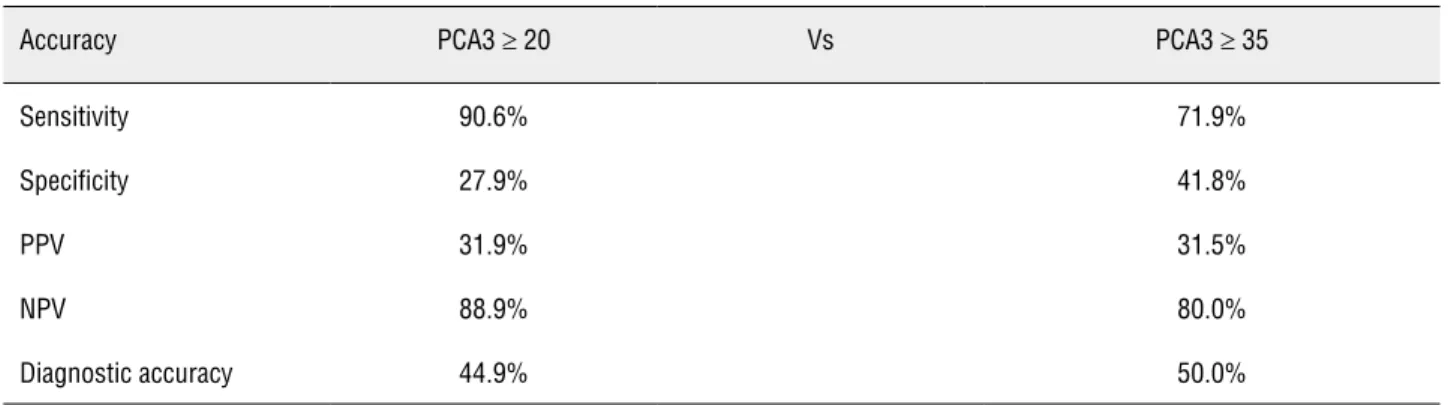
Diagnostic accuracy, sensitivity, specific-ity, PPV and NPV of PCA3 score cut-off of 20 vs 35 are listed in Table-1. ROC analysis demon-strated an AUC for PCA3 ≥ 20 vs PCA3 ≥ 35 of 0.678 and 0.634, respectively.
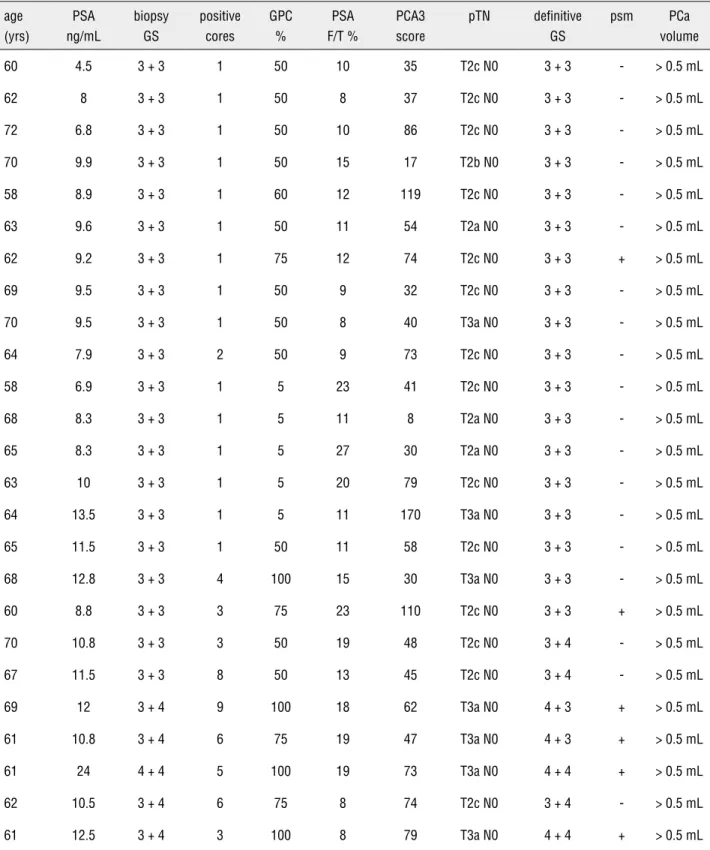
Among the patients with PCa 4 cases (12.5%) underwent radiotherapy and 3 cases (10%) followed AS protocol. None of the 25 pa-tients submitted to RRP had a pIPCa (18 pT2cN0 and 7 pT3aN0); the clinical (PSA, PSA F/T, PCA3 score) and pathological (biopsy and surgical spec-imens) characteristics are listed in Table-2.
DISCUSSION
Currently, with repeated prostate biopsy constituting 20-30% of all performed procedures, and low percentage discovery rates for PCa, cer-tain clinical criteria for the selection of patients at high risk of developing PCa cancer are still lack-ing. Vlaeminck-Guillem (16) demonstrated that PCA3 predicts PCa multifocality while Ploussard (11) and Auprich (8) confirmed PCA3 to be a valu-able predictor of pIPCa in selection between AS protocols or focal therapy. In the largest studies to date (1072, 463 and 226 cases) all undergoing core in 12 cases (37.5%) or a microfocus of PCa
(defined as a percentage of cancer ≤ 5% in a single core with GS ≤ 6) in 6 (19%); greatest percentage of cancer (GPC) was ≤ 50 and > 50% in 22 (68%) and 10 (32%) cases, respectively. The remaining 73 men (61.8%) had normal parenchyma, 4 (3.4%) had ASAP and 9 (7.7%) had HGPIN.
PCA3 score was 59 (median; range: 7-201) in the presence of PCa and 35 (median; range: 3-253) in the absence of cancer (p < 0.05); In the presence of ASAP and HGPIN median PCA3 score was 109 (range: 42-253) and 40 (range: 30-140), respectively.
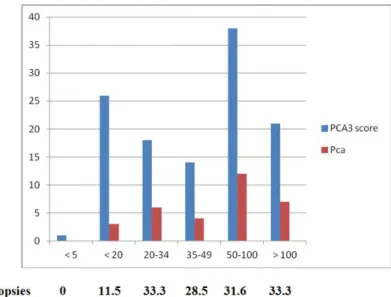
PCa detection rate increased from 11.5% with PCA3 score of less than 20 to 33.3% with scores greater than 100 (Figure-1); moreover, a PCA3 cut off of 20 and 35 found 29 (90.6%) and 23 (71.9%) PCa, respectively. Men with a PCA3 score ≥ 35 had a 31.5% probability of a positive biopsy compared to 31.8% probability in patients with PCA3 score ≥ 20. Median PCA3 score in the presence of GS equal to 6, 7 and 8 was 62, 68 and 145, respectively. Setting a PCA3 cut-off at 20 vs 35 would have avoided 22.9% vs 38.1% of biop-sies but 3 (9.4%) and 9 cases (28%) of cancer with GS of 6 would have been missed.
Table 1 - PCA3 score accuracy in diagnosing prostate cancer: cut-off 20 vs 35.
Accuracy PCA3 ≥ 20 Vs PCA3 ≥ 35
Sensitivity 90.6% 71.9%
Specificity 27.9% 41.8%
PPV 31.9% 31.5%
NPV 88.9% 80.0%
Diagnostic accuracy 44.9% 50.0%
PPV = positive predictive value; NPV = negative predictive value
repeated biopsy Aubin (10), Haese (7) and Marks (5) respectively reported positive biopsy probabil-ity [upon comparison of PCA3 score < 5-10 to PCA3 score = 100] as being 6 vs 12%, 12 vs 57% and 47 vs 50%. Aubin (10) demonstrated that a PCA3 cut-off equal to 35 predicts biopsy out-comes 2 years in advance resulting more accurate than PSA; moreover, Haese (7) at a PCA3 cut-off of 20 vs 35 reported a 44% vs 67% reduction of repeated biopsies missing 12 vs 21% of cancers with GS ≥ 7.
Despite these interesting reports, PCA3 accuracy (cut-off ≥ 35) at repeated biopsy re-mains contradictory: sensitivity, specificity, PPV and NPV range between 47 to 76.6% (5), 66.6 to 78.6% (6), 39 to 74% (16) and 62.5 to 87% (17), respectively; in fact, only NPV is satisfactory be-ing > 80% in three of the five studies evaluated (5,6,17,18,19).
Recently, Roobol (20) reported that PCA3 cannot replace the PSA test as the choice of an appropriate cut-off level with acceptable perfor-mance is debatable and Rigau (21) suggested the usefulness of a multiplexed urine-based diagnos-tic test having the same sensitivity as the PSA test. In our series, the best parameter was NPV equal to 88.9% and 80% using a cut-off of 20 and 35, respectively; to the contrary PPV resulted the worst (about 31%) due to the high number of false positive results. These data suggest that PCA3 is more useful as an exclusion tool; moreover, a PCA3 cut-off of 20 in comparison with PSA
dem-number of unnecessary repeated biopsy (22.9% of the cases) and minimizes the risk of missing significant PCa (3 out 32 cases).
Regarding our results three further consid-erations need to be made. Firstly, we don’t know if the false positive results correlate to SPBx false negatives or, on the other hand, could be predic-tive for future PCa detection (22): 4 men had an HGPIN and 8 an ASAP; moreover, 11 (12.8%) out of 86 patients with negative SPBx had a PCA3 score greater than 100 that allows a risk to detect a cancer at repeated biopsy equal to 30% (23). Secondly, due to the limited number of cases sub-mitted to RRP (25 patients) the accuracy of PCA3 score in diagnosing pIPCa cannot be established, especially in patients with a PCA3 score below 20; however, overall pIPCa detection rate is lower in case-finding protocols (7.7% of the patients in case of repeated SPBx) (6) in comparison with screening programs for PCa (50% of the cases) (1). Finally, detection rate for PCa after repeated SPBx (27.1%) resulted similar to that observed with standard repeated biopsy protocol (27% for Marks and 28% for Haese, respectively) (5,6); probably, the performance of a 18 cores biopsy protocol as initial procedure decreased detection rate for PCa at repeated SPBx.
CONCLUSIONS
manage-Table 2 - Clinical and pathological characteristics of the 25 patients with prostate cancer submitted to retropubic radical prostatectomy.
age (yrs)
PSA ng/mL
biopsy GS
positive cores
GPC %
PSA F/T %
PCA3 score
pTN definitive GS
psm PCa volume
60 4.5 3 + 3 1 50 10 35 T2c N0 3 + 3 - > 0.5 mL
62 8 3 + 3 1 50 8 37 T2c N0 3 + 3 - > 0.5 mL
72 6.8 3 + 3 1 50 10 86 T2c N0 3 + 3 - > 0.5 mL
70 9.9 3 + 3 1 50 15 17 T2b N0 3 + 3 - > 0.5 mL
58 8.9 3 + 3 1 60 12 119 T2c N0 3 + 3 - > 0.5 mL
63 9.6 3 + 3 1 50 11 54 T2a N0 3 + 3 - > 0.5 mL
62 9.2 3 + 3 1 75 12 74 T2c N0 3 + 3 + > 0.5 mL
69 9.5 3 + 3 1 50 9 32 T2c N0 3 + 3 - > 0.5 mL
70 9.5 3 + 3 1 50 8 40 T3a N0 3 + 3 - > 0.5 mL
64 7.9 3 + 3 2 50 9 73 T2c N0 3 + 3 - > 0.5 mL
58 6.9 3 + 3 1 5 23 41 T2c N0 3 + 3 - > 0.5 mL
68 8.3 3 + 3 1 5 11 8 T2a N0 3 + 3 - > 0.5 mL
65 8.3 3 + 3 1 5 27 30 T2a N0 3 + 3 - > 0.5 mL
63 10 3 + 3 1 5 20 79 T2c N0 3 + 3 - > 0.5 mL
64 13.5 3 + 3 1 5 11 170 T3a N0 3 + 3 - > 0.5 mL
65 11.5 3 + 3 1 50 11 58 T2c N0 3 + 3 - > 0.5 mL
68 12.8 3 + 3 4 100 15 30 T3a N0 3 + 3 - > 0.5 mL
60 8.8 3 + 3 3 75 23 110 T2c N0 3 + 3 + > 0.5 mL
70 10.8 3 + 3 3 50 19 48 T2c N0 3 + 4 - > 0.5 mL
67 11.5 3 + 3 8 50 13 45 T2c N0 3 + 4 - > 0.5 mL
69 12 3 + 4 9 100 18 62 T3a N0 4 + 3 + > 0.5 mL
61 10.8 3 + 4 6 75 19 47 T3a N0 4 + 3 + > 0.5 mL
61 24 4 + 4 5 100 19 73 T3a N0 4 + 4 + > 0.5 mL
62 10.5 3 + 4 6 75 8 74 T2c N0 3 + 4 - > 0.5 mL
61 12.5 3 + 4 3 100 8 79 T3a N0 4 + 4 + > 0.5 mL
liminary dataset, the high NPV equal to 88.9 (cut off of 20) and 80% (cut off of 35) should limit the use of PCA3 score to avoid the risk of unneces-sary repeated biopsy. Moreover, setting a PCA3 cut-off at 20 vs 35, would have avoided 22.9 vs 38.1% of biopsies while missing 3 (9.4%) and 9 cases (28%) of significant PCa, respectively.
ABBREVIATIONS
PCa = prostate cancer;
PCA3 = Prostate Cancer Gene 3;
pIPCa = pathological indolent prostate cancer; SPBx = saturation prostate biopsy;
PPV = positive predictive value; NPV = negative predictive value; GS = Gleason score;
GPC = greatest percentage of cancer; PSA F/T = free/total PSA;
psm = positive surgical margins;
ROC = receiver operating characteristic; AUC = area under the curve.
CONFLICT OF INTEREST
None declared.
REFERENCES
1. Schröder FH, Hugosson J, Roobol MJ, Tammela TL, Ciatto S, Nelen V, et al.: Screening and prostate-cancer mortality in a randomized European study. N Engl J Med. 2009; 360: 1320-8.
2. Andriole GL, Crawford ED, Grubb RL 3rd, Buys SS, Chia D, Church TR, et al.: Mortality results from a randomized prostate-cancer screening trial. N Engl J Med. 2009; 360: 1310-9. Erratum in: N Engl J Med. 2009; 360: 1797. 3. Walz J, Graefen M, Chun FK, Erbersdobler A, Haese A,
Steu-ber T, et al.: High incidence of prostate cancer detected by saturation biopsy after previous negative biopsy series. Eur Urol. 2006; 50: 498-505.
4. Pepe P, Aragona F: Saturation prostate needle biopsy and prostate cancer detection at initial and repeat evaluation. Urology. 2007; 70: 1131-5.
5. Marks LS, Fradet Y, Deras IL, Blase A, Mathis J, Aubin SM, et al.: PCA3 molecular urine assay for prostate cancer in men
6. Pepe P, Aragona F: PCA3 score vs PSA free/total accuracy in prostate cancer diagnosis at repeat saturation biopsy. Anti-cancer Res. 2011; 31: 4445-9.
7. Haese A, de la Taille A, van Poppel H, Marberger M, Stenzl A, Mulders PF, et al.: Clinical utility of the PCA3 urine assay in European men scheduled for repeat biopsy. Eur Urol. 2008; 54: 1081-8.
8. Auprich M, Chun FK, Ward JF, Pummer K, Babaian R, Au-gustin H, et al.: Critical assessment of preoperative urinary prostate cancer antigen 3 on the accuracy of prostate cancer staging. Eur Urol. 2011; 59: 96-105.
9. Perdonà S, Cavadas V, Di Lorenzo G, Damiano R, Chiappetta G, Del Prete P, et al.: Prostate cancer detection in the “grey area” of prostate-specific antigen below 10 ng/mL: head-to-head comparison of the updated PCPT calculator and Chun’s nomogram, two risk estimators incorporating prostate can-cer antigen 3. Eur Urol. 2011; 59: 81-7.
10. Aubin SM, Reid J, Sarno MJ, Blase A, Aussie J, Rittenhouse H, et al.: PCA3 molecular urine test for predicting repeat prostate biopsy outcome in populations at risk: validation in the placebo arm of the dutasteride REDUCE trial. J Urol. 2010; 184: 1947-52.
11. Ploussard G, Durand X, Xylinas E, Moutereau S, Radulescu C, Forgue A, et al.: Prostate cancer antigen 3 score accu-rately predicts tumour volume and might help in selecting prostate cancer patients for active surveillance. Eur Urol. 2011; 59: 422-9.
12. Pepe P, Aragona F: Incidence of insignificant prostate cancer using free/total PSA: results of a case-finding protocol on 14,453 patients. Prostate Cancer Prostatic Dis. 2010; 13: 316-9. 13. Groskopf J, Aubin SM, Deras IL, Blase A, Bodrug S, Clark C,
et al.: APTIMA PCA3 molecular urine test: development of a method to aid in the diagnosis of prostate cancer. Clin Chem. 2006; 52: 1089-95.
14. Bostwick DG, Grignon DJ, Hammond ME, Amin MB, Cohen M, Crawford D, et al.: Prognostic factors in prostate can-cer. College of American Pathologists Consensus Statement 1999. Arch Pathol Lab Med. 2000; 124: 995-1000.
15. Epstein JI, Walsh PC, Carmichael M, Brendler CB: Pathologic and clinical findings to predict tumor extent of nonpalpable (stage T1c) prostate cancer. JAMA. 1994; 271: 368-74. 16. Vlaeminck-Guillem V, Devonec M, Colombel M,
Rodriguez-Lafrasse C, Decaussin-Petrucci M, Ruffion A: Urinary PCA3 score predicts prostate cancer multifocality. J Urol. 2011; 185: 1234-9.
17. Fradet Y, Saad F, Aprikian A, Dessureault J, Elhilali M, Trudel C, et al.: uPM3, a new molecular urine test for the detection of prostate cancer. Urology. 2004; 64: 311-5; discussion 315-6. 18. Schilling D, Hennenlotter J, Munz M, Bökeler U, Sievert KD,
19. Vlaeminck-Guillem V, Ruffion A, André J, Devonec M, Pa-parel P: Urinary prostate cancer 3 test: toward the age of reason? Urology. 2010; 75: 447-53.
20. Roobol MJ: Contemporary role of prostate cancer gene 3 in the management of prostate cancer. Curr Opin Urol. 2011; 21: 225-9.
21. Rigau M, Morote J, Mir MC, Ballesteros C, Ortega I, Sanchez A, et al.: PSGR and PCA3 as biomarkers for the detection of prostate cancer in urine. Prostate. 2010; 70: 1760-7. 22. Remzi M, Haese A, Van Poppel H, De La Taille A, Stenzl A,
Hennenlotter J, et al.: Follow-up of men with an elevated PCA3 score and a negative biopsy: does an elevated PCA3 score indeed predict the presence of prostate cancer? BJU Int. 2010; 106: 1138-42.
23. Roobol MJ, Schröder FH, van Leenders GL, Hessels D, van den Bergh RC, Wolters T, et al.: Performance of prostate can-cer antigen 3 (PCA3) and prostate-specific antigen in Pre-screened men: reproducibility and detection characteristics for prostate cancer patients with high PCA3 scores (≥ 100). Eur Urol. 2010; 58: 893-9.