524
MALE PERINEAL AUTOLOGOUS SLING Surgical Technique
International Braz J Urol
Official Journal of the Brazilian Society of Urology
Vol. 29 (6): 524-527, November - December, 2003
MALE PERINEAL SLING WITH AUTOLOGOUS APONEUROSIS AND
BONE FIXATION – DESCRIPTION OF A TECHNICAL MODIFICATION
LUIS A.S. RIOS, RODRIGO T. TONIN, RENATO PANHOCA, OSMAR E.R. DE SOUZA,
LIMÍRIO L. DA FONSECA FILHO, DEMERVAL MATTOS JR.
Department of Urology, State Civil Servant’s Hospital, São Paulo, SP, Brazil
ABSTRACT
Post-prostatectomy urinary incontinence is an uncommon complication of adenomectomies, occurring in approximately 1% of cases and being more frequent following radical prostatectomies. There is a significant implication in the quality of life for these patients. The surgical techniques employed for its treatment are the implantation of an artificial sphincter, peri-urethral injections and suburethral slings.
Considering the low efficacy of peri-urethral injections and the high cost of artificial sphinc-ters, we present in this work a technical modification of the suburethral sling, whose preliminary results are satisfactory.
The fundamental modification in this technique is due to the replacement of the synthetic material usually employed for making the sling for autologous tissue, constituted by an aponeurotic strip taken from the rectus muscle of abdomen.
This modification aims to minimize risks of urethral erosion that, despite it was not de-scribed in this population due to the use of synthetic materials, is a possibility when facing the tension that is used over the bulbar urethra. In addition to such aspects the autologous aponeurosis does not have a cost except for a short prolongation of the surgical act.
Key words: urinary incontinence; male; perineum; urinary sphincter, artificial; transplantation,
autologous
Int Braz J Urol. 2003; 29: 524-527
INTRODUCTION
Post-prostatectomy urinary incontinence (PPUI) is an uncommon complication of adenomectomies, whether they are performed by transurethral or transvesical route. It is estimated that approximately 1% of pa-tients who undergo these surgeries develop urinary incontinence.
After the advent of the routine use of PSA, however, the number of radical surgeries for treat-ment of prostate adenocarcinoma has significantly increased and brought along an equally important increase in the diagnoses of incontinence following radical prostatectomies. It is estimated that the
in-crease in the number of diagnosis of prostate cancer has been around 467% in the last 12 years, leading to a real increase of 404% in the number of prostate radical surgeries in the same period.
pub-525
MALE PERINEAL AUTOLOGOUS SLING
lic health system (Medicare), revealed that 50% of patients presented some degree of urinary inconti-nence. Among the incontinent patients 32% used pe-nile clamps continuously and 6% required surgical treatment for the problem. A study on incidence con-ducted at a University Hospital revealed that 8.2% of patients who underwent radical prostatectomy (RP) evolved with PRPUI (2).
The surgical alternatives used in the treatment of PPUI include the use of peri-urethral injectables, artificial sphincter or suburethral slings.
Peri-urethral injections are technically simple and minimally invasive procedures, which can be performed at an outpatient setting. Among the sub-stances most often employed, bovine collagen, au-tologous fat, texturized silicone and more recently pyrolitic carbon stand out. Despite the simplicity of these procedures, there are serious issues concerning the method’s costs and efficacy. In our setting, injectables are marketed at high costs, making their routine use unfeasible, especially when one consid-ers the frequent need of repeat injections for obtain-ing and maintainobtain-ing the results. The analysis of re-sults from peri-urethral injections, in turn, shows that the indexes of cure and significant improvement in urinary leaks lies around 30-60%, with a follow-up longer than 24 months, being variable according to the substance employed (3). The artificial sphincter is considered as the standard therapy for treating PPUI today. Introduced in 1973, by Scott and colleagues, the device underwent some modifications and tech-nical refinements that made it highly reliable in terms of biocompatibility and function, as well as in terms of efficacy in controlling urinary incontinence. The currently available design, AMS 800, provides posi-tive results in 60 to 95% of treated patients (4).
Even though the artificial sphincter is cur-rently a routine and low-risk procedure, its use is not free from complications and technical problems. Among the possible complications, the most common are infection, urethral erosion and poor mechanical function. All of those complications require a man-datory surgical treatment and, in the case of infec-tion, it involves the early removal of the sphincter and its connections. Urethral erosion is due to bulbar ischemia and forces the removal of the urethral cuff
until the wound is completely healed. Bulbar atro-phy, which can occur as a result of chronic bulbar compression, manifests through recidivation or wors-ening of the urinary incontinence, and can be treated by replacing the cuff or placing a second cuff distal to the first one.
The cost of the AMS 800 sphincter, associ-ated with the fact that the device is not available in the public health service prevents its application in the vast majority of potential candidates in our coun-try.
Recently, Comiter (5) described the place-ment of a suburethral sling in men with PPUI using the perineal approach and the synthetic strip fixed by means of screws placed in the ischiopubic rami. The procedure, technically simple, and with low indexes of complications in the first series reported, showed quite satisfactory results in short and medium-term follow-up.
Even though there was no erosion in the first series of male slings that were presented, we know from previous experience with female population that the use of synthetic material under the urethra bears a risk of erosion of adjacent tissues. Such complica-tion, quite frequent with the use of some substances that were employed in the past for treating female SUI, has turned the autologous fascia into the stan-dard material for treatment of SUI in incontinent women.
The use of orthopedic anchors placed in the ischiopubic rami allows the proper fixation of the fascial flap to the bony tissue in a safe and techni-cally simple way. The option for the use of anchors is based in the easy handling, low cost, safety and com-fort since the suture thread is already present in the material. The cost of these anchors is less than 5% of the artificial sphincter’s value, making the procedure widely advantageous even when using 4 units for proper fixation.
SURGICAL TECHNIQUE
526
MALE PERINEAL AUTOLOGOUS SLING
Through a transverse incision in the lower abdomen, a strip is removed from the aponeurosis of the rectus muscle of abdomen, measuring approxi-mately 6.0 x 2.0 cm. This graft is kept in warm saline solution with antibiotics (gentamicin 160 mg in 500 mL of saline) until the moment of its use.
A 5-cm longitudinal perineal incision is made (Figure-1), the bulbocavernous muscle is identified and then incised. The ischiopubic ramus is dissected bilaterally and the periosteum is identified through a 3-cm incision over the ischiocavernous muscle. Two
special ortopedic screws are placed (anchor FASTIN Mitekâ) in each ischiopubic ramus 2 cm apart. These screws have a polyester wire measuring approxi-mately 25 cm in length, coupled to its plane surface (Figure-2).
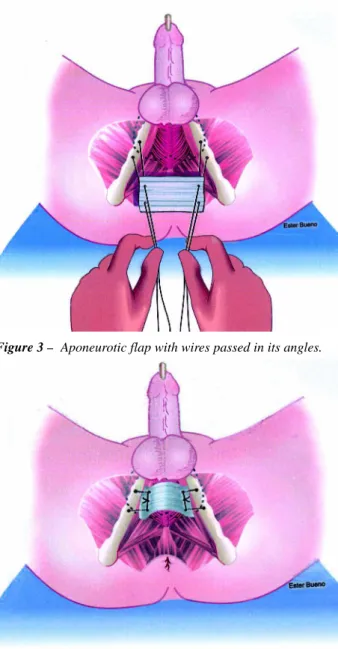
Once the screws have been placed, the apo-neurotic fascia (Figure-3) is fixed with wires to the bones, over the bulbo-urethral muscle, compressing it with a controlled pressure (Figure-4). The pressure with which the sling compresses the urethra is con-trolled using retrograde perfusion sphincterometry.
Figure 1 – Longitudinal perineal incision.
Figure 2 – Anchors applied to ischiopubic rami bilaterally.
Figure 3 – Aponeurotic flap with wires passed in its angles.
527
MALE PERINEAL AUTOLOGOUS SLING
An 8F urethral catheter is inserted in the distal ure-thra, occluding the glans around the catheter so that there is no leakage of fluid. This catheter is connected to the liquid column placed 60 cm above the patient’s pubic symphysis. When the fluid is open in order to run backwards through the urethra, the bulbo-urethral muscle is compressed with the sling until the drip-ping stops. In this way we impose a resistance of 60 cm of water to the passing of fluids through the ure-thra, a pressure that is similar to the one used in the artificial sphincter.
After fixing the sling, the surgical wound is copiously irrigated with antibiotic solution and the incision is drained and closed in 2 planes.
COMMENTS
The use of this procedure for correcting PPUI has shown to be an alternative to the employment of synthetic material, minimizing, like those slings used for correction of female UI, the risk of urethral ero-sion. It is a technical modification that is easy to
re-produce and has an acceptable cost when compared with the use of artificial sphincters.
REFERENCES
1. Rudy DC, Woodside JR, Crawford ED: Urodynamic evaluation of incontinence in patients undergoing modified Campbell radical retropubic prostatectomy: A prospective study. J Urol. 1984; 132: 708-11. 2. Goluboff ET, Said JA, Mazer S, Bagiella E, Heitjan
DF, Benson MC, et al.: Urinary continence after radi-cal prostatectomy: The Columbia experience. J Urol. 1998; 159: 1276-9.
3. Rios LAS, Panhoca R Borrelli IM: Injectables in the Treatment of Urinary Incontinence. In: Rubinstein I (ed.), Brazilian Clinics of Urology. 2001; vol 1: 265-74 [in Portuguese].
4. Gundian JC, Barret DM, Parulkar BG: Mayo Clinic experience with use of the AMS 800 artificial urinary sphincter for urinary incontinence following radical prostatectomy. J Urol. 1989; 142: 1459-967.
5. Comiter C V: The male sling for stress urinary incontince: A prospective study. J Urol. 2002; 167: 597-601.
Correspondence address:
Dr. Luis Augusto Seabra Rios
Rua Conselheiro Brotero, 1539 / 2o andar
São Paulo, SP, 01232-011, Brazil Fax: + 55 11 3826-2871
E-mail: [email protected]