Adult urethral stricture: practice of Turkish urologists
_______________________________________________
Mehmet Akyuz
1, Zulfu Sertkaya
1, Orhan Koca
1, Selahattin Calıskan
1, Musab Ali Kutluhan
1, Muhammet
Ihsan Karaman
11 Department of Urology, Haydarpasa Numune Training and Research Hospital, Istanbul, Turkey
ABSTRACT
ARTICLE
INFO
______________________________________________________________ ______________________
Objectives: To evaluate national practice patterns in the treatment of male anterior urethral strictures among Turkish urologists.
Materials and Methods: A survey form including 12 questions prepared to determine active Turkish urologists’ approach to diagnosis and treatment of the adult urethral stricture (US) were filled out. Based on the survey results, the institutions which 218 urologists work and their years of expertise, methods they used for diagnosis and tre-atment, whether or not they perform open urethroplasty and timing of open urethro-plasty were investigated.
Results: Optic internal urethrotomy and dilatation are the most commonly used mini-mal invasive procedures in treatment of US with the ratios of 93.5% and 63.3% res-pectively. On the other hand it was seen that urethroplasty was a less commonly used procedure, compared to minimal invasive techniques, with the ratio of 36.7%. Survey results showed us that the number of US cases observed and open urethroplasty proce-dures performed increases with increasing years of professional experience.
Conclusions: As a method demanding special surgical experience and known as a time-consuming and challenging procedure, open urethroplasty will be able to take a greater part in current urological practice with the help of theoretical education and practical courses given by specific centers and experienced authors.
Key words:
Urethra; Therapeutics; Pathology
Int Braz J Urol. 2016; 42: 339-45
_____________________
Submitted for publication: December 29, 2014
_____________________
Accepted after revision: May 06, 2015
INTRODUCTION
Urethral stricture is a well-known and com-mon problem in pathology which, as the result of scar formation, causes stenosis of urethral lumen in the subepithelial tissue (1). Even though treat-ment of urethral stricture due to different etiolo-gical reasons keeps improving, it is still one of the most challenging and complex issues in urological practice (2). Different minimally invasive proce-dures like periodic dilatation, direct visual internal urethrotomy (DVIU) and urethral stent placement are commonly applied forms of treatment. The mi-nimally invasive procedure is easy to perform and also, this method can be used more than once on
the same patient. The fact that results, in the long term, have not shown to be satisfactory has made definitive urethroplasty a necessity (3, 4).
or open urethroplasty which is a more complex and time consuming procedure, but has excellent long term results.
As a consequence, various studies show that different approaches can be seen on a na-tional and internana-tional level in diagnosis, treat-ment and patient follow-up in cases of urethral stricture (8-10). In this study our aim is to define which techniques are used by Turkish urologists in the process of diagnosis and treatment of ure-thral stricture, how often open urethroplasty and minimally invasive methods are used and the re-lationship of choice of treatment with the institu-tions the urologists work for.
MATERIALS AND METHODS
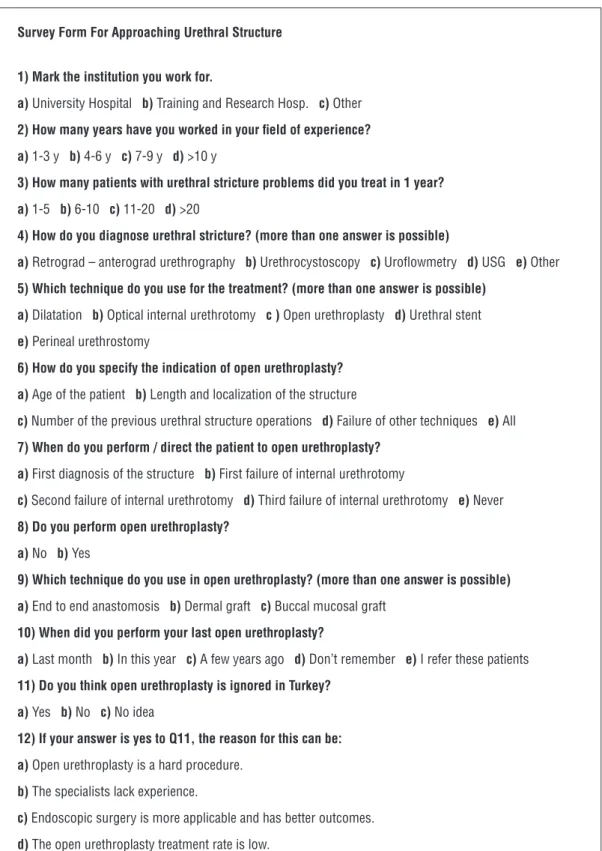
On the 22nd National Congress of Urolo-gy in Turkey in 2012, a survey called “Approach to urethral stricture survey form” consisting of 12 questions (Table-1), prepared to define approaches of Turkish urologists to diagnosis and treatment of urethral stricture, was given to participants to be filled out. 274 participants who filled the form were included in the study. 56 participants were excluded as some of them were still residents and some experts were also excluded due to the fact that their survey forms were not filled out com-pletely.
The 218 urologists who were a part of this study represent 15% of all urologists in Turkey. The results of this survey have revealed relevant information about the 218 urologists who have taken part in this study. The results show which institutions the urologists work for and also give information about their years of expertise. Fur-thermore, data could be found on the methods used by the participants for diagnosing and forms of treatment used. Also, the results present us with information on whether the participants performed open urethroplasty or not, in which circumstances they tend to use open urethroplasty and the rea-sons for ruling it out. Nevertheless, urethroplasty rates were checked upon and research was done to get information about the impact that institutions have on the decisions which the urologists have to
For statistical analysis, the computer pro-gramme SPSS® for Windows was used. The Stu-dent T test and Mann Whitney U test were used for data analysis. A P value<0.05 was considered statistically significant.
RESULTS
The results of the study are summarized in Table-2. According to the survey results, the most commonly used methods in the diagnosis of ure-thral stricture in Turkey were urethrocystoscopy (85.3%), uroflowmetry (69.7%) and retrograde ure-thrography (55.0%). Ultrasound and urethral cali-bration were rarely used methods for the diagnosis of urethral stricture (0.9%).
Optic internal urethrotomy and dilatation are the most commonly used minimally invasive procedures in treatment of urethral stricture with the ratios of 93.5% and 63.3% respectively. On the other hand, urethroplasty with the ratio of 36.7% is a less common procedure, compared to other mi-nimally invasive techniques. According to the re-sults of the survey, 63.3% of the urologists stated that they did not perform open urethroplasty while 8.2% of the participants used urethral stents and 3.7% performed perineal urethrostomy. The survey results showed that as the physician’s years of ex-perience increase, so does the number of open ure-throplasty procedures that they perform in cases of urethral stricture.
Table 1 - Survey Form.
Survey Form For Approaching Urethral Structure
1) Mark the institution you work for.
a) University Hospital b) Training and Research Hosp. c) Other
2) How many years have you worked in your field of experience?
a) 1-3 y b) 4-6 y c) 7-9 y d) >10 y
3) How many patients with urethral stricture problems did you treat in 1 year?
a) 1-5 b) 6-10 c) 11-20 d) >20
4) How do you diagnose urethral stricture? (more than one answer is possible)
a) Retrograd – anterograd urethrography b) Urethrocystoscopy c) Uroflowmetry d) USG e) Other
5) Which technique do you use for the treatment? (more than one answer is possible)
a) Dilatation b) Optical internal urethrotomy c ) Open urethroplasty d) Urethral stent
e) Perineal urethrostomy
6) How do you specify the indication of open urethroplasty?
a) Age of the patient b) Length and localization of the structure
c) Number of the previous urethral structure operations d) Failure of other techniques e) All
7) When do you perform / direct the patient to open urethroplasty?
a) First diagnosis of the structure b) First failure of internal urethrotomy
c) Second failure of internal urethrotomy d) Third failure of internal urethrotomy e) Never
8) Do you perform open urethroplasty?
a) No b) Yes
9) Which technique do you use in open urethroplasty? (more than one answer is possible)
a) End to end anastomosis b) Dermal graft c) Buccal mucosal graft
10) When did you perform your last open urethroplasty?
a) Last month b) In this year c) A few years ago d) Don’t remember e) I refer these patients
11) Do you think open urethroplasty is ignored in Turkey?
a) Yes b) No c) No idea
12) If your answer is yes to Q11, the reason for this can be:
a) Open urethroplasty is a hard procedure.
b) The specialists lack experience.
c) Endoscopic surgery is more applicable and has better outcomes.
DISCUSSION
Urethral stricture has been known for a long time, the symptoms differ from a mild decre-ase in urine flow velocity to inability to void and as it has a high recurrence rate after treatment it is considered a serious urological problem (1-3). Within the last 30 years, a significant change in the treatment algorithm of urethral stricture, cau-sed by trauma, infection, idiopathic reasons and iatrogenic reasons like transurethral surgery, ca-theterization and cystoscopy, was observed from more frequently performed minimally invasive te-chniques to definitive urethroplasty (4, 5).
In van Leeuwen et al.’s research from the Netherlands, 72% of the urologists use urethro-graphy in the diagnosis of urethral structure, on the other hand, urethrography use in Palminteri et al. research is at a surprisingly low rate of 16% indicating the denial of the test by the Italian pa-tients and acceptance of the technique as invasi-ve (9, 10). It is obserinvasi-ved that ultrasonography is seldom used in the diagnosis of urethral stricture (0.9%) but uroflowmetry (69.2%) and urethrocys-toscopy (85.3%) is frequently used. In our study we have observed that the ratio of using retrogra-de urethrography, which is the basic assessment method, is 55%.
Firstly described by Sachse in 1974, cold--cut direct visual internal urethrotomy (DVIU) is a popular method that is used frequently, easily and safely in current urological practices (11). According to Pansadoro and Heyns’s studies, re-currence ratios after the first, second and third DVIU, are 61%, 100% and 100% respectively in a 4 year patient follow-up (4, 12). In a prospecti-ve, randomized study that compares optical ure-throtomy to dilation, no significant difference was shown between both methods in the aspect of the recurrence of the stenosis (13). Accor-ding to our results, the most frequent methods used for adult urethral stricture by urologists in Turkey are minimally invasive methods such as DVIU and urethral dilatation. Urologist that took the survey indicated that they use DVIU (93.5%) and dilatation (63.3%). These results are
Table 2 - Survey Results.
Variables No (%)
Institute
Training-research hospital 58 (26.6)
University hospital 60 (27.5)
Other (Private – State hospital) 100 (47.9)
Professional Experience
1-3 y 34 (15.6)
4-6 y 20 (9.2)
7-9 y 50 (22.9)
10 y and above 114 (52.3)
Urethral structure treatment per year
1-5 cases 12 (5.5)
6-10 cases 26 (12.9)
11-19 cases 70 (32.1)
20 and above cases 110 (50.5)
Methods for Diagnosis
Retrograde urethrography 120 (55.0)
Urethrocystoscopy 186 (85.3)
Uroflowmetry 152 (69.7)
USG and other 2 (0.9)
Methods for Treatment
Urethral dilatation 138 (63.3)
Internal urethrotomy 204 (93.5)
Urethroplasty 80 (36.7)
End-to end anostomosis 80 (36.7)
Buccal graft 48 (22)
Dermal graft 22 (10)
Urethral stent 18 (8.2)
Perineostomy 8 (3.7)
Perform open urethroplasty?
Yes 80 (36.7)
No 138 (63.3)
Time of referral to open urethroplasty
First diagnosis 2 (0.9)
After 1st failure 12 (5.6)
After 2nd failure 72 (33.0)
After 3rd failure 122 (55.9)
Never 10 (4.6)
Is open urethroplasty ignored?
Yes 168 (77.0)
No 26 (11.9)
No idea 24 (11.1)
Reasons for ignoring open urethroplasty
Difficulty 94 (43.1)
Our observations showed that 8.2% of uro-logists use urethral stents which is associated with restenosis and complications, and which fails to show long-term effects. Urethral stent usage is 1.3% in van Leeuwen’s study, 12% in Palminteri’s and 23.4% in Bullock’s study (14, 15). The perine-ostomy implementation ratio is 3.7% and it shows similarity with the other survey results.
Open urethroplasty is the best and most definitive surgical technique in strictures in which minimally invasive techniques failed: cases with complete obstruction, long and multiple strictu-res and in serious spongiofibrosis. This technique
which requires technical skills and good experien-ce has a sucexperien-cess rate of about 90-95% and a recur-rence rate of 2-7% (16, 17). 36.7% of our survey participants perform open urethroplasty. In other studies this rate is about 29-42% (8-10). According to four different national survey studies, there are no serious differences in diagnosis and treatment of urethral stricture among urologists. When we compared the techniques used in open ure-throplasty, we saw that end-to-end anastomosis was more frequently used than graft techniques. The reason for more frequent use of end-to-end anastomosis rather than graft techniques may be
Table 3 - Procedures in urethral stricture treatment according to the institutions.
Training and Research Hosp
No (%)
University Hospital
No (%)
Other Hospital
No (%) P Value
Doing urethroplasty or not Yes 30 (37.5) 34 (42.5) 16 (20.0)
P1:0.20
P2:0.002
No 28 (20.3) 22 (15.9) 88 (63.8) P3:0.001
Procedure
Optic internal
urethrotomy 56 (27.4) 54 (26.4) 94 (46.0)
P1:0.32
P2:0.001
P3:0.001
Dilatation 30 (21.7) 40 (28.9) 68 (49.2)
P1:0.08
P2:0.001
P3:0.001
Urethroplasty 30 (37.5) 34 (42.5) 16 (20.0)
P1:0.20
P2:0.002
P3:0.001
Methods for urethroplasty
End to end
anastomosis 28 (34.7) 33 (41.3) 19 (23.9)
P1:0.05
P2:0.018
P3:0.001
Buccal mucosal
graft 18 (37.5) 22 (45.8) 8 (16.7)
P1:0.046
P2:0.01
P3:0.001
Dermal graft 12 (54.5) 10 (45.5) 0 (0.0)
P1:0.10
P2<0.001
P3<0.001
not combining a complicated procedure which requires special surgical experience, special care and special instrumentation with another com-plicated procedure.
One of the interesting results of our stu-dy is the relationship between the institution the treating physician works for and the treatment te-chniques for urethral stricture. When we compa-red the use of open urethroplasty and minimally invasive techniques between university hospitals and training and research hospitals where aca-demic urologists work, there was no significant difference. On the other hand, there was a sig-nificant difference between them when compared with urologists working in other hospitals. Ano-ther result of our study is that 77% of urologists ignored open urethroplasty and the main reason for this was a lack of experience (66%). For this reason, just as stated in the study of Bullock et al., due to financial worries and concerns minimally invasive procedures are performed more frequen-tly than definitive urethroplasty (8).
Another interesting result of our study was that open urethroplasty is generally preferred after two to three unsuccessful DVIUs in urethral stric-ture. A rate of 0.9% in preferring open urethro-plasty in the first diagnosis makes us think that primarily minimally invasive techniques are pre-ferred in almost all urethral strictures. However, according to literature in this field, multiple dila-tations and internal urethrotomy procedures lower the success rate of urethroplasty and affect the re-sults negatively. Updated survey rere-sults show that urologists lead their patients to urethroplasty after the 2nd and 3rd failure (75% in the study of Bullock
et al. and 88.9% in our study (8, 18, 19).
A relatively low number of participants and the preference of the urologists who attended the congress can be seen as the limitations of our research. Likewise, the usage of an invalid form has been another limitation for our research.
CONCLUSIONS
Minimally invasive methods are the most frequently used procedures in the treatment of
cause they are easily applicable and show good results in short term, while on the other hand, in the long term, stricture relapse is the most impor-tant flaw. End-to-end anastomosis and urethro-plasty with buccal graft is less frequently used. Open urethroplasty, which is a method demanding special surgical experience and is known as a ti-me-consuming and challenging procedure, can be more frequently performed in the current urologi-cal practice with the help of theoretiurologi-cal education and practical courses given by specific centres and experienced authors.
CONFLICT OF INTEREST
None declared.
REFERENCES
1. Mundy AR, Andrich DE. Urethral strictures. BJU Int. 2011;107:6-26.
2. Chiou RK, Matamoros A, Anderson JC, Taylor RJ. Changing concepts of urethral stricture management. I: Assessment of urethral stricture disease. Nebr Med J. 1996;81:282-6. 3. Andrich DE, Mundy AR. What is the best technique for
urethroplasty? Eur Urol. 2008;54:1031-41.
4. Pansadoro V, Emiliozzi P. Internal urethrotomy in the management of anterior urethral strictures: long-term followup. J Urol. 1996;156:73-5.
5. Chiou RK, Taylor RJ. Changing concepts of urethral stricture management. II: Selection of treatment options. Nebr Med J. 1996;81:287-91.
6. Heyns CF, Steenkamp JW, De Kock ML, Whitaker P. Treatment of male urethral strictures: is repeated dilation or internal urethrotomy useful? J Urol. 1998;160:356-8.
7. Datta B, Rao MP, Acharya RL, Goel N, Saxena V, Trivedi S, et al. Dorsal onlay buccal mucosal graft urethroplasty in long anterior urethral stricture. Int Braz J Urol. 2007;33:181-6. 8. Bullock TL, Brandes SB. Adult anterior urethral strictures: a
national practice patterns survey of board certified urologists in the United States. J Urol. 2007;177:685-90.
9. van Leeuwen MA, Brandenburg JJ, Kok ET, Vijverberg PL, Bosch JL. Management of adult anterior urethral stricture disease: nationwide survey among urologists in the Netherlands. Eur Urol. 2011;60:159-66.
12. Heyns CF, Steenkamp JW, De Kock ML, Whitaker P. Treatment of male urethral strictures: is repeated dilation or internal urethrotomy useful? J Urol. 1998;160:356-8.
13. Steenkamp JW, Heyns CF, de Kock ML. Internal urethrotomy versus dilation as treatment for male urethral strictures: a prospective, randomized comparison. J Urol. 1997;157:98-101.
14. Palminteri E, Gacci M, Berdondini E, Poluzzi M, Franco G, Gentile V. Management of urethral stent failure for recurrent anterior urethral strictures. Eur Urol. 2010;57:615-21. 15. Hussain M, Greenwell TJ, Shah J, Mundy A. Long-term results
of a self-expanding wallstent in the treatment of urethral stricture. BJU Int. 2004;94:1037-9.
16. Barbagli G, Kulkarni SB, Fossati N, Larcher A, Sansalone S, Guazzoni G, et al. Long-term followup and deterioration rate of anterior substitution urethroplasty. J Urol. 2014;192:808-13.
17. Andrich DE, Dunglison N, Greenwell TJ, Mundy AR. The long-term results of urethroplasty. J Urol. 2003;170:90-2. 18. Roehrborn CG, McConnell JD. Analysis of factors
contributing to success or failure of 1-stage urethroplasty for urethral stricture disease. J Urol. 1994;151:869-74. 19. Andrich DE, O’Malley KJ, Greenwell TJ, Mundy AR. Does
urethrotomy jeopardize the outcome of urethroplasty? BJU Int, 2003;91:89-92.