Factors associated with diabetic foot amputations
Fatores associados a amputações por pé diabético
Isabel Cristina Ramos Vieira Santos1, Eduardo Freese de Carvalho2, Wayner Vieira de Souza2, Emídio Cavalcanti de Albuquerque3
Abstract
Background: Diabetes and the problem of the diabetic foot speciically are a severe burden on the public healthcare system. Amputations caused by this condition are still common in our setting (Brazil), although the true magnitude of the problem is not known with certainty. Lower limb amputation rates have come to be seen as an indicator of the quality of preventative care of the diabetic foot. Objective: To identify associations between amputations and factors related to people, to morbidities and to primary care received. Methods: his was a cross-sectional study of a sample of 137 patients with diabetic feet admitted to a large hospital in the city of Recife, Pernambuco, Brazil. Logistic regression analysis was conducted. Results: Associations with amputation were detected for the following variables: age over 60; resident of the Metro zone; income of three minimum salaries or less; presence of gangrene on admission; glycemia ≥ 126 mg/dL; smoking; not receiving information about results of glycemia testing; not having feet examined, and not being given guidance on caring for feet at consultations during the previous year. Conclusions: Factors related to Primary Care, such as time since onset of ulcers, information about results of glycemia testing and lack of guidance on how to care for their feet, were associated with occurrence of lower limb amputations.
Keywords: diabetic foot; amputation; primary care.
Resumo
Contexto: O diabetes e especiicamente o problema do pé diabético representam grave adversidade ao sistema de saúde pública. As amputações resultantes deste agravo ainda são frequentes em nosso meio, embora não se conheça ao certo a sua magnitude. A taxa de amputações de membros inferiores tem sido considerada um indicador da qualidade dos cuidados preventivos do pé diabético. Objetivo: Identiicar a existência de associação entre amputações e fatores relacionados às pessoas, à morbidade e à atenção básica recebida. Métodos: Estudo transversal que incluiu uma amostra de 137 portadores de pé diabético internados em hospital de grande porte da cidade do Recife. Realizou-se análise de regressão logística. Resultados: Veriicou-se associação para as variáveis: idade de 60 anos ou mais; procedência da Região metropolitana; renda de até três salários mínimos; presença de gangrena à admissão; glicemia de 126 mg/ dL ou mais; tabagismo; não receber informação dos resultados da glicemia; não ter os pés examinados, e não receber orientação sobre cuidados com os pés nas consultas do ano anterior. Conclusões: Fatores relacionados à Atenção Básica, tais como o tempo de ocorrência da úlcera, a informação dos resultados do exame de glicemia e a falta de orientação sobre cuidados com os pés, estiveram associados com a ocorrência de amputações de membros inferiores.
Palavras-chave: pé diabético; amputação; atenção básica.
1Universidade de Pernambuco – UPE, Faculdade de Enfermagem Nossa Senhora das Graças – FENSG, Recife, PE, Brazil. 2Fundação Oswaldo Cruz – Fiocruz, Centro de Pesquisas Aggeu Magalhães – CPqAM, Recife, PE, Brazil.
3Instituto de Medicina Integral Professor Fernando Figueira – IMIP, Recife, PE, Brazil.
Financial support: None.
Conlicts of interest: No conlicts of interest declared concerning the publication of this article. Submitted: June 07, 2014. Accepted: September 08, 2014.
INTRODUCTION
Ulcers of the diabetic foot and resulting lower limb amputations are common, complex and incapacitating complications of diabetes. Prevalence rates are increasing all the world and the incidence of diabetic foot ulcers is increasing at a higher rate than other complications of diabetes.1,2
In the United States, diabetic patients account for around 3% of the total population and more than 50% of them suffer lower limb amputations. Around 1 to 4% of diabetic patients develop foot ulcers each year and around 15% will suffer ulceration at least once in their lives.2,3
Additionally, it is estimated that from 30 to 50% of those who have an amputation will require additional amputations within 1 to 3 years and 50% of them
will die within 5 years of the irst major amputation.1
Diabetes, and speciically the problem of the
diabetic foot, represent a severe challenge to and burden on the public health system. Several European countries and also organizations such as the World Health Organization and the International Diabetes Federation have set a target for reduction of amputation rates by 50%.4
This target can be hit by means of adoption of simple measures for preventative care, diagnosis and more effective treatment during the early stages of the disease.4-7
Although controversial, lower limb amputation rates have come to be viewed as an indicator of the quality of care of the diabetic foot. Therefore, it is essential to understand the factors associated with utilization of hospital services, in order to monitor preventative care, which in turn is primarily in order to address potentially avoidable morbidity at this level of care.8
The objective of this study was to identify
associations between amputations and factors related to people, to morbidities and to primary care.
METHODS
This was a cross-sectional epidemiological study conducted to identify factors associated with the outcome diabetic foot amputations, analyzing factors related to people, to morbidity and to (preventative) Primary Care received, this last because the condition can be avoided, depending on the preventative action that is taken.
The setting chosen for the study was one of the largest hospitals on the public health system in the Brazilian state of Pernambuco. The hospital was chosen because it is one of only three in the state
that has a specialist vascular clinic that treats patients with diabetic feet.
The study population comprised all diabetic foot patients admitted for treatment and totaled 151 patients. After application of the inclusion criterion (patients with a diagnosis on their medical records of ischemic, neuropathic or infectious diabetic foot, with class 2 to 5 ulceration according to the Wagner
classiication) and exclusion criteria (never having
attended primary care or a lack of the physical and/or mental conditions necessary to answer the questions), data were analyzed on a total of 137 patients, which equates to 90.7% of the population that had been admitted with the condition of interest.
A questionnaire was constructed based on the International Consensus on the Diabetic Foot9 and the Arterial Hypertension and Diabetes Manual,10 which is the Brazilian Ministry of Health’s normative standard, published to guide reorganization of primary care for these two diseases.
The irst step in data collection was a daily review
of admissions to identify diabetic foot patients at the vascular clinic, using the clinic’s records and
individual patient records to select those that it the
study criteria. The second stage in data collection was administration of the questionnaire in interview format, after patients had provided consent.
The deinition of amputations used for this study include both major amputations, i.e. those above
the level of the ankle, and minor amputations (disarticulation of the ankle or below).9
In addition to the dependent variable ‘amputation’, the independent variables analyzed were related either to people (age, sex, origin, educational level and income); to morbidity (time since diagnosis of DM [TDM], point at which informed of DM diagnosis [before or after admission], circumstances of DM diagnosis [before or after onset of foot condition], time since onset of current problem, time on treatment, presence of gangrene on admission, glycemia on admission, smoking and prior amputation); or to (preventative) Primary Care received (number of consultations, glycemia testing, information about glycemia test results, foot examinations, guidance on caring for feet, nutritional guidance, advice about physical activity, use of medication to control DM and availability of medication, all of which were with reference to the previous 12 months).
was analyzed using the chi-square test with Yates’ correction.
In both bivariate and multivariate analyses, odds ratios (OR) were used to estimate relative risk,
with a 95% conidence interval (95%CI). Logistic
regression modeling was employed to construct estimations of the probability of the dependent variable (amputation) as a function of the explanatory variables.
All variables that were associated with amputations
to a level of p≤0.20 in the bivariate analysis were
included in the initial logistic model, except for variables with very low frequencies and high odds, indicating that they were confounding factors. Variables were then excluded one-by-one using the
Backward Stepwise method (Likelihood Ratio). All analyses were conducted to a signiicance level of 5%.
Data were double input to SPSS version 13.0, which was also used for the analyses.
The project was approved by the Research Ethics
Committee under registration number CAAE: 1025.0.000.095-06.
RESULTS
Eight-ive of the 137 patients studied underwent
some type of amputation, while the remaining 52 were receiving conservative treatment (revascularization or clinical procedures).
Amputations and factors related to people
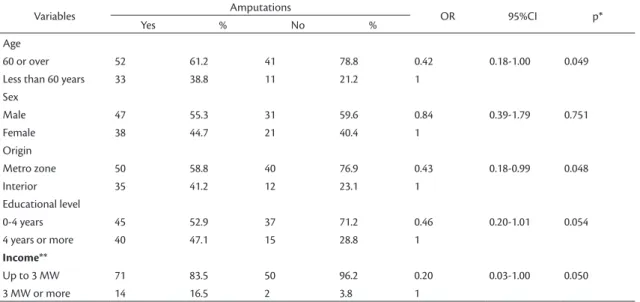
Within the subset of patients who underwent amputations (n=85), it can be observed in Table 1
that the age group 60 or over was the most frequent (61.2%).
Tests for the association between amputation and the variable ‘sex’ showed that male patients had more amputations when compared to female patients; but
the difference was not signiicant (p=0.751). There
were also more amputations among residents of the Metro zone (58.8%).
Educational level and income were associated with greater frequency of amputations for the categories 0-4 years’ schooling (52.9%) and up to three times the minimum wage (83.5%) respectively. The differences observed for age, origin and income
were statistically signiicant to 5%.
Amputations and factors related to morbidity
Patients who did have amputations reported a time since diagnosis of diabetes mellitus (TDM) greater
than 5 years, the majority (71.4%) of them stated
that they only found out about their condition after an admission and 54.1% of them only found out they were diabetic after developing foot ulcers (Table 2).
The patients studied reported having their current foot problems for more than 1 month (83.5%) and having waited more than 1 month for care (81.2%). According to the bivariate analysis, these patients had probabilities of suffering an amputation that were 3 times (95%CI: 1.33-7.64) and 2.7 times (95%CI: 1.15-6.33) greater than the remainder of the sample.
Among the subset of patients who had amputations, gangrene was present on admission in 85.9% and those that had this complication on admission had a 3 times greater chance of amputation.
Table 1. Amputations and variables related to people.
Variables Amputations OR 95%CI p*
Yes % No %
Age
60 or over 52 61.2 41 78.8 0.42 0.18-1.00 0.049
Less than 60 years 33 38.8 11 21.2 1
Sex
Male 47 55.3 31 59.6 0.84 0.39-1.79 0.751
Female 38 44.7 21 40.4 1
Origin
Metro zone 50 58.8 40 76.9 0.43 0.18-0.99 0.048
Interior 35 41.2 12 23.1 1
Educational level
0-4 years 45 52.9 37 71.2 0.46 0.20-1.01 0.054
4 years or more 40 47.1 15 28.8 1
Income**
Up to 3 MW 71 83.5 50 96.2 0.20 0.03-1.00 0.050
3 MW or more 14 16.5 2 3.8 1
Glycemia results on admission showed that 65.9% of the patients who suffered amputation arrived at hospital with levels over the cutoff point. Mean
concentration was 212 mg/dL and the median was 183 mg/dL ± 86.7. This variable had a statistically signiicant association with amputation (p = 0.003).
Among the subset of patients who had amputations, 82.4% reported smoking and the difference in occurrence of amputation between those who smoked
and those who did not was signiicant to 1%, with
a 6.4 times greater probability (95%CI: 2.90-13.93) of amputation among smokers.
There was a high prevalence of previous history
of amputation among those subjected to amputation
during the current admission (92%). Analysis of this
variable revealed a statistically signiicant difference
at the level of 5%, confirming the association between prior amputation and current amputation. Analysis showed that those with a history of previous amputation exhibited a four times greater chance
(95%CI: 1.53-11.01) of amputation during the current admission.
Amputations and factors related to (preventative) Primary Care received
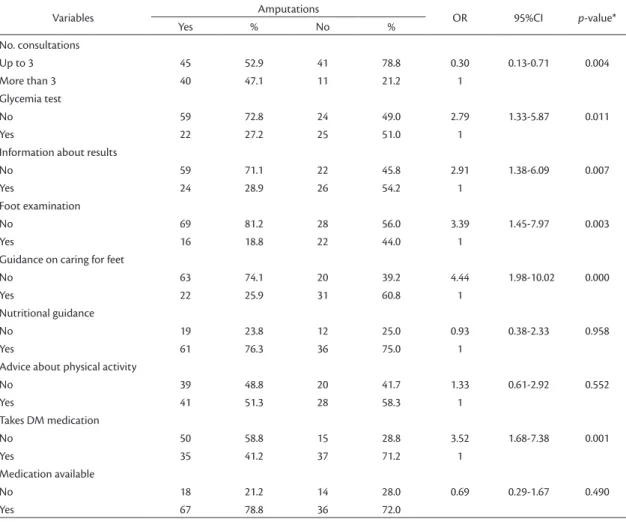
A little over half of the patients who underwent amputations (52.9%) reported having attended three or fewer consultations during the previous year and the difference between these patients and patients who attended higher numbers of consultations
was statistically signiicant to 5%, indicating an
association with amputation, as can be observed from the results listed in Table 3.
With regard to testing of plasma glycemia, 72.8% of the patients who had amputations reported that glycemia had not been tested and 71.1% of same subset reported that they had not received information about glycemia test results. Both of these variables
exhibited statistically signiicant differences with a
three times greater chance of amputation (95%CI: 1.33-5.87 and 1.38-6.09, respectively) among
Table 2. Amputations and variables related to morbidity.
Variables Amputations OR 95%CI p*
Yes % No %
TDM
More than 5 years 42 50.6 29 55.8 0.81 0.38-1.73 0.683
Up to5 years 41 49.4 23 44.2 1
Informed of DM Diagnosis
After admission 60 71.4 22 44.0 3.18 1.53-6.61 0.003
Before admission 24 28.6 28 56.0 1
Circumstance of Diagnosis
After onset of foot problem 46 54.1 41 78.8 0.32 0.13-0.74 0.006
Before onset of foot problem 39 45.9 11 21.2 1
Time since onset of current problem
More than 1 month 71 83.5 32 61.5 3.17 1.33-7.64 0.007
Up to 1 month 14 16.5 20 38.5 1
Time waiting for care
More than 1 month 69 81.2 32 61.5 2.70 1.15-6.33 0.019
Up to 1 month 16 18.8 20 38.5 1
Gangrene on admission
Yes 73 85.9 34 65.4 3.22 1.39-7.43 0.009
No 12 14.1 18 34.6 1
Glycemia on admission
≥ 126 mg/dL 56 65.9 47 45.6 0.21 0.06-0.62 0.003
< 126 mg/dL 29 34.1 5 9.6 1
Smoking
Yes 70 82.4 22 42.3 6.36 2.90-13.93 0.000
No 15 17.6 30 57.7 1
Previous amputation
Yes 78 91.8 38 73.1 4.11 1.53-11.01 0.007
No 7 8.2 14 26.9 1
patients who did not have glycemia tests and did not receive information about the results.
Both examination of the feet and guidance about
caring for the feet exhibited signiicant differences.
Among the subset of patients who had amputations, 81.2% reported that their feet were not examined at consultations (OR: 3.39; 95%CI: 1.45-7.97) and 74.1% reported that they had not been given instructions about how to care for their feet (OR: 4.44; 95%CI: 1.98-10.02).
When the outcome amputation was analyzed with respect to nutritional guidance and advice on physical
activity, it was found that there were no signiicant
differences.
With regards to variables related to use of medication to control diabetes, 58.8% of the patients reported they did not take such medications (p=0.001), although 78.8% of them reported that these medications were available at their health centers. The difference for this last variable between
patients who had amputations and patients who
did not was not statistically signiicant. However,
not taking medication for DM was associated with occurrence of amputation, with a 3.5 times greater chance (95%CI: 1.68-7.38).
The result of the logistic regression analysis of the variables related to people, to morbidity and to (preventative) primary care received is shown in Table 4.
As can be observed, time since onset of current problem greater than 1 month (OR= 4.419; 95%CI: 1.502-13.007) and failure to receive guidance on caring for feet (OR=3.583; 95%CI:1.243-10.328) are strongly associated with the occurrence of amputations. Not being informed about the results of the glycemia tests conducted (OR=3.341; 95%CI: 1.254-8.899) and presence of gangrene on admission (OR=3.086; 95%CI: 0.920-10.352) were both also associated with the outcome.
Table 3. Amputations and variables related to (preventative) primary care received.
Variables Amputations OR 95%CI p-value*
Yes % No %
No. consultations
Up to 3 45 52.9 41 78.8 0.30 0.13-0.71 0.004
More than 3 40 47.1 11 21.2 1
Glycemia test
No 59 72.8 24 49.0 2.79 1.33-5.87 0.011
Yes 22 27.2 25 51.0 1
Information about results
No 59 71.1 22 45.8 2.91 1.38-6.09 0.007
Yes 24 28.9 26 54.2 1
Foot examination
No 69 81.2 28 56.0 3.39 1.45-7.97 0.003
Yes 16 18.8 22 44.0 1
Guidance on caring for feet
No 63 74.1 20 39.2 4.44 1.98-10.02 0.000
Yes 22 25.9 31 60.8 1
Nutritional guidance
No 19 23.8 12 25.0 0.93 0.38-2.33 0.958
Yes 61 76.3 36 75.0 1
Advice about physical activity
No 39 48.8 20 41.7 1.33 0.61-2.92 0.552
Yes 41 51.3 28 58.3 1
Takes DM medication
No 50 58.8 15 28.8 3.52 1.68-7.38 0.001
Yes 35 41.2 37 71.2 1
Medication available
No 18 21.2 14 28.0 0.69 0.29-1.67 0.490
Yes 67 78.8 36 72.0
DISCUSSION
Age has been identified as a risk factor for amputations secondary to diabetic feet in several different studies.3,8,11,12 However, specifically in the present study, although age exhibited a statistically significant difference in bivariate
analysis, signiicance was not maintained in the inal
regression model.
In contrast, region of origin was associated with occurrence of amputation in both analyses, with a higher frequency of people resident in the Metro zone among those patients who underwent amputations.
This inding about the origins of patients with relation
to the condition diabetic foot and amputation is a
sign that greater relection is needed with regard to
the social conditions of the population at risk and also raises questions with relation to the diabetic foot situation in provincial areas in the interior of the state,
which is a subject requiring further investigation.
The high proportion of patients who only discovered they had diabetes after developing
problems with their feet is evidence that dificulties
still remain with ensuring diagnosis and follow-up of diabetes mellitus. Since it is known that the diabetic
foot is associated with long disease duration and poor metabolic control,4,12,13 these services, which should be provided by Primary Care services, have a direct relationship with the prevalence of amputations because of the diabetic foot.
Along the same lines, the time since onset of the current problem is indicative of the most recent
occurrence, whether the irst or a continuation of a
process lasting many years, and is an expression both
of a need for care and of dificulties accessing and
utilizing the healthcare system.
The results observed revealed significant differences between patients who had had a foot problem for more than 1 month and those who had not. Multivariate analysis showed that the subset that had suffered from foot ulcers for more than 1 month had a 3 times greater probability of suffering an amputation than those whose problem had been detected more recently, thereby demonstrating that this is a risk factor for amputation. It is of note that no similar data could be found in the literature that were appropriate for comparison.
The variable gangrene at admission indicates the severity of the case at the point that the patient is seen at a healthcare institution of a higher level
Table 4. Multivariate analysis of variables associated with occurrence of amputations.
Variables OR IC [95%] p-value
Origin
Interior 1.000 - 0.072
Metro zone 0.357 0.116-1.098
Gangrene on admission
No 1.000 - 0.068
Yes 3.086 0.920-10.352
Time since onset of current problem
Up to 1 month 1.000 - 0.007
More than 1 month 4.419 1.502-13.007
Glycemia on admission
≤126 mg/dL 1.000 - 0.113
> 126 mg/dL 0.297 0.066-1.332
Circumstance of Diagnosis
Before onset of foot problem 1.000 - 0.043
After onset of foot problem 0.298 0.092-0.962
No. consultations
More than 3 1.000 - 0.045
Up to 3 0.299 0.092-0.974
Information about results
Yes 1.000 - 0.016
No 3.341 1.254-8.899
Guidance on caring for feet
Yes 1.000 - 0.018
of complexity and those who presented at hospital already with gangrene had a three times greater chance of undergoing amputation than those who did not have the condition at admission.
In theory, this inding is evidence of either a lack
of access to or a failure to comply with primary care and compounds other risk factors for amputation, such as time since becoming aware of the disease and time since onset of current problem. Bearing in mind that the diabetic foot is avoidable through early diagnosis and preventative measures, the high rates of gangrene by the time of hospital admission, the numbers of patients who only became aware they had DM after a problem with their feet had occurred and the proportion who had ulcers that had been progressing for more than 1 month all show the existence of problems with the effectiveness of primary care actions.
The high rates of hyperglycemia on admission observed in this study are compatible with the results of other studies.3,14 Although there was an association
between the subset with glycemia levels ≥126 mg/dL
and amputations, both the analysis using odds ratios and the logistic regression modeling indicated that the association between this variable and occurrence of amputations was weak, probably because of the small number of patients analyzed.
Several different studies have shown how poor glycemic control encourages emergence and development of chronic complications and increases the risk of neuropathy, which is one of the most important factors in triggering ulceration of the feet, but there are no studies demonstrating a direct relationship between hyperglycemia and amputations.11,13-15
There is consistent evidence to show that any improvement in control of glycemia reduces the risk of microvascular and neuropathic complications and their progression.6,9
With regard to information about the results of this test, ignorance of the normal value for glycemia was associated with a three times greater chance of loss of the limb at the most recent admission.
Poor metabolic control and failure to provide information about the result are both factors that compromise adequate management of the diabetic foot, exposing patients to unpleasant outcomes.
Recognition of co-responsibility and the need to develop autonomy and initiative-taking in diabetic patients, through establishment of relationships of solidarity between Primary Care professionals and their clients, has the potential to improve self-care through the probable effect of their satisfaction
with the results of compliance with treatment. In contrast, patients who are not compliant with treatment have a 50 times greater probability of suffering from foot ulcers and a 20 times greater probability of amputation than those who correctly follow guidance.6,16,17
The inding of 3 or fewer consultations attended
during the previous year, combined with time since onset of current problem, high glycemia levels and presence of gangrene on admission, reveals
dificulties with screening and follow-up by primary
care services and shows a failure to provide coverage and surveillance of this complication.
The primary care professionals’ training manual recommends that, when faced with chronic complications in unstable patients with inadequate control, consultations should be scheduled every 2 or 3 months, which is the equivalent of four to six times a year.10 The International Consensus on the Diabetic Foot recommends that patients with a prior history of amputation should attend consultations at intervals of 1 to 3 months.9
Not conducting foot examinations during the
previous year with the objective of prevention or
control of the diabetic foot was associated with a 3.39 times greater probability of patients suffering an amputation, according to the bivariate analysis. In
line with this inding, a lack of guidance about how to
care for the feet was associated with approximately 3.6 times greater chance of requiring an amputation,
according to the inal regression model.
Several different studies emphasize the importance of proactive intervention, with care provided by a multidisciplinary team and focusing on caring for the high-risk population.6,8,17,18
According to the International Consensus on the Diabetic Foot,9 people should undergo, as a minimum, one examination of the feet per year (and more frequently if the risk of complications is high).9 The consensus also insists, in agreement with several different studies, that these examinations are an essential component of adequate management of this complication, involving investigation of the feet’s protective sensitivity, their structure, biomechanics and circulation and the integrity of their skin, using simple and low-cost tests.
The majority of these measures fall within the
strategy for managing disease and a way of dealing with the growing demand for consultations, some
have reported dificulties with relation to planning,
implementing and assessing the process.17
The findings reported here with relation to examinations of and guidance given to diabetic patients with relation to their feet reveal that these practices have not yet been incorporated into the routine activities of Primary Care services and are important factors associated with amputations among these patients, even acknowledging the methodological limitations of this study.
One limitation of this study is related to a possible memory bias, since factors related to preventative care received previously were surveyed by questioning patients when hospitalized for diabetic feet. However, it is believed that this bias was minimal, in view of the relevance to their current conditions.
Among the factors that were identiied in this
study as being associated with amputation of lower limbs because of diabetic feet, those that stand out are related to the (preventative) Primary Care received, particularly the extensive interval since onset of the problem with the foot, the lack of information about the glycemia test results and the lack of guidance on caring for feet.
REFERENCES
1. Armstrong DG, Cohen K, Courric S, Bharara M, Marston W. Diabetic foot ulcers and vascular insufficiency: our population has changed, but our methods have not. J Diabetes Sci Tech. 2011;5(6):1591-5. http://dx.doi.org/10.1177/193229681100500636. PMid:22226282 2. Lee KM, Kim WH, Lee JH, Choi MSS. Risk factors of treatment failure in diabetic foot ulcer patients. Arch Plast Surg. 2013;40(2):123-8. http://dx.doi.org/10.5999/aps.2013.40.2.123. PMid:23532959 3. Brechow A, Slesaczeck T, Münch D, et al. Improving major
amputation rates in the multicomplex diabetic foot patient: focus on the severity of peripheral arterial disease. Ther Adv Endocrinol Metab. 2013;4(3):83-94. http://dx.doi. org/10.1177/2042018813489719. PMid:23730502
4. Konstantikaki V. The role of primary care in the prevention of diabetic foot amputations. Int J Caring Sci. 2008;1(1):26-33. 5. Prompers L, Schaper N, Apelqvist J, et al. Prediction of outcome
in individuals with diabetic foot ulcers: focus on the differences between individuals with and without peripheral arterial disease. The EURODIALE Study. Diabetologia. 2008;51(5):747-55. http:// dx.doi.org/10.1007/s00125-008-0940-0. PMid:18297261 6. Caiafa JS, Castro AA, Fidelis C, Santos VP, Silva ES, Sitrângulo
CJ Jr. Atenção integral ao portador de pé diabético. J Vasc
Bras. 2011;10(4, Supl 2):1-32. http://dx.doi.org/10.1590/ S1677-54492011000600001.
7. Weck M, Slesaczeck T, Paetzold H, et al. Structured health care for subjects with diabetic foot ulcers results in a reduction of major amputation rates. Cardiovasc Diabetol. 2013;12(1):45. http:// dx.doi.org/10.1186/1475-2840-12-45. PMid:23497152
8. Alvarsson A, Sandgren B, Wendel C, Alvarsson M, Brismar K. A retrospective analysis of amputation rates in diabetic patients: can lower extremity amputations be further prevented? Cardiovasc Diabetol. 2012;11(1):18. http://dx.doi.org/10.1186/1475-2840-11-18. PMid:22385577
9. International Working Group on the Diabetic Foot. International consensus on the diabetic foot and practical guidelines on the management and prevention of the diabetic foot [DVD]. Brussels: International Diabetes Federation (IDF); 2011.
10. Brasil. Ministério da Saúde. Secretaria de Políticas de Saúde.
Departamento de Ações Programáticas Estratégicas. Plano
de reorganização da atenção à hipertensão arterial e diabetes mellitus: manual de hipertensão arterial e diabetes mellitus. Brasília: Ministério da Saúde; 2002.
11. Assumpção EC, Pitta GB, Macedo ACL, et al. Comparação dos fatores de risco para amputações maiores e menores em pacientes diabéticos de um Programa de Saúde da Família. J Vasc Bras. 2009;8(2):133-8. http://dx.doi.org/10.1590/ S1677-54492009000200006.
12. Venermo M, Manderbacka K, Ikonen T, Keskimäki I, Winell K, Sund R. Amputations and socioeconomic position among persons with diabetes mellitus, a population-based register study. BMJ Open. 2013;3(4):e002395. http://dx.doi.org/10.1136/ bmjopen-2012-002395. PMid:23572197
13. García-Álvarez Y, Lázaro-Martínez JL, García-Morales E, Cecilia-Matilla A, Aragón-Sánchez J, Carabantes-Alarcón D. Morphofunctional characteristics of the foot in patients with diabetes mellitus and diabetic neuropathy. Diabetes Metab Syndr. 2013;7(2):78-82. http://dx.doi.org/10.1016/j.dsx.2013.02.029. PMid:23680245
14. Vieira-Santos ICR, Souza WV, Carvalho EF, Medeiros MCW, Nóbrega MGL, Lima PMS. Prevalência de pé diabético e fatores associados nas unidades de saúde da família da cidade do Recife, Pernambuco, Brasil, em 2005. Cad Saude Publica. 2008;24(12):2861-70. http://dx.doi.org/10.1590/S0102-311X2008001200015. PMid:19082277
15. Dos Santos Tavares DM, Dias FA, Araújo LR, Pereira GA. Perfil de clientes submetidos a amputações relacionadas ao diabetes mellitus. Rev Bras Enferm. 2009;62(6):825-30. http://dx.doi. org/10.1590/S0034-71672009000600004. PMid:20098872 16. Kafaie P, Noorbala MT, Soheilikhah S, Rashidi M. Evaluation of
patients’ education on foot self-care status in diabetic patients. Iran Red Crescent Med J. 2012;14(12):829-32. http://dx.doi. org/10.5812/ircmj.1138. PMid:23482390
17. Santos L, Torres HC. Práticas educativas em Diabetes Mellitus: compreendendo as competências dos profissionais da saúde. Texto Contexto Enferm. 2012;21(3):574-80. http://dx.doi. org/10.1590/S0104-07072012000300012.
Correspondence
Isabel Cristina Ramos Vieira Santos Rua Teles Junior, 475, apto. 201 – Rosarinho CEP 52050-040 – Recife (PE), Brazil Tel.: +55 (81) 32426575/88886575 E-mail: [email protected]
Author information
ICRVS - PhD in Sciences from Centro de Pesquisas Aggeu Magalhães (CPqAM), Fundação Oswaldo Cruz (FIOCRUZ). EFC - PhD in Social and Sanitary Sciences from Universidad Complutense de Madrid. WVS - PhD in Public Health from Fundação Oswaldo Cruz (FIOCRUZ). ECA - MSc in Public Health from Centro de Pesquisas Aggeu Magalhães (CPqAM), Fundação Oswaldo Cruz (FIOCRUZ).
Author contributions
Conception and design: ICRVS, EFC, WVS Analysis and interpretation: ICRVS, WVS, ECA Data collection: ICRVS Writing the article: ICRVS Critical revision of the article: EFC Final approval of the article*: ICRVS, EFC, WVS, ECA Statistical analysis: WVS, ECA Overall responsibility: ICRVS