Geographical distribution of medical graduates from
a public university
OSCARINADA SILVA EZEQUIEL1*, GIANCARLO LUCCHETTI1, ALESSANDRA LAMAS GRANERO LUCCHETTI1, MARIA HELENA SENGER2,
LUCAS BRAGA3, RAFAEL LACERDA3, MARLON FILIPPO3, FERNANDO COLUGNATI4, DANETTE MCKINLEY5, ELIANA AMARAL6
1MD, PhD, Faculdade de Medicina da Universidade Federal de Juiz de Fora (UFJF), Juiz de Fora, MG, Brazil
2MD, PhD, Faculdade de Ciências Médicas e da Saúde, Pontifícia Universidade Católica de São Paulo (PUC-SP), São Paulo, SP, Brazil 3Medical Student, Faculdade de Medicina da UFJF, Juiz de Fora, MG, Brazil
4PhD, Faculdade de Medicina da UFJF, Juiz de Fora, MG, Brazil
5PhD, Foundation for Advancement of International Medical Education and Research (FAIMER)
6MD, PhD, Faculdade de Ciências Médicas da Universidade Estadual de Campinas (Unicamp), Campinas, SP, Brazil
S
UMMARYStudy conducted at Faculdade
de Medicina da Universidade Federal de Juiz de Fora,
Juiz de Fora, MG, Brazil
Article received: 10/26/2016
Accepted for publication: 12/19/2016
*Correspondence:
Address: Av. Eugênio do Nascimento, s/n Juiz de Fora, MG – Brazil
Postal code: 36038-330 [email protected]
http://dx.doi.org/10.1590/1806-9282.63.06.512
Objective: To evaluate the geographic distribution and career trajectory of medical graduates and the factors associated with their choice of practice location.
Method: A cross-sectional study involving graduates from December 2001
to December 2010 was conducted. A self-administered questionnaire collected demographics and geographic information (place of birth, place of residence at the time of medical school admission, place of residency training and practice location), and reason for choosing the current location. Statistical analyses assessed trends in geographic distribution of graduates, and identified factors associated with location choice (through the population density of the location chosen for professional practice).
Results: A total of 563 graduates completed the questionnaire. Of those, 4.3% (n=24) reported family medicine as their medical specialty, 19.9% (n=112) reported other primary care specialties (internal medicine, pediatrics, surgery and obstetrics-gynecology) and the others chose subspecialties. Larger cities were more likely to be chosen for practice, particularly for newly-graduated doctors. Job invitations received during medical residency training increased the likelihood of choosing high-populated cities. In contrast, job invitations received during medical school increased the likelihood of choosing cities less populated. Amongst those in cities with lower population density, proximity to family members was an additional influencing factor; those who chose more densely populated cities did so because of better infrastructure and recreational options.
Conclusion: Most of the physicians included in this study pursue subspecialties training and were practicing medicine in large cities. Knowing the multiple factors that influenced the choice of practice location can assist in planning future strategies to reduce physician workforce misdistribution.
Keywords: physicians distribution, primary health care, professional
practice location.
I
NTRODUCTIONOne of the challenges of providing health care for all is distributing the physician workforce to meet the health needs of the population, including those in remote areas and living under adverse socioeconomic and geographic
conditions.1,2 Besides meeting the needs of the population,
there is also the goal of strengthening primary health care (PHC), since general practitioners act as gatekeepers in relation to other levels of care.3 Studies investigating the
re-sources and initiatives for locating doctors in certain areas, as well as exploring the reasons for choosing pri-mary care, are important to identify new strategies to address these challenges.3,4
The problem of an uneven distribution of doctors is universal. Despite a gradual increase in the number of doctors in rural areas in the United States, there is still a shortage of general practitioners and specialists.5
Simi-larly, in Greece, a striking predominance of physicians in urban regions was also reported.6 Although there are many
reasons for misdistribution, preference for specialties to the detriment of general practitioners is considered a determinant factor of this shortage in countries such as the United States, Australia, Canada and France.7,8 In fact,
the number of physicians in the secondary and tertiary healthcare levels are greater than those in primary care in Spain and Brazil.9-11
In Brazil, although the health system is decentralized, physicians are primarily located in urban locations, with a high concentration in large cities.12 Since almost one
quarter of Brazil’s inhabitants live in rural areas in the North and Northeastern states of the country,13 recruiting
physicians to practice in remote areas in Brazil is urgent in order to achieve the goals of the proposed health sys-tem.11,12,14 According to a representative survey, there were
399,692 practicing physicians in 2015 in Brazil, resulting in an approximate rate of 1.95 workers per 1,000 inhabit-ants. However, significant differences in the distribution of these professionals among the different regions of Brazil were observed, resulting in lower rates in the North (1.09 per 1,000 inhabitants) and Northeast (1.3 per 1,000 inhabitants) compared to the national rate, with a pre-dominance of doctors practicing in larger cities.12
Earlier research showed that more than two-thirds of the Brazilian physicians practice in a city other than the one where they graduated and a third of them return to their hometowns.15 Attraction to larger cities was a determining
factor for location choice, despite whether the physicians earned their degree at that same location or not.15 While the
location of postgraduate training (i.e. medical residency) was found to affect the country’s aggregate supply of physi-cians, medical school location did not have the same impact.16
There are complex interactions between factors con-tributing to geographic misdistribution and the spe-cialty choice of health professionals. Research has shown that reasons include regional, sociocultural and econom-ic factors, as well as personal reasons related to quality of life, individual characteristics or conditions of profes-sional practice, such as the number of hospital beds and access to other professionals.1,17,18 Some authors classify
factors affecting choice of practice location into indi-vidual (age, gender, marital status, background), organi-zational (job, resources, team, financial incentives) and environmental (regulation, culture, security) factors.1,19-23
The ability to provide quality services, less social isolation, professional and financial incentives are associated with the choice to practice in rural locations.19
Although there have been studies documenting the misdistribution of physicians based on practice location and specialty choice, there is little research examining the career trajectory of medical doctors and seeking to under-stand the determining factors for misdistribution of the workforce.1,2,12,21 Knowing the factors associated with
phy-sician career choices can help create recruitment strategies intended to promote a more equitable distribution.
Therefore, our study aimed to describe the practice locations and specialty choices of graduates from a Brazil-ian public medical school, and to identify associated factors.
M
ETHODWe conducted a cross-sectional study with graduates from a public medical school at the Federal University of Juiz de Fora (UFJF), Brazil. UFJF is located in the state of Minas Gerais, Southeast Brazil, which is an economically devel-oped area in Brazil.13 All graduates from December 2001
to December 2010 were invited to participate. Those who dropped out of medical school or who were not practicing medicine were excluded (Figure 1).
The database provided by the university administration included information on 1,642 graduates. To establish initial contact, from October to December 2014, e-mails were sent to all eligible graduates inviting them to partici-pate in the study. In order to increase the response rate, the study was promoted through social media (Facebook) and additional contacts were obtained by phone. Gradu-ates were excluded if they could not be contacted by e-mail, phone or Facebook (Figure 1). Those who provided in-complete responses and those who did not respond after four contact attempts were excluded.
Initial contact was made between December 2014 and March 2015. The invitation contained an explanation of the research objectives and a request to send the link to an electronic questionnaire, via REDCap® (Research Electronic Data Capture). The invitation was sent through e-mail or Facebook, and contained an embedded consent form. Participation was based on electronic consent.
Data included sociodemographic characteristics (i.e., gender, age, income) and geographic location, such as place of birth, place of residence at the time of medical school admission, place of residency training and prac-tice location; as well as reason for choosing current loca-tion. To study factors associated with choice of practice location, participants were asked to select one or more of the following reasons, checking all that applied: no reason; invitation received during medical school train-ing; invitation received during residency traintrain-ing; invita-tion received from a family member; labor market favor-able to specialty; family members lived in the city (including spouse); friends lived in the city; town with favorable educational, recreational and entertainment conditions for children and family. Participants were asked whether they completed medical residency, and if they had, they were asked which specialty they chose. The selections included family medicine, general internal medicine, general pediatrics, obstetrics-gynecology, gen-eral surgery or other specialties (i.e., cardiology, vascular surgery, and ophthalmology) and whether they worked as a faculty members.
Data were exported from REDCap to Excel for Win-dows and statistical analysis was performed using SPSS software version 21.0 (SPSS Inc.). Descriptive statistics (frequency, means and standard deviations) for gender, residency completion, specialty, medical teaching and income, and for variables related to place of birth, place of residence when entering medical school, medical resi-dency location and practice location were calculated.
As it was possible that more recent graduates had not yet completed their specialty (or subspecialty) training, we divided the sample into two distinct groups based on year of graduation:
• Group 1: Those who graduated between 2001 and 2005, more likely to have completed residency and to have selected a practice location; and
• Group 2: Those who graduated between 2006 and 2010, who may still be in residency training.
Comparisons between the groups were made based on sex, residency completion, practice specialty, faculty ap-pointment, income, and the size of the practice location using Chi-square statistics. Group comparisons based on age, density and population of the practice location used t-tests. We selected population density (people per sq. km) as our dependent variable, a proxy of development, includ-ing workforce, infrastructure and service availability. To evaluate geographic distribution of graduates, we con-sidered the population density of place of birth, place of residence at the time of medical school admission, place of residency training and place of practice location.13
We used repeated measures analysis of variance (ANOVA) with location characteristics as the dependent variable and time (birth, medical school, residency, prac-tice) as the independent variables. Post hoc analyses using the Bonferroni test were conducted for statisti-cally significant ANOVA findings. Finally, we used mul-tiple linear regression models (stepwise method) to es-tablish the factors associated with choice of cities for
FIGURE 1 Composition of the sample of graduates from 2001 to 2010.
Medical graduates from 2001 to 2010
1,642
3 deaths
1 never practiced medicine
851 not found through e-mail, phone,
internet or social media
221 no response
3 incomplete responses
335 graduates from 2006-2010
228 graduates from 2001-2005
1,638 physicians
787 physicians contacted
housing in relation to population density of cities chosen for professional practice for each group.
In order to assess which factors were associated with the choice of practice location for all graduates and group 1, we used a multiple linear regression analysis. Group 2 was not included in a separate regression analysis because these physicians may not have completed their specialty training and, therefore, their current practice location may reflect their location of training, not the choice for practice. The dependent variable was population density of the loca-tion chosen for professional practice and the independent variables were sex, age, average monthly income, residency completion, year of graduation, working in the PHC unit, and reason for choosing practice location (no reason; in-vitation received during medical school training; inin-vitation received during residency training; invitation received from a family member; labor market favorable to specialty; fam-ily members lived in the city including spouse; friends lived in the city; town with favorable educational, recreational and entertainment conditions for children and family).
R2 was used to assess the adequacy of the model. We used p<0.05 for all analyses and the 95% confidence in-terval was calculated for a regression coefficient.
The Research Ethics Committee at the University Hospital/UFJF approved the project (no. 790823). An electronic consent form was signed before answering the electronic questionnaire.
R
ESULTSThere were 1,642 medical graduates identified between 2001 and 2010. We excluded three individuals who died after graduating, as well as one graduate who never practiced medicine. We obtained e-mail addresses from 787 (48.05%) professionals, and 566 responded to the questionnaire, finding three questionnaires incomplete. The final sample consisted of 563 respondents (34.4% of 1,638 graduates; 71.5% of 787 graduates with contact information). Of the
787 graduates with contact information, 450 (79.9%) ac-cessed the questionnaire through a Facebook link and 113 (20.1%) through an e-mail link. The number of respondents by year of program completion ranged from 39 (completion in 2003) to 73 (completion in 2007 or 2010).
Most graduates (86.5%) resided in the state of Minas Gerais (state of medical school) at the time they began undergraduate medical training. Graduates were practic-ing in 23 of the 26 states of Brazil, with the highest con-centration in the states of Minas Gerais (58.1%), São Paulo (17.4%) and Rio de Janeiro (11.7%). They undertook residency training in Minas Gerais (46%), São Paulo (20.4%) and Rio de Janeiro (16.3%).
Twenty-four physicians (24/4.3%) practiced family medicine, 112 (19.9%) practiced other primary care spe-cialties including pediatrics, obstetrics-gynecology, inter-nal medicine and surgery, and 427 (75.8%) chose other specialties or subspecialties.
An analysis of all graduates showed that reasons for choosing practice location in smaller cities included fam-ily members living there (p≤0.001), the perception that the location had favorable educational opportunities (p=0.013), working in PHC Unit (p=0.019), and receiving an invitation during medical school training (p=0.003). For those choosing larger cities, the reasons were that the location had favorable recreational and entertainment conditions (p<0.001), having received an invitation during residency training (p=0.007) and in the final year of med-ical training (p<0.001) (Table 1).
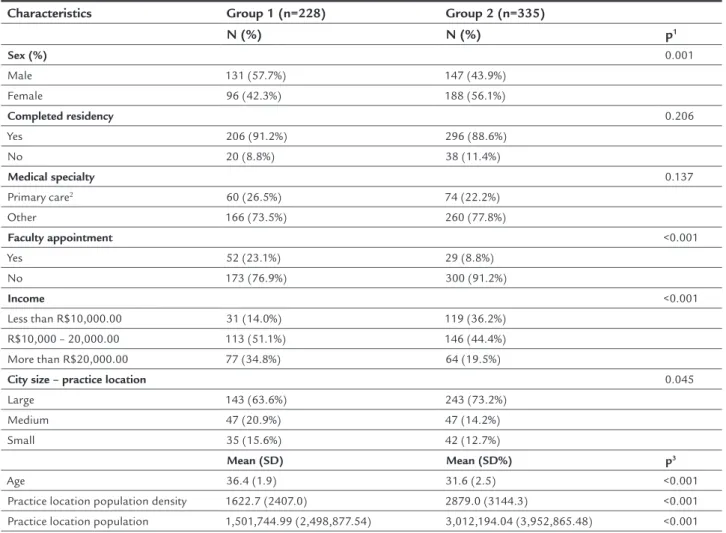
Since those who graduated more recently were likely to be in their location of residency training, we divided respondents based on graduation year (Table 2). Group 1 was comprised of the 228 respondents who graduated between 2001 and 2005 (40.5%); and group 2 was com-posed of the 335 respondents who graduated between 2006 and 2010 (59.5%). Those graduating earlier had higher incomes (p<0.001), were older (p<0.001), more
TABLE 1 Factors associated with choosing a practice location according to population density: All respondents.
B (SE) Beta t p
City density
Constant 336516.4 (82789.9) -4.065 <0.001
Family members lived in the city -1742.2 (241.4) -0.286 -7.216 <0.001 Town with favorable recreational and entertainment conditions 1015.3 (264.7) 0.172 3.836 <0.001 Town with favorable educational conditions -676.9 (270.2) -0.114 -2.505 0.013
Work in Primary Health Care Unit -905.9 (386.5) -0.098 -2.344 0.019 Invitation received during residency training 677.6 (251.4) -0.110 2.696 0.007 Invitation received during medical school -1032.8 (340.8) -0.119 -3.031 0.003
likely to be male (p=0.001), reported working as faculty members more often (p<0.001) and lived in cities with lower population density (p<0.001) (Table 2).
Figure 2 shows that graduates migrated from less pop-ulated cities to more poppop-ulated cities during the course of their training and initial career, compared with birthplace and location of medical school. The mean population den-sity of the birthplaces was 909.2 people per sq. km for group 1 and 927.4 for group 2. In contrast, their residence at the start of medical school had lower mean population den-sity, 466.3 people per sq. km for group 1 and 662.6 for group 2. Location of residency training occurred in higher den-sity cities (mean population denden-sity: 3,093.7 people per sq. km of land area for group 1 and 4,074.0 for group 2).
Practice location mean population densities were lower: 1,764.3 people per sq. km of land area for group 1 and 3,080.7 for group 2. Physicians who had been
practic-ing longer tended to return to cities with lower density, while those who had completed their training more re-cently tended to report living in larger cities. There was a significant difference between the population density of cities over the course of their careers for groups 1 and 2 (within group, p<0.001), as well as between groups (p<0.05), except for those whose birth location was a densely populated city.
The significant predictors for those graduating be-tween 2001 and 2005 who chose smaller cities as practice locations included having family members there (p<0.001) and receiving an invitation during medical school train-ing (p=0.027). For those who chose larger cities, the factors identified were that the location offered better recreational activities and entertainment (p=0.003), they tended to be female (p=0.012) and had received an invitation during residency training (p=0.009) (Table 3).
TABLE 2 Socioeconomic characteristics, professional proile and size of city of residence for medical school graduates.
Characteristics Group 1 (n=228) Group 2 (n=335)
N (%) N (%) p1
Sex (%) 0.001
Male 131 (57.7%) 147 (43.9%)
Female 96 (42.3%) 188 (56.1%)
Completed residency 0.206
Yes 206 (91.2%) 296 (88.6%)
No 20 (8.8%) 38 (11.4%)
Medical specialty 0.137
Primary care2 60 (26.5%) 74 (22.2%)
Other 166 (73.5%) 260 (77.8%)
Faculty appointment <0.001
Yes 52 (23.1%) 29 (8.8%)
No 173 (76.9%) 300 (91.2%)
Income <0.001
Less than R$10,000.00 31 (14.0%) 119 (36.2%) R$10,000 – 20,000.00 113 (51.1%) 146 (44.4%)
More than R$20,000.00 77 (34.8%) 64 (19.5%)
City size – practice location 0.045
Large 143 (63.6%) 243 (73.2%)
Medium 47 (20.9%) 47 (14.2%)
Small 35 (15.6%) 42 (12.7%)
Mean (SD) Mean (SD%) p3
Age 36.4 (1.9) 31.6 (2.5) <0.001
Practice location population density 1622.7 (2407.0) 2879.0 (3144.3) <0.001 Practice location population 1,501,744.99 (2,498,877.54) 3,012,194.04 (3,952,865.48) <0.001
1Chi-square test.
2Primary care specialties include family medicine, general pediatrics, general internal medicine, general surgery and obstetrics-gynecology.
FIGURE 2 Population density of the cities chosen by graduates for living from birth to residency:(Birth) Place of birth, (Childhood) Place of
residence when entering medical school, (Med. res) Place of residency training, (Residency) Place of practice location.
All pairwise within-group comparisons: p<0.05
City pop
. density (inh./km
2)
0
1
,000
2,000
3
,0
0
0
4,000
Birth
Childhood Med. r
es
Residency
2001-2005 2006-2010
TABLE 3 Factors associated with choosing a practice location according to population density: Physicians that graduated between 2001 and 2005.
B (SE) Beta t p
City density
Graduates 2001-2005a
Constant 370.7 (533.2) 0.695 0.488
Family members lived in the city -1228.8 (322.6) 0.247 -3.809 <0.001 Town with favorable recreational and entertainment conditions Female 934.9 (309.4) -0.193 3.021 0.003
Female 798.7 (314.1) 0.165 2.543 0.012
Invitation received during residency training 845.9 (321.5) 0.170 2.631 0.009 Invitation received during medical school -1047.1 (469.9) -0.142 -2.228 0.027
aR=0.399; R-square=0.159.
bR=0.403; R-square=0.163.
D
ISCUSSIONPrevious publications have shown an unequal distribution of the medical workforce and sought to understand the reasons for misdistribution. In 1963, there was a substan-tially greater number of doctors per capita in areas of greater economic income in US urban areas.24 More recent
research showed that the situation persists.25 Also, in
Canada, there were many specialists and fewer general practitioners and family physicians practicing in areas of higher socioeconomic level.26 These results corroborate
the findings of our study; larger cities were those more likely to be chosen as practice location, particularly for more recent graduates.
Factors leading to the choice of larger cities included residency training, similar to other studies in Brazil27 and
the US.16 Some authors found the choice for professional
practice related to the location of medical schools.9,28 In
contrast, for other authors, location of medical school was not related to choice of practice location.16 Although 86.5%
of the respondents were born in the state where the school was located, only 58.1% remained there after graduation, practicing mainly where they completed residency training. Doctors with less training time tended to live in cities with greater population densities. This is probably because these professionals are still considering opportunities for employment. Perhaps, with time, this group will show the same pattern as those who graduated earlier, migrat-ing to cities with lower population density in search of better quality of life and greater proximity to their origi-nal households.22,27 Invitation to practice in a specific
location was also an important determinant of choice. When the invitation came during residency training, there was an increased likelihood for choosing larger cities, as residency programs are mostly available in these locations. In contrast, respondents invited during medical school training chose less populated cities.
As in other studies, family issues determined where to settle down,29,30 including motivation to return to less
densely populated cities.31,32 On the one hand, family
location attracted physicians to smaller cities; on the other hand, more entertainment opportunities influenced the choice for more densely populated cities, with better infrastructure and recreational options
In the present study, we noticed two distinct profiles in accordance with the time of graduation. First, there was a lower percentage of male doctors in the cohort graduat-ing after 2005, corroboratgraduat-ing with worldwide trends on feminization of the medical profession.2,12 Also, higher
income was observed for the cohort of earlier graduates, probably due to the time spent in the profession.
Furthermore, the majority of physicians chose to specialize to the detriment of a primary health practice. Only a quarter of graduates opted for family medicine, general pediatrics, obstetrics-gynecology, general internal medicine and general surgery, and 90% had residency train-ing. There was no difference between groups 1 and 2. In Britain, there is a trend toward more equitable distribution, perhaps driven by the character of the local health system, while this was not observed in Japan.33 Choosing
special-ties other than primary care is not surprising, since those professionals tend to have higher wages and greater in-crease in income over the years.34
In order to develop incentives to improve physician distribution in Brazil and increase access to PHC, many government policies have been implemented. These in-clude more vacancies for training in medicine and resi-dency programs, spread out at various Brazilian regions, as well as guidelines on curricular changes directing train-ing toward PHC.35,36 However, results from the literature
on the impact of these policies to attract and retain doc-tors remains controversial, with multiple confounding factors such as the size of the city where medical schools are located.1 The same discussion is observed in relation
to different educational interventions when examined as a factor in physician workforce retention predictor in rural or underserved areas.17,19
Understanding the complex relationship between the factors that motivate doctors in their choice of workplace can help to define strategies to enhance provision of ser-vices in remote and rural areas. Studies show that the simple increase in physician supply did not reduce the distribution disparities. Thus, proposals for a better dis-tribution of health professionals should rely on knowledge of the determining factors for choosing the place for their professional practice, which includes family composition and socioeconomic and cultural issues at the organiza-tional level, as well as other factors related to the environ-ment and their own training. A broad view of the multi-dimensional nature of choice of specialty and practice location, along with the creation of attractive conditions in remote areas, small towns and rural areas seems to be indispensable for a real change. This is an intersectorial challenge to be faced, associated with the regional develop-ment as a whole.
social networking for both the request and distribution of the questionnaire. In the current investigation, 79.9% of the respondents answered the questionnaire by click-ing on a Facebook link. Nevertheless, this may represent sampling bias, since participants are likely to be those with greater electronic access (e-mail and social networks). Usually, response rates based on mailed questionnaires studies reach an average of 20 to 30%.9,28 It is likely that
younger respondents in locations with better infrastructure were more likely to respond to the survey.
Despite that, our study adds to existing literature as it highlights the importance of using different media to survey and contact graduates. In addition, we examined the influence of different factors other than those com-monly reported in the literature such as the invitation to work in a location at the time of medical school comple-tion, location of residency training, and impact of the size difference between the cities of origin, medical school and residency on the distribution of physicians in Brazil. One of the difficulties encountered in studies involv-ing the population of graduates is access to the target population. In Brazil, it is not routine to follow them throughout their careers. Another potential limitation is that the migration of those who graduated more recently (2006 through 2010) may not yet be complete. It will be necessary to see whether this group shows similar patterns to those who have been in the workforce for a longer period of time.
C
ONCLUSIONIn conclusion, our study showed that most physicians still select large cities as practice location and pursue specialist training rather than PHC. While residency and more recreational opportunities are the attractions in major urban centers, family issues and invitations at the time of medical school completion favor the choice of settling in smaller cities. These findings may help in the planning of future strategies to reduce misdistribution of the medical workforce.
R
ESUMODistribuição geográfica e trajetória dos médicos egressos de instituição pública
Objetivo: Avaliar a distribuição geográfica e a trajetória dos médicos e fatores associados à escolha para o local da prática médica.
Método: Estudo transversal envolvendo graduados entre 2001 a 2010, utilizando-se questionário autoaplicado com
dados sociodemográficos, informações de localização geo-gráfica (local de nascimento, local onde residia quando entrou na faculdade de medicina, local onde realizou a residência médica e local de prática profissional), e as razões para esco-lha do local de sua fixação. Análises estatísticas avaliaram as tendências da distribuição dos egressos e os fatores associados com a escolha do local para a prática médica.
Resultados: 563 egressos completaram o questionário.
Destes, 4,3% (n=24) eram médicos de família, 19,9% (n=112) tinham especialidades em grandes áreas (medicina interna, pediatria, cirurgia e ginecologia-obstetrícia), enquanto os outros escolheram subespecialidades. Houve predomínio da escolha de cidades de grande porte para a prática pro-fissional. Convites para trabalhar recebidos durante a re-sidência médica aumentaram a escolha de cidades de maior densidade populacional. Por outro lado, os convites rece-bidos durante a graduação influenciaram a escolha de cidades de mais baixa densidade populacional. Para estes últimos, a presença da família no local foi fator de influên-cia, enquanto, para os que escolheram cidades de maior densidade populacional, os fatores de influência foram melhor infraestrutura e mais opções de diversão.
Conclusão: A maioria dos médicos deste estudo fixou-se em grandes cidades e escolheu subespecialidades. Conhe-cer os múltiplos fatores que influenciaram a escolha do local para prática profissional pode auxiliar no planeja-mento de estratégias para reduzir a má distribuição do trabalho médico.
Palavras-chave: distribuição de médicos, atenção primá-ria à saúde, área de atuação profissional.
R
EFERENCES1. Lehmann U, Dieleman M, Martineau T. Staffing remote rural areas in middle-and low-income countries: a literature review of attraction middle-and retention. BMC Health Serv Res. 2008; 8:19.
2. Scollan-Koliopoulos M. OECD. Health at a Glance 2011: OECD Indicators. Paris: OECD Publishing; 2011.
3. Awosogba T, Betancourt JR, Conyers FG, Estapé ES, Francois F, Gard SJ, et al. Prioritizing health disparities in medical education to improve care. Ann N Y Acad Sci. 2013; 1287:17-30.
4. Mason J. Review of Australian government health workforce programs. 2013. 5. Ricketts TC. Workforce issues in rural areas: a focus on policy equity. Am J
Public Health. 2005; 95(1):42-8.
6. Huber M, Stanciole A, Wahlbeck K, Tamsma N, Torres F, Jelfs E, et al. Quality in and equality of access to healthcare services. Brussels, European Commission, DG Employment, Social Affairs & Equal Opportunities. 2008:196-201.
7. Rosenblatt RA, Hart LG. Physicians and rural America. West J Med. 2000; 173(5):348.
8. Jeffe DB, Whelan AJ, Andriole DA. Primary care specialty choices of United States medical graduates, 1997-2006. Acad Med 2010; 85(6):947-58. 9. Castellanos MEP, Silveira AdFMH, Martins LC, Nascimento VBd, Silva CSd,
10. Machado MH. Os médicos no Brasil: um retrato da realidade. Rio de Janeiro: SciELO-Editora FIOCRUZ; 1997.
11. Sakai MH, Cordoni Junior L. Os egressos da medicina da Universidade Estadual de Londrina: sua formação e prática médica. Espaço para Saúde. 2004; 6(1):34-47.
12. Scheffer M. Demografia médica no Brasil: cenários e indicadores de distribuição: relatório de pesquisa–fevereiro de 2015. São Paulo: Conselho Regional de Medicina do Estado de São Paulo; 2015.
13. IBGE. Instituto de Geografia e Estatística 2015 [cited 2015 Jul. 20]. Available from: http://www.ibge.gov.br/home/estatistica/economia/comercioeservico/ pas/analisepas99.shtm#.
14. Póvoa L, Andrade MV. Distribuição geográfica dos médicos no Brasil: uma análise a partir de um modelo de escolha locacional. Cad Saúde Pública. 2006; 22(8):1555-64.
15. Scheffer M. Demografia médica no Brasil (Vol. 2). São Paulo: Conselho Federal de Medicina e Conselho Regional de Medicina do Estado de São Paulo. 2013.
16. Whitcomb ME. New medical schools in the United States. N Eng J Med. 2010; 362(14):1255-8.
17. Rabinowitz HK, Diamond JJ, Veloski JJ, Gayle JA. The impact of multiple predictors on generalist physicians’ care of underserved populations. Am J Public Health. 2000; 90(8):1225-8.
18. Wibulpolprasert S. Inequitable distribution of doctors: can it be solved? Human Resources for Health Development Journal. 1999; 3(1):2-22. 19. Dieleman M, Kane S, Zwanikken P, Gerretsen B. Realist review and synthesis
of retention studies for health workers in rural and remote areas. WHO. 2011. 20. Dussault G, Franceschini MC. Not enough there, too many here: understanding geographical imbalances in the distribution of the health workforce. Hum Resour Health. 2006; 4:12.
21. Meliala A, Hort K, Trisnantoro L. Addressing the unequal geographic distribution of specialist doctors in Indonesia: the role of the private sector and effectiveness of current regulations. Soc Sci Med. 2013; 82:30-4. 22. Wibulpolprasert S, Pengpaibon P. Integrated strategies to tackle the
inequitable distribution of doctors in Thailand: four decades of experience. Hum Resour Health. 2003; 1(1):12.
23. Wilson N, Couper I, De Vries E, Reid S, Fish T, Marais BJ. A critical review of interventions to redress the inequitable distribution of healthcare professionals to rural and remote areas. Rural Remote Health. 2009; 9(2):1060. 24. Rimlinger GV, Steele HB. An economic interpretation of the spatial distribution of physicians in the US. Southern Economic Journal. 1963; 30(1):1-12.
25. Salsberg E, Grover A. Physician workforce shortages: implications and issues for academic health centers and policymakers. Acad Med. 2006; 81(9):782-7. 26. Krishnan V. A macro model of change in specialty and spatial distribution of physicians in Canada, 1971-1981. Socioecon Plann Sci. 1992; 26(2):111-27. 27. Albuquerque CPd. Inequality in the distribution of rheumatologists in
Brazil: correlation with local of medical residency, Gross Domestic Product and Human Development Index. Rev Bras Reumatol. 2014; 54(3):166-71. 28. Caovilla F, Leitzke L, Menezes HS, Martinez PF. Perfil do médico egresso
do Curso de Medicina da Universidade Luterana do Brasil (Ulbra). Rev AMRIGS. 2008; 52(2):103-9.
29. Brooks RG, Walsh M, Mardon RE, Lewis M, Clawson A. The roles of nature and nurture in the recruitment and retention of primary care physicians in rural areas: a review of the literature. Acad Med. 2002; 77(8):790-8. 30. Hancock C, Steinbach A, Nesbitt TS, Adler SR, Auerswald CL. Why doctors
choose small towns: a developmental model of rural physician recruitment and retention. Soc Sci Med. 2009; 69(9):1368-76.
31. Kristiansen IS, Førde OH. Medical specialists’ choice of location: the role of geographical attachment in Norway. Soc Sci Med. 1992; 34(1):57-62. 32. Lin G, Rosenthal TC, Horwitz M. Physician location survey: self-reported and
census-defined rural/urban locations. Soc Sci Med. 1997; 44(11):1761-6. 33. Matsumoto M, Inoue K, Farmer J, Inada H, Kajii E. Geographic distribution
of primary care physicians in Japan and Britain. Health Place. 2010; 16(1):164-6.
34. Bodenheimer T. Primary care—will it survive? N Eng J Med. 2006; 355(9):861-4. 35. Brasil. Lei Nº 12.871, de 22 de outubro de 2013. Programa Mais Médicos
2013 [cited 2016 Jul. 20]. Available from: http://www.planalto.gov.br/ ccivil_03/_ato2011-2014/2013/Lei/L12871.htm.