Offi cial Publication of the Brazilian Society of Anesthesiology www.sba.com.br
REVISTA
BRASILEIRA DE
ANESTESIOLOGIA
Abstract
Background and objectives: Preoperative tests aim to reduce morbidity and mortality of surgical patients, cost of perioperative care, and preoperative anxiety. Clinical evaluation allows defi ning the need for additional tests and strategies to reduce the surgical-anesthetic risk. The aim of this study was to evaluate the benefi t of routine preoperative testing of low-risk patients undergoing minor and medium surgical procedures.
Methods: A descriptive cross-sectional study of 800 patients seen at the preanesthetic assessment department of Hospital Santo Antonio, Salvador, BA. Patients with physical status ASA I, aged 1-45 years and scheduled to undergo elective minor and medium surgeries were include in the study. We evaluated changes in blood count, coagulation profi le, electrocardiogram, chest X-ray, blood sugar, kidney function, sodium and potassium levels, and eventual change in clinical approach occurring due to these changes.
Results: Of 800 patients evaluated, a blood count was performed in 97.5%, coagulation in 89%t, electrocardiogram in 74.1%, chest X-ray in 62%, fasting glucose in 68%, serum urea and creatinine in 55.7%, and plasma levels of sodium and potassium in 10.1%. Of these 700 patients, 68 (9.71%) showed changes in preoperative routine tests and only 10 (14.7%) of the patients with abnormal tests had a preoperative modifi ed approach (i.e., new tests ordered, referral to a specialist or surgery postponement). No surgery was suspended.
Conclusion: We found that preoperative additional tests are excessively ordered, even for young patients with low surgical risk, with little or no interference in perioperative management. Laboratory tests, besides generating high and unnecessary costs, are not good standardized screening instruments for diseases.
© 2013 Sociedade Brasileira de Anestesiologia. Published by Elsevier Editora Ltda. All rights reserved.
Relevance of Routine Testing in Low-risk Patients
Undergoing Minor and Medium Surgical Procedures
Danielle de Sousa Soares
1, Roberta Ribeiro Marques Brandão
2,
Mirla Rossana Nogueira Mourão
2, Vera Lucia Fernandes de Azevedo
2,
Alexandre Vieira Figueiredo*
2,
Eliomar Santana Trindade
21. PhD in Anesthesiology, Universidade Estadual Paulista Júlio de Mesquita Filho, Brazil; CET-SBA - Centro de Ensino e Treinamento em Anestesiologia das Obras Sociais Irmã Dulce - Hospital Santo Antonio, Salvador, BA, Brazil 2. Anesthesiologist, Hospital Santo Antonio, Salvador, Bahia, Brazil
Received from the Hospital Santo Antonio, Salvador, Bahia, Brazil.
Submitted on February 27, 2012. Approved on April 12, 2012.
Keywords:
Diagnostic Tests, Routine;
Unnecessary Procedures; Preoperative Care.
SCIENTIFIC ARTICLE
*Corresponding author: E-mail: [email protected]
Introduction
Preoperative evaluation is aimed at reducing morbidity associated with surgical-anesthetic procedures and,
prefer-ably, should be performed by the anesthesiologist 1. When
the anesthesiologist takes responsibility for preoperative tests, he can get a more appropriate clinical profi le and consequently reduce surgery cancellations due to inadequate
laboratory evaluation 2-3. Another aspect to consider is the
reduction of hospital costs when tests are made wisely. During pre-anesthetic evaluation in most patients admitted for elective surgeries, complementary tests are routinely
ordered 4 with the purpose of identifying or diagnosing
dis-eases and disorders that may compromise the perioperative period, functional evaluation of previously diagnosed and under treatment diseases, and also help in the formulation
of specifi c or alternative approaches for anesthetic care 5.
Routine tests are defi ned as compulsory tests for all patients
regardless of the fi ndings obtained from clinical evaluation 4,6.
In this list, there are serum and urine biochemical changes, blood count and coagulation studies, X-ray and
electrocardio-gram examinations, among others 4. However, literature data
indicate that these tests are not cost- effective and neither
related to any perioperative complications 4. Published
stud-ies show no laboratory test benefi t when used as the sole
means of preanesthetic evaluation 6. History and physical
examination are considered the most effective methods of
diagnosing disease 6,7. There is also the possibility of tests
not based on clinical history leading to increased risk for the patient, especially when false-positive results motivate further research, sometimes invasive, and leading to the un-necessary postponement of surgery, prolonging hospital stay and subjecting the patient to the risk of hospital infections. It is estimated that of the US$30 billion spent in the U.S. on laboratory tests, at least 10% are intended for preoperative assessments. When taking into consideration the history and physical examination as determinants of preoperative tests,
about 60-70% of laboratory tests would be unnecessary 5. Vogt
and Henson conducted a retrospective review of medical records and estimated hospital savings to be approximately US$80,000 annually just by eliminating preoperative testing
not indicated for the 5,100 patients studied 2. Tests may be
benefi cial for patients who require postoperative care in the intensive care unit, as well as providing baseline values for
later comparisons 8. However, considering the lack of benefi ts
and high costs, routine testing is expendable, especially in institutions in which surgical procedure must absorb the costs
of laboratory tests 8. Pzankie et al. proved that even in the
elderly, routine laboratory tests were not better predictors of perioperative morbidity than ASA physical status classifi cation and surgical risk (according to the cardiac risk criteria of the
ACC/AHA) 8. According to Miguel Garcia et al. 9, education
and training of doctors should be more scientifi cally sound, emphasizing the importance of effective and cost-effective clinical decisions. The fi nancial aspects and benefi ts of objec-tive tests, as opposed to extensive preoperaobjec-tive screening,
have been thoroughly reviewed in the literature 8. Current
trends point to performing preoperative tests based on clini-cal assessment and careful physiclini-cal examination, which, no
doubt, are the bases of preanesthetic evaluation 4.
The aim of this study was to evaluate the benefi t of routine preoperative tests performed during preanesthetic evaluation of low-risk patients undergoing minor and medium elective surgeries.
Method
Prospective, cross-sectional, clinical study of a survey con-ducted at the preanesthetic department of Hospital Santo Antônio, Salvador, BA.
The study included 800 (eight hundred) patients of both genders, aged between 1-45 years, classifi ed as ASA I, un-dergoing minor-medium elective surgeries (Table 1) at the operating theatre of Hospital Santo Antônio.
Table 1 Size of Surgical Procedure.
Size · Surgery type
Medium · Intraperitoneal and intrathoracic · Carotid endarterectomy
· ENT-laryngeal and head and neck · Orthopedic
· Neurological · Urogynecological Minor · Endoscopic procedures
· Eye surgery · Breast surgery · Superfi cial procedures
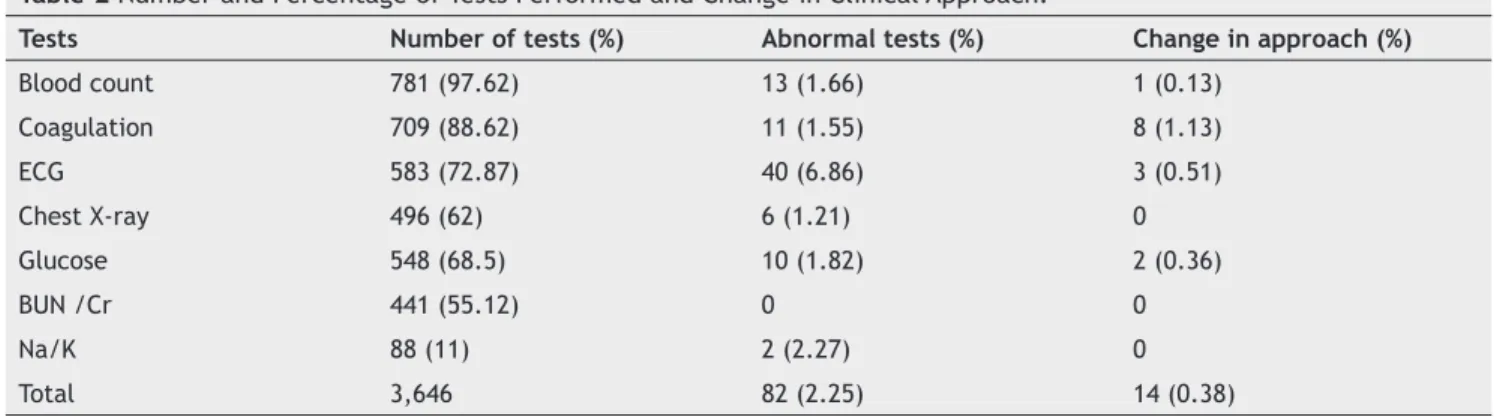
Table 2 Number and Percentage of Tests Performed and Change in Clinical Approach.
Tests Number of tests (%) Abnormal tests (%) Change in approach (%)
Blood count 781 (97.62) 13 (1.66) 1 (0.13)
Coagulation 709 (88.62) 11 (1.55) 8 (1.13)
ECG 583 (72.87) 40 (6.86) 3 (0.51)
Chest X-ray 496 (62) 6 (1.21) 0
Glucose 548 (68.5) 10 (1.82) 2 (0.36)
BUN /Cr 441 (55.12) 0 0
Na/K 88 (11) 2 (2.27) 0
Patients were attended at the preanesthetic evaluation department in the period between March and December 2009. A paper form was fi lled with data from laboratory tests, abnormalities in these tests, and change in approach. Change in approach was defi ned as new tests ordered, referral to a specialist and/or postponement of surgery. The surgeon previ-ously ordered preoperative additional tests, according to his routine, without interference from the anesthesiologist. The results were assessed using descriptive statistics.
Results
Of the 800 patients studied, 453 (56.62%) were female and 347 (43.4%) were male. We performed 3646 preoperative tests, including complete blood count, coagulation profi le, fasting glucose, urea, creatinine, sodium, potassium, elec-trocardiogram and chest X-ray. Of these 3646 tests, only 82 (2.25%) showed change in results, and only 14 (0.38%) required a change in approach.
Discussion
The American College of Physicians recommends that labora-tory tests be ordered with selective and restrictive criteria, always supported by clinical justifi cation. Finding changes in tests of clinically healthy patients usually does not infl uence
their treatment 6, and commonly does not alter the
plan-ning and management during the perioperative period 1,4,6.
Furthermore, there is little evidence that any abnormalities found in tests compulsorily performed are associated with increased surgical morbidity. Evidence suggests that 60-70% of preoperative tests would be unnecessary if a careful clinical
evaluation was performed 5-14. However, routine preoperative
tests increase hospital costs and provide no protection re-garding legal medicine, becoming, in this sense, an eventual extra risk for medical staff when unnecessary tests result in requests for other diagnostic procedures, which may entail
risks and complications for patients 4,10. In contrast, in more
than half of cases, doctors seem to ignore abnormal labora-tory results, which can be more serious in terms of legal
liability than not ordering the test 6. The factors infl uencing
the indiscriminate ordering of preoperative tests are not well known. Some of the assumptions are insecurity during clinical evaluation, distrust of doctors in their work and literature, confi dence in the fact that a larger number of exams mean more security, belief that they will have legal protection, and fear that these patients have their anesthesia postponed
for lack of preoperative tests 4.
Considering tests that are independent of each other, the greater the number of tests ordered, the greater the possibility of obtaining an abnormal result in a healthy
patient 4.13. When a preoperative test shows normal results
or any abnormality with no particular clinical implication, virtually no action will be taken, and it will become a test without any utility or benefi t. Currently, almost all anesthetic drugs and techniques can be handled safely for kidney and
cardiovascular systems 4. Thus, if preoperative tests are
ordered with the purpose of contraindicating drugs and anes-thetic techniques that could cause damage to these organs,
the ordering lost its meaning 4. Literature reports that the
possibility of fi nding abnormal hematocrit and hemoglobin values during preoperative evaluation is very uneven, and there is no concrete evidence to confi rm the hypothesis that these abnormal values increase the morbidity of these
Coagulation
Glucose
ECG
Chest X-ray Renal function
Na/K
Blood count
Tests Abnormal Change
781 709
548
583
496
441
88
2 0 0 0
6 0
40 3 10 2
11 8 13 1
800
700
600
500
400
300
200
100
0
patients 4. Likewise, renal function quantifi ed by serum urea
and creatinine during preanesthetic evaluation shows very
different values, motivating no changes in anesthetic
plan-ning and perioperative period 1,4,6,12.
Recent guideline from the American College of Cardiology/ American Heart Association advises that routine preoperative electrocardiogram (ECG) in asymptomatic patients undergo-ing low-risk operation is not useful and, in some cases, may
even be harmful 1,14. Recently, Correll et al. 15 published an
article investigating the value of preoperative ECG and found that ECG adds no benefi t in predicting postoperative cardio-vascular complications, compared to the main features of medical history. The practice of indiscriminate test ordering is a problem that affects more than 30 million procedures, with a conservatively estimated direct cost above US$18 million 14.
According to a systematic review by Joo et al. 16, the
au-thors concluded that the number of abnormalities observed on chest X-ray increase with age and risk factors, and that most of these changes did not alter the perioperative period
or affect postoperative evolution 5.
At Hospital Santo Antônio (OSID), most surgical clinics routinely perform hematocrit, hemoglobin, coagulation, electrocardiogram, chest X-ray, blood glucose, urea/creati-nine, and sodium/potassium tests during the preoperative evaluation of most patients, regardless of physical status.
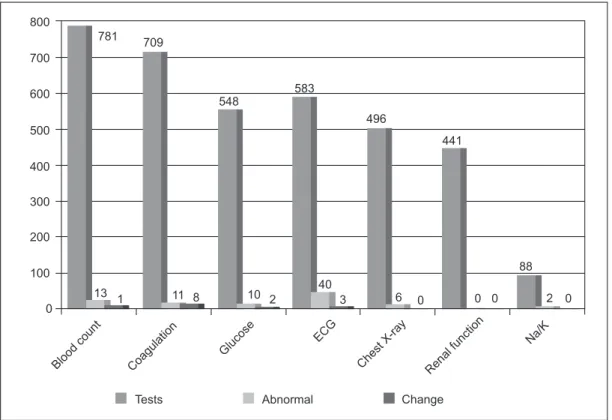
In this study, the assistant physician ordered a total of 3,646 tests from the 800 patients admitted to the anesthesia department, of which 82 were altered (2.25%), with change in approach only in 14 (0.38%). A blood count was performed in 97.62% of patients, with only 1.66% showing alterations and 0.13% requiring change in approach. Coagulation studies were ordered in 88.62% of patients, with abnormal results in 1.55% and change in approach in 1.13%. Electrocardiograms were ordered in 583 patients, with 6.86% showing alterations and only 0.51% requiring change in approach. Chest radiographs were ordered in 496 patients, with 1.21% showing alterations and none requiring change in approach. Of a total of 548 blood glucose tests ordered, only 1.82% showed abnormal results and 0.36% required change in approach. Of the 441 urea and creatinine tests, there was no change in results or approach. Of the 88 sodium and potassium tests, only 2.25% were altered and 0.38% required change in approach.
According to the Practice Advisory for Preanesthesia Evaluation - ASA Task Force, routine ECG results were docu-mented as abnormal in 7-42.7% of cases and required change in clinical approach in 9.1% of cases. Regarding routine X-ray, results were abnormal in 2.5-60.1% of cases and change in clinical approach in 0-51%. Routine hemoglobin abnormal fi ndings represented 0.5-43.8% of cases and requirement for change in approach represented 0-28.6%. Routine hematocrit was abnormal in 0.2-38.9% of cases and change in clinical ap-proach in 0-100% of cases. Routine coagulation tests showing abnormalities in BT, PT, aPTT or platelet count represented 0.8-22% of cases and required change in approach in 1.1-4% of cases. Preoperative routine potassium dosages showed
1.5-12.8% of abnormal results 9.
In preoperative routine glucose measurement in non-diabetic patients or patients with no altered glucose me-tabolism, abnormal glucose levels were found in 5.4-13.8% of cases. ASA Task Force agrees that preoperative tests should
not be ordered routinely. In preoperative cases, it should be
ordered in a selective manner with the purpose of guiding or
optimizing perioperative management. The indications for such tests must be documented and based on information obtained from the results and scheduled surgical procedure
complexity 9. Unnecessary tests may cause injury to patients
due to overtreatment of a false-positive or borderline result, and increase costs without reducing perioperative
complica-tions 12,13. Reducing the number of laboratory tests results
thereby decreasing operating costs, time, and medical stress
associated with false positive results 12.
Several studies have attempted to defi ne the cost of unnecessary tests before elective surgery. Previous study de-signs have included comparison of tests ordered by surgeons
with those ordered by the anesthesiologist. Em Fleicher 17,
Starsnic et al.18 of Thomas Jefferson University, Philadelphia,
Pennsylvania, compared the group with tests ordered by the surgeon and complemented by the anesthesiologist and vice versa, deemed necessary for two consecutive periods of time in 1992. These investigators reported an average cost saving of US$ 20.89 per patient when the anesthesiologist was the fi rst physician determining the tests. However, there was no cancellation or changes recorded for intraoperative
manage-ment attributable to inadequate testing 17.
According to recent studies, the practice of anesthesiolo-gists assessing patients and ordering tests showed a potential cost reduction of billions of dollars in preoperative testing
without negatively affecting patient care 17,19.
Therefore, we conclude that preoperative tests should not be ordered routinely and indiscriminately, but with the purpose to guide and optimize perioperative care based on clinical history, physical examination, and size of the surgical procedure. Thus, the selective ordering of these tests is a more rational conduct.
References
1. Nascimento JP, Castiglia YMM - O eletrocardiograma como exame pré-operatório do paciente sem doença cardiovascular. É mesmo necessário? Rev Bras Anestesiol. 1998;48:352-361. 2. Fleisher LA - Avaliação pré-operatória. Em: Barash PG et al. -
Anestesia Clínica. São Paulo: Ed Manole, 2004;473-487. 3. Gusman PB, Nascimento JP, Castiglia YMM - Avaliação
pré-anestésica ambulatorial. Rev Bras Anestesiol. 1997:47:522-527.
4. Nascimento JP, Kirsch LA, Samaha JT - Avaliação da necessidade rotineira de hematócrito, hemoglobina, uréia e creatinina séricos durante a avaliação pré-anestésica. Rev Bras Anestesiol. 1998:48:264-271.
5. Mathias LAST, Guaratini AA, Gozzani JL et al. - Exames complementares pré-operatórios: Análise Crítica. Rev Bra Anestesiol. 2006;56:658-668.
6. Costa VV, Pereira ES, Saraiva RA - Exames laboratoriais na avaliação pré-anestésica para pequenas cirurgias. Estudo retrospectivo. Rev Bras Anestesiol. 1998;48:14-19.
7. Mathias LAS, Mathias RS - Avaliação pré-operatória: Um fator de qualidade. Rev Bras Anestesiol. 1997;47:335-349.
8. Halaszynski TM, Juda R, Silverman DG - Optimizing postoperative outcomes with efficient preoperative assessment and management. Crit Care Med. 2004:32:76-88.
10. Practice advisory for preanesthesia evaluation: A report by the American Society of Anesthesiologist Task Force on preanesthesia evaluation. Anesthesiology. 2002;96:485-496. 11. Van Klei WA, Moons KGM, Rutten CLG .The effect of outpatient
preoperative evaluation of Hospital inpatients on cancellation of surgery and length of hospital stay. Anesth Analg. 2002;94:644-649.
12. Ajimura FY, Maia ASSF, Hachlya A, Watanabe AS - Preoperative laboratory evaluation of patients aged over 40 years undergoing elective non cardiac surgery. Sao Paulo Med J. 2005;123:50-53.
13. Lira RPC, Nascimento MA, Kara-José M, Arieta CEL – Valor preditivo de exames pré-operatórios em facectomias. Rev Saude Publica. 2003;37:197-202.
14. Yen C, Mitchell T, Macario A - Preoperative evaluation clinics. Current Opinion in Anesthesiology. 2010;23:167-172.
15. Correll DJ, Hepner DL, Chang C, Tsen L, Hevelone ND, Bader AM. Preoperative electrocardiograms: patient factors predictive of abnormalities. Anesthesiology. 2009;110:1217-1222.
16. Joo HS, Wong J, Naik VN et al. - The value of screening preoperative chest x-rays: a systematic review. Can J Anesth. 2005;52:568-574.
17. Fleicher LA - Effect of preoperative evaluation and consultation on cost and outcome of surgical care. Current Opinion in Anesthesiology. 2000;13:209-213.
18. Starsnic MA, Guarnieri DM, Norris MC - Effi cacy and fi nancial benefi t of an anesthesiologist-directed university preadmission evaluation center. J Clin Anesth. 1997;9:299-305.