Relationship between anxiety, depression and quality of
life with the intensity of reflex sweating after thoracoscopic
sympathectomy for treatment of primary hyperhidrosis
Relação entre ansiedade, depressão e qualidade de vida com a intensidade da
sudorese reflexa após simpatectomia torácica por videocirurgia para tratamento
da hiperidrose primária
Luciara irenede nadai dias1; eLiana cristina Martins Miranda2; ivan FeLizardo contrera toro1; ricardo KaLaF Mussi1.
INTRODUCTION
P
rimary hyperhidrosis (PH) is a clinical condition defined as sweating, localized excessive, which mainly affects the hands, armpits, feet and face. It has unknown eti-ology, occurring due to hyperactivity of the sympathetic nervous system. The literature reports an incidence of 1% and it is more frequent in young adult patients1.Currently the first choice therapy, and the pro-viding better outcomes in PH treatment, is the thoraco-scopic sympathectomy2,3. Its most common side effect
is the reflex sweating (RS), characterized by increased sweating in other parts of the body such as the back, abdomen and thighs4.
The use of scores allows for better quality and refinement of diagnostic assessments and/or monitoring of patients in clinical trials5.
The literature extensively discusses the relation-ship between RS intensity and the adopted surgical level2,
but few studies have correlated this side effect with the degree of anxiety and depression and the quality of life in patients undergoing thoracoscopic sympathectomy.
METHODS
This was a prospective cohort study conducted between January 2010 and September 2013 in the Department of Thoracic Surgery, State University of Campinas (UNICAMP), Brazil. We analyzed 54 PH patients of both genders, aged between 16 and 70 years, submitted to thoracoscopic sympathectomy, the surgery being performed in the R3-R4 levels for all the different sweating sites.
Participants responded to the questionnaires on quality of life and anxiety in the preoperative period and 30 and 180 days after surgery. To evaluate the quality of life of patients with PH, we applied the “Quality of Life Questionnaire in Patients with Primary hyperhidrosis”1.
1 - Post-graduate Program in Surgery Sciences, Faculty of Medical Sciences, Campinas State University (Unicamp), Campinas, SP, Brazil. 2 - Post-gra-duate Program in Internal Medicine, Faculty of Medical Sciences, Campinas State University (Unicamp), Campinas, SP, Brazil.
Objective: to compare the intensity of reflex sweating with the degree of anxiety and its interference in the quality of life of patients un-dergoing Thoracoscopic (VATS) sympathectomy in the pre- and postoperative period. Methods: we evaluated 54 patients with a mean age of 26 years (16-49 years) undergoing sympathectomy in the R3-R4 level. We applied two questionnaires at three different times: “Quality of life in patients with primary hyperhidrosis” and “Scale for anxiety and depression”. Results: of the patients studied, 93% showed significant improvement in quality of life 30 days after surgery, the effects remaining after six months. There were no postoperative complications. The patient’s level of anxiety is highly correlated with the intensity of reflex sweating after 30 and 180 days. Conclusion: Thoracoscopic sympathectomy improves quality of life of patients with primary hyperhidrosis, even with the emergence of reflex sweating. Anxiety directly relates to the intensity of reflex sweating, without compromising the degree of patient satisfaction.
Keywords: Hyperhidrosis. Quality of Life. Anxiety. Sympathectomy. Thoracic Surgery, Video-Assisted.
The questionnaire consists of 20 questions divided into five domains. The higher the score, the worse the patient’s quality of life. Each domain contains different levels of responses based on tables that admit only one answer. The difference between the pre and postoperative assessment is considered the treatment effect on quality of life1.
Regarding the anxiety of patients with PH, we used the questionnaire “Scale for Anxiety and Depression (HAD)” translated and validated by Botega et al., in 19956. This is a self-rating scale consisting of 14
multiple choice questions, requiring approximately four minutes to perform. The patient is requested to respond according to what he/she has felt during the last week6.
In addition, all participants signed an informed consent form previously approved by the local Ethics in Research Committee.
After 30 and 180 days, we questioned the patient if there was sweating in another location and its intensity: absent (did not develop RS), mild (presented sweating in other areas, without relapse, but not bothersome), moderate (presented sweating in other areas, without recurrence, but it did not hinder usual daily activities) or severe (presented sweating in other areas, without recurrence, and desired treatment).
We carried out the comparisons between the three evaluation periods with respect to the variables quality of life, anxiety and depression using the Friedman test, and when we found a significant difference, we applied the non-parametric Wilcoxon test considering the Bonferroni correction7 for multiple comparisons.
The p value was considered <0.01. For the analyzes of reflex sweating levels with respect to quality of life scores, anxiety and depression during periods 30 and 180 days
after surgery, we used the Kruskal-Wallis test, and when necessary, the Dunn post-test, also considering the Bonferroni correction and contemplating the value of p <0.02. We used the software the SAS (Statistical Analysis System) version 9.2.
RESULTS
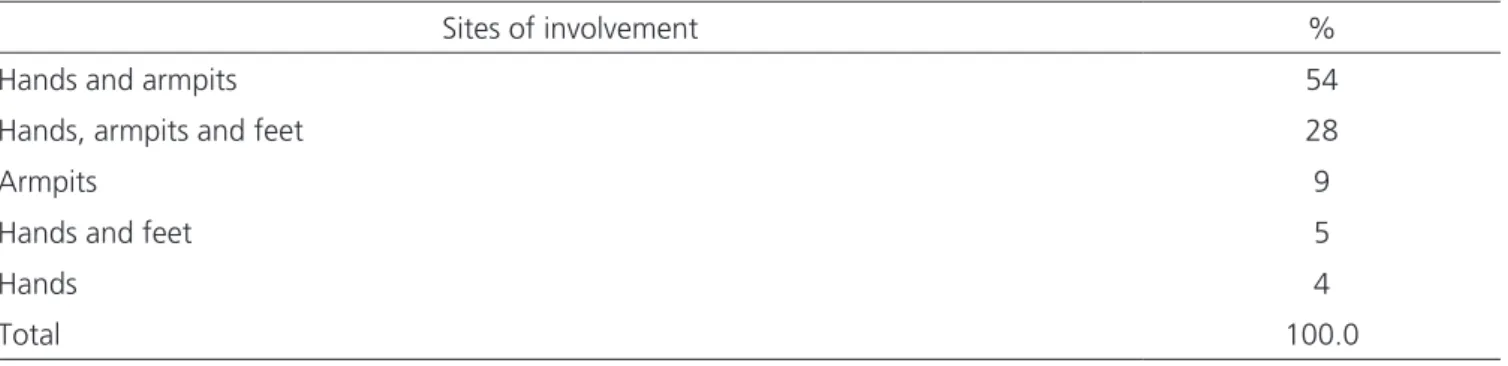
We analyzed all 54 patients enrolled in the study, with a median age of 26 years (16-49), of whom 33 (61%) were female. The main localization of excessive sweating was in the hands and armpits (54%), as shown in Table 1.
Before surgery, 32% of patients rated their quality of life (QOL) as very bad, 43% bad, 24% good and 2% very good. After 30 days, 87% of patients rated their quality of life regarding hyperhidrosis as much better, 9% a little better, 2% as the same and 2% as much worse. After six months, 80% of patients rated their quality of life as much better, 13% a little better, 5% as unchanged and 2% as slightly worse (p<0.0001). Regarding the domains assessed, before surgery they showed statistically significant differences when compared to the domains after 30 or 180 days, reflecting the effect of treatment (p<0.0001), while the domains of QOL within 30 and 180 days did not result in any difference. Table 2 shows the distribution of values for QOL scales, anxiety and depression in the respective analyzed times and their p values.
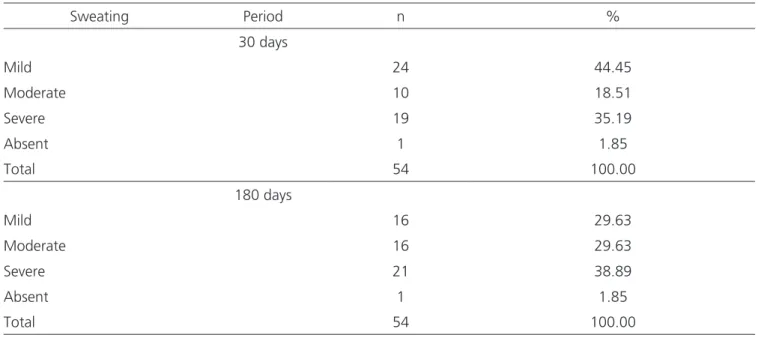
As for the classification of reflex sweating after 30 days, its frequency was: mild in 24 cases (44%); moderate in 19 (35%); intense in 10 (18%) and only one (2%) individual denied having RS in any period. After 180 days, 16 (30%) classified it as mild; 21 (39%) moderate Table 1. Sites of primary Hyperhidrosis
Sites of involvement %
Hands and armpits 54
Hands, armpits and feet 28
Armpits 9
Hands and feet 5
Hands 4
and 16 (30%) intense, showing increase in cases of severe sweating (p<0.0001) in the late postoperative period. There was no recurrence, in any individual, in the hands, armpits or feet. The sites mentioned with reflex sweating were thighs, abdomen and back.
Table 3 makes possible to identify the changes in classification referred to by patients after 30 and 180 days after surgery, as well as the absence of symptoms in one individual.
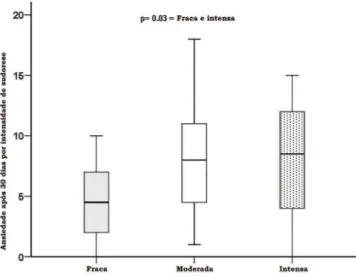
By analyzing the distribution of reflex sweating rating with the quality of life of patients and the level of anxiety and depression after 30 and 180 days, we found a significant difference in the intensity of sweating with the anxiety level (Figures 1 and 2). On the other hand, the comparison between the different domains of QOL and the rates of depression were not significant.
DISCUSSION
Currently, quality of life questionnaires have been highlighted as an important tool to assess results in medicine, as psychosocial factors may result in better patients’ management4. In this study we applied the
quality of life questionnaire for individuals with specific PH, allowing a careful analysis of these patients’ quality of life. Furthermore, we used a questionnaire to assess the intensity of anxiety and depression, aiming to verify the presence and magnitude of these disorders in our sample.
Clinical symptoms lead to consider PH’s diagnosis as a psychiatric disorder, with some studies characterizing such individuals as anxious8,9. In our study, patients reported
excessive fear and embarrassment, anxiety features known as social phobia.
Table 2. Comparison of QOL versus anxiety and depression at different times
Quality of life Anxiety Depression
Before 30 d 180d Before 30 d 180d Before 30 d 180d
Median 83.0 20.5 20.0 6.0 6.0 6.0 3.0 2.0 2.5
Range 49-100 20-95 20-91 1-6 0-18 0-18 0-19 0-20 0-13
Average 80.4 27.3 25.2 7.1 6.2 6.9 3.5 3.4 3.2
SD ± 13.9 ± 12.7 ± 11.8 ± 4.4 ± 4.1 ± 4.51 ± 3.6 ± 3.7 ± 3.2
p-value * < 0, 0001 0.30 0.89
* p values obtained through the Friedman test.
Table 3. Reflex sweating intensity 30 and 180 days after surgery
Sweating Period n %
30 days
Mild 24 44.45
Moderate 10 18.51
Severe 19 35.19
Absent 1 1.85
Total 54 100.00
180 days
Mild 16 29.63
Moderate 16 29.63
Severe 21 38.89
Absent 1 1.85
Before surgery, patients were very committed to participating in the study due to the problem presented, ie, excessive sweat that bothered so much. After 30 days, they found themselves happy, with high self-esteem due to the initial improvement and the positive impact that surgery performed in their lives, and still willing to collaborate, responding calmly to the questionnaires, on request. However, after six months, with the problem solved, ie, hands and armpits dry as part of the routine, there was a greater resistance to cooperation with this study regarding the questionnaires. At this time of the postoperative period, even with full return to daily activities, it was possible to correlate the rise in anxiety level with the most intense sweating reflex, and slight decrease in quality of life. The evaluation after 30 days already presented evidence that the rate of anxiety was related to the intensity of RS, being confirmed in the evaluation after 180 days, showing that the higher the level of anxiety, the greater the RS intensity.
PH may be associated with significant impairment in patients’ quality of life, interfering with social and professional activities8,10. Wolosker et al.4 demonstrated that
the quality of life of individuals with PH is severely diminished, though not at risk of death. These authors add that, in some cases, not only anxiety, stress and apprehension are present, but also risks in professional activities, such as police handling weapons and electricians. They observed that the preoperative quality of life was significantly affected by the presence of abundant sweating in the hands, armpits and/
or feet.
Primary hyperhidrosis and anxiety seem to have a complex relationship11. Excessive sweating, especially in
the hands, is accompanied by a high degree of anxiety and sympathetic overactivity4,12. This study demonstrated
the presence of anxiety both in the pre and postoperative periods, sometimes at high levels, suggesting the need for medical/psychological evaluation and support.
Reflex sweating is the main side effect of sym-pathectomy. It comprises episodes of sweating in other body parts that were not common before surgery. It usu-ally occurs in the back, legs, abdomen, thighs, groin, feet and butocks13. The signs and symptoms start soon after
surgery and may worsen with the climate and/or psy-chological and emotional fluctuations14. This side effect
appeared in the 30-day postoperative evaluation in 53 cases, with main complaints in the back, abdomen and thighs. Lyra et al.15 describe the need for psychological
support and claim that the reflex sweating resembles PH, being induced by mental stress or anxiety.
One can also observe significant improvement in patients’ quality of life 30 days after surgery, such re-sult being persistent after 180 days. Moreover, the im-provement of quality of life related to the intensity of reflex sweating over time showed that the results were significantly better not only till the thirtieth day after the surgery, but also after 180 days, though with a slight de-crease at this later time, and directly related to the RS intensity.
Figure 1. Anxiety level stratified b reflex y sweating 30 days after surgery.
Apparently most patients accept RS well, since they respond to postoperative assessment question-naires as the operation result being excellent or satis-factory. The study from Stefaniak and Cwigon in 201316
shows improvement in the quality of life of more than 90% of patients after sympathectomy. Of the 54 pa-tients in this study, none regretted having undergone sympathectomy, proving that the RS is preferable to PH, as also demonstrated in the Cardoso et al.3. Baroncello
et al.17 reported that reflex sweating is generally weak
in most of patients and does not cause as much social, emotional or professional commitment as primary hy-perhidrosis, patients preferring the reflex sweating. In this study, 53 (98%) of the 54 patients experienced this
side effect, reporting that the higher the level of anxiety presented at any given time, the worse the sweating int the reflex sweating sites (abdomen, thighs, back and groin). However, there were no cases of intolerable re-flex sweating.
The main disadvantage of this procedure is its potential irreversibility and, therefore, the patient should be fully informed of the possible complications and post-operative side effects2.
The qualitative analysis of this group of pa-tients’ psychosomatic factors demonstrated in this study will allow other quantitative analyzes, such as different levels of the sympathetic chain blockage or even the ex-tent of the interrupted area, to be better studied.
REFERENCES
1. Campos JRM, Kauffman P, Werebe EC, Andrade Fil-ho LO, Kuzniek S, Wolosker N, et al. Questionário de qualidade de vida em pacientes com hiperidrose primária. J Bras Pneumol. 2003;29(4):178-81.
2. Boscardim PCF, Oliveira RA, Oliveira AAFR, Souza JM, Carvalho RG. Simpatectomia torácica ao nível de 4ª e 5ª costelas para tratamento de hiper-hidrose axilar. J Bras Pneumol. 2011;37(1):6-12.
3. Cardoso PO, Rodrigues KCL, Mendes KM, Petroianu A, Resende M, Alberti LR. Avaliação de pacientes submeti-dos a tratamento cirúrgico de hiperidrose palmar quan-to à qualidade de vida e ao surgimenquan-to de hiperidrose compensatória. Rev Col Bras Cir. 2009;36(1):14-8. 4. Wolosker N, de Campos JR, Kauffman P, de Oliveria
LA, Munia MA, Jatene FB. Evaluation of quality of life over time among 453 patients with hyperidrosis
to endoscopic thoracic sympathectomy. J Vasc Surg. 2012;55(1):154-6.
5. Nardi AE. Comentários do debatedor: escalas de aval-iação de ansiedade. Rev Psiq Clin. 1998;(6):331-3. 6. Botega NJ, Bio MR, Zomignani MA, Garcia Jr. C,
Pereira WAB. Transtornos do humor em enfermaria de clínica médica e validação de escala de medida (HAD) de ansiedade e depressão. Rev Saúde Pública. 1995;29(5):355-63.
7. Johnson RA, Wichern DW. The Bonferroni method of multiple comparisons. In: Johnson RA, Wichern DW, editors. Applied multivariate statistical analysis.3rd ed. New Jersey: Prentice-Hall. 1992. p.197-9.
8. Davidson JR, Foa EB, Connor KM, Churchill LE. Hyper-idrosis in social anxiety disorder. Prog Neuropsycho-pharmacol Biol Psychiatry. 2002;26(7-8):1327-31. 9. Ramos R, Moya J, Morera R, Masuet C, Perna V, Macia I,
et al. An assessment of anxiety in patients with primary
Objetivo: avaliar a intensidade de sudorese reflexa com o grau de ansiedade e sua interferência na qualidade de vida de indivíduos submetidos à simpatectomia por videotoracoscopia nos períodos pré e pós-operatório. Métodos: foram avaliados 54 pacientes com média de idade de 26 anos (16 a 49 anos), submetidos à simpatectomia em nível R3-R4. Dois questionários foram aplicados em três momentos diferentes: “Qualidade de vida em pacientes com hiperidrose primária e “Escala para ansiedade e depressão”. Resultados: dos pacientes estudados, 93% mostrou melhora significativa na qualidade de vida após 30 dias da cirurgia, com os efeitos remanes-centes após seis meses. Não houve complicações pós-operatórias. A análise mostrou que o nível de ansiedade do paciente é altamente correlacionado com a intensidade da sudorese reflexa após 30 e 180 dias. Conclusão: a simpatectomia torácica por videotoracoscopia melhora a qualidade de vida de pacientes com hiperidrose primária, mesmo com o surgimento de sudorese reflexa. A ansiedade está diretamente relacionada com a intensidade da sudorese reflexa, sem comprometer o grau de satisfação do paciente.
Descritores: Hiperidrose. Qualidade de Vida. Ansiedade. Simpatectomia. Cirurgia Torácica Vídeoassistida.
hyperhidrosis before and after endoscopic thoracic sym-pathicolysis. Eur J Cardiothorac Surg. 2006;30(2):228-31. 10. Campanati A, Penna L, Guzzo T, Menotta L, Silvestri
B, Lagalla G, et al. Quality-of- life assessment in pa-tients with hyperhidrosis before and after treatment with botulinum toxin: results of an open-label study. Clin Ther. 2003;25(1):298-308.
11. Schneier FR, Heimberg RG, Liebowitz MR, Liebow-itz MR, Blanco C, Gorenstein LA. Social anxiety and functional impairment in patients seeking surgi-cal evaluation for hyperhidrosis. Compr Psychiatry. 2012;53(8):1181-6.
12. Ramos R, Moya J, Turón V, Pérez J, Villalonga R, Morera R, et al. [Primary hyperidrosis and anxiety: a prospective preoperative survey of 158 patients]. Arch Bronconeumol. 2005;41(2):88-92. Spanish. 13. Ruchinskas RA, Narayan RK, Meagher RJ, Furukawa
S. The relationship of psychopathology and hyperhi-drosis. Br J Dermatol. 2002;147(4):733-5.
14. Álvarez PDA. Hiperhidrosis primaria, simpatectomía y sudoración compensadora. Rev Patol Respir. 2005;8(4):335-7.
15. Lyra RM, Campos JRM, Kang DWW, Loureiro MP, Fu-rian MB, Costa MG, et al. Diretrizes para a prevenção, diagnóstico e tratamento da hiperidrose compen-satória. J Bras Pneumol. 2008;34(11):967-77. 16. Stefaniak TJ, wigo M. Long-term results of tho
-racic sympathectomy for primary hyperhidrosis. Pol Przegl Chir. 2013;85(5):247-52.
17. Baroncello JB, Baroncello LRZ, Schneider EGF, Martins GG. Evaluation of quality of life be-fore and after videothoracoscopic simpatheto-my for primary hyperidrosis. Rev Col Bras Cir. 2014;41(5):325-30.
Received in: 16/06/2016
Accepted for publication: 04/09/2016 Conflict of interest: none.
Source of funding: none.
Mailing address: