Knowledge and attitude regarding standard
precautions in a Brazilian public emergency
service: a cross-sectional study
CONHECIMENTO E ATITUDE SOBRE PRECAUÇÕES-PADRÃO EM UM SERVIÇO PÚBLICO DE EMERGÊNCIA BRASILEIRO: UM ESTUDO TRANSVERSAL
CONOCIMIENTO Y ACTITUD SOBRE LAS PRECAUCIONES ESTÁNDAR EN UN SERVICIO PÚBLICO DE EMERGENCIA BRASILEÑO: UN ESTUDIO TRANSVERSAL
ABSTRACT
The purpose of this study was to assess the knowledge and attitude of health care pro-fessionals regarding their use of universal precaution measures at a public emergency service. The study also aimed to assess the rates of occupational accidents involving biological substances among those workers. This study was performed with 238 work-ers, from June to November 2006, using univariate and multivariate analysis. The chance of not adopting precaution mea-sures was 20.7 (95% CI: 5.68 - 75.14) times greater among drivers compared to physi-cians. No significant association was found between adopting universal precaution measures. The occupational accident rate was 20.6% (40.8% involving sharp-edged objects). The risk of physicians having an occupational accident was 2.7(95% CI: 1.05 - 7.09) times higher than that of drivers. The fact that a staff member had adequate know-ledge about universal precaution measures was insufficient to foster compatible atti-tudes towards reducing the risk of transmit-ting infectious agents and causing occupa-tional accidents.
KEY WORDS Emergencies.
Accidents, occupational. Accidentprevention. Occupational health. Patient care team
1
RN. PhD. Professor at Department of Basic Nursing, College of Nursing, Federal University of Minas Gerais. Belo Horizonte, MG, Brazil. [email protected]
2
Professor at Departament of General and Specialized Nursing, College of Nursing, University of São Paulo. Ribeirão Preto, SP, Brazil. [email protected]
A
R
TI
G
O
O
R
I
G
I
N
A
L
Adriana Cristina Oliveira1
, Maria Helena Palucci Marziale2
, Maria Henriqueta Rocha Siqueira Paiva3
, Aline Cristine Souza Lopes4
RESUMO
Objetivou-se avaliar a adoção das medidas de precaução padrão por meio de conheci-mento e atitude dos profissionais de um serviço público de emergência, assim como a incidência de acidentes de trabalho en-volvendo material biológico entre tais pro-fissionais. A pesquisa foi realizada com 238 profissionais entre Junho e Novembro de 2006. Utilizou-se análise univariada e multi-variada. A possibilidade de não-adoção das medidas de precaução foi 20.7 (95%CI: 5,68 - 75,14) vezes maior entre motoristas, quan-do comparaquan-dos aos médicos. Não houve associação significante entre a adoção às medidas de precaução padrão. A incidência de acidentes de trabalho foi 20.6% (40.8% envolvendo material pérfuro-cortante). O risco de médicos terem um acidente de tra-balho foi 2.7(95%CI:1.05 - 7.09) vezes mai-or que os condutmai-ores. O fato de os membros da equipe apresentarem conhecimentos ade-quados sobre as medidas de precaução pa-drão foi insuficiente para promover atitudes compatíveis a fim de reduzir o risco de trans-missão de agentes infecciosos e acidentes de trabalho.
DESCRITORES Emergências. Acidentes de trabalho. Prevenção de acidentes. Saúde do trabalhador.
Equipe de assistência ao paciente.
RESUMEN
El estudio tuvo como objetivo evaluar la adopción de medidas de precaución estándar por medio del conocimiento y ac-titud de los profesionales de un servicio pú-blico de emergencia; también evaluar la in-cidencia de accidentes de trabajo con mate-rial biológico entre esos profesionales. La investigación fue realizada con 238 profesio-nales entre Junio y Noviembre de 2006. Se utilizó el análisis univariado y multivariado. La posibilidad de no adoptar las medidas de precaución fue de 20.7 (95%CI: 5,68 -75,14) veces mayor entre los choferes en compara-ción con los médicos. No hubo asocia-ción significativa entre la adopción de las medidas de precaución estándar. La inciden-cia de accidentes de trabajo fue 20.6% (40.8% con material punzo cortante). El riesgo de los médicos de sufrir un accidente de traba-jo fue 2.7(95%CI:1.05 - 7.09) veces mayor que los choferes. El hecho de que los miem-bros del equipo hubiesen presentado un conocimiento adecuado sobre las medidas de precaución estándar fue insuficiente para promover actitudes compatibles para redu-cir el riesgo de transmisión de agentes in-fecciosos y accidentes de trabajo.
DESCRIPTORES Urgencias médicas. Accidentes de trabajo. Prevención de accidentes. Salud laboral.
INTRODUCTION
Public emergency services offer health care services to people with any sudden illness or traumas until they reach a specialized facility(1). Over the last years, there has been an increase in the search for emergency services worldwide due to the number of accidents, cases of violence, and acute diseases(1-2). This fact has caused a fast growth in the num-ber of emergency services and, therefore, public depart-ments, such as the centers for disease control (CDC) and the occupational safety and health administration (OSHA), to oversee the workers safety and health as well as to pro-vide specialized training on universal precaution measures(3).
This service often exposes professionals to body flu-ids, which are likely to transmit diseases, mainly viral in-fections, like hepatitis B and C, and acquired immune de-ficiency syndrome(3-4).
The workload in this service, as well as the negligence in using precaution measures, such as using individual tection equipment (IPE), handwashing,
pro-moting vaccination against Hepatitis B, and appropriately disposing sharp-edged objects are all important factors that cause or in-crease health workers risk of accidents(5-6).
Studies have shown that the failure to com-ply with precaution measures is associated with the health professionals knowledge and atti-tude, the lack of knowledge in this area, insuffi-cient preparation to deal with the clientele, their belief that it the risk is a regular part of their work, disregarding the patients health condi-tions, lack of support from the population and institutions who should provide their safety, an
accelerated cadence of assignments and care services(7-9).
Within this context, few studies have been performed in Brazil with the aim to assess emergency service profession-als knowledge and attitudes regarding precaution measures, occupational risks, and specific care, like infection control.
Therefore, this study aimed to assess the knowledge level and attitudes of the multiprofessional team of a public emer-gency health service with the purpose to identify the factors that affect adopting those measures and establish the rate for occupational accidents involving biological substances.
METHOD
This cross-sectional survey was performed between June and November 2006 with workers from public emergency health service in Belo Horizonte, Brazil. The structured ques-tionnaire developed for this study included the following items: a) demographics (occupation, gender, age, years of professional experience, years of work at public emergency service); b) knowledge- and attitude-related issues regard-ing infection control, universal precautions, and factors that
affect the compliance to these measures; and c) occupa-tional accidents involving biological substances.
Knowledge was defined as a piece of information, for-mal understanding or notion about infection control and recommendations about biosafety(8). The information re-garding the required knowledge was interpreted according to the principles that guide quality-care praxis, with a view to reducing occupational hazards. Moreover, references regarding occupational safety and universal precaution measures recommended by the CDC were also used.
As for inadequate knowledge, it was interpreted as the information about specific issues that was not in harmony with scientific literature. To analyze the knowledge between adopting precaution and infection control measures at the emergency service, the following items were selected: trans-mission vehicle of infectious agents; recommending the use of disposable gloves in pre-hospital care; recommending handwashing before caring for patients; handwashing when caring for patients in coma; risk of infection with the ocular mucosa as a door for infectious agents; risk for crossed in-fection during procedures through venous ac-cess; diseases that can be acquired due to the occupations characteristic in pre-hospital care; specific universal precautions for pre-hospital care; where the waste produced dur-ing pre-hospital care is disposed; adequate conduct performed with the professional af-ter the accident involving exposure to biologi-cal substances; comprehensive vaccine scheme for Hepatitis B; and comprehensive vaccine scheme for tetanus.
On the other hand, attitude was defined as ones response or reaction toward the in-fection control principles or recommendations about biosafety(8). The response to the adequate attitude was verified in a hypothetical situation described considering the behavior that is expected during the service. This behavior is in harmony with the guidelines for quality healthcare prac-tice and reducing occupational hazards as well as with the references regarding occupational safety and universal pre-caution measures recommended buy the CDC.
To analyze the attitude toward precaution measures, the following topics were selected: measures to reduce the transmission of infectious agents; recommending the use of masks and safety goggles; appropriately disposing of sharp-edged objects; and making adequate use of individual protection equipment when providing emergency services.
This instrument was validated by a group of experts in hospital infection control, epidemics, and occupational health. After reviewing the formulated questions, the strument was carefully analyzed for clarity and content in-telligibility, and the experts suggested changes were made. The instrument was then administrated in a sample con-sisting of nurses, physicians, drivers; technicians; nursing auxiliaries and other emergency service workers. After the Few studies have been
performed in Brazil with the aim to assess emergency service
professionals knowledge and attitudes
regarding precaution measures, occupational
assessment, the instrument was forwarded to the same experts for their analysis and criticisms. This validation stage is yet to be published.
The validation results were examined item by item, and a general indicator of good knowledge and good attitude
was created. The latter was defined as giving correct an-swers to more than 75% of the questions concerning knowl-edge and attitude.
These results were analyzed according to the participants occupation (physicians, nurses, nursing auxiliaries, and driv-ers), age, gender, years of professional experience; years in the institution; and work location(9). In addition, to analyze the results, the public emergency services were assigned to two distinct groups, according to the Health Ministry Regu-lation 2.048/2002, basic support unit (care to victims at the place of the accident and transportation of patients with risk of death), and advanced support unit (care to victims that require complex invasive procedures for life maintenance)(1).
Chi-square tests were used to compare category vari-ables. Univariate analysis with logistic regression was used to evaluate possible associations between adopting pre-caution measures and occupational accidents. Variables
with a significance level at 25% were analyzed using the multivariate model, and only those with a 5% significance level remained in the final model.
Logistic regression results were reported as coefficients with confidence intervals of 95% (CI95). For all tests, p val-ues under 0.05 were considered statistically significant. The statistical analyses were performed using SSPS 13.5 (statis-tical package for social sciences).
The proposed study was presented to and approved by the Ethics Committee at Federal University of Minas Gerais (File #458/05).
RESULTS
Our sample includes complete answers from 238 partici-pants, who belonged to the multiprofessional team. It was comprised by physicians (14.3%), nurses (10.5%), nursing auxiliaries (47.5%), and drivers (27.7%). In the sample in which 66.8% were men, 58.4% had up to two years of work experi-ence at the facility, and 69.7% worked in the basic care unit.
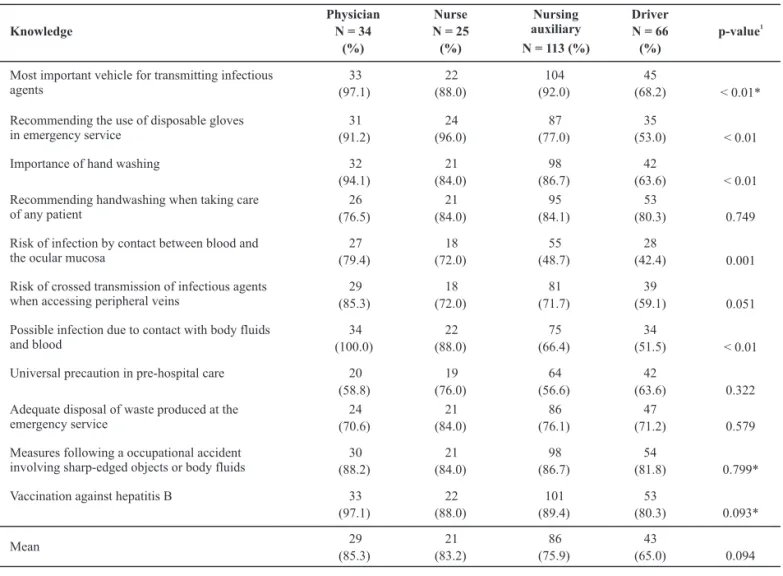
Table 1 displays the proportion of correct answers to knowledge; items regarding universal precautions.
Table 1 - Distribution of the answers about knowledge regarding universal precaution measures according to the participants occupation
- Belo Horizonte, Brazil - 2006
Knowledge
Physician N = 34
(%)
Nurse N = 25 (%)
Nursing auxiliary N= 113(%)
Driver N = 66 (%)
p-value1
Most important vehicle for transmitting infectious agents
33 (97.1)
22 (88.0)
104 (92.0)
45
(68.2) < 0.01*
Recommending the use of disposable gloves in emergency service
31 (91.2)
24 (96.0)
87 (77.0)
35
(53.0) < 0.01
Importance of hand washing 32
(94.1)
21 (84.0)
98 (86.7)
42
(63.6) < 0.01
Recommending handwashing when taking care of any patient
26 (76.5)
21 (84.0)
95 (84.1)
53
(80.3) 0.749
Risk of infection by contact between blood and the ocular mucosa
27 (79.4)
18 (72.0)
55 (48.7)
28
(42.4) 0.001
Risk of crossed transmission of infectious agents when accessing peripheral veins
29 (85.3)
18 (72.0)
81 (71.7)
39
(59.1) 0.051
Possible infection due to contact with body fluids and blood
34 (100.0)
22 (88.0)
75 (66.4)
34
(51.5) < 0.01
Universal precaution in pre-hospital care 20
(58.8)
19 (76.0)
64 (56.6)
42
(63.6) 0.322
Adequate disposal of waste produced at the emergency service
24 (70.6)
21 (84.0)
86 (76.1)
47
(71.2) 0.579
Measures following a occupational accident involving sharp-edged objects or body fluids
30 (88.2)
21 (84.0)
98 (86.7)
54
(81.8) 0.799*
Vaccination against hepatitis B 33
(97.1)
22 (88.0)
101 (89.4)
53
(80.3) 0.093*
Mean 29
(85.3)
21 (83.2)
86 (75.9)
43
Table 1 shows that physicians scored 85.3% on average; however, for items related to universal precaution and dis-posal of waste produced during care, scores were below 75%. Nurses scored 83.2% on average; however for issues related to the risk of crossed transmission of infectious agents and the risk of infection by contact between blood and the eye, scores were below 75%. Nursing auxiliaries scored 75.9% on average; but for issues concerning crossed infection, univer-sal precautions, blood-transmitted diseases, and the risk of infection by contact between blood and the eye, scores were below 75%. Drivers had the lowest level of knowledge com-pared to the other workers, scoring 65.0% (adequate an-swers) on average. They showed a lack of knowledge about almost all the items assessed, except for recommending handwashing, care after accidents with sharp-edged objects, and vaccination against hepatitis B.
It is emphasized that, compared to other workers, only physicians scored over 75% of adequate answers
regard-ing the items concernregard-ing risk of infection by contact be-tween blood and the ocular mucosa and risk of crossed transmission of infectious agents when accessing periph-eral veins.
In addition, there was a statistically significant differ-ence among occupations regarding the vehicle for trans-mitting infectious agents, recommending the use of dispos-able gloves at the emergency service, importance of hand-washing, infection risk by contact between blood and the ocular mucosa; and possible infection due to contact with body fluids and blood (p< 0.01).
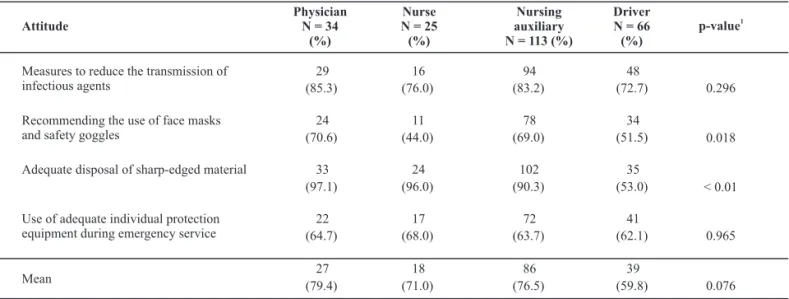
Table 2 shows the ratio of correct answers for items concerning attitude toward universal precautions. Over-all, no statistically significant association was found be-tween mean attitude and each occupational categorys knowledge level, although nurses and drivers scored be-low 75%.
Table 2 - Distribution of the answers regarding attitude toward universal precaution measures
Attitude
Physician N = 34
(%)
Nurse N = 25 (%)
Nursing auxiliary N = 113 (%)
Driver N = 66 (%)
p-value1
Measures to reduce the transmission of infectious agents
29 (85.3)
16 (76.0)
94 (83.2)
48
(72.7) 0.296
Recommending the use of face masks and safety goggles
24 (70.6)
11 (44.0)
78 (69.0)
34
(51.5) 0.018
Adequate disposal of sharp-edged material 33
(97.1)
24 (96.0)
102 (90.3)
35
(53.0) < 0.01
Use of adequate individual protection equipment during emergency service
22 (64.7)
17 (68.0)
72 (63.7)
41
(62.1) 0.965
Mean (79.4)27 (71.0)18 (76.5)86 (59.8)39 0.076
1
p-value is related to the chi-square test.
As shown in Table 2, no occupational categories scored over 75% (adequate answers) on the items: using a face mask and safety goggles; and adequate individual protec-tion equipment during emergency care service. There was a statistically significant difference among the staff mem-bers for items concerning the recommendation for using face masks, safety goggles, and the appropriate disposal of sharp-edged material (p<0.01). During pre-hospital care, nurses and drivers did not use face masks and safety goggles, different from physicians and nursing technicians/ auxiliaries. Furthermore, compared to the other workers, drivers did not follow appropriate measures to dispose of sharp-edged objects (p<0.01).
Table 3 displays the answers to questions about occu-pational accidents due to the exposure to biological sub-stances among the multiprofessional team workers. The global incidence of occupational accidents was categorized by over the last year was 20.6%. The average accident rates for staff members were as follows: body fluid contact 49.0%; involving sharp-edged objects 40.8%; and
involv-ing both contact with body fluids and handlinvolv-ing sharp-edged objects 10.2%. A medical evaluation after accidents was done in 36.7% of cases, and the occupational accident re-port was issued for 18.4% of victims. No measure was un-dertaken in 55.1% of cases, and serological monitoring was not completed in 61.2% of accident victims.
Table 3 -Rates of occupational accidents involving exposure to biological substances and assessment/management after the accident, per occupation - Belo Horizonte, Brazil - 2006
Occupational accidents
Occupational accident over the last year No
Yes
Form of contact Body fluids
Sharp-edged objects
Both
Medical assessment after accident Yes
No
Occupational accident report Yes
No
Management immediately after the accident Quick HIV test for the patient, positive result. Use of retroviral medication during the first 2h following the accident
Physician N = 34
(%)
22 (64.7)
12 (35.3)
28 (83.3)
7 (16.7)
0 (0.0)
7 (16.7)
28 (83.3)
0 (0.0)
34 (100.0)
0 (0.0)
Nurse N = 25 (%)
19 (76.0)
6 (24.0)
8 (33.3)
13 (50.0)
4 (16.7)
8 (33.3)
17 (66.7)
0 (0.0)
25 (100.0)
0 (0.0)
Nursing auxiliary N = 113
(%)
93 (82.3)
20 (17.7)
51 (45.0)
40 (35.0)
22 (20.0)
34 (30.0)
79 (70.0)
23 (20.0)
90 (80.0)
6 (5.0)
Driver N = 66 (%)
55 (83.3)
11 (16.7)
18 (27.3)
48 (72.7)
0 (0.0)
48 (72.7)
18 (27.3)
30 (45.5)
36 (54.5)
0 (0.0)
The occupational accident rate involving biological sub-stances was 17.7% among nursing technicians/auxiliaries; 45.0% of these cases involved contact with body fluids, 35.0% occurred with sharp-edged objects, and 20.0% in-volved both. A medical evaluation was performed in 30.0% of the accidents, and the occupational accident report was issued for 20.0% of workers. Among the staff that under-went medical evaluation, 25.0% were monitored by serol-ogy for one year. Drivers had the smallest accident rate (16.7%). Of these cases, 72.7% involved sharp-edged ob-jects, and medical assessments were carried out in every one. However, only 45.5% of the accidents were reported,
and only 9.1% of the assessed workers were monitored by serology for one year (Table 3).
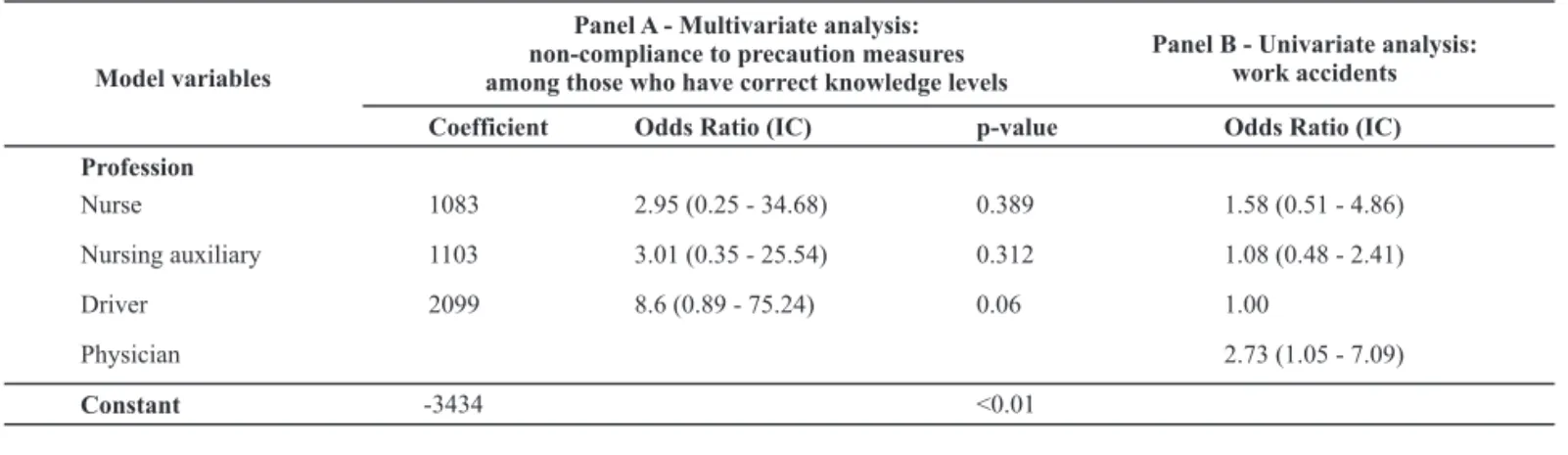
The univariate logistic regression analysis (Table 4) re-vealed that the variables occupation, gender, and work lo-cation were significantly associated (p<0.05) with the com-pliance or not of universal precaution measures. The esti-mated probability of not adopting precaution measures was 20.7 (CI 95%: 5.68- 75.14) times higher among drivers com-pared to physicians, 2.2 (IC 95%: 1,22- 4,10) times higher in men compared to women, and 3.5 (IC 95%: 1,77- 6,82) times higher in workers located in the primary care unit compared to workers located in the advanced care unit.
Panel A - Multivariate analysis: non-compliance to precaution measures among those who have correct knowledge levels
Panel B - Univariate analysis: work accidents Model variables
Coefficient Odds Ratio (IC) p-value
Profession
Nurse 1083 2.95 (0.25 - 34.68) 0.389
Nursing auxiliary 1103 3.01 (0.35 - 25.54) 0.312
Driver 2099 8.6 (0.89 - 75.24) 0.06
Physician
Odds Ratio (IC)
1.58 (0.51 - 4.86)
1.08 (0.48 - 2.41)
1.00
2.73 (1.05 - 7.09)
Constant -3434 <0.01
Table 4 -Results of multivariate logistic regression regarding the non-compliance to precaution measures and occupational accidents
The multivariate logistic regression analysis consider-ing demographic variables showed that drivers and nurs-ing auxiliaries were statistically associated with the non-compliance to precaution measures. Since there is a differ-ence among occupations regarding knowledge, the analy-sis was restricted to those who answered knowledge-ques-tions correctly. In this case, drivers were associated with non-compliance to precaution measures at the level of 10% (Table 4, panel A).
The univariate logistic regression analysis for occupa-tional accidents revealed that the estimated chance of phy-sicians having a work-related accident was 2.7 (IC95%: (1.05-7.09) times higher than that of drivers (Table 4, panel B).
DISCUSSION
In respect to the workers knowledge level, it was ob-served that most did not provide correct answers to the ques-tion regarding precauques-tion measures inherent to the emer-gency care service. At the 5% level, there was no statistically significant association between the mean knowledge level and the occupation (p=0.094), although drivers had a lower rate of correct answers in most questions. It can be inferred that the workload often keeps workers from consulting the guidelines and implementing them in their practice(9-10).
Overall, analyzing knowledge by occupation showed that drivers were the only workers who did not reach the mean level of 75% of adequate answers. The differences regarding knowledge, in a multiprofessional tem, can be explained in part by the different educational approaches in each of these workers. Drivers are required to have the skill to drive quickly and safely. However, they also participate by performing less complex procedures, thus becoming exposed to the same occupational risks of the other workers.
According to the Centers for Disease Control and Preven-tion (CDC), any emergency service worker, whose job implies contact with blood and other body fluids, should receive in-formation about biosafety during work hours, and partici-pate in yearly courses(3,11). In addition, preventive programs should develop and implement policies and procedures to manage occupational risks, with a view to reducing the indi-vidual differences concerning knowledge in the health team(3).
In the attitude analysis, none of the occupations reached 75% of adequate answers for the recommendation of us-ing safety goggles and individual protection equipment during emergency services. Adopting precaution measures helps to control the dissemination of pathogens; the use of individual protection equipment is essential for protecting the emergency service worker in the public. Although the use of individual protection equipment does not keep the worker from having an accident, it does help to reduce the exposure to risk(12). The investigation showed that the real-ity of complying with precaution measures is far from be-ing that which is recommended(13-14).
The global incidence of occupational accidents among public emergency care service workers exposed to biologi-cal material was 20.6%. Other authors have reported rates of health workers involved in accidents with exposure to biological material varying from 18.4% to 100%(15-16). Health workers are exposed to occupational accidents caused mostly by sharp-edged materials and contact with body flu-ids. In public emergency care services, the worker is con-stantly exposed to occupational hazards, particularly when handling the bodily excretions and secretions of patients potentially carrying unknown diseases, who may become the source of transmission of microorganisms for the worker and/or other victims(15).
Surprisingly, medical assessments were performed in 36.7% of public emergency care service workers victims of occupational accidents; and, accident reports were issued in 18.4% of cases. These rates are similar to those found in previous studies(16-17). The difference in accident rates ob-served among occupations can be justified by the presence of physicians and nurses in advanced support units. Fur-thermore, during emergency care, the activities performed by physicians constantly expose them to the contact with blood and body fluids, whereas nurses perform several ac-tivities that involve sharp-edged objects.
On the other hand, drivers perform less complex activi-ties, although after providing emergency care they help the nursing team to clean the ambulances and dispose of the sharp-edged material that was used. For this reason, this group presented the highest rate of accidents with sharp-edged objects.
Although drivers deal with ill people, accident victims, and sharp objects, it is observed there is a lack of knowl-edge regarding exposure to contagious diseases, serologic tests(12) and post-accident follow-up, since this group pre-sented the highest level of medical assessments after acci-dents with sharp-edged material. Workers who reported occupational accidents are those who presented multiple lesions and those who think that cleaning the wound im-mediately is enough(9).
In this study, workers with the highest levels of specific knowledge (physicians and nurses) had a higher rate of adequate answers regarding precaution measures. Physi-cians, however, had the highest rate of accidents involving body fluids. This suggests that the level of knowledge did not have any effect over the use of individual protection equipment against occupational accidents.
It is evident that complying with safe practices is ulti-mately the result of a multitude of factors; some are im-measurable or impossible to change. The factors that were not included in this study regard the non-observation of workers compliance(9).
compared to other public emergency services. This can be justified by the different forms of training that each of these professionals get, besides the fact that drivers do not re-ceive any specific instruction in health sciences.
CONCLUSION
Based on these results, it is concluded that there was no association between complying with precaution mea-sures and public emergency service workers. However, it was observed there are differences among them regarding their knowledge and attitude. The rates for the item knowl-edge applied to infectious agents, in general, were over 75%; the attitude toward the item precaution measures was
gen-erally below 75%. The occupational accident rate was 20.6% (40.8% involving sharp-edged objects). The estimated prob-ability of physicians becoming involved in an accident was 2.7 times greater that that of drivers. The fact that the worker has knowledge about adequate precaution mea-sures, infection control, and occupational risks was not enough to promote attitudes that would be compatible with reducing the risk of transmitting infectious agents and caus-ing occupational accidents.
Continuous education programs are suggested to im-prove knowledge about precaution measures. The purpose would be to reduce the exposure of public emergency ser-vice users and occupational risks agents, along with a for-mal program to supervise and follow the injured workers.
REFERENCES
1. Brasil. Ministério da Saúde. Portaria n. 737, de 16 de maio de 2001. Dispõe sobre a Política Nacional de Redução da Morbimortalidade por Acidentes e Violências. Diário Oficial da União, Brasília, DF, 17de maio de 2001.
2. Barrios JP, Pérez IO, Cabal FC. Sistema médico prehospitalario de emergencia especializado en Medicina Crítica, a 10 años de operación en la ciudad de México. Neumol Cir Tórax. 2000;59(4):102-8.
3. Centers for Disease Control [CDC]. Guideline for Isolation Precautions: Preventing Transmission of Infectious Agents in Healthcare Settings [text on the Internet]. 2007. [cited 2007 Sept. 15]. Available from: http://www.cdc.gov/ncidod/dhqp/pdf/ isolation2007.pdf
4. Garner JS. Hospital Infection Control Practices Advisory Commitee. Guideline for isolation precautions in hospitals. Infect Control Hosp Epidemiol. 1996;17(2):53-80.
5. Phipps W, Honghong W, Min Y, Burgess J, Pellico L, Atkins CW, et al. Risk of medical sharps injuries among chinese nurses. Infect Control Hosp Epidemiol. 2006;34(4):277-82.
6. Brevidelli MM, Cianciarullo TI. Compliance with standard-precautions among medical and nursing staff at a university hos-pital. Online Braz J Nurs [serial on the Internet].2006 [cited 2006 Nov. 20];5(1). Available from: http://www.uff.br/objnursing/ index.php/nursing/article/view/291
7. Kermode M, Jolley D, Langkham B, Thomas MS, Holmes W, Gifford SM. Compliance with Universal/Standard Precautions among health care workers in rural north India. Am J Infect Control. 2005;33(1):27-33.
8. Sax H, Perneger T, Hugonnet S, Herrault P, Chraiti MN, Pittet D. Knowledge of standard and isolation precautions in a large teaching Hospital. Infect Control Hosp Epidemiol. 2005;26(3):298-304.
9. Askarian M, Shiraly R, McLaws ML. Knowledge, attitudes and practices of contact precautions among Iranian nurses. Infect Control Hosp Epidemiol. 2005;33(8):486-8.
10. Cooper S, OCarroll J, Jenkin A, Badger B. Collaborative practices in unscheduled emergency care: role and impact of the emergency care practitionerqualitative and summative findings. Emerg Med J. 2007;24(9):625-9.
11. Brandi S, Benatti MCC, Alexandre NMC.Ocorrência de
aciden-te do trabalho por maaciden-terial perfurocortanaciden-te entre trabalhado-res de enfermagem de um hospital universitário da cidade de Campinas, Estado de São Paulo. Rev Esc Enferm USP. 1998;32(2):124-33.
12. Angtuaco TL, Oprescu FG, Lal SK, Pennington JH., Russell BD, CO JM, et al. Universal precautions guidelines: self-reported compliance by gastroenterologists and gastrointestinal endos-copy nurses a decades lack of progress. Am J Gastroenterol. 2003;98(11):2420-3.
13. Cutter J, Jordan S. Uptake of guidelines to avoid and report expo-sure to blood and body fluids. J Adv Nurs. 2004;46(4):441-52.
14. Florêncio VB, Rodrigues CA, Pereira MS, Souza ACS. Adesão às precauções padrão entre os profissionais da Equipe de Resgate Pré-Hospitalar do Corpo de Bombeiros de Goiás-Brasil. Rev Ele-trônica Enferm [periódico na Internet]. 2003 [citado 2006 nov. 19];5(1):[cerca de 6 p.]. Disponível em: http://www.fen.ufg.br/ revista/revista5_1/pdf/adesao.pdf
15. Memish ZA, Almuneef M, Dillon J. Epidemiology of needlestick and sharps injuries in a tertiary care center in Saudi Arabia. Infect Control Hosp Epidemiol. 2002;30(4):234-41.
16. Nishide VM, Benatti MAC, Alexandre NMC. Ocorrência de aci-dente do trabalho em uma Unidade de Terapia Intensiva. Rev Lat Am Enferm. 2004;12(2):204-11.