review
Copyright
© ABE&M todos os dir
eitos r
eser
vados.
Pathophysiology of type 2
diabetes
melli-tus
in youth: the evolving chameleon
Fisiopatologia do diabetes melitotipo 2 no jovem: um camaleão em evolução
Hala Tfayli1,2, Silva Arslanian1,2
ABSTRACT
Type 2 diabetes mellitus (T2DM) in children and adolescents is an important Public Health problem against the backdrop of the epidemic of childhood obesity. The clinical presentation of T2DM in you-th is heterogeneous from minimal symptomatology to diabetic ketoacidosis. The increasing rates of youth T2DM have paralleled the escalating rates of obesity, which is the major risk factor impacting insulin sensitivity. Additional risk factors include minority race, family history of diabetes mellitus, maternal diabetes during pregnancy, pubertal age group and conditions associated with insulin resistance (IR) – such as polycystic ovary syndrome (PCOS). The pathophysiology of T2DM has been studied extensively in adults, and it is widely accepted that IR together with beta-cell failure are necessary for the development of clinical diabetes mellitus in adulthood. However, pathophysiolo-gic studies in youth are limited and in some cases conflicting. Similar to adults, IR is a prerequisite, but beta-cell failure is necessary for progression from normal glucose tolerance to prediabetes and frank diabetes in youth. Even though rates of T2DM in youth are increasing, the overall prevalen-ce remains low if compared with type 1 diabetes mellitus (T1DM). However, as youth with T1DM are becoming obese, the clinical distinction between T2DM and obese T1DM has become difficult, because of the overlapping clinical picture with evidence of islet cell autoimmunity in a significant proportion of clinically diagnosed youth with T2DM. The latter are most likely obese children with autoimmune T1DM who carry a misdiagnosis of T2DM. Further research is needed to probe the pathophysiological, immunological, and metabolic differences between these two groups in the ho-pes of assigning appropriate therapeutic regimens. These challenges combined with the evolving picture of youth T2DM and its future complications provide unending opportunities for acquisition of new knowledge in the field of childhood diabetes. Arq Bras Endocrinol Metab. 2009;53(2):165-174.
Keywords
Policystic ovarian syndrome; obesity; diabetic physiopathology
RESUMO
Em um cenário de uma epidemia de obesidade, odiabetes melito tipo 2 (DM2) em crianças e adoles-centes é um importante problema de Saúde Pública. As manifestações clínicas do DM2 na juventude são heterogêneas e vão desde sintomas leves até a cetoacidose diabética. As taxas crescentes de DM2 no jovem seguem em paralelo ao aumento da obesidade, a qual constitui o mais importante fator de risco para a redução da sensibilidade à insulina. Outras condições de risco para o DM2 são: minorias étnicas, história familiar de DM2, diabetes materno durante a gestação, idade puberal e si-tuações associadas à resistência à insulina (RI) – como a síndrome dos ovários policísticos (SOP). A fi-siopatologia do DM2 tem sido muito estudada em adultos, sendo aceita como condições necessárias à RI em conjunto com a disfunção da célula beta. Estudos da fisiopatologia em jovens são escassos e conflitantes. Semelhante ao que se passa com os adultos, a RI é um pré-requisito, mas a falência da célula beta é necessária para que haja progressão da tolerância normal à glicose para o pré-diabetes e DM2. Mesmo com o aumento da incidência de DM2 no jovem, a prevalência permanece baixa em comparação com o diabetes mellitus tipo 1 (DM1). Se uma criança com DM1 é obesa, a distinção clí-nica entre o DM2 e DM1 é dificultada, pois existem semelhanças clíclí-nicas e evidências da presença de autoimunidade contra a célula beta em uma significativa proporção de jovens diagnosticados com DM2. Esta condição normalmente representa uma criança obesa com autoimunidade para DM1 com o diagnóstico equivocado de DM2. Novas pesquisas são necessárias para caracterizar os diferentes mecanismos fisiopatológicos, imunológicos e metabólicos entre estes dois grupos, na esperança de que sejam alcançados regimes terapêuticos apropriados. Esses desafios e o quadro em mutação do diabetes na criança e no adolescente nos fornecem oportunidades infindáveis para a aquisição de novos conhecimentos no campo da diabetologia. Arq Bras Endocrinol Metab. 2009;53(2):165-174.
Descritores
Síndrome do ovário policístico; obesidade; fisiopatologia diabética
1 Division of Weight Management
and Wellness from Center
2 Division of Pediatric Endocrinology,
Metabolism and Diabetes Mellitus, Children’s Hospital of Pittsburgh, University of Pittsburgh Medical Center, Pittsburgh, USA
Correspondence to:
Silva Arslanian
Children’s Hospital of Pittsburgh 3705 Fifth Avenue
Pittsburgh, Pennsylvania 15213, U.S.A.
Copyright © ABE&M todos os dir
eitos r
eser
vados.
INTRODUCTION
T
ype 2 diabetes mellitus (T2DM), classically a diag-nosis restricted to adults, became increasingly rec-ognized in children and adolescents worldwide over the last two decades (1-5).In the United States, between 2002 and 2003, the proportion of physician-classiied T2DM among newly diagnosed diabetes cases in the 10 to 19 years age group ranged from 14.9% in non His-panic whites to 46.1% in HisHis-panics, 57.8% in African Americans and 86.2% in American Indians (5). The rates are lower in Europe, where T2DM accounts for 1% to 2% of young-onset diabetes mellitus cases (6-8); higher in Taiwan, where T2DM accounts for 54.2% of newly diagnosed diabetes mellitus cases in school age children (9);in Japan, where the incidence of T2DM in school age children is estimated at 3.0/100,000/yr (10); and, among Kuwaiti children, whose reported prevalence is 34.9 per 100,000 (11). The increase in T2DM cases in youth has paralleled the epidemic increase in child-hood obesity and an increase in the prevalence of adult T2DM (1,12).In addition to obesity, which is the ma-jor risk factor, genetic and environmental inluences as well as family history of diabetes, minority ethnic background, female gender, polycystic ovary syndrome (PCOS), and sedentary lifestyle operate together and enhance the risk of youth T2DM (13). Thus, environ-mental, behavioral and social factors contribute to un-raveling diabetes in the genetically susceptible youth. Important aspects in the pathophysiology of T2DM in children have been elucidated over the last decade; however, research in this area remains in its early stages, with several questions to be explored. In this article, we reviewed the studies pertinent to the pathophysiology of T2DM in children and adolescents.PATHOPHYSIOLOGY OF T2DM
Normal glucose homeostasis and glucose disposition index
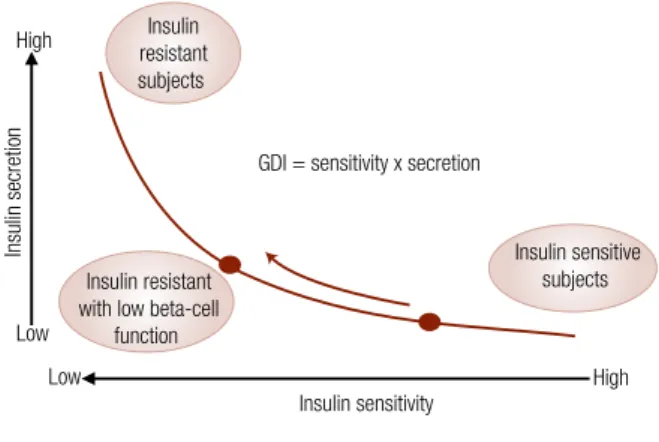
Under normal physiologic conditions, glucose con-centrations remain within a narrow range in the fasting as well as in the fed state. This tight glucose regula-tion is maintained by a delicate balance between insu-lin secretion and insuinsu-lin sensitivity (14). A hyperbolic relationship governs this balance, such as the product of insulin sensitivity and insulin secretion is a constant at a given glucose tolerance in any individual (15). This product, known as the glucose disposition index (GDI), is a more accurate relection of pancreatic
be-ta-cell function than simple quantiication of insulin secretion, as it normalizes the beta-cell response to the degree of insulin resistance (IR) (16). In individu-als with normal glucose tolerance (NGT), a decrease in insulin sensitivity of the peripheral tissues results in a compensatory increase in insulin secretion, and normoglycemia is maintained. Failure of this compen-satory response can lead to glucose intolerance and diabetes (15,17) (Figure 1).
Figure 1. Hyperbolic relationship between insulin sensitivity and insulin secretion. Adapted with permission from Arslanian (15).
GDI = glucose disposition index
GDI = sensitivity x secretion
Insulin sensitive subjects Insulin resistant
with low beta-cell function
Insulin resistant subjects
Insulin sensitivity
High Low
Low High
Insulin secretion
Currently, it is well accepted that adult T2DM is a “2 hit” disease, in which IR is necessarily accom-panied by beta-cell failure (16,17). The sequence of development of these abnormalities, the causes of fail-ure of the pancreatic beta-cell and the natfail-ure of the signals from the insulin resistant tissues that fail to induce an appropriate beta-cell response remain the subject of ongoing debate and research in both the adult and the pediatric literature. However, there is a general consensus that IR with compensatory hyper-insulinemia is the earliest abnormality with the sub-sequent step being impairment in insulin secretion, resulting in hyperglycemia and overt clinical diabetes (18). In the following sections of the present paper, the pediatric studies that assessed insulin sensitivity and beta-cell function in young patients with T2DM are reviewed.
Insulin sensitivity in youth T2DM
Obesity, particularly abdominal obesity, PCOS, puber-tal age group and intrauterine exposure to hypergly-cemia are among the risk factors for development of
Copyright © ABE&M todos os dir
eitos r
eser
vados.
T2DM in children and adolescents (18). IR is a com-mon denominator in individuals carrying one or more of these risk factors, and represents a necessary, albeit not suficient, condition in the progression to clinical diabetes. The few studies that evaluated children with T2DM showed variable results regarding the degree of decline in insulin sensitivity in youth with T2DM compared to obese controls with or without impaired glucose tolerance (19-24). Using the state of the art hyperinsulinemic-euglycemic clamp technique, our group reported signiicantly lower insulin-stimulated glucose disposal, total, oxidative and non-oxidative in a cohort of 14 obese adolescents with T2DM compared with 20 obese controls with similar degrees of obesity and body fat distribution. Adolescents with T2DM had ~50% lower in vivo insulin sensitivity when compared with their obese non diabetic peers (Figure 2A) (20).
Similar to our indings, Elder and cols. reported 3 to 4-fold lower insulin sensitivity in a group of 16 obese adolescents with T2DM compared with 13 obese
con-trols with similar percent of body fat mass, using the modiied intravenous glucose tolerance test (IVGTT) with minimal model assessment (22). Abdominal fat distribution was not assessed in this study (22).
In a smaller study from France, Druet and cols. re-ported signiicant IR in six patients with T2DM, with different ethnicities, using the euglycemic-hyperinsu-linemic clamp (23). Contrary to these indings, Ko-bayashi and cols., using the modiied IVGTT with min-imal model assessment, found similar insulin sensitivity in 12 obese Japanese adolescents with relatively mild T2DM, 10 obese adolescents with more severe T2DM, and 18 obese adolescents with NGT. The three obese groups, however, had lower insulin sensitivity than 26 lean controls (19).
Similarly, Weiss and cols., using the hyperglycemic clamp technique, reported no difference in insulin sen-sitivity between 10 obese adolescents with T2DM, 22 equally obese adolescents with impaired glucose tole-rance (IGT) and 30 equally obese adolescents with
Figure 2. (A) Insulin sensitivity; (B) insulin secretion; (C) glucose disposition index in T2DM patients (black bars) and obese controls (white bars). Adapted with permission from Gungor and cols. (20).
OBCN = obese children with normal glucose tolerance
p < 0.001
p < 0.001
OBCN T2DM
Time (min) T2DM OBCN
-30 -15 0 15 30 45 60 75 90 105 120 OBCN T2DM
GDI (mg/kg/min)
Insulin sensitivity
(mg\kg\min per
U/mL)
Insulin (
U/mL)
B
A C
400
200
0 3
2
1
0
800
400
0
Copyright © ABE&M todos os dir
eitos r
eser
vados.
NGT (21). However, the same group had previously reported contrasting indings by showing signiicantly lower peripheral insulin sensitivity, and lower non-ox-idative glucose metabolism in obese adolescents with IGT compared with NGT with similar body mass index (BMI) and percent of body fat, using the hyperinsu-linemic-euglycemic clamp (25).
This discrepancy between the various studies is due partly to the methodology used in assessing insulin sen-sitivity. The hyperinsulinemic-euglycemic clamp used in the latter study by Weiss and cols. (25), by our group (20) and by Druet and cols. (23) is accepted as the “purest” measure of tissue sensitivity to insulin (15). During this procedure, both insulin and glucose levels are clamped, such as under steady-state plasma glucose concentrations, the amount of glucose infused is equal to the amount of glucose metabolized, provided that endogenous hepatic glucose production is suppressed. On the other hand, insulin sensitivity derived from the hyperglycemic clamp depends on endogenous insulin secretion, which may vary tremendously among pa-tients. In addition, calculating insulin sensitivity from the hyperglycemic clamp assumes a linear relationship between plasma insulin concentration and the rate of glucose metabolism. Both these factors may cloud true differences in insulin sensitivity between groups (15). Insulin sensitivity measured by IVGTT with minimal model assessment is another indirect – but relatively – reliable technique in estimating IR. However, the within subject reproducibility of the method in pediat-ric patients has not be evaluated.
Both Elder and cols. (22) and Kobayashi and cols. (19) used the IVGTT, however the populations they studied were from different ethnic backgrounds: the for-mer being African Afor-merican and Caucasian and the lat-ter being Japanese. This raises the importance of ethnic/ racial differences in the study of the pathophysiology of T2DM. Genome-wide association studies identiied around 20 susceptibility loci robustly implicated in adult T2DM. Some of these loci such as TCF7L2 are frequent in European populations, while others, such as KCNQ1, were identiied with higher frequency in East Asian pop-ulations (26), suggesting that variations in the genetic background of a population could potentially impact the pathophysiologic risks leading to T2DM (27).
Another important element in assessing insulin sen-sitivity in youth is body fat topography. It is well es-tablished that obesity is associated with IR in all ethnic groups (28). It accounts for 55% of the variance in
in-sulin sensitivity among Caucasians (29),and it was the most important risk factor for IR independent of age, sex or ethnicity in the National Health and Nutrition Examination Survey (NHANES) 1999-2002 data, ex-plaining 29.1% of the variance in homeostasis assess-ment model of IR (HOMA-IR) (30).
However, not all obese children develop the same degree of IR. Higher visceral adiposity is associated with ~40% lower insulin sensitivity in obese children independent of race (31), and with lower levels of adi-ponectin (32). Waist circumference is an independent predictor of IR (33) and of metabolic syndrome com-ponents (34) in obese youth after controlling for BMI percentiles. Moreover, the lipid deposition in the in-tramyocellular and in the visceral compartments, rather than increased weight per se, are related to the reduc-tion in insulin sensitivity (25). Thus, visceral adiposity is an important risk factor for IR and T2DM develop-ment and should be accounted for in studies compar-ing insulin sensitivity in obese youth with NGT, IGT or T2DM. Not all of the abovementioned studies of insulin sensitivity in youth with T2DM assessed visceral adiposity in the diabetic youth versus the obese con-trols. Another confounding factor that may be respon-sible for the divergent indings among the different studies is the varying therapeutic modalities, ranging from lifestyle intervention to insulin sensitizers, to in-sulin secretagogues, and to inin-sulin in different youths with T2DM.
Insulin secretion in youth T2DM
Copyright © ABE&M todos os dir
eitos r
eser
vados.
sensitivity of SPIS speciic to the T2DM adolescents was found, with no signiicant differences between the
IGT versus NGT obese adolescents (21). Both studies
used the hyperglycemic clamp technique, and included control groups with matched body fat composition.
Other studies that used the modiied IVGTT tech-nique had somewhat conlicting results. Elder and cols. reported lower irst phase insulin response in the T2DM patients versus obese controls; however, the response was similar to that in lean controls. In their study, the control subjects were slightly older than the T2DM pa-tients, and the race distribution was not similar between the three studied groups (~60% African Americans in the T2DM group, versus 38% in the obese controls and only 8% in the lean controls) (22). Kobayashi and cols. found signiicantly lower irst phase insulin response in young Japanese patients with T2DM compared with lean controls and with obese controls with NGT (19). In a smaller European study of six patients with T2DM (23), irst phase insulin response to IVGTT was pre-served in three subjects and signiicantly impaired in the other three. In the same study, insulin secretion in response to a graded intravenous glucose infusion and in response to an arginine test varied from sustained and exaggerated in some patients to impaired in others. The authors attributed this discrepancy in insulin responses to a longer diabetes duration and lack of weight loss in the patients with worse insulin secretion.
All of the aforementioned studies are limited by the relatively small numbers of patients with T2DM (rang-ing from 6 in the smallest to 22 in the largest), which relects the relatively low prevalence of T2DM in this age group, despite its increased incidence. However, all of those studies used relatively sensitive methods in assessing beta-cell function, which offsets the power limitation to a certain extent. The hyperglycemic clamp is accepted as the gold standard for assessing beta-cell function in both adults (35) and children (15), and the IVGTT with the minimal model approach is a well validated method for quantiication of insulin secretion (36) in adults, but its reproducibility in the pediatric population is unknown – especially when the individual develops hypoglycemia following tolbutamide or insulin injection (15). Moreover, information on insulin secre-tion alone, without informasecre-tion on insulin sensitivity, does not provide the complete picture. Insulin secre-tion relative to insulin sensitivity, i.e. the GDI, is the crucial piece of data when assessing beta-cell function. In those studies which evaluated GDI, it was uniformly
decreased in young patients with T2DM (19,20,22,23) (Figure 2C).
Defects in proinsulin processing relected by a high proinsulin to insulin ratio in the T2DM patients com-pared with IGT and NGT obese controls were reported in some studies (20,21), providing further evidence of impaired beta-cell function.Other studies, however, did not detect any differences in the proinsulin/insulin ratio in either the fasting state or over the irst ten minutes after IV glucose infusion between the T2DM patients (22).
Thus, there is convincing evidence that beta-cell failure is an important component in the pathogenesis of T2DM in youth, similar to adults. The severity of reported beta-cell failure in youth T2DM is quite vari-able and may be inluenced by glycemic control (20), duration of diabetes, prior beta-cell function, ethnicity (37) and other yet unknown factors.
In our reported patients, HbA1c correlated inverse-ly with FPIS (r = -0.61, p = 0.025) and GDI (r = -0.77, p = 0.004) (20). Whether or not this relationship is a relection of glucotoxicity impacting beta-cell function or poor beta-cell function resulting in elevated HbA1C can not be deduced from our cross sectional study.
Our data also demonstrated that there are ethnicity related differences in beta-cell function with higher FPIS in black versus white American adolescents with T2DM with comparable HbA1C levels and similar duration of diabetes (37). More research is needed to investigate the factors res ponsible for variable beta-cell failure in youth with T2DM.
AUTOIMMUNITY AND CLINICALLY DIAGNOSED
T2DM IN YOUTH
Between 10% to 75% of youth diagnosed with T2DM based on clinical features, namely obesity, acanthosis nigricans, family history of diabetes, minimal to severe hyperglycemia with or without ketosis, are reported to have beta-cell auto-antibodies (38-43). The antibodies tested and reported to be positive in these patients in-clude ICA, in 5% to 8% (38,40-42), GAD in 8% to 30% (38-40,42), IA-2 in 8% to 42% (39-42), and insulin antibodies in 5 to 35% (38-41). In one study, 11% of clinically diagnosed T2DM youth were positive for all four auto-antibodies (40).
Copyright © ABE&M todos os dir
eitos r
eser
vados.
– clinically distinguishing features (obesity, acanthosis nigricans, ketosis, HbA1C and insulin requirements at diagnosis or on follow-up) between patients with or without beta-cell antibodies (38,42). A preliminary report of a much larger scale of 432 youth with physi-cian diagnosed T2DM screened in the TODAY study revealed that 17.4% were positive for one or both an-tibodies, GAD and IA-2 (43). Antibody positive versus
negative subjects did not differ in age, diabetes duration, BMI z-score and lipid levels; however, there seemed to be a tendency for C-peptide to be lower and HbA1C to be higher in antibody positive (Ab+) youth (43).
Patients who are clinically diagnosed with T2DM but also have evidence of islet cell autoimmunity pres-ent a diagnostic challenge, and have been referred to as patients with autoimmune T2DM, hybrid diabetes, diabetes 1.5, double diabetes, and late onset autoim-mune diabetes of the young (LADY) (44).
As clinicians caring for such patients, it is crucial to make a proper diagnosis for the appropriate choice of therapy. In a recent study (45), we investigated pathophysiological differences between antibody posi-tive versus antibody negative youth with a clinical di-agnosis of T2DM. Using the hyperinsulinemic-eugly-cemic and the hyperglyhyperinsulinemic-eugly-cemic clamp, we demonstrated important pathophysiologic differences between the two groups. Insulin secretion/beta-cell function was severely impaired in those patients with Ab+ compared
with those with negative antibodies (Ab-) (Figure 3A).
On the other hand, Ab- patients had severe impairment
in insulin sensitivity compared with the Ab+ ones and
the obese controls, with no difference in insulin sensi-tivity between obese controls and Ab+ patients (Figure
3B) (45).These data imply that obese youth who are clinically diagnosed with T2DM, but have evidence of pancreatic autoimmunity, are, in reality, obese children with type 1 diabetes mellitus (T1DM), without the in-herent IR that is typical of patient with T2DM but evi-dence of autoimmune beta-cell damage manifested in severe insulin deiciency.
Our efforts to ind clinically distinguishing character-istics between the two groups did not reveal differences in HbA1C at diagnosis, BMI and insulin requirements (45). However, ketonuria/ketonemia was signiicantly more frequent in Ab+versus Ab- patients at initial
pre-sentation (45). Furthermore, both blood pressure and ALT were higher in Ab- patients consistent with their
underlying severe IR (45). Thus, the Ab- group has an
inherent IR that is typical of the metabolic syndrome. At the present, it is not clear whether or not the clinical course of Ab+versus Ab- patients would differ, because
there are no long-term longitudinal studies assessing the progression of diabetes in either group.
One study assessed insulin requirement of the Ab+
patients one year after diagnosis and did not ind sig-niicant differences compared with the Ab- ones (42).
Previous limited studies from a single group of investi-gators found that some youth clinically classiied with T2DM or indeterminant diabetes (admixture of clinical features of types 1 and 2, T1.5) show T-cell reactivity to islet proteins (40) and have T1DM-associated HLA al-leles (41). Baseline C-peptide levels in the T1.5 patients
Figure 3. (A) First and second phase insulin secretion during the hyperglycemic clamp in Ab- (empty circles) versus Ab+ (filled circles) versus obese controls (filled triangles);
(B) insulin stimulated-glucose disposal during the hyperinsulinemic-euglycemic clamp in Ab- (white bars) versus Ab+ (dotted bars) versus obese controls (black bars). Adapted
with permission from Tfayli and cols. (45).
OBCN = obese children with normal glucose tolerance A
500
250
0
Insulin (
U/mL)
Time (min)
OBCN
Ab
-2nd phase
p = 0.008 2st phase
p < 0.001
Ab+
-30 -15 0 15 30 45 60 75 90 105 120
Ab- Ab+ OBCN
Insulin stimulated glucose disposal
(mg/kg/min)
p = 0.017 B
p = 0.023 10
5
Copyright © ABE&M todos os dir
eitos r
eser
vados.
were signiicantly lower than those in patients classiied as T2DM and higher than those in patients classiied as T1DM (41). A more aggressive clinical course in patients with autoimmune markers and T2DM pheno-type was proposed. The indings in our study are in agreement with this proposition, and provide direct evidence to the more severe degree of impairment in beta-cell function in Ab+ patients. The more frequent
ketonuria at initial diagnosis in Ab+ patients may be a relection of the severity of beta-cell impairment. A similar observation of more frequent ketonuria in pa-tients with positive T-cell reactivity or antibodies was made before (40). Additional studies need to be done to pursue the differences between Ab-versus Ab+
com-bined with careful immunological evaluation of T-cell reactivity and HLA antigens.
Our metabolic observations in Ab+versus Ab- youth
with T2DM are consistent with indings in GAD posi-tive adults with T2DM or latent autoimmune diabe-tes (LADA) (46). GAD positive adult patients had decreased early insulin response; however, when the insulin response was corrected for the degree of insu-lin sensitivity, GAD positive and negative patients had similar beta-cell function. Thus, in the absence of care-ful metabolic studies using sensitive tools, it will be dif-icult to discern the underlying pathways, impaired in-sulin action versus beta-cell function, which may result in similar GDI. However, such knowledge is important to help guide pathopysiology-based therapy amidst the multiple terminologies used, double diabetes, hybrid diabetes, diabetes 1.5 etc.
PROGRESSION FROM NGT TO PREDIABETES, IGT
AND T2DM
Longitudinal studies of adult populations at high risk of developing T2DM, such as the Pima Indians showed that progression from NGT to IGT and to T2DM was associated with an increase in body weight, worsening of insulin sensitivity and a decrease in biphasic insulin secretion (47,48).In the Botnia study, which included 5,396 adults, a progressive decline in insulin sensitiv-ity was observed when moving from NGT to IGT and to diabetes, while an absolute decompensation of beta-cell function characterized the transition from IGT to T2DM (49).
There are currently no published longitudinal stud-ies pertinent to the progression to overt T2DM in youth. We had the opportunity to follow a high-risk
African American obese female over a ive-year period. The progression from NGT to IGT and from IGT to T2DM in this patients was associated with signiicant weight gain, a large increase in visceral adipose tissue and remarkable decompensation in insulin secretion relative to insulin sensitivity (50).The available pediat-ric data come mostly from cross sectional studies com-paring metabolic differences between NGT, IGT and T2DM – with conlicting indings.
In a recent report by our group, adolescents with T2DM had signiicantly lower insulin-stimulated total and oxidative glucose disposal compared with IGT and compared with NGT, while no difference was detected between the IGT and the NGT subjects (24) (Figure 4A). An earlier study by Weiss and cols. did not ind dif-ferences in insulin sensitivity in T2DM adolescents versus
those with IGT and those with NGT (21),in contrast to their prior observation of lower insulin sensitivity in adolescents with IGT compared with NGT (25).In the latter study, the adolescents with IGT had signiicantly higher ratio of visceral to subcutaneous abdominal fat compared to the NGT group, while in the study by Ba-cha and cols. the three groups had similar percent of body fat and abdominal fat distribution. This could ex-plain the discrepancy in the data, as visceral fat has been associated with lower insulin sensitivity (25,31).
chil-Copyright © ABE&M todos os dir
eitos r
eser
vados.
Figure 4. (A) Insulin-stimulated total, oxidative, and nonoxidative glucose disposal in NGT (white bars), IGT (hatched bars) and T2DM (black bars); (B) first and second-phase insulin levels in NGT (open triangles), IGT (hatched squares), and T2DM (filled circles); (C) glucose disposition index in NGT (open bars), IGT (hatched bars) and T2DM (filled bars). Adapted with permission from Bacha and cols. (24).
NGT IGT T2DM
Insulin (
U/mL)
Time (minutes)
p < 0.001
GDI (mg/kg/min)
1st phase
2nd phase
p = 0.001 P < 0.001
A
B
C
Total Oxidative Non-oxidative
Insulin stimulated glucose disposal (mg/kg/min)
p = 0.02 8
4
0
800
400
0
0.8
0.4
0 p = 0.004
p = 0.08
-30 -15 0 15 30 45 60 75 90 105 120
NGT IGT T2DM
dren with IGT (51).In overweight Latin children with family history of T2DM, IGT seems to be related to deterioration in beta-cell function (52). Both insulin sensitivity and the GDI in these children are reported to deteriorate over age and to be related to maternal history of T2DM (53).
Thus, based on the available data, it can be postu-lated that a defect in irst phase insulin response is seen early on in the development of T2DM in youth, and defects in second phase response are evident by the time overt diabetes develops. This deterioration occurs in the context of a decline in insulin sensitivity.
FINAL CONSIDERATIONS
The interplay between insulin sensitivity and insulin se-cretion determines glucose homeostasis and the progres-sion from normal glucose tolerance to IGT toT2DM in youth. Defects in both insulin action and responses are present in the early stages of T2DM development, and are triggered by environmental modulators against the back drop of genetic susceptibility. Even though the
study of T2DM in youth is in its infancy, our knowledge has advanced signiicantly with more to be learned. As we amass scientiic knowledge, T2DM in youth contin-ues to evolve as a chameleon, changing its color every time we think we have come across new information, such as the contrast between Ab- versus Ab+ patients.
There remains much to be investigated and discovered about youth T2DM, including its future microvascu-lar and macrovascumicrovascu-lar complications, best therapeutic approaches and potential prevention strategies in these youth aflicted with an adult disease.
Aknowledgments: This work was supported by the United States Public Health Service grant RO1HD27503 (SA), K24 HD01357 (SA), Richard L Day endowed chair (SA) and MO1 RR00084 (GCRC) and UL1 RR024153 (CTSA), and U01 DK61254 (SA).
Disclosure: No potential conlict of interest relevant to this article was reported.
REFERENCES
Rosenbloom AL, Joe JR, Young RS, Winter WE. Emerging epide-1.
Copyright © ABE&M todos os dir
eitos r
eser
vados.
Fagot-Campagna A, Pettitt DJ, Englegau MM, Burrows NR, Geiss 2.
LS, Valdez R, et al. Type 2 diabetes among North American chil-dren and adolescents: an epidemiologic review and a public he-alth perspective. J Pediatr. 2000;136(5):664-72.
Pinhas-Hamiel O, Zeitler P. The global spread of type 2 diabetes 3.
mellitus in children and adolescents. J Pediatr. 2005;146(5):693-700. Rosenbloom AL, Silverstein JH, Amemiya S, Zeitler P, Klingens-4.
mith GJ. ISPAD Clinical Practice Consensus Guidelines 2006-2007. Type 2 diabetes mellitus in the child and adolescent. Pedia-tric Diabetes. 2008;9(2):512-26.
Writing Group for the SEARCH for Diabetes in Youth Study 5.
Group, Dabelea D, Bell RA, D’Agostino RB Jr, Imperatore G, Jo-hansen JM, Linder B, Liu LL, Loots B, Marcovina S, Mayer-Davis EJ, Pettitt DJ, Waitzfelder B. Incidence of diabetes in youth in the United States. JAMA. 2007; 297(24):2716-24.
Rotteveel J, Belksma EJ, Renders CM, Hirasing RA, Delemarre-Van 6.
de Waal HA. Type 2 diabetes in children in the Netherlands: the need for diagnostic protocols. Eur J Endocrinol. 2007;157(2):175-80. Feltbower RG, McKinney PA, Campbell FM, Stephenson CR, 7.
Bodansky HJ. Type 2 and other forms of diabetes in 0-30 year olds: a hospital based study in Leeds, UK. Arch Dis Child. 2003;88(8):676-9.
Ortega-Rodriguez E, Levy-Marchal C, Tubiana N, Czernichow P, 8.
Polak M. Emergence of type 2 diabetes in an hospital based co-hort of children with diabetes mellitus. Diabetes Metab. 2001;27(5 Pt 1):574-8.
Wei JN, Sung FC, Lin CC, Lin RS, Chiang CC, Chuang LM. Natio-9.
nal surveillance for type 2 diabetes mellitus in Taiwanese chil-dren. JAMA. 2003;290(10):1345-50.
Urakami T, Morimoto S, Nitadori Y, Harada K, Owada M, Kitaga-10.
wa T. Urine glucose screening program at schools in Japan to de-tect children with diabetes and its outcome-incidence and clinical characteristics of childhood type 2 diabetes in Japan. Pediatr Res. 2007;61(2):141-5.
Moussa MA, Alsaeid M, Abdella N, Refai TM, Al-Sheikh N, Gomez 11.
JE. Prevalence of type 2 diabetes mellitus among Kuwaiti chil-dren and adolescents. Med Princ Pract. 2008;17(4):270-5. Dabelea D, Pettitt DJ, Jones KL, Arslanian SA. Type 2 diabetes 12.
mellitus in minority children and adolescents. An emerging pro-blem. Endocrinol Metab Clin North Am. 1999;28(4):709-29. Bacha F, Arslanian S. Insulin resistance and insulin secretion in 13.
the pathophysiology of youth type 2 diabetes. In: Dabelea D, Klingensmith G, editors. Epidemiology of pediatric and adoles-cent diabetes. First edition. New York: Informa Healthcare; 2008. p.139-64.
Kahn SE. The relative contributions of insulin resistance and 14.
beta-cell dysfunction to the pathophysiology of Type 2 diabetes. Diabetologia. 2003;46(1):3-19.
Arslanian SA. Clamp techniques in paediatrics: what have we le-15.
arned? Horm Res. 2005;64 Suppl 3:16-24.
Bergman RN, Ader M, Huecking K, Van Citters G. Accurate as-16.
sessment of β-cell function: the hyperbolic correction. Diabetes. 2002; 51(Suppl. 1):S212-20.
Kahn SE. The relative contributions of insulin resistance and 17.
beta-cell dysfunction to the pathophysiology of type 2 diabetes. Diabetologia. 2003;46(1):3-19.
Gungor N, Hannon T, Libman I, Bacha F, Arslanian S. Type 2 dia-18.
betes mellitus in youth: the complete picture to date. Pediatr Clin North Am. 2005;52(6):1579-609.
Kobayashi K, Amemiya S, Higashida K, Ishihara T, Sawa
19. nobori E,
Kobayashi K, et al. Pathogenic factors of glucose intolerance in obese Japanese adolescents with type 2 diabetes. Metabolism. 2000;49(2):186-91.
Gungor N, Bacha F, Saad R, Janosky J, Arslanian S. Youth type 2 20.
diabetes: insulin resistance, beta-cell failure, or both? Diabetes Care 2005;28(3):638-44.
Weiss R, Caprio S, Trombetta M, Taksali WV, Bonadonna R. Beta-21.
cell function across the spectrum of glucose tolerance in obese youth. Diabetes. 2005;54(6):1735-43.
Elder DA, Prigeon RL, Wadwa RP, Dolan LM, D’Alessio DA. Beta-22.
cell function, insulin sensitivity, and glucose tolerance in obese diabetic and nondiabetic adolescents and young adults. J Clin Endocrinol Metab. 2006;91(1):185-91.
Druet C, Tubiana-Rufi N, Chevenne D, Rigal O, Polak M, Levy-23.
Marchal C. Characterization of insulin secretion and resistan-ce in type 2 diabetes of adolesresistan-cents J Clin Endocrinol Metab. 2006;91(2):401-4.
Bacha F, Gungor N, Lee S, Arslanian SA. In vivo insulin sensitivity 24.
and secretion in obese youth: what are the differences between normal glucose tolerance, impaired glucose tolerance, and type 2 diabetes? Diabetes Care. 2009; 32(1):100-5.
Weiss R, Dufour S, Taksali SE, Tamborlane WV, Petersen KF, 25.
Bonadonna RC, et al. Prediabetes in obese youth: a syndrome of impaired glucose tolerance, severe insulin resistance, and altered myocellular and abdominal fat partitioning. Lancet. 2003;362(9388):951-7.
McCarthy MI. Casting a wider net for diabetes susceptibility ge-26.
nes. Nat Genet. 2008;40(9):1039-40.
Frayling TM. Genome-wide association studies provide new insights 27.
into type 2 diabetes aetiology. Nat Rev Genet. 2007;8(9):657-62. Crossrow N, Falkner B. Race/ethnic issues in obesity and 28.
obesity-related comorbidities. J Clin Endocrinol Metab. 2004;89(6):2590-4.
Arslanian SA, Suprasongsin C. Insulin sensitivity, lipids, and 29.
body composition in childhood: is “syndrome X” present? J Clin Endocrinol Metab. 1996;81(3):1058-62.
Lee JM, Okumura MJ, Davis MM, Herman WH, Gurney JG. Preva-30.
lence and determinants of insulin resistance among US adoles-cents. Diabetes Care. 2006;29(11):2427-32.
Bacha F, Saad R, Gungor N, Janosky J, Arslanian SA. Obesity, 31.
regional fat distribution and syndrome X in obese black vs whi-te adolescents: race differential in diabetogenic and atherogenic risk factors. J Clin Endocrinol Metab. 2003;88(6):2534-40. Bacha F, Saad R, Gungor N, Arslanian S. Adiponectin in youth: 32.
relationship to visceral adiposity, insulin-sensitivity, and beta-cell function. Diabetes Care. 2004;27(2):547-52.
Lee S, Bacha F, Gungor N, Arslanian S. Waist circumference is an 33.
independent predictor of insulin resistance in African-American and White youth. J Pediatr. 2006;148(2):188-94.
Lee S, Bacha F, Arslanian S. Waist circumference, blood pressu-34.
re and lipid components of the metabolic syndrome. J Pediatr. 2006;149(6):809-16.
De Fronzo RA, Tobin JD, Andres R. Glucose clamp technique: a 35.
method for quantifying insulin secretion and resistance. Am J Physiol. 1979;237(3):E214-23.
Bergman RN. Lilly lecture 1989. Toward physiological understan-36.
ding of glucose tolerance: Minimal-model approach. Diabetes. 1989; 38(12):1512-27
Bacha F, Gungor N, Lee S, Arslanian S. Pathophysiology of 37.
type 2 diabetes in youth: are rhere racial differences? Diabetes. 57;(Suppl. 1):A857.
Hathout EH, Thomas W, El-Shahawy M, Nahab F, Mace JW. Dia-38.
betic autoimmune markers in children and adolescents with type 2 diabetes. Pediatrics. 2001;107(6):E102.
Umpaichitra V, Banerji MA, Castells S. Autoantibodies in chil-39.
Copyright © ABE&M todos os dir
eitos r
eser
vados.
Brooks-Worrell BM, Greenbaum CJ, Palmer JP, Pihoker C. Au-40.
toimmunity to islet proteins in children diagnosed with new-on-set diabetes. J Clin Endocrinol Metab. 2004; 89(5):2222-7. Gilliam L
41. , Brooks-Worrell B, Palmer J, Greenbaum C, Pihoker C. Autoimmunity and clinical course in children with type 1, type 2, and type 1.5 diabetes. J Autoimmunity. 2005;25(3):244-50. Reinehr T, Schober E, Wiegand S, Thon A, Holl R; DPV-Wiss Stu-42.
dy Group: Beta-cell autoantibodies in children with type 2 dia-betes mellitus: subgroup or misclassification? Arch Dis Child. 2006;91(6):473-7.
Klinkgensmith GJ, Coombs LP, Arslanian S, Copeland K, Cuttler L, 43.
Haffner S, Kaufman F, Laffel L, Linder B, Marcovina SM, Tollefsen SE, Weinstock RS; for the TODAY study group. Autoantibody po-sitivity in subjects screened for participation in a treatment trial for T2D in youth. Diabetes. 2006;55(Suppl. 1): 67.
Pozzilli P, Guglielmi C, Pronina E, Petraikina E. Double or hybrid 44.
diabetes associated with an increase in type 1 and type 2 diabetes in children and youths. Pediatr Diabetes. 2007;8 Suppl. 9:88-95. Tfayli H, Bacha F, Gungor N, Arslanian A. Phenotypic type 2 dia-45.
betes in obese youth: insulin sensitivity and secretion in islet-cell antibody negative vs. antibody positive patients. Diabetes 2009:58:738-44.
Zinman B, Kahn SE, Haffner SM, O’Neill MC, Heise MA, Freed MI; 46.
ADOPT Study Group. Phenotypic characteristics of GAD antibo-dy-positive recently diagnosed patients with type 2 diabetes in North America and Europe. Diabetes. 2004;53(12):3193-200.
Weyer C, Bogardus C, Mott DM, Pratley RE. The natural his-47.
tory of insulin secretory dysfunction and insulin resistance in the pathogenesis of type 2 diabetes mellitus. J Clin Invest. 1999;104(6):787-94.
Festa A, Williams K, D’Agostino R Jr, Wagenknecht LE, Haffner 48.
SM. The natural course of beta-cell function in nondiabetic and diabetic individuals: the Insulin Resistance Atherosclerosis Stu-dy. Diabetes. 2006;55(4):1114-20.
Tripathy D, Carlsson M, Almgren P, Isomaa B, Taskinen MR, Tuomi T, 49.
et al. Insulin secretion and insulin sensitivity in relation to glucose to-lerance: lessons from the Botnia Study. Diabetes. 2000;49(6):975-80. Saad R, Gungor N, Arslanian S. Progression from normal glucose 50.
tolerance to type 2 diabetes in a young girl: longitudinal changes in insulin sensitivity and secretion assessed by the clamp techni-que and surrogate estimates. Pediatr Diabetes. 2005;6(2):95-9. Sinha R, Fisch G, Teague B, Tamborlane WV, Banyas B, Allen K, et al. 51.
Prevalence of impaired glucose tolerance among children and ado-lescents with marked obesity. N Engl J Med. 2002;346(11):802-10. Goran MI, Bergman RN, Avila Q, Watkins M, Ball GD, Shaibi GQ, 52.
et al. Impaired glucose tolerance and reduced beta-cell function in overweight Latino children with a positive family history for type 2 diabetes. J Clin Endocrinol Metab. 2004;89(1):207-12. Kelly LA, Lane CJ, Weigensberg MJ, Koebnick C, Roberts CK, 53.