Comparative analysis of the effect of two
chlorhexidine mouthrinses on plaque
accumulation and gingival bleeding
Abstract: The aim of the present study was to evaluate the effect of two chlorhexidine rinsing solutions (0.12% and 0.2%) on plaque and gin-gival bleeding. Ten dental students participated in this double-blind, cross-over study, rinsing twice a day, for one minute, with each one of the tested solutions for fourteen days. A wash-out period of one week between treatments was observed. In order to assess gingival bleeding, the van der Weijden et al.1 (1994) index was used. The plaque indexes used were those of Quigley, Hein2 (1962) and Silness, Löe3 (1964). In the pre-experimental period, subjects received oral hygiene instructions and dental prophylaxis. The results revealed no signiicant differences between both concentrations in relation to plaque and gingival bleeding. Mean values (± standard deviation) of the Quigley & Hein index were 0.25 ± 0.16 for the 0.12% solution and 0.23 ± 0.26 for the 0.2% solu-tion (p = 0.4838). Mean values (± standard deviation) of the Silness-Löe index were 0.12 ± 0.10 for the 0.12% solution and 0.11 ± 0.11 for the 0.2% solution (p = 0.7592). The bleeding index mean values at the end of the study were not different for both concentrations with mean values (± standard deviation) of 14.93% ± 6.68% and 13.95 ± 9.24% for the 0.12% and 0.2% solutions, respectively. Although an increase in gingival bleeding was observed, both concentrations were able to control dental plaque.
Descriptors: Chlorhexidine; Dental plaque; Products with antimicrobial action; Gingivitis.
Carlos Alfredo Franco Neto(a)
Clarissa Cavalcanti Fatturi Parolo(b)
Cassiano Kuchenbecker Rösing(c)
Marisa Maltz(d)
(a) Docent; (b)Docent, MS; (d)PhD, Professor
– Department of Preventive and Social Dentistry, School of Dentistry, Federal University of Rio Grande do Sul.
(c) PhD, Professor, Department of Conservative
Dentistry, School of Dentistry, Federal University of Rio Grande do Sul.
Corresponding author: Marisa Maltz
Universidade Federal do Rio Grande do Sul Faculdade de Odontologia
Departamento de Odontologia Preventiva e Social
Rua Ramiro Barcelos, 2492, Santana Porto Alegre - RS - Brazil
CEP: 90035-003
E-mail: [email protected]
Introduction
The most prevalent infectious oral diseases in hu-mans, caries and periodontal diseases, are associated with dental plaque. The removal of bacterial bioilm is a decisive component in the prevention and treat-ment of these diseases. The use of mechanical agents is a simple and cost-effective method that has been demonstrated to be eficient in gingivitis control.4 The effectiveness of this method, however, is inlu-enced by the individual’s manual ability and moti-vation. Because of the dificulty to ensure adequate removal of plaque by mechanical means, there is a great interest in the use of antimicrobial agents to re-place or to be adjuncts to the mechanical approaches. Chlorhexidine (CHX) is one of the most effective an-timicrobial agents for plaque control.5-10 It is retained in the oral cavity and is progressively desorbed in bacteriostatic concentrations 8 hours after rinsing.11 When a low dose of CHX is used, the cellular trans-port of the bacterial cell is damaged with the cre-ation of pores in the cellular membrane.12 In higher concentration, the solution penetrates the bacterial cell and leads to microorganism destruction.
In Europe, a 0.2% CHX solution was developed and became the standard international concentra-tion.6 A lower concentration of CHX (0.12%) has been tested in animals and human populations and has also demonstrated clinical beneits.7,13,14 Al-though CHX is an effective antimicrobial agent in both concentrations, comparison of the two exist-ing formulations is still necessary. The aim of the present study was to assess the eficacy of two con-centrations of chlorhexidine solutions (0.12% and 0.20%) on plaque development and gingival bleed-ing control durbleed-ing 14 days.
Material and Methods
This study involved a randomized controlled clinical trial with a cross-over double-blind design. Ten dental students (7 male and 3 female) aged 20-25 years were included in the study.
To be included in the study, the volunteers should have at least 24 teeth, not have prosthetic or orthodontic appliances, no previous or present his-tory of periodontitis (the subjects had no site with PPD > 3 mm and had no site with PAL > 2 mm) or
any systemic condition that could negatively inlu-ence oral health, not have been under antimicrobial treatment locally or systemically in the 90 days pre-vious to the experiment.
Two regimes of chlorhexidine rinsing were pre-scribed: (a) 15 ml of a 0.12% chlorhexidine solu-tion, which corresponds to 18 mg of chlorhexi-dine (Hibitane Dental, ICI Pharmaceuticals PLC, Macclesield, UK) twice daily; (b) 10 ml of a 0.20% chlorhexidine solution, equivalent to 20 mg of chlorhexidine (Hibitane Dental, ICI Pharmaceuti-cals PLC, Macclesield, UK) twice daily.
Two weeks prior to baseline, a thorough clini-cal examination was performed in order to identify sites with plaque (determined by visible plaque in-dex)15 and gingival bleeding (Gingival Bleeding In-dex).1 The volunteers that had plaque and extrinsic pigmentation were submitted to professional me-chanical tooth cleaning with the use of abrasives, rubber cups and brushes. The volunteers with gin-givitis received oral hygiene instruction. Calculus was removed by meticulous scaling carried out with manual instruments.
In the beginning of each experimental period, the Gingival Bleeding Index1 was assessed. After this, plaque disclosure and prophylaxis were per-formed. At this moment, the irst rinsing was given to the volunteers, who received a 500 ml coded plas-tic bottle and a corresponding dose dispenser. Half of the volunteers received the 0.12% CHX solution and the other half received the 0.2% CHX solution. No mechanical plaque control was performed dur-ing the experiment.
At day 14 after baseline in each experimental peri-od, subjects were examined using the Quigley & Hein Plaque Index,2 followed by the Silness & Löe Plaque Index3 and the Gingival Bleeding Index, according to van der Weijden et al.1 (1994). For the Quigley & Hein Plaque Index,2 a photo-activated plaque disclo-sure system was utilized (Plaque test – Ivoclar Viva-dent, Schaan, Liechtenstein), thus not disturbing the following Silness and Löe Plaque assessment.
All the clinical parameters were assessed by one trained experienced examiner under standard den-tal ofice and light source conditions.
wash-out interval was given, when the volunteers performed standard mechanical plaque control. Fol-lowing washout, each volunteer received the oppo-site regime.
At day 21, following the wash-out period, the volunteers were clinically examined in the same way as at Baseline. At day 35, inal examination, similar to that performed at day 14, took place.
For each Plaque Index, mean values (± standard deviation) were calculated at day 14 and 35 (and merged according to the CHX regimen) and statisti-cally analysed by the Wilcoxon rank sign test.
Mean values (± standard deviation) of Gingival Bleeding scores at baseline and at day 14 and 35 (merged according to CHX regimen) were calculat-ed and analyscalculat-ed by the Wilcoxon rank sign test.
The relation between each one of the plaque indi-ces and the Gingival bleeding index was determined by linear regression. The alpha level for all the analyses in this study was set at 5%. The data for this trial was used in order to calculate the power of the study. The primary outcome considered was the Silness & Löe Plaque Index.3 Taking into con-sideration the study design and the variability of the results, a clinically relevant difference of 0.10 and α error of 0.05, β error of 0.24 were expected. Thus,
the power of this study was 76%.
Results
Table 1 shows the results concerning plaque ac-cumulation. Fourteen days after plaque accumula-tion, no statistically signiicant differences were observed between both chlorhexidine concentration regimes. For the Silness & Löe Plaque Index, mean values were 0.12 (± 0.10) and 0.11 (± 0.11) and for the Quigley & Hein Index, mean values were 0.25 (± 0.16) and 0.23 (± 0.26) for the 0.12% and 0.20% regimes, respectively.
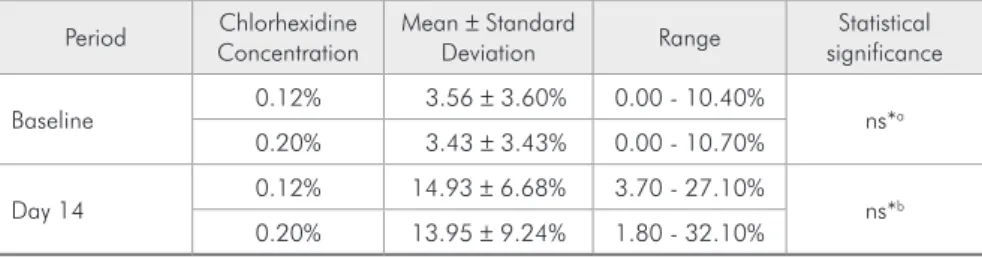
The results concerning the Gingival Bleeding In-dex are demonstrated in Table 2. At the beginning, both groups displayed around 3% of gingival bleed-ing. After 14 days, the group that rinsed with 0.12% chlorhexidine had a percentage of 14.93 (± 6.68) and the 0.20% group had 13.95% (± 9.24). These values were not statistically different. It should be noted that some individuals had up to 30% of bleeding sites.
The relation between both plaque index sys-tems and the Gingival Bleeding Index is shown in Graphs 1 and 2. For the Quigley & Hein index, the linear regression coeficients were R2 = 0.77 and R2 = 0.22 for the 0.12% and 0.20% groups respec-tively (Graph 1).
Index Chlorhexidine
Concentration
Mean ± Standard
Deviation Range
Statistical significance
Visible Plaque 0.12% 5.00 ± 0.05% 0.00 - 17% ns*a
0.20% 6.00 ± 0.07% 0.00 - 18%
Silness & Löe (Silness,
Löe,3 1964)
0.12% 0.12 ± 0.10 0.00 - 0.35
ns*b
0.20% 0.11 ± 0.11 0.00 - 0.28
Quigley & Hein
(Quigley, Hein,2 1962)
0.12% 0.25 ± 0.16 0.04 - 0.46
ns*c
0.20% 0.23 ± 0.26 0.00 - 0.67
ns*: Non-significant difference. (Wilcoxon: ns*a p = 0.7504; ns*b p = 0.7592; ns*c p = 0.4838). Table 1 - Mean values (± standard
deviation) of Plaque Indices, range and statistical significance at baseline (Visible plaque index) and after 14 days (Silness & Löe and Quigley & Hein) of two chlorhexidine concentration regimes.
Period Chlorhexidine
Concentration
Mean ± Standard
Deviation Range
Statistical significance
Baseline 0.12% 3.56 ± 3.60% 0.00 - 10.40% ns*a
0.20% 3.43 ± 3.43% 0.00 - 10.70%
Day 14 0.12% 14.93 ± 6.68% 3.70 - 27.10% ns*b
0.20% 13.95 ± 9.24% 1.80 - 32.10%
ns*: Non-significant difference (Wilcoxon: ns*a p = 1.000; ns*b p = 0.6784). Table 2 - Gingival Bleeding (GB)
When the Silness & Löe index was compared with the Gingival Bleeding Index, linear regression coeficients were R2 = 0.75 and R2 = 0.68 for the 0.12% and 0.20% chlorhexidine concentrations, re-spectively (Graph 2).
The results showed the relation between the Sil-ness & Löe index and the Gingival Bleeding Index in both concentrations. For the Quigley & Hein in-dex, a relation between plaque index and the Gingi-val Bleeding Index was observed for the 0.12% con-centration but not for the 0.2% concon-centration.
Discussion
The present study evaluated clinically two chlorhexidine concentration regimes as substitutes for mechanical plaque control. A randomized,
cross-over, double blind design was chosen in order to generate the best possible evidence. Calibration was not quantiied prior to or during the experiment since the clinical parameters evaluated are indica-tors of the moment, so it is not possible for them to be tested in these terms. Thus, a single trained examiner was responsible for assessments.
The study population comprised dental stu-dents, which is an interesting group for this kind of study,9,16 taking into consideration the fact that they have lower levels of gingival inlammation and can be easily controlled in terms of compliance. Baseline data indicate this and facilitate plaque accumulation experimental designs.
In terms of plaque accumulation, two studies did not ind differences between two chlorhexi-Graph 1 - Linear regression analysis between Gingival Bleeding and Quigley & Hein index for the 0.12% (A) and 0.20% (B) groups.
Quigley & Hein index 0.0
0 10 20 30 40
0.1 0.2 0.3 0.4 0.5
G
ingiv
al
B
leeding
(%)
A
Quigley & Hein index 0.0
–0.1 0.1 0.2 0.3 0.4 0.5 0.6 0.7 0
10 20 30 40
G
ingiv
al
B
leeding
(%)
B
Graph 2 - Linear regression analysis between Gingival Bleeding and Silness & Löe index for the 0.12% (A) and 0.20% (B) groups.
0 10 20 30 40
–0.1 0.0 0.1 0.2 0.3 0.4
G
ingiv
al
B
leeding
(%)
Silness & Loe index
A
0 10 20 30 40
0.0
–0.1 0.1 0.2 0.3
G
ingiv
al
B
leeding
(%)
Silness & Loe index
dine concentrations. Lang et al.14 (1982) observed mean Silness & Löe Plaque Indices of 1.24 and 1.29 following 6 months of use of 0.20% and 0.10% chlorhexidine rinses. When the Quigley & Hein In-dex is concerned, Segreto et al.17 (1986) demonstrat-ed mean indices of 1.01 for the 0.12% solution and 1.14 for the 0.2% solution after 3 months. The dif-ference in terms of plaque accumulation from these studies and the present may be due to the different timing of the experimental settings.
On the other hand, Jenkins et al.18 (1989), with an experimental design similar to ours, demonstrat-ed less plaque accumulation when the higher con-centration was tested. Ernst et al.19 (1998) also did not demonstrate statistically signiicant differences between 0.1% and 0.2% chlorhexidine rinses as ad-juncts to mechanical plaque control in a larger sam-ple of 130 subjects. The same result was obtained by Asari et al.20 (1996) when these two chlorhexidine concentrations were used as subgingival irrigators.
A point that should not be overlooked is the sample size of the present study. Studies with similar aims have been published with sample sizes similar to that of this study.16,21
In our study, no signiicant differences were ob-served in terms of gingival bleeding after 14 days. However, gingivitis was observed in 14.93% and 13.95% of sites in users of the 0.12% and 0.20% chlorhexidine solutions, demonstrating an establish-ment of inlammation. Jenkins et al.18 (1989) also observed some degree of gingival bleeding after con-trolled-force probing (8.86% and 10.95% for the 0.10% chlorhexidine solution and 6.0% and 6.29% for the 0.12% solution after 12 and 19 days, re-spectively). The study by Siegrist et al.22 (1986) also showed an increase in the Gingival Index from day 7 to 21 (6.2% to 13%).
The subjects with a higher plaque index at
base-line were the ones with the larger amount of bleed-ing sites. The relation observed between plaque in-dices and gingival inlammation conirms this fact, previously demonstrated by Siegrist et al.22 (1986) and Brecx et al.23 (1992).
A bacterial succession during the 14-day period could explain the results, leading to inlammation even with low plaque scores. Also, it has been pos-tulated that chemical agents would be superior to mechanical means especially in dificult-to-reach ar-eas, but this is not totally supported by the results of this study, since baseline bleeding scores (obtained by mechanical means solely) were lower than after 14 days of chemical plaque control.
The results of this study may contribute to clini-cal practice in two ways. First, demonstrating that mechanical plaque control is still the gold standard for patients that have the capacity of performing it, since some plaque accumulation and gingival inlammation occurred after 14 days of chemical plaque control. Second, that lower concentrations of chlorhexidine should be prescribed, diminishing adverse effects, since higher concentrations do not seem to generate lower plaque and gingivitis scores. However, it should be noted that the amounts of rinsing solution should be observed (as in the pres-ent study) in order to guarantee similar chlorhexi-dine amounts in the oral cavity.
Conclusions
No differences were observed in terms of anti-plaque eficacy between the 0.12% and 0.20% chlorhexidine rinsing solutions. Chlorhexidine rins-ing keeps plaque levels low, but allows some degree of gingival inlammation after 14 days.
Acknowledgments
We thank the volunteers for their dedication.
References
1. van der Weijden GA, Timmerman MF, Nijboer A, Reijerse E, Van der Velden U. Comparison of different approaches to assess bleeding on probing as indicators of gingivitis. J Clin Periodontol. 1994;21(9):589-94.
4. Beltrami M, Bickel M, Baehni PC. The effect of supragingival plaque control on the composition of the subgingival microflo-ra in human periodontitis. J Clin Periodontol. 1987;14(3):161-4.
5. Bral M, Brownstein CN. Antimicrobial agents in the preven-tion and treatment of periodontal diseases. Dent Clin North Am. 1988;32(2):217-41.
6. Hase JC, Attstrom R, Edwardsson S, Kelty E, Kisch J. 6-month use of 0.2% delmopinol hydrochloride in comparison with 0.2% chlorhexidine digluconate and placebo. (I). Ef-fect on plaque formation and gingivitis. J Clin Periodontol. 1998;25(9):746-53.
7. Keijser JA, Verkade H, Timmerman MF, van der Weijden FA. Comparison of 2 commercially available chlorhexidine mouthrinses. J Periodontol. 2003;74(2):214-8.
8. Lang NP, Brecx MC. Chlorhexidine digluconate - an agent for chemical plaque control and prevention of gingival inflamma-tion. J Periodontal Res. 1986;21(16):74-89.
9. Lorenz K, Bruhn G, Heumann C, Netuschil L, Brecx M, Hoffmann T. Effect of two new chlorhexidine mouthrinses on the development of dental plaque, gingivitis, and discoloura-tion. A randomized, investigator-blind, placebo-controlled, 3-week experimental gingivitis study. J Clin Periodontol. 2006;33(8):561-7
10. van Strydonck DA, Demoor P, Timmerman MF, van der Velden U, van der Weijden GA. The anti-plaque efficacy of a chlorhex-idine mouthrinse used in combination with toothbrushing with dentifrice. J Clin Periodontol. 2004;31(8):691-5.
11. Rolla G, Löe H, Schiott CR. Retention of chlorhexidine in the human oral cavity. Arch Oral Biol. 1971;16(9):1109-16. 12. Rye RM, Wiseman D. Effect of chlorhexidine upon 32P release
and cell viability in Escherichia coli. J Pharm Pharmacol. 1966;18(S):114-8.
13. Bay LM. Effect of toothbrushing with different concentra-tions of chlorhexidine on the development of dental plaque and gingivitis. J Dent Res. 1978;57(2):181-5.
14. Lang NP, Hotz P, Graf H, Geering AH, Saxer UP, Sturzenber-ger OP et al. Effects of supervised chlorhexidine mouthrinses in children. A longitudinal clinical trial. J Periodontal Res. 1982;17(1):101-11.
15. Ainamo J, Bay I. Problems and proposals for recording gin-givitis and plaque. Int Dent J. 1975;25(4):229-35.
16. Quirynen M, Avontroodt P, Peeters W, Pauwels M, Coucke W, van Steenberghe D. Effect of different chlorhexidine for-mulations in mouthrinses on de novo plaque formation. J Clin Periodontol. 2001;28(12):1127-36.
17. Segreto VA, Collins EM, Beiswanger BB, de la Rosa M, Issacs RL, Lang NR et al. A comparison of mouthrinses contain-ing two concentrations of chlorhexidine. J Periodontal Res. 1986;21(16):23-32.
18. Jenkins S, Addy M, Newcombe R. Comparison of two com-mercially available chlorhexidine mouthrinses: II. Effects on plaque reformation, gingivitis, and tooth staining. Clin Prev Dent. 1989;11(6):12-6.
19. Ernst CP, Prockl K, Willershausen B. The effectiveness and side effects of 0.1% and 0.2% chlorhexidine mouthrinses: a clinical study. Quintessence Int. 1998;29(7):443-8.
20. Asari AM, Newman HN, Wilson M, Bulman JS. 0.1%/0.2% commercial chlorhexidine solutions as subgingival irrigants in chronic periodontitis. J Clin Periodontol. 1996;23(4):320-5. 21. Sekino S, Ramberg P, Uzel NG, Socransky S, Lindhe J. Effect
of various chlorhexidine regimens on salivary bacteria and de novo plaque formation. J Clin Periodontol. 2003;30(10):919-25.
22. Siegrist BE, Gusberti FA, Brecx MC, Weber HP, Lang NP. Efficacy of supervised rinsing with chlorhexidine digluconate in comparison to phenolic plant alkaloid compounds. J Peri-odontal Res. 1986;21(16):60-73.