*Correspondence: J. Mancini-Filho. Departamento de Alimentos e Nutrição Experimental, Faculdade de Ciências Farmacêuticas – USP. Av. Prof. Lineu Prestes, n.580 – 05508-000 – São Paulo – Brasil. E-mail: [email protected]
A
vol. 48, n. 1, jan./mar., 2012
Inhibition of LDL-oxidation and antioxidant properties related to
polyphenol content of hydrophilic fractions from seaweed
Halimeda Incrassata
(Ellis) Lamouroux
Ariana Costa-Mugica
1, Ana Elsa Batista- Gonzalez
1, Diadelis Mondejar
1, Yosdel Soto-López
2, Victor
Brito-Navarro
2, Ana Maria Vázquez
2, Dieter Brömme
3, Claudina Zaldívar-Muñoz
1, Alexis
Vidal-Novoa
1, Ana Mara de Oliveira e Silva
4, Jorge Mancini-Filho
4*1Department of Biochemistry, Faculty of Biology, University of Havana, Cuba, 2Center for Molecular Immunology, Havana City, Cuba, 3Department of Oral Biological and Medical Sciences, Faculty of Dentistry, University of British Columbia, Canada,
4Department of Food and Experimental Nutrition, Faculty of Pharmaceutical Sciences, University of Sao Paulo, Brazil
LDL oxidation and oxidative stress are closely related to atherosclerosis. Therefore, natural antioxidants have been studied as promising candidates. In the present study, the LDL oxidation inhibition activity of bioactive compounds from Halimeda incrassata seaweed. associated to antioxidant capacity, was evaluated in vitro. Experimental work was conducted with lyophilized aqueous extract and phenolic-rich fractions of the seaweed and their effect on LDL oxidation was evaluated using heparin-precipitated LDL (hep-LDL) with exposure to Cu2+ ions and AAPH as the free radical generator. H. incrassata had a
protective effect for hep-LDL in both systems and the presence of phenolic compounds contributed to the activity where phenolic-rich fractions showed signiicant capacity for inhibition of oxidation mediated by Cu2+ ions. The observed effect could be related to the antioxidant potential of polar fractions evidenced
by reducing activity and DPPH• radical scavenging. The results obtained in vitro further support the antioxidant and LDL oxidation inhibition properties of H. incrassata and further knowledge toward future phytotherapeutic application of the seaweed.
Uniterms:Halimeda incrassata/antioxidant properties. Antioxidants. Polyphenols. Lipoproteins/ oxidation inhibition.
A oxidação da LDL e o estresse oxidativo estão intimamente relacionados com a aterosclerose. Por isso, os antioxidantes naturais têm sido estudados como candidatos promissores. No presente trabalho foi avaliada in vitro a capacidade de inibição da oxidação da LDL pelos compostos bioativos da alga
Halimeda incrassata em associação à capacidade antioxidante. O trabalho experimental foi conduzido com extratos polares (extrato aquoso lioilizado e frações ricas em fenólicos) e seu efeito na oxidação da LDL foi avaliado usando LDL precipitada com heparina (hep-LDL), oxidada com íons de Cu2+ e
AAPH, como geradores de radicais livres. A H. incrassata apresentou efeito protetor para hep-LDL em ambos sistemas e a presença de compostos fenólicos contribuiu para a atividade em que as frações ricas em fenólicos demonstram capacidade signiicativa em inibir a oxidação mediada pelos íons de Cu2+. O
efeito observado deve estar relacionado com o potencial antioxidante das frações polares medido pela atividade redutora e varredura do radical DPPH. Os resultados obtidos demonstram as propriedades antioxidantes e de inibição da oxidação da LDL da H. incrassata e podem contribuir para as evidências de futuras aplicações itoterapêuticas desta alga.
INTRODUCTION
Atherosclerosis is a complex multifactorial disease characterized by modiication and oxidation of lipopro -teins that, together with a chronic inlammatory response in the artery wall, leads to atherosclerotic lesions (Fernán-dez-Britto, 1998). LDL oxidation and oxidative stress are closely related to atherosclerosis. Therefore, natural antioxidants have been studied as promising candidates (Vogiatzi et al., 2009; Kaliora et al., 2006).
Oxidative modiications have been shown to be in -volved in all stages of atherosclerosis progression so anti-oxidants from natural sources are of interest in the quest for antiatherogenic activity. In this respect, edible seaweeds are an excellent source of antioxidants that have been evaluated for cardiovascular health and for their beneicial properties (Jimenez-Escrig et al., 2001; Bocanegra et al., 2009).
Seaweed extracts are presently regarded as an at-tractive source of natural antioxidants as they have highly developed antioxidant defence systems that have provided evolutionary advantage for sea survive in stressful envi-ronmental conditions. Their wide array of antioxidants such as mycosporine-derived aminoacids, polysaccharides, carotenoids, terpenoids and phenolic compounds could be beneicial for human health (Jiménez-Escrig et al., 2001; Kang et al., 2003). Indeed, decreased mortality from car-diovascular diseases in Asian populations could be linked to seaweed consumption (Bocanegra et al., 2009).
It has been shown in previous studies that H. incras-sata has a high phenolic content (Vidal et al., 2011), together with low amounts of other antioxidants such as ascorbate, β-carotene, chlorophylls and selenium. The quantity of hy -drophilic phenolics found in this seaweed lies in the same range as other seaweeds reported in the literature and also studied by our group (Jiménez-Escrig et al., 2001; Yoshie et al., 2002; Vidal et al., 2001). The cardioprotective properties of phenolic compounds from different food types have been described by several authors (Kaliora et al., 2006; Aviram et al., 2008) with particular interest in the unique antioxidant combination found in marine algae that is not found in ter-restrial plants (Kang et al., 2003; Chan et al., 2006).
In the present study, the capacity of H. incrassata
for the inhibition of LDL oxidation owing to its phenolic content and antioxidant activity was evaluated in vitro.
MATERIAL AND METHODS
Seaweed collection and hydrophilic extract preparation
The seaweed Halimeda incrassata (Ellis)
Lamour-oux was collected in December/2010 in the Bajo de Santa Ana, Havana City coast, Cuba. Voucher specimens were authenticated at the Seaweeds Laboratory of the Marine Research Center of the University of Havana. Freshly collected specimens were washed with distilled water and dried at room temperature for seven days. An analytical mill and a sieve with a 32 mesh were used for milling and sieving, respectively. The dry powder was used to obtain polar extracts. Dry seaweed powder was extracted with distilled water (1:5 w/v) for 1 hour under agitation at room temperature and then centrifuged at 800 g and 4 ºC for 20 minutes. Supernatant was recovered, lyophilized and kept at -20 ºC until use. Weight yield of the inal extract in terms of dry seaweed was 6%. The lyophilized material was dissolved in distilled water at a known concentration for the study.
Polyphenolic rich fractions were obtained according to Krygier et al., (1982). Free phenolic acids (FPA) were extracted six times, each into 20 mL of tetrahydrofurane (THF), using a separatory funnel. The combined extract was then evaporated to dryness under vacuum at room temperature. With the residue of the previous extraction, and through extractions with methanol:acetone:water, the aqueous solution and residue were obtained. The aqueous solution was neutralized and residue dissolved in 20 mL of 2 M NaOH and hydrolyzed for 4 h at room temperature under a stream of nitrogen. After acidiication to pH 2 (us -ing 6 M HCl), phenolic acids liberated from esters were extracted ive times, each into 20 mL of tetrahydrofurane: ethylether:ethyl acetate, using a separatory funnel. The combined extracts were then evaporated to dryness. The dry residues of of soluble esters of phenolic acids (SEPA) and of insoluble esters of phenolic acids (IEPA) were obtained and dissolved separately in 5 mL of methanol.
Total phenolic concentration
Total phenolic content was determined by the Folin-Ciocalteau assay (Quettier-Deleu et al., 2000) and expressed as µg of gallic acid equivalents (GAE) /gram of sample. The calibration curve was obtained in the range of 100 - 1000 µg gallic acid /mL.
Reducing power
centrifugation was done at 800 g for 10 minutes. 2.5 mL aliquots were taken from the upper layer and 0.5 mL of 0.1% FeCl3 with 2.5 mL distilled water were added for the inal reaction. Absorbance was read at 720 nm on a Ray -leigh VIS-723G device against a water blank. Increments in absorbance were considered as increases in reducing power.
DPPH• radical scavenging assay
Free radical scavenging activity of H. incrassata
extract was examined by the DPPH• assay. DPPH• radical absorbance capacity of H. incrassata polyphenol-rich frac-tions was tested according to Goupy et al. (1999). A 0.6 mL volume of the extract (10 - 40 μg GAE) was mixed with 0.6 mL of methanolic solution of DPPH• (60 μM). After 30 minutes, absorbance was measured at 517 nm against a sample without antioxidant. Radical scavenging activity was calculated relative to reference absorption as Percent-age Inhibition (PI) (%) = [1-Asample/Asample without antioxidant] × 100. Results were given as % antioxidant activity and 50% inhibitory concentration (IC50).
In vitro inhibition of LDL oxidation in cell-free
system
Oxidation experiments were conducted with hep-arin-precipitated LDL (hep-LDL), a model of LDL that has interacted with extracellular matrix and is therefore more prone to oxidation (Upritchard, Sutherland, 1999). Lipoproteins were isolated from normolipemic human serum by the method of Wieland (1983). A 5 mL volume of sodium citrate buffer (64 mmol/L, pH 5.12) containing heparin (50 000 UI/L) was added to 0.5 mL serum. After incubating for 10 minutes at room temperature, the sample was centrifuged at 800 g for 15 minutes. Hep-LDL precipi-tate was washed 3 times with Hepes buffer (5 mM Hepes, 20 mM NaCl, 4 mM CaCl2 and 2 mM MgCl2, pH 7.2), by centrifuging at 800 g for 15 minutes, hep-LDL was next dissolved in 0.5 mL phosphate buffer, pH 7.4, with NaCl 4 %. The Hep-LDL fraction was then divided into aliquots and kept at 4 ºC. Cholesterol content was determined by enzymatic assay (Boehringer Mannhein Diagnostics) and protein content by the Lowry method (1951).
To evaluate the action of the extracts against LDL oxidation and determine the contribution of the bioactive compounds present in it, experiments were irst done with the lyophilized aqueous extract, a more crude extract con-taining algae component.
The hep-LDL oxidation assay was done using LDL (0.2 μmol cholesterol) diluted in phosphate buffer and
incubated in the presence or absence of H. incrassata
lyophilized aqueous extract for 6 hours at 37 oC with
10 μM Cu2+ or 20 mM AAPH. Inhibitory activity against
lipoperoxidation of the phenolic-rich FPA, SEPA and IEPA fractions was evaluated based on Cu2+ mediated hep-LDL
oxidation. The oxidation was determined by thiobarbituric reactive substances (TBARS) as described in Frostegard
et al. (1990) and expressed as nmoles MDA equivalents/ mg protein, using tetramethoxypropane (TMP) as the standard. Results are expressed as percentage of inhibition of lipoperoxidation.
RESULTS
Phenolic content of hydrophilic fractions of H.
incrassate
Phenolic content in aqueous extract and fractions FPA, SEPA and IEPA of H.incrassata are shown in Table I.
Reducing power of polar fractions of H. incrassata
There was an increment in reducing power with increasing phenolic content of the polar extracts with values of absorbance - OD of around 0.16 at 30 μg GAE and highest absorbance (nearly 1.2) reached at 360 µg GAE (Figure 1).
DPPH• radical scavenging capacity of polar
fractions
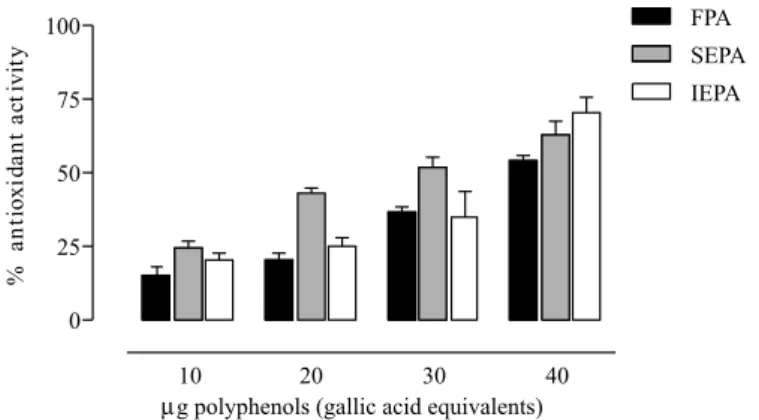
The polar fractions had concentration-dependent free radical scavenging activity in the DPPH• assay with more than 50% inhibition at a concentration of 40 µg polyphenols (Figure 2).
TABLE I - Phenolic content (µg total phenolics/g dry seaweed)
in polar fractions obtained from seaweed Halimeda incrassata.
Fraction µg GAE/g dry seaweed
FPA 14.16 ± 0.92
SEPA 9.91 ± 0.81
IEPA 11.06 ± 4.2
aqueous extract 130.98 ± 8.04
In vitro inhibition of LDL oxidation in cell-free system
Inhibition of LDL oxidation was dose-dependent for both Cu2+ ions and AAPH mediated oxidation on addition
of H. incrassata lyophilized aqueous extract (0.6 - 10 mg/ mL) as indicated in Figure 3.
Similarly, the mean inhibitory concentration (IC50) for n-LDL (native LDL) and hep-LDL oxidation mediated by Cu2+ and AAPH is shown in Table II.
The three polar fractions rich in phenolic compounds (FPA, SEPA and IEPA) were also active against hep-LDL oxidation mediated by Cu2+ ions with more than 50%
inhi-FIGURE 1 - Reducing capacity of polar fractions of Halimeda incrassata. Reducing power of the polar fractions was evaluated at concentrations of 10 - 360 µg polyphenols and the assay was
performed according to Oyaizu et al., (1986). Values expressed
as mean ± s.d. (n=3).
FIGURE 2 - DPPH• radical scavenging activity of polar fractions of Halimeda incrassata seaweed. The assay was performed
as described by Goupy et al., 1999. Results were given as %
antioxidant activity and 50 % inhibitory concentration (IC50).
Values represent mean ± s.d. (n=3).
FIGURE 3 - Dose-response curves of the aqueous extract
of Halimeda incrassata on inhibition of lipoperoxidation in
hep-LDL oxidation mediated by Cu2+ 10 µM (A) or AAPH
20 mM (B). H. incrassata concentration is expressed in
log concentration of aqueous extract (1 mg lyophilized is equivalent to 0.02 g dry seaweed containing 2.183 ± 0.134 µg GAE/mg lyophilized aqueous extract. Values represent mean ± s.d. (n=3).
TABLE II - Effect of Halimeda incrassata on LDL oxidation in cell free systems.
50 % mean inhibitory concentration (IC50) of H. incrassata(mg/mL)
Cell-free systems Cu 2+ AAPH
Hep-LDL 3. 747 ± 0.106 1.222 ± 0.1196
n-LDL 0.875 ± 0.0962 0.161 ± 0.014
bition of TBARS formation at 20 µg polyphenols (Figure 4) indicating that phenolic compounds are relevant in pro-tection against lipoperoxidation exerted by H. incrassata.
DISCUSSION
Phenolic content has been correlated to the antioxi-dant capacity of several seaweed extracts (Jiménez-Escrig
et al., 2001; Senevirathne et al., 2006). Values of phenolic contents of H. incrassata obtained were 9.99-14.1 and 131 µg GAE/g dry seaweeds for phenolic rich fractions and aqueous extract, respectively. The values for these frac-tions proved higher than those reported for others varieties of seaweeds, but are consistent with the levels found in
F.vesiculosus and B.triquetrum (Jiménez-Escrig et al., 2001; Vidal et al., 2001). It had been previously reported that FPA, SEPA and IEPA fractions and aqueous extract from
H.incrassata were rich in phenolic acids (Vidal et al., 2011). The relevance of hydrophilic phenolics was also emphasized by other authors (Senevirathne et al., 2006) who showed that reducing capacity and DPPH• scaveng-ing increased with solvent polarity and phenolic content in seven fractions of the seaweed E. cava. In the present study, a dose-dependent reducing activity and DPPH• scavenging (Figures 1 and 2) was obtained with increas-ing phenolic content for the evaluated polar extracts (r2 = 0.69 for reducing power and r2 = 0.77 for DPPH•
radical scavenging).
Likewise, a similar reducing activity was obtained by Cho et al. (2007) with the seaweed S. siliquastrum
which had an absorbance of 0.8 at a lower phenolic content than the phenolic rich-fractions of our study (240 μg EAG vs 360 µg EAG).
FIGURE 4 - Inhibitory activity of phenolic-rich polar fractions
in hep-LDL oxidation mediated by Cu2+done according to
Frostegard et al. (1990). Oxidation was conducted in the
presence of the fractions FPA, SEPA and IEPA from seaweed
Halimeda incrassata and evaluated by TBARS formation. Values expressed as mean ± s.d.
Interestingly, both for reducing capacity and DPPH• radical scavenging (IC50= 29.42 to 39.17 versus 0.75 µg polyphenols, respectively) there was a higher activity for the aqueous extract than for the phenolic-rich fractions showing that other antioxidant components present in
H. incrassata could have a synergic action with phenolic compounds.
In vitro inhibition of LDL oxidation was evaluated. The assays were done with heparin precipitated LDL, with Cu2+ ions and AAPH used as oxidants to model transition
metal or free radical mediated oxidation respectively. In LDL oxidation experiments (Figures 3 and 4) there was a more advanced degree of oxidation in the presence of Cu2+ than for AAPH as the oxidant (causing formation of
28.4 nmol MDA/mg protein versus 14.5 nmol MDA/mg protein as oxidation products respectively). Indeed oxi-dation mediated by Cu2+ is considered a more aggressive
system that transits through Cu2+ binding, causing
continu-ous free radical formation with reduction of lipoprotein antioxidants; whereas oxidation by AAPH is a simpler model that ignores the inluence of transition metals (Pin -chuk and Lichtenberg, 2002). Accordingly, the aqueous extract had inhibitory action in both, where attaining a protective effect required higher doses for transition metal-mediated oxidation compared with free radical oxidation (IC50 = 3.747 versus 1.222 mg/mL).
Also, it should be noted that, in comparison to our previous studies on native LDL oxidation, higher doses of aqueous extract were required to protect hep-LDL consis-tent with their higher susceptibility to oxidation compared to n-LDL (IC50 = 0.875 and 0.161 for Cu2+ and AAPH as
inductor, respectively).
The effect of H. incrassata can be compared to that found for other extracts in the literature with 0.5-1 mg/mL needed to inhibit Cu2+ ion-mediated LDL oxidation in
the case of P.quinquefolium, a ginseng variant (Li et al., 1999) and 0.2 mg/mL causing 18.7 % inhibition of TBARs formation for VNP, a commercial product prepared from a mixture of several brown seaweeds (Kang et al., 2003).
The inluence of seaweed phenolics on inhibition of lipoprotein oxidation was evaluated (Figure 4). The Cu2+ ions-induced hep-LDL oxidation inhibition activity
found (100% for 40µg of polyphenols) for the fractions (FPA, SEPA and IEPA) supports the protective effect of the seaweed and indicates that phenolic compounds of H. incrassata contribute to the inhibition of LDL oxidation.
In this study, a positive correlation was conirmed between DPPH• radical scavenging and inhibition of LDL oxidation for phenolic rich fractions (r2 = 0.92 for
lipoperoxida-tion mediated by the seaweed. Our group has previously highlighted the relevance of free radical scavenging for antilipid peroxidative activity (Rivero et al., 2003).
Other authors have studied the action of natural phenolic compounds in the inhibition of LDL oxidation. Aviram et al. (2008), studying antiatherogenic properties of pomegranate juice, found that signiicant inhibition of TBARs formation during LDL oxidation was achieved at 0.5 μg GAE. In another study on the antiatherogenic properties of olive oil polyphenols Rosenblat et al. (2007)
found 80 % inhibition of oxidation at 1.2 μg GAE for olive oil, whereas when enriched with tea polyphenols the ef-fect obtained was enhanced, correlating with an increase in phenolic content.
CONCLUSIONS
The results of this study indicated that H. incras-sata polar extracts have properties for inhibition of LDL oxidation that could be related to high antioxidant activ-ity evaluated as reducing capacactiv-ity and scavenging of free radicals. Seaweed phenolic compounds could be the main components involved in the antioxidant and antilipid per-oxidative action, although small quantities of other anti-oxidants present could have a synergic effect and enhance LDL oxidation inhibition activity. Additionally, these results represent a further step toward its application as a phytotherapeutic for oxidative stress-related conditions.
ACKNOWLEDGEMENTS
The research was funded by IFS grant F/4897-1. Par -tial funding was also provided by CIHR grant MOP24447, the Canadian Research Chair award (D.B.), a personal grant from GSEP, offered by the Canadian Bureau for International Education (A.C) and CNPq- (Brasil).
REFERENCES
AVIRAM, M.; VOLKOVA, N.; COLEMAN, R.; DREHER, M.; REDDY, M.K.; FERREIRA, D.; ROSENBLAT, M. Pomegranate phenolics from the peels, arils, and lowers
are antiatherogenic: studies in vivo in atherosclerotic
apolipoprotein e-deicient (e0) mice and in vitro in cultured
macrophages and lipoproteins. J. Agric. Food Chem., v.56,
n.3, p.1148-1157, 2008.
BOCANEGRA, A.; BASTIDA, S.; BENEDI, J.; RODENAS, S.; SANCHEZ, F.J. Characteristics and nutritional and
cardiovascular-health properties of seaweeds. J. Med. Food,
v.12, n.2, p.236-258, 2009.
CHAN, C.-X.; HO, C-L.; PHANG, S.-M. Trends in seaweed
research. Trends Plant Sci., v.11, n.4, p.165-166, 2006.
CHO, S.; KANG, S.; CHO, J.; CHO, A.; KIM, S.; PARK, Y.K.; HONG; AHN, D.H. The antioxidant properties of brown
seaweed (Sargassum Siliquastrum) extracts. J. Med. Food.,
v.10, n.3, p.479-485, 2007.
FERNANDEZ-BRITTO, J.E. La lesión aterosclerótica: estado
del arte a las puertas del siglo XXI. Rev. Cub. Invest.
Biomed., v.17, n.2, p.112-127, 1998.
FROSTEGARD, J.; NILSSON, J.; HAEGERSTRAND, A.; HAMSTEN, A.; WIGZELL, H.; GIDLUND, M. Oxidized low density lipoprotein induces differentation and adhesion of human monocytes and the monocytic cell line U937.
PNAS., v.87, n.3, p.904-908, 1990.
GOUPY, P.; HUGHES, M.; BOIVIN, P.; AMIOT, M.J. Antioxidant composition and activity of barley (Hordeum vulgare) and malt extracts and of isolated phenolic
compounds. J. Sci. Food Agric., v.79, n.12, p.1625-1634,
1999.
JIMENEZ-ESCRIG, A.; JIMENEZ-JIMENEZ, I.; PULIDO, R.; SAURA-CALIXTO, J. Antioxidant activity of fresh
and processed edible seaweeds. J. Sci. Food Agric., v.81,
n.5, p.530-534, 2001.
KALIORA, A.C.; DEDOUSSIS, G.V.Z.; SCHMIDT, H. Dietary
antioxidants in preventing atherogenesis. Atherosclerosis.,
v.187, n.1, p.1-17, 2006.
KANG, K.; PARK, Y.; HWANG, H.J.; KIM, S.H.; LEE, J.G.; SHIN, H.C. Antioxidative properties of brown algae polyphenolics and their perspectives as chemopreventive agents against vascular risk factors. Arch. Pharm. Res., v.26, n.4, p.286-293, 2003.
KRYGIER, K.; SOSULSKI, F.; HOGGE, L. Free, esteriied, and insoluble-bound phenolic acids. 1. Extraction and puriication procedure. J. Agric. Food Chem., v.30, n.2, p.330-334, 1982.
LI, J.; HUANG, M.; TEOH, H.; MAN, R.Y.K. Panax
quinquefolium saponins protects low density lipoproteins from oxidation. Life Sci., v.64, n.1, p.53-62, 1999.
L O W RY, O . H . ; R O S E B R O U G H , N . J . ; FA R R , A . L . ; RANDALL, R.J. Protein measurement with the folin phenol
OYAIZU, M. Studies on product of browning reaction prepared
from glucose amine. Jpn. J. Nutr., v.44, n.6, p.307-315,
1986.
PINCHUK, I.; LICHTENBERG, D. The mechanism of action of antioxidants against lipoprotein peroxidation, evaluation
based on kinetic experiments. Prog. Lip. Res., v.41, n.4,
p.279-314, 2002.
QUETTIER-DELEU, C.; GRESSIER, B.; VASSEUR, J.; DINE, T.; BRUNET, C.; LUYCKX, M.; CAZIN, M.; CAZIN, J-C.; BAILLEUL, F.; TROTIN, F. Phenolic compounds and antioxidant activities of buckwheat (Fagopyrum esculentum Moench) hulls and lour. J Ethnopharmacol., v.72, n.1-2,
p.35-42, 2000.
RIVERO, F.; FALLARERO, A.; CASTAÑEDA, O.; DAJAS, F.; MANTA, E.; ARECES, F.; MANCINI FILHO, J.; VIDAL,
A. Antioxidant activity in vivo and in vitro of Halimeda
incrassata aqueous extracts. Cienc. Tecnol. Aliment. Campinas., v.23, n.2, p.256-263, 2003.
ROSENBLAT, M.; VOLKOVAA, N.; COLEMANB, R.; ALMAGORC, Y.; AVIRAM, M. Antiatherogenicity of extra virgin olive oil and its enrichment with green tea polyphenols in the atherosclerotic apolipoprotein-E-deicient mice: enhanced macrophage cholesterol eflux.
J. Nutr. Biochem., v.19, n.8, p.514-523, 2008.
SENEVIRATHNE, M.; KIM, S.; SIRIWARDHANA, N.; HA,
J.; LEE, K.; JEON, Y. Antioxidant potential of Ecklonia
cava on reactive oxygen species scavenging, metal
quelating, reducing power and lipid peroxidation inhibition.
Food Sci. Tech. Int.,v.12, n.1, p.27-38, 2006.
UPRITCHARD, J.E.; SUTHERLAND, W.H.F. Oxidation of heparin-treated low density lipoprotein by peroxidases.
Atherosclerosis., v.146, n.2, p.211-219, 1999.
VIDAL, A.; MOTIDOME, M.; MANCINI-FILHO, J.; FALLARERO, A.; MIDORE TANAE, M.; BRANDAO TORRES, L.M.; LAPA, A.J. Antioxidant activity related to phenolic acidics in the aqueous extract of the marine
seaweed Bryothamnion triquetrum (S.G.Gmelim) Howe.
Braz. J. Pharm. Sci., v.37, n.3, p.373-382, 2001.
VIDAL, A.A; ANDRADE-WARTHA, E.R.S.; FALLARERO, A.; SILVA, A.M.O.; VUORELA, P.; MANCINI-FILHO, J. Antioxidant activity and bioactive components from the
seaweed Halimeda incrassata (Ellis) Lamouroux. Braz. J.
Pharmacogn., v.21, n.1, p.53-57, 2011.
VOGIATZI, G.; TOUSOULIS, D.; STEFANADIS, C. The role of oxidative stress in atherosclerosis. Hellenic J. Cardiol., v.50, n.5, p.402-409, 2009.
YOSHIE, Y.; WANG, W.; HSIEH, Y.P.; SUZUKI, T. Compositional difference of phenolic compounds between
two seaweeds, Halimeda spp. J. Tokyo Univ. Fish., v.88,
p.21-24, 2002.
Received for publication on 29th July 2011