A vol. 49, special issue, 2013
Javier Rojo received a BSc in Organic Chemistry in 1989, MSc degree in 1990 at the Autónoma University (UAM), Madrid (Spain). Then, he was embarked in the doctoral program to obtain a PhD degree under the supervision of Prof. Juan Carlos Carretero at UAM in 1995. He was a postdoctoral fellow with Prof. Jean-Marie Lehn at the University Louis Pasteur in Strasbourg (France) (1995-1998) and with Prof. Larry W. McLaughlin at Boston College in USA (1998-1999). In January 2000, he joined the Carbohydrate Group at the Institute of Chemical Research of the Spanish National Research Council (CSIC) in Seville as an associate researcher. In 2001 he was awarded a “Ramón y Cajal” contract and in 2004 he got a permanent position at the CSIC in Seville as Tenured Scientist. In 2011 he was promoted to Senior Research Scientist. Since April 2012, Javier Rojo is the National Coordinator of Science and Chemical Technology Area of the
CSIC. His present research interests are in the ield of dendrimers,
supramolecular chemistry and carbohydrate molecular recognition. In particular, he is focused on the development of multivalent carbohydrate tools, mainly glycodendrimers, to understand and intervene in those biological processes related with pathogen infection and immunity.
José Juan Reina received a BSc in Organic Chemistry in 2001 and a MSc degree in 2003 at the University of Málaga (UMA), Málaga (Spain). Then, he was embarked in the doctoral program to obtain a PhD degree under the supervision of Dr. Javier Rojo at University of Seville - CSIC in 2008. He was a postdoctoral fellow with Prof. Anna Bernardi at the University of Milan (Italy) (2009-2012). During this period he was awarded with the prestigious Marie Curie Intra-European Fellowship (2009). In January 2013, he joined the Glycosystems Laboratory at the Institute of Chemical Research of the Spanish National Research Council (CSIC) in Seville as a JAE-Doc researcher. His present research interests are in the
ield of multivalent systems, carbohydrate molecular recognition
and design of glycomimetics. In particular, he is focused on the development of multivalent carbohydrates mimetics tools to mimic the role of natural oligosaccharides in biological processes related with pathogen infection and immunity.
*Correspondence: Javier Rojo. Glycosystems Laboratory, Instituto de Investigaciones Químicas (IIQ) CSIC, Universi-dad de Sevilla, Americo Vespucio, 49 - 41092 Sevilla, Spain. E-mail: [email protected]
Glycodendritic structures: tools to
interact with DC-SIGN
Jose J. Reina, Javier Rojo
*Glycosystems Laboratory, Institute of Chemical Research (IIQ), CSIC - Univesity of Seville, Seville, Spain
The key role of carbohydrates in many biological events has attracted the interest of
the scientiic community. This fact has demanded the access to new tools necessary to understand this role and the interaction of carbohydrates with their corresponding receptors,
lectins. Glycodendrimers and glycodendritic structures in general, have demonstrated to
be very eficient and interesting tools to intervene in those processes where carbohydrates participate. In this review, we discuss the different glycodendritic structures that have been used to interfere with DC-SIGN, a very attractive lectin involved in infection processes
and in the regulation of the immune response.
Uniterms: DC-SIGN. Ebola. Glycodendrimers. Glycofullerenes. HIV. Mannose.
O papel chave dos carboidratos em muitos eventos biológicos tem atraído interesse
da comunidade cientíica. Este fato demonstrou o acesso de novas ferramentas para a
compreensão da interação dos carboidratos com seus receptores correspondentes, lectinas. Glicodendrímeros e estruturas glicodendríticas, em geral, mostram-se como ferramentas
muito eicientes e interessantes para intervir nos processos em que os carboidratos participam. Nesta revisão, discutimos diferentes estruturas glicodendríticas que têm sido úteis para interferir com DC-SIGN, uma lectina muito atraente envolvida em processos
infecciosos e na regulação da resposta imune.
Unitermos: DC-SIGN. Ebola. Glicodendrímeros. Glicofulerenos. HIV. Manose.
INTRODUCTION
Glycans are not only an important source of metabolic energy; they
are also widely expressed as glycoconjugates on the surface of cells where
they play a key role in many important biological processes (Varki, 1993; Kamerling 2007; Werz, Seeberger, 2007). In the past decade, the increased appreciation for the ubiquity of glycans and their ability to encode
bio-chemical information has given rise to the ield of glycobiology (Varki, 1999; Bertozzi, Kiessling, 2001) with the aim to explain and understand how chemical information is encode in sugar structures and how this infor -mation is read out by sugar binding proteins (lectins) (Gabius et al., 2011; Gupta, Surolia, 2012). Lectins are proteins that recognize glycans
(glyco-lipids and glycoproteins) with high speciicity, and this carbohydrate-lectin
interaction is implicated in several important biological events such as
immuno-modulation and inlammation, host-pathogen interactions,
glycoprotein folding and routing, mitogenic induction and homeostasis (Varki, 1993; Weis, 1998; Sharon, Lis, 2004; Ghazarian, 2011). Thus, in principle, lectins can clearly be
considered as potential targets for the development of new drugs. However, they have rarely been exploited for the
discovery of novel therapeutic opportunities. Frequently, medicinal chemists have mostly disregarded carbohy-drates as a class of molecules for drug development, basi-cally due to their poor drug-like properties including their
low stability and their high polar character.
Carbohydrate-protein (carbohydrate-lectin) inter-actions are characterized by a high selectivity, metal ion
dependence, and a low afinity compensated in nature by
a multivalent presentation of glycans and receptors (Lee, Lee, 1995; Chabre, Roy, 2010). The carbohydrate
recogni-tion domains (CRD) of lectins are often able to recognize complex oligosaccharides in a selective manner; however,
the recognized oligosaccharide determinants often consist
of only one or two residues, usually located in the
non-reducing end of the oligosaccharide structure, that appear to act as anchors, driving the entire glycoconjugate to
interact with the protein. The most abundant animal lectins
are the C-type lectins (CTL) (Kilpatrick, 2000), that in most of the cases are large, asymmetric trans-membrane
glycoproteins, with one or more CRDs attached to a vari -able number of structurally and functionally different polypeptide domains.
The interaction between sugars and lectins is driven
by hydrogen bonds, coordination of monosaccharide
resi-dues with metals (for C-type lectins and related
calcium-dependent proteins), ionic and hydrophobic interactions,
that all contribute to the binding afinity (Weiss, Drickamer, 1996). The energy associated with hydrogen bonding in sugar–protein interactions is signiicantly reduced by competition from bulk solvent and by the lexible nature of hydroxyl groups, which results in a considerable entro
-pic penalty when they become constrained upon binding. Sugar CH bonds can engage in stacking interactions with
protein aromatic side chains, but natural carbohydrates
usually lack extended hydrophobic areas, often a domi
-nant factor in high-afinity receptor–ligand interactions. Hence, the afinity of lectins for monovalent carbohydrates is typically weak (dissociation constants are in the mM to μM range). However, most lectins are multimeric and,
therefore, polyvalent presentations of monosaccharides acting as binding determinants for a given lectin can be
used for inhibition, increasing the afinity in comparison with the corresponding monovalent ligands (Mammen,
1998; Culf, 2006; Turnbull, Field, 2007). For this aim, a vast array of unnatural glycoconjugates
(neoglycoconju-gates) with different valencies and spatial arrangement of
the ligand have been constructed as sugar binding proteins antagonist to prevent or treat diseases caused by pathogens (Bernardi et al., 2013). Scaffolds based on peptides and
proteins (Davis, 2002; Payne, Wong, 2010; Westerlind,
2012), polymers (Miura, 2012; Eissa, Cameron, 2013),
calixarenes (Baldini, et al., 2007; Dondoni, Marra, 2010),
dendrimers (Li, Cheng, Xu, 2007; Chabre, Roy, 2008),
cyclodextrins (Fulton, Stoddart, 2001; Gomez-Garcia,
2012; Martínez, Ortíz Mellet, García Fernández, 2013), cyclopeptides (Galan, Dumy, Renaudet, 2013), fullerenes
(Nierengarten, 2010), gold nanoparticles and quantum
dots (El-Boubbou, 2011; Marradi et al., 2013) provide
nanoscale materials with anti-adhesive and cell targeting
properties.
In our research group, we are interested in a speciic lectin named DC-SIGN, a C-type lectin able to recognize and interact with a number of highly glycosylated proteins
presented in the surface of a diverse group of pathogens (Van Kooyk, Geijtenbeek, 2003). The broad pathogen
spectrum that could use DC-SIGN during the infection
process places this lectin as an important target in
infec-tion diseases. In the present review, we will describe
the approaches to design and synthesize glycodendritic
antagonist for DC-SIGN.
DC-SIGN
DC-SIGN (Dendritic cell-speciic ICAM-3 grabbing nonintegrin, CD209) was originally deined as an intercel -lular adhesion molecule-3 (ICAM-3) receptor that play an
important role in establishing the irst contacts between dendritic cells (DCs) and resting T cells (Geijtenbeek et al., 2000). It is a type II trans-membrane C-type lectin with
a single C-terminal Carbohydrate Recognition Domain (CRD). In the cellular membrane, DC-SIGN is assembled as a tetramer, due to an extended coiled-coil region that allows simultaneous presentation of four CRDs (Mitchell
et al., 2001; Feinberg et al., 2005; Serrano-Sierra-Gomez
et al., 2008; Tabarani et al., 2009).
DC-SIGN is one of the dendritic cells speciic patho -gen-uptake receptors and recognizes glycoconjugates on the surface of several pathogens, including viruses (HIV,
Ebola, Cytomegalovirus, Dengue, SARS), bacteria (M. tu-berculosis, S. pneumoniae), fungi (C. albicans, A. fumiga-tus), and parasites (Leishmania, S. mansoni) (Van Kooyk, Geijtenbeek, 2003). It has been proven that this lectin plays a key role in the initial steps of infections caused by some
compartments, thus using DCs as a Trojan horse to invade
the host organism (Geijtenbeek et al., 2000a). Inhibition
of DC-SIGN is currently considered as an interesting ap
-proach for the design of new anti-infective agents (Reina et al., 2010; Sánchez-Navarro, Rojo, 2010; Reina, Bernardi,
2012). The detailed molecular mechanism by which this
receptor operates is not fully understood, thus effective
modulators of DC-SIGN are also needed to unravel the different biological processes in which this receptor is
involved. The main carbohydrate ligand recognized by
DC-SIGN is the high mannose glycan, (Man)9(GlcNAc)2,
(Figure 1) a branched oligosaccharide presented in
mul-tiple copies by several pathogen glycoproteins and specii
-cally by the gp120 envelope protein of HIV. DC-SIGN can
also recognize branched fucosylated structures bearing
terminal fucose residues, such as the Lewis antigens.
The primary interaction of oligosaccharides and
DC-SIGN occurs by coordination of a residue of the oligo -saccharide (often the non-reducing end) to a Ca2+ binding
site exposed to the surface of the protein (Feinberg et al., 2001; Guo et al., 2004; Feinberg et al., 2007). X-ray data
are available for complexes of the DC-SIGN carbohydrate recognition domain (CRD) with both mannose oligosac
-charides and Lewis-X (Feinberg et al., 2001; Guo et al., 2004; Feinberg et al., 2007). Besides the role that
DC-SIGN plays in infection processes, the recent discovery of DC-SIGN as a lectin involved in immunoregulation
processes attracted the interest of many scientists due to
the possibility to exploit this lectin as a new potential target
in immunotherapy. This important discovery has opened
the possibility to design speciic carbohydrate multivalent
systems to modulate the immune response through the
interaction with DC-SIGN. This is a ield of tremendous
interest and very active research is ongoing in this area
for the design of new glycodendritic structures targeting
this receptor.
CARBOHYDRATES MULTIVALENT
COM-POUNDS TARGETING DC-SIGN
Highly mannosylated polyvalent compounds have
been developed in an effort to target DC-SIGN mediated viral transmission. This topic has been recently reviewed (Sánchez-Navarro, Rojo, 2010) and therefore, only two representative examples, one based on gold nanoparticles
and another one based on a polymer scaffold have been
selected to be highlighted in the present review.
Penadés and Alcami have reported a remarkable example using gold nanoparticles (GNP) displaying differ
-ent mannosyl oligosaccharides (Manno-GNPs) as pot-ent inhibitors of DC-SIGN mediated HIV trans-infection of
human activated peripheral blood mono-nuclear cells (Martinez-Avila et al., 2009). The selected ligands were
linear and branched oligosaccharides containing one to
seven mannose units. Using Biosensors with Surface Plasmon Resonance (SPR) detection it was demonstrated that these GNPs were very good inhibitors in a competi
-tive study using DC-SIGN and gp120 (Hijazi, 2009). In particular, the GNPs functionalized with the linear disac
-charide Manalpha1-2Man was the best inhibitor showed a
20,000-fold increased activity in comparison with the cor
-responding monovalent ligand. It was also demonstrated that the maximum activity was achieved with 50% surface density. A selection of GNPs was tested in in vitro HIV-1
infection studies using viruses with different tropism (Mar -tinez-Avila et al., 2009). The experiments demonstrated
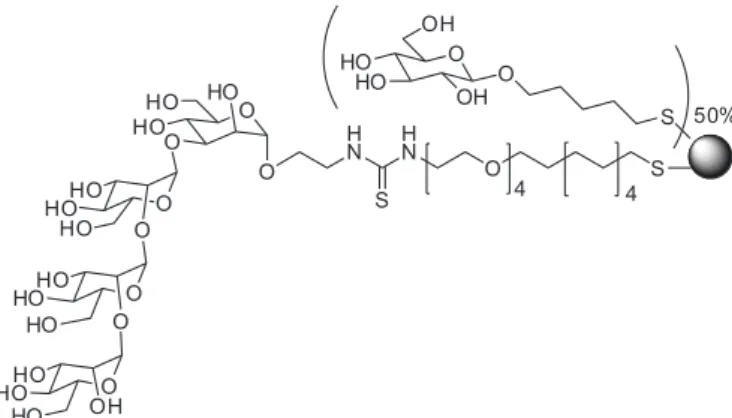
that these GNPs were able to inhibit the trans-infection of T cells at very low concentrations. In particular, the GNP with 56 copies of a linear tetrasaccharide at a density of 50% (Figure 2) was the most potent inhibitor with an IC50
in the low nanomolar range. This is the irst example where
a carbohydrate multivalent system has been tested in in vitro HIV infection studies successfully.
Another approach to prepare DC-SIGN inhibitors was described by the group of Kiessling, who used a
shikimic acid-derived glycomimetic scaffold of general formula A (Schuster et al., 2003; Gaber et al., 2010). (Fig-ure 3). The shikimic acid derivative prepared by Kiessling
and co-workers shared the same hydroxyl arrangement as
mannose at positions 2, 3 and 4, and could be considered as a good mimetic of mannose for lectin recognition. In
addition to the hydroxyl groups that mimic mannose, this shikimic acid derivative presented two possible points of diversiication, a carboxylic group and a thiol that were exploited to introduce different substituents and to syn -thesize a library of 192 compounds. All these compounds
were tested using a luorescence-based high-throughput
competition assay that assessed their ability to compete
with immobilized mannan for binding the luorophore-labeled extracellular domain of DC-SIGN. The best compound of the library was B, (Figure 3) which had an
IC50 of 11.2 mM, but was found to be more selective for
DC-SIGN than for mannose-binding protein A (MBP-A).
A multivalent presentation of compound B was prepared
by ring-opening metathesis polymerization (ROMP) (Bielawski, Grubbs, 2007). The inal glycopolymer was
1000-fold more potent than the monomeric inhibitor, the compound B.
GLYCODENDRIMERS TARGETING DC-SIGN
There are several precedents where dendrimers have
been used as scaffolds to achieve a multivalent presenta-tion of carbohydrates, the so called glycodendrimers. Furthemore, it have been observed that these kind of
FIGURE 2 - Gold glyconanoparticle with 50% of glucose and
50% of a linear tetrasaccharide.
carbohydrates multivalent systems are important tools to
interfere in biological processes where lectins or sugar
binding proteins are implicated (Roy, 1996; Turnbull, Stoddart, 2002; von der Lieth, Frank, Lindhorst, 2002; Roy, Baek, 2002; Bezouška, 2002; Roy, 2003; Li, Cheng, Xu, 2007; Chabre, Roy, 2008, 2010; Sánchez-Navarro, Rojo, 2010).
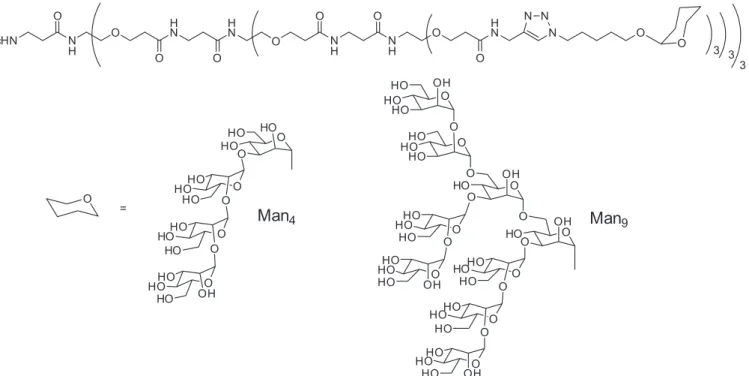
Among them, a recent interesting example where a glycodendron was used to interact with DC-SIGN was described by Wong and co-workers. They have reported oligomannose dendrons which display 3, 9 and 27 copies of complex oligomannoses (Figure 4) in high density as in
-hibitors of gp120 binding to recombinant dimeric DC-SIGN
(Wang et al., 2008). The selected carbohydrates were a
linear tetramannosyl ligand (Man4) corresponding to the D1
arm of high mannose and a branched nanomannosyl oligo-saccharide that represented the high mannose glycan (Figure
1). In a competition experiment using gp120 as a ligand for DC-SIGN, it was demonstrated that these glycodendrons inhibited the binding between gp120 and DC-SIGN with
an IC50 of 20 and 8 nM for compounds with nine copies of
Man4 and nine copies of Man9, respectively.
Since almost a decade ago, our group is interested in the design and synthesis of different multivalent com-pounds based on mannose and glycomimetics of high
mannose oligosaccharides and Lewis-X, as potential
molecules able to block the binding of pathogen envelope
glycoproteins to DC-SIGN. For this aim, we focused on
dendrimers and dendritic structures as appropriate
scaf-FIGURE 4 - Glycodendrons with 27 copies of Man4 and Man9.
folds for a multivalent presentation of carbohydrates
trying to achieve binding afinities to DC-SIGN in the
mM to nM range, a task without precedents at that time. In this revision article, we will give and overview of the work performed in our group related with glycodendritic structures as DC-SIGN antagonist.
Boltorn-type glycodendritic structures
As a proof of concept, we addressed a divergent approach (Fréchet, Tomalia, 2001; Newkome, Moore -field, Vögtle, 2001; Sánchez-Navarro, Rojo, 2012) to synthesize glycodendrimers using very simple and ac-cessible molecules. We selected a Boltorn hyperbranched
dendritic polymer, commercially available at a very low
price, as scaffold and a simple monosaccharide,
man-nose, as ligand to DC-SIGN to be conjugated on it. These
hyperbranched polymers have been constructed using
bis-hydroxymethylpropionic acid (Bis-MPA) as build -ing block and pentaerythritol as core. The glycodendritic
polymers were prepared using the 2nd and 3rd generation
of Boltorn dendritic polymers conjugated with 16 and 32
mannoses, respectively. (Figure 5). We demonstrated that
these glycodendritic structures were perfectly soluble in physiological conditions, non-toxic against several cell
lines and easy to be prepared (Arce et al., 2003).
BH30sucMan based on BH30 (3rd generation of Boltorn)
to DC-SIGN was calcium and carbohydrate dependent and
therefore should take place through the carbohydrate
rec-ognition domain of the lectin. An apparent afinity in the sub microMolar range was found (3 orders of magnitude increase in comparison with the monovalent mannose). Using SPR, we also set up a competition experiment assay in which different glycodendritic structures were analyzed for their ability to inhibit the gp120/DC-SIGN interaction, inding an IC50 of 50 µM for BH30sucMan. Additionally, it
was demonstrated the antiviral properties of the mannosyl
glycodendritic structure BH30sucMan using an Ebola Virus infection model. This glycodendritic hyperbranched
polymer inhibited DC-SIGN-mediated Ebola Virus infec -tion in cis and intrans (Lasala et al., 2003; Rojo, Delgado,
2004). The experiment showed that BH30sucMan was able to selectively inhibit direct DC-SIGN-mediated Ebola infection in an eficient dose-dependent manner (IC50 337
nM). In the experiment in trans, in which a more complex
series of events such as internalization and presentation of the viral particle to susceptible cells can take place,
BH30sucMan also showed a signiicant reduction of
DC-SIGN-mediated infection in trans at levels comparable to
the inhibition shown in cis. These glycodendritic polymers
were the irst example of a multivalent DC-SIGN antago -nist describe in the literature.
After this proof of concept where sub micromolar apparent afinity and good antiviral activity have been
reached presenting a simple carbohydrate (a mannose
monosaccharide) as ligand for DC-SIGN, an improvement of these activities could be envisaged using more complex and speciic carbohydrate ligands. Moreover, Boltorn hy -perbranched dendritic polymers are polydisperse materials and the control of the synthesis and the reproducibility of biological assays could be compromised by the presence
of a mixture of compounds. A monodisperse Boltorn type dendrimers and dendrons were prepared using a step-wise synthesis avoiding these potential problems. In this way, a new set of carbohydrate multivalent compounds were syn -thesized using these monodisperse multivalent scaffolds.
From the point of view of the ligand moiety, it has been reported the design and synthesis of two glycomi
-metic compounds that bind to DC-SIGN. A
pseudo-1,2-mannobioside 1 (Figure 6), which contains a mannose unit
connected to a conformationally locked cyclohexanediol
to mimic 1,2-mannobioside (Mana (1,2)Man) (Reina et al.,2007). The pseudo-trisaccharide 2 mimicking the linear Mana (1,2)Mana (1,6)Man trisaccharide of the D3 arm of Man9, (Figure 6) was designed following the same
concept (Mari et al.,2007). The afinity for DC-SIGN of
both monovalent ligands was too weak (mM range) to be considered as effective inhibitors of DC-SIGN-mediated infections and their therapeutic potential was limited. However, this low afinity could be overcome when li
-gands were presented in a multimeric form.
The multivalent presentation of glycomimetics 1
and 2 was achieved by conjugation of the monovalent
ligands to tetra- and multivalent scaffolds based on
Bis-FIGURE 6 – pseudo-disaccharide 1 and pseudo-trisaccharide 2.
MPA as building block to generate dendritic compounds with Boltorn-type structures. Two scaffolds with different valency were synthesized: a tetravalent dendron and a 3rd
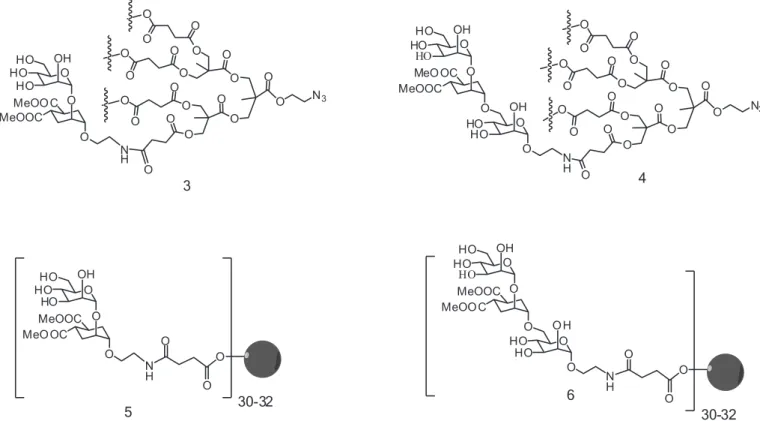
generation Boltorn-type dendrimer, both being monodis-perse compounds. The corresponding tetravalent glyco-dendrons 3 and 4, and the multivalent glycodendrimers 5
and 6 (Figure 7) were evaluated as potential inhibitors of
DC-SIGN (Sattin et al., 2010).
The tetravalent dendron 4 with four copies of
pseudo-trisaccharide 2 was shown to inhibit the trans
in-fection of T lymphocytes by HIV. Inin-fection was abrogated
almost totally by 4 at 100 mM concentration, and an IC50 ca. 10 mM could be estimated (Sattin et al., 2010), a very
promising value as starting point to deine better antiviral
compounds. Furthermore, dendron 4 was evaluated as a
suitable candidate for the development as topical HIV mi-crobicide (Berzi et al.,2012). This compound was tested as
inhibitor in an experimental model based on HIV infection of explant tissues taken from human uterine cervix. This experiment was the previous step to test the inhibitors in in vivo models. It was demonstrated that dendron 4 inhibited
80-90% of cervical explant HIV infection.
Additionally, the tetra- and multivalent systems
were tested in vitro using an infection model based on
pseudotyped viral particles with the Ebola virus envelope glycoprotein GP1. In these experiments, the tetravalent
systems 3 and 4 were very active in the low micromolar
range, and the multivalent systems 5 and 6 showed a very
strong inhibition effect with IC50 in the nanomolar range
(Luczkowiak et al., 2011).
Glycodendritic systems based on the Cu (I) catalyzed azide-alkyne cycloaddition (CuAAC)
In the previous section, it has been described an ap-proach to create carbohydrates multivalent systems based on Boltorn type structures. The synthesis of these kinds of polyesters-based glycodendrons and glycodendrimers presented some disadvantages. The divergent synthetic approach entailed the attachment of the saccharidic units to the multivalent scaffold in the last stage, generating several covalent bonds simultaneously in a single syn-thetic step. For this reason, this approach can generate structural defects due to an incomplete conjugation giving
rise to molecules with similar structure, and physical and chemical properties and therefore, being very dificult the puriication step to get pure and monodisperse glycoden
-drimers. A more eficient strategy should be addressed to
achieve the preparation of this kind of molecules.
In this context, our group designed new multivalent systems based on a convergent strategy using a very efi -cient type of click reaction (Kolb, Finn, Sharples, 2001), in particular, the Cu(I) catalyzed azide-alkyne cycloaddition (CuAAC) (Rostovtsev et al., 2002; Tornøe, Christensen, Medal, 2002), as an alternative to the preparation of glycodendrons and glycodendrimer. The click chemistry
reaction CuAAC is a very eficient, versatile, and popu -lar reaction that has found several applications in many
ields to achieve the preparation of very diverse molecules
ranging from small compounds to polymers, hydrogel and other larges entities, including dendrimers (Wu et al., 2004; Joralemon et al., 2005; Malkoch et al., 2005; Fernández-Megia et al., 2006; Franc, Kakkar, 2010).
Fol-lowing a convergent strategy based on CuAAC reaction, the synthesis of a new class of glycodendrons with full control of the structure was developed. In the new design, it was considered the presence at the focal position of an
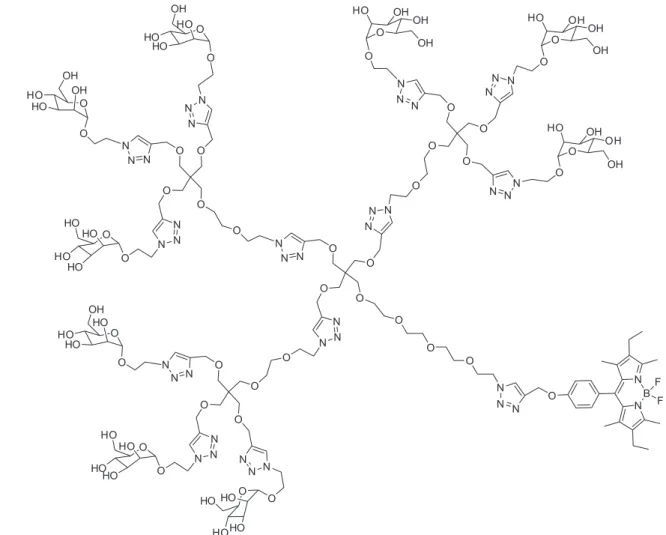
appropriated functional group permitting the conjugation of biomolecules of interest (peptides, nucleic acids, etc.) using again a CuAAC reaction. Glycodendrons, contain-ing up to nine copies of carbohydrate ligands (mannose or
fucose) (Figure 8), showed an eficient binding with the DC-SIGN receptor at the surface of DCs (Ribeiro-Viana et al., 2012). The functional group at the focal position was
used to conjugate a luorophore (a BODIPY derivative) to study the DC-SIGN-mediated internalization of these gly
-codendrons after the binding event at the surface of DCs.
These glycodendrons internalized eficiently into monocyte derived DCs in a receptor-dependent manner as it was demonstrated using imaging flow cytometry. Additional experiments performed to determine the in
-tercellular routing of these molecules into DCs showed that glycodendrons were co-localized within lysosomes. Finally, it was evaluated the capacity of glycodendrons to induce the maturation of DCs. None of the glycodendron showed any activity to induce DCs maturation neither ex -pression of cytokines at the concentration tested. Besides this fact, they can be considered as interesting vectors to internalize into target cells biomolecules of interest such as immunogenic peptides, conjugated to the focal position of these glycodendrons, opening the door for their use to develop synthetic vaccines.
This convergent click chemistry approach to prepare glycodendritic structures could be applied to different scaffolds generating interesting carbohydrate multivalent systems.
Glycodendrofullerenes
Fullerene could be a very attractive core with a
rigid spherical shape for a unique globular carbohydrate
multivalent presentation. However, its low solubility in polar solvents is one of the major drawbacks to address
the preparation of biological active compounds. On the
other hand, fullerenes allow the possibility to functional
-ize its 3D structure in different positions of the C60 cage
in a controlled fashion. Initially, the approaches reported in the literature to synthesize fullerenes derivatives
bear-ing carbohydrates were based on a mono-addition pattern (Nishida et al., 2004; Enes et al. 2005) on the fullerene sphere or on a “one side” multi-addition pattern (Cardullo
et al., 1998; Ito et al., 2003; Kato et al., 2005; Isobe et al.,
2007). In all these cases, fullerene derivatives showed an amphiphilic character with the fullerene being the lipophilic part of the structures. Recently, it has been shown that this
amphiphilic character of sugar fullerene conjugates can be
avoided by obtaining hexakis-adducts of [60]fullerene in which the C60 sphere could be completely surrounded by
the sugar moieties (mannose, glucose, galactose or fucose) in a T-symmetrical octahedral addition pattern (Nieren -garten et al., 2010). The conjugation of sugar residues to
an alkyne-substituted Bingel-Hirsch hexakis-adducts was
performed by employing the CuACC methodology. So, it
was obtained the irst example of a globular polytopic ligand
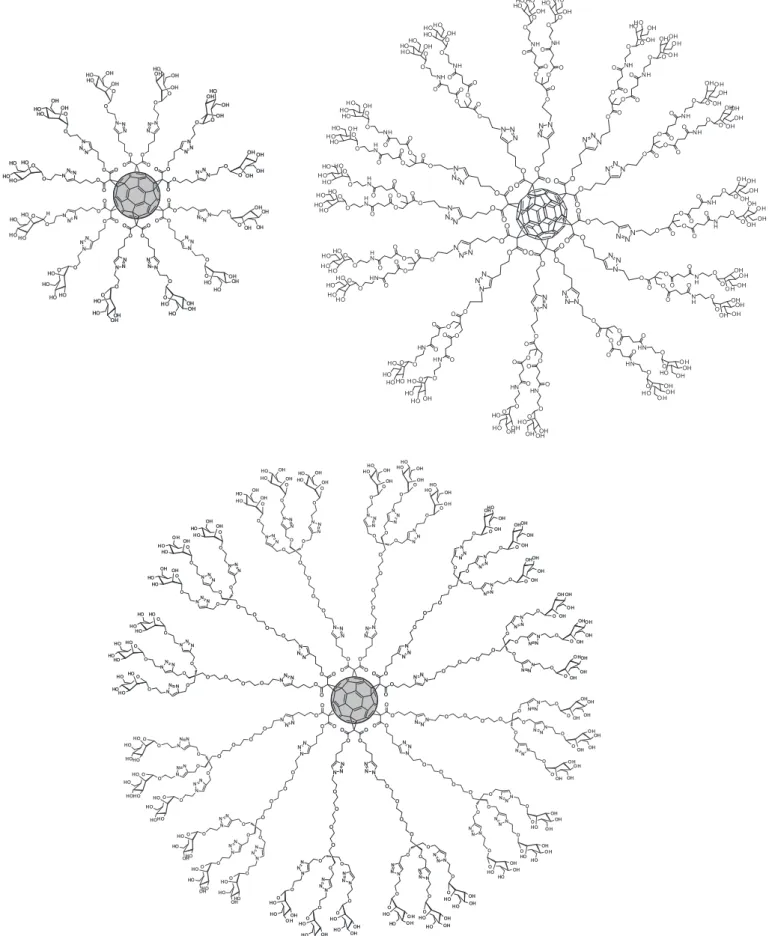
named glycofulleres or “sugar balls” (Figure 9).
To increase the valency of these systems, a divalent
dendron with mannose was used to obtain the irst glyco
FIGURE 8 - Mannosyl nonavalent dendron luorescence labeled with BODIPY.
of C60 (Sánchez-Navarro et al., 2011) (Figure 9). These
compounds were water soluble and interact with Con -canavalin A in a multivalent manner demonstrating the accessibility of the sugars on the fullerene surface to be
recognized by a lectin. Moreover, the compounds showed a good stability and low toxicity which conirmed the ap -propriate features to be used in cellular assays.
Globular glycofullerenes with higher valency were
prepared by a convergent strategy combining
trimannosyl-ated glycodendrons with a Bingel-Hirsch hexakis-adduct [60]fullerene to obtain glycodendrofullerenes with 36 mannoses (Figure 9) and two different spacers. Also, it was introduced for the irst time the biological activity of these
compounds in a cellular infection model providing
impor-tant information about the potential use of these new gly -comimetics as viral inhibitors. These
glycodendrofuller-enes act as antiviral agents in a DC-SIGN dependent Ebola pseudotype infection model (Luczkowiak et al., 2013).
Glycofullerene with 12 mannoses showed an IC50 of 2 mM,
a very promising data; however, an unexpected result was obtained for the activity of the glycodendrofullerene with
36 mannoses. The increase of valency induced a loss of antiviral effect (IC50 c.a. 70 mM). This could be probably related to the steric congestion of sugars at the surface of fullerene. Furthermore, one important factor to achieve
high afinity in binding processes was not only the spatial
presentation of ligands but also the adequate accessibility
of these ligands to interact with the receptor, DC-SIGN in this case. Using a glycodendrofullerene with 32 man
-nose (same valency) but including a longer spacer, was
observed a remarkably increase of the inhibitory activity of this compound (IC50 0.3 mM), probably due to a more
eficient interaction of the mannose ligand with DC-SIGN.
This result highlights the importance to combine an ad-equate scaffold to achieve the multivalency (the spherical
fullerene) with the right ligand accessibility and lexibility.
The valency of the compound is an important factor to
obtain good afinities in a carbohydrate-lectin interaction but as it has been shown in these assays, it is not the only
Virus-like glycodendrinanoparticles
Despite their elegant design, none of the artificial
carbohydrates multivalent systems described (including the glycodendrofullerenes) have achieved the size and the valency to mimic properly natural systems implicated in
DC-SIGN dependent infection processes such as viruses or other pathogens while maintaining full control of shape and
structure. In the particular cases of glycodendritic structures, valency up to 100 are very rare and, in most of the cases,
without full control of shape. Recently, a novel strategy of “nested polyvalency” was reported to achieve a controlled
design of highly polyvalent glycodendriproteins. This
ap-proach was performed through the multivalent assembly
of protein monomers themselves carrying polyvalent glycan display motifs (glycodendrons) (Ribeiro-Viana et al., 2012a). These synthetic protein assemblies display the
highest known number of glycans (n = 1620) yet presented
in a homogeneous manner (Figure 10). To perform the construction of glycodendriprotein nanoparticles trying to mimic the display in target pathogens, the self-assembled protein sphere-like icosahedron Qb (Kozlovska et al., 1993)
was used. The monomer of this protein can assemble into
a 180 copy multimer. Using a tag-and modify strategy
(Chalker, Bernardes, Davis, 2011), a non-natural alkyne
containing amino acid (tag), the L-homopropargyl glycine
(Hpg), was introduced in the Qb monomer. This tag was used for the attachment of glycodendrons with three and
nine mannose units appropriately functionalized at the focal
position with and azide group. The well-deined polyvalent
glycoprotein assemblies presenting on their surface 1620
copies of mannose was tested in the DC-SIGN dependent
Ebola pseudotype infection model.
The glycoprotein particles showed exciting antivi -ral activity, preventing dendritic cells infection by Ebola pseudotyped virus through competitive blockage of the
DC-SIGN receptor in the nanomolar to picomolar range
(Ribeiro-Viana et al., 2012a). This result clearly indicates
the eficiency of these systems to interact with this pattern recognition receptor and to compete with pathogens during
their entry into target cells.
CONCLUSIONS
The ield of dendrimers is in its maturity and many achievements and goals have been reached since the irst
publication describing the synthesis of a dendritic molecule in 1978 (Buhleier, Wehner, Vögtle, 1978). One of the most
interesting areas of research where dendrimers start to have
an important contribution is nanomedicine. Taking advan-tage of the possibilities that offer the dendritic structures and the opportunities to combine biomolecules or any kind of
ligands with these platforms for a multivalent presentation,
many different applications have been described for these so beautiful and interesting molecules. The combination of
carbohydrates with dendrimers allows the creation of glyco
-dendrimers, very powerful tools to be exploited in the ield
of glycoscience mimicking the presentation of
carbohy-drates in nature. DC-SIGN, a very important and attractive receptor with relevant biological implications, has been one of the targets for these glycodendrimers. Several examples
have been described in the literature that demonstrate the potential applications of glycodendritic structures to interact
eficiently with DC-SIGN inhibiting infection processes mediated by this lectin. From these examples, important
lessons came out respect to the necessary relevant issues to
have access to effective glycodendritic molecules. Eficient chemistries, valency, size, spatial presentation, lexibility
and accessibility of the ligands are among the important
is-sues to be considered. Still, much work remains be done in
the near future and novel scaffolds for multivalent
presenta-tions will be explored to achieve new goals and applicapresenta-tions.
ACKNOWLEGEDMENTS
We would like to thanks the financial support by MINECO of Spain CTQ2011-23410 and the EU RTN CARMUSYS (PITN-GA-2008-213592). J.J thanks CSIC for a JAE-DOC contract.
REFERENCES
ARCE, E.; NIETO, P.M.; DIAZ, V.; CASTRO, R.G.; BERNAD,
A.; ROJO, J. Glycodendritic structures based on boltorn
hyperbranched polymers and their interactions with Lens culinaris lectin. Bioconjugate Chem., v.14, p.817-823, 2003.
BERNARDI, A.; JIMENEZ-BARBERO, J.; CASNATI, A.; DE CASTRO, C.; DARBRE, T.; FIESCHI, F.; FINNE, J.; FUNKEN, H.; JAEGER, K.-E.; LAHMANN, M.; LINDHORST, T.K.; MARRADI, M.; MESSNER, P.; MOLINARO, A.; MURPHY, P.V.; NATIVI, C.; OSCARSON, S.; PENADES, S.; PERI, F.; PIETERS, R.L.; RENAUDET, O.; REYMOND, J.-L.; RICHICHI, B.; ROJO, J.; SANSONE, F.; SCHÄFFER, C.; TURNBULL, W.B.; VELASCO-TORRIJOS, T.; VIDAL, S.; VICENT, S.; WENNEKES, T.; ZUILHOF, H.; IMBERTY, A. Multivalent
glycoconjugates as anti-pathogenic agents. Chem. Soc. Rev., v.42, p.4709-4727, 2013.
BERTOZZI, C.R.; KIESSLING, L.L. Chemical glycobiology.
Science, v.291, p.2357-2364, 2001.
BERZI, A.; REINA, J.J.; OTTRIA, R.; SUTKEVICIUTE, I.; ANTONAZZO, P.; SANCHEZ-NAVARRO, M.; CHABROL, E.; BIASIN, M.; TRABATTONI, D.; CETIN, I.; ROJO, J.; FIESCHI, F. BERNARDI, A.; CLERICI, M. A glycomimetic compound inhibits DC-SIGN-mediated HIV infection in cellular and cervical explant models. AIDS, v.26, p.127-137, 2012.
BEZOUŠKA, K. Design, functional evaluation and biomedical
applications of carbohydrate dendrimers (glycodendrimers).
J. Biotechnol., v.90, p.269-290, 2002.
BIELAWSKI, C.W.; GRUBBS, R.H. Living ring-opening metathesis polymerization. Prog. Polym. Sci., v.32, p.1-29, 2007.
BUHLEIER, E.; WEHNER, W.; VÖGTLE, F. “Cascade”- and “Nonskid-Chain-like” syntheses of molecular cavity
topologies”. Synthesis, v.2, p.155-158, 1978.
CARDULLO, F.; DIEDERICH, F.; ECHEGOYEN, L.; HABICHER, T.; JAYARAMAN, N.; LEBLANC, R.M.; STODDART, J.F.; WANG, S. Stable langmuir
and langmuir-blodgett films of fullerene-glycodendron conjugates. Langmuir, v.14, p.1955-1959, 1998.
CHABRE, Y.M.; ROY, R. Recent trends in glycodendrimer
syntheses and applications. Curr. Top. Med. Chem., v.8, p.1237-1285, 2008.
CHABRE, Y.M.; ROY, R. Design and creativity in synthesis of
multivalent neoglycoconjugates. Adv. Carbohydr. Chem. Biochem., v.63, p.165-393, 2010.
CHALKER, J.M.; BERNARDES, G.J.L.; DAVIS, B.G.
A “tag-and-modify” approach to site-selective protein
modiication. Acc. Chem. Res., v.44, p.730-741, 2011.
CULF, A.S.; CUPERLOVIC-CULF, M.; OUELLETTE, R.J.
Carbohydrate microarrays: survey of fabrication techniques.
OMICS, v.10, p.289-310, 2006.
DAVIS, B.G. Synthesis of glycoproteins. Chem. Rev., v.102, p.579-602, 2002.
EISSA, A.M.; CAMERON, N.R. Glycopolymers conjugates.
EL-BOUBBOU, K.; AND HUANG, X. Glyco-Nanomaterials:
translating insights from the “Sugar-Code” to biomedical applications. Curr. Med. Chem., v.18, p.2060-2078, 2011.
ENES, R.F.; TOMÉ, A.C.; CAVALEIRO, J.A.S.; EL-AGAMEY, A.; McGARVEY, D.J. Synthesis and solvent dependence of the photophysical properties of [60]fullerene-sugar
conjugates. Tetrahedron, v.61, p.11873-11881, 2005.
FEINBERG, H.; MITCHELL, D.A.; DRICKAMER, K.;
WEIS, W.I. Structural basis for selective recognition of
oligosaccharides by DC-SIGN and DC-SIGNR. Science, v.294, p.2163-2166, 2001.
FEINBERG, H.; GUO, Y.; MITCHELL, D.A.; DRICKAMER, K.; WEIS, W.I. Extended neck regions stabilize tetramers of the receptors DC-SIGN and DC-SIGNR. J. Biol. Chem., v.280, p.1327-1335, 2005.
FEINBERG, H.; CASTELLI, R.; DRICKAMER, K.; SEEBERGER, P.H.; WEIS, W.I. Multiple modes of binding enhance the afinity of DC-SIGN for high mannose N-linked glycans found on viral glycoproteins. J. Biol. Chem., v.282, p.4202-4209, 2007.
FERNANDEZ-MEGIA, E.; CORREA, J.; RODRÍGUEZ-MEIZOSO, I.; RIGUERA, R. A click approach to
unprotected glycodendrimers. Macromolecules,v.39, p.2113-2120, 2006.
FRANC, G.; KAKKAR, A.K. “Click” methodologies; eficient,
simple and greener routes to design dendrimers. Chem. Soc. Rev., v.39, p.1536-1544, 2010.
FRÉCHET, L.M.J.; TOMALIA, D.A. Dendrimers and other dendritic polymers. Chichester: Wiley, 2001. 633 p.
FULTON, D.A.; STODDART, J.F. Neoglycoconjugates based on cyclodextrins and calixarenes. Bioconjugate Chem., v.12, p.655-672, 2001.
GABIUS, H.-J.; ANDRÉ, S.; JIMÉNEZ-BARBERO, J.; ROMERO, A.; SOLÍS, D. From lectin structure to
functional glycomics: principles of the sugar code. Trends Biochem. Sci., v.36, p.298-313, 2011.
GALAN, M.C.; DUMY, P.; RENAUDET. O. Multivalent
glycol(cyclo)peptides. Chem. Soc. Rev., v.42, p.4599-4612, 2013.
GARBER, K.C.A.; WANGKANONT, K.; CARLSON, E.E.; KIESSLING, L.L. A general glycomimetic strategy yields non-carbohydrate inhibitors of DC-SIGN. J. Chem. Soc. Chem. Commun., v.46, p.6747-6749, 2010.
GEIJTENBEEK, T.B.H.; TORENSMA, R.; VAN VLIET, S.J.; VAN DUIJNHOVEN, G.C.F.; ADEMA, G.J.; VAN KOOYK, Y.; FIGDOR, C.G. Identiication of DC-SIGN, a novel dendritic cell–speciic ICAM-3 receptor that supports
primary immune responses. Cell, v.100, p.575-585, 2000.
GEIJTENBEEK, T.B.H.; KWON, D.S.; TORENSMA, R.; VAN VLIET, S.J.; VAN DUIJNHOVEN, G.C.F.; MIDDEL, J.; CORNELISSEN, I.L.M.H.A.; NOTTET, H.S.L.M.; KEWAL RAMANI, V.N.; LITTMAN, D.R.; FIGDOR, C.G.; VAN KOOYK, Y. DC-SIGN, a dendritic cell–speciic
HIV-1-binding protein that enhances trans-infection of T cells. Cell, v.100, p.587-597, 2000a.
GHAZARIAN, H.; IDONI, B.; OPPENHEIMER, S.B. A glycobiology review: carbohydrates, lectins and
implications in cancer therapeutics. Acta Histochem., v.113, p.236-247, 2011.
GOMEZ-GARCÍA, M.; BENITO, J.M.; BUTERA, A.P.; ORTIZ MELLET, C.; GARCÍA FERNANDEZ, J.M.; JIMENEZ BLANCO, J.L. Synthesis of heteroglycoclusters by using orthogonal chemoselective ligations. J. Org. Chem., v.77, p.1273-1288, 2012.
GUO, Y.; FEINBERG, H.; CONROY, E.; MITCHELL, D.A.; ALVAREZ, R.; BLIXT, O.; TAYLOR, M.E.; WEIS, W.I.; DRICKAMER, K. Structural basis for distinct ligand-binding and targeting properties of the receptors DC-SIGN and DC-SIGNR. Nat. Struct. Mol. Biol., v.11, p.591-598, 2004.
GUPTA, G.; SUROLIA, A. Glycomics: an overview of the complex glycocode. Adv. Exp. Med. Biol., v.749, p.1-13, 2012.
HIJAZI, K.; MARRADI, M.; CLAVEL, C.; CAMPION, C.; KELLY, C.; PENADES, P. Gold mano-glyconanoparticles:
multivalent systems to block HIV-1 gp120 binding to the
lectin DC-SIGN. Chem. Eur. J., v.15, p.9874-9888, 2009.
ISOBE, H.; CHO, K.; SOLIN, N.; WERZ, D.B.; SEEBERGER, P.H.; NAKAMURA, E. Synthesis of
ITO, H.; TADA, T.; SUDO, M.; ISHIDA, Y.; HINO, T.; SAIGO, K. [60]fullerenoacetyl chloride as a versatile precursor for fullerene derivatives: eficient ester formation with various
alcohols. Org. Lett., v.5, p.2643-2645, 2003.
JORALEMON, M.J.; O’REILLY, R.K.; MATSON, J.B.; NUGENT, A.K.; HAWKER, C.J.; WOOLEY, K.L. Dendrimers clicked together divergently. Macromolecules, v.38, p.5436-5443, 2005.
KAMERLING, J.P. Comprehesive glycoscience: from chemistry to system biology. Amsterdam: Elsevier, 2007. v.3-4.
KATO, H.; KANETA, N.; NII, S.; KOBAYASHI, K.; FUKUI, N.; SHINOHARA, H.; NISHIDA, Y. Preparation and
supramolecular properties of unadulterated glycosyl liposomes from a Bis(α-D-mannopyranosyl)-[60] fullerene conjugate. Chem. Biodivers., v.2, p.1232-1241, 2005.
KILPATRICK, D.C. Hanbook of animal lectins: properties and biomedical applications. Chichester: John Wiley & Sons, 2000. 468 p.
KOLB, H.C.; FINN, M.G.; SHARPLES, K.B. Click chemistry:
diverse chemical function from a few good reactions.
Angew. Chem. Int. Ed., v.40, p.2004-2021, 2001.
KOZLOVSKA, T.M.; CIELENS, I.; DREILINNA, D.; DISLERS, A.; BAUMANIS, V.; OSE, V.; PUMPENS, P. Recombinan RNA phage Qbb capsid particles synthesized
and self-assembled in Escherichia coli.Gene, v.137, p.133-137, 1993.
LASALA, F.; ARCE, E.; OTERO, J.R.; ROJO, J.; DELGADO, R. Mannosyl glycodendritic structure inhibits
DC-SIGN-Mediated ebola virus infection in cis and trans. Antimicrob. Agents Chemother., v.47, p.3970-3972, 2003.
LEE, Y.C.; LEE, R.T. Carbohydrate-protein interactions: basis
of glycobiology. Acc. Chem. Res., v.28, p.321-327, 1995.
LI, Y.; CHENG, Y.; XU, T. Design, synthesis and potent
pharmaceutical applications of glycodendrimers: a mini
review. Curr. Drug Discov. Technol., v.4, p.246-254, 2007.
LUCZKOWIAK, J.; SATTIN, S.; SITKEVICIUTE, I.; REINA, J.J.; SÁNCHEZ-NAVARRO, M.; THÉPAUT, M.; MARTÍNEZ-PRATS, L.; DAGHETTI, A.; FIESCHI, F.; DELGADO, R.; BERNARDI, A.; ROJO, J. Pseudosaccharide functionalized dendrimers as potent inhibitors of DC-SIGN dependent Ebola pseudotyped viral
infection. Bioconjugate Chem., p.22, p.1354-1365, 2011.
LUCZKOWIAK, J.; MUÑOZ, A.; SÁNCHEZ-NAVARRO, M.; RIBEIRO-VIANA, R.; GINIEIS, A.; ILLESCAS, B.M.; MARTÍN, N.; DELGADO, R.; ROJO, J. Glycofullerenes inhibit viral infection. Biomacromolecules, v.14, p.431-437, 2013.
MALKOCH, M.; SCHLEICHER, K.; DROCKENMULLER, E.; HAWKER, C.J.; RUSSELL, T.P.; WU, P.; FOKIN,
V.V. Structurally diverse dendritic libraries: a highly
eficient functionalization approach using click chemistry.
Macromolecules, v.38, p.3663-3678, 2005.
MAMMEN, M.; CHOI, S.-K.; WHITESIDES, G.M. Polyvalent
interactions in biological systems: implications for design and use of multivalent ligands and inhibitors. Angew. Chem. Int. Ed., v.37, p.2755-2794, 1998.
MARI, S.; SANCHEZ-MEDINA, I.; MEREGHETTI, P.; BELVISI, L.; JIMÉNEZ-BARBERO, J.; BERNARDI,
A. Synthesis and conformational analysis of an α -D-mannopyranosyl-(1,2)- α-D-mannopyranosyl-(1,6)- α -D-mannopyranose mimic. Carbohydr. Res., v.342, p.1859-1868, 2007.
MARRADI, M.; CHIODO, F.; GARCÍA, I.; PENADÉS, S.
Glyconanoparticles as multifunctional and multimodal carbohydrate systems. Chem. Soc. Rev., v.42, p.4515-4517, 2013.
MARTÍNEZ, A.; ORTIZ MELLET, C.; GARCÍA FERNÁNDEZ, J.M. Cyclodextrin-based multivalent glycodisplays:
covalent and supramolecular conjugates to access carbohydrate-protein interactions. Chem. Soc. Rev., v.42, p.4746-4773, 2013.
MARTINEZ-AVILA, O.; BEDOYA, L.M.; MARRADI, M.; CLAVEL, C.; ALCAMI, J.; PENADES, P. Multivalent mano-glyconanoparticles inhiblit DC-SIGN-mediated
HIV-1 trans-infection of human T cells. ChemBioChem, v.10, p.1806-1809, 2009.
MITCHELL, D.A.; FADDEN, A.J.; DRICKAMER, K. A novel
mechanism of carbohydrate recognition by the C-type
lectins DC-SIGN and DC-SIGNR: subunit organization
and binding to multivalent ligands. J. Biol. Chem., v.276, p.28939-28945, 2001.
MIURA, Y. Design and synthesis of well-deined glycopolymers
NEWKOME, G.R.; MOOREFIELD, C.N.; VÖGTLE,
F. Dendrimers and dendrons: concepts, syntheses,
applications. Weinheim: Wiley VCH, 2001. 635 p.
NIERENGARTEN, J.-F.; IEHL, J.; MOLLER, M.; GOYARD, D.; ILLESCAS, B.M.; MUÑOZ, A.; MARTÍN, N.; ROJO, J.; SÁNCHEZ-NAVARRO, M.; CECIONI, S.; VIDAL, S.; BUFFET, K.; DURKA, M.; VINCENT, S.P. Fullerene
sugar balls. J. Chem. Soc. Chem. Commun., v.46, p.3860-3862, 2010.
NISHIDA, Y.; MIZUNO, A.; KATO, H.; YASHIRO, T.; OHTAKE, T.; KOBAYASHI, K. Stereo- and Biochemical
Profiles of the 5-6- and 6-6-Junction Isomers of α -D-Mannopyranosyl [60]Fullerenes. Chem. Biodiversity, v.1, p.1452-1464, 2004.
PAYNE, R.J.; WONG, C.H. Advances in chemical ligation
strategies for the synthesis of glycopeptides and glycoproteins. J. Chem. Soc. Chem. Commun., v.46, p.21-43, 2010.
REINA, J.J.; SATTIN, S.; INVERNIZZI, D.; MARI, S.; MARTINEZ-PRATS, L.; TABARANI, G.; FIESCHI, F.; DELGADO, R.; NIETO, P.M.; ROJO, J.; BERNARDI, A. 1,2-Mannobioside mimic: synthesis, DC-SIGN interaction by NMR and docking, and antiviral activity,
ChemMedChem, v.2, p.1030-1036, 2007.
REINA, J.J.; BERNARDI, A.; CLERICI, M.; ROJO, J. HIV microbicides: state of the art and new perspectives on the
development of entry inhibitors. Future Med. Chem., v.2, p.1141-1159, 2010.
REINA, J.J.; BERNARDI, A. Carbohydrates mimics and lectins: a source of new drugs and therapeutic opportunities.
Mini Rev. Med. Chem., v.12, p.1434-1442, 2012.
RIBEIRO-VIANA, R.; GARCÍA-VALLEJO, J.J.; COLLADO, D.; PEREZ-INESTROSA, E.; BLOEM, K.; VAN KOOYK, Y.; ROJO, J. BODIPY-labeled DC-SIGN-targeting glycodendrons eficiently internalize and route to lysosomes
in human dendritic cells. Biomacromolecules, v.13, p.3209-3219, 2012.
RIBEIRO-VIANA, R.; SÁNCHEZ-NAVARRO, M.; LUCZKOWIAK, J.; KOEPPE, J.R.; DELGADO, R.; ROJO, J.; DAVIS, B.G. Virus-like glycodendrinanoparticles
displaying quasi-equivalent nested polyvalency upon glycoprotein platforms potently block viral infection. Nat. Commun., v.3, 2012a. Doi: 10.1038/ncomms2302.
ROJO, J.; DELGADO, R. Glycodendritic structures: promising new antiviral drugs. J. Antimicrob. Chemother., v.54, p.579-581, 2004.
ROSTOVTSEV, V.V.; GREEN, L.G.; FOKIN, V.V.; SHARPLES, K.B. A stepwise huisgen cycloaddition process:
copper(I)-catalyzed regioselective “ligation” of azides and terminal alkynes. Angew. Chem. Int. Ed., v.41, p.2596-2599, 2002.
ROY, R. Synthesis and some applications of chemically deined
multivalent glycoconjugates. Curr. Opin. Struct. Biol., v.6, p.692-702, 1996.
ROY, R.; BAEK, M.-G. Glycodendrimers: novel glycotope isosteres unmasking sugar coding. Case study with
T-antigen markers from breast cancer MUC1 glycoprotein.
J. Biotechnol., v.90, p.291-309, 2002.
ROY, R. A decade of glycodendrimer chemistry. Trends Glycosci. Glyc., v.15, p.289-308, 2003.
SÁNCHEZ-NAVARRO, M.; ROJO J. Targeting DC-SIGN with
carbohydrate multivalent systems. Drugs News Perspect., v.23, p.557-572, 2010.
SÁNCHEZ-NAVARRO, M.; MUÑOZ, A.; ILLESCAS, B.M.; ROJO, J.; MARTIN, N. [60]Fullerene as multivalent
scaffold efficient molecular recognition of globular glycofullerenes by concanavalin. Chem. Eur. J., v.17, p.766-769, 2011.
SÁNCHEZ-NAVARRO, M.; ROJO J. Synthetic strategies to create dendrimers: advantages and drawbacks. In: FUENTE, J.M.; GRAZU, V. Nanobiotechnology: inorganic
nanoparticles vs organic nanoparticles. Oxford: Frontiers in Nanoscience, 2012. v.4, chap.5, p.137-149.
SATTIN, S.; DAGHETTI, A.; THÉPAUT, M.; BERZI, A.; SÁNCHEZ-NAVARRO, M.; TABARANI, G.; ROJO, J.; FIESCHI, F.; CLERICI, M.; BERNARDI, A. Inhibition of
DC-SIGN-mediated HIV infection by a linear trimannoside
mimic in a tetravalent presentation. ACS Chem. Biol., v.3, p.301-312, 2010.
SERRANO-SIERRA-GOMEZ, D.; SIERRA-FILARDI, E.; MARTINEZ-NUÑEZ, E.T.; CAPARROS, E.; DELGADO, R.; MUÑOZ-FERNANDEZ, A.; ABAD, M.A.;
JIMÉNEZ-BARBERO, J.; LEAL, M.; CORBI, A.L. Structural requirements for multimerization of the pathogen receptor
dendritic cell-speciic ICAM3-grabbing non-integrin (CD209)
SHARON, N.; LIS, H. History of lectins: from hemagglutinins
to biological recognition molecules. Glycobiology, v.14, p.53R-62R, 2004.
SCHUSTER, M.C.; MANN, D.A.; BUCHHOLZ, T.J.; JOHNSON, K.M.; THOMAS, W.D.; KIESSLING, L.L. Parallel synthesis of glycomimetic libraries: targeting a
C-type lectin. Org. Lett., v.5, p.1407-1410, 2003.
TABARANI, G.; REINA, J.J.; EBEL, C.; VIVES, C.;
LORTAT-JACOB, H.; ROJO, J.; FIESCHI, F. Mannose
hyperbranched dendritic polymer interact with clustered organization of DC-SIGN and inhibit gp120 binding. FEBS Lett., v.580, p.2402-2408, 2006.
TABARANI, G.; THEPAUT, M.; STROEBEL, D.; EBEL, C.; VIVES, P.; VACHETTE, P.; DURAMD, D.; FIESCHI, F. DC-SIGN neck domain is a pH-sensor controlling
oligomerization. J. Biol. Chem., v.284, p.21229-21240, 2009.
TORNØE, C.W.; CHRISTENSEN, C.; MEDAL, M. Peptidotriazoles on solid phase: [1,2,3]-Triazoles by regiospeciic copper(I)-catalyzed 1,3-Dipolar cycloadditions
of terminal alkynes to azides. J. Org. Chem., v.67, p.3057-3064, 2002.
TURNBULL, J.E.; STODDART, J.F. Design and synthesis of
glycodendrimers. J. Biotechnol., v.90, p.231-255, 2002.
TURNBULL, J.E.; FIELD, R.A. Emerging glycomics
technologies. Nat. Chem. Biol., v.3, p.74-77. 2007.
VAN KOOYK, Y.; GEIJTENBEEK, T.B. DC-SIGN: escape
mechanism for pathogens. Nat. Rev. Immunol., v.3, p.697-709, 2003.
VARKI, A. Biological roles of oligosaccharides: all of the theories are correct. Glycobiology, v.2, p.97-130, 1993.
VARKI, A.; CUMMINGS, R.; ESKO, J.; FREEZE, H.; HART,
G.; MARTH, J. Essentials of glycobiology. 2.ed. New York:
Cold Spring Harbor Laboratory Press, 1999. 653 p.
VON DER LIETH, C.-W.; FRANK, M.; LINDHORST, T.K.
Molecular dynamics simulations of glycoclusters and glycodendrimers. J. Biotechnol., v.90, p.311-337, 2002.
WANG, S.K.; LIANG, P.H.; ASTRONOMO, R.D.; HSU, T.L.; HSIEH, S.L.; BURTON, D.R.; WONG, C.H. Targeting
the carbohydrates on HIV-1: interaction of oigomannose
dendrons with human monoclonal antibody 2G12 and DC-SIGN. P. Natl. Acad. Sci. USA, v.105, p.3690-3695, 2008.
WEISS, I.W.; DRICKAMER, K. Structural basis of the
lectin-carbohydrate recognition. Annu. Rev. Biochem., v.65, p.441-473, 1996.
WEIS, I.W.; TAYLOR, M.E.; DRICKAMER, K. The C-type
lectin superfamily in the immune system. Immunol. Rev., v.163, p.19-34, 1998.
WERZ, D.B.; SEEBERGER P.H. Chemical glycomical
glycomics as basis for drug discovery. In: SCHREIBER,
S.L.; KAPOOR, T.M.; WESS, G. (Eds.). Chemical biology: from small molecules to systems biology and drug design. Weinheim: Wiley-VCH, 2007. chap.11, p.668-691.
WESTERLIND, E. Synthetic glycopeptides and glycoproteins with applications in biological research. Beilstein J. Org. Chem., v.8, p.804-818, 2012.
WU, P.; FELDMAN, A.K.; NUGENT, A.K.; HAWKER, C.J.; SCHEEL, A.; VOIT, B.; PYUN, J.; FRÉCHET, J.M.J.; SHARPLESS, K.B.; FOKIN, V.V. Eficiency and idelity