OPTIMIZATION OF EXOPOLYSACCHARIDES PRODUCTION FROM A NOVEL STRAIN OF
GANODERMA
LUCIDUM
CAU5501 IN SUBMERGED CULTURE
Baojing Yuan, Xiaoyan Chi, Rijun Zhang*
Laboratory of Feed Biotechnology, State Key Lab. of Animal Nutrition, College of Animal Science & Technology, China
Agricultural University, No.2 Yuanmingyuan West Road, Haidian District, Beijing 100193, China.
Submitted: March 26, 2011; Returned to authors for corrections: April 09, 2011; Approved: January 16, 2012.
ABSTRACT
This study aimed at optimizing the medium of a new
Ganoderma lucidum
strain CAU5501 to enhance the
yield of exopolysaccharides (EPS) and mycelial growth. Firstly, the suitable level of glucose, magnesium,
phosphate and C/N ratio was determined by single factor experiment. Subsequently, the optimum
concentrations of these medium components were investigated using the orthogonal matrix method. The
results indicated that the higher levels of EPS were correlated with the level of cell growth when glucose
concentration was studied (data no show). The optimum medium for EPS yield was found to be 70 g/l
glucose, 5 C/N ratio, 2.5 g/l KH
2PO
4, 0.75 g/l MgSO
4·7H
2O, and for mycelial growth was 50 g/l glucose, 5
C/N ratio, 1.5 g/l KH
2PO
4, 0.5 g/l MgSO
4·7H
2O. When cultivated in the obtained optimal media in 3 L
shake flask, compared to the basal medium, the EPS yield increased markedly from 1.003 to 1.723 g/l, and
the mycelium formation was also markedly improved from 2.028 to 7.235 g/l. Results obtained in this study
are beneficial to further study for enhancing the production of
Ganoderma lucidum
polysaccharides in large
scale commercialized production.
Key word:
Optimization; exopolysaccharides;
Ganoderma lucidum
; orthogonal matrix method; submerged
culture
INTRODUCTION
Over the past decades there has been an increasing
attention to the production of polysaccharides from mushrooms
due to their various physiological activities (14, 17).
Ganoderma lucidum
, a medicinal fungus called “Lingzhi” in
Chinese and “Reishi” in Japanese, has been widely used as a
remedy for promotion of health and longevity in the Far East,
especially in China, Japan and Korea for centuries. Recent
studies on
G. lucidum
have showed polysaccharides is one of
the major sources that are considered to possess many
bioactivities
,
such as anti-tumor (5), immunomodulation (13),
antioxidation (16).
Polysaccharides yield extracted from fruiting bodies and
mycelia is relatively low and its cost is high. By comparison
exopolysaccharides (EPS) have several advantages: the use of
harsh extraction steps can be avoided in EPS production, thus
lessening product degradation during recovery and reducing
production cost. Viewed as a promising alternative for efficient
production, submerged cultivation of
G. lucidum
has attracted
much attention recent years. However, most investigators have
focused their efforts mainly on polysaccharides from fruiting
bodies and mycelia (6, 9, 12). Little information is available
with respect to the optimal condition for EPS production from
G. lucidum
.
Until now, in spite of several decades of efforts, the
production and productivity of secondary metabolites by cell
culture technology is still facing many biological and
engineering limitations. One of the major obstacles is the low
yield of secondary metabolites (19).
G. lucidum
CAU5501
(China patent application No. 200510066114.7), a novel strain
bred by Chi
et al.
in this Laboratory, is an excellent strain with
steady property, high EPS production and high mycelial
growth rate (4). Orthogonal design, one of the important
statistical methods, is feasible to investigate the influence of
controlled factors in a multivariable system and have been
successfully applied to the improvement of culture media for
the production of primary and secondary metabolites in the
fermentation process (9). In the present study, attempts were
made to optimize the formulated suitable media for the
production of EPS and mycelial biomass by
G. lucidum
CAU5501 in shake flasks using the orthogonal matrix method.
MATERIALS AND METHODS
Microorganism and media
The strain of
G. lucidum
CAU5501 was screened in this
laboratory and maintained on potato dextrose agar (PDA)
slants. The slants were inoculated and incubated at 30
℃
for
7days, then stored at 4ºC for about 1 month. The seed medium
that was also used as the basal medium consisted of 40 g/l
glucose, 2 g/l peptone, 2 g/l
KH
2PO
4, 1 g/l MgSO
47H
2O,
40mg/l thiamin.
Inoculum preparation and flask culture
G. lucidum
CAU5501 was initially grown on PDA
medium in a petridish, and then transferred to the seed culture
medium by punching out 5mm of the agar plate culture. The
seed culture was grown in 250ml flasks containing 100ml of
basal medium at 30ºC on a rotary shaker incubator at 150rpm
for 5 days. Shake flask culture experiments were performed in
a 250ml flask containing 100ml of the media (natural pH
value) after inoculating with 5% (v/v) of the seed culture at 150
rpm in dark at 30ºC for 4 days. All experiments were
performed in triplicate.
Experimental design and data treatment single-factor test
To find the optimal culture media requirements, the
following factors were investigated using the
one-factor-at-a-time method, namely the glucose, phosphate (PO
43-),
magnesium: (Mg
2+) concentrations and carbon-nitrogen ratio in
the media.
Concentration of glucose:
To determine the optimal
carbohydrate concentration in the medium, eight different
concentrations (10, 20, 30, 40, 50, 60, 70, and 80 g/l) of
glucose were used as the carbon source for production of EPS
and mycelium growth by
G. lucidum
CAU5501.
Carbon-nitrogen ratio:
To find out the suitable C/N ratio
for EPS production and mycelial growth,
G. lucidum
CAU5501
was cultivated in the media with 40 g/l of glucose as carbon
source adjusting the ratio of nitrogen source (C/N ratio 10, 30,
50, 70 and 90).
Concentration of phosphate
:
In this work, KH
2PO
4was
used as phosphate source to examine the influence of
phosphate on EPS production and mycelial growth from
G.
lucidum
CAU5501 at different levels (from 1.0 g/l to 6.0 g/l) of
KH
2PO
4in the midium.
Concentration of magnesium:
To find the appropriate
Mg
2+concentration for EPS production and mycelia growth of
G. lucidum
CAU5501 in submerged culture, different levels of
MgSO
4·7H
2O ranging from 0.5 g/l to 5 g/l were tested.
Orthogonal matrix method
these media components concentrations for mycelial growth
and EPS production were optimized using the orthogonal
matrix method. The design of L
9(3
4) orthogonal array was
employed for optimizing nutritional components of medium, as
noted in Table 1 (3, 10, 18, 20). The experimental conditions
for each experimental group are listed in Table 2 including the
experimental results in the last two columns. All experiments
were performed in triplicate.
Table 1.
L9 (3
4) orthogonal design of optimization of culture medium.
Factor
Variable
Level 1
Level 2
Level 3
A glucose
concentration
50.00
60.00
70.00
B C/N
ratio 5
10
15
C phosphate
concentration
1.50 2.00 2.50
D Mg
2+concentration 0.50 0.75 1.00
Table 2.
Results of L
9(3
4) orthogonal test of exopolysaccharide production and mycelial growth of
G. lucidum
CAU5501 in shake
flask culture.
Run
A B C D
EPS
production
(g
l
-1)
mycelial biomass (g l
-1)
1
1
1
1
1
0.82 ± 0.08
1.12 ± 0.06
2
1
2
2
2
0.42 ± 0.08
0.76 ± 0.27
3
1
3
3
3
0.93 ± 0.10
0.51 ± 0.12
4
2
1
2
3
0.67 ± 0.18
0.73 ± 0.13
5
2
2
3
1
0.68 ± 0.02
0.94 ± 0.09
6
2
3
1
2
0.78 ± 0.11
0.57 ± 0.08
7
3
1
3
2
1.14 ± 0.02
0.64 ± 0.28
8
3
2
1
3
0.45 ± 0.18
0.59 ± 0.20
9
3
3
2
1
0.65 ± 0.07
0.73 ± 0.02
Symbols A, B, C and D represent factors of glucose concentration (g l-1), C/N, KH
2PO4(g l-1) and MgSO4, respectively. Values are means ± SD of triple determinations.
Analytical methods
Exopolysaccharides:
Samples from every shake flasks
were centrifuged at 4 000rpm for 15min. The resulting culture
filtrate was added to four volumes of absolute ethanol, and left
at 4ºC for 24hr to precipitate the crude EPS. The precipitated
EPS was centrifuged at 10000 rpm for 10 min, with the
supernatant discarded, and then the precipitated EPS was
dissolved in distilled water, precipitated with alcohol again, by
four times. At last, the precipitated EPS was lyophilized and
the EPS yield (which was expressed as gram of EPS per litre of
culture medium) was measured by a phenol–sulphuric acid
method according to Chen
et al.
(3).
Mycelial growth:
The mycelial biomass amount of
G.
lucidum
was determined by measuring the dry cell weight
(DCW). Fermentation broth collected from each shake flask
were filtrated with four layers of gauze and washed three times
with distilled water. Then the mycelial pellets were dried at
105ºC in thermostatic drying chamber until a constant weight
was achieved.
RESULTS AND DISCUSSION
Effect of concentration of glucose
The concentrations of carbon sources in the media are
very important for cell growth and optimal metabolite
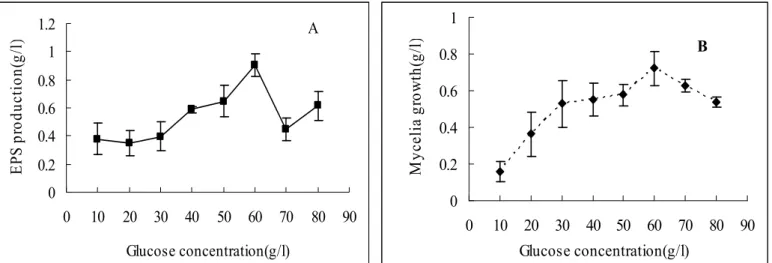
production (20). As shown in Figure 1A, the more EPS was
from 10 to 60 g/l) in the media, and the highest yield of EPS
(0.90 g/l) was obtained when a glucose concentration of 60 g/l
was used. Similar results were obtained by Lee
et al.
(12) and
Hsieh
et al.
(6). However, contrary to the previous research by
Hsieh
et al.
(6) who reported that the highest levels of EPS
were not correlated with the level of cell growth when
G.
lucidum
CCRC 36041 was used for submerged culture, in this
study, a noticeable phenomenon was that, the maximum EPS
yield and mycelial biomass (0.72 g/l) were achieved
simultaneously at glucose concentration of 60 g/l (Figure 1). It
seemed the levels of EPS were correlated with the levels of cell
growth (data no show) when
G. lucidum
CAU5501 was used.
These results showed that different strains of
Ganoderma
lucidun
had different metabolic characteristics and there
seemed no lag phase between the primary metabolism and the
secondary metabolism in
G. lucidum
CAU5501. This result
demonstrated that
G. lucidum
CAU5501 might be a strain
which could give consideration to both EPS production and
mycelial biomass and the best concentration of glucose was 60
g/l in the medium.
A
0
0.2
0.4
0.6
0.8
1
1.2
0
10
20
30
40
50
60
70
80
90
Glucose concentration(g/l)
E
P
S
pr
oduc
ti
on(
g/
l)
B
0
0.2
0.4
0.6
0.8
1
0
10
20
30
40
50
60
70
80
90
Glucose concentration(g/l)
M
y
cel
ia g
ro
w
th
(g
/l
)
Figure 1.
Effect of glucose concentration on exopolysaccharide production (A) and mycelial growth (B) of
G. lucidum
CAU5501
in shake flask culture.
Effect of carbon to nitrogen ratio (C/N ratio)
The C/N ratio is an important factor affecting the
biosynthesis of EPS and mycelial growth in mushroom
cultures. The results are shown in Figure 2. The best
performance of EPS production was achieved when the ratio of
carbon and nitrogen was 10, and then reduced to the lowest
point with C/N ratios of 30. This finding was not in accordance
with previous results (at a C/N ratio of 25) reported by
Babitskaya
et al.
(1). This variance of EPS production from the
same kind of fungus may differ due to strains and their culture
conditions. In contrast, the maximum mycelia outgrowth was
achieved at C/N ratios of 30, and then decreased with the C/N
ratios increased from 30 to 90. These results indicated that C/N
ratios had effect on both cell growth and EPS accumulation of
G. lucidum
and a very high C/N ratio resulted in a relatively
lower yield of mycelial biomass. Moreover, it seemed that
good cell growth was not a determining factor for high
production yield of EPS, which was in agreement with the
previous reports (3). However, the function of C/N ratio level
with regard to polysaccharides is still unclear and worthy of
A
0
0.1
0.2
0.3
0.4
0.5
0.6
0.7
0.8
0
10
20 30
40
50
60
70 80
90 100
C/N
E
P
S
pr
oduc
ti
on(
g/l
)
B
0
0.2
0.4
0.6
0.8
1
1.2
1.4
1.6
1.8
0
10 20 30 40 50 60 70 80 90 100
C/N
Myc
e
li
a
gr
ow
th(
g/
l)
Figure 2.
Effect of C/N ratio on exopolysaccharide production (A) and mycelial growth (B) of
G. lucidum
CAU5501 in shake
flask culture.
Effect of phosphate (PO
43-)
The trace nutrient sources usually affect the rates of
biosynthesis of many metabolites. Figure 3A showed that
phosphate influenced the EPS production of
G. lucidum
in
submerged culture and the maximum EPS production (0.57g/l)
was obtained when KH
2PO
4was added to the basal medium at
a level of 2.0 g/l, which was 23.91% higher than that in
fermentation without KH
2PO
4addition. The result suggested
that phosphate had promoting effect on EPS accumulation and
the proper concentration of was 2.0 g/l KH
2PO
4. However,
excess phosphate had negative effect on EPS accumulation. In
Contrast, KH
2PO
4had slight effect on mycelial biomass, of
was difference from the report by Hsieh
et al.
(6). In addition,
the media without phosphate source addition showed certain
cell growth and EPS production as showed in Figure 3, the
similar phenomenon was observed by other workers (6). The
reason for this was that there was some phosphate source
contained in the peptone which can satisfy the requirements of
cell growth and some requirements for EPS synthesis from
G.
lcidum
.
A
0.2
0.3
0.4
0.5
0.6
0.7
0
1
2
3
4
5
6
7
KH
2PO
4concentration(g/l)
E
P
S
pr
od
uc
ti
on
(g
/l
)
B
0.2
0.3
0.4
0.5
0.6
0.7
0
1
2
3
4
5
6
7
KH
2PO
4concentration(g/l)
M
y
c
e
li
a
l g
row
th(
g
/l
)
Figure 3.
Effect of phosphate concentration on exopolysaccharide production (A) and mycelial growth (B) of
G. lucidum
Effect of magnesium ( Mg
2+)
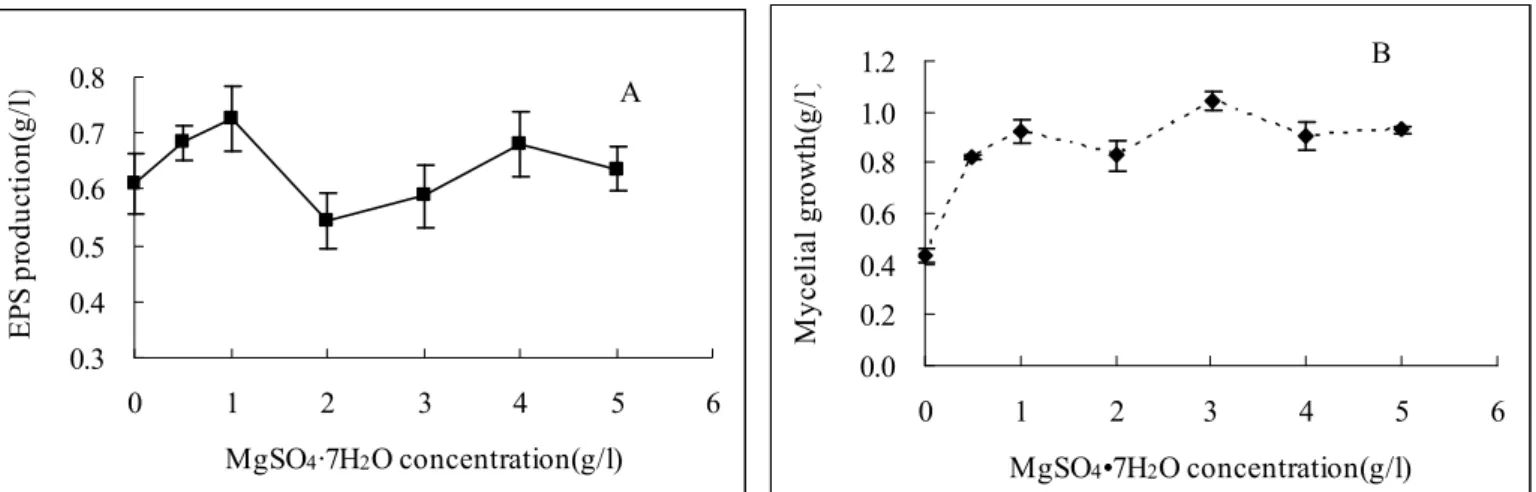
As showed in Figure 4B. The magnesium supplement
showed a significant promotive effect on the mycelial growth
of
G. lucidum
CAU5501. The mycelial production increased
from 0.43 to 1.04 g/l when magnesium source increased from 0
to 3 g/l in the media. The maximum mycelial biomass at 3 g/l
magnesium sources was about 2.5 times of that at 0 g/l. In
comparison, high concentration of MgSO
4·7H
2O did not
demonstrated enhancing effect on the EPS yield. The
maximum EPS yield (0.73) was achieved at 1 g/l of
MgSO
4·7H
2O in the media. The results were in consistent with
the previous reports by Hsieh
et al.
(6) and Kim
et al.
(10).
These findings revealed that an increase of Mg
2+level favored
mycelial growth rather than EPS production. It is well known
that magnesium is involved in the synthesis of many structural
components and stabilizes the plasma membrane (8, 10, 11). In
comparison, thought magnesium also takes part in the synthesis
of saccharides metabolism, this role can be replaced by
manganese (2). Perhaps this was the reason why magnesium
showed more distinct effect on mycelial growth than that of
magnesium on EPS production in this work. Another
researcher suggested that concentrations of magnesium can
change polysaccharides composition rahter than polysaccharide
production (6). The function of magnesium with regard to
polysaccharides is still unclear, being and worth of further
study.
A
0.3
0.4
0.5
0.6
0.7
0.8
0
1
2
3
4
5
6
MgSO
4·7H
2O concentration(g/l)
E
P
S
p
rodu
c
tion(
g/l
)
B
0.0
0.2
0.4
0.6
0.8
1.0
1.2
0
1
2
3
4
5
6
MgSO
4•7H
2O concentration(g/l)
My
c
e
lia
l g
ro
w
th
(g
/l
)
Figure 4.
Effect of magnesium concentration on exopolysaccharide production (A) and mycelial growth (B) of
G. lucidum
CAU5501 in shake flask culture.
Optimization results by the orthogonal matrix method
Based on the above results achieved, dominated by
gaining more EPS the four selected variables (glucose, C/N
ratios, phosphate and magnesium) for the metabolite
production and cell growth were further optimized using an
orthogonal layout L
9(3
4).
As shown in Table 2, the highest mean production of EPS
by
G. lucidum
CAU5501 was 1.14 g/l among 9 experimental
groups, where it was the seventh experimental group whose
levels of corresponding factors involved A
3, B
1, C
3and D
2,respectively. Whereas, it was in the first experimental group
that mycelia yield reached the maximum value (1.12 g/l).
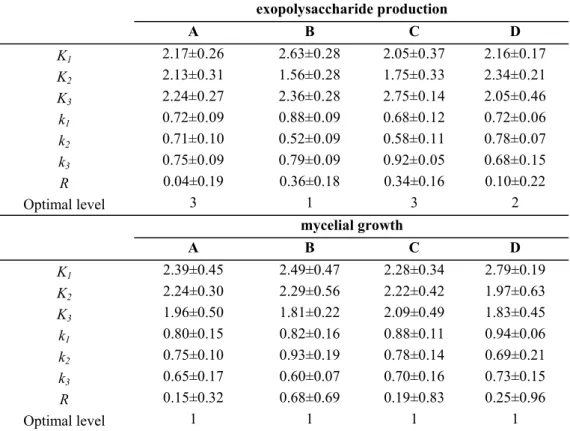
According to the orthogonal method, the effect of those
media on EPS production and mycelial growth was analysed
and the results were shown in Table 3. Based on the magnitude
order of R value (maximum difference), the order of effects of
all factors on EPS production and mycelial growth was
EPS production was C/N ratio > KH
2PO
4> MgSO
4> glucose
concentration (B > C > D > A) while the order of effects of all
factors on mycelial growth was B > D > A > C, i.e. C/N ratio >
MgSO
4> glucose concentration > KH
2PO
4. In terms of the
maximum
K
value of each column in Table 3, optimal level of
each medium ingredient for EPS production by
G. lucidum
CAU5501 was A
3B
1C
3D
2. The levels of corresponding factors
included glucose (70 g/l), C/N ratio (5), KH
2PO
4(2.5 g/l) and
MgSO
4·7H
2O (0.75 g/l) (A
3B
1C
3D
2), respectively. In the same
way, the optimal medium for mycelial growth was
A
1B
1C
1D
1,
namely glucose concentration (50 g/l), C/N ratio (5), KH
2PO
4(1.5 g/l) and MgSO
4·7H
2O (0.5 g/l).
Table 3.
Analysis of L
9(3
4) orthogonal test on exopolysaccharide production and mycelial growth of
G. lucidum
CAU5501 in
shake flask culture.
exopolysaccharide
production
A B
C
D
K
12.17±0.26 2.63±0.28
2.05±0.37
2.16±0.17
K
22.13±0.31 1.56±0.28
1.75±0.33
2.34±0.21
K
32.24±0.27 2.36±0.28
2.75±0.14
2.05±0.46
k
10.72±0.09 0.88±0.09
0.68±0.12
0.72±0.06
k
20.71±0.10 0.52±0.09
0.58±0.11
0.78±0.07
k
30.75±0.09 0.79±0.09
0.92±0.05
0.68±0.15
R
0.04±0.19 0.36±0.18
0.34±0.16
0.10±0.22
Optimal level
3 1
3
2
mycelial
growth
A
B
C
D
K
12.39±0.45 2.49±0.47
2.28±0.34
2.79±0.19
K
22.24±0.30 2.29±0.56
2.22±0.42
1.97±0.63
K
31.96±0.50 1.81±0.22
2.09±0.49
1.83±0.45
k
10.80±0.15 0.82±0.16
0.88±0.11
0.94±0.06
k
20.75±0.10 0.93±0.19
0.78±0.14
0.69±0.21
k
30.65±0.17 0.60±0.07
0.70±0.16
0.73±0.15
R
0.15±0.32 0.68±0.69
0.19±0.83
0.25±0.96
Optimal level
1 1
1
1
KXi=∑ mycelial biomass or exopolysaccharide in thrice experiment at Xi. kXi=KXi / 3. Values are means ± SD of triple determinations.
Symbol X represents A, B, C and D, respectively, and symbol i represents each level.
R refers to the result of extreme analysis
Fermentation results in 3-L shake flask
To verify the credibility of experiment results,
G. lucidum
CAU5501 was cultured in optimized media for EPS production
or mycelial growth in 3-litre shake flask (work volume 1.2 l).
The result suggests that EPS production reached 1.723 g/l in
optimal medium, which was 70% higher than that in the basal
medium(1.003 g/l
), and the mycelia outgrowth (7.235 g/l) was
about 3.6 times as much as that in the basal medium(2.028 g/l).
But the mycelia growth were no evident variance between the
optimal medium for EPS (7.016 g/l) and the optimized medium
for mycelial biomass. Consideration to EPS yield and mycelia
output, the optimal combination of A
3B
1C
3D
2was better.
The results obtained in this work suggested the more EPS
was produced with the increasing of glucose level (ranging
from 10 to 60 g/l) in the media, and the higher levels of EPS
distinct influence on mycelia output, but had insignificant
impact on EPS yield. The optimal media were found to be
composed of (g/l): glucose 70, C/N ratio 5, KH
2PO
42.5 and
MgSO
4·7H
2O 0.75 for EPS production
,and for mycelia the
optimal media consisted of: glucose 50, C/N ratio 5, KH
2PO
41.5 and MgSO
4·7H
2O 0.5. With the comprehensive assessment
of the EPS yield and mycelia output, the combination of
A
3B
1C
3D
2was the best medium for
G. lucidum
CAU5501
culture in shake flask.
ACKNOWLEDGEMENTS
This work was Supported by State Key Laboratory of
Animal Nutrition. (No. 2004DA1251840810).
REFERENCES
1. Babitskaya, V.G.; Shcherba, V.V.; Pushkova, T.A.; Smirnov, D.A. (2005). Polysaccharides of Ganoderma lucidum: factors affecting their production. Appl. Biochem. Microbiol., 41,169–173.
2. Bock, C.W.; Katz, A.K.; Markham, G.D.; Glusker, J.P. (1999). Manganese as a replacement for magnesium and zinc: functional comparison of the divalent ions. J. Am. Chem. Soc., 121, 7360–7372. 3. Chen, W.; Zhao, Z.; Chen, S.F.; Li, Y.Q.; (2008). Optimization for the
production of exopolysaccharide from Fomes fomentarius in submerged culture and its antitumor effect in vitro. Bioresource Technol., 99 (8), 3187-3194.
4. Chi, Xy.; Wang, Z.; Zhang, R.j.; (2006). Breeding of Ganoderma lucidum polysaccharide-peptide complex(GPSPc) high yield striain by UV Induced protoplast mutagenesis and substituted effect of GPSPc on antibiotics in broiler chicken. J. Agric. Biotechnol., 14 (4), 51 1-516. 5. Hsiao, W.L.; Li, Y.Q.; Lee, T.L.; Li, N.; You, M.M.; Chang, S.T.;
(2004). Medicinal mushroom extracts inhibit ras-induced cell transformation and the inhibitory effect requires the presence of normal cells. Carcinogenesis, 25(7), 1177-83.
6. Hsieh, C.; Tseng, M.H.; Liu, C.J. (2006). Production of polysaccharides from Ganoderma lucidum (CCRC. 36041) under limitations of nutrients.
Enzyme Microb. Technol., 38, 109–117.
7. Hua, K.F.; Hsu, H.Y.; Chao, L.K.; Chen, S.T.; Yang, W.B.; Hsu, J.; Wong, C.H. (2007). Ganoderma Lucidum polysaccharides enhance CD14 endocytosis of LPS and promote TLR4 signal transduction of cytokine expression. J. Cell Physiol., 212, 537–550.
8. Hurwitz, C.; Rosano, C.L. (1967). The intracellular concentration of bound and unbound magnesium ions in Escherichia coli. J. Biol. Chem., 242, 3719–3722.
9. Kim, H.M.; Paik, S.Y.; Ra, K.S.; Koo, K,B.; Yun, J.W.; Choi, J.W. (2006). Enhanced production of exopolysaccharides by fed-batch culture of Ganoderma resinaceum DG-6556. J. Microbiol., 44 (2), 233-242. 10. Kim, H.O.; Lim, J.M.; Joo, J.H.; Kim, S.W.; Hwang, H.J.; Choi, J.W.;
Yun, J.W. (2005). Optimization of submerged culture condition for the production of mycelial biomass and exopolysaccharides by Agrocybe cylindracea. Bioresource Technol., 96, 1175–1182.
11. Klein, D.J.; Moore, P.J.; Steitz, T.A. (2004). The contribution of metal ions to the structural stability of the large ribosomal subunit. RNA, 10, 1366–1379.
12. Lee, W.Y.; Park, Y.; Ahn, J.K.; Ka, K.H.; Park, S.Y. (2007). Factors influencing the production of endopolysaccharide and exopolysaccharide from Ganoderma applanatum. Enzyme Microb. Technol., 40(2), 249-254.
13. Mojadadi, S.; Ebtekar, M.; Hassan, Z.M. (2006). Immunomodulatory effects of Ganoderma lucidum (W. Curt.:Fr.) P. Karst. (aphyllophoromycetideae) on CD4+/CD8+ tumor infiltrating lymphocytes in breast-cancer-bearing mice. Int. J. Med. Mushrooms., 4, 315-320.
14. Pinto, M.R.; Barreto-Bergter, E., Taborda, C.P. (2008). Glycoconjugates and polysaccharides of fungal cell wall and activation of immune system.
Braz. J. Microbiol., 39, 195-208.
15. Rubel, R.; Santa, H.S.D.; Fernandes, L.C.; Filho, J.H.C.L.; Figueiredo, B.C.; Di Bernardi, R.; Moreno, A,N.; Leifa, F.; Soccol, C.R. (2008). High immunomodulatory and preventive effects against sarcoma 180 in mice fed with Ling Zhi or Reishi mushroom Ganoderma lucidum (W. Curt.: Fr.) P. Karst. (Aphyllophoromycetideae) mycelium. Int. J. Med. Mushrooms., 10, 37-48.
16. Sudheesh, N.P.; Ajith, T.A.; Janardhanan, K.K. (2009). Ganoderma lucidum (Fr.) P. Karst enhances activities of heart mitochondrial enzymes and respiratory chain complexes in the aged rat.
Biogerontology, 10(5), 627-36.
17. Vieira, G.R.T.; Liebl, M.; Benathar, L.; Tavares, B.; Paulert, R.; Júnior, A.S. (2008). Submerged culture conditions for the production of mycelial biomass and antimicrobial metabolites by Polyporus tricholoma Mont.
Braz. J. Microbiol., 39(.3), 561-568.
18. Zhang, Z.C.; Li, Y.; Zhang, K.C. (2007). Application of statistical analysis for the optimization of mycelia and polysaccharide production by Tremella aurantialba. Food Tech. Biotech., 45, 45−50.
19. Zhu, L.W.; Zhong, J.J.; Tang, Y.J. (2008). Significance of fungal elicitors on the production of Ganoderma polysaccharides and ganoderic acid by submerged fermentation of medicinal mushroom Ganoderma lucidum. Process Biochem., 43,1359-1370.
20. Zou, X. (2005). Optimization of nutritional factors for exopolysaccharide production by submerged cultivation of the medicinal mushroom